





Against all odds, certain objects have survived thousands of years to reach our modern world. For instance, a 3,000-year-old Egyptian ring carved with playful kittens, or the Orkney Hood — the only complete piece of woven clothing to survive from medieval Scotland.
These incredible relics prove that our ancestors loved art, beauty, and comfort just as much as we do. Since we don’t have a real time machine, looking at these items is easily the next best thing — offering a rare, personal glimpse into everyday life centuries ago.
We’ve collected photos of some of the most remarkable historical objects shared by an online community that acts as a “virtual museum.” The best part is that you can admire these ancient treasures right from the comfort of your couch, and even dig deeper if something catches your eye.
#41
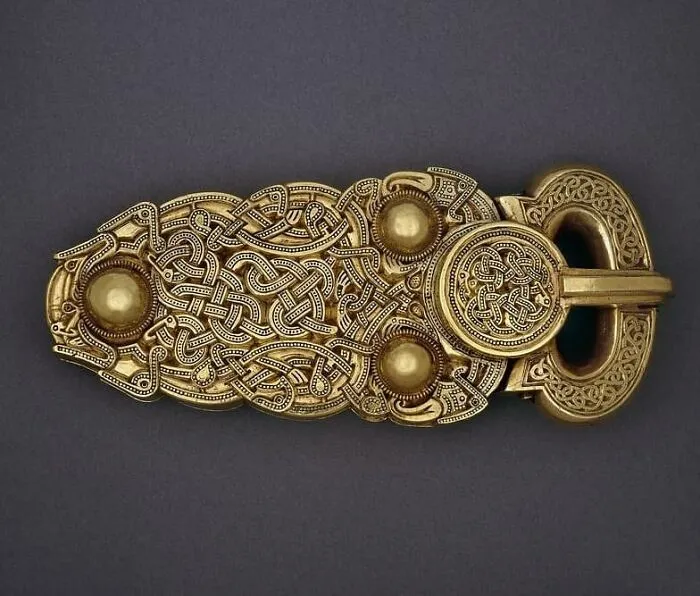
Gold belt buckle from the ship burial at Sutton Hoo - AD 650
In early Anglo-Saxon England, buckles used to fasten waist belts were a means of expressing a man's wealth and status. The type of metal used and the finesess of decoration were key factors. This spectacular gold buckle from the Sutton Hoo ship burial shows that the person commemorated there was of great importance.
Weighing more than 400 grams, the buckle is actually a hollow box that opens at the back on a hinge beneath the loop. A locking system, involving a complex system of sliders and internal rods which fit into slotted fixings, enables it to close securely.
Similarly-made buckles from Frankish and Burgundian parts of the Continent appear to have contained Christian relics, but we do not know for certain whether the Sutton Hoo buckle was used for this purpose.
No fewer than thirteen creatures decorate the buckle's surfaces. The plate and round tongue shield feature writhing snakes and intertwining four-legged beasts. Their bodies are highlighted with punched ornament filled with black niello.
Stylised snakes biting their own bodies slither on the loop, while at the tip of the buckle, two animals grip a small, dog-loke creature in their jaws. These together with the two fierce birds' heads on the buckle's shoulders, make this extraordinary object one of the most powerful images from early Anglo-Saxon England.
Photos courtesy: British Museum
Report
6points
#42
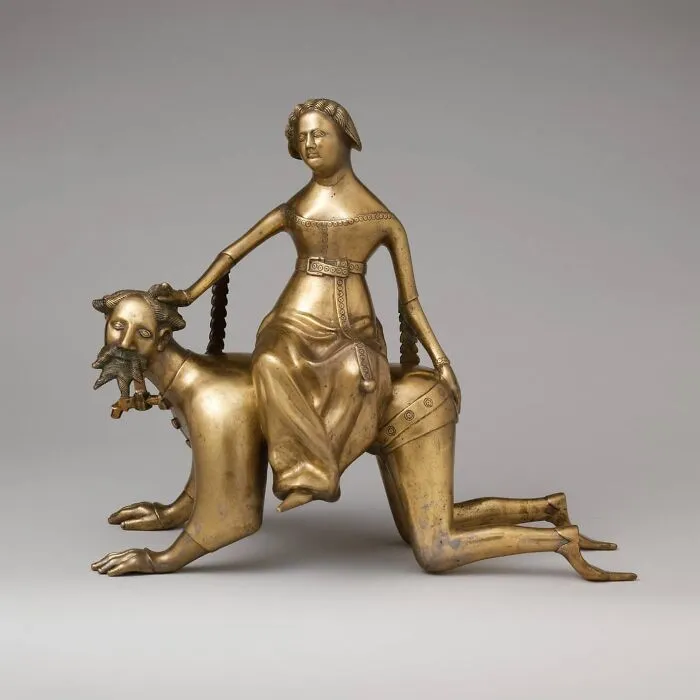
Aquamanile in the form of Aristotle and Phyllis - 14th century, South Netherlands
Medium: gilded bronze
An aquamanile is a vessel for pouring water used in the ritual of washing hands in both religious and secular contexts—by the priest before Mass and in a private household before a meal.
The subject of this celebrated example is the moralizing legend of Aristotle and Phyllis, which achieved popularity in the late Middle Ages.
Aristotle, the Greek philosopher and tutor of Alexander the Great, allowed himself to be humiliated by the seductive Phyllis as a lesson to the young ruler, who had succumbed to her wiles and neglected the affairs of state.
Encouraging Alexander to witness his folly, Aristotle explained that if he, an old man, could be so easily deceived, the potential consequences for a young man were even more perilous.
The ribald subject indicates that this aquamanile was made for a domestic setting, where it would have doubled as an object of entertainment for guests at the table.
The object has the size of an artifact and it is displayed at the Metropolitan Museum of Art in New York
Report
6points
#43
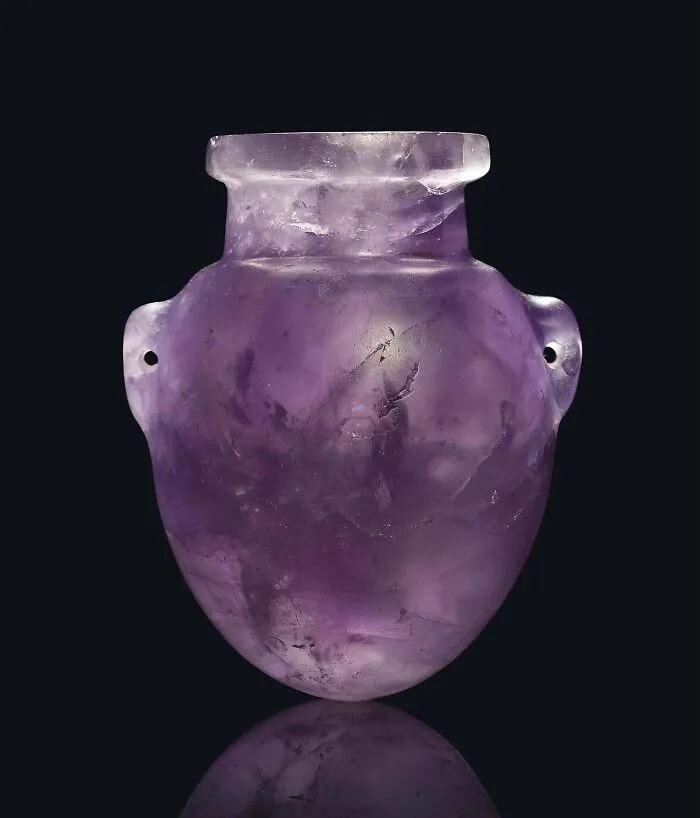
A Neo-Assyrian amethyst vase
- 8th century B.C.
Of ovoid form, with short cylindrical neck and overhanging disc rim, the mouth flat with a descending step framing the central opening, the interior hollowed out, with two trapezoidal lugs on the shoulders, drilled horizontally for suspension. Vases of this type were used to store perfume oils.
Sold at Christies in 2012
Dimensions: 2 1/8 in. (7.9 cm.) high
Report
6points
#44
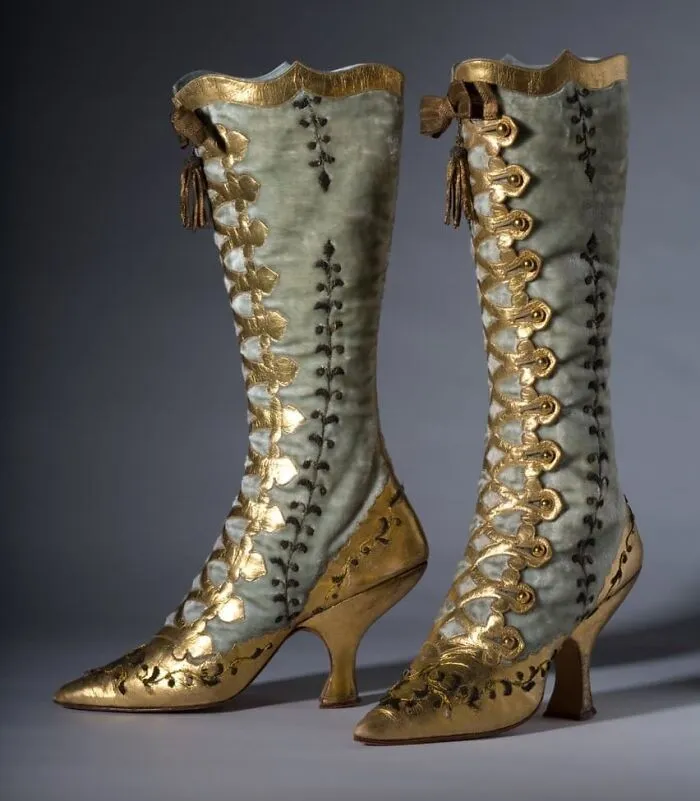
Victorian leather and velvet boots - Swedish or German, 1890s
This pair of handmade, bespoke button boots reflects the infusion of erotically charged references in women’s dress that emerged at the end of the 19th century.
The level of artisanry, the luxury of the materials and the whimsy found in the overall design, is exceptional. The gold kid leather appliqué and velvet are 'erotically charged' and they resemble a stockinged leg. Even a glimpse beneath a skirt would have been tantalizing.
These boots may have been commissioned by a specific client or perhaps more likely, as a ‘show off’ piece meant for display at an exposition.
The pair is kept now at the Bata Shoe Museum in Toronto
Report
6points
#45
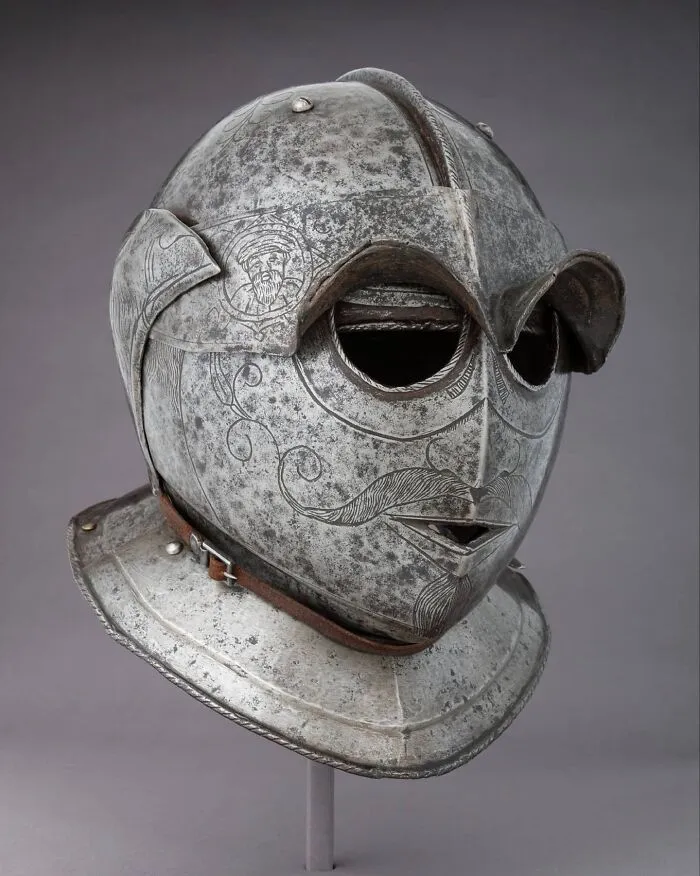
Siege helmet weighing 8kg - Italy, 1625
The siege helmets were worn by hostages after they were taken away from the warfares.
All helmets are designed to protect but beyond a certain point this will come at the expense of your ability to see what you're doing, turn your head, hear, breath and communicate. This design made an impossible mission for the hostages to see the surroundings on their way to the prisons.
It is now on display at the Metropolitan Museum of Art in New York
Report
6points
#46
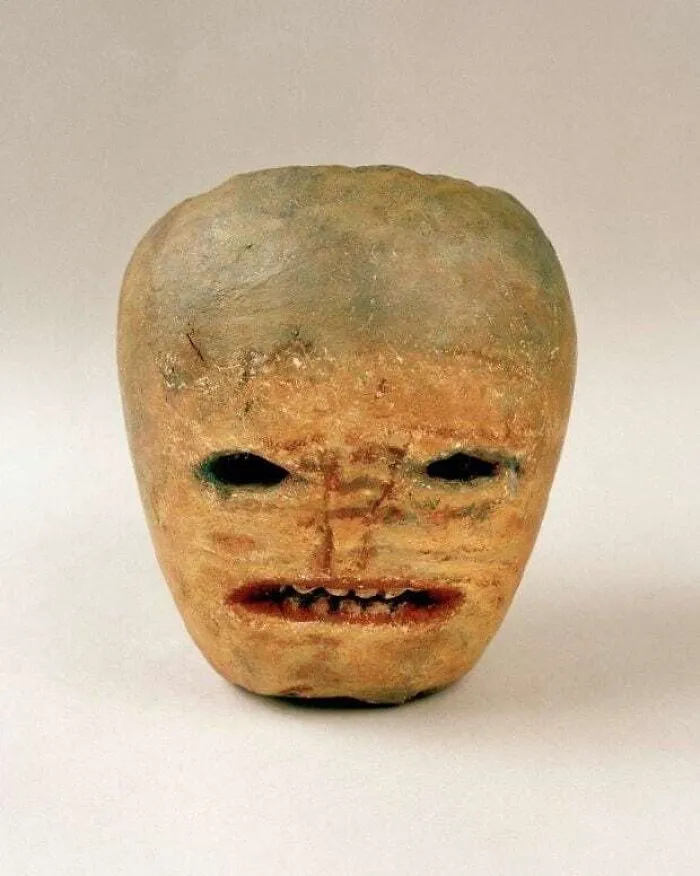
Carved Halloween turnip Jack-o-Lantern from about 1850
A far cry from the grinning pumpkins of Halloween today, the original folklore version of Jack-o-Lanterns, named for Jack O’Lantern of the Irish myth, were actually quite terrifying. They were carved from turnips or beets rather than festive orange pumpkins and were intended to ward off unwanted visitors.
The origin of the carved turnip began with Irish folklore. The legend is about a man they called Jack O’Lantern who was condemned to roam the earth for eternity after playing tricks on the devil. He carried with him a carved-out turnip with a burning coal inside to light his way.
In Ireland and Scotland, people began to make their own versions of Jack’s lanterns by carving scary faces into turnips or potatoes and placing them into windows or near doors to frighten away Stingy Jack and other wandering evil spirits. In England, large beets are used. Immigrants from these countries brought the jack-o’-lantern tradition with them when they came to the United States. They soon found that pumpkins, a fruit native to America, make perfect jack-o’-lanterns.
Kept now at the National Museum of Ireland
Report
6points
#47
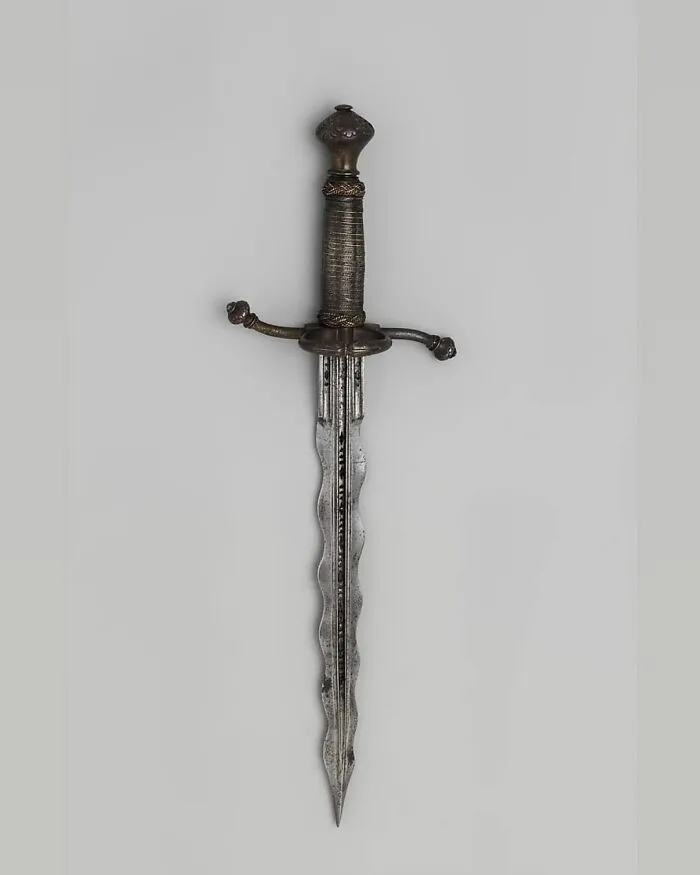
Parrying dagger - Italy, 1550–75
Designed to be used together with a rapier, this dagger is fitted with a side ring, recurved quillons, and a depression at the base of one side of the blade to accommodate the thumb and facilitate a firmer grip.
The waves in the blade may be intended to act like "speed bumps" in breaking the impact of a blow from an opponent's blade. The piercing of the fullers (grooves) is a decorative motif.
It is now on display at the Metropolitan Museum of Art in New
Report
6points
#48
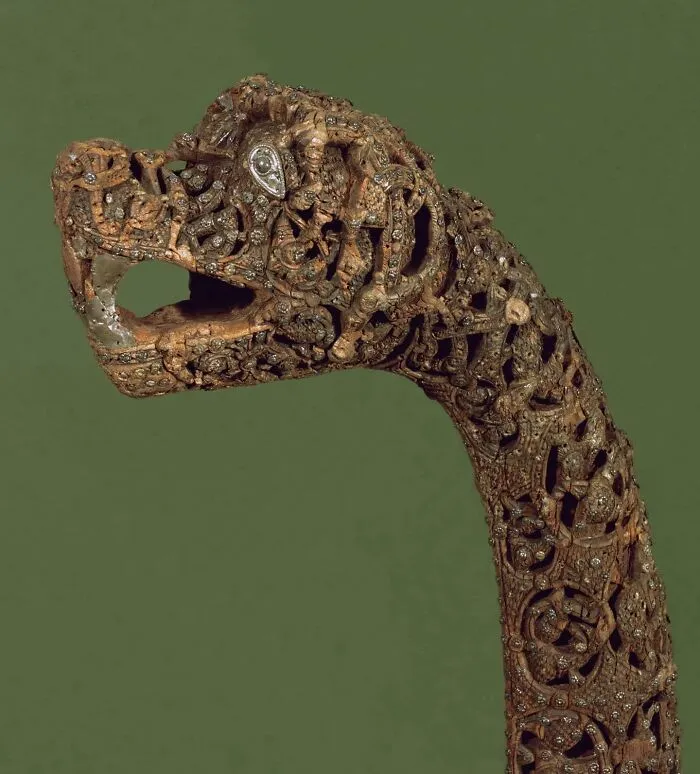
Skillfully carved dragon head - Vikings, 10th century
Dragonships were large longships that had carved heads of dragons and other magical beings mounted on their stem. They were ships for chieftains and kings.
The dragonhead should scare away enemies. It also had magical functions: It would provide protection for ships and crew – and it should ward off evil spirits both on land and sea.
The Icelandic law code Grágás says that the dragonhead should be taken off the ship when the Vikings returned to their homestead, not to intimidate the spirits of their native land. (Grágás was used from about 930 and written down about 1117)
The dragonhead made it easy to recognize a certain ship. It clearly shows who the leader is and where the leader is in battle.
The symbolic function of the dragonhead is enhanced by the fact that ships often were named after the magical animal that graced it’s prow.
The dragon, also called serpent, was a primary motive for the royal longships, but also other magical beings could be used as dragonheads on some ships.
When Christianity was introduced, Christian symbols and ship names eventually replaced the magical role former played by old Norse beings.
Sagas and skaldic poems tell many stories of dragonships with beautifully carved fabled animals in the stem and a tail at the stern. Some ships had dragonheads both on stem and stern. There are also old depictions of dragonheads.
Photo courtesy: Museum of Cultural History, University of Oslo, Norway
Report
6points
#49
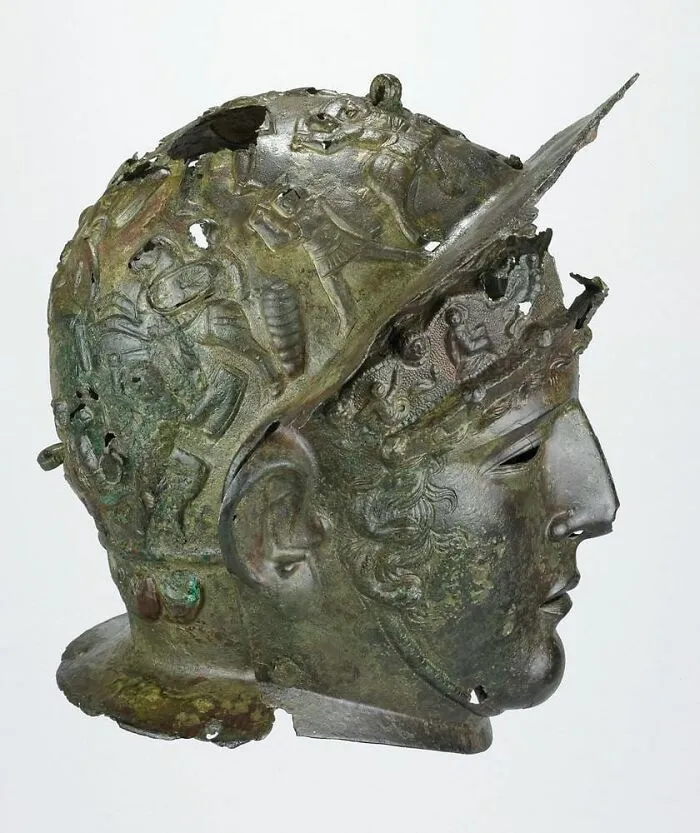
The Ribchester Helmet - A Roman cavalry sports helmet with face mask, cca. 1st-2nd century AD
In 1796 a clogmaker's son, playing behind his father's house in Ribchester, Lancashire, discovered a mass of corroded metalwork. This proved to be a hoard of Roman military equipment and military awards.
Cavalry sports (hippika gymnasia) were flamboyant displays of military horsemanship and weapons drill. They served both as training sessions and to entertain the troopers.
The most colourful events were mock battles among the elite riders of the unit, often in the guise of Greeks and Amazons. Both men and horses wore elaborate suites of equipment on these occasions.
The helmet, decorated with a scene of a skirmish between infantry and cavalry, is the most spectacular piece. When used, the head-piece and face mask of embossed bronze would be held together by a leather strap. A crest-box and a pair of trailing streamers or 'manes' would have been attached to the head-piece.
On display at the British Museum in London
Report
6points
#50
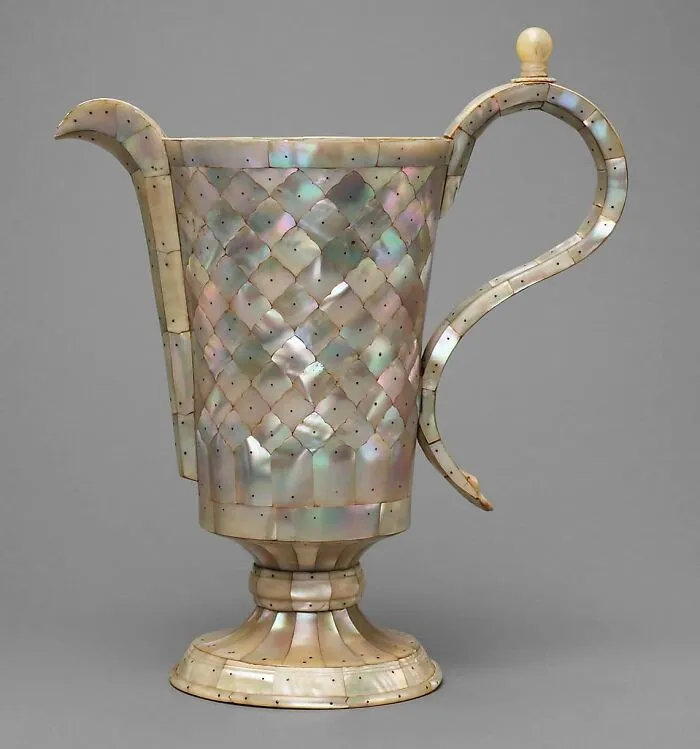
Mother-of-pearl Ewer from Gujarat, India - 1596
A ewer is an older word for pitchers or jugs of any type, though tending to be used for a vase-shaped pitcher, often decorated, with a base and a flaring spout.
This ewer and the set it belongs to are Indian in origin. They were made in Gujarat. However when the V&A acquired the set in 1857, curators thought these pieces were Italian. This was because the set had a European shape.
Another reason was that from about 1590 to 1700 European goldsmiths deliberately copied Gujarati mother-of-pearl work for both familiar and new forms.
This created problems of identification for future scholars that still exist today
Cabinet of Curiosities of Ferdinand II, Archduke of Austria. Originally at Ambras Castle. Height: 25cm
Report
6points
#51
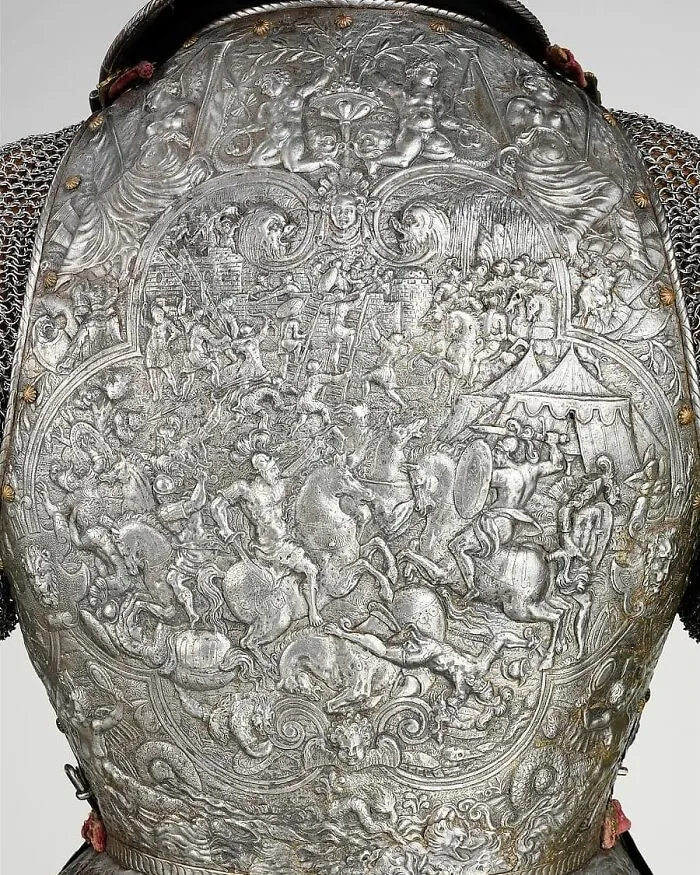
Portions of a ceremonial armor - France, 1575–80
This armor was severely damaged by fire in the 1870s, destroying its gorget (collar) and arm defenses and melting off the gilding that originally covered all its exterior surfaces.
Despite this damage, the remaining parts are important as examples of French ceremonial armor from the period of Henri III (reigned 1574–89).
The embossed decoration consists of battle scenes of soldiers wearing Classical armor.
On display at the Metropolitan Museum of Art in New York
Report
5points
#52
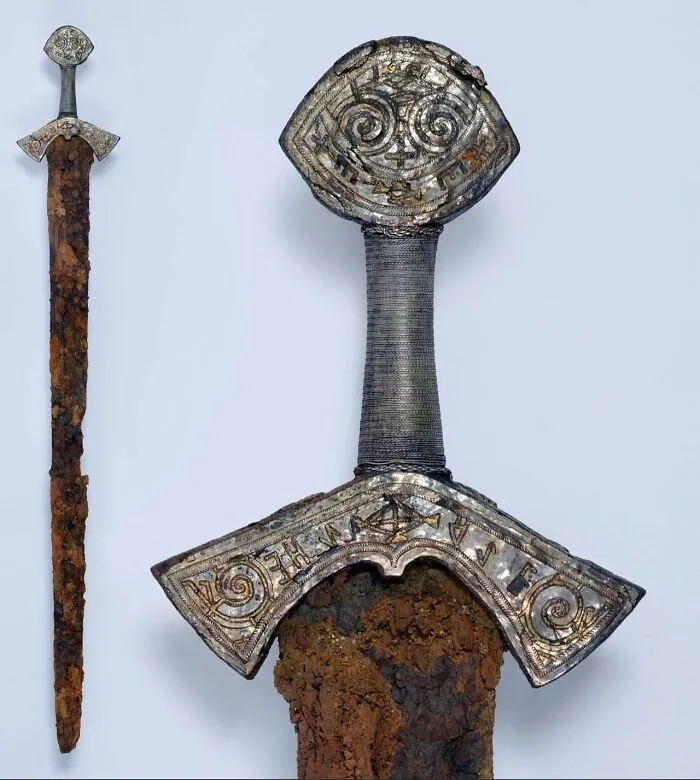
Viking Era Sword with a well preserved engraved silver hilt, bearing runes - dated back to 1030 CE
The sword, dating back to the late Viking Age, was recovered from a site near the village of Langeid in Norway's Bygland municipality. It was found inside a Viking grave, lying next to a coffin.
When they cleaned it, however, the researchers found that the rust was hiding gold embellishments, stunning ornamentations, and even inscriptions. Hence, the team concluded that it once belonged to a wealthy man.
More so given the fact that, when compared to other graves discovered in the area, the one that produced this sword, built sometime around the year 1030, was quite big and, therefore, fit for a person of status.
This Viking Age sword measures 94 centimeters (37 inches) in length. Rust has eaten away at its iron blade, but its handle and the ornamentations on it are pretty much intact.
The inscriptions on the sword were written using the Latin alphabet. However, the researchers have not yet managed to figure out what they could possibly mean. Mind you, they are starting to think they are magical runes
Report
5points
#53
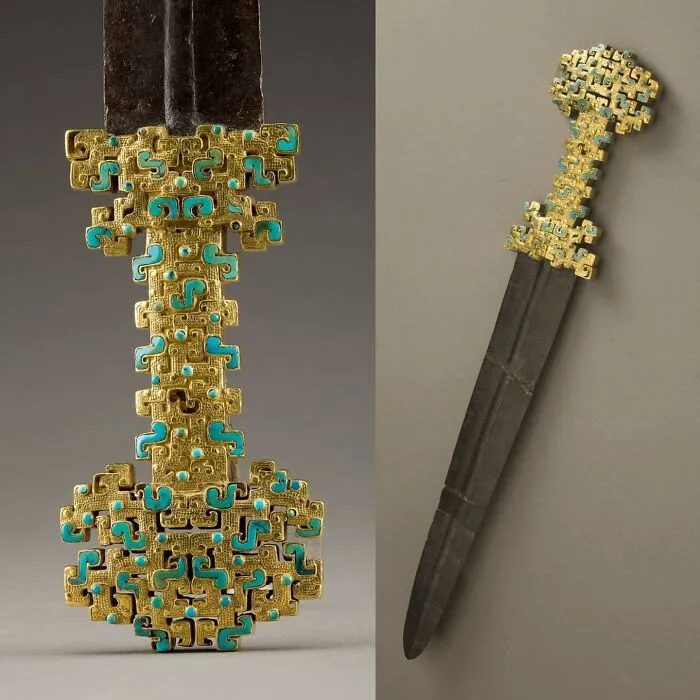
Short sword with gold ornate handle inlaid with turquoise(The Qin Sword) - China, Zhou dynasty 776-476 BC.
In Ancient China, gold and silver were not the prestigious materials they were in the West. Jade and bronze were more highly prized. Gold was used for decorative purposes, as inlay or coating on bronze or lacquer, and only very rarely for vessels or other independent objects.
However, in the Eastern Zhou period(771-221 BC) gold began to be increasingly used on a larger scale, though goldworking still relied to a great extent on well-established bronze technology, with ornaments and other items cast using moulds instead of beaten into shape.
This sword's handle has a conspicuous line on its sides, showing that it was probably cast in a two-piece mould. The hilt is hollowed out and both sides are decorated with a design known as 'dragon interlace'
The gold handle is fragile, which probably made it impractical for use on a battle sword. The sword may have been made for display or for placing in a tomb for taking to the afterlife.
The sword was excavated at Yangjiagou in Baoji, and it is now on display at Baoji Bronze Museum, in China
Report
5points
#54
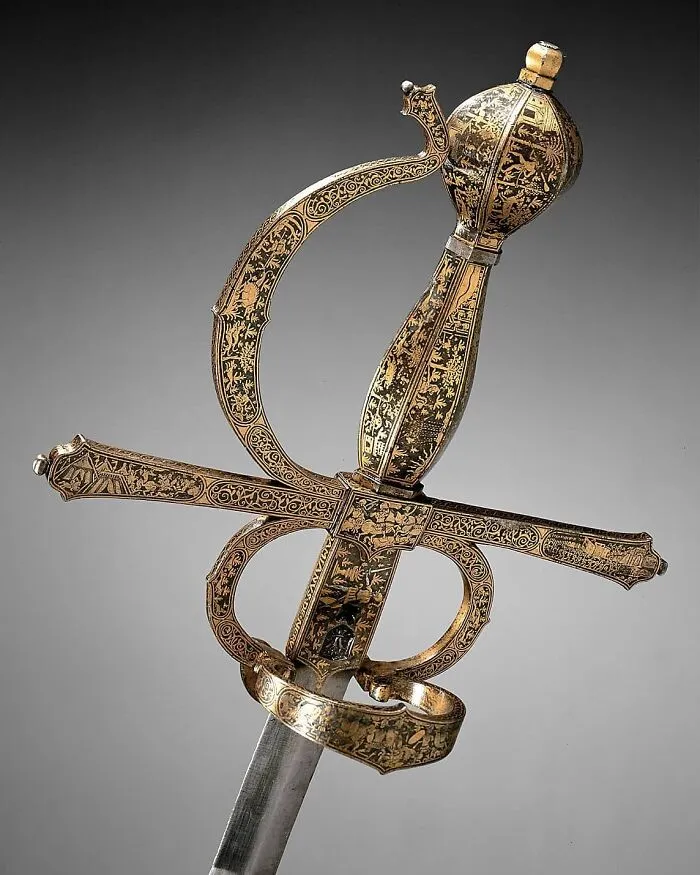
Rapier sword - 1555, Italy
From the early sixteenth century onward, the practice of wearing a sword or rapier with civilian dress made duels between unarmored opponents more common. Lacking the armor or shield worn in battle, combatants had to block or parry an attack by other means. Methods of defense included the use of a dagger or a buckler held in the left hand and an increased reliance on parries made with the rapier itself.
During the sixteenth and seventeenth centuries, distinct schools of fencing developed rapidly in Italy, France, Germany, and Spain. Instruction in the art and science of fencing became an indispensable part of a nobleman’s education.
Consequently, accomplished fencing masters were hired to teach at the principal courts and universities of Europe. From about 1525 to about 1625, the rapier was regularly worn in tandem with a parrying dagger. They were sometimes made and decorated as a set.
By the mid-seventeenth century, however, parrying with the rapier blade alone had become the preferred style as a result of the development of refined fencing techniques and lighter, smaller rapiers. Most forms of left-hand parries were abandoned, except in southern Italy and Spain, where parrying daggers remained popular well into the eighteenth century.
This particular rapier was made by Damiano da Nervi. He engraved the entire surface of the hilt with gold and silver. The rich design depicts wavy tendrils, cityscapes, hunting or war scenes as well as ancient scenes such as the capture of Cerberus by Hercules or the heroic deed of Mucius Scaevola. His signature "DAMIANVS DE NERVE ME FECIT" can be found on the inner side.
Dimensions: L. (110.2 cm); L. of blade (97.2 cm)
On display at the Kunsthistorisches Museum in Vienna
Report
5points
#55
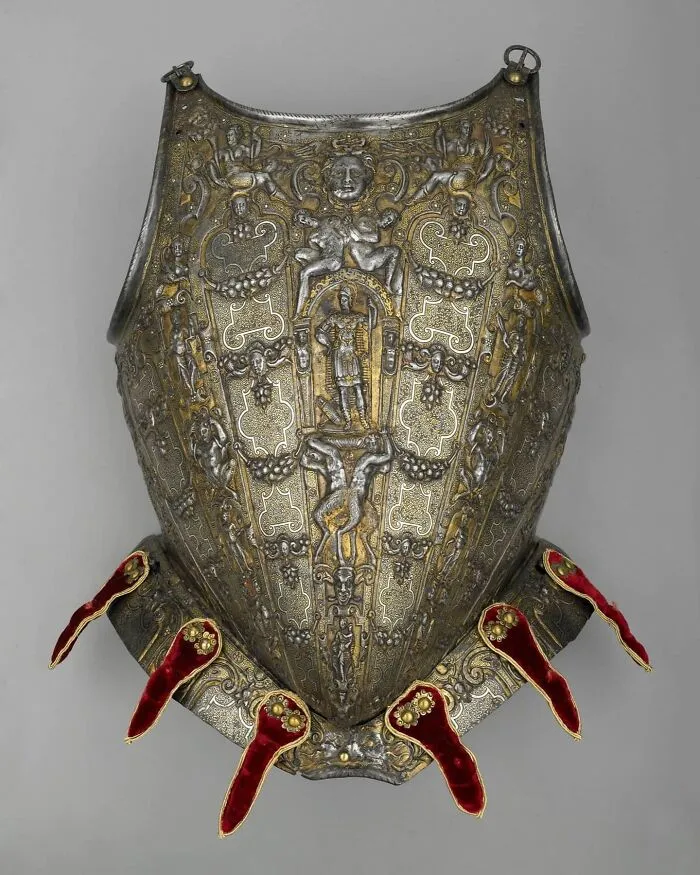
Ceremonial armour belonging to Alfonso II d'Este, Duke of Ferrara from 1559 to 1597
Alfonso II d'Este was the elder son of Ercole II d'Este and Renée de France, the daughter of Louis XII of France and Anne of Brittany and was the fifth and last Duke of Ferrara.
As a young man, he fought in the service of Henry II of France against the Habsburgs. Soon after his accession, he was forced by Pope Pius IV to send back his mother to France due to her Calvinist creed.
The 1570 Ferrara earthquake fell into his reign. In 1583 he allied with Emperor Rudolf II in the war against the Turks in Hungary.
His armour employs essentially every decorative technique possible, typical of those of the Renaissance period, as well as inlay and overlay in silver and gold. This armour therefore is entirely appropriate; its luxurious forms have been rendered in very thin, soft iron, which provide almost no protection against attack.
To create richer visual effects, embossed, chased and/or etched decoration could then be covered in precious metal through the process of mercury- or fire-gilding and -silvering. After the iron or steel had been given a thin coating of copper, a mixture or amalgam of gold (or silver) and mercury was applied to the surface of the work, which was then heated up, causing the mercury to boil or fume away, leaving the gold (or silver) chemically bonded to the metal.
Alfonso II raised the glory of Ferrara to its highest point, and was the patron of Torquato Tasso, Giovanni Battista Guarini, and Cesare Cremonini—favouring the arts, sciences, and literature.
Now part of the Wallace collection in London
Report
5points
#56
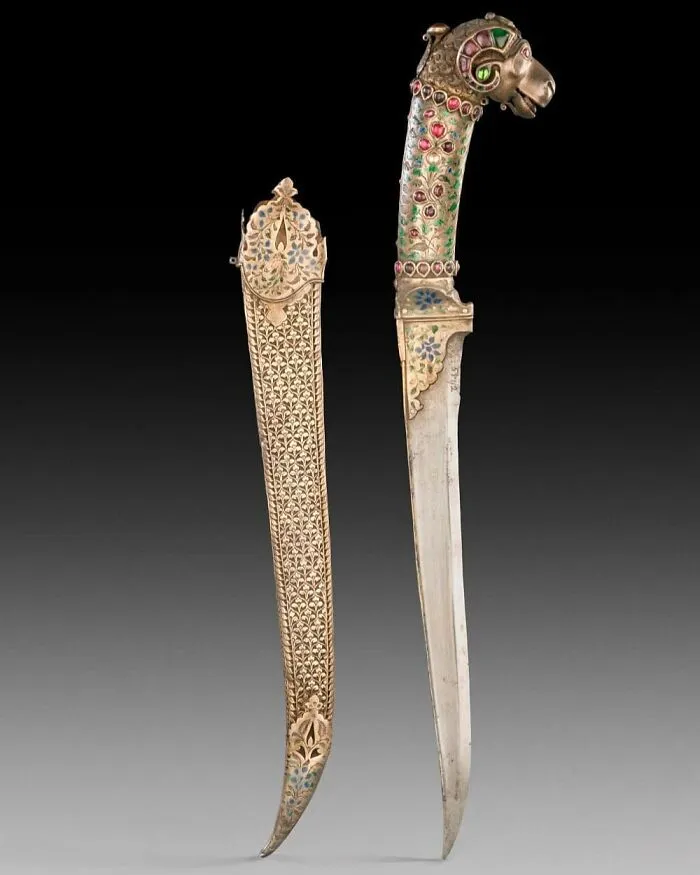
Enameled dagger with ram-headed hilt. Encrusted with rubies and emeralds - Mughal India, 1720
Often tucked into a sash or horseman’s boot, daggers in Mughal India displayed the wealth and power of their owners.
An intricately patterned ram’s head pommel adorns the hilt of this dagger, made in the kundan technique in which gems are set into malleable pure gold foil, allowing them to be arranged in any pattern or density over curved surfaces.
The ram’s head is decorated with a floral scroll and is separated from the hilt grip by a quartz collar, also in the kundan method. The ram's horns are encrusted with rubies and emeralds
The dagger was intended for ceremonial events in the Mughal Empire.
On display at the National Museum, New Delhi, India
Report
5points
#57
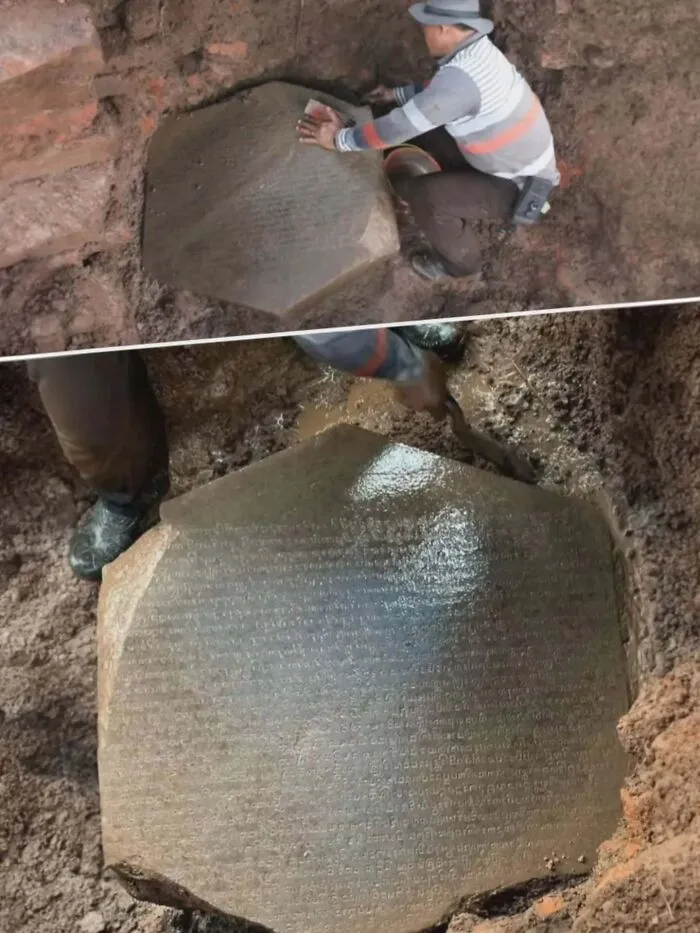
In 2022, archaeologists in Indonesia discovered a 1,096-year-old inscription stating that King Mpu Sindok declared a tarukan rice field tax-exempt. The inscription also describes a ceremonial feast featuring alcohol, salted fish, eggs, beef jerky, boiled vegetables, coconut, and other foods.
Report
5points
#58
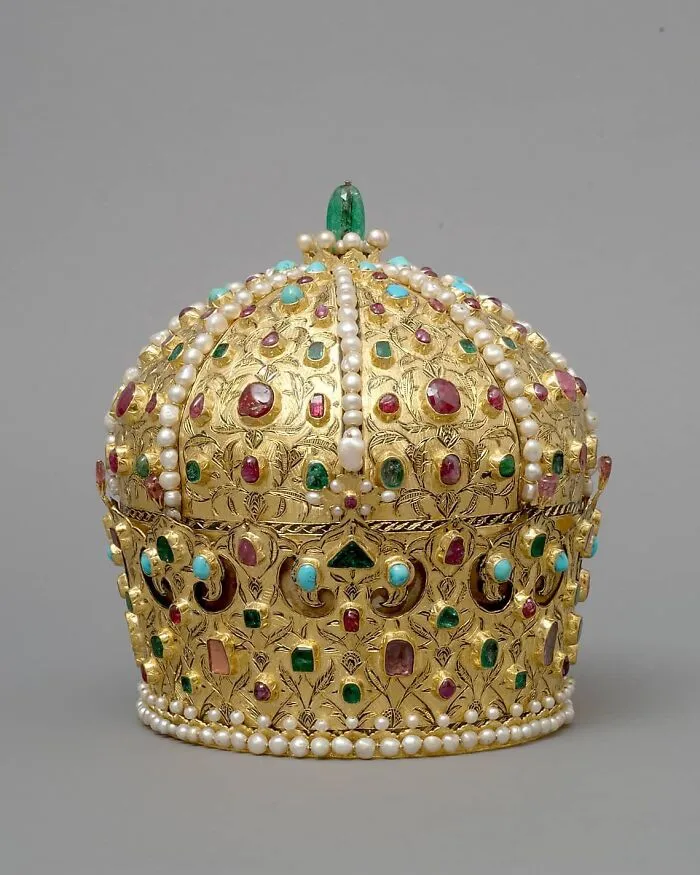
The crown of Stephen Bocksai, Prince of Transylvania(now part of Romania), 1557 - 1606. Made from gold, rubies, spinels, emeralds, turquoises, pearls and silk
The Crown of Stephen Bocskai is a crown given by the Ottoman sultan to Stephen Bocskai, Prince of Hungary and Transylvania, in the early 17th century.
To save the independence of Transylvania, Bocskay assisted the Turks. In 1605, as a reward for his part in driving Basta out of Transylvania, the Hungarian Diet assembled at Medgyes/Mediasch (Mediaş) elected him Prince of Transylvania; in response the Ottoman sultan Ahmed I sent a special envoy to greet Bocskay and presented him with a splendid jewelled crown made in Persia. Bocskay refused the royal dignity, but made skillful use of the Turkish alliance.
Medium: height 0,235 m, weight 1,88 kg
The crown is today displayed in the Kaiserliche Schatzkammer (Imperial Treasury) at the Hofburg in Vienna.
Report
5points
#59
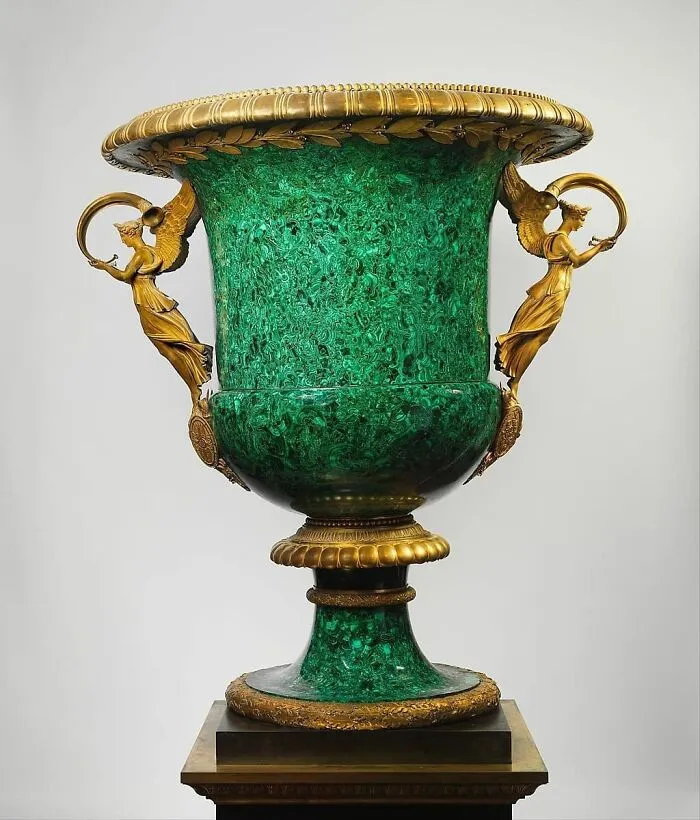
Russian malachite monumental vase with gilt-bronze mounts. Pedestal and mounts by Pierre Philippe Thomire French - 1819
Malachite is a carbonate mineral often associated with copper ores.
In the late eighteenth and nineteenth centuries, most malachite came from mines in Russia owned by the noble Demidov family, who exploited hardstone quarries and metal deposits on their estates in the remote Ural Mountains.
One of the great discoveries in the history of semiprecious stones occurred in the 1820s, when an enormous boulder of malachite weighing about five hundred tons was unearthed in the Urals.
A schistose material, malachite is extremely brittle, and only small display objects can be cut from single blocks of this rock. Large objects require a core structure, to which the malachite can be attached in thin pieces.
Russian craftsmen perfected a way of utilizing the stone’s natural pattern and a precision cutting technique to form a continuing or, on the round body of a vase, an "endless" ornament. This type of veneer, called "Russian mosaic," looks almost seamless.
The Demidovs used the showy appearance of malachite to increase their social status. They filled their palaces and decorated a whole room in one of them with the green stone, inspiring Czar Nicolas I to commission the famous Malachite Room in the Winter Palace in Saint Petersburg.
The winged female figures in gilded bronze mounted on the body of the vase represent Fame. Their trumpets are shaped like handles—something of a paradox, since the object is far too heavy to be lifted like a loving cup.
Dimensions: 277.5 cm, 714.4153 kg
Technique: lapidary work
On display at the Metropolitan Museum of Art in New York
Report
5points
#60
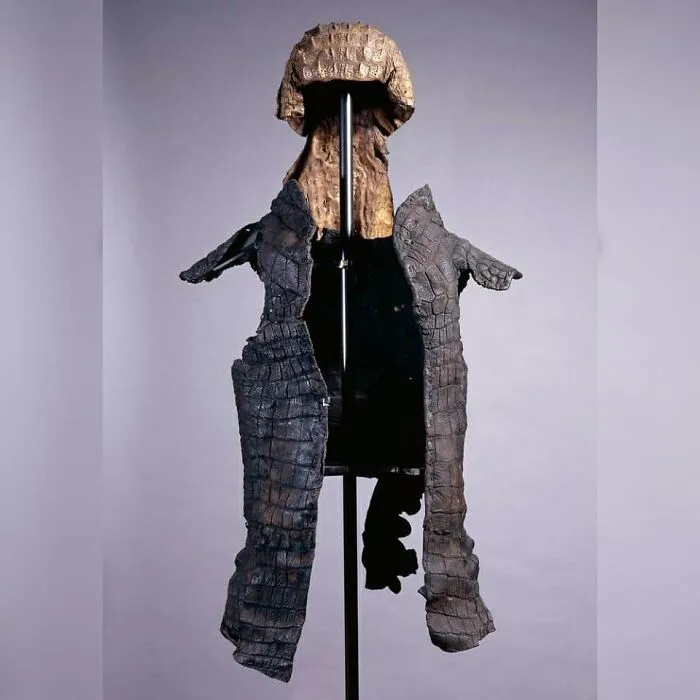
Crocodile-skin suit armour - Roman Egypt, 250 AD
In ancient Egypt the crocodile was seen as sacred and divine, and worshipped as a god, so this suit might have been worn by priests of the crocodile sect who by wearing such a garment would take on the spirit of the deity.
In many parts of Africa the crocodile is seen as a fearsome and invincible creature and so by wearing a crocodile armour and a headpiece like this, a warrior might be transformed in some magical way and take on the attributes of the animal.
When the province of Egypt became part of the Roman Empire, it put Romans into direct contact with Egyptian culture and religion. In Egypt Roman garrisons were closely integrated into civic and religious life and participated in local cults.
Around Manfalout, on the banks of the Nile in central Egypt, Roman soldiers were particularly attracted to the crocodile cult centered on the sacred grottoes of the region.
This imposing armour is made from the skin of a crocodile. It comprises a helmet and a cuirass(body armour) and would have been used in military-style ceremonies of the regional crocodile cult. The skin has been radio-carbon dated to the 3rd century AD.
Although the cold, dry environment of the grotto preserved the suit well, the cuirass in particular was flattened and brittle. It has been painstakingly remoulded by the British Museum Department of Conservation and it resides there from 1846.
Photos courtesy: Google Arts&Culture
Report
5points