



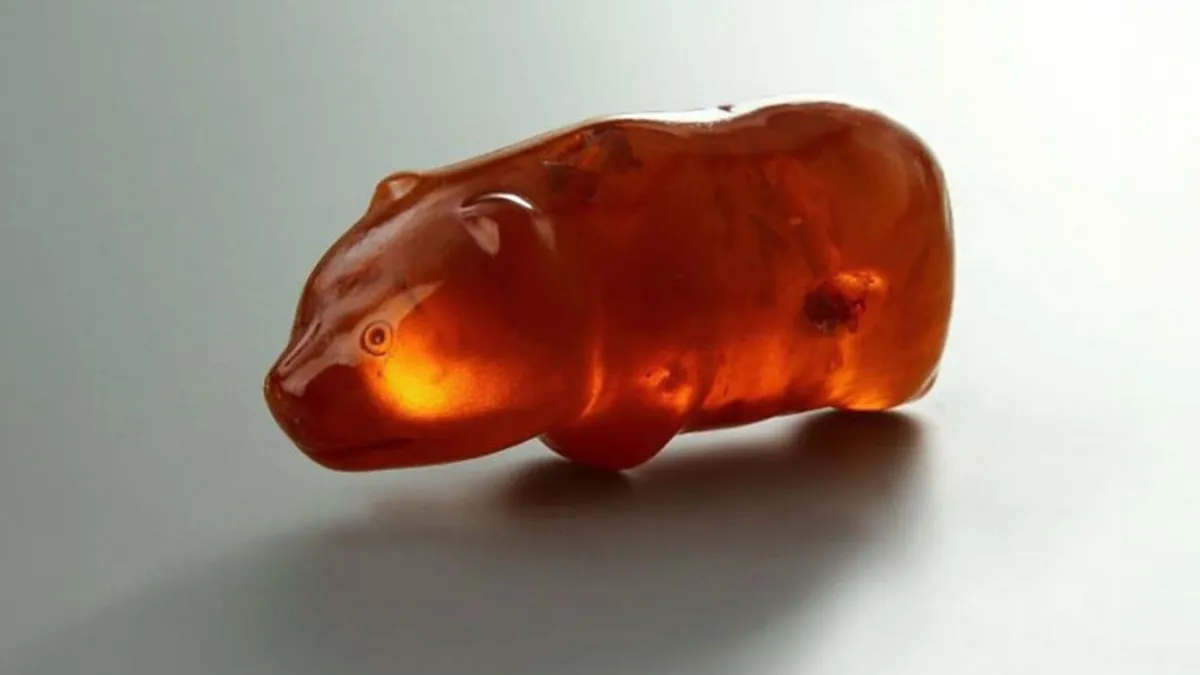


Against all odds, certain objects have survived thousands of years to reach our modern world. For instance, a 3,000-year-old Egyptian ring carved with playful kittens, or the Orkney Hood — the only complete piece of woven clothing to survive from medieval Scotland.
These incredible relics prove that our ancestors loved art, beauty, and comfort just as much as we do. Since we don’t have a real time machine, looking at these items is easily the next best thing — offering a rare, personal glimpse into everyday life centuries ago.
We’ve collected photos of some of the most remarkable historical objects shared by an online community that acts as a “virtual museum.” The best part is that you can admire these ancient treasures right from the comfort of your couch, and even dig deeper if something catches your eye.
#61
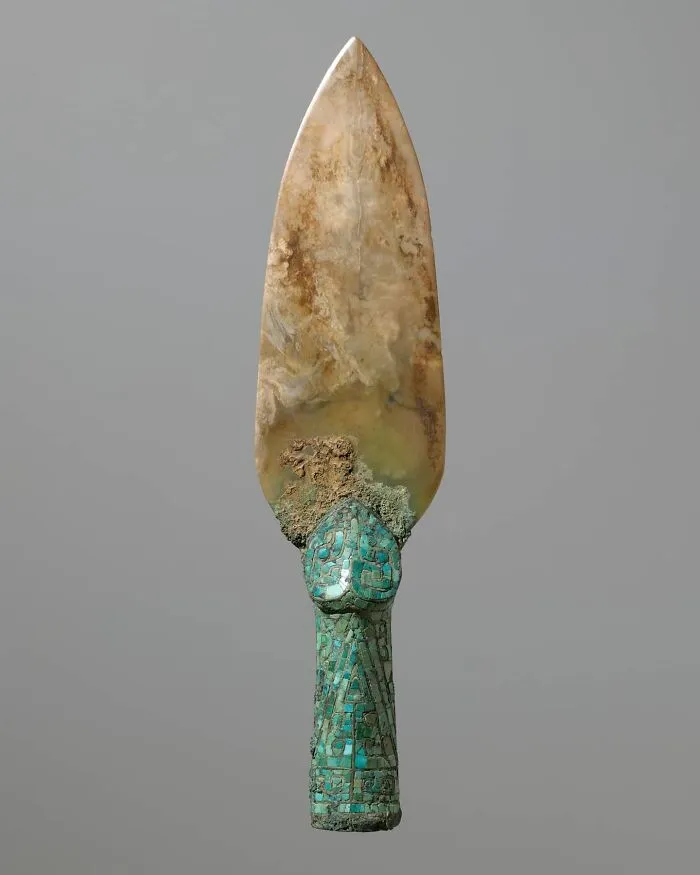
Jade spearhead in a bronze socket - China, Shang dynasty - 1250 BC
A highly religious and ritualistic society, the Shang established their dynastic kingdom in northern China around 1600 BCE. Their king served as the intermediary between his subjects, a powerful god known as Shang Di, and deceased ancestors that the Shang believed could intercede on their behalf.
The extraordinary emphasis placed on ancestor worship and state ritual during the Shang dynasty necessitated the production of massive numbers of bronze vessels and ceremonial weapons.
Specific types of bronze vessels for cooking, warming, or serving sacrificial offerings of food and wine were required for ceremonies designed to feed and appease ancestral spirits.
Ceremonial weaponry, such as the jade blades with turquoise-inlaid bronze hafts were an important part of state regalia, as Shang rulers owed their domination over neighboring societies to their military prowess.
Ritual bronzes and weapons were essential burial objects, for they represented the power and authority that the deceased intended to take with him into the afterlife.
Now on display at the Harvard Art Museum in U.S.A
Report
5points
#62
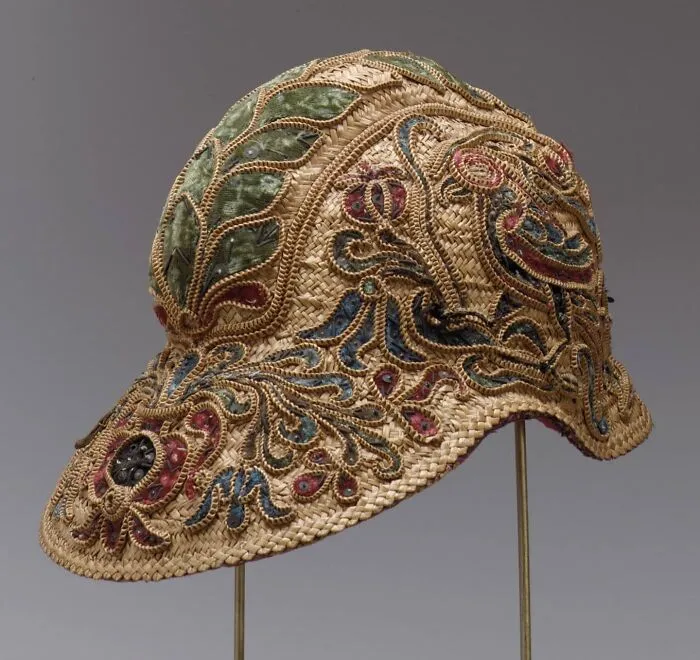
Spanish helmet - 1560
This unusual plaited-straw helmet-shaped hat is very similar in both shape and ornament to contemporary steel military helmets.
However, this highly decorative example was likely worn by a high-ranking official for festive peacetime occasions.
Medium: straw, metal, silk
Now on display at the Metropolitan Museum of Art in New York
Report
5points
#63
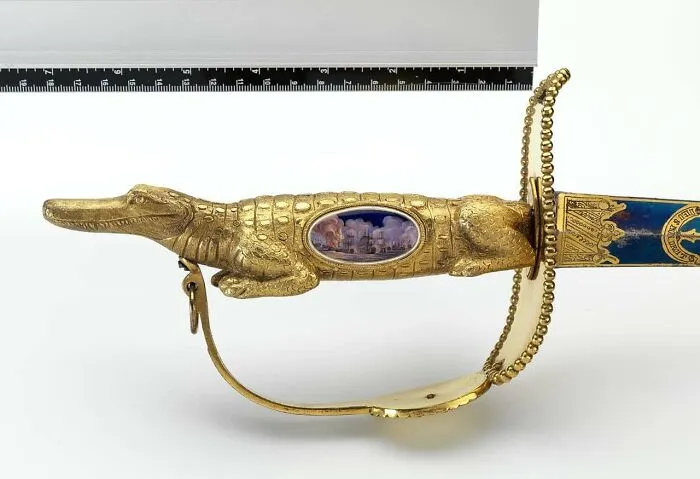
Presentation sword made for Vice-Admiral Horatio Nelson by the Captains of the Fleet after the Victory of the Nile on the 1st August 1798.
The hilt of the sword consists of a gilt crocodile forming the pommel and grip, along with a gilt knuckle-bow. There is a ring on the pommel in order to accommodate a sword knot.
There is a nearly flat, single shell and an oval shield on the knuckle-bow, which are now plain, any original enamel or engraving having been rubbed away. On the obverse and in the centre of the grip there is an oval shield decorated with coloured enamel depicting ships of the line in action.
The panel on the reverse of the shield is engraved with the words 'VICTORY of the NILE, 1st of August, 1798.' The straight, double-edged steel blade has a diamond section, which becomes hexagonal towards the point, and the blade is also damascened in blue and gold for 318mm from the hilt, after which point it consists of plain undecorated steel.
Engraved on the obverse of the blade, near the hilt are the Royal arms contained within a shield with a crown above, along with the French motto 'Honi soit qui mal y pense' that is engraved around the shield.The motto 'Dieu et mon droit' is engraved below the shield. Engraved above this on a longitudinal panel, and also on the reverse of the blade is the inscription 'For my Country and King.'
This sword is in all probability a replica of the one presented to Vice-Admiral Horatio Nelson (1758-1805) by the Captains of the Fleet after the Victory of the Nile on the 1st August 1798. It is believed that some of the Captains, if not all of them, had copies made of the sword for themselves and that this sword is one of those copies.
The sword resides now at the National Maritime Museum in UK
Report
4points
#64
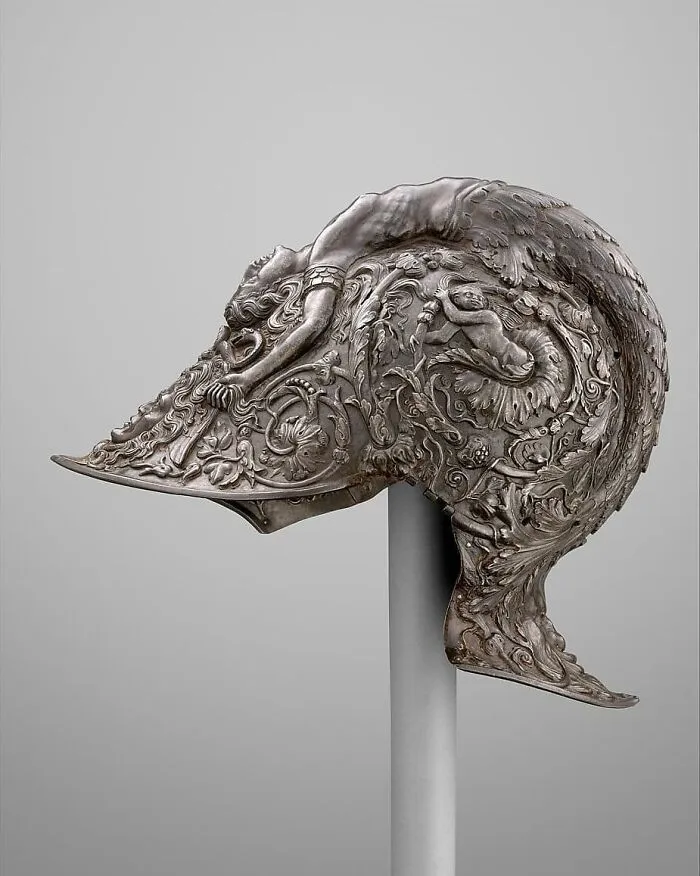
Renaissance burgonet with medusa designs made by Filippo Negroli - Milan, Italy 1543
This masterpiece of Renaissance metalwork is signed on the browplate by Filippo Negroli, whose embossed armor was praised by sixteenth-century writers as "miraculous" and deserving "immortal merit."
Formed of one plate of steel and patinated to look like bronze, the bowl is raised in high relief with motifs inspired by classical art. The graceful mermaidlike siren forming the helmet's comb holds a grimacing head of Medusa by the hair.
The sides of the helmet are covered with acanthus scrolls inhabited by putti, a motif ultimately derived from ancient Roman sculpture and wall paintings.
Now on display at the Metropolitan Museum of Art in New York
Report
4points
#65
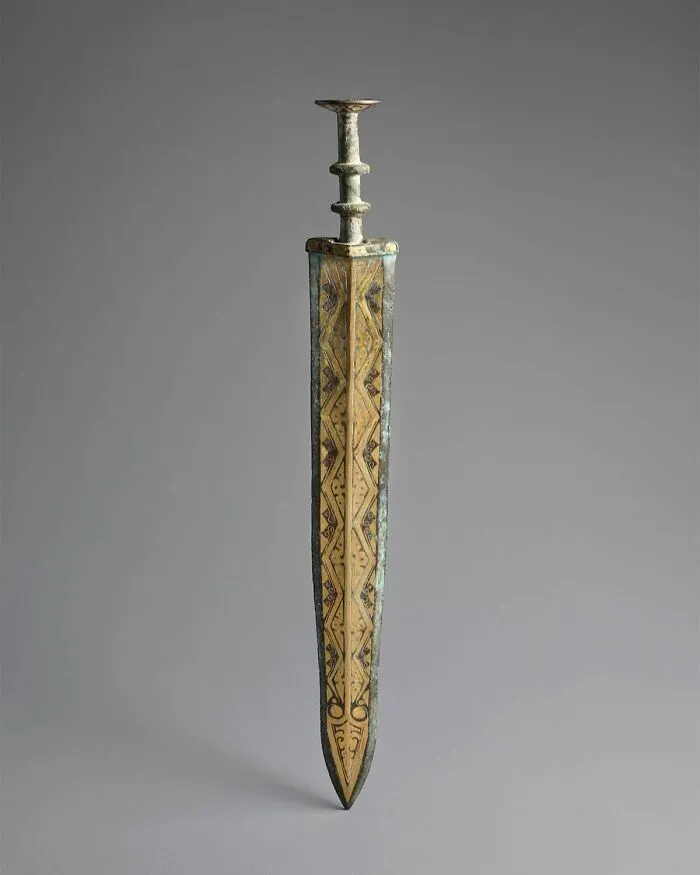
Bronze and gold sword - Eastern Zhou Dynasty, 4th century BC
China's bronze weapon manufacturing technology reached its peak during the Eastern Zhou Dynasty, and the most exquisite swords were produced in the southern states of Wu and Yue.
This sword is densely decorated with gold patterns and should have been used in ceremonies or decorations.
China's bronze weapon manufacturing technology reached its peak during the Eastern Zhou Dynasty, and the most exquisite swords were produced in the southern states of Wu and Yue.
This sword is densely decorated with gold patterns and should have been used in ceremonies or decorations.
Report
4points
#66
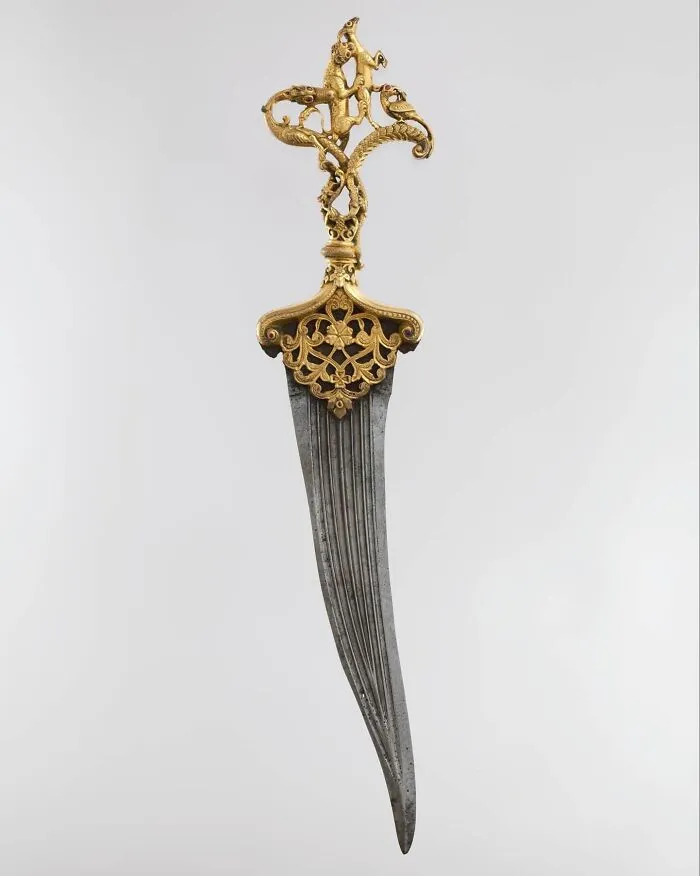
Dagger with zoomorphic hilt - India, 1655
Medium: Hilt: copper; cast, chased, gilded, and inlaid with rubies.
Blade: steel; forged
Portraits of Sultan 'Ali 'Adil Shah of Bijapur show him wearing daggers with zoomorphic hilts which combine Persian and Indian symbols of power.
In this superlative, ruby-studded example, a dragon, whose tail wraps around the grip, attacks a lion, which in turn attacks a deer. Before the deer is a parrot-like bird with a snake in its beak, symbolism associated with the deity Garuda.
Lower down on the hilt is the head of a yali, a mythical lion-like animal, with floral scrolls issuing from its mouth.
Now on display at the Metropolitan Museum of Art in New York
Report
4points
#67
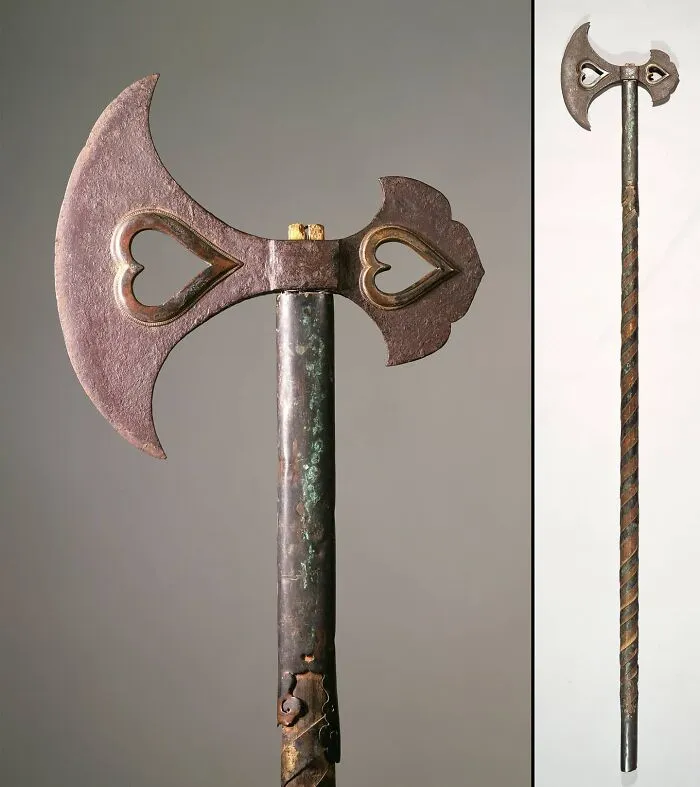
Mountaineer's axe with heart-shaped holes and bronze reinforced shaft
Japan, Muromachi period - 1325
This axe was carried by a 'yamabushi' (a follower of Shugendō) leading a group on 'nyūbu'(mountain ascetic training), which was usually a long pilgrimage stopping at every temple in the mountains. It's derived from more utilitarian axes that monks used to clear the brush while training in the wild.
Two *inome* ("boar's eyes") have been worked into the axehead, or what English speakers would call heart shapes. They are a common motif on temples and shrines. The shaft has been reinforced with a bronze coil and caps.
Now on display at the Nara National Museum in Japan
Report
4points
#68
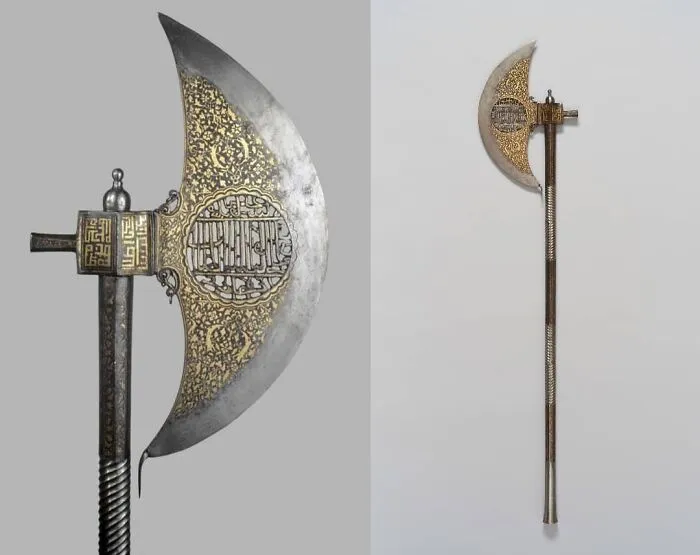
Battle axe of a member of the Life Guards of the Mamluk Sultan Muhammad ibn Qaytbay, 1496 - 1498 AD
Sultan Abu Al-Nasr Sayf Qaytbay was the eighteenth Burji Mamluk Sultan of Egypt from 1468–1496 AD.
During his reign, he stabilized the Mamluk state and economy, consolidated the northern boundaries of the Sultanate with the Ottoman Empire, engaged in trade with other contemporaneous polities, and emerged as a great patron of art and architecture.
In fact, although Qaytbay fought sixteen military campaigns, he is best remembered for the spectacular building projects that he sponsored, leaving his mark as an architectural patron on Mecca, Medina, Jerusalem, Damascus, Aleppo, Alexandria, and every quarter of Cairo.
An-Nasir Muhammad ibn Qaytbay was the son of Qaytbay, and a Mamluk sultan of Egypt from 1496 to 1498.
This axe belonged to a member of the Life Guards of Sultan Muhammad ibn Qaytbay from the Caucasian-Burji Mamluks.
The Mamluks ruled Egypt and Syria from 1250 AD until their empire fell to the Ottomans in 1517 AD, when a wealth of Mamluk booty was removed to Istanbul.
Medium: Iron, gold damascening, heat-blued
Dimensions:
Length: 99.5cm, Width: 20.5cm
Kept now at Kunsthistorisches Museum in Vienna
Report
4points
#69
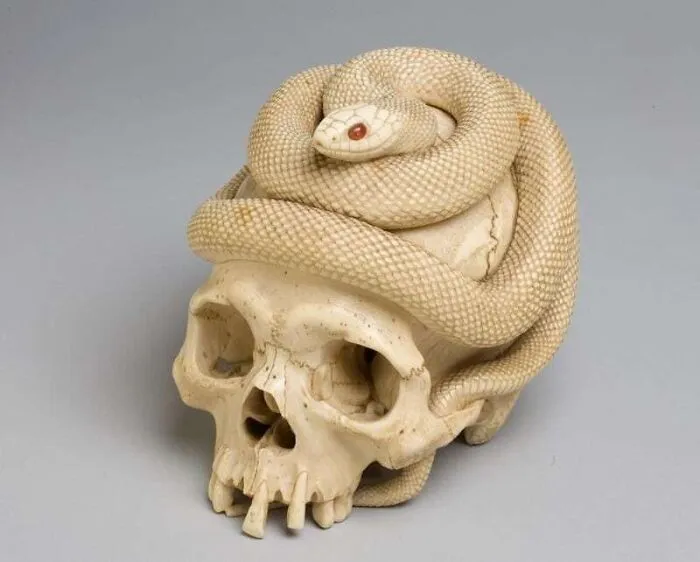
Ivory carving of a skull and coiled snake with carnelian eyes - Japan, Edo Period, 1860
Ivory carving for interior ornaments, or okimono, developed from the tradition of meticulous ivory carving for netsuke that flourished in particular around the mid-19th century, at the end of the Edo period.
Netsuke were initially used as toggles tied to the end of inro medicine cases, tobacco cases, and precious belongings, to carry them by hanging from the waist. Eventually, however, they became fashion accessories to represent the wearers’ tastes. This resulted in the production of elaborately formed, designed, and crafted netsuke. Many ivory works, notably figures and animals, demonstrate the artisans’ expertise as well.
As Western fashion spread from the time of modernization in the Meiji era, which is the last quarter of the 19th century, netsuke gradually became obsolete. Instead, ivory carving techniques for netsuke came to be applied to ornament making.
Ornaments of figures and animals, therefore, often display features common to netsuke. These ivory carved netsuke and ornaments became popular among Westerners who visited Japan from overseas, and as early as the beginning of the Meiji period, ivory okimono became favorites of exported Japanese decorative art. Ivory okimono were once so dominate that they were reputed to have “whitened the world of sculpture.
Dimensions: 11.5 x 12.5 x 14.8 cm
Kept now at the Art Gallery of Greater Victoria in Canada
Report
4points
#70
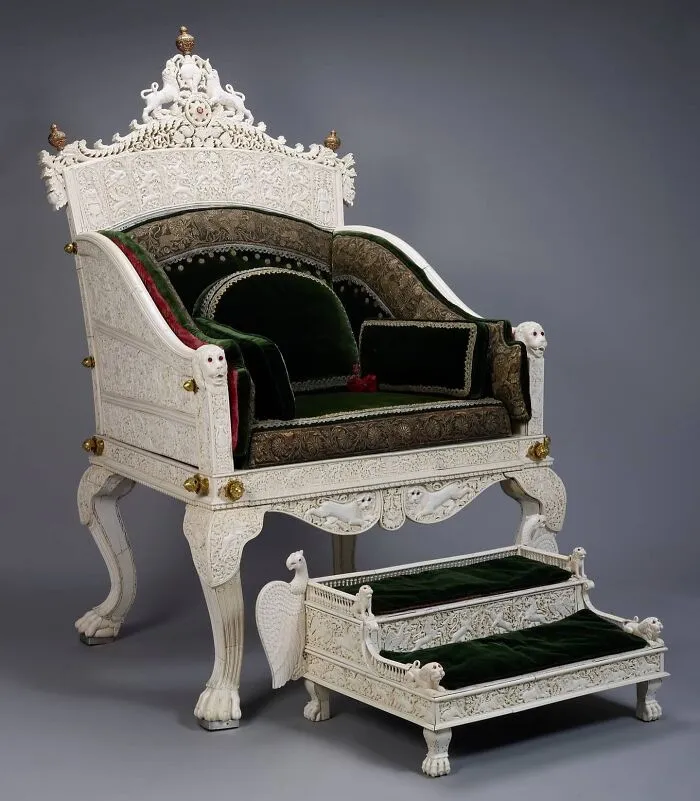
Carved ivory throne and footstool adorned with gold, diamonds, emeralds, rubies, gilt bronze, hardwood and embroidered silk velvet. Presented to Queen Victoria by Travancore king - 1851
This spectacular throne, the centrepiece of the Indian section in the Great Exhibition of 1851, was presented to Queen Victoria in part to advertise the carving skills of Travancore in southern India. The densely-carved elephant-ivory plaques incorporate Indian and European motifs, and the conch-shell emblem of Travancore forms the cresting.
Travancore was widely regarded in India as one of the leading centres of ivory carving, and successive rulers in the nineteenth century, including Maharajah Martanda Varma (ruled 1847-60), were keen to promote and support this industry.
The throne arrived in time to be lent by the Queen to the Great Exhibition, where it occupied the centre of the tented and richly hung Indian section.
The Queen particularly noted her 'magnificent chair, carved in ivory' on a visit to the Exhibition with King Leopold of the Belgians on 24 June; and at the closing ceremony in October the throne was prominently placed on the dais at the centre of the Nave for Prince Albert's use.
When the Queen became Empress of India in 1876, she chose to be shown seated on the throne at Windsor for her official photograph.
It is now on display at the Royal Collection Trust in UK
Report
3points
#71
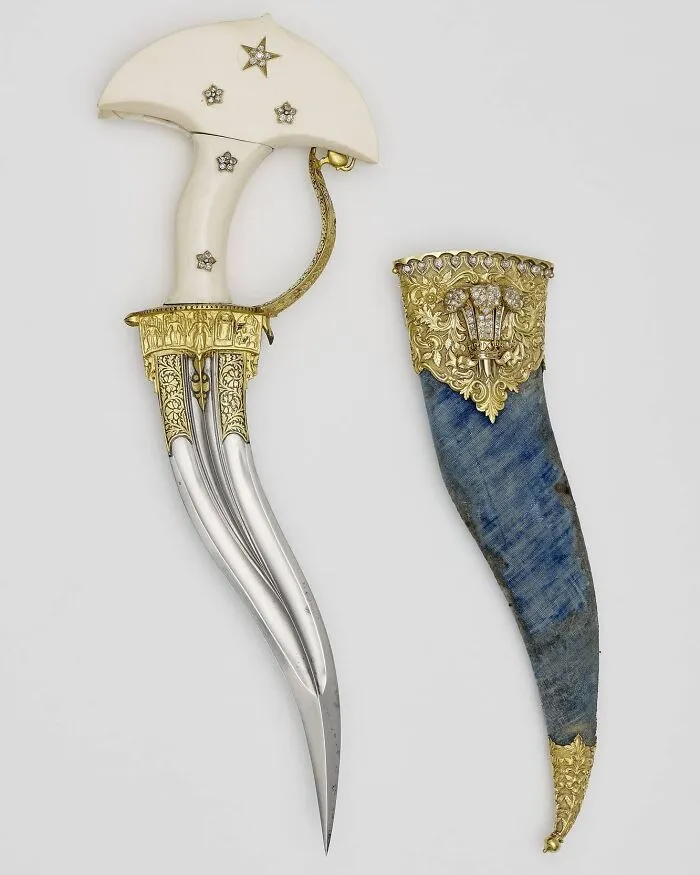
Dagger and scabbard, made of: watered crucible steel, gold, ivory, velvet, diamonds - South India, 1820
This dagger is incised directly below the hilt with the ten avatars of the Hindu god Vishnu and was probably made for a Hindu patron.
The scabbard mounts have been adapted for presentation with the addition of the Prince of Wales’s feathers.
It is now on display at the Royal Collection Trust in England
Report
3points
#72
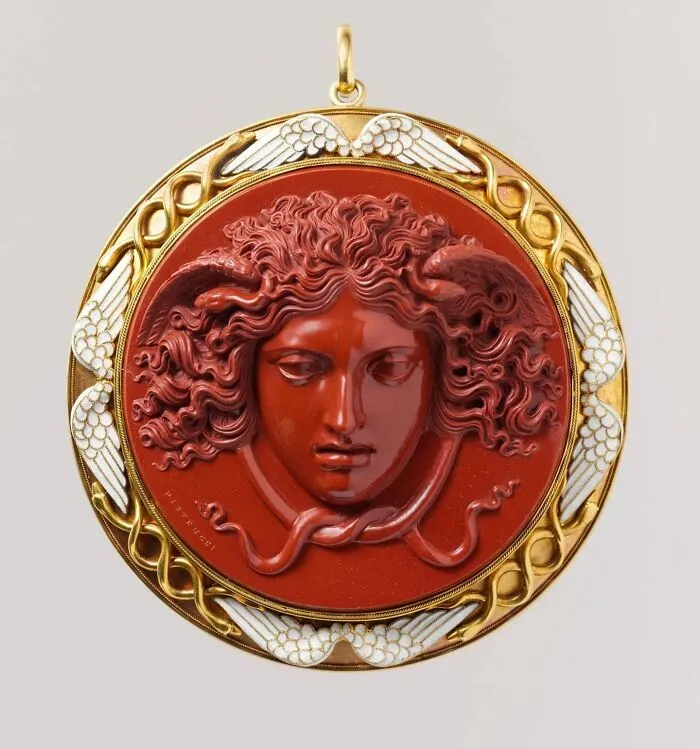
Head of Medusa cameo by Benedetto Pistrucci, 1850 - Red jasper mounted in gold with white enamel
One of the most elegant of all Medusas, this head borrows freely from the ancient marble mask known as the Rondanini Medusa in the Glyptothek, Munich.
The cameo was commissioned from Benedetto Pistrucci for the impressive sum of 200 guineas by a London dentist and collector, Samuel Cartwright, who also ordered a marble bust of himself (National Portrait Gallery, London).
The wings and snakes on the cameo’s frame allude to the caduceus of Mercury, emblem of the medical profession. The existence of a silver copy of the Medusa head bearing the mark of the silversmith Carlo Giuliano (sold at Sotheby’s in New York in 2006) proves that he was the author of the strikingly handsome mount.
Overall (visible cameo): 5.3 cm
Overall (in setting): 6.8 x 6.8 cm
Now on display at the Metropolitan Museum of Art in New York
Report
3points
#73
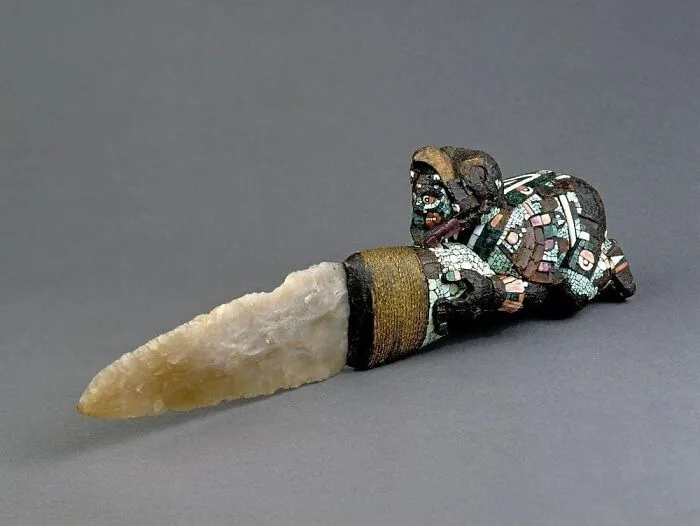
Tecpatl - Aztec ceremonial knife for use in human sacrifice, 1400 - 1521
Sacrificial knife, in the form of a crouching eagle warrior, with flint blade. Handle made of cedro wood (Cedrela odorata) and covered with mosaic made of turquoise, malachite and three types of shell.
Pine resin is used as adhesive and decoratively as inlay. The blade hafting is bound with maguey fibre and coated with Protium resin.
Plain, unadorned knives served many practical purposes in hunting, food preparation and warfare, while more ornate decorated examples were probably reserved for ritual sacrifice.
Flint blades were often placed in temple offerings, sometimes set vertically in resin to represent the glyph tecpatl (meaning flint or sacrificial knife).
It is now on display at the British Museum in London
Report
3points
#74
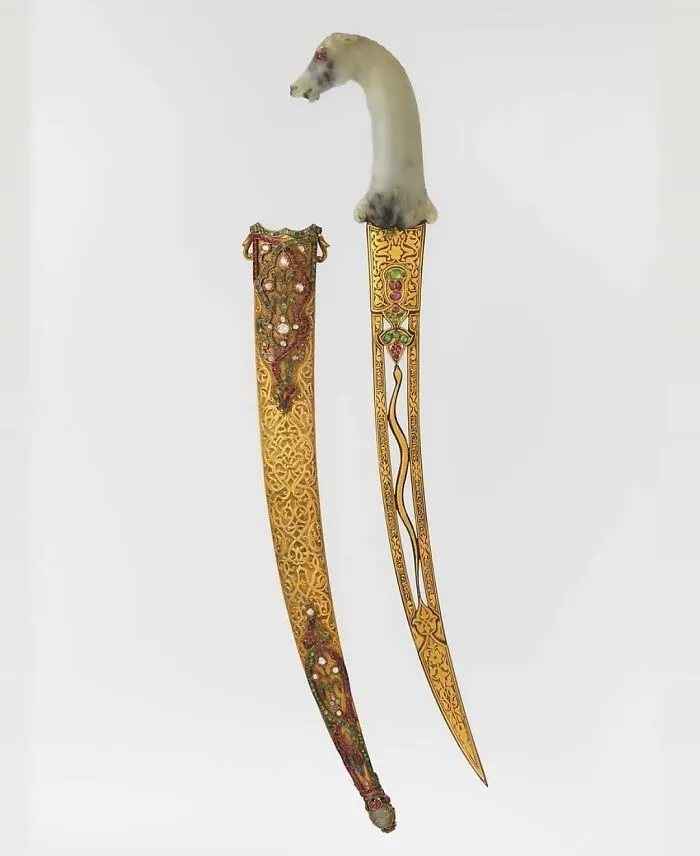
Dagger with sheath(Khanjar) studded with diamonds, nephrites, sapphires
Hilt, 17th–18th century(India, Mughal); blade and sheath(Turkish, Ottoman), 19th century
A khanjar is a traditional dagger originating from Oman. Worn by men for ceremonial occasions, it is a short curved sword shaped like the letter "J" and resembles a hook.
Although it is not known when the Omani khanjar was first created, rock carvings epitomizing the dagger were found on gravestones located in the central part of the Ru’us al Jibal region.
These are believed to have predated the Wahhabi revival, which occurred in the late 1700s. They were also mentioned in an account by Robert Padbrugge of the Dutch Republic, who journeyed to Muscat in June 1672.
The Ottoman Empire spread further the use of this type of knife. In the Balkans, where it was known as Handschar, such knives were regularly carried by Ottoman policemen, and it remained in local use also after the end of Ottoman rule.
The most elemental sections of the khanjar are its handle and blade, with the material utilized in the former playing a significant role influencing the final price of the dagger.
Rhinoceros horn and ivory were once the common standard, as it was "considered the best material" to make the hilt out of. However, with the international ban on the ivory trade and rhinoceros horn, the usage of other materials such as wood, plastic, and camel bone has become more prevalent
The inscription on the blade includes the names of the owner and the maker and the date, A.H. 1151 (A.D. 1689–90).
4th picture: overall view with daggers displayed on tray
Medium: Steel, nephrite, gold, emerald, ruby, diamond, sapphire, jade
Dimension: overall 48.7 cm
On display at the Metropolitan Museum of Art in New York
Report
2points