






Whether you are a history buff, a science fan, or just someone who loves learning random new things, there is a popular corner of the internet made just for you.
With over 1.4 million members, this massive Facebook group brings people from around the globe together to share fun facts, deep thoughts, and heartwarming real-life stories. Take the kind man who walks the streets carrying rescue pups to help them find loving homes — nobody asked him to, yet he shows up every day. Or the incredible mom who shocked the world by giving birth to not one, not two, but nine babies all at once.
To save you some scrolling, Bored Panda has gathered the most curious gems from the group right here. Keep reading to stock up on great conversation starters for your next trivia night or dinner party.
#21
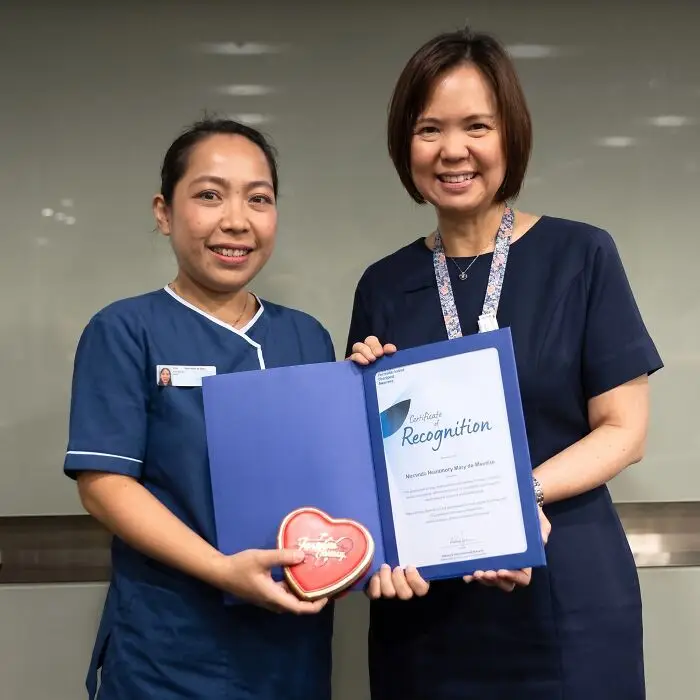
A Filipina nurse working in Singapore has received recognition for helping save an elderly man's life after he collapsed at a gym in Toa Payoh. Even though she was off duty, Staff Nurse Bernadette Marie Joy Bernado Borromeo did not hesitate to step in when someone needed urgent medical attention.
The incident happened while Bernadette was at the gym. An elderly man suddenly collapsed on a treadmill and had no detectable pulse. Recognizing the seriousness of the situation, she immediately began cardiopulmonary resuscitation (CPR) to help maintain blood circulation.
She also used an Automated External Defibrillator (AED), delivering two shocks as directed by the device. Her quick response helped restore the man's pulse before he was taken to Tan Tock Seng Hospital for further medical care.
Tan Tock Seng Hospital later presented Bernadette with a Certificate of Recognition to acknowledge her actions. She also received a small heart-shaped tin as a token of appreciation.
Her actions show that the knowledge and skills nurses develop through their work can make a difference far beyond hospital walls. Bernadette was simply spending time at the gym when an emergency occurred, but she chose to help without hesitation.
For many Filipinos working overseas, her story is a proud reminder of the dedication and compassion healthcare workers bring to their communities. Her response also highlights the importance of learning CPR and knowing how to use an AED.
Bernadette did not set out to receive recognition that day. She saw someone in danger and used her training to help. That decision made all the difference.
Report
2points
Keeping our curiosity alive matters more than ever today. Most online feeds are packed with mindless noise that leaves us zoning out or doomscrolling.
Reading through a mix of wild facts and true stories does the exact opposite. It wakes up that natural urge to question things and brings back a sense of wonder.
So keep reading and seeking out new and fascinating facts whenever you can.
#22

Rome didn't always conquer with armies. Sometimes, it conquered with gold.
This 1,500-year-old gold medallion, now kept at Dumbarton Oaks in Washington, may have been a diplomatic gift from Emperor Anastasius to a king of Lazica, a small kingdom on the eastern Black Sea coast in what is today Georgia.
For decades, scholars thought the Latin inscription around the emperor's portrait was just a badly copied imitation of Roman coin lettering. But historian Marco Cristini of the University of Florence has a new reading: the letters may be abbreviated Latin words that say, "Our lord Anastasius wishes to appoint you as king."
If he is right, this was no ordinary piece of jewellery. Lazica sat between two great powers, the Eastern Roman Empire and Sasanian Persia, and both wanted its loyalty. A gift like this told a foreign king that Constantinople recognised him, without Rome giving up its claim to be above him.
The other side of the pendant makes the message even more interesting. It shows Dionysus, the god of wine, pouring drink for a panther, with two satyrs beside him. A Christian emperor sending a pagan god seems strange, until you remember that wine and Dionysian imagery were deeply woven into the culture of ancient Georgia. The gift spoke the king's own language.
The reading is still debated, and no document names the medallion's first owner. But the history around it fits: in AD 522, King Tzath of Lazica travelled to Constantinople, was baptised, and received royal garments bearing the emperor's portrait.
Sometimes the most powerful weapon in an empire's arsenal was a beautifully made piece of gold, handed over with a smile.
What do you think, was this a genuine honour, or a bribe dressed up as diplomacy?
Report
2points
#23
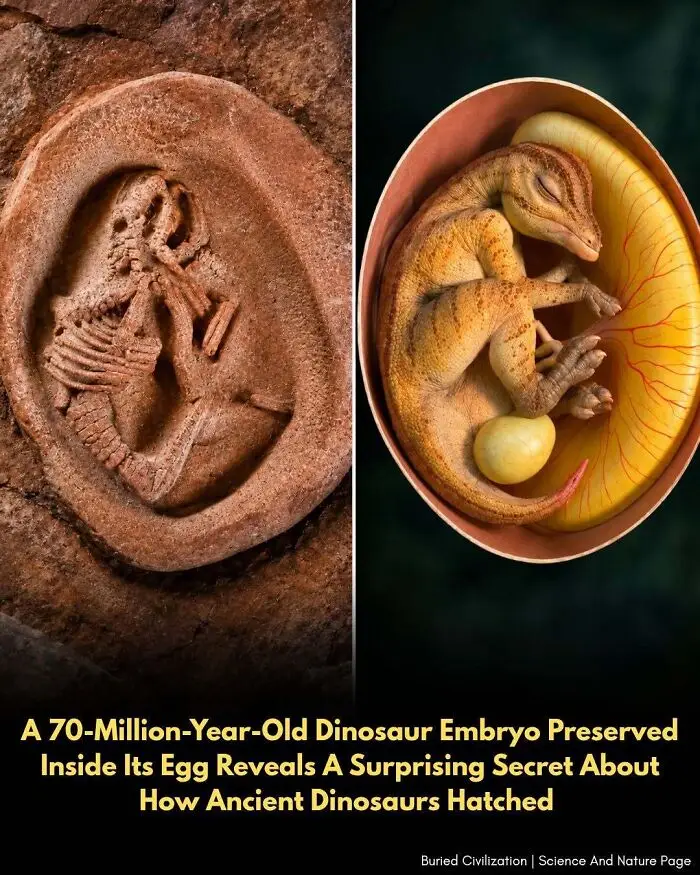
A dinosaur embryo preserved inside its egg for around 70 million years is helping scientists understand how ancient dinosaurs developed before hatching. The remarkable fossil, known as Baby Yingliang, was discovered in southern China and is considered one of the most complete dinosaur embryos ever found.
The embryo belonged to an oviraptorosaur, a group of feathered, bird-like dinosaurs that lived during the Late Cretaceous period. What caught researchers' attention was the way the tiny dinosaur was positioned inside its egg.
Its head was tucked beneath its body, its back followed the curve of the eggshell, and its feet rested close to its head. This arrangement closely resembles the position modern bird embryos take shortly before hatching.
Scientists call this behavior "tucking." In living birds, the movement helps embryos position themselves correctly inside the egg, making it easier to prepare for breaking through the shell. Finding the same posture in Baby Yingliang suggests that this behavior existed in dinosaur ancestors long before modern birds evolved.
The embryo measures approximately 27 centimeters from head to tail, while its egg is around 17 centimeters long. Researchers estimate that it lived between 66 and 72 million years ago, making the fossil an extraordinary window into prehistoric life.
The discovery offers valuable evidence of the evolutionary relationship between dinosaurs and modern birds. It suggests that some behaviors seen in today's birds developed millions of years before the first modern bird species appeared.
First reported in 2021, Baby Yingliang remains an important scientific discovery. Its exceptional preservation allows researchers to study details of dinosaur development that are rarely found in the fossil record. A single egg has revealed an unexpected connection between ancient dinosaurs and the birds we see today.
Report
2points
#24
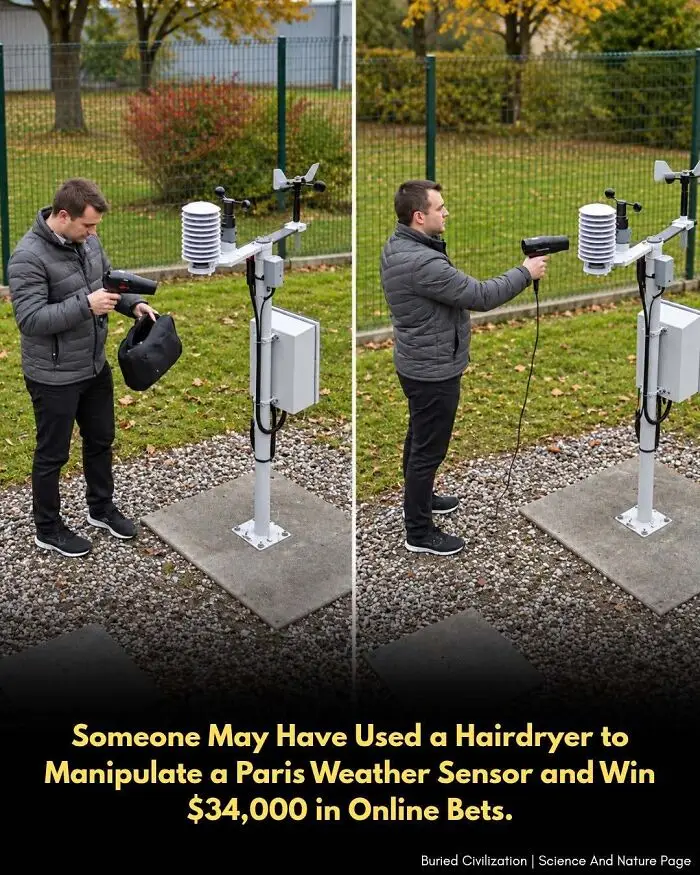
A Suspected Weather Station Scam May Have Helped Someone Win $34,000 on Polymarket. The Strange Part? A Hairdryer Was Among the Theories.
What sounds like a scene from a comedy movie became the subject of a real investigation in France after unusual temperature readings at Paris Charles de Gaulle Airport coincided with some surprisingly profitable online bets.
The incidents happened on April 6 and April 15, 2026. On both evenings, a weather sensor at the airport recorded sudden temperature increases that appeared inconsistent with readings from other weather stations.
On April 6, the temperature briefly climbed above 21°C before dropping again. Nine days later, the same sensor recorded approximately 22°C around 9:30 p.m., despite temperatures having remained much lower earlier in the day.
At almost exactly the same time, traders on Polymarket were making substantial profits by betting on unusually high temperatures in Paris.
Reports indicate that one successful bet generated around $14,000, while another produced approximately $20,000 in winnings. One trader reportedly turned a $119 wager into more than $21,000 in profit.
The unusual timing raised questions about whether someone had deliberately interfered with the weather equipment to influence the outcome of the bets.
One theory discussed by weather enthusiasts was that a portable hairdryer might have been used to artificially heat the sensor. However, this explanation has not been officially confirmed, and investigators have not publicly established exactly how the readings were affected.
France's national weather service, Météo-France, took the matter seriously. After examining the sensor data and finding physical evidence of possible interference with one of its instruments, the agency filed a formal complaint with the airport's air transport police.
The incident also exposed a weakness in weather-based prediction markets: when a financial outcome depends on a single measuring instrument, interference with that instrument can raise serious questions about the reliability of the entire market.
Polymarket subsequently changed its reference weather station for Paris temperature bets, moving from Charles de Gaulle Airport to Paris-Le Bourget Airport.
The case attracted international attention because it showed how real-world information can become valuable in unexpected ways when people are allowed to place money on the outcome.
A weather sensor, suspicious temperature readings, and thousands of dollars in winnings turned an ordinary forecasting system into the center of a financial investigation.
It also raises an important question: how can online prediction markets protect themselves when the real-world data used to settle bets may be manipulated?
As of November 2026, I found no publicly confirmed conclusion identifying who was responsible or proving that a hairdryer was used. The investigation remains a case of suspected interference rather than a proven scam.
Report
2points
#25

Gloria Kennard has been serving free Thanksgiving meals in Bryan, Texas, since 1988. Today, the annual meal feeds more than 2,000 people at Pleasant Grove Baptist Church with support from the Rotary Club. Gloria also serves meals on New Year’s and volunteers every week at The Bridge Ministries food pantry.
This summer, her community had a chance to give back. On July 29, Gloria was on her way to Bible study when another driver ran a stop sign on East MLK Street and totaled her truck. She walked away unhurt, but the insurance payout fell short of what she needed to replace it.
The Bridge Ministries started a GoFundMe with a $15,000 goal. A total of 174 donors gave about $17,700, and Kent Moore Cabinets chipped in another $10,000. On October 30, Gloria received a 2027 Kia Seltos.
Thank you, Gloria, for keeping a seat at the table for so many of your neighbors. And thank you to everyone who showed up for her.
Report
2points
#26

Michael and Julia share the special bond of being twins, but their birth stories are quite different. Michael was born with Down syndrome, while his twin sister, Julia, was not. Their different genetic circumstances make their story an unusual example of how twins can have very different beginnings.
Despite this difference, the two siblings share something far more important: a close family bond. Growing up together, they have shared childhood memories, everyday experiences, and the special connection that comes from being twins.
Their story is a reminder that Down syndrome does not define a person or determine the strength of family relationships. Michael and Julia may have different experiences, but they are united by the love and connection they share as brother and sister.
Report
2points
#27

"Go paperless. Save a tree."
We heard it on every bank statement, every phone bill, every email footer. So we did it. We switched off the paper bills, stopped printing, and felt good about helping the forests.
But all those emails, photos and files didn't disappear into thin air. They live in data centers. Huge, windowless buildings that run day and night.
And now, in place after place, forests are being cleared to make room for more of them. Hundreds of acres of trees, gone in a few weeks.
Report
2points
#28
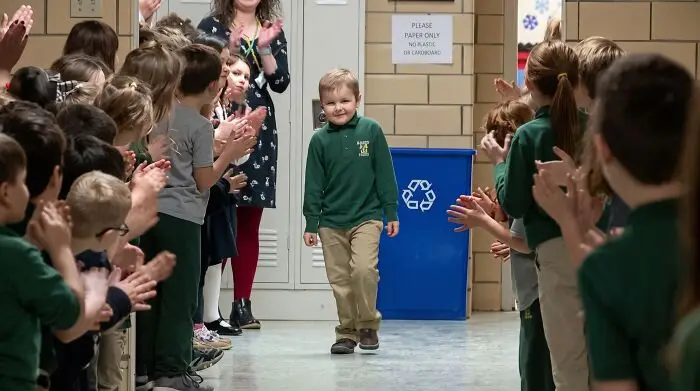
THREE YEARS OF FIGHTING, ONE UNFORGETTABLE WELCOME!
John Oliver “J.O.” Zippay spent three years battling acute lymphoblastic leukemia, enduring chemotherapy, hospital visits, and long periods away from school.
Despite the challenges, his teachers and classmates never forgot him. With support from tutors, he continued keeping up with his studies.
On December 27, 2019, J.O. completed his final round of intravenous chemotherapy.
When he returned to St. Helen Catholic School in January, his classmates and teachers lined the hallways and welcomed him with a heartwarming standing ovation.
After three difficult years, he returned not just to school, but to a community that had supported him every step of the way.
A beautiful reminder that love and support make every battle easier.
Report
2points
#29

At 105 Years Old, She's Finally Getting the Recognition She Deserves!
Meet Nell Bright, a remarkable World War II pilot who helped make aviation history. At a time when flying military aircraft was considered a man's job, she became one of the first 20 women selected to fly B-25 bombers through the Women Airforce Service Pilots (WASP) program.
During the war, she towed targets for military training in Texas, helping prepare American pilots for service.
But despite their contributions, women pilots were initially denied veteran status and faced discrimination when seeking jobs with commercial airlines simply because they were women.
Now, after decades of being overlooked, Nell Bright is set to be inducted into the International Air & Space Hall of Fame on November 21.
At 105, her legacy reminds us that courage has no gender, and true heroes deserve to be remembered!
Report
2points
#30

America's biggest nuclear operator got a lot bigger this year.
On January 7, 2026, Constellation Energy completed its purchase of Calpine. The deal was valued at about $26.6 billion including debt, and the combined company calls itself the nation's largest producer of electricity.
The two fit together like puzzle pieces. Constellation already ran the biggest fleet of nuclear reactors in the U.S. Calpine added about 23 gigawatts of mostly natural gas plants, plus The Geysers in Northern California, the world's largest geothermal complex. Together they have about 55 gigawatts, enough to power tens of millions of homes, and about 2.5 million retail and business customers.
Regulators made it sell some plants to protect competition, including a 606-megawatt gas plant in Texas.
With AI data centers driving demand, companies that own round-the-clock power now hold enormous leverage. Constellation has already signed nuclear deals with Microsoft and Meta.
Is it good or bad for your electric bill when one company controls this much power?
Source: Constellation Energy, 2026.
Report
2points
#31

She only asked for firewood. But he made sure she had everything she needs.
Nana Abernathy, 85, lives alone in North Carolina. A widow. Just days before Christmas in December, she rang Brittain's Tree and Crane Services in Connelly Springs.
She was cold.
Her Social Security had not arrived yet.
She asked for firewood and said she would pay later.
Paul Brittain took the call. He loaded the truck himself and drove it to her house. At her door, he told her there would be no bill. No coming back for money later.
Then he came back.
With his crew.
They patched her leaking roof. They fixed her heating and AC unit so it would work through winter. They cleaned her gutters and yard. They put new tyres on her car. All free.
Paul started a fundraiser for her Christmas. Over 500 people gave. More than $22,000 (£18,000) by 22 December. And he still checks on her every week.
One call for firewood.
One man who refused to let her face winter alone.
Don't you think the world needs more men like him?
Report
2points
#32
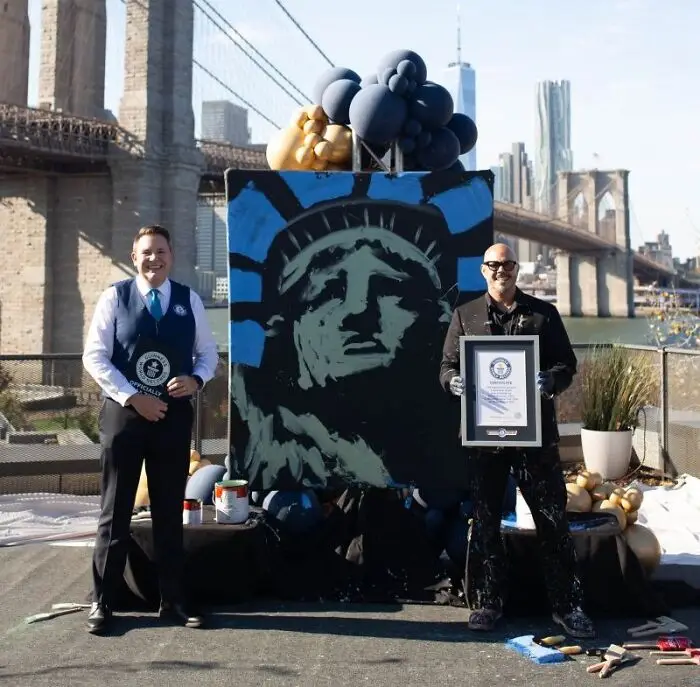
ARTIST PAINTS THE STATUE OF LIBERTY IN JUST 43.5 SECONDS, SETTING A NEW GUINNESS WORLD RECORD.
American performance artist David Garibaldi made history on November 19, 2026, during Guinness World Records Day by creating an impressive painting of the Statue of Liberty in just 43.5 seconds.
The remarkable performance took place on the rooftop of DUMBO House in Brooklyn, New York, with the iconic Brooklyn Bridge providing a spectacular backdrop. A crowd gathered to watch as Garibaldi moved rapidly across a large canvas, applying bold strokes of green and blue paint to create an abstract image.
At first, the painting looked like a collection of random brushstrokes. But when he finished, Garibaldi dramatically turned the canvas upside down, revealing the unmistakable face of the Statue of Liberty.
Guinness World Records officially recognized his achievement as the fastest time to paint a landmark statue. It also marked his first official Guinness World Records title.
Garibaldi has spent more than two decades developing his unique performance-painting style. He became widely known after reaching the finals of America's Got Talent in 2012, where audiences were introduced to his energetic combination of music, movement, and live painting.
Today, he performs around the world, creating large-scale portraits in front of live audiences. His work has also supported charitable causes, with some of his paintings being auctioned to raise money for people in need.
For Garibaldi, this achievement was about more than speed. He wanted to challenge himself, set a new personal standard, and encourage others to pursue their creative ambitions.
His performance showed what years of practice, confidence, and artistic dedication can accomplish. In less than a minute, he transformed a blank canvas into a recognizable symbol of freedom and became an official world-record holder.
Report
2points
#33
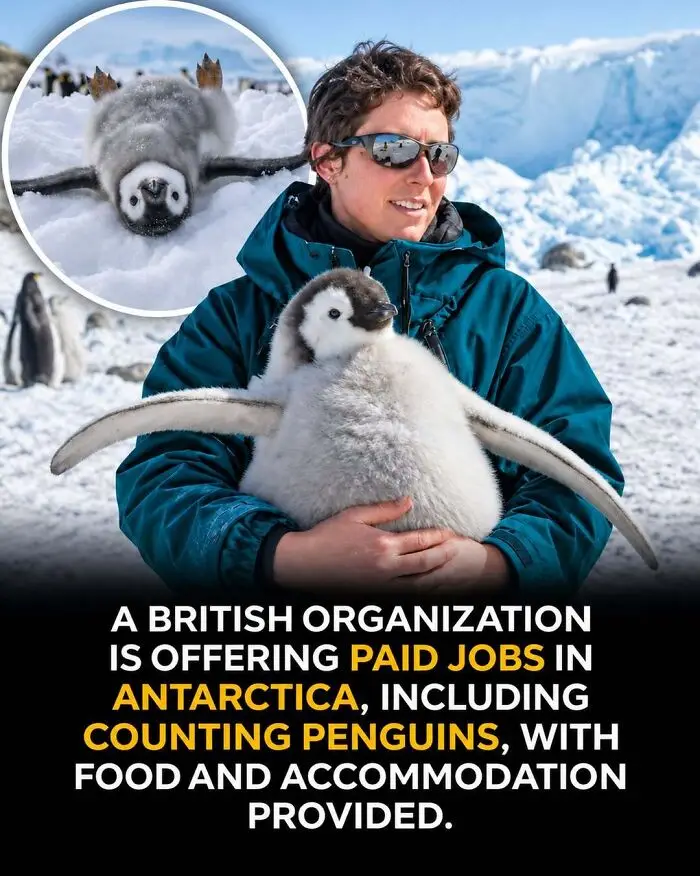
Imagine getting paid to live in Antarctica, surrounded by snow, ice, and thousands of penguins!
The UK Antarctic Heritage Trust (UKAHT), a British organization responsible for preserving historic sites in Antarctica, has offered paid seasonal jobs at Port Lockroy, one of the continent's most famous historic sites.
One of the interesting responsibilities involves monitoring the local Gentoo penguin population by counting their nests, eggs, and chicks. But that's not all. Workers also help run a small museum, manage a gift shop and post office, welcome visitors, and maintain the historic buildings.
The salary ranges from approximately £1,449 to £2,096 per month, with the highest rate equivalent to around $2,800. Even better, accommodation, meals, and essential work equipment are provided during the assignment, allowing workers to save much of their earnings.
However, life in Antarctica is far from comfortable. Workers spend several months in an extremely remote environment, with limited facilities, no running water, and very limited opportunities for showers. It's certainly not an ordinary workplace!
The recruitment was for the 2026–2027 Antarctic season, and applications have now closed.
Would you take a job like this for the chance to live and work among penguins in Antarctica?
Report
2points
#34

A tiny retinal implant may help some people with advanced age-related macular degeneration read again. In a clinical trial, the PRIMA system paired a small chip implanted beneath the retina with special glasses that send images to it. Of the 32 participants who completed the one-year follow-up, 27 were able to read with the device.
It’s a promising step in vision research, but it does not restore normal sight or work for everyone. The study also reported surgery- and device-related side effects, so the results need to be understood in the context of clinical care and ongoing research.
Report
2points
#35
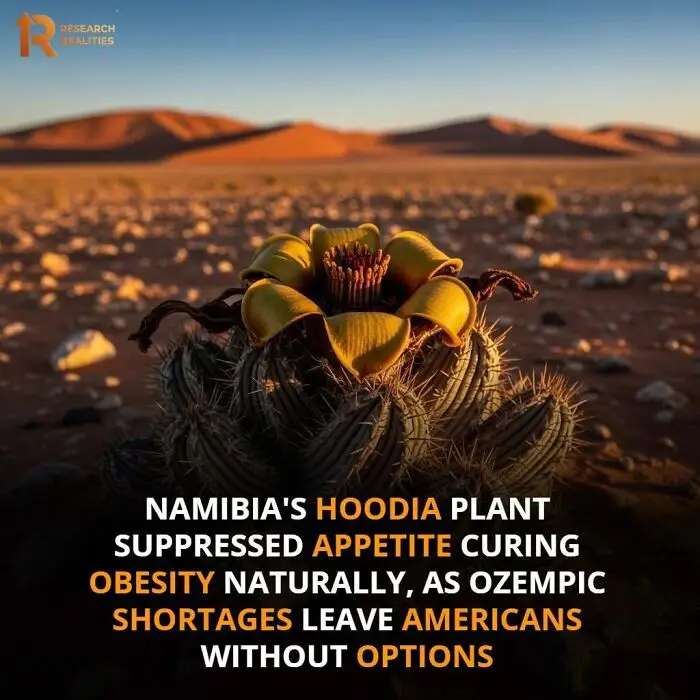
Namibia's hoodia plant suppressed appetite curing obesity naturally, as Ozempic shortages leave Americans without options
Namibian indigenous communities led researchers to Hoodia gordonii containing P57 compound that eliminates hunger completely, enabling effortless weight loss—natural alternative to expensive GLP-1 medication experiencing widespread shortages.
Obesity results partly from modern diets hijacking appetite regulation, making people constantly hungry despite adequate nutrition. Namibia's San people traditionally used hoodia cactus to suppress hunger during long hunts. Scientific investigation revealed P57 molecule that directly activates satiety centers in the hypothalamus—the brain region controlling hunger—making people feel completely satisfied with less food without stimulants, side effects, or medical supervision. Clinical trials showed 15-20 pound weight loss over 12 weeks from reduced caloric intake driven by natural hunger elimination.
The pharmaceutical shortage contrast: Ozempic and similar GLP-1 medication create pharmaceutical shortages as demand exceeds supply, leaving diabetics without medication while celebrities use it for vanity weight loss. These medications cost $900-1,200 monthly and require ongoing injections. Hoodia extract costs $40 monthly, works through different mechanisms, requires no prescription, and grows abundantly. Yet pharmaceutical companies never developed hoodia seriously because natural plant extracts generate minimal profits compared to patented injectable medications. American weight loss seekers can't access Ozempic while ignoring hoodia that works effectively without shortages.
Americans desperately seeking weight loss solutions face Ozempic shortages, insurance denials, and $15,000 annual costs while effective natural appetite suppressant exists affordably but remains marginalized because it threatens pharmaceutical profit models.
Report
2points
#36

Scientists in France held a ball of plasma hotter than the core of the Sun for more than 22 minutes.
On February 12, 2025, France's WEST tokamak, run by the CEA at its Cadarache site, sustained a hydrogen plasma for 1,337 seconds. That beat the previous tokamak record of 1,066 seconds set by China's EAST machine just weeks earlier, an improvement of about 25 percent.
The plasma reached about 50 million degrees Celsius, roughly three times hotter than the center of the Sun.
A tokamak is a doughnut-shaped machine that uses powerful magnets to hold super-hot plasma in place without letting it touch the walls. That's the path many scientists hope will lead to fusion power, the same process that powers the stars.
Why does time matter so much? Getting plasma hot for a split second is one thing. A real fusion power plant must keep it stable for long periods, continuously. WEST's record shows the materials and controls are getting better at handling that heat over time.
The CEA says the result is promising for ITER, the giant international fusion project being built nearby in southern France.
WEST's inner walls are lined with tungsten, a metal that can survive extreme heat, and they are actively cooled while the plasma runs.
Fusion power isn't on the grid yet. But records like this keep falling faster than ever.
For 22 minutes, a small piece of a star existed inside a machine on Earth.
Do you think fusion power will light up homes in your lifetime?
Source: CEA, ""Nuclear fusion: WEST beats the world record for plasma duration!"" February 18, 2025.
Report
2points
#37
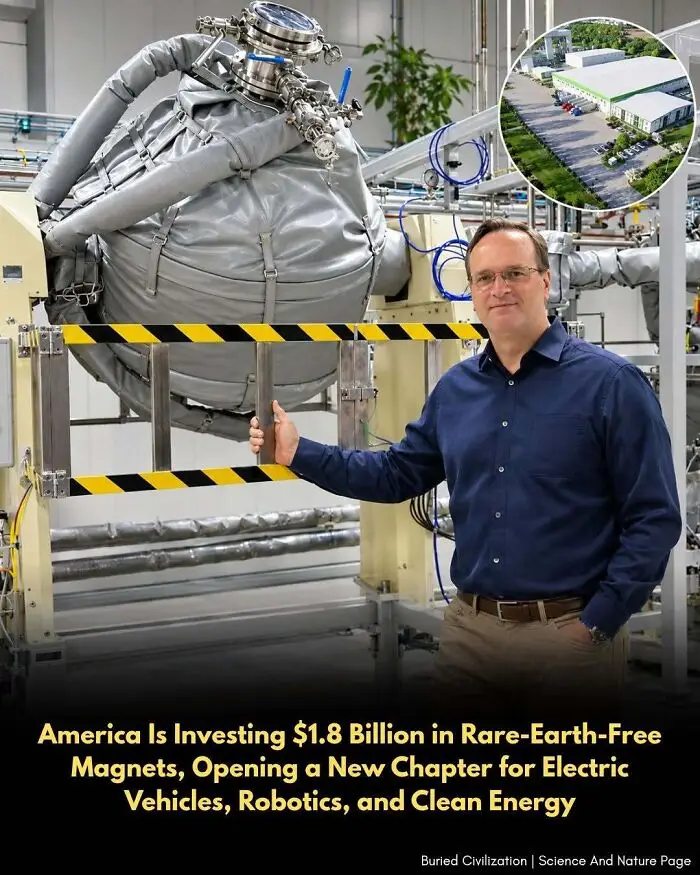
THE UNITED STATES IS TAKING A MAJOR STEP TOWARD MAKING POWERFUL PERMANENT MAGNETS WITHOUT USING RARE EARTH ELEMENTS.
Niron Magnetics has announced a $1.8 billion investment in a new manufacturing campus in Dothan, Alabama, designed to produce up to 10,000 metric tons of iron nitride magnets every year.
Announced on November 20, 2026, the project will become the company's second major manufacturing facility in the United States. Construction is expected to begin in 2028, with production planned to start in 2029. The project is also expected to create around 700 jobs within five years.
What makes this development important is the technology behind it. Traditional high-performance permanent magnets often depend on rare earth elements such as neodymium. These materials are essential in many modern technologies, but their supply chains are heavily concentrated in China.
Niron is developing an alternative using iron and nitrogen. Iron is widely available, and the technology aims to produce powerful permanent magnets without relying on rare earth materials. The company believes this approach could help build a more secure and reliable supply chain for American manufacturers.
These magnets have applications across several industries. Electric vehicles use them in motors, wind turbines rely on them to generate electricity, and manufacturers use permanent magnets in robotics, industrial equipment, consumer electronics, and artificial intelligence infrastructure.
The new Alabama facility will be built on a 446-acre industrial site in Dothan. Once fully operational, its planned annual capacity of 10,000 metric tons will make it a major addition to America's permanent magnet manufacturing industry.
Niron is also building its first full-scale production facility in Sartell, Minnesota. That plant is expected to begin production in 2027, with an annual capacity of up to 1,500 metric tons. The Alabama project will expand the company's production capacity on a much larger scale.
The development comes as the United States looks for ways to reduce its dependence on overseas suppliers of materials and components used in advanced manufacturing. Producing magnets domestically could support industries that depend on reliable access to these essential parts.
The technology still needs to prove itself at large industrial scale, but the investment marks an important step toward expanding the range of materials used in modern manufacturing.
From electric cars and wind turbines to robots and advanced electronics, powerful magnets are part of the machinery shaping the future. And with this project, iron and nitrogen could play a much bigger role in that future.
Report
2points
#38

At 38 years old, Deirdre Keane achieved something extraordinary in 2026. The New York nurse practitioner and experienced marathon runner completed all seven World Marathon Majors in a single year, finishing her final race while 34 weeks pregnant.
On November 1, Deirdre crossed the finish line of the New York City Marathon in 4 hours, 6 minutes, and 55 seconds. It was her seventh marathon of the year and the final race needed to complete her ambitious goal.
Her achievement became even more remarkable because pregnancy was never part of the original plan.
After getting married to her husband, Brian, in 2025, Deirdre had planned to make 2026 a year of personal challenges before starting a family. She signed up for 11 endurance events, including all seven World Marathon Majors, two ultramarathons, an Ironman competition, and a trail marathon in Ireland.
She began her journey with the Tokyo Marathon in March. During the Boston and London races in April, however, she noticed that her pace had slowed and she was feeling different from usual. A pregnancy test confirmed that she was expecting a baby.
Rather than abandoning every goal, Deirdre reconsidered her plans. She decided to continue with the marathons after discussing the situation with her obstetrician and receiving medical approval. She also dropped the Ironman and another ultramarathon, choosing to approach each remaining race carefully.
Her pregnancy did not stop her from completing the Sydney Marathon at 25 weeks, the Berlin Marathon at 29 weeks, and the Chicago Marathon at 31 weeks. She finished the Chicago race in just under four hours.
The biggest challenge came in New York, where she was already 34 weeks pregnant. Her husband, Brian, supported her throughout the event, meeting her at different points along the course to provide water. Friends also came out to cheer her on.
Deirdre has completed more than 70 marathons and ultramarathons throughout her running career. Her determination was inspired in part by her father, John, who was also a marathon runner. He continued running even while battling cancer and completed his final New York City Marathon just one day before undergoing surgery to remove a tumour.
Deirdre has said that her experience was a personal decision based on her fitness, medical guidance, and understanding of her changing body. She also recognises that research on extremely demanding exercise during pregnancy remains limited.
Her achievement has attracted attention from runners and families around the world. It is an unusual example of how an experienced athlete adapted her ambitions during a major life change without abandoning a goal that meant so much to her.
Deirdre's story is about determination, preparation, and the support of loved ones. Completing seven major marathons in one year would be an extraordinary accomplishment on its own. Doing so while preparing to welcome her first child makes her 2026 journey even more memorable.
Report
2points
#39

AN EMPTY ELECTRIC CAR IN CHINA TRIED TO PARK ITSELF 868 TIMES OVERNIGHT, LEAVING A SECURITY GUARD COMPLETELY BAFFLED.
An unusual incident in Anhui province, China, has caught people's attention after an electric car was seen repeatedly attempting to park itself inside an underground garage with nobody behind the wheel.
The strange episode reportedly happened around 3 a.m. A security guard heard unusual noises coming from the parking area and went to investigate. To his surprise, he found an empty electric vehicle moving forward and backward, repeatedly adjusting its position as if it were struggling to find the perfect parking spot.
CCTV footage captured the vehicle performing the same manoeuvre again and again. When the owner checked the car's system records the following morning, the results were astonishing: its automatic parking function had been activated 868 times overnight.
The vehicle eventually stopped beside another parked car, bringing its unusual parking marathon to an end.
The incident has sparked questions about what caused the repeated movements. One possibility is a software problem, while another theory suggests that someone may have repeatedly activated the remote parking feature through a smartphone application.
The incident also attracted attention because similar videos appeared online during China's Huawei Qiankun Intelligent Driving competition. However, the competition's parking activities were counted only between 6 a.m. and 10 p.m., so the overnight attempts cannot be confirmed as part of the contest.
For now, the exact cause remains unknown. The available CCTV footage shows what happened, but it does not establish whether the vehicle experienced a technical malfunction or was repeatedly controlled remotely.
What should have been an ordinary night in an underground parking garage turned into a bizarre demonstration of automated driving technology. And after 868 attempts, this electric car certainly gave the internet a parking story to remember.
Report
2points
#40

Born With Fragile Bones, Kristin Refuses To Let Her Condition Stop Her From Exploring The World
Kristin was born with osteogenesis imperfecta, a rare genetic condition that causes bones to break more easily than usual. Throughout her life, she has experienced numerous fractures and undergone several surgeries. She also lives with scoliosis, a condition that affects the curve of her spine.
Standing just 3 feet 6 inches tall, Kristin has metal rods supporting her bones. She often jokes that she is "full of metal," using humor to describe the medical hardware that has become part of her life.
Her condition has brought many challenges, but it has never taken away her love of adventure. Alongside her husband, Mark, Kristin travels to different parts of the world, explores new places and enjoys experiences that create lasting memories.
Their journeys show that a meaningful life does not have to look the same for everyone. Kristin has faced physical challenges that require extra care and planning, but she continues to make room for the things she loves.
For her, life is about more than the condition she was born with. It is about sharing experiences, discovering new places and making the most of every opportunity alongside the person she loves.
Report
1point