



The wait is over. Everyone who was enjoying 2017, 2016 and 51 earlier 'Wildlife Photographer of the Year' (WPY) competitions has just received this year's biggest treat. London's Natural History Museum announced the winners of the 2018 photo contest, and the beautiful pictures reveal the abundance, beauty, resilience, and vulnerability of life on Earth.
The winning wildlife photography stills were chosen from more than 45,000 entries from 95 countries for their artistic composition, technical innovation and accurate interpretation of the natural world. The international jury awarded the grand title to Dutch photographer Marsel van Oosten for his shot, titled "The Golden Couple." The breathtaking picture features a pair of endangered golden snub-nosed monkeys in central China’s Qin Ling Mountains. "It is a symbolic reminder of the beauty of nature and how impoverished we are becoming as nature is diminished," Roz Kidman Coz, the chair of the judging panel, said in a press release. "It is an artwork worthy of hanging in any gallery in the world." Golden snub-nosed monkeys only live in this particular part of China, and their numbers are steadily decreasing, mainly because of habitat loss from commercial logging and firewood collection.
"As we were going through the pictures of animals and nature, we just kept coming back to this one," Roz Kidman Coz added. "It's almost like a stage set. I think what makes it are the colors and the lighting. These monkeys normally feed in the trees, but somehow Marsel managed to catch them on the ground, and he's carefully thrown a very gentle flash on to the scene to illuminate that amazing fur."
"This image was shot on my first trip to the Qinling mountains," Marsel van Oosten told Bored Panda. "I spent five days on this location. Since then I have been there two more times."
"I was planning to visit China for landscape photography but decided to check out what kind of wildlife China has apart from pandas. After doing some research, I stumbled across the snub-nosed monkeys. There are two main species; the golden snub-nosed monkeys and the black snub-nosed monkeys, and they both look amazing. Not only that, [but] they're also endangered species, so all the more reason to photograph them."
"My main objective for the golden snub-nosed monkeys was to show the beautiful long guard hairs on the back of one of the males," the photographer added. "To show those hairs I needed to be slightly behind the monkey, which made it difficult to show the face. Luckily, both monkeys in this image looked up at an altercation in the larger group of 50 monkeys - the perfect moment for me to get the animal photography shot I wanted."
"What makes this image better than most of the other ones I've shot is the fact that the background is near perfect: there is some light shining through the canopy in the upper right corner, the rock on which the male is sitting has some beautiful texture, and the trees to the left really complement the scene. Very often when the subjects adopt the perfect pose, the background is not great, or vice versa. What takes this image to the next level for me, is the light. I used an off-camera flash to bring out the color and the texture in the fur. My wife Daniella was standing on the right, just outside the frame, holding the flash which I controlled remotely. The almost painterly light was exactly what I wanted."
Van Oosten wanted to direct everyone's attention to the current mass extinction of plants and animals, too. "Unlike past mass extinctions, caused by events like asteroid strikes, volcanic eruptions, and natural climate shifts, the current crisis is almost entirely caused by humans. Ninety-nine percent of currently threatened species are at risk because of human activities."
"If current rates of human destruction of the biosphere continue, half of all plant and animal species of life on earth will be extinct within 100 years."
"If current rates of human destruction of the biosphere continue, half of all plant and animal species of life on earth will be extinct within 100 years."
"Perhaps one of the most striking elements of the present extinction crisis is the fact that the majority of our closest relatives - the primates - are severely endangered. About 90 percent of them lives in tropical forests, which are disappearing quickly. The IUCN estimates that almost 50 percent of the world's primate species are at risk of extinction. Overall, the IUCN estimates that half the globe's 5,491 known mammals are declining in population and a fifth are clearly at risk of disappearing forever with no less than 1,131 mammals across the globe classified as endangered, threatened, or vulnerable."
"The golden snub-nosed monkey is endangered due to habitat loss. For instance, lichens are the main staple of the monkey's diet and dead trees contain the most lichen. Unfortunately, dead trees are harvested, thus reducing the quality of the habitat and availability of food. The monkey is a highly selective feeder, so damage to its habitat seriously impacts the species. There are less than 4,000 of these animals left."
"Successful wildlife conservation starts with awareness, and most people don’t even know this species exists. I hope that my photograph will help to spread awareness about this species and that people will realize that not only the rhinos, tigers and polar bears are worth worrying about."
More info: nhm.ac.uk
#41 "Glass-House" Guard By Wayne Jones, Australia, Highly Commended 2018 Under Water
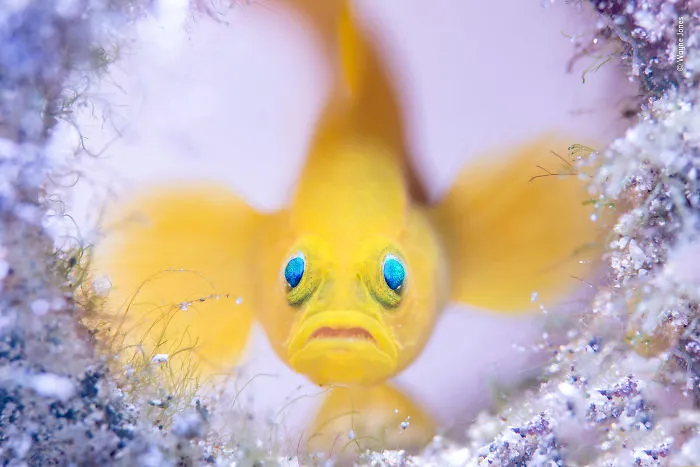
A yellow pygmy goby floats inside its human-made home: a discarded bottle lying on the seabed. Wayne set up his camera a few centimetres from the bottle’s narrow opening, and focused on the goby’s arresting, bulging blue eyes. The movement of the fish blurred the rest of its features into a haze of yellow.
Usually found in breeding pairs, the tiny and colourful yellow pygmy goby often inhabits old worm holes or empty bottles or cans. In this temporary home, the female lays several batches of eggs, while the male takes on guard duty to defend its spawn from intruders. Plastic is an increasing feature of its marine environment.
Report
60points
#42 "Hellbent" By David Herasimtschuk, Us, Winner 2018 Behaviours Amphibians And Reptiles
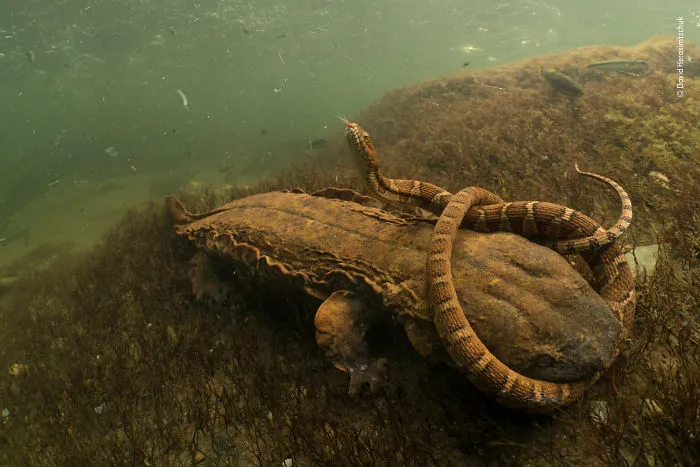
Clamped in the jaws of a hungry hellbender salamander, things were not looking good for the northern water snake. But when its attacker repositioned its bite, the snake pushed free and escaped. David was thrilled to catch a battle between these two unlikely foes. ‘I’ve seen hellbenders display an array of behaviours, but this was by far the most remarkable,’ he says.
Hellbenders are the largest salamanders in the USA and are among the most endangered. Usually they hunt for small prey, such as crayfish, insects and eggs, so a northern water snake is an unexpected choice. These amphibians use suction to secure their prey before using their teeth – a method unlikely to subdue a wriggling snake.
Report
59points
#43 "Home Of The Quoll" By David Gallan, Australia, Highly Commended 2018 Animals In Their Environment
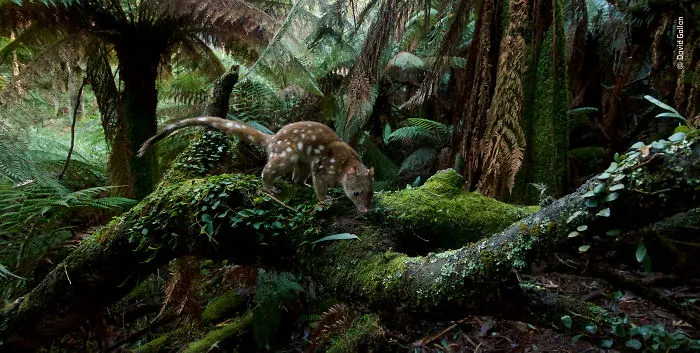
It took David three years to locate this quoll – and another six months to take this photograph. He set up a camera trap where a fallen log bridged a stream, foregoing flash to minimise disturbance, then placed a scent bait to pause any passing quolls. His perseverance paid off when this hunting female scampered into view.
These shy creatures are ferocious predators. Almost a metre long from nose to tail, quolls can slice meat off the reptiles, birds and mammals they hunt with their strong teeth and muscles. Like all quoll species, the spotted-tailed quoll is threatened by habitat loss due to industrial logging and competition with introduced species.
Report
58points
#44 "Fitting The Bill" By Jess Findlay, Canada, Highly Commended 2018 Behaviours Birds
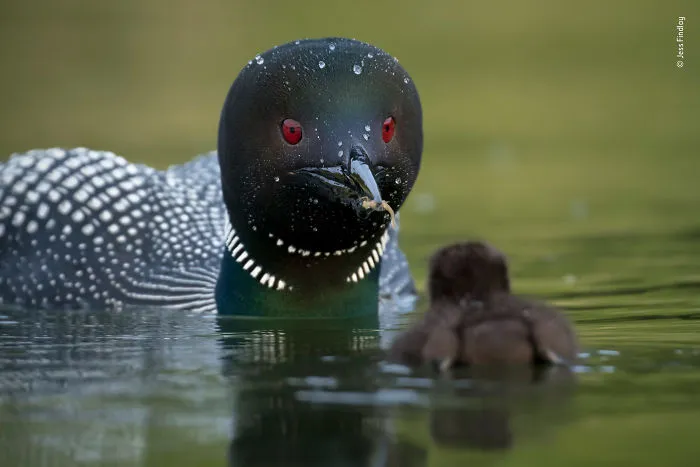
Jess captured the intense focus of this great northern diver parent, a species that usually lays just one to three eggs. With food for its precious chick gripped in its beak, its piercing red eyes stand out from its smart summer plumage.
In the first few days of life, young great northern divers struggle to swallow even small fish. This parent is instead offering its chick a damselfly nymph. Parents lead them into shallow water, where the young birds can pluck small aquatic insects from the lake bottom and underwater vegetation.
Report
58points
#45 "The Spring Ball" By David Herasimtschuk, Usa, Highly Commended 2018 Behaviours Amphibians And Reptiles"
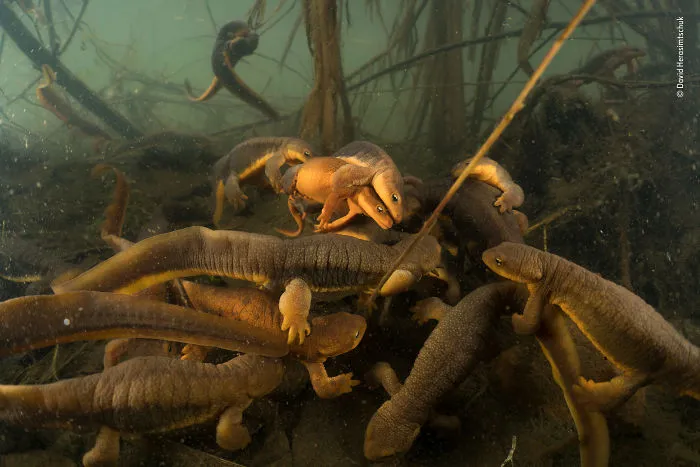
Every spring, hundreds of rough-skinned newts migrate from nearby forests to this pond to breed. David follows suit, spending hours in the icy water. He seized this moment, when one male successfully embraced the female in the centre, while rivals jostled beneath. ‘The males are so desperate to mate,’ says David, ‘that I usually have a few hanging off me’.
This large, writhing group of newts indicates a healthy population, where the two lighter skinned ones are female, and the others are male. Scientists have, however, become concerned about a new fungal disease called bsal, which is fatal to newts and other salamanders. Named the amphibian plague, once in a habitat it can decimate numbers.
Report
57points
#46 Inner Fire By Denis Budkov, Russia, Highly Commended 2018 Earth’s Environments
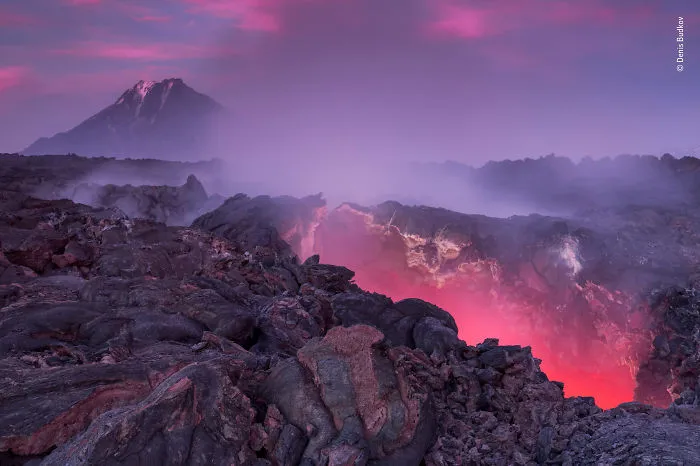
Plosky Tolbachik volcano stopped erupting in 2013. Yet five years later, molten rock was still glowing as Denis picked his way through the lava field. Suddenly, the heat stopped him in his tracks – getting closer was out of the question. As the Sun set, he framed his shot, the dramatic clouds and glowing fissure in the lava tube reflecting the same deep pink.
With around 300 volcanoes, 20 of which are active, the Kamchatka Peninsula is one of the most volcanically active areas in the world. In the north is Plosky Tolbachik, a volcano with a history of eruptions stretching back thousands of years. The most recent episode lasted a year and left a lava plateau 50 metres thick.
Report
54points
#47 "Life Among Litter" By Greg Lecoeur, France, Highly Commended 2018 Wildlife Photojournalism
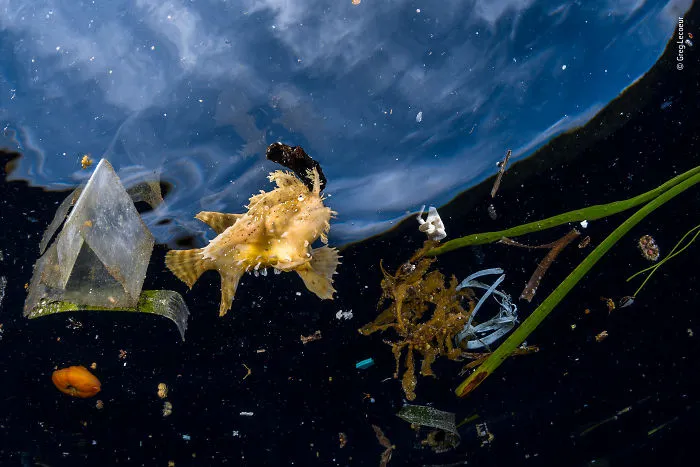
‘The ocean is a victim of human activity,’ explains Greg. This frogfish couldn’t hide among the plastic, and the nearby frond of Sargassum seaweed was a far cry from the rafts of it that normally shelter this specialised species. Some people classify the mass of plastic carried on ocean currents as the seventh continent.
A master of camouflage and a voracious ambush predator, the frogfish normally stalks its prey through floating islands of brown Sargassum seaweed, using the lure on its head to entice prey. In recent decades, it has been forced to share its habitat with some of the 12.7 million tonnes of plastic that end up in the oceans each year. Reducing our usage is an obvious solution.
Report
54points
#48 "Sinuous Moves" By Lorenzo Shoubridge, Italy, Highly Commended 2018 Behaviours Amphibians And Reptiles
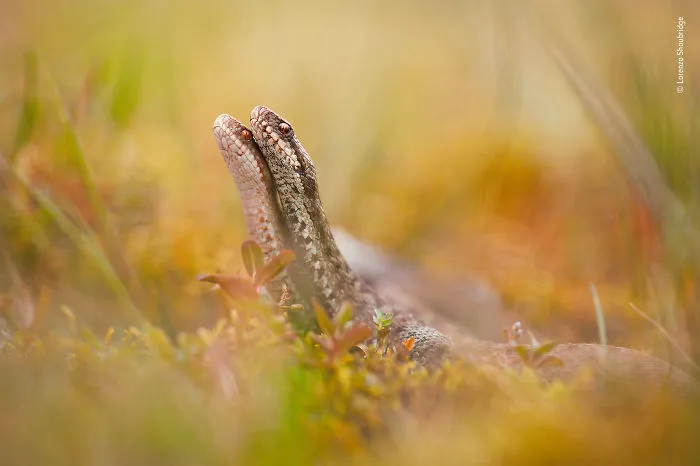
Lorenzo watched quietly as the two adders swayed cheek to cheek, aware that even the smallest movement from him would distract the pair. Glad of the low angle, he isolated the intertwined bodies of the courting couple, softly blurring their surroundings in the light of a foreboding sky
These male and female adders are taking part in a courtship ritual. Bodies entwined, the pair will restlessly rise up and down, constantly shifting positions and on occasions vibrating their tails. If mating goes ahead, they will twist closer together, and the female will then give birth to up to 18 live young about three months later.
Report
51points
#49 "Blood Thirsty" By Thomas P Peschak, Germany / South Africa, Winner 2018 Behaviours Birds
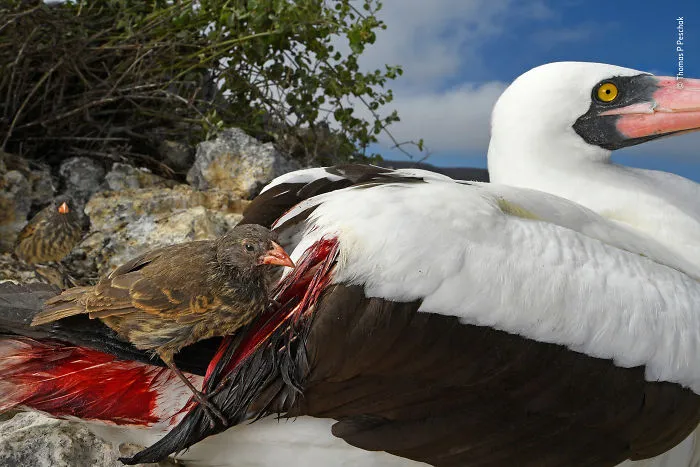
Working on a climate change story, Thomas had secured a rare permit to land on Wolf Island, a remote part of the Galápagos Islands. Scrambling over loose rocks to reach this plateau, he spied a bizarre scene – pecking away at the flight feathers of a Nazca booby was a sharp-beaked ground finch. With scarce food alternatives, it had resorted to drinking blood to survive.
Encircled by steep cliffs, with no permanent water and little rainfall, Wolf Island is a difficult place to live. While the boobies can fish in the ocean, the finches are limited to a scant supply of seeds and insects. To survive they drink the blood of the Nazca boobies – a behaviour that may have evolved from feeding on parasites in their feathers
Report
51points
#50 "Dinner For Two" By Justin Gilligan, Australia, Highly Commended 2018 Behaviours Invertebrates
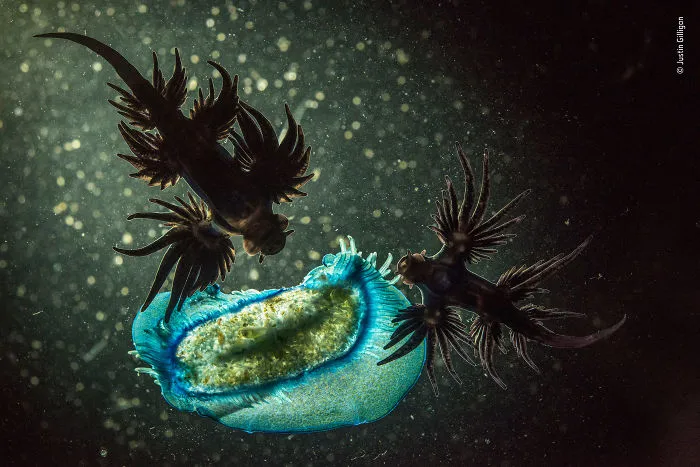
Justin spotted these hungry blue dragons closing in on a by-the-wind sailor in a rock pool, and wanted to capture this ‘different layer of life in the ocean’. He used an underwater torch to light his shot from beneath, and framed their elaborate forms from above, against a galaxy of reflective particles.
Blue dragons are small sea slugs that float upside down buoyed by air bubbles in their stomachs. They feed on cnidarians, a group of marine animals that includes jellyfish and this by-the-wind sailor. Storing stinging cells from their prey in finger-like protrusions, the blue dragons use this venom to defend themselves against predators.
Report
50points
#51 "The Upside-Down Flamingos" By Paul Mckenzie, Ireland / Hong Kong, Highly Commended 2018 Creative Visions
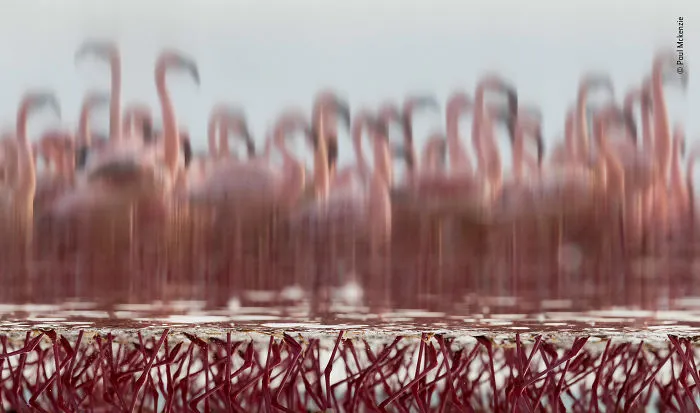
Lying prone in a quagmire of thick, gooey mud, Paul spent an hour quietly nudging closer to this flock of flamingos. Eventually, he focused on the birds’ red legs, framing the shot to include their reflection. In post-production he rotated the image 180 degrees to create, as he describes, ‘a more abstract reflective image’.
Lesser flamingos find safety in numbers and tend to gather in large groups to protect themselves against predators. They feed almost entirely on blue-green algae, but will also feed on crustaceans. Gathering food by holding their beaks upside down in the water, they often synchronise, raising and lowering their heads to feed in orchestrated mass movements.
Report
50points
#52 "The Ice Pool" By Cristobal Serrano, Spain, Winner 2018 Creative Visions
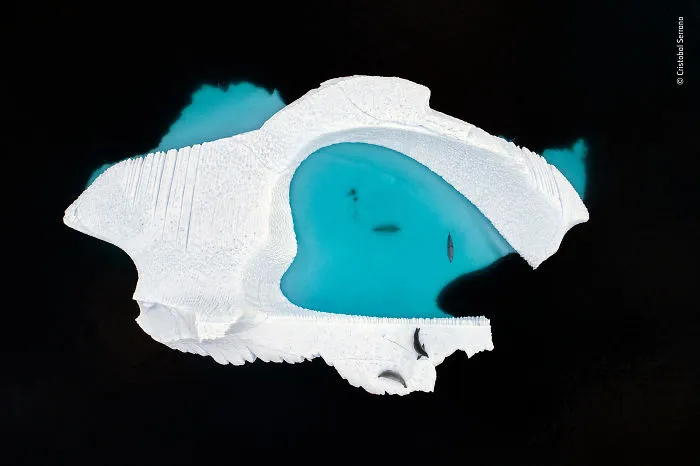
‘Humans have tried to master the art of sculpture, but icebergs show us we are no match for nature’s great design,’ explains Cristobal. To reveal the beauty of this spectacular ice carving, he used a low-noise drone, flying it high so as not to disturb the crabeater seals. The aerial viewpoint showed a heart-shaped pool in the iceberg’s centre.
Crabeater seals feed primarily from dusk to dawn, hauling out onto the ice around the middle of the day to rest. The clear blue area in this image is where the iceberg has melted away below the water line, creating a small and shallow pool, contrasted against the deep and dark ocean.
Report
49points
#53 "Trailblazer" By Christian Wappl, Austria, Highly Commended 2018 Behaviours Invertebrates
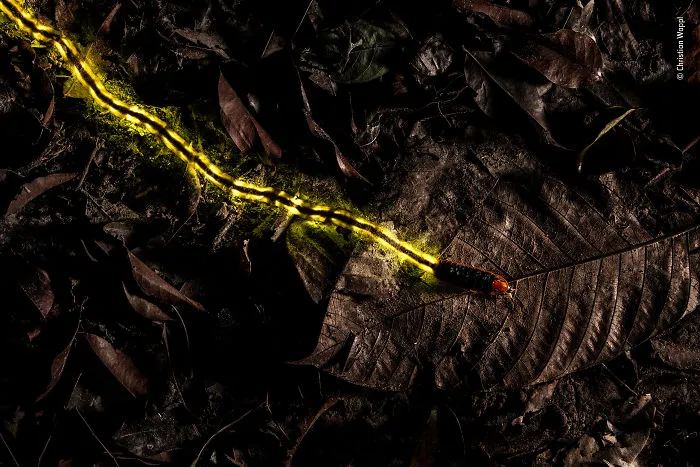
By one in the morning, the forest was quiet, but its nightlife shone out from the leaf litter. The star of the show was a large firefly larva about seven centimetres long, which emitted a continuous glow from four light organs at its rear end. Using a long exposure with a burst of flash, Christian revealed the larva apparently blazing a trail.
Fireflies spend most of their lives as larvae, feeding on other invertebrates such as snails and slugs. This one is a voracious predator of snails, even tackling those many times its size. Its glow is the result of a chemical reaction within its light organs, and is most likely a warning to predators that it is unpalatable.
Report
47points
#54 Michel D’oultremont, Belgium, Winner 2018 Rising Star Portfolio Award
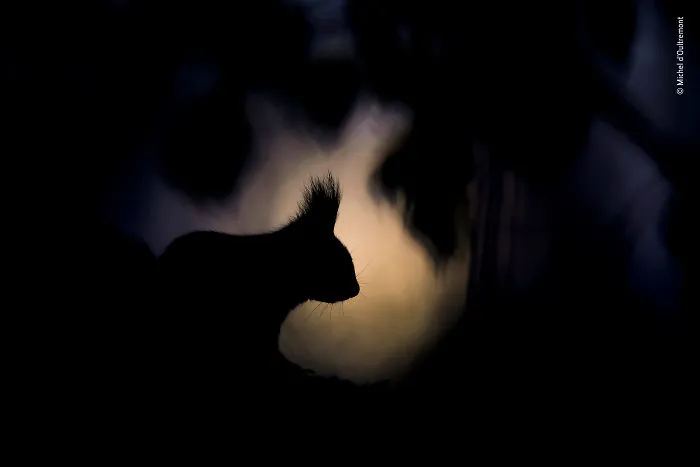
Snow Snooze
Passionate about not disturbing his subjects, Michel silently approached this slumbering red fox, first walking and then crawling. Finally close enough, he isolated the fox against the snow with a long lens and blurred the background. ‘I stayed with it for a sublime 10 minutes,’ he says. ‘Its ears twitched from time to time, but it never once woke up.’
Passionate about not disturbing his subjects, Michel silently approached this slumbering red fox, first walking and then crawling. Finally close enough, he isolated the fox against the snow with a long lens and blurred the background. ‘I stayed with it for a sublime 10 minutes,’ he says. ‘Its ears twitched from time to time, but it never once woke up.’
When hunting, foxes are able to detect their prey through the layers of snow by using their keen sense of smell and excellent hearing. They begin their hunt by standing motionless, listening for any sound of a mouse or vole. When they are sure of their prey’s location, they will leap into the snow, using their strong forelegs to pin their meal to the ground.
Report
47points
#55 Colour, Sound, Action By Liron Gertsman, Canada, Highly Commended 2018 15–17 Years Old
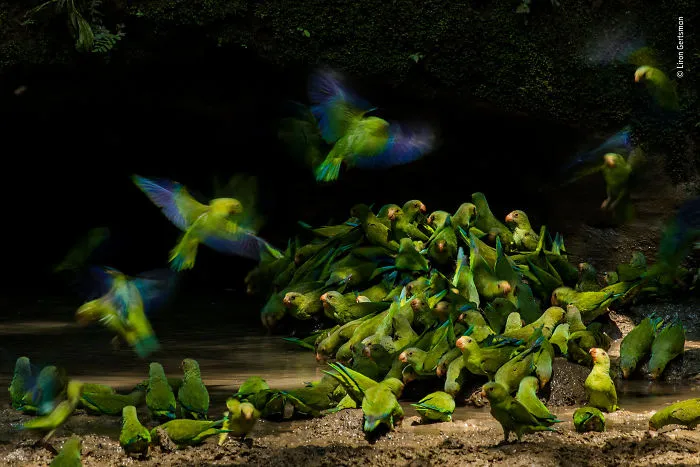
With a frenzy of colour and squawks, a flock of cobalt-winged parakeets descended on the small muddy pool Liron had positioned himself next to. Using a slow shutter speed, he framed the birds in mid-flight to capture the flurry of movement. Liron hopes that his image shows ‘just how amazing and worth protecting nature is’.
The parakeets spend most of their day up in the safety of the trees – predators are unlikely to catch these strong and rapid flyers up in the canopy. But the birds need to come down to drink, and so, aware of the risks, they descend in groups, gathering together near pools. They are vulnerable to attack on the ground, and so even the slightest noise can disperse the flock.
Report
46points
#56 "Night Flight" By Michael Patrick O’neill, Usa, Winner 2018 Under Water
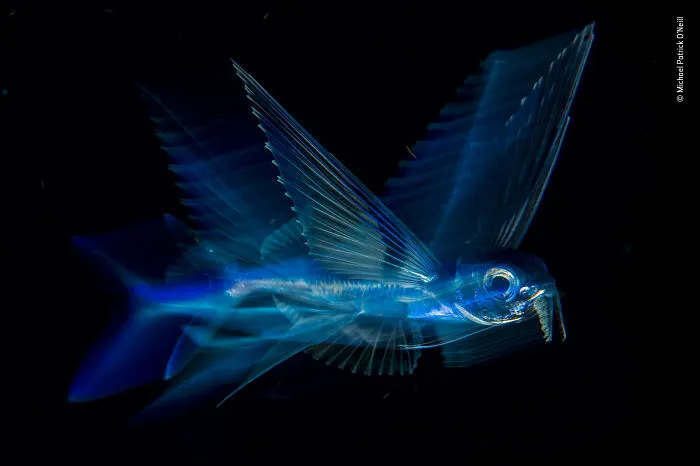
Late one night, over deep water, Michael was following a flying fish. By day, they move extraordinarily fast, but at night they swim slowly just below the surface. He tried various shutter and flash settings, all the while keeping track of his small subject. ‘I wanted to create a sense of movement,’ he says.
By rapidly beating their forked tails, flying fish such as this juvenile propel themselves in the water until they take off at the surface. By holding their long, pointed pectoral fins out stiffly, they can glide in the air for several hundred metres, away from underwater predators.
Report
46points
#57 Delta Design By Paul Mckenzie, Ireland / Hong Kong, Highly Commended 2018 Earth’s Environments
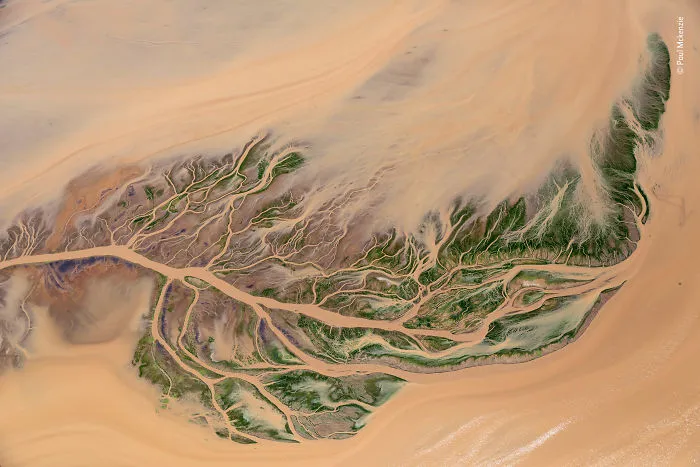
‘I love images where nature can be depicted as art,’ says Paul. At first glance you might think this is an image of a fern. But it is actually an intricate river delta. As his small plane flew over the scene one final time, Paul framed his shot through the open door, battling against turbulence to capture nature’s silt and water composition.
Flowing south through Kenya, the Southern Ewaso Ng’iro River empties into the salt-rich waters of Lake Natron, a major breeding site for hundreds of thousands of lesser flamingos. The birds rely on the river’s fresh water for drinking, as well as for cleaning the hypersaline lake water from their feathers.
Report
46points
#58 "Misguided Mayflies" By Jose Manuel Grandío, Spain, Highly Commended 2018 Urban Wildlife
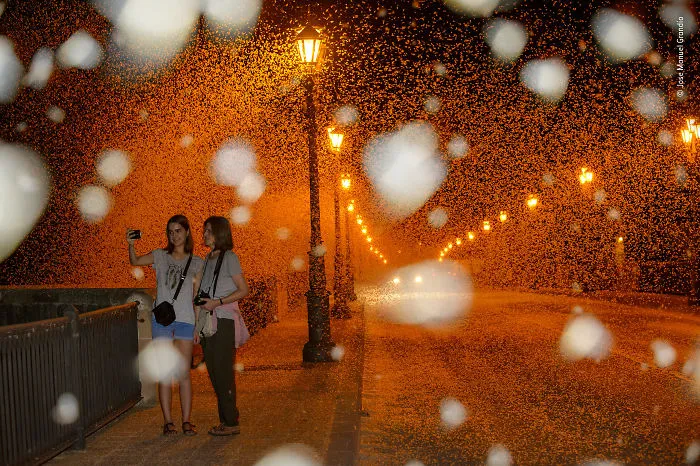
As dusk fell over the River Ebro, a thick cloud of mayflies descended on the bridge. Confused by the dazzling lights, the insects had mistaken it for water, laying their eggs on the dark asphalt. Jose had only minutes to document this phenomenon before the air cleared – a carpet of doomed eggs and wasted bodies left behind.
After emerging from their larval cases, female adult mayflies have just hours to lay their eggs before they die. The bridge lights have likely upset their navigation and while the phenomenon may be a spectacle for tourists, for the mayflies the effect of the artificial light has devastating consequences.
Report
45points
#59 Michel D’oultremont, Belgium, Winner 2018 Rising Star Portfolio Award
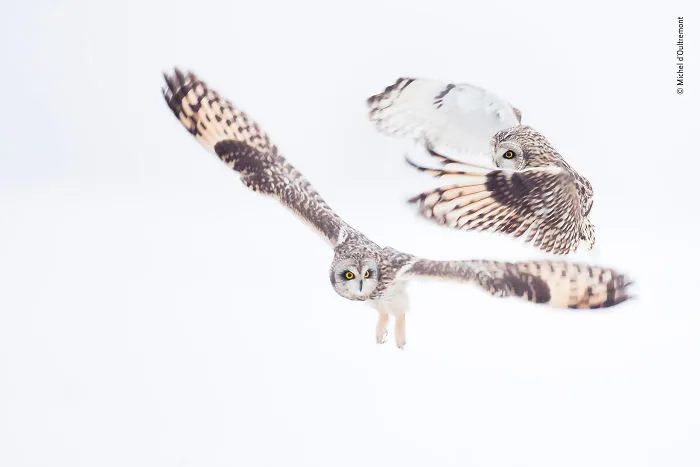
Silent Skirmish
In a winter white-out, two short-eared owls squabbled over a mouse that the larger one had caught. Michel focused on their piercing yellow eyes, capturing the scene from his car so as not to disturb them. As the owls demonstrated their aerial agility, Michel captured his shot, but the contest had no victor. ‘The mouse fell and escaped alive,’ he says.
In a winter white-out, two short-eared owls squabbled over a mouse that the larger one had caught. Michel focused on their piercing yellow eyes, capturing the scene from his car so as not to disturb them. As the owls demonstrated their aerial agility, Michel captured his shot, but the contest had no victor. ‘The mouse fell and escaped alive,’ he says.
Skilled hunters, short-eared owls detect their small mammal prey by listening intently for it rustling in the vegetation of open countryside. They fly low, almost silently, in their search. Owls are solo hunters and it is unusual to see two fighting for the same prey – it may be that the snow meant food was scarce.
Report
44points
#60 Togetherness By Karen Schuenemann, Usa, Highly Commended 2018 Behaviours Birds
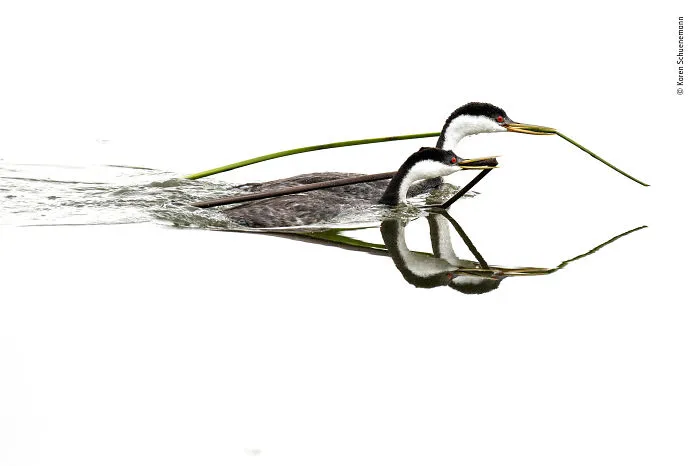
It was late in the season to be nest-building, but the previous nest of this pair of western grebes had been raided by a raccoon, and so they had to start over. Karen spotted this elegant couple on her early morning walk, busily gathering reeds, ‘so absorbed in their work,’ she says, ‘they didn’t seem to notice me’.
These two birds are mirroring each other, so their nest-building activity might also be a courtship ritual. Western grebes have intricate display rituals, including the weed dance, where the birds hold tufts of water weeds in their bills and paddle to maintain an upright position, chest to chest.
Report
43points