



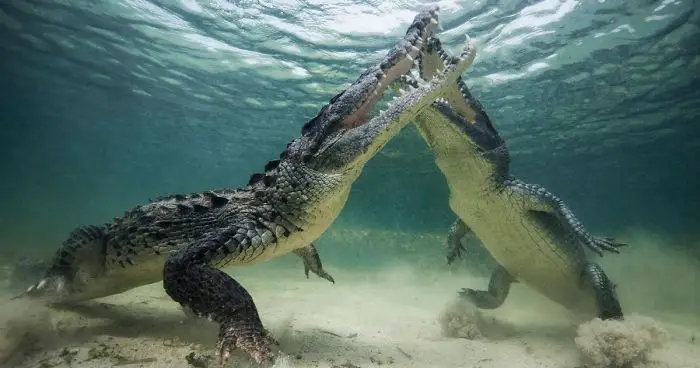

A ceremony at the Natural History Museum, London, has revealed the results of the Wildlife Photographer of the Year contest, and the winning photos are worth all of the attention they can get. This year, the annual competition has attracted nearly 50,000 entries from 92 countries and the organizers were kind enough to share them.
Photojournalist Brent Stirton has won the Grand Title for his picture of a black rhino's mutilated body. According to judge Roz Kidman Cox, his image was "symbolic of one of the most wasteful, cruel and unnecessary environmental crimes, one that needs to provoke the greatest public outcry." The shot was also included in Stirton's entry to the World Press Photo 2017 Nature category where his story won the first prize as well.
The powerful photo will go on show alongside 99 others at the Wildlife Photographer of the Year exhibition which opens on Friday October 20 at the central London museum.
More info: nhm.ac.uk
#61 'Death By A Thousand Bites' By Lucas Bustamante, Ecuador, Behaviour: Invertebrates Finalist
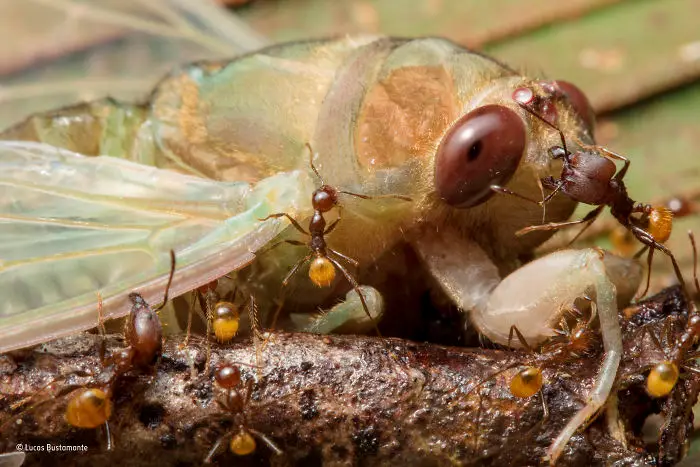
Lucas encountered this cicada on a night hike in the Amazon rainforest, but so did an army of ants. ‘This one was still so soft and pale,’ recalls Lucas. ‘It moved only its legs, slowly, in a vain effort to escape.’ Amid the chaos of ants racing over their helpless victim, Lucas composed his shot to tell the dramatic story.
Cicadas spend most of their lives underground – up to 17 years for some species. The nymphs emerge under cover of darkness and are vulnerable as they moult one last time to become adults. These lucky ants have arrived at just the right time – the big-headed soldiers working with the smaller workers to disassemble the cicada alive.
Report
15points
#62 'Spawn Rivals' By David Herasimtschuk, USA, Under Water Finalist
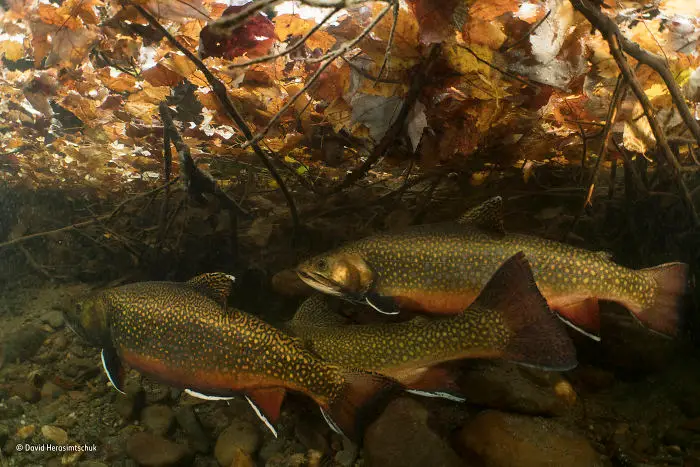
Every autumn the brook trout start to spawn, driven by declining water temperatures. Unfortunately for David, it meant lying motionless for hours in freezing water. With leaves falling above one female’s nest, David finally got close enough to capture the rivalry between her patterned suitors, the warm hues underwater matching those above.
Chaotic disputes between male brook trout are frequent in the breeding season. Rivals bite and ram each other while the female digs a nest in the gravel, a redd, to lay her eggs. Brook trout are sensitive to changes in the water – temperature as well as pollution – and are in decline, but collaborative conservation efforts aim to curb this.
Report
15points
#63 'The Ancient Ritual' By Brian Skerry, USA, Behaviour: Amphibians And Reptiles Winner
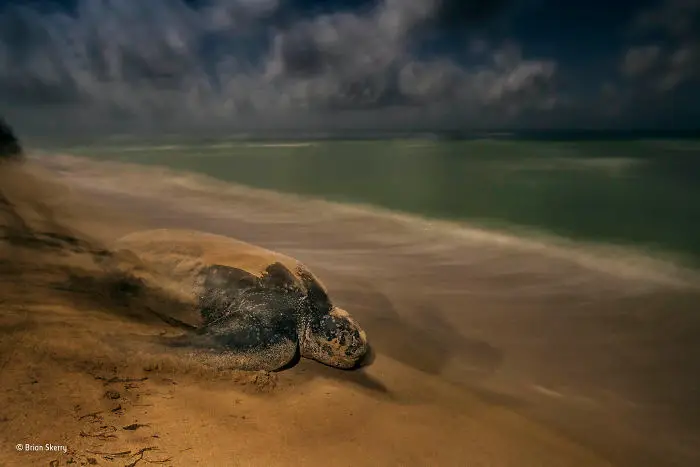
Like generations before her, this leatherback turtle journeys back to the ocean. Nesting turtles were not seen every night and were often too far away. When at last Brian got the encounter he wanted – under clear skies, with no distant city lights – he hand-held a long exposure under the full moon, artfully evoking a timeless atmosphere.
Leatherbacks are the largest, fastest, deepest-diving and widest-ranging sea turtles. Much of their lives are spent at sea, shrouded in mystery. Sandy Point provides critical nesting habitat, but elsewhere, leatherbacks are not so lucky. They are threatened by fisheries, coastal development and climate change.
Report
14points
#64 'The Gladiator Versus The Beetle' By Javier Aznar González De Rueda, Spain, Behaviour: Amphibians And Reptiles Finalist
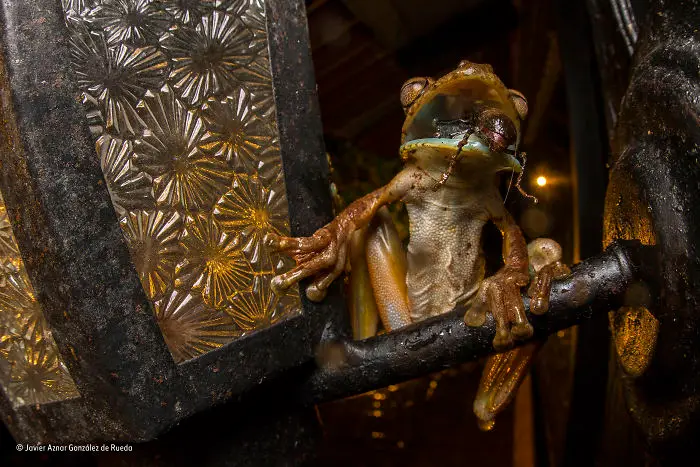
Javier was taking pictures of the insects attracted to the lights of a lodge when his friend pointed out this tree frog battling a weevil. Javier framed his shot, the frog’s gold-flecked eyes echoed by the glow through the patterned glass. Two photos later, the weevil escaped and the frog narrowly avoided choking.
The Rosenberg’s gladiator treefrog is no stranger to aggression. Males must provide a nest to secure a mate and the ensuing territory disputes can be lethal. But their food doesn’t usually put up as much of a fight. Built like a tiny tank, this weevil is gripping the frog’s tongue as it would a leaf.
Report
14points
#65 'Picky Eaters' By Daniel Rosengren, Sweden, Behaviour: Birds Finalist
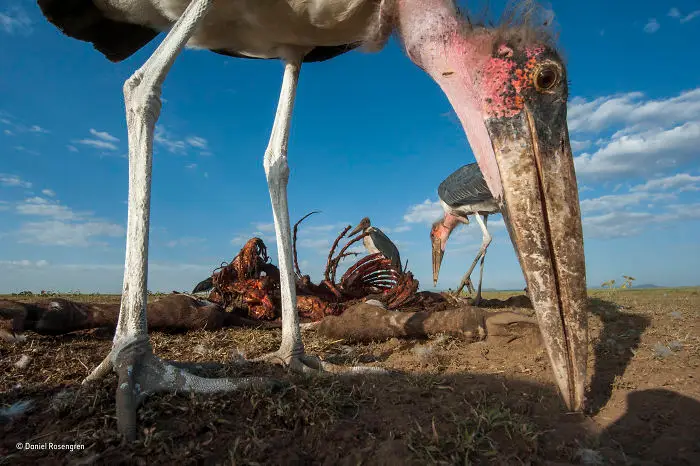
Daniel first spotted these marabou storks as they patiently waited on the sidelines, watching as a group of vultures fed on a zebra carcass. Seizing the opportunity, he quickly set up his camera and retreated to a nearby wall to wait for the shot. Not long after, the vultures left the scene and the storks approached the carcass to feast.
During the wildebeest and zebra migration, food in the Serengeti National Park is in plentiful supply for opportunists like the marabou stork. Despite their size, their huge beaks are delicate and unwieldy, and the storks must wait for other scavengers, like vultures, to tear open a carcass.
Report
14points
#66 'Breakfast At Dawn' By Jari Heikkinen, Finland, Behaviour: Birds Finalist
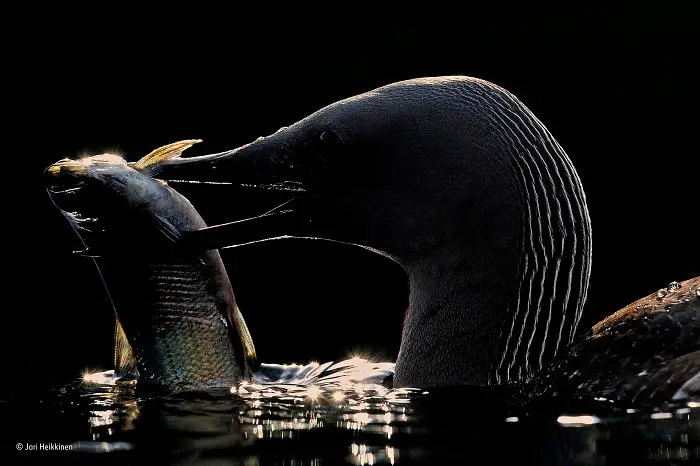
Jari arrived before dawn to photograph a pair of divers. His attention was on the adult preening nearby when the other landed with a skidding splash right in front of his floating hide, gripping their chick’s breakfast in its beak. Light bounced off ripples, fish and feathers, creating an explosion of sparkles that was, Jari says, ‘heavenly’.
With waterproof feathers and powerful feet, red-throated divers actively hunt fish, like this vendace, underwater. Perfectly adapted for swimming, they are clumsy on land. The couple will perform a pair-bonding ritual several times a day, proclaiming their ownership of a territory. Both adults help to raise the chicks.
Report
14points
#67 'The Unstoppable Force' By Paddy Scott, UK, Earth’s Environments Finalist
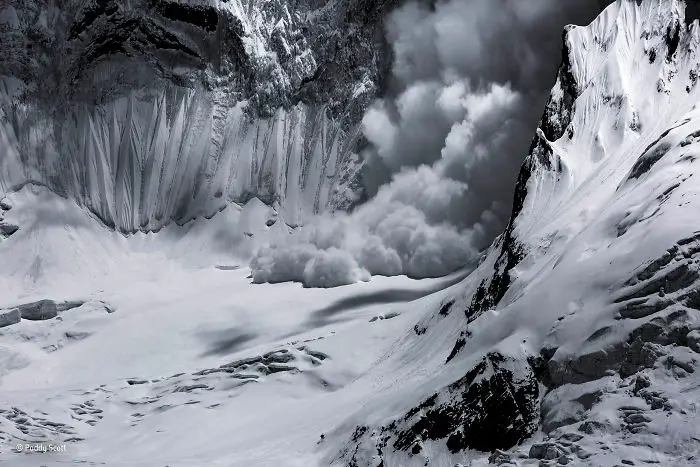
Paddy was safely across the valley when the avalanche struck, stopping him in his tracks. Dwarfed by the immense backdrop, the snow and ice seemed to tumble in slow motion, billowing across the majestic landscape. Quickly framing his shot with a jagged ridge to give depth and scale, Paddy captured the avalanche’s unstoppable force.
Despite being smaller than its sisters, the steep faces of K6 make this mountain a formidable opponent. Conditions can change quickly with avalanches taking little more than a minute to reach the valleys below. Although Paddy’s shot may look sedate and gentle, in reality the snow and ice are travelling at hundreds of kilometres per hour.
Report
14points
#68 'Arctic Blues' By Reiner Leifried, Germany, Earth’s Environments Finalist
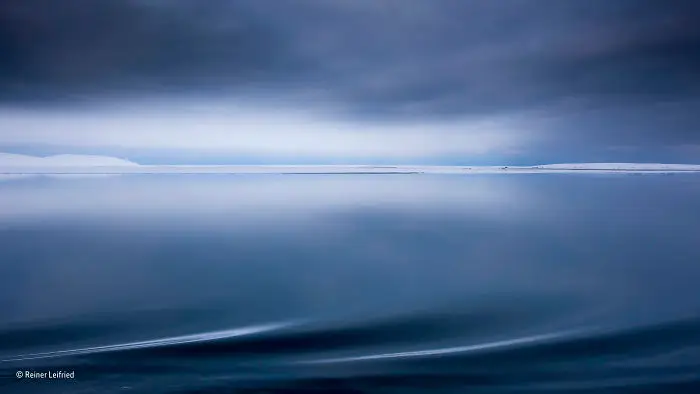
Set against the backdrop of the snowy landscape, the blue light of the Arctic winter created a hypnotic atmosphere. Viewing the scene, Reiner raised his camera hoping to capture ‘calmness with an endless view’. Using the ship’s smooth wave to frame his shot he found his scene, the icy water rippling like folds of satin.
Svalbard has two winter seasons, dark and light. From November to February, darkness prevails, periodically bathing the landscape in a blue glow, an effect created when residual light reflects off the sea and snow. From March to May, the sun begins to return, gently warming the white winter landscape.
Report
13points
#69 'Fly Killer' By Kutub Uddin, Bangladesh/UK, Behaviour: Invertebrates Finalist
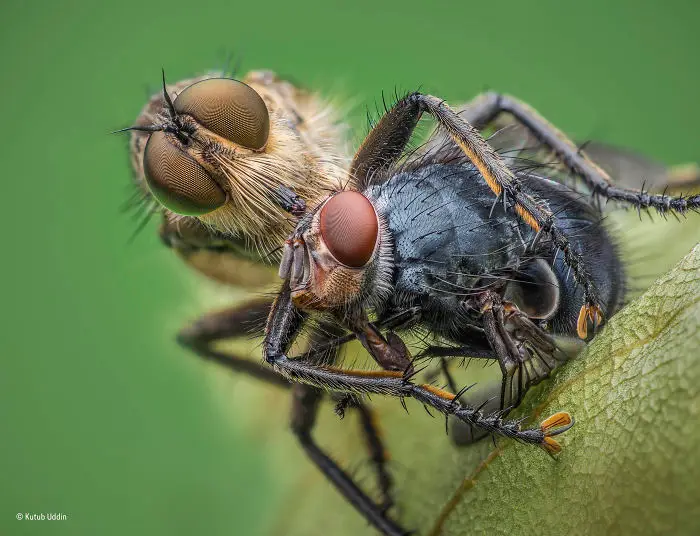
Kutub witnessed this robber fly attack an unsuspecting fly in mid-air. After a few minutes, he managed to relocate the pair. ‘It was fascinating to watch the robber fly eat,’ says Kutub. The meal took half an hour, long enough for Kutub to take several pictures with different points of focus. Combined, they reveal the moment in intricate detail.
Gripping its prey – a common bluebottle – between its strong bristly legs, this golden-tabbed robberfly will inject venom into the unfortunate victim to paralyse it and digest its insides, before it sucks up the liquid like a spider. The robber fly’s stiff moustache protects its eyes from struggling prey.
Report
12points
#70 'Dog’s Dinner' By Greg Du Toit, South Africa, Black And White Finalist
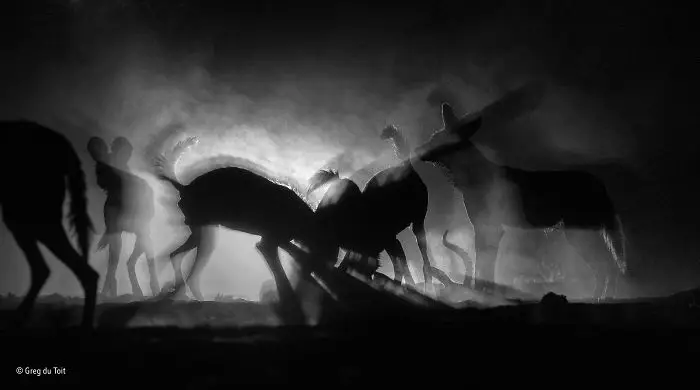
Returning to camp after a safari drive, Greg watched as a single wild dog stood over its kill. Moments later, the rest of the pack descended and devoured the prey’s corpse in a frenzied feeding. ‘Shooting this scene was one of the most exhilarating experiences of my life and one I will never forget,’ he says.
These endangered carnivores are rarely seen, as they hunt at dawn and dusk across an expansive range. Due to habitat fragmentation, they are in increasing contact with people and domestic animals, causing growing conflict between humans and dogs, and the transmission of infectious diseases.
Report
12points
#71 'Hornbill Losing Patience' By Dhanu Paran, India, 15–17 Years Old Finalist
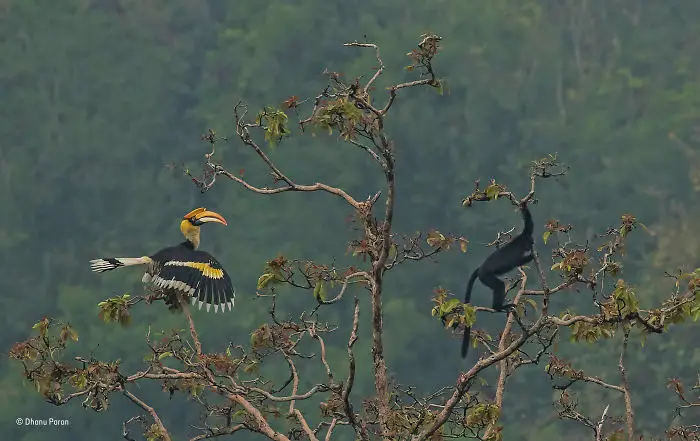
Dhanu had discovered where the great hornbills congregated and trekked the 22 kilometres to get there as often as possible. One day, a Nilgiri langur sat down opposite this bird as it was preening. As the hornbill flapped its annoyance and the langur retreated, Dhanu quickly framed the bird in striking profile, its magnificent wings outstretched.
Great hornbills prefer areas with large trees, like the Anaimalai Hills, and are often found nesting in tree cavities. Eye-catching hollow horns, or casques, top their large curved beaks. Sometimes used by male hornbills to clash with rivals in spectacular aerial ‘casque-butting’ displays, they are prized by hunters.
Report
12points
#72 'Head Hunter' By Kutub Uddin, Bangladesh/UK, Behaviour: Invertebrates Finalist
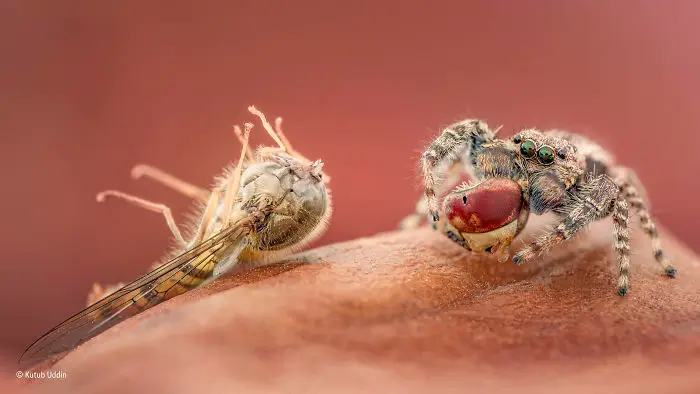
Glimpsing movement out of the corner of his eye, Kutub saw this spider pounce on a marmalade hoverfly. The pair jostled in the leaf litter until the spider began its meal – head first. Kutub stacked several images together, capturing the drama against a background card to complement the tone of the leaf and the now dried eye of the hoverfly.
The fence post jumper is one of more than 5,000 species of jumping spider, renowned for their excellent vision and cat-like hunting skills. Like most spiders, it has eight eyes – the two largest providing acute vision. Spotting prey from afar, it creeps up and then pumps three pairs of its legs full of fluid to spring.
Report
11points
#73 'The Bird Rack' By Bence Máté, Hungary, The Wildlife Photojournalist Award: Single Image Finalist
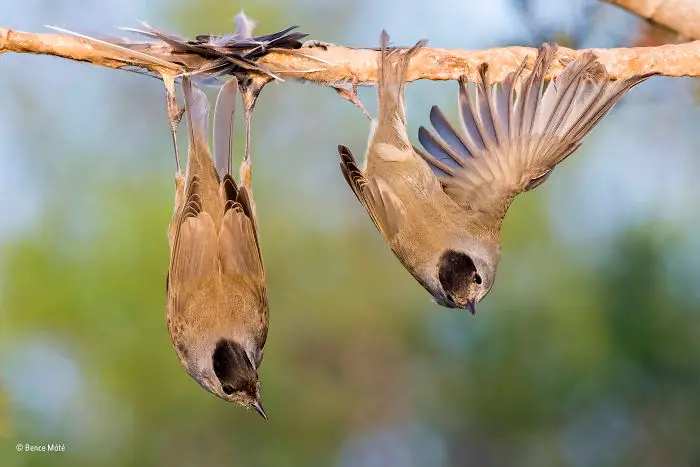
Grilled, pickled or boiled – around two million protected birds die each year for the traditional Cypriot dish of ambelopoulia. Poachers catch the unsuspecting song birds by coating branches with a sticky glue and luring them to the trap with recorded sounds. Once stuck, the birds are left to die agonising deaths.
Although the practice of bird trapping is illegal, the poachers, dealers and restaurants serving ambelopoulia are rarely brought to justice. The toll of this horrific practice continues to rise with populations of nearly 40 migratory songbird species in decline. For Bence, it is ‘one of the biggest conservation failures of our time’.
Report
11points
#74 'The Make-You-Jump Spider' By Adam Hakim Hogg, Malaysia, 10 Years And Under Finalist
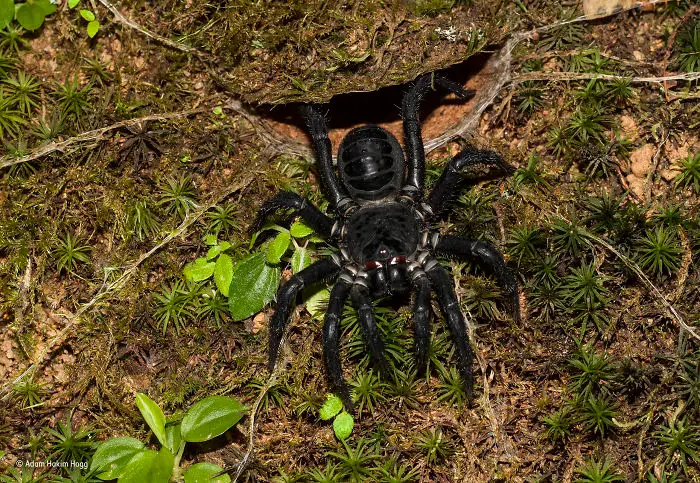
To photograph this nocturnal spider without disturbing it, Adam and his dad set up the camera and flash in the daylight, then crept back at night to wait. ‘When the spider does come out it’s like a bullet,’ says Adam, ‘it makes you jump every time.’ Adam loves the thrill of night walks in the rainforest, even if it takes three days to get one image.
Trapdoor spiders lie in their silken burrows, camouflaged with plant matter. Their feet are in contact with the strands of silk that radiate out from the entrance, waiting for unsuspecting prey to stumble on the trip lines. But trapdoor spiders are not easily fooled – a single twitch isn’t enough, they only pounce when a few lines are tugged.
Report
11points
#75 'Alfred In Contemplation' By Russell Laman, USA, 15–17 Years Old Finalist
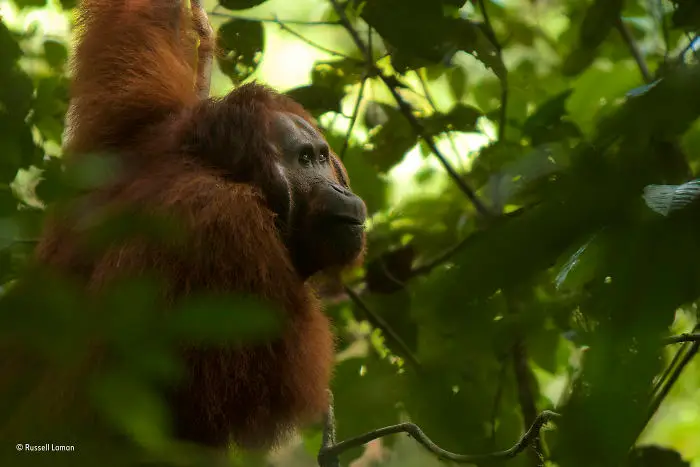
Visiting his mother’s orang-utan research programme in the Gunung Palung National Park, Russell was tracking a female through the rainforest. Suddenly, this male – Alfred – came swinging down almost to the ground to eat, a rare opportunity for Russell. ‘As Alfred gazed off into the distance, I couldn’t help wonder what he was thinking,’ he says.
Gunung Palung National Park is one of the last remaining strongholds of Bornean orang-utans. They face multiple threats: forest clearance for oil palm plantations, logging, slash-and-burn farming and illegal hunting, as well as a lack of legal protection and awareness. They are now critically endangered.
Report
11points
#76 'Rough Love' By Edwar Herreno, Colombia/Costa Rica, Under Water Finalist
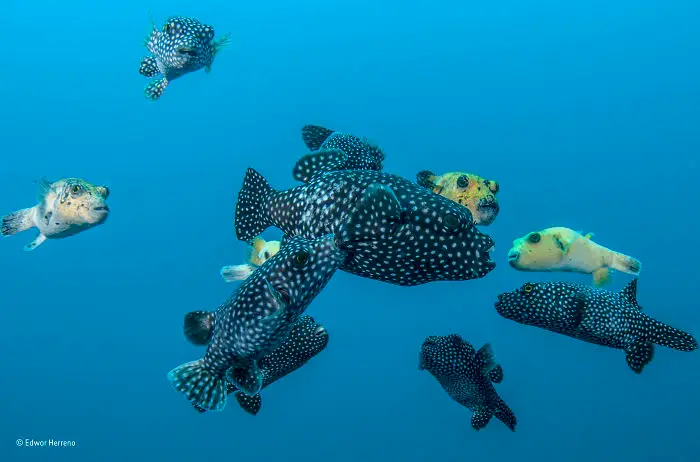
Edwar first spotted this female guineafowl puffer cowering in a crevice, surrounded by a gang of amorous males. Intent on fertilising her eggs, they soon tugged her into the open water, where they used their powerful jaws to nip her skin. Exhausted and exposed, she eventually succumbed to their advances.
The ‘love-bites’ captured by Edwar are part of the fish’s complex mating ritual. They use their parrot-like beaks to bite their mate, usually causing superficial wounds that will heal within a few days. On rare occasions males will sink their jaws into a female’s flesh causing more significant damage.
Report
10points
#77 'Bay Of Egrets' By Roberto González García, Spain, Urban Wildlife Finalist
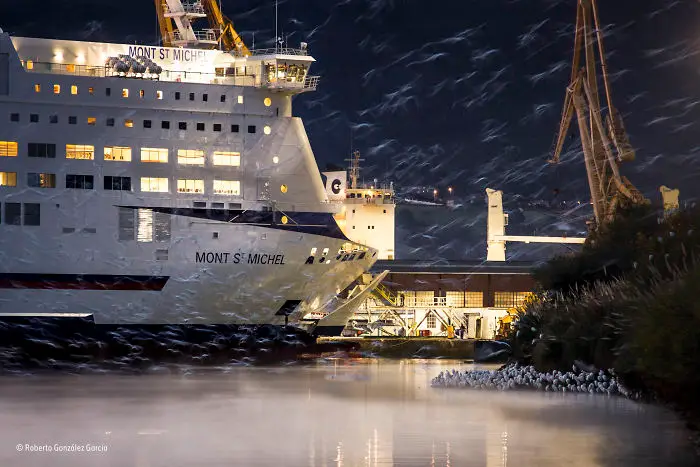
For two years, Roberto photographed these spectacular flocks of cattle egrets as they descended on the Bay of Santander. After visiting this spot countless times, he eventually found his perfect composition amid the industrial shipyard activity. That morning, in the magical pre-dawn hour, his photograph finally came together.
Since the 1980s, cattle egrets have spread across the north of Spain and Cantabria is now home to flocks of about 4,000. In the industrial area of the Bay of Santander, the birds descend every evening to find refuge in the tranquil reed beds. The next morning, they will take to the air in their hundreds.
Report
10points
#78 'Desert Canvas' By Angiolo Manetti, Italy, Earth’s Environments Finalist
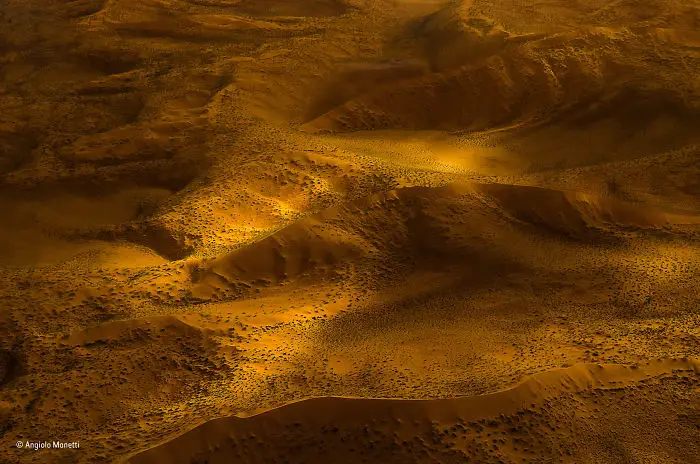
Undeterred by the turbulence shaking his tiny Cessna plane, Angiolo surveyed the beautiful scene unfolding below him. The endless dunes of the Namib Desert glimmered and glowed as the last of the day’s light filtered through the clouds. Each ray illuminated a bewitching pattern, ‘like the painting of a great artist’.
The Namib is one of the world’s biggest and oldest deserts – at least 55 million years old – and is largely devoid of surface water. Yet if you look closely, the smooth contours of the sand are roughened with vegetation. These plants are able to survive on groundwater and moisture from fog swept inland from the coast.
Report
10points
#79 'Tapestry Of Life' By Dorin Bofan, Romania, Plants And Fungi Winner
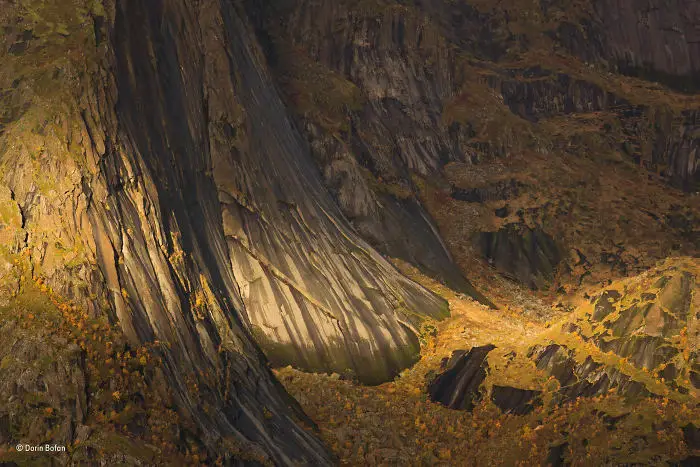
Dorin stood alone on the shores of the fjord contemplating the immense landscape as shafts of light warmed great walls of metamorphic rock. Drawn to the gentle curve at the base of one rock face – like the moss-covered trunk of a tree in an ancient wood – Dorin composed his picture of a timeless landscape reluctant to give up its scale.
The mountains bounding Hamnøy rise steeply from the sea (a sheer drop of 200 metres in some places) yet they are flecked with the gold of mountain birches growing on their slopes, some clinging on in the most precipitous spots. These are a type of downy birch, a species that varies in habit and stature depending on where it grows.
Report
9points
#80 'Sheer Endurance' By David Pattyn, Belgium, Animals In Their Environment Finalist
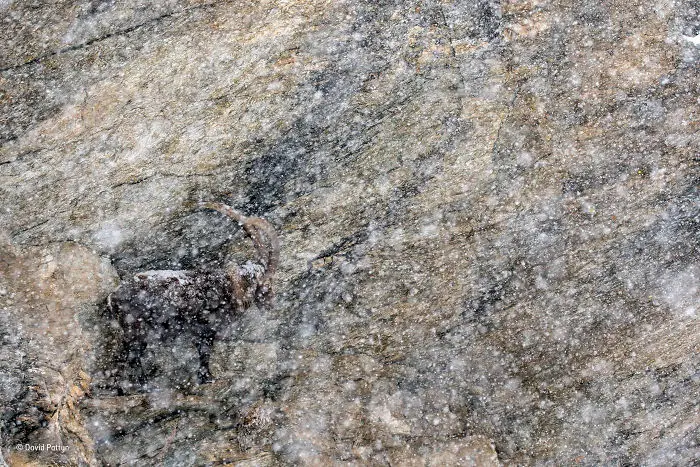
Every day, David set out to find the lone male ibex that had arrived in the valley. This time he spotted it sheltering on a precipitous ledge, beneath an overhang. With quiet endurance, the ibex almost disappeared against the fabric of metamorphic rock, save for the snow on its back and head, and its eye, glimpsed between the flakes.
Stately in its thick winter coat, with imposing backward-curved horns, the Alpine ibex is emblematic of Italy’s Gran Paradiso National Park. Threatened with extinction more than 100 years ago, ibex have returned across Europe, thanks to conservation efforts. Recent data, however, suggest numbers are going down again, and we don’t yet know why.
Report
8points