



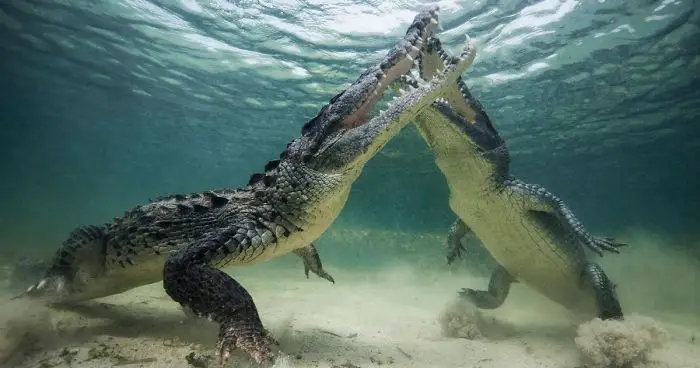

A ceremony at the Natural History Museum, London, has revealed the results of the Wildlife Photographer of the Year contest, and the winning photos are worth all of the attention they can get. This year, the annual competition has attracted nearly 50,000 entries from 92 countries and the organizers were kind enough to share them.
Photojournalist Brent Stirton has won the Grand Title for his picture of a black rhino's mutilated body. According to judge Roz Kidman Cox, his image was "symbolic of one of the most wasteful, cruel and unnecessary environmental crimes, one that needs to provoke the greatest public outcry." The shot was also included in Stirton's entry to the World Press Photo 2017 Nature category where his story won the first prize as well.
The powerful photo will go on show alongside 99 others at the Wildlife Photographer of the Year exhibition which opens on Friday October 20 at the central London museum.
More info: nhm.ac.uk
#41 'Black Kites, Red Sunset' By Dhyey Shah, India, 10 Years And Under Finalist
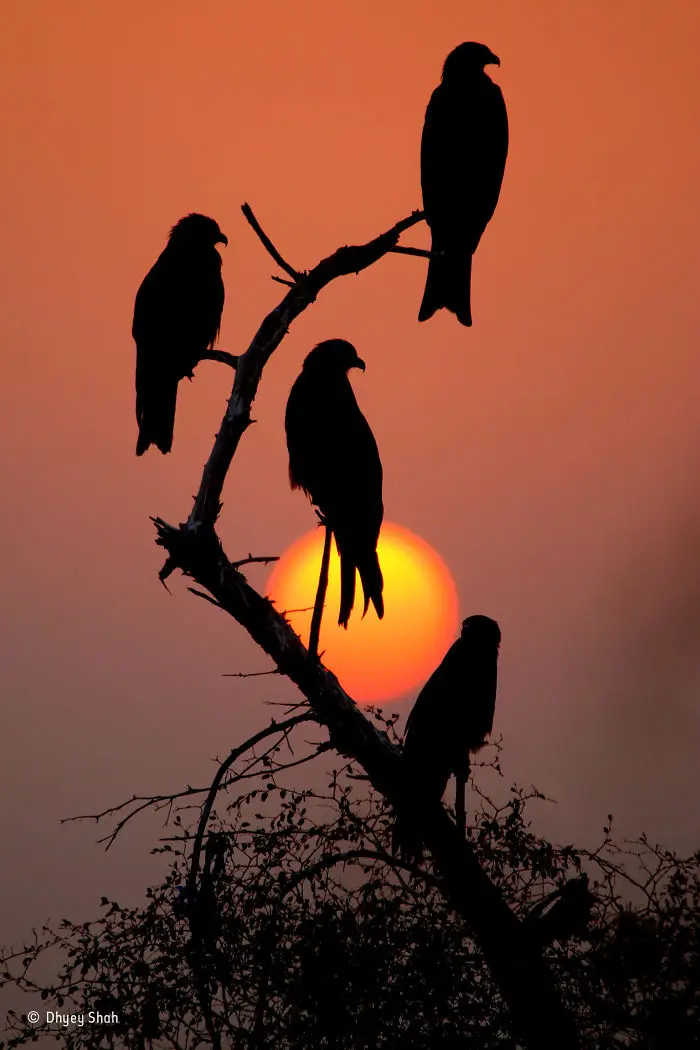
Dhyey was planning to photograph vultures when he spotted this scene: black kites gathering to roost as the setting sun turned the sky a vibrant, dusky red. Inspired by last year’s competition to experiment with silhouettes, Dhyey feels this image brings together ‘the beauty of all mother nature’s elements – sun, sky and wildlife’.
The carcasses of cows, camels and horses that are dumped at Jorbeer attract migratory and resident vultures, as well as black kites. Black kites are probably the most abundant birds of prey in the world. These raptors eat carrion, as well as live prey – even hovering around bush fires to pluck fleeing insects out of the air.
Report
27points
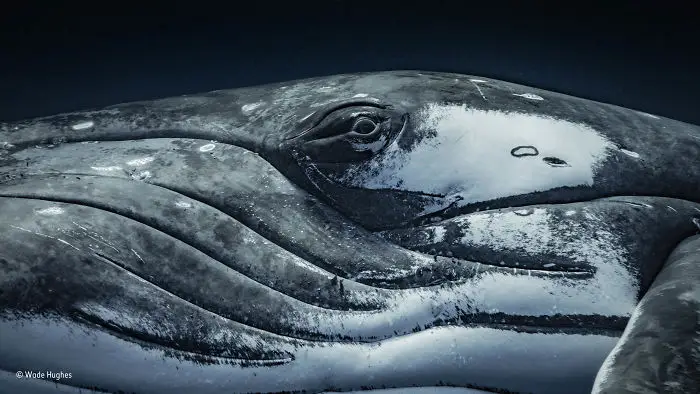
#42 'The Look Of A Whale' By Wade Hughes, Australia, Animal Portraits Finalist
Report
26points
#43 'The Jellyfish Jockey' By Anthony Berberian, France, Under Water Winner
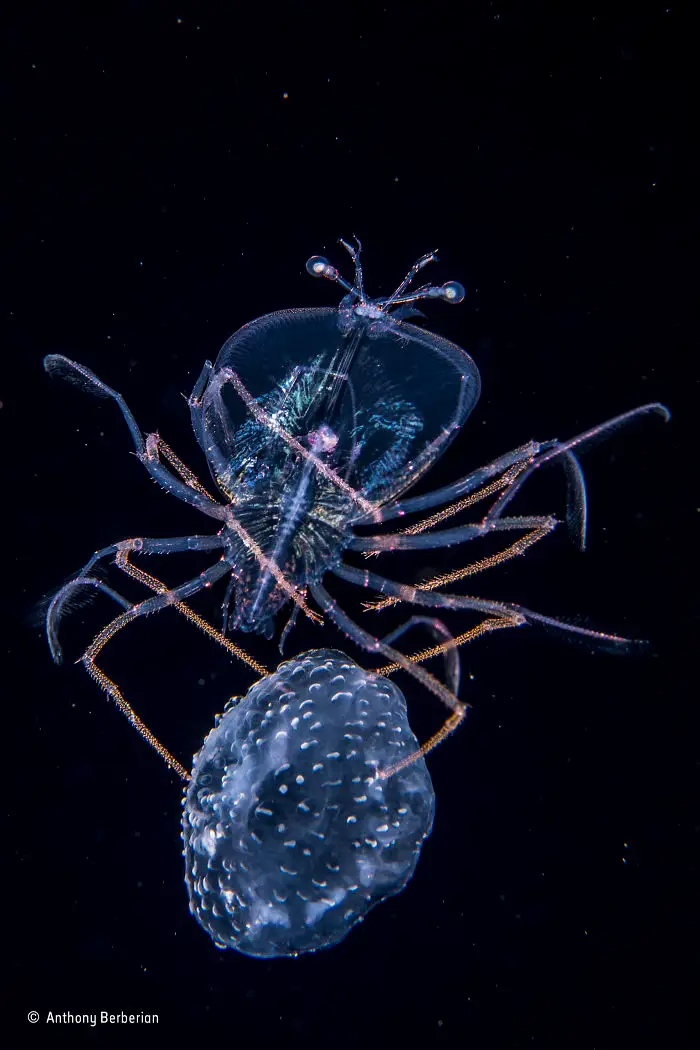
Late at night, in the open ocean, Anthony dives in water more than 2,000 metres deep. His aim is to photograph tiny deep sea creatures that migrate to the surface under the cover of darkness to feed. Coming across this pair one night, it took many shots to get the right composition – a rare glimpse of these creatures in their natural surroundings.
This phyllosoma, a lobster larva, is just 1.2 centimetres across. With a flattened body and eyes on stalks, its spindly legs grip the empty bell of a small dead jellyfish, a mauve stinger. When alive, this jellyfish glows in the dark and has a nasty sting. The little hitchhiker probably ate the jellyfish’s tentacles and now gets a free ride in the ocean current.
Report
26points
#44 'Boar Crossing' By Marc Albiac, Spain, 15–17 Years Old Finalist
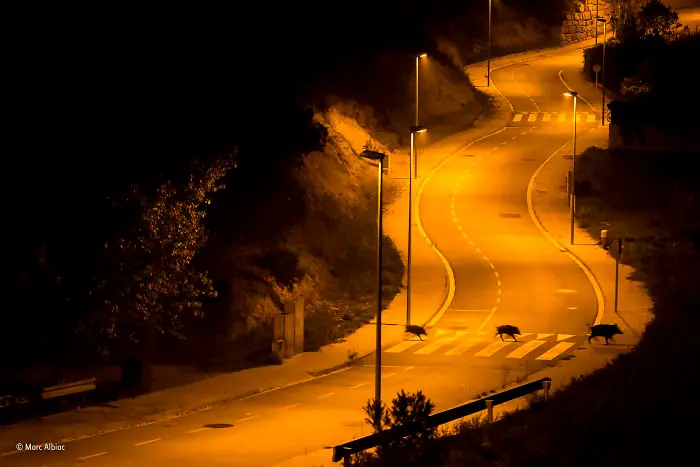
The winding curves of an empty road caught Marc’s eye. He knew wild boar crossed it each night to find food. Marc framed his shot with the road snaking away ‘like a river’. Luck was with him when a mother and two piglets crossed dutifully at the zebra crossing, perfecting this scene of wildlife and people coexisting.
Though wild boar mainly eat fruits, seeds, roots and tubers, in this residential area, they also enjoy an abundant supply of cat food. Usually most active in the early morning and late afternoon, the adaptable wild boar can become nocturnal in urban areas, travelling up to 15 kilometres a night in search of food.
Report
26points
#45 'The Mud Crowd' By Mark Cale, UK, Animals In Their Environment Finalist
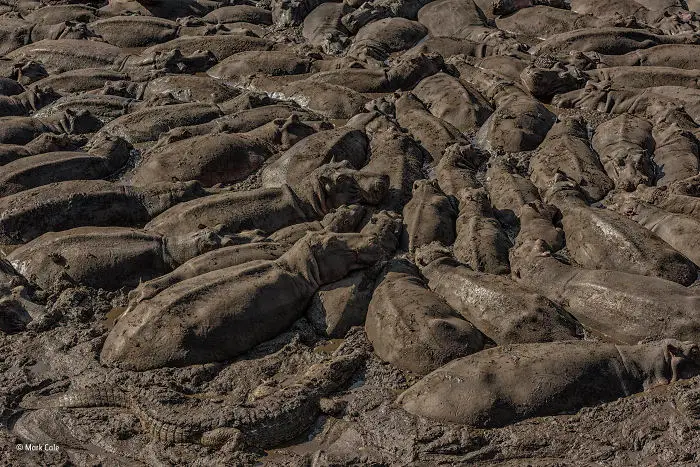
The first teasing rain showers had fallen, but the rivers were still only small mud pools. Mark was watching the jostling hippos when a Nile crocodile surprised the group. As the nearest one retreated, a ripple of panic swept through the crowd. Keeping near his vehicle, Mark framed the commotion.
Hippos rest in schools of up to 150 individuals during the day and mud is as good as water to keep their skin moist. The cold-blooded crocodile needs this muddy external heat sink to stay cool in hot conditions. As an apex predator, it seems relaxed around the hippos, but together, they would be more than a match for it, if necessary.
Report
25points
#46 'Palm-Oil Survivors' By Aaron 'Bertie' Gekoski, UK/USA, The Wildlife Photojournalist Award: Single Image Winner
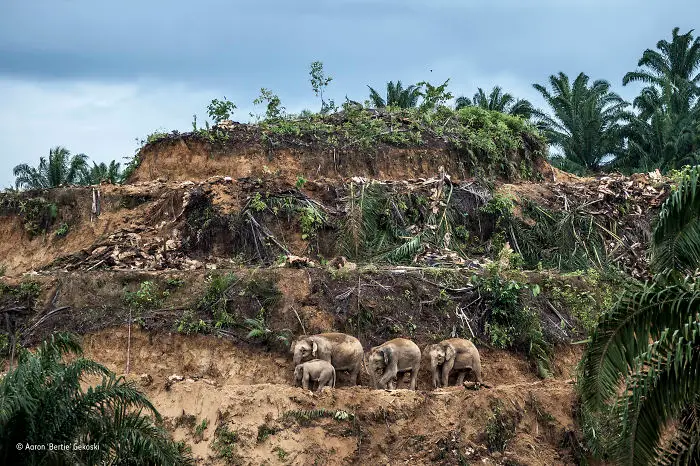
Bertie looked on as a herd of Asian elephants picked their way through a cleared oil palm plantation. With the light fading fast he quickly shot the four majestic mammals, reflecting on how they ‘huddled together, dwarfed by a desolate and desecrated landscape’.
In Sabah, the palm-oil trade is a main driver for deforestation. It destroys habitats, squeezing elephants out of the forest and into plantations. As reports of elephants being poisoned or shot by plantation workers become increasingly common, Asia must face one of its largest conservation challenges – mitigating human–elephant conflict.
Report
23points
#47 'Killer Tactics' By George Karbus, Czech Republic/Ireland, Behaviour: Mammals Finalist
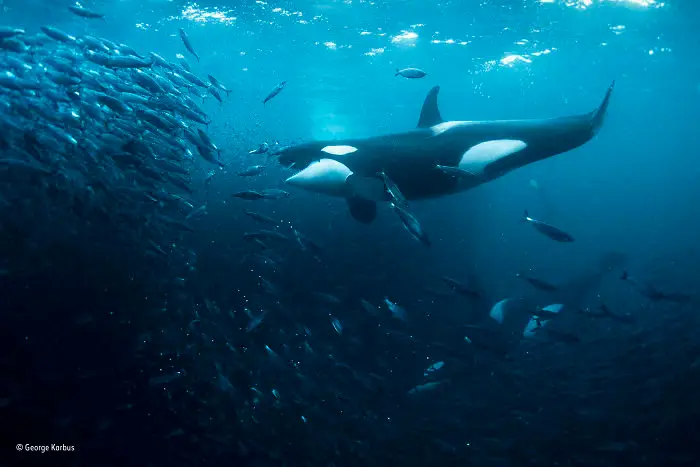
George was freediving, watching this pod of killer whales stunning fish with their tails before eating them. Suddenly, the mood changed as the whales regrouped 50 metres away. ‘A minute later, they came back in full attack mode,’ recalls George. ‘It was the most powerful behaviour I have ever witnessed – an intense, life-changing experience.’
Flying through the baitball at high speed with their mouths open, the killer whales will decimate this shoal of herring. This pod of around 20 individuals feed here from November to January. Each population of killer whales employs different strategies to catch prey, the mothers teaching their calves how to hunt with the group.
Report
21points
#48 'Saguaro Twist' By Jack Dykinga, USA, Plants And Fungi Finalist
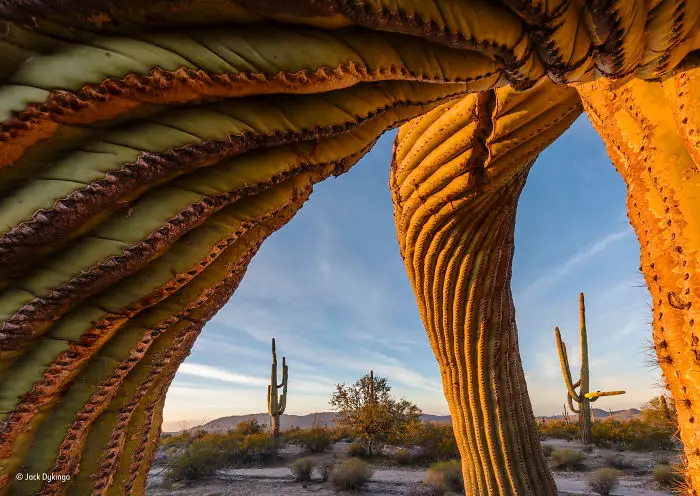
As the dawn light bathed the desert, Jack trained his lens on the distant Sand Tank Mountains. The saguaro cactus had fallen victim to frost damage, allowing Jack to climb inside its contorted and drooping limbs. He has spent a lifetime photographing frost-damaged cacti. ‘This is probably my best effort,’ he says.
Towering over the Sonoran Desert, these cacti have a plethora of amazing adaptions that enable them to survive long droughts. The roots absorb precious rainfall, while the surface pleats expand like accordions as the cactus swells. It is this adaptation that makes the cacti susceptible to frost, as the water in the saturated limbs can freeze.
Report
21points
#49 'Layers Of Autumn' By Uge Fuertes Sanz, Spain, Plants And Fungi Finalist
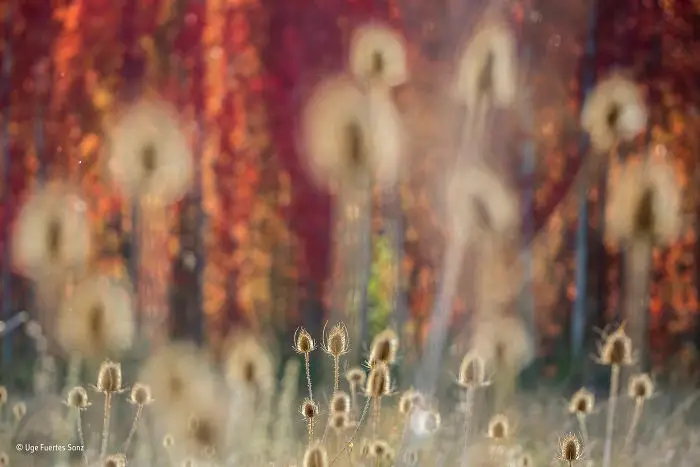
Uge was drawn to the mountains by the promise of autumn colours. The trees didn’t disappoint, but a sea of teasels stole the show, backlit in the soft evening light. In Uge’s shot, the backdrop of crimson trees falls like a curtain, leaving the audience wondering who the leading players are, as their eyes wander between the planes of focus.
It is the spiny, egg-shaped seedheads that give teasels their name: they were once used as combs to tease out the fibres of wool. These statuesque plants boast bands of vivid purple flowers in summer – attracting pollinators such as bees and long-tongued flies – followed by a bounty of seeds through autumn and winter.
Report
20points
#50 'The Tyre Nightjar' By Jaime Culebras, Spain, Urban Wildlife Finalist
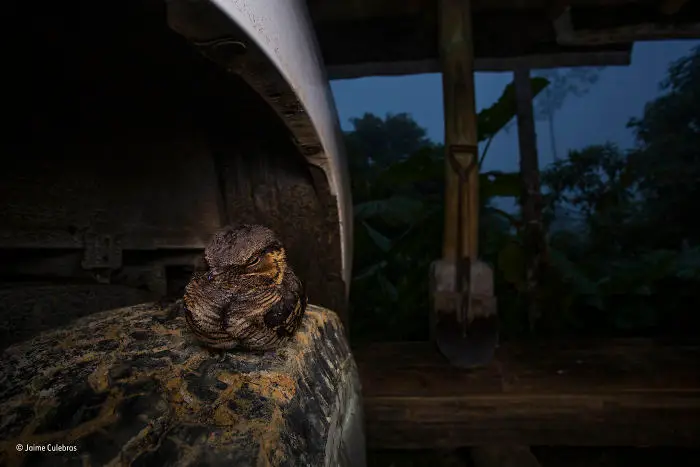
Jaime was looking for snakes when he stumbled across this nightjar, its mottled feathers mimicking the truck’s colours. The next night, he set up his camera and waited for the bird to return for its post-hunt snooze. ‘I was sure it wouldn’t come,’ he explains, ‘but finally, after hours, it arrived and I was able to capture that beautiful moment.’
The cryptic plumage of these birds makes it difficult to distinguish between species and consequently, new species of nightjars are still being discovered. Their colouring is a creative camouflage and allows them to blend into leaf litter (or the mud and treads of a car tyre) while sleeping and nesting.
Report
20points
#51 'Father Knows Best' By Christian Ziegler, Germany, Behaviour: Birds Finalist
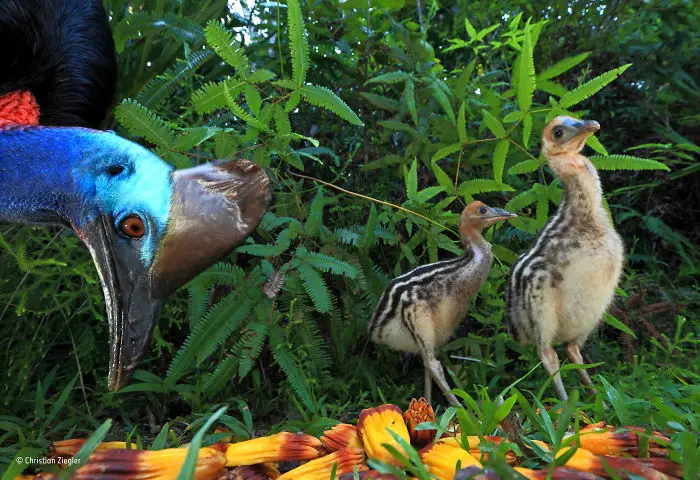
Christian had spent three months trailing cassowaries to gain their trust, with varying success. This territorial male had already chased him out of the forest three times. Returning to the same spot, he achieved this close, low-angle shot with a remote camera and flashes, revealing a tender moment between a male and its six-week-old chicks.
At nearly two metres tall, southern cassowaries have a fearsome reputation, and can deliver a nasty kick. But the males have a soft side, looking after their chicks for nine months and teaching them which fruits to eat. Vital dispersers of seeds, cassowary numbers are dwindling with the destruction and fragmentation of their rainforest home.
Report
19points
#52 'Off Piste' By Hugo Wassermann, Italy, Urban Wildlife Finalist
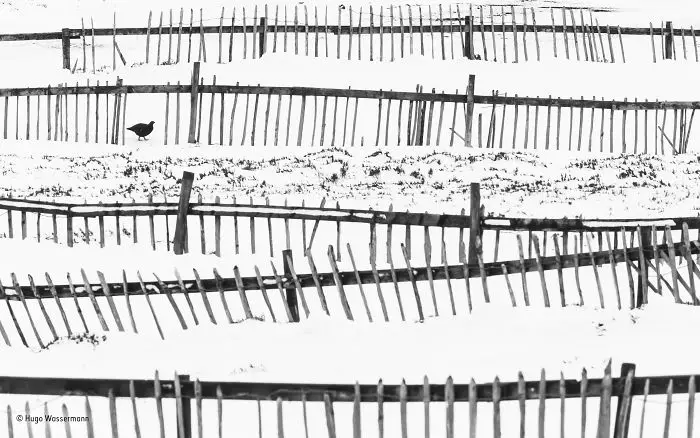
In a deserted ski resort in the Cairngorms National Park, Hugo watched as a red grouse ambled across the patchy snow, searching for food among the sparse vegetation. Waiting patiently, he took his shot just as the bird appeared in the gap between the fence posts.
Red grouse are easy to spot during the Scottish winter, as unlike other grouse, they hold onto their red plumage even while snow blankets the ground. They are often protected by gamekeepers who kill the bird’s potential predators to ensure numbers are high enough for the shooting season.
Report
19points
#53 'An Elegant Affair' By Knut Erik Alnæs, Norway, 15–17 Years Old Finalist
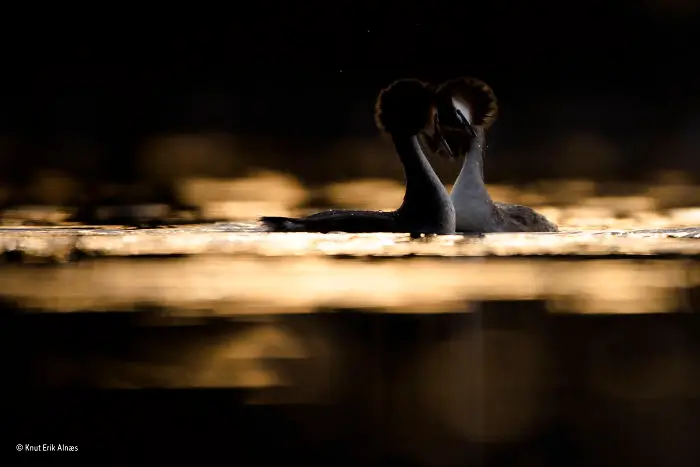
The spectacle of courting great crested grebes had long fascinated Knut Erik. Night after night he lay on a muddy bank, determined to capture their elegance. The light was exquisite, but he couldn’t get a clear shot. On his fifth and final night two birds united in clear water for a few seconds.
Minutes later, the light faded. Every spring, great crested grebes perform a mesmerising ballet, bedecked in black and chestnut head-plumes. Pairs of these elegant birds rise up together out of the water, shaking their long necks. Their grace in the water is not matched on land – their legs are effective propellers but are positioned too far towards their tails for walking.
Report
19points
#54 'Limpet Exposure' By Theo Bosboom, The Netherlands, Animals In Their Environment Finalist
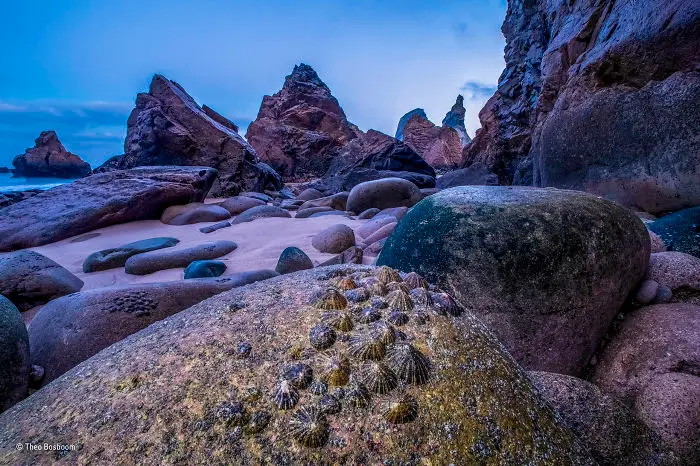
It was a long, steep scramble in the dark to catch the blue light before sunrise. To get both the limpets and distant rocks in focus and correctly exposed, Theo merged 21 images. A small flashlight masked with a handkerchief gave a radiant touch to the limpets against the jagged rocks behind. A dramatic backdrop for a familiar subject.
The conical forms of the limpets mirror the tiny barnacles surrounding them and the folded rocks behind. A muscular foot clamps each limpet to the rock and stops it drying out at low tide. Once the sea returns, they move around scraping algae off the rocks with teeth made of a mineral–protein composite – the strongest natural material ever found.
Report
18points
#55 'Shelf Life' By Pål Hermansen, Norway, Urban Wildlife Finalist
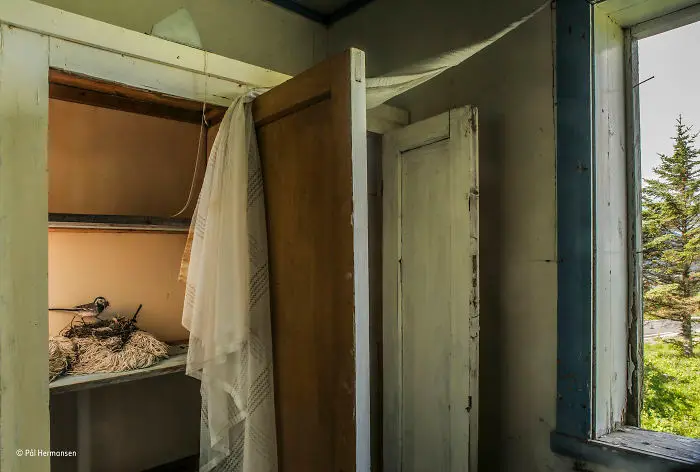
‘The birds were very shy and did not enter the house as long as I was in there,’ explains Pål. Trying not to disturb the wagtails, Pål set up a remote camera with a monitor controlled from his car. After three days he was able to photograph the couple’s nest – snug inside was a brood of half-grown chicks.
From drainpipes to disused machinery, white wagtails make nests in unusual locations. Once settled, the adults will both care for between three to seven chicks inside a rough cup of twigs, roots and moss – delivering regular beakfuls of insects for two weeks.
Report
18points
#56 'Freshwater Eden' By Michel Roggo, Switzerland, Plants And Fungi Finalist
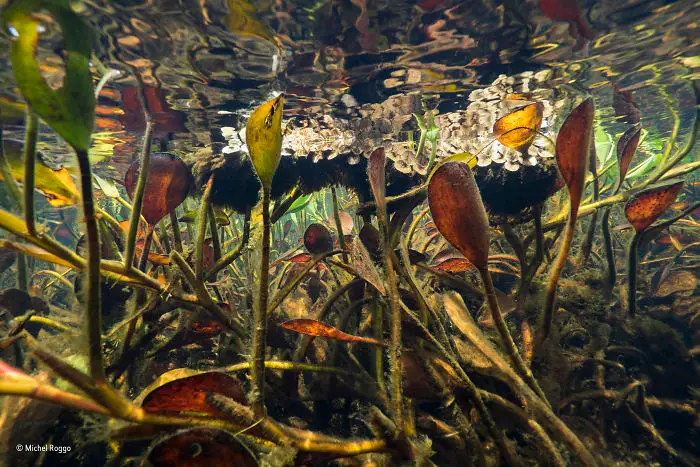
This was Michel’s second visit to the Pantanal, on a journey to reveal the undervalued beauty of freshwater. ‘I’ve never seen any place on earth with such diversity of forms, shapes and colours,’ says Michel. This scene, ‘like an impressionist painting’, captured the spirit of the place. ‘The longer you look, the more you see, and that is the Pantanal.’
This tiny unnamed tributary is part of the vast Pantanal – the world’s largest tropical wetland. A sprawling patchwork of marshes, its annual cycle of floods nurtures a dazzling variety of life. Water hyacinths have received bad press as invasive weeds, but in its native habitat this species forms the architecture of a ‘freshwater Eden’.
Report
17points
#57 'Road Hog' By Evalotta Zacek, Estonia, 10 Years And Under Finalist
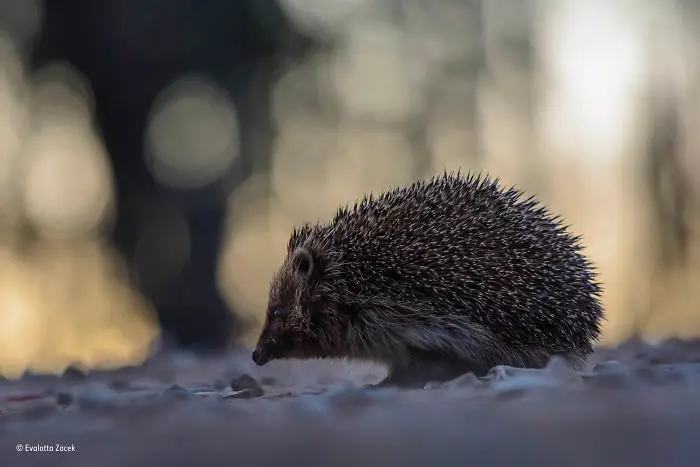
Evalotta was out for the evening on one of the family’s ‘animal drives’, looking for deer and foxes at the edge of a dusky forest. They stopped the car to allow this wandering hedgehog to cross, and ‘in return it posed for a photo’, she says. Evalotta likes the unusual angle of this shot – and climbed into a ditch to get it.
Hedgehogs can travel over a kilometre on their nocturnal wanderings to forage for food such as beetles, slugs and other invertebrates. They are an integral part of Estonia’s exceptionally rich wildlife. But hedgehogs are getting rarer: this family of keen wildlife watchers hardly see them anymore.
Report
17points
#58 'The Hairy Raincoat' By Josiah Launstein, Canada, 11–14 Years Old Finalist
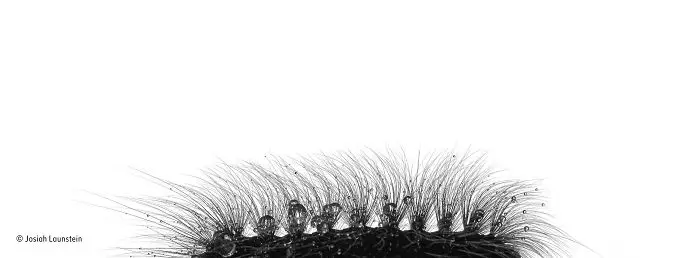
‘It rains a lot in Thailand in the summer,’ says Josiah. But that didn’t stop him exploring and discovering this miniature marvel. Without a macro lens to hand, he crouched down to silhouette the caterpillar against the bright, overcast sky. ‘I love how the water drops and hair clusters make it look like water is squirting out of it like little fountains,’ he says.
Monkey moths are named after their furry adult bodies, but the caterpillars are even hairier. The hairs are water-repellent, protecting the insect from daily rain showers, although their main role is defence – making the juicy caterpillar less palatable to birds and small mammals that might be looking for a snack.
Report
17points
#59 'Romance Among The Angels' By Andrey Narchuk, Russia, Behaviour: Invertebrates Finalist
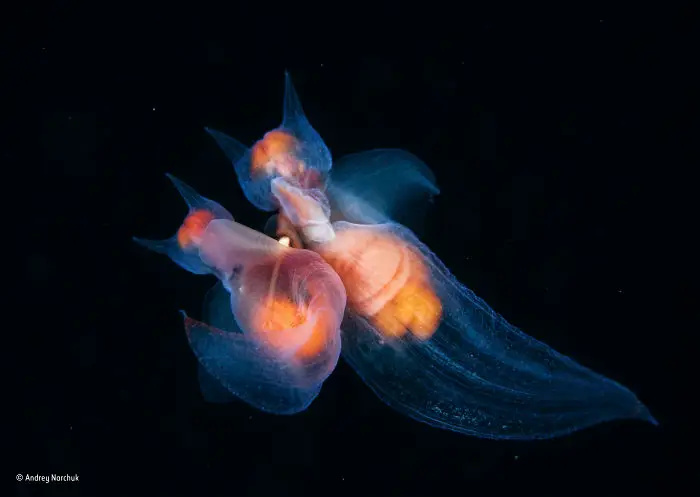
He was meant to be filming salmon, but as soon as Andrey jumped in, he changed his mind. Surrounded by thousands of mating sea angels he quickly swapped to macro equipment. In strong currents, close to fishing nets, Andrey captured this little known and rarely photographed spectacle.
The following day, there wasn’t a single angel to be seen. Flying through the water on wing-like paddles, sea angels, Clione limacina, are molluscs related to slugs and snails. They are carnivorous, catching small sea snails, hooking them out of their shells and eating them whole. Thought to be hermaphrodites, individuals transfer sperm to one another in synchrony before laying 100 or so tiny eggs in the ocean.
Report
16points
#60 'Fire Ice' By Chris Bray, Australia, Earth’s Environments Finalist
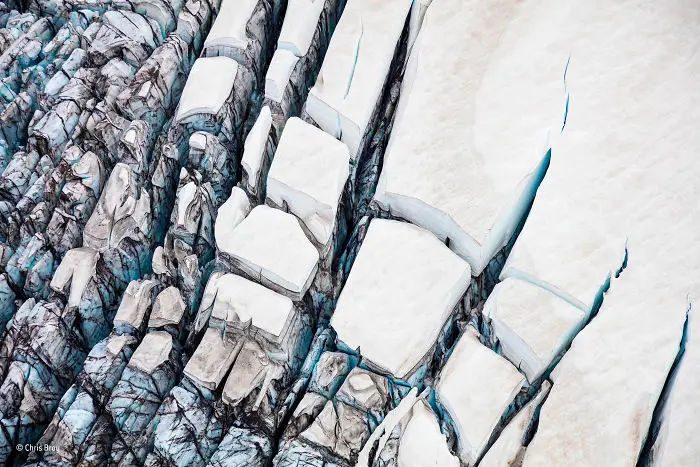
As the helicopter lifted over the Icelandic landscape, Chris was astounded by its beauty, admiring it as ‘a smorgasbord of colourful craters, mountain ranges and river delta patterns’. Through the open doors of the helicopter, fighting the biting wind and turbulence, he captured the most dramatic sight of all – the fractured Mýrdalsjökull ice cap.
Spanning almost 600 square kilometres, the vast ice cap is more than 650 metres thick in places and conceals the top of Katla – a large, active volcano. On average, Katla erupts every 40–60 years, each time covering Mýrdalsjökull with a fine layer of ash that gives the ice its sooty appearance.
Report
16points