




A ceremony at the Natural History Museum, London, has revealed the results of the Wildlife Photographer of the Year contest, and the winning photos are worth all of the attention they can get. This year, the annual competition has attracted nearly 50,000 entries from 92 countries and the organizers were kind enough to share them.
Photojournalist Brent Stirton has won the Grand Title for his picture of a black rhino's mutilated body. According to judge Roz Kidman Cox, his image was "symbolic of one of the most wasteful, cruel and unnecessary environmental crimes, one that needs to provoke the greatest public outcry." The shot was also included in Stirton's entry to the World Press Photo 2017 Nature category where his story won the first prize as well.
The powerful photo will go on show alongside 99 others at the Wildlife Photographer of the Year exhibition which opens on Friday October 20 at the central London museum.
More info: nhm.ac.uk
#21 'Spring Release' By John Mullineux, South Africa, Behaviour: Mammals Finalist
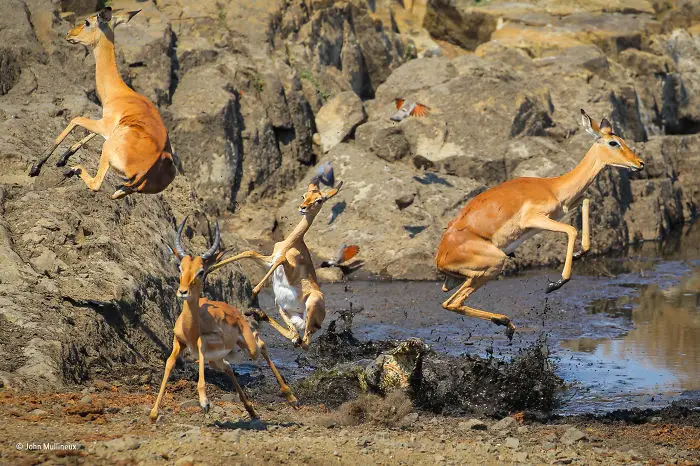
John waited patiently, never taking his eyes off the animals at the waterhole. Drought had heightened tensions in Kruger National Park and if he was lucky, he would be able to capture a crocodile attack. Wish granted, the crocodile suddenly exploded out of the water attacking the impala in the briefest of moments.
With lightning speed, the impala elude the reptile’s jaws, using their incredible acrobatic skills to escape. When alarmed, these mammals have been known to leap up to three metres in the air and can travel nine metres in a single bound – perfect for escaping a hungry crocodile.
Report
47points
#22 'Cold Catch' By Fred Zacek, Estonia, 10 Years And Under Finalist
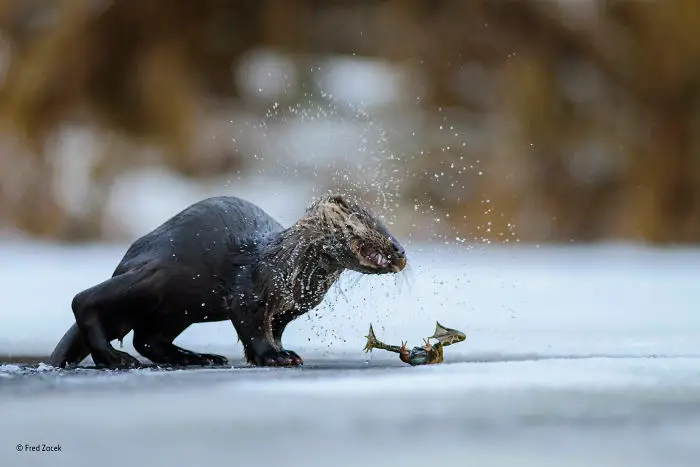
Lying on his stomach on the river ice, Fred was watching carefully. It was the first time he had seen an otter. It kept diving and resurfacing with frogs, and each time it went back in Fred slid closer across the ice. ‘The sound of the otter’s sharp teeth chewing through a frog as if it was a sandwich was unforgettable,’ he says.
Frogs can form a significant part of an otter’s diet, especially in winter when hibernating individuals, like this moor frog, make for easy pickings. Otters will keep feeding holes open and ice-free through the cold weather – their dense, oily coats act as both insulation and waterproofing.
Report
47points
#23 'Swim Gym' By Laurent Ballesta, France, Behaviour: Mammals Finalist
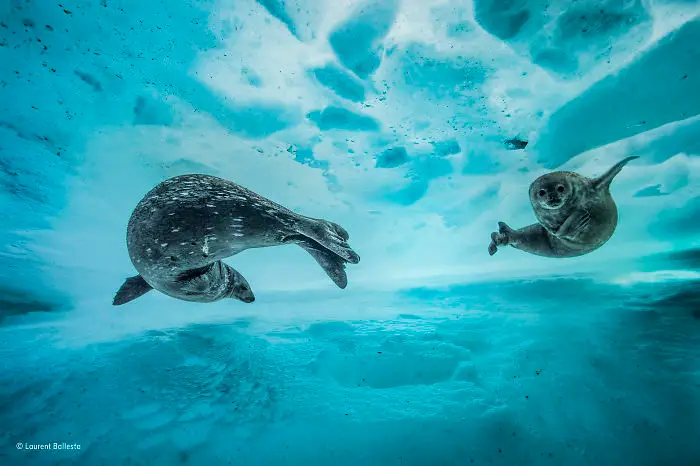
‘We were still a few metres from the surface, when I heard strange noises,’ explains Laurent. Curious, he approached slowly and was rewarded with the glorious sight of two Weddell seals – a mother and her newborn pup. ‘They looked so at ease, where I felt so inappropriate.’
Weddell seals give birth on ice and take their offspring for their first frosty swim a few weeks later. Eventually, the pups will grow up to be accomplished divers with excellent underwater vision. After familiarising themselves with their watery surroundings, adult seals can reach depths of 600 metres, staying submerged for up to 80 minutes.
Report
44points
#24 'Wolf Watch' By Lasse Kurkela, Finland, 11–14 Years Old Finalist
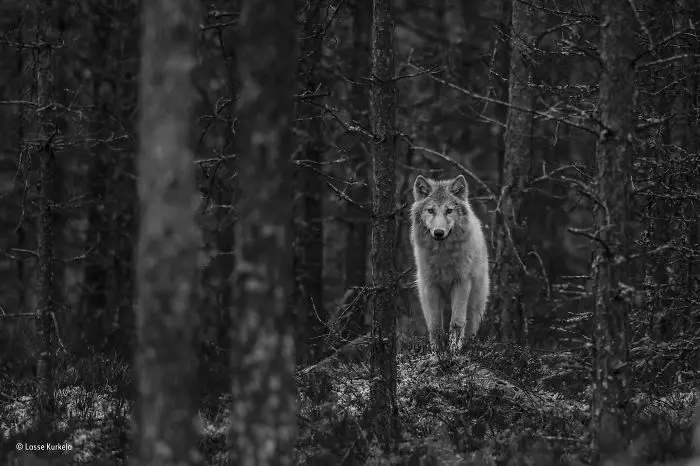
After an unsuccessful year looking for wolves, Lasse and his father heard of a group attracted by bait for bears and arrived at a remote hide in darkness. First light revealed movement in the trees as a wolf cautiously approached. Wrapping his camera in fabric to silence it, Lasse used black and white to best capture the dark, misty atmosphere.
Lone wolves have a bad reputation, but have a natural role in mixing the gene pool and expanding to new areas. Wary of people, Finland’s wolves are hunted, both legally and illegally. Bitter controversy continues about their numbers in the wild. Some argue culling is necessary to protect people and hunting dogs. Others call for conservation.
Report
44points
#25 'Lions’ Long Shot' By Michael Cohen, USA, Behaviour: Mammals Finalist
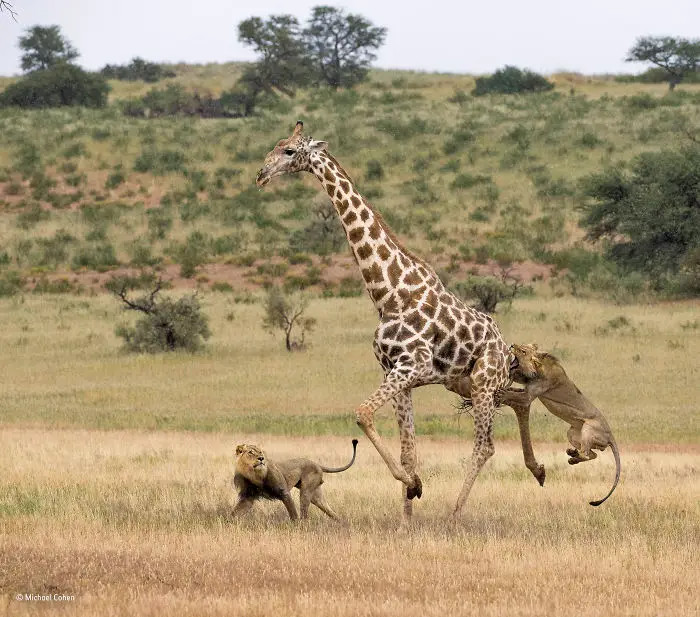
Peering through the rain, Michael spotted a captivating site, two lions hot on the hooves of a fully-grown male giraffe. Unable to remain detached, the scene connected with Michael. ‘Something draws me to life and death struggles in nature. It’s raw and emotional and a rare privilege to witness.’
This struggle is particularly unusual. Lions rarely attack giraffes as a single kick from their long, powerful legs could prove fatal. But as the hunt drew closer, Michael saw that this giraffe had misshapen hooves. This may have affected the giraffe’s ability to run, which could have attracted the lions’ attention.
Report
43points
#26 'Sweet-Grass And Ripples' By Theo Bosboom, The Netherlands, Plants And Fungi Finalist

With his initial plans to photograph the forest scuppered by wind, Theo walked past the lake frustrated and discouraged. However, with his second glance at the water he began to appreciate the blustery conditions. ‘When I looked closer, I noticed the beautiful patterns created by the play of the wind, the waves and the grass,’ he says.
Typically found in marshes, river margins and around lake shores, the streaming forms of floating sweet-grass are easy to spot, especially in summer, when their half-metre tall flower spikes grow straight out of the water. A creeping perennial, it is likely that it plays an important role in the process that changes shallow open water into fringing grassland.
Report
43points
#27 'Glimpse Of A Lynx' By Laura Albiac Vilas, Spain, 11–14 Years Old Finalist

Laura travelled to the Sierra de Andújar Nature Park with her family to follow her dream of seeing wild Iberian lynx. On their second day, a pair were relaxing just 15 metres from the road. Laura watched for an hour and half in total silence. ‘I felt huge respect to be so close to them and to observe them so peacefully,’ says Laura.
One of the world’s most endangered felines, the Iberian lynx is only found in two small populations in southern Spain. Unlike the larger European lynx, Iberian lynx feed almost entirely on rabbits and need open scrub to breed. Thanks to intensive conservation efforts, populations have recently started to recover, but continued action is still essential.
Report
43points
#28 'Contemplation' By Peter Delaney, Ireland/South Africa, Animal Portraits Winner

Peter had spent a long, difficult morning tracking chimpanzees through dense undergrowth. ‘Photographing in a rainforest with dim light and splashes of sunlight means your exposure settings are forever changing,’ he says. Keeping his camera at its optimum ISO setting meant a slow shutter speed, so it was hard to keep a sharp focus without a tripod.
The troop of 250 chimpanzees had spent the morning high in the canopy. Totti, named after an Italian footballer, is a favourite with the rangers, but perhaps not the ladies. After trying everything to entice a female to join him on the ground – posturing, gesturing and calling seductively – he gave up and flopped onto the forest floor.
Report
41points
#29 'A Whorl Of Sharks' By Esantosh Shanmuga, USA, Black And White Finalist

The sandbar sharks circled far below Santosh, slipping in and out of the dark like ghostly apparitions. Inherently cautious, only a few brave individuals rose to check him out. During those moments he felt ‘not terror, but admiration’, he says. ‘I was just a visitor in their watery ‘ohana (family) and they graciously let me stay.’
These sandbar sharks are all male and have probably come together to feed or spawn. A school of females may join them later in the season, but in the meantime, they must establish a hierarchy. Sizing each other up, the dominant sharks attempt to secure the better spots nearer the surface.
Report
41points
#30 'Crab Surprise' By Justin Gilligan, Australia, Behaviour: Invertebrates Winner

Justin was busy documenting an artificial reef experiment when the army of crabs appeared, with an octopus acting ‘like an excited child in a candy store’, as it chose its final catch. The irony of this unexpected encounter isn’t lost on Justin: ‘An aggregation of crabs the size of a football field wandered through the experiment and we had no idea why.’
Moments like these reinforce how little we know about Australia’s temperate reefs, and ocean ecosystems generally. Spider crabs usually come together for protection while they moult or mate, but these groupings were previously unknown in this area. Crabs like these are common prey for the Maori octopus – the largest in Australian waters.
Report
38points
#31 'Snap Shot' By Rodrigo Friscione Wyssmann, Mexico, Behaviour: Amphibians And Reptiles Finalist

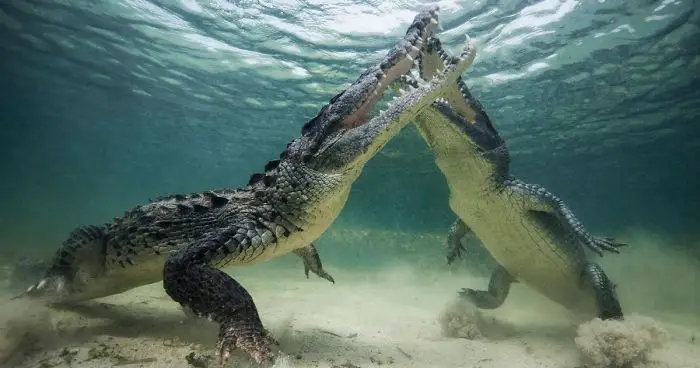
As Rodrigo dived down, two crocodiles lunged at one another, less than a metre away. The fight lasted seconds, but it was a moment Rodrigo had dreamed of for years. Lying on the bottom, camera pre-set to shoot into the surface light, and strobes aimed downwards to minimise backscatter, he finally captured the fierce energy of a clash.
Though American crocodiles are well known for their territorial aggression, combats are rare – smaller crocodiles usually give way to larger ones. Both about three metres long, these two were evenly matched. They attacked each other’s eyes and throat, powered by strong limbs, sharp claws and muscular tails and wielding up to 30 pointed, conical teeth.
Report
35points
#32 'Night Of The Turtles' By Ingo Arndt, Germany, Behaviour: Amphibians And Reptiles Finalist

Ingo was in Costa Rica for three weeks, but the conditions he needed – an arribada (a mass arrival of turtles) and enough light to capture the spectacle – only combined on one night. Tracing their paths with a four-second exposure in the dim blue of the night, he portrayed hundreds of turtles dragging themselves up the sand.
The greatest arribadas occur in the rainy season, often on the darkest nights, a few days before a new moon. Hundreds of thousands of female olive ridley turtles haul themselves up their natal beaches to dig nests in the sand and lay their eggs. A million eggs can be laid on the beaches of this reserve each year.
Report
33points
#33 'Big Sucker, Little Sucker' By Alex Sher, USA, Under Water Finalist

'The tricky part for the remora, and me,’ says Alex, ‘was staying close enough without being sucked in.’ Alex swam with this whale shark for three hours, even after his camera ran out of battery. Keeping an eye on Alex, the gentle giant granted him this powerful close-up, the wide arch of its mouth set off by the timely curve of the remora.
The world’s largest fish, whale sharks are filter feeders, sustaining their huge size with plankton and small crustaceans, like krill. Remoras often associate with a larger host, using the modified fin on their heads like a suction cup to hitchhike. They get free transport, protection, and a tasty and steady supply of parasites from the larger sharks.
Report
33points
#34 'Anticipation' By Marco Urso, Italy, Behaviour: Mammals Finalist

The anticipation of the brown bear cubs was palpable as their mother fished in Lake Kuril. As soon as she emerged grasping a plump sockeye salmon, they ran towards her, eager to claim their supper. As Marco took the photograph, the mother glanced towards him, her look of maternal protection clear to see.
The bright colour of this fish shows us that it is breeding season in Lake Kuril, which plays host to one of the largest salmon-spawning events in the world. These bears are mostly vegetarian, but they will take advantage of the well-stocked lake before moving on.
Report
32points
#35 'Polar Pas De Deux' By Eilo Elvinger, Luxembourg, Black And White Winner

Driven by curiosity and hunger, this polar bear and her cub stopped to investigate the dirty puddle leaking from Eilo’s ship. Without hesitation and in synchrony, they quickly lowered their heads to taste the stained snow. Ashamed, Eilo framed her shot in black and white, emphasising the contrast between the pollution and the pristine environment.
Year on year, a variety of noxious substances are brought into these bears’ habitats. Due to their low degradation rates, the pollutants remain in the environment, gradually accumulating as they make their way through the food web. As apex predators, the bears are exposed to high levels of these pollutants, which endanger their health and reproduction.
Report
32points
#36 'Realm Of The Condor' By Klaus Tamm, Germany, Animals In Their Environment Finalist

Report
31points
#37 'Cat Attack' By Stefano Unterthiner, Italy, Urban Wildlife Finalist

Early one morning, Stefano was awoken by an unusual alarm, the calls of a worried pair of kestrels. Peering outside, he spotted the cause of the racket. A cat had crept perilously close to the couple’s nest and in retaliation, the protective mother was repeatedly mobbing the predator.
Matera is home to Europe’s largest breeding colony of lesser kestrels, who build their nests in the town’s historic stonework. Fond of their winged tourists, the town’s residents create nest boxes to protect the kestrels from curious cats and have even been known to hand-rear clumsy chicks that have fallen from their nests.
Report
31points
#38 'In The Grip Of The Gulls' By Ekaterina Bee, Italy, 10 Years And Under Winner

Setting out to sea, Ekaterina and her parents were looking for white-tailed sea-eagles. But five-year-old Ekaterina was more interested in the cloud of herring gulls that surrounded the small boat, attracted by her bread. She snapped this image, engrossed in the noise, the wing beats and the colours of their feet and beaks among the whirl of white.
The impressive white-tailed sea-eagles of Nord-Trøndelag attract many visitors and photographers and so the more common herring gulls are not usually the focus. Often considered pests because of their gregarious nature and habit of stealing food, silver-backed herring gulls are a symbol of the coast in many countries.
Report
30points
#39 'The Good Life' By Daniël Nelson, The Netherlands, Young Wildlife Photographer Of The Year Grand Title Winner

Daniël met Caco after a three-hour trek through dense vegetation with skilled trackers. He was part of a family of 16 gorillas feeding on sweet African breadfruit. In his compelling portrait of this relaxed young gorilla, Daniël captured the inextricable connection of these wild apes with the forest on which they depend.
The nine-year-old gorilla, Caco, is preparing to leave his family – putting on muscle and getting a little too bold. He will soon become a solitary silverback, hopefully starting his own family in eight to 10 years’ time. Western lowland gorillas are still critically endangered, threatened by illegal hunting and the spread of diseases like the Ebola virus.
Report
30points
#40 'The Ice Monster' By Laurent Ballesta, France, Earth’s Environments Winner

As soon as he saw the magnificent ice giant, Laurent craved to reveal its hidden depths. It took many hours to check out the location and prepare the shots but finally Laurent and his team were ready. Using a wide-angle lens they snapped 147 different images over three days. After careful stitching, the final image was assembled and ready to view.
Trapped by the surrounding ice field, the iceberg floats safely above the sea floor. When free to roam, however, these icebergs can gouge great marks across the ocean bed as they are turned about by the wind, current and tide. The curves and curlicues of the scars leave a record of the past that scientists can use to study climate change.
Report
29points