





Your insatiable curiosity is something you should never be ashamed of. That desire to learn more about the world that surrounds us is hardwired into you. But no matter how educated you are, there will always be something new to learn.
We are featuring the most interesting and thoroughly weird facts and stories from around the globe, as shared on one popular Instagram account. Scroll down if you’re in the mood to learn something new and expand your mind.
#21

Jad Issa, a Syrian man with Down syndrome, worked tirelessly in a local wheat mill for over 25 years. He saved his earnings specifically to fund his son Sader’s education and give him the best possible life.
Motivated by his father’s love, sacrifice, and determination, Sader successfully pursued a university degree and became a dentist.
Jad Issa lived in the city of Sweida, Syria, with his wife and son, Sader. He was a respected and beloved figure in his community, known for his kindness, generosity, and strong work ethic.
To provide for his family and ensure his son had the best possible future, Jad worked for 25 years at a local grain mill. His hard-earned wages paid for Sader’s education and helped maintain a stable, loving household during challenging times.
Today, Sader is a successful dentist who openly credits his father as his greatest inspiration and support. Sader often speaks with immense pride about Jad, highlighting how his father’s determination and unwavering love taught him invaluable life lessons.
Report
55points
#22
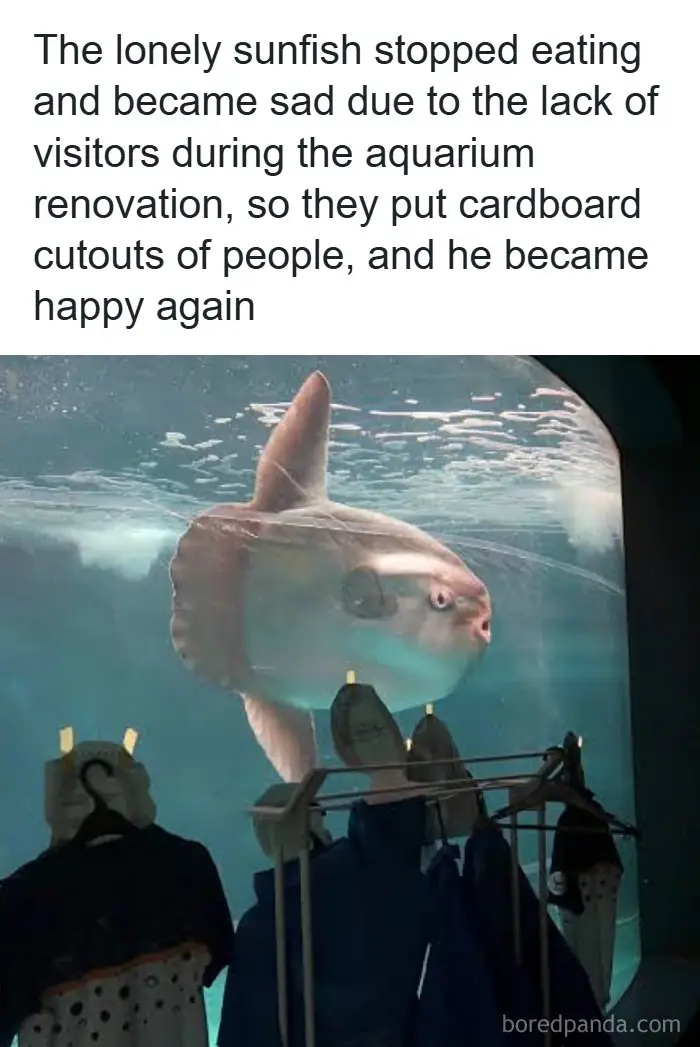
At Kaikyokan Aquarium in Japan, a sunfish stopped eating and showed signs of distress after the facility closed for renovations in December 2024. With no physical health issues found, staff believed the fish was reacting to the sudden absence of visitors it had grown used to seeing each day.
To help, they placed photos of human faces on the tank and hung staff uniforms nearby. The next day, the sunfish began eating again and became more active, showing clear interest in the cutouts. The aquarium’s quick and creative response shows how even solitary animals can be affected by changes in their environment, and how simple actions can support their mental well-being.
Report
54points
#23
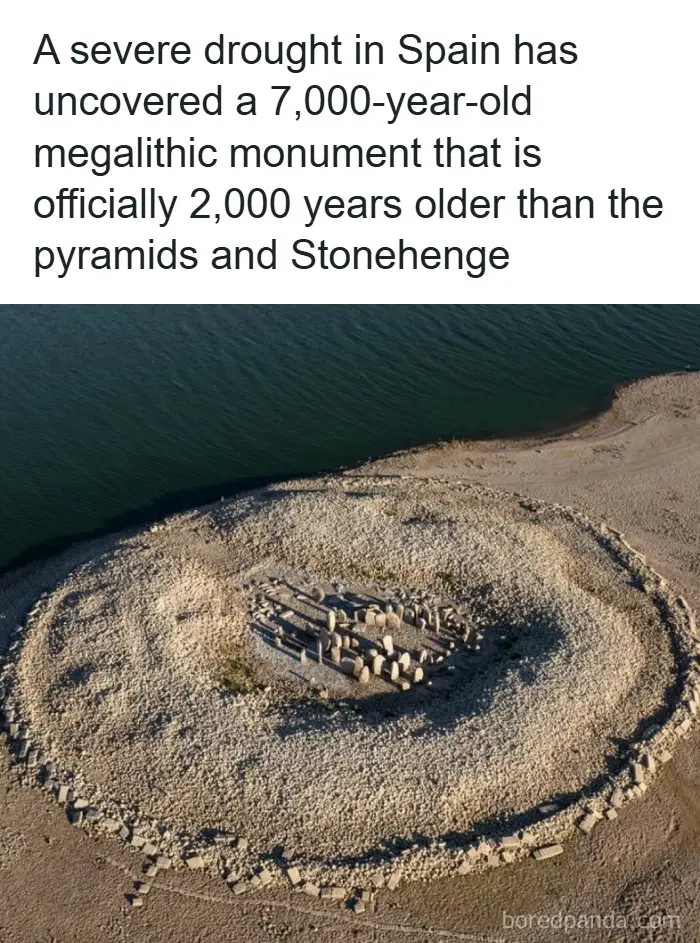
A significant 7,000-year-old megalithic monument known as the Dolmen of Guadalperal has been periodically uncovered in Spain, particularly during droughts, by the receding waters of the Valdecañas reservoir. The structure, which predates both the Great Pyramids of Egypt and Stonehenge, has emerged from the water during droughts the first time in 2019 and then more in 2022. While its precise purpose is still debated, it is believed to have functioned as a ceremonial tomb, a religious site for rituals, or an astronomical observatory, possibly serving also as a trading post. The monument’s arrangement of over 100 standing stones suggests a sophisticated understanding of architecture and a deep connection to the cosmos, offering valuable insights into the spiritual and social lives of ancient Iberian societies.
Report
54points
#24

In 2012, while international navies were trying to stop Somali piracy, a Japanese sushi chain owner decided to try something completely different.
Kiyoshi Kimura, known in Tokyo as the Tuna King, flew to the region.
He met men who had been involved in piracy and asked them a simple question: why were they doing this?
Their answer was always the same.
They didn’t like being pirates.
They just needed a way to feed their families. The fishing had collapsed.
So Kimura offered another option.
He provided fishing boats.
He taught them how to catch yellowfin tuna.
He helped set up freezers.
And he promised to buy whatever they caught.
“They didn’t even like pirating,” he said.
“I suggested that they catch tuna instead, and make a proud living for their families.”
Piracy later collapsed for many reasons.
But Kimura gave them something the navies never could: a real alternative.
In 2013, the government of Djibouti gave him a medal for helping reduce piracy.
Sometimes the best solution isn’t more force.
It’s a better option.
Report
52points
#25

Six Polk County jail inmates who were on an outdoor work detail at a cemetery rushed to the aid of a deputy sheriff who collapsed from heat and a preexisting medical condition. One inmate used the deputy’s cell phone to call 911 while others removed the deputy’s vest and gun belt and stayed with him until emergency crews arrived; the deputy recovered and returned to duty. (2017).
Report
52points
#26
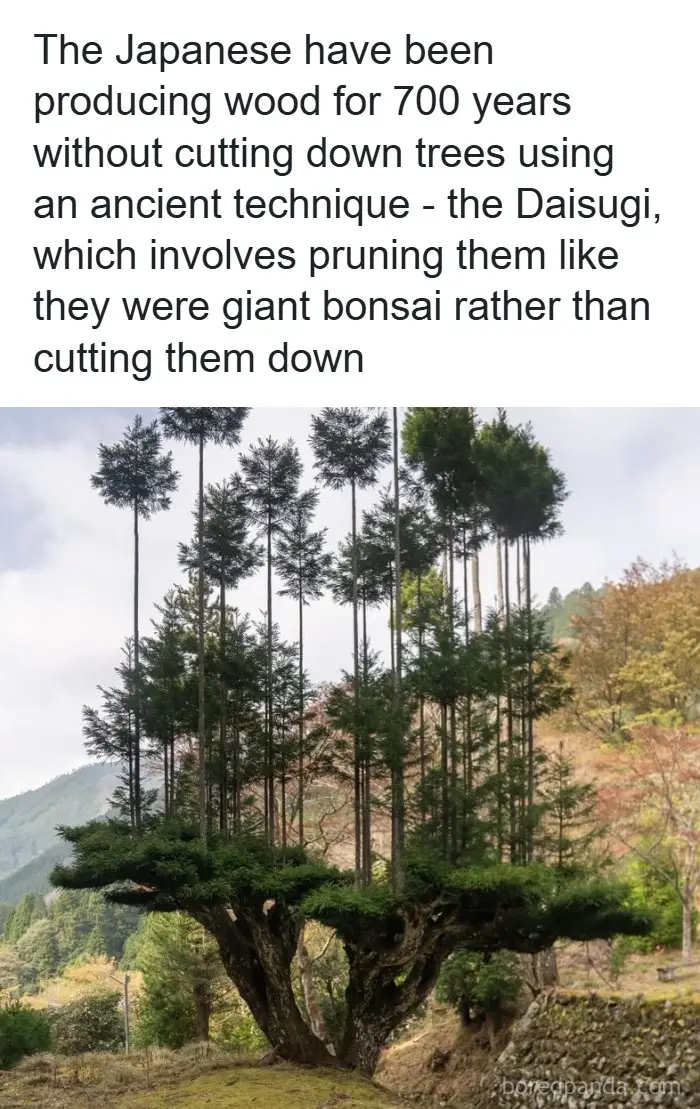
Daisugi (台杉) is an ancient Japanese forestry technique, originating in the Kitayama region near Kyoto, that allows for sustainable tree cultivation, producing high-quality timber without cutting down the main tree. Literally translated as “platform cedar,” daisugi involves selectively pruning a tree (usually Japanese cedar) to grow multiple straight, parallel stems from its base.
This method involves growing multiple straight, knot-free cedar trees from a single, existing tree by pruning and shaping the branches to encourage vertical growth. This allows for a sustainable harvest of timber without cutting down the original tree, making it a method of “growing trees on trees”.
Report
52points
#27
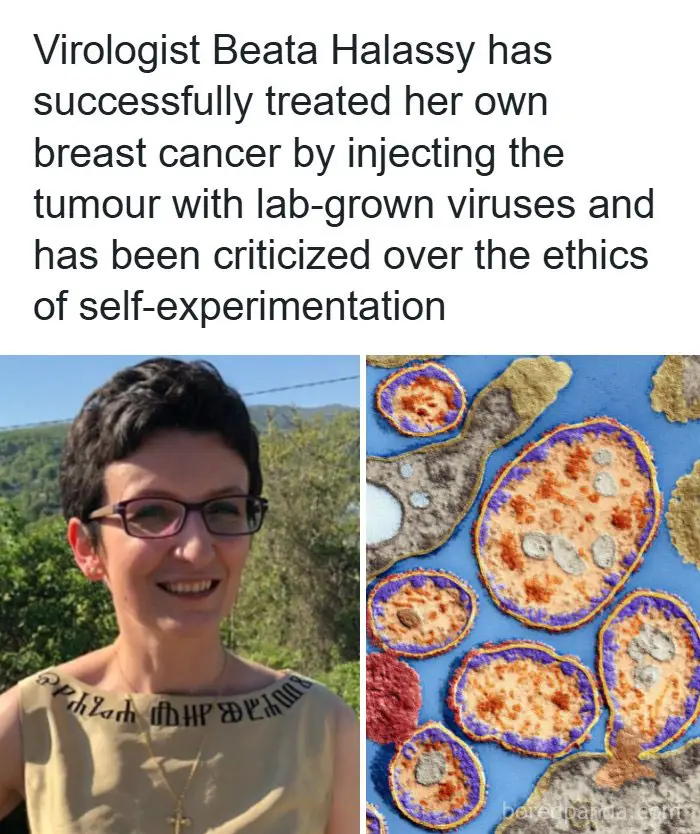
A scientist who successfully treated her own breast cancer by injecting the tumour with lab-grown viruses has sparked discussion about the ethics of self-experimentation.
Beata Halassy discovered in 2020, aged 49, that she had breast cancer at the site of a previous mastectomy. It was the second recurrence there since her left breast had been removed, and she couldn’t face another bout of chemotherapy.
Halassy, a virologist at the University of Zagreb, studied the literature and decided to take matters into her own hands with an unproven treatment.
A case report published in Vaccines in August1 outlines how Halassy self-administered a treatment called oncolytic virotherapy (OVT) to help treat her own stage 3 cancer. She has now been cancer-free for four years.
In choosing to self-experiment, Halassy joins a long line of scientists who have participated in this under-the-radar, stigmatized and ethically fraught practice. “It took a brave editor to publish the report,” says Halassy.
Report
50points
#28

Kylie Arellano disappeared from Utah at 15 and was found alive 521 days later after a conversation that began on Among Us helped investigators locate her. According to a federal complaint, a man she met online picked her up in May 2025, threw her phone into a river and drove her to his home in Oregon, where he told her she could not leave.
Investigators say he kept her in his basement and eventually gave her another phone without mobile data, although it could still connect to Wi-Fi. In October 2026, she began talking to another young player on Among Us before they moved their conversation to another app. There, she revealed her identity and said she was being held against her will. She also said she believed police were no longer looking for her.
The other player’s mother contacted the FBI, which monitored a video call with Kylie on November 1. That same day, Oregon State Police and federal agents rescued her and took her for medical treatment.
Report
49points
#29
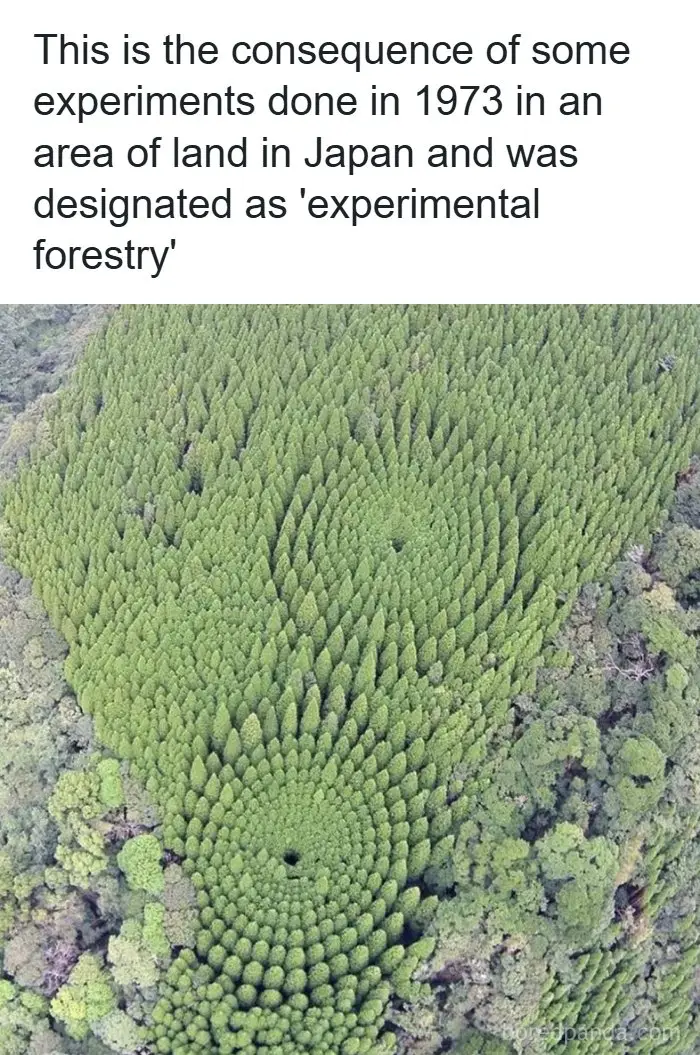
In 1973 an area of land near Nichinan City in Japan, was designated as “experimental forestry” and one of the experiments was to try and measure the effect of tree spacing on growth. 50 years later here is the result.
As you can see from today’s images, the forest has taken on this bizarre shape because there are the same number of trees in each ring, but each ring is smaller as you get closer to the center. It is very noticeable that the trees closest to each other are smaller, while those on the outer rings are significantly taller with a larger crown diameter.
Trees, as living beings, grow smaller when they are closer together, this happens due to the lack of space; furthermore, plants sense the presence of other plants near them and therefore grow according to the space they have available.
Report
48points
#30
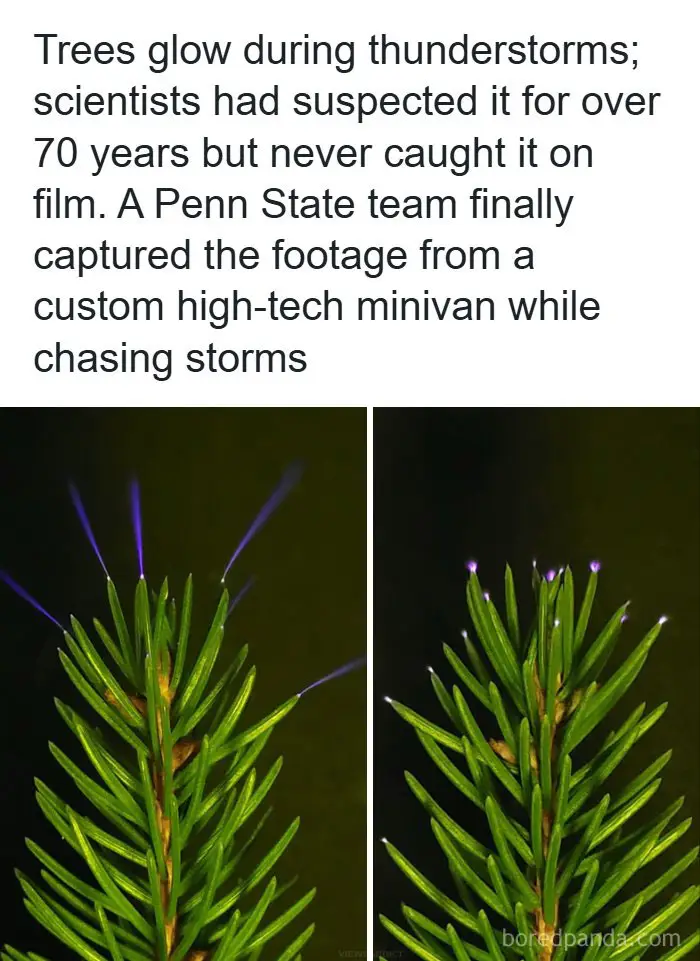
For over 70 years, meteorologists theorized that forests weren’t just standing still during thunderstorms, they were electrically alive. This year, a Penn State team finally proved it. The eerie glow comes from corona discharges, which are tiny, high-frequency electrical pulses that ignite at the very tips of leaves. As massive storm clouds roll in, they carry a heavy negative charge that acts like a giant magnet, pulling an intense positive charge up from the Earth and through the veins of every tree.
This was captured by researchers William Brune and Patrick McFarland, who transformed a 2013 Toyota Sienna into a mobile laboratory to track the phenomenon. After weeks of chasing elusive storms through Florida, the team finally caught their target on camera. While parked in a North Carolina lot during a raging storm, they filmed hundreds of these electrical events flickering across the leaves of a sweetgum tree and a nearby loblolly pine.
The most mind-blowing reality is that this isn’t just a light show, it is a massive, planetary chemical factory. These billions of tiny sparks produce hydroxyl radicals (OH), which are known as the “detergent of the atmosphere.” This means that during a thunderstorm, an entire forest transforms into a glowing, purple-hued air purifier, aggressively breaking down greenhouse gases like methane on a global scale. We now know that trees don’t just breathe out oxygen, they use the power of the storm to scrub the very air we breathe.
Report
48points
#31
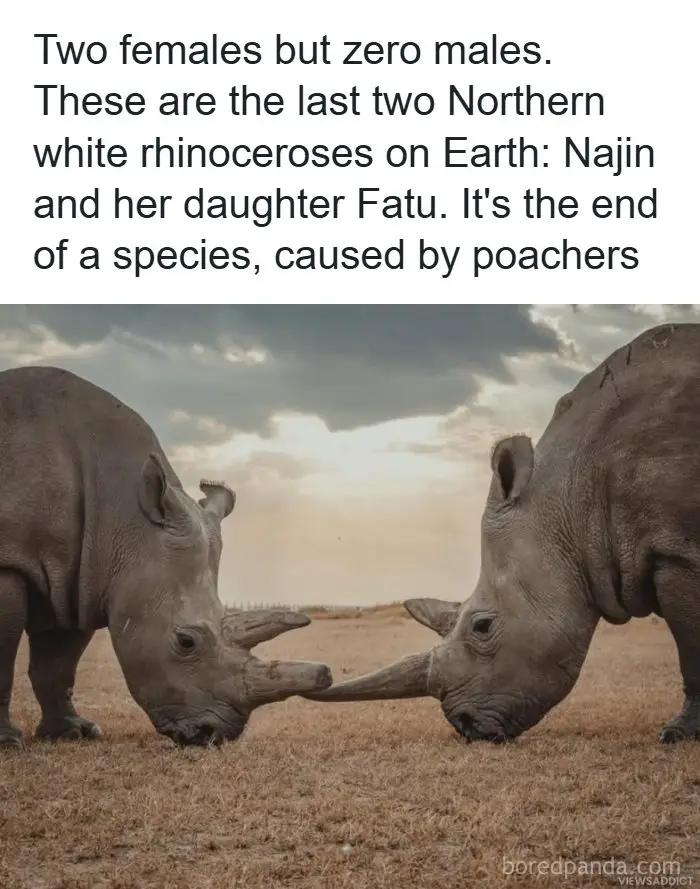
There are only two living northern white rhinoceroses left in the world, and both are female: Najin and her daughter Fatu. The last male, Sudan, d**d in 2018 in Kenya.
Because no males remain, the northern white rhino is considered “functionally extinct”, meaning the subspecies can no longer reproduce naturally.
There were around 500 Northern White Rhinos in the 1970s. By the late 1980s, only about 15 remained in the wild, largely because of poaching.
However, it is not necessarily the absolute end yet. Scientists have preserved material from deceased males and have created viable embryos using IVF techniques. The plan is to implant those embryos into surrogate southern white rhinos.
Even though it is hard, scientists are still trying to save it.
Report
46points
#32
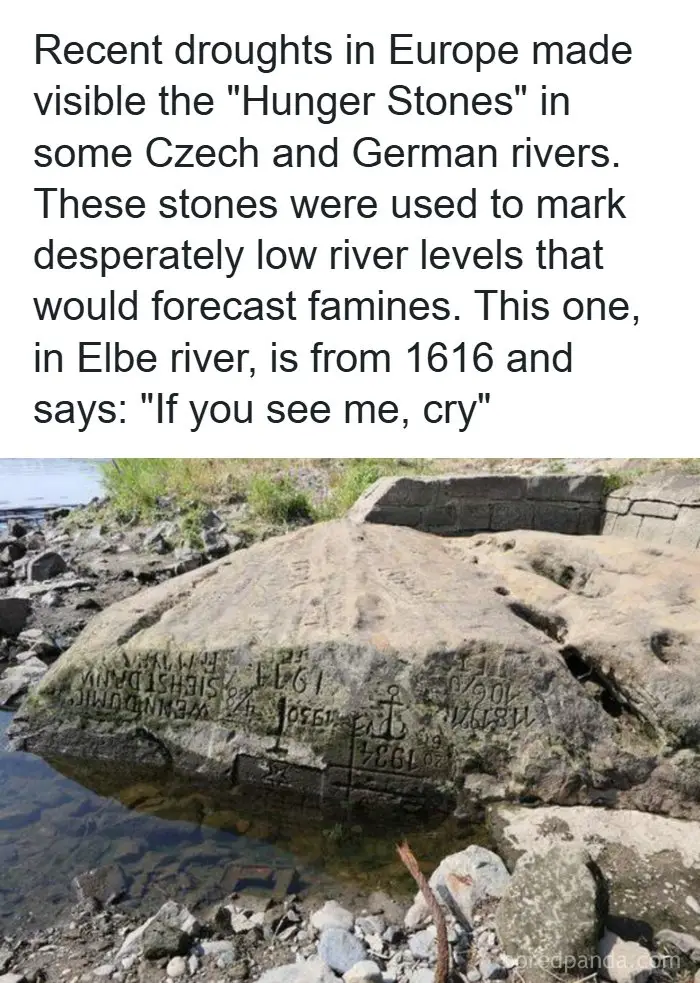
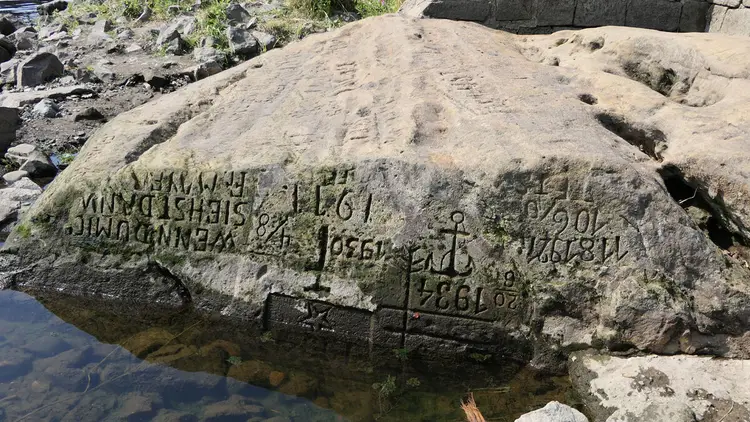
The severe European drought of 2022 caused river levels to fall so dramatically that long-submerged “hunger stones”reappeared in rivers such as the Elbe, Rhine, and Danube, drawing renewed attention to these stark historical warnings carved centuries ago into the riverbeds of Central Europe; created during periods of extreme drought, famine, and social distress, the stones marked dangerously low water levels that once halted river trade and ruined harvests, and many bear blunt inscriptions intended for future generations, including the famous Elbe stone dated 1616 that reads “If you see me, cry,” a message that resonates uncomfortably today as modern climate-driven droughts echo the conditions that once led to widespread hunger, revealing these stones not merely as archaeological curiosities but as enduring reminders of how closely human survival has long been tied to the rhythms, and failures of water.
Report
43points
#33

A Japanese man escaped his car after it plunged into a river on November 8 by recalling a scene from the anime Detective Conan
On November 8, he described a collision near a cemetery that sent his car into the water. “For the first 20 seconds I really thought this was it,” he wrote. “But then this scene flashed through my mind.”
He was remembering a sequence involving FBI agent Andre Camel, who escapes a submerged car in the anime. The scene showed a character breathing from an air pocket near the roof and waiting for water pressure to equalize before opening the door.
The driver says the memory helped him react: he found the door handle, pushed the door open and swam out.
A nearby resident helped him reach the bank. After describing his escape, he had one person he especially wanted to thank: “I can’t thank the creator of Conan enough.”
Report
43points
#34
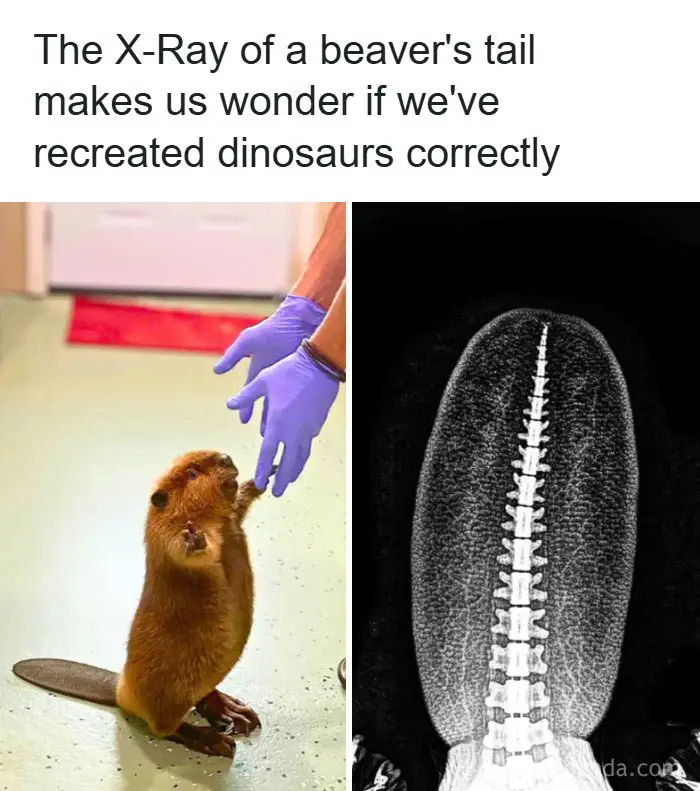
The X-ray of a beaver’s tail is a striking reminder of how misleading bones alone can be. On the outside, the beaver’s tail is flat and leathery, yet its skeleton shows only a narrow line of vertebrae. The distinctive paddle shape comes not from bone, but from fat, connective tissue and skin, none of which would survive in the fossil record.
This illustrates a major challenge paleontologists face when reconstructing the bodies of extinct animals such as dinosaurs. Fossils usually preserve only bones and, in rare cases, impressions of skin or feathers. The muscles, fat, colors, and unique adaptations that shaped how these creatures looked and lived are often lost to time. Without modern beavers as a reference, one might wrongly assume they had thin, rat-like tails. Similarly, many dinosaur reconstructions have changed over the years as new fossil evidence revealed feathers, soft crests, or body shapes that were invisible from skeletons alone.
Rebuilding extinct animals is therefore a blend of science and imagination. Bones give us the framework, but the living creature, the texture, the weight, the vibrant adaptations, requires careful inference and sometimes a bit of guesswork. The beaver’s tail reminds us that even the strangest features of life often lie hidden beyond the bones.
Report
42points
#35
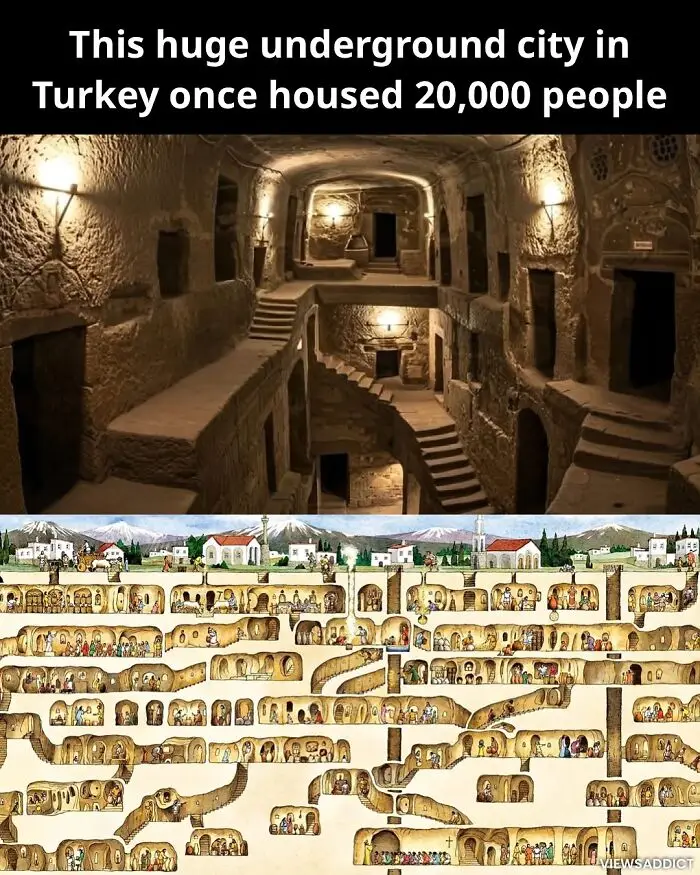
Beneath the volcanic rock formations of Cappadocia in central Turkey lies Derinkuyu, the largest underground city ever discovered. Descending about 85 meters (280 feet) into the earth and stretching across 18 levels, it is believed to have housed up to 20,000 people, along with their livestock, food stores, and even schools and chapels. Ventilation shafts, wells, kitchens, stables, wine presses, and massive rolling stone doors reveal a design focused on survival and security.
The official archaeological interpretation is that Derinkuyu was first dug by the Phrygians around the 8th–7th century BCE and later expanded during the Byzantine era. Scholars argue that its purpose was clear: a fortified refuge. Christian communities used it during times of persecution, and the city protected local populations during the Arab–Byzantine conflicts between the 7th and 12th centuries AD. Tool marks linked to iron implements support this dating. To archaeologists, Derinkuyu was a city built to withstand raids and invasions — a practical defense strategy for dangerous times.
But the journalist and scholar Graham Hancock challenges this explanation. He suggests that Derinkuyu was far older — perhaps as early as 9500 BC, during the climatic upheavals of the Younger Dryas. He argues that the city makes more sense as a survival bunker against cataclysmic events, such as sudden climate shifts or cosmic disasters, rather than as a military hideout.
Hancock highlights a key problem with the siege-defense theory: if Derinkuyu’s residents had simply been hiding from human enemies, “they would have been screwed.” An army could have easily blocked the exits, cutting off supplies, and then waited aboveground until those inside were forced to emerge. From this perspective, Hancock argues that the city’s enormous scale and sophisticated ventilation system suggest it was designed for long-term underground survival — not to outlast an enemy at the surface, but to endure a disaster that made the surface itself unlivable.
Derinkuyu remains a marvel of human ingenuity, a vast city hidden beneath the earth, still keeping its ultimate purpose shrouded in mystery.
Report
40points
#36
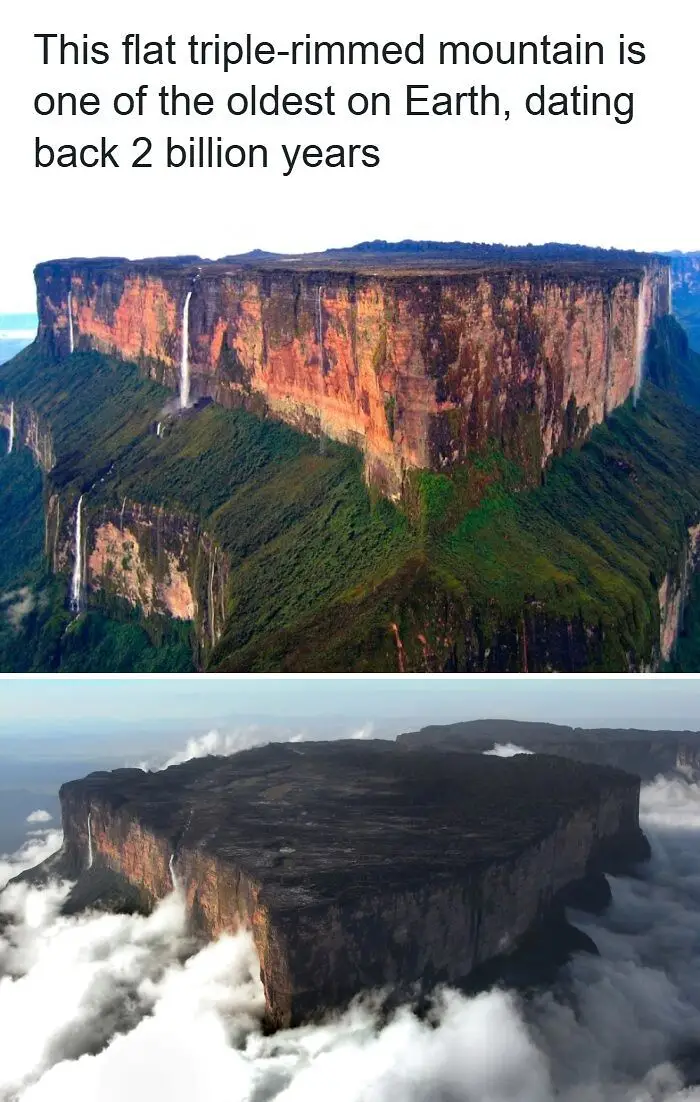
This geometrically shaped mountain with a flat top and triple rim is one of the oldest on Earth, dating back two billion years - when the land was lifted high above the ground by tectonic activity. The sides of the mountain are sheer vertical cliffs, with several waterfalls, making it nearly impossible to climb.
Mount Roraima is an anomaly from the typical idea of a mountain peak, as it is more a plateau than a mountain, with a summit that is approximately 31 km^2.
Mount Roraima is the highest of the Pakaraima chain of tepui plateaus in South America. First described by the English explorer Sir Walter Raleigh in 1596, its 31 km^2 summit area is bounded on all sides by cliffs rising 400 meters.
Report
38points
#37
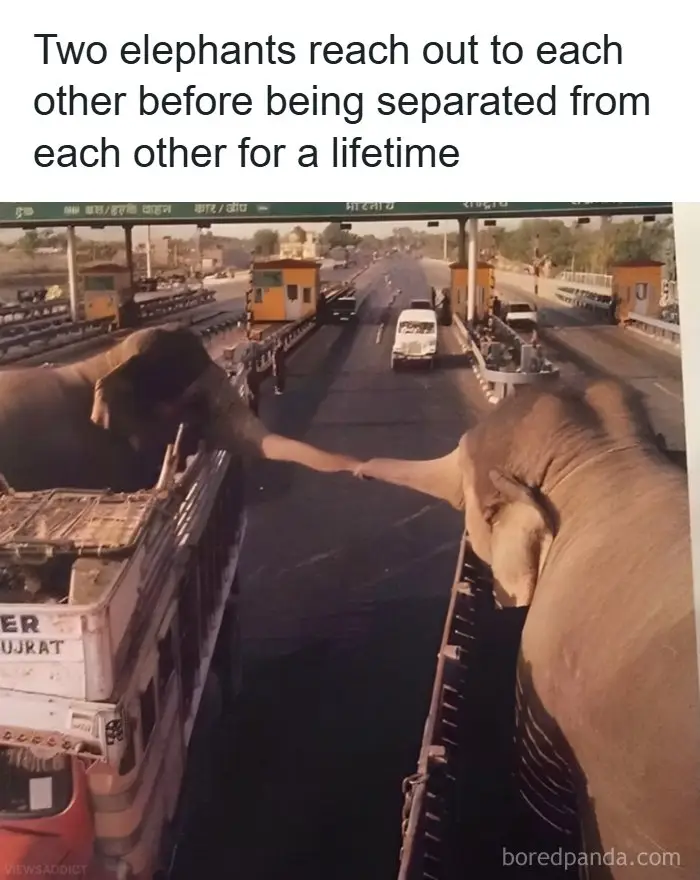
A real, albeit tragic, moment captured on an Indian highway in December 2016, depicts two elephants, accustomed together and separated due to human service or tourism, reached for each other in a poignant trunk-to-trunk embrace as a final moment of connection before being taken to different destinations.
Elephants are among the most social and emotionally complex animals on Earth. At the heart of their lives is family, a tightly knit group led by a matriarch, where every member plays a role in caring for and protecting one another.
It’s well known that elephants value their family structure, perhaps more so than many other animals. Calves depend not only on their mothers but also on “allomothers,” relatives who help raise and guide them. Older elephants pass down knowledge of migration routes, water sources, and survival strategies. These bonds are more than practical, they are deeply emotional.
When elephants become separated from their families, they often experience profound distress. Researchers have documented signs of grief, from elephants lingering near the bones of deceased relatives to their mournful trumpets when a calf is taken away. Their sadness and pain reveal the depth of their attachments and highlight just how central family is to their existence.
Report
34points
#38
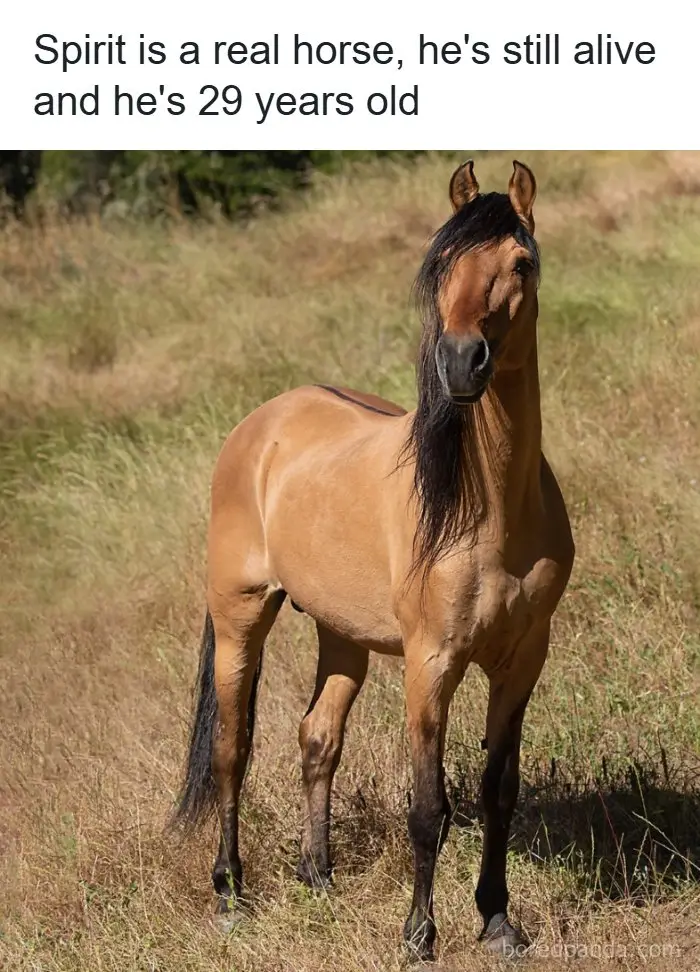
Spirit from the movie is a real horse, he’s still alive and he’s 29 years old.
DreamWorks selected the now-named Spirit when he was a colt. Born to a stallion and mare that had been captured by the BLM in Oregon, Spirit was (and still is) a beautiful example of the Kiger mustang breed. His wide-set eyes and thick, wavy, multi-colored tail and mane became the inspiration for the animated horse that is still stealing hearts all these years later.
Like his animated character, the real-life Spirit is part of the fight to help wild horses maintain their natural habitats and freedom. While he lives at the sanctuary and loves interacting with people, Spirit is a prominent ambassador for wild horses. He engages youth around the world to learn more about America’s mustangs and every horse’s need for freedom and protection.
He lives on Return to Freedom’s headquarter facility in Santa Barbara County on 300 acres of pristine California pasture. From a young age he learned to be comfortable around people, but those who know him best say he has a spirit similar to that of his fictional character. He’s grown to be an important part of the wild horse sanctuary, and he’s helping educate the public about his breed and ways humans can protect all of America’s wild horses.
With Spirit’s claim to fame, he attracts crowds of fans to his sanctuary home. During these visits, the real-life Spirit helps the sanctuary spread an important message about what’s currently happening to the country’s wild horses and what the public can do to help.
Now 25 years old, the real-life Spirit is busy enjoying life at the sanctuary. He spends his days interacting with a few of his equine friends and enjoying attention and care from his favorite humans. He was born in captivity, but the spirit of independence and the wild west lives in his veins. And thanks to Spirit: Stallion of the Cimarron, his image will continue to show others that freedom is always worth fighting for.
Report
34points
#39

Florida Deputy Robert Pounds pulled over a speeding car, but instead of issuing a ticket, he helped deliver a baby girl in the passenger seat, who was born quickly at the roadside. The father was rushing his wife, who was in labor, to the hospital when Pounds made the stop. After the delivery, mother and baby were checked by paramedics and transported to the hospital, with the baby, named Leila Robert Jean Lewis, honoring the deputy.
Report
34points
#40

A weasel riding on the back of a green woodpecker - Photographer Martin Le-may captured this photo in 2015.
Though this looks like it could be a fantastic animal rendition of Jasmine’s magic carpet ride from Disney’s classic Aladdin, the photo is real and the truth behind it is somewhat more sinister. Martin Le-May, a hobby photographer in East London, took these photos of a woodpecker and a baby weasel fighting for their lives over Hornchurch Country Park.
Report
33points