





Your insatiable curiosity is something you should never be ashamed of. That desire to learn more about the world that surrounds us is hardwired into you. But no matter how educated you are, there will always be something new to learn.
We are featuring the most interesting and thoroughly weird facts and stories from around the globe, as shared on one popular Instagram account. Scroll down if you’re in the mood to learn something new and expand your mind.
#41

In 1996, a 12-year-old boy living in Pensacola, Florida, named Hunter Scott, watched Jaws on home video and became deeply interested in a monologue by Quint about the USS Indianapolis and shark attacks during World War II. He later learned the story was based on a real event.
In one short scene in the film, Quint delivers a brief monologue describing survivors of the sinking being attacked by sharks while stranded at sea, which deeply captured the boy’s attention.
Hunter Scott, began researching the 1945 sinking of the USS Indianapolis, interviewed around 150 survivors and reviewed 800 documents. His research focused on the role of the ship’s captain, Charles B. McVay III, who had been court-martialed after the incident. He concluded that the ship’s Captain Charles Butler McVay III, who had been blamed for the tragedy, was innocent.
Scott presented his findings to the United States Congress at age 14. In 2000, Congress passed a resolution clearing Captain McVay’s name, and the U.S. Navy later formally exonerated him.
Report
2points
#42

Kirk Alexander from Salem, Oregon, was the ultimate creature of habit. For over a decade, he ordered food online from the exact same Domino’s store every single day. The staff knew his routine by heart.
Then, his daily orders suddenly vanished.
At first, the evening delivery drivers didn’t panic, assuming Kirk had finally gone out of town or was visiting family. But the days kept stretching on.
The turning point came on a Saturday night, a specific night Kirk had literally never missed in years.
When his order failed to pop up on the screen by midnight, the store manager, Sarah Fuller, knew something was deeply wrong. She opened the store’s database and confirmed the reality: Kirk hadn’t placed an order in exactly 11 days.
Knowing Kirk lived alone and had suffered from health issues in the past, Sarah didn’t hesitate. At 1:00 AM, she sent a veteran delivery driver straight to his house.
When the driver arrived, he saw the lights were on and could hear the television blaring inside, but nobody answered the door. He tried calling Kirk’s phone, and it went straight to voicemail. He immediately dialed 911.
Deputies forced entry into the home and found Kirk collapsed on the floor. He had suffered a severe stroke and had been trapped inside, unable to move or call for help, for days. Doctors later confirmed that he was in critical condition and wouldn’t have survived another 24 hours.
It wasn’t a doctor or a neighbor who saved Kirk, it was the staff of his favorite pizza place who paid attention when his routine broke.
Report
2points
#43
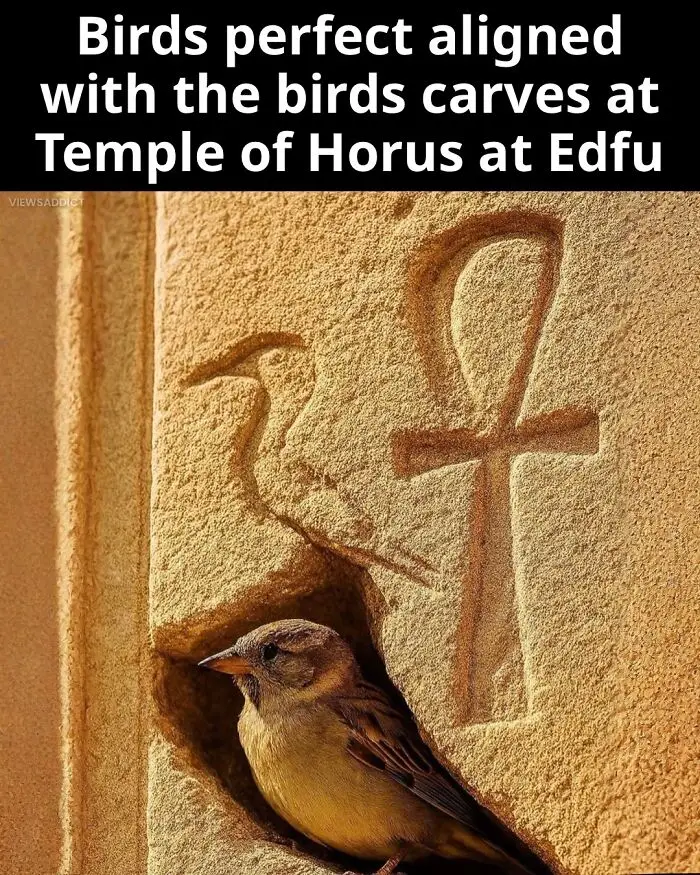
The Temple of Horus at Edfu is one of the best-preserved ancient Egyptian temples, dedicated to the falcon god Horus, symbol of kingship and protection. Built in the Ptolemaic period, its walls are covered with detailed carvings meant to act as sacred “stone texts.”
Common symbols include the ankh, representing life and divine power, and the falcon of Horus, representing the god himself watching over Egypt. Many reliefs also depict the mythic struggle between Horus and Seth, symbolizing the eternal balance between order and chaos.
Common symbols include the ankh, representing life and divine power, and the falcon of Horus, representing the god himself watching over Egypt. Many reliefs also depict the mythic struggle between Horus and Seth, symbolizing the eternal balance between order and chaos.
Report
2points
#44

In 2015, an unusual friendship captured the hearts of millions around the world. At a safari park in Primorsky, Russia, a goat was placed into a Siberian tiger’s enclosure as part of the tiger’s weekly live prey feeding routine. Keepers fully expected the tiger, named Amur, to hunt the goat immediately.
Instead, something remarkable happened—the tiger spared the goat’s life. The goat, later named Timur, showed no fear and calmly wandered the enclosure, even taking over Amur’s sleeping spot. To the amazement of staff and visitors, the tiger accepted Timur as a companion rather than a meal.
The unlikely pair spent weeks together, sharing the same space, walking side by side, and even playing.
Their friendship became a global sensation, symbolizing resilience, peace, and the unexpected ways life can defy instincts. Though their companionship eventually ended, the story of Amur and Timur remains a powerful reminder that friendship can blossom in the most surprising places.
Report
2points
#45
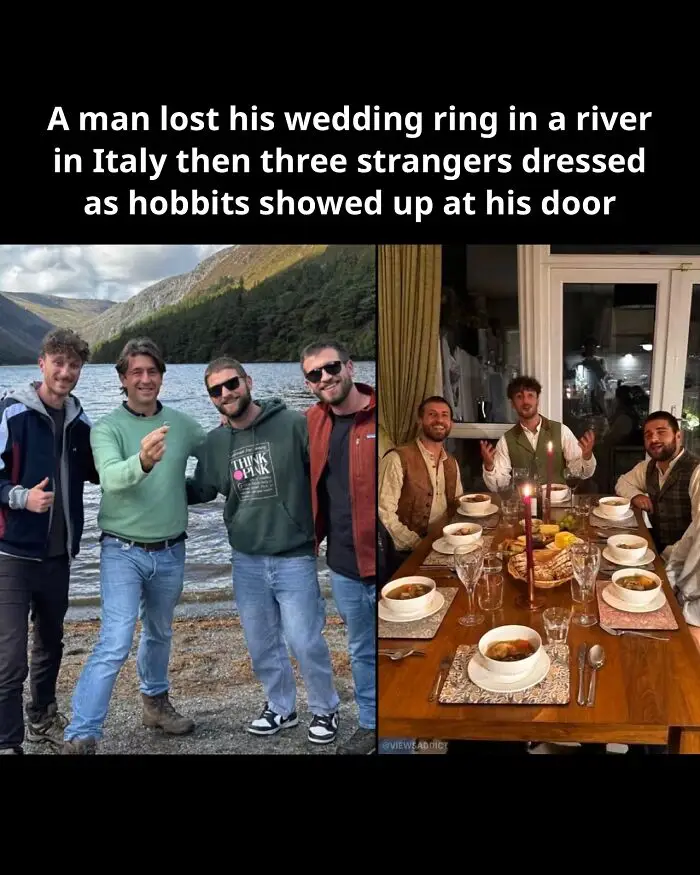
Patrick Mohr, an Irishman married for 16 years, lost his wedding ring in a mountain stream in Tuscany while playing with his daughters.
His wife asked three Italian men nearby for help, Filippo, Nicola and Edoardo. They took his number and promised to keep an eye out.
Naturally, they turned it into a quest.
Filippo, Nicola and Edoardo spent days searching, eventually tying themselves to boulders and diving into the rapids.
Against ridiculous odds, they found it.
Nine days after losing it, Patrick got a text from an unknown Italian number: a photo of his ring, with the message: “Hi Sméagol, look what we found.”
But they didn’t just mail it back.
Filippo, Nicola and Edoardo flew more than 1,000 miles to Ireland, showed up at his door dressed as Frodo, Merry and Sam.
Patrick later described the moment they arrived:
“They approached me, all three dressed like hobbits, playing music from the Lord of the Rings to hand me back the ring.”
Patrick invited them inside for a dinner togheter, and they became friends that night.
Sometimes the right people find you in the most unexpected way.
Report
2points
#46
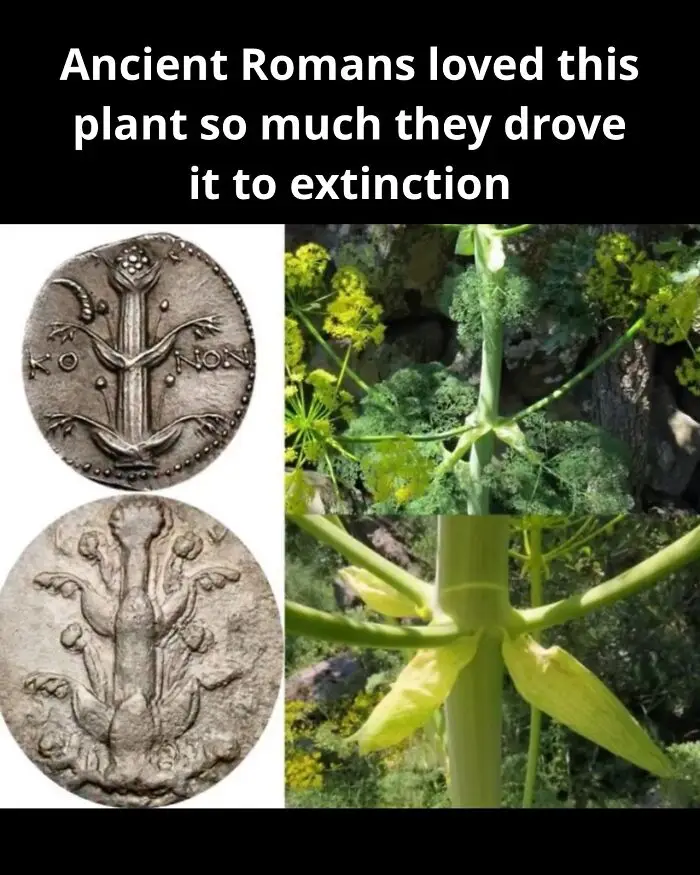
Julius Caesar reportedly kept a stockpile of it in the Roman treasury. Emperor Nero is said to have owned the very last stalk of it. And yet today, not a single living specimen exists anywhere on Earth. The plant is called silphium, and its story is one of ancient history’s most captivating mysteries.
Silphium grew wild only along the north coast of modern-day Libya and stubbornly refused to be cultivated by human hands.
The Greeks and Romans prized it above almost everything else, using it as a contraceptive, an abortifacient, a medicine, a food seasoning, a perfume ingredient, and even a livestock improver.
Its resin, extracted from the roots and stems and preserved in flour for long-distance trade, was so valuable that it appeared on coins and was treated as a state-controlled resource.
Ancient medical texts, including a four-volume gynecology treatise by the physician Soranus of Ephesus, describe how silphium mixed with wine could be taken orally to prevent conception. As a food, it was categorized as a warming, clearing herb believed to remove internal obstructions and prevent pregnancy depending on when it was consumed. The heart-shaped seed pods depicted in ancient art may even be the origin of the heart symbol we associate with love today.
Because it could not be farmed, supply was always finite and demand was relentless. Climate change, the desertification of North Africa, deliberate vandalism by local populations resentful of state control, and overgrazing by livestock are all believed to have contributed to its extinction by around the 1st century CE.
A giant fennel species discovered in Turkey in 2021, Ferula drudeana, bears a striking resemblance to ancient depictions of silphium, and may be a surviving relative, but the mystery remains officially unsolved.
Report
2points
#47

It was January 2026, Vipan Kumar was just an ordinary guy; an Indian construction worker who moved to Romania to support his 8-year-old daughter back home.
One morning while walking through a park in Craiova, a nightmare unfolded right in front of him.
A 5-year-old girl ran onto a frozen lake. The ice instantly gave way, plunging her into the sub-zero water. Her father tried to jump in but became trapped in the broken ice.
Without a second thought, Vipan grabbed a sled and rushed onto the ice. But midway through, the ice shattered beneath him too, dragging him into the freezing depths.
Instead of panicking or swimming away to save himself, Vipan grabbed the little girl and held her body above the water for nearly 30 agonizing minutes until rescue teams arrived.
Both survived severe hypothermic shock.
Romania was so moved by his bravery that the city officially awarded him honorary citizenship.
But the story didn’t end there. Deeply touched by his sacrifice, the local community raised funds to send him on an all-expenses-paid trip back to India, allowing him to finally reunite with his 8-year-old daughter.
This is the recent story of Vipan Kumar. From an immigrant construction worker to a certified national hero.
Report
2points
#48
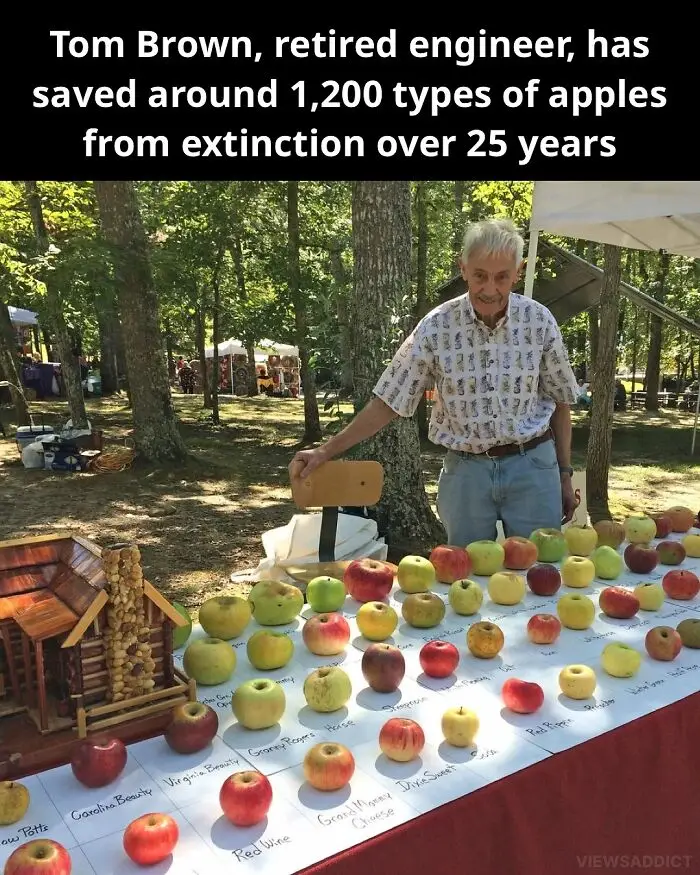
For the past 25 years, retired engineer Tom Brown has dedicated his life to preserving a forgotten part of America’s agricultural history: heirloom apples. Traveling through the Appalachian region, Brown has tracked down and saved around 1,200 rare apple varieties that were on the brink of extinction.
Many of these apples, once cultivated by small farms and homesteads, had vanished from markets and orchards as commercial agriculture shifted toward a handful of high-yield varieties. Brown’s work involves locating old trees, collecting cuttings, and grafting them to ensure the apples endure for future generations.
What began as a hobby has become a mission of preservation. His efforts not only safeguard biodiversity but also keep alive the flavors, colors, and stories of apples that were once integral to rural communities.
Thanks to Brown’s dedication, apples thought lost forever are finding new life in orchards and inspiring renewed interest in heritage fruit.
Report
2points
#49
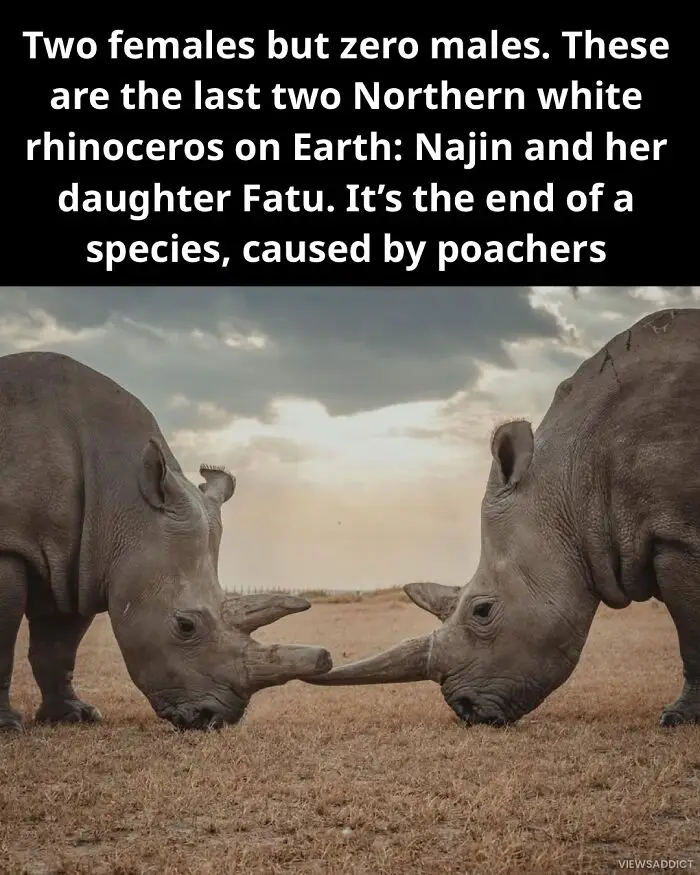
There are only two living northern white rhinoceroses left in the world, and both are female: Najin and her daughter Fatu. The last male, Sudan, d**d in 2018 in Kenya.
Because no males remain, the northern white rhino is considered “functionally extinct”, meaning the subspecies can no longer reproduce naturally.
There were around 500 Northern White Rhinos in the 1970s. By the late 1980s, only about 15 remained in the wild, largely because of poaching.
However, it is not necessarily the absolute end yet. Scientists have preserved material from deceased males and have created viable embryos using IVF techniques. The plan is to implant those embryos into surrogate southern white rhinos.
Even though it is hard, scientists are still trying to save it.
Report
1point
#50

A US woman sued a casino that told her the slot machine displaying a $43m (£34m) jackpot was faulty and offered a steak dinner instead.
Katrina Bookman hit the largest slot machine jackpot in US history at Resorts World Casino in Jamaica, Queens, and took a selfie showing the machine saying “printing cash ticket $42,949,672.76”. However, when she returned to find out her winnings, a casino employee informed her she had not won anything but only $2.25.
The New York State Gaming Commission confirmed that Bookman’s machine had malfunctioned, and the casino offered her a complimentary steak dinner instead.
The lawsuit filed at the Queens County Supreme Court said the Sphinx slot machine’s “bells, noises and lights” as well as the message on the screen told Ms Bookman she had won the jackpot. The subsequent disappointment left Ms Bookman anxious and depressed, the report said. She seeked damages from the casino for failing to maintain the slot machine as well as two companies that make and operate games machine.
A Resorts World spokesman said at the time that the machine had suffered an “obvious malfunction”.
The New York State Gaming Commission said Bookman’s machine had malfunctioned, and that she’d actually won just $2.25 (£1.86). The machine had a disclaimer stating ‘malfunctions void all pays and plays’, and as a result the commission said that they were required by law to give Bookman only what she’d actually won.
Unfortunately, there was no happy ending for Katrina Bookman. After delays to the case due to Covid, a judge at Queens County Supreme Court eventually ruled in favor of the defendants.
The reality was, the machine malfunctioned and the machine did display the following warning message to all players: Malfunctions void all pays and plays.
Report
1point
#51
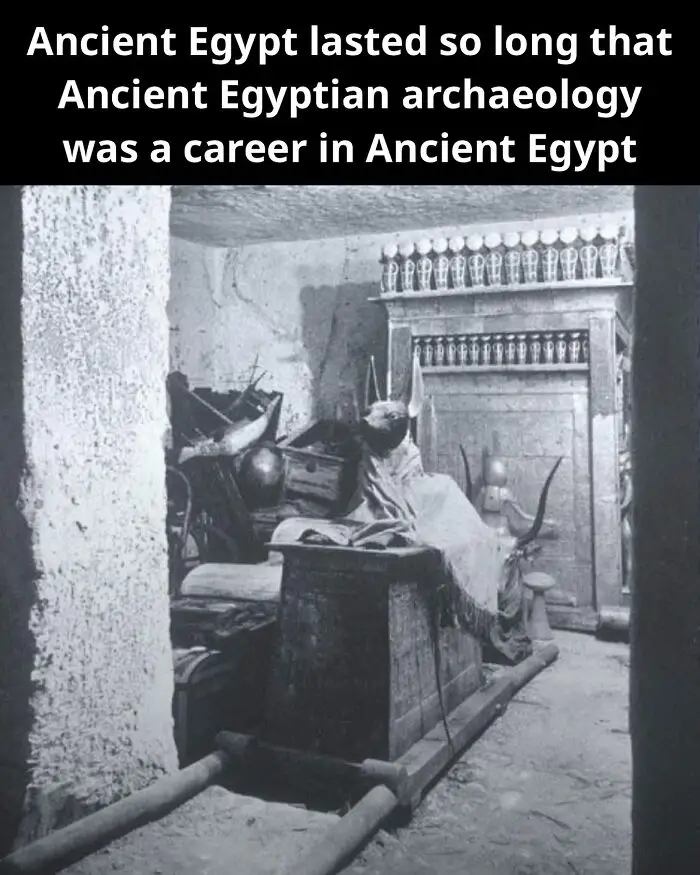
Some Ancient Egyptians, like Prince Khaemwaset under Ramesses II, engaged in activities akin to modern archaeology by excavating and restoring older structures from previous dynasties, a practice rooted in a conservative cultural appreciation for the past as a source of wisdom and authority. This ancient practice of studying and preserving their own civilization’s history demonstrates a form of “archaeology” within ancient Egypt itself, preceding the modern field of Egyptology.
Ancient Egypt lasted, as far as we know, for over 3,000 years, with its civilization starting around 3150 BC and ending with the Roman conquest in 30 BC, which marked the end of pharaonic rule and Cleopatra VII’s reign. This longevity made it one of the most enduring civilizations in human history, characterized by a remarkable continuity of culture and the iconic monuments like pyramids and temples left behind.
Ancient Egypt lasted, as far as we know, for over 3,000 years, with its civilization starting around 3150 BC and ending with the Roman conquest in 30 BC, which marked the end of pharaonic rule and Cleopatra VII’s reign. This longevity made it one of the most enduring civilizations in human history, characterized by a remarkable continuity of culture and the iconic monuments like pyramids and temples left behind.
Report
1point
#52

A blind Chicago man whose service dog was stolen is walking up to seven miles (11 km) each day, handing out “missing” flyers in hope to find his dog.
Angel Santiago, who became legally blind due to glaucoma and also manages Type 2 diabetes, says his beloved 14-year-old dachshund, Bam Bam, was stolen from the yard at his home in Chicago’s Logan Square neighborhood.
Now, he walks up to seven miles or more each day, giving out flyers to people in hopes that someone has seen his beloved pooch.
“Bam Bam means the world to me, and I feel my body draining away. I can only do so much,” Santiago said.
Report
1point
#53

At Kaikyokan Aquarium in Japan, a sunfish stopped eating and showed signs of distress after the facility closed for renovations in December 2024. With no physical health issues found, staff believed the fish was reacting to the sudden absence of visitors it had grown used to seeing each day.
To help, they placed photos of human faces on the tank and hung staff uniforms nearby. The next day, the sunfish began eating again and became more active, showing clear interest in the cutouts. The aquarium’s quick and creative response shows how even solitary animals can be affected by changes in their environment, and how simple actions can support their mental well-being.
To help, they placed photos of human faces on the tank and hung staff uniforms nearby. The next day, the sunfish began eating again and became more active, showing clear interest in the cutouts. The aquarium’s quick and creative response shows how even solitary animals can be affected by changes in their environment, and how simple actions can support their mental well-being.
Report
1point
#54

Before the EPA’s 1970 creation, America faced severe pollution, with legal dumping of toxic waste, rivers catching fire from industrial discharge, heavy smog, and little federal oversight, as environmental protection was fragmented and state-run, leading to a “race to the bottom” in regulations until the first Earth Day and growing public outcry spurred federal action for comprehensive laws like the Clean Air Act.
Before the EPA, states would actively try to encourage businesses to setup shop in their state by competing on what the companies could get away with like dump harmful chemicals, not properly treat byproducts, etc.
The EPA was created to set nationwide standards. It was created out of rising public pressure to control pollution, but one side effect was that states could no longer allow their lands to be destroyed to the highest bidder.
Report
1point
#55

Italian MEP brought her daughter to work when she was just 44 days old - and kept bringing her for three years straight
When Italian MEP Licia Ronzulli stepped into the European Parliament with her daughter Vittoria, just 44 days old, it was more than a mother returning to work. It was the beginning of a quiet revolution. For over three years, session after session, Ronzulli brought Vittoria with her into the heart of European politics, turning the parliamentary floor into a powerful symbol of motherhood, inclusion, and resilience.
By the time she turned three, Vittoria had become a veteran of the Parliament. From just six weeks old to a toddler with a front-row seat to democracy, she sat beside her mother through countless votes and debates—sometimes sleeping, sometimes watching, always present. And she didn’t come alone. Whenever Ronzulli raised her hand to vote, so did Vittoria, and so did her constant companion, Po the Teletubby, who often joined in with an enthusiastic wave.
The pictures are wonderful. Not just because they are charming, but because they show how surreal it can be to be a working mother. When Ronzulli first parcelled her daughter up in a sling and marched into parliament, she did it not to be political but to be maternal, she said. She was still breastfeeding and had to come into work to vote, to do her job and earn a crust. As her daughter has grown, she has become a powerful symbol. “I have been bringing her along because I want to show the difficulties faced by a woman who works and is also a mother,” said Ronzulli.
Report
1point
#56

Japan has completed a massive 395km (246 miles) tsunami wall and planted 9 million trees along its coastline to shield communities from tsunamis, storm surges, and rising seas. This project blends engineering with natural defenses, serving as a global model for disaster resilience and eco-friendly protection.
Report
1point
#57
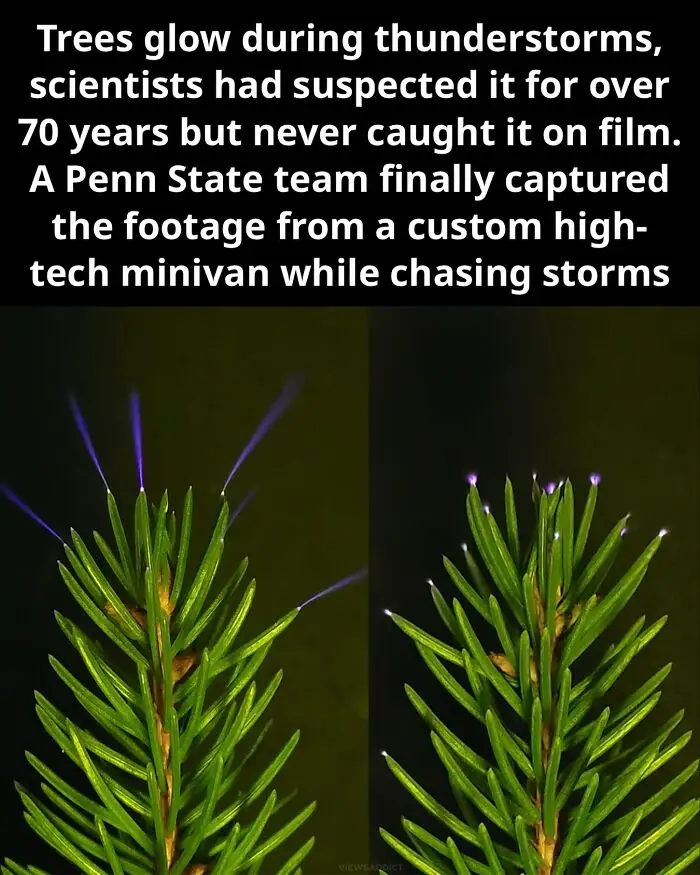
For over 70 years, meteorologists theorized that forests weren’t just standing still during thunderstorms, they were electrically alive. This year, a Penn State team finally proved it. The eerie glow comes from corona discharges, which are tiny, high-frequency electrical pulses that ignite at the very tips of leaves. As massive storm clouds roll in, they carry a heavy negative charge that acts like a giant magnet, pulling an intense positive charge up from the Earth and through the veins of every tree.
This was captured by researchers William Brune and Patrick McFarland, who transformed a 2013 Toyota Sienna into a mobile laboratory to track the phenomenon. After weeks of chasing elusive storms through Florida, the team finally caught their target on camera. While parked in a North Carolina lot during a raging storm, they filmed hundreds of these electrical events flickering across the leaves of a sweetgum tree and a nearby loblolly pine.
The most mind-blowing reality is that this isn’t just a light show, it is a massive, planetary chemical factory. These billions of tiny sparks produce hydroxyl radicals (OH), which are known as the “detergent of the atmosphere.” This means that during a thunderstorm, an entire forest transforms into a glowing, purple-hued air purifier, aggressively breaking down greenhouse gases like methane on a global scale. We now know that trees don’t just breathe out oxygen, they use the power of the storm to scrub the very air we breathe.
Report
1point
#58
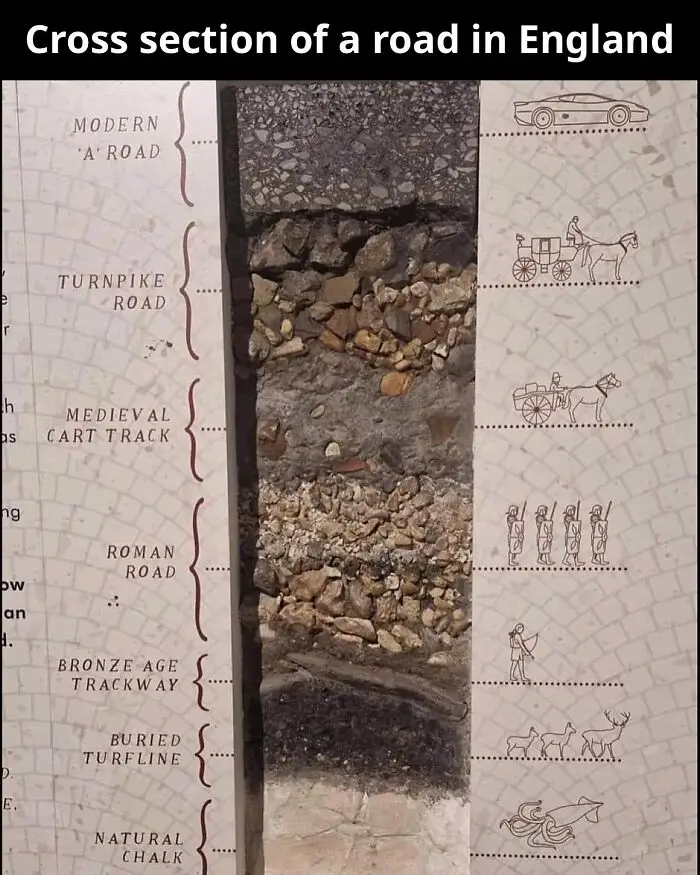
A ‘slice’ of the A303 main road in England showing several cross-sections dating from different eras, starting from the natural chalk and ending up to modern asphalt road.
The A303 is a major road in southern England, running between Basingstoke in Hampshire and Honiton in Devon via Stonehenge.
The A303 is a major road in southern England, running between Basingstoke in Hampshire and Honiton in Devon via Stonehenge.
Report
1point
#59
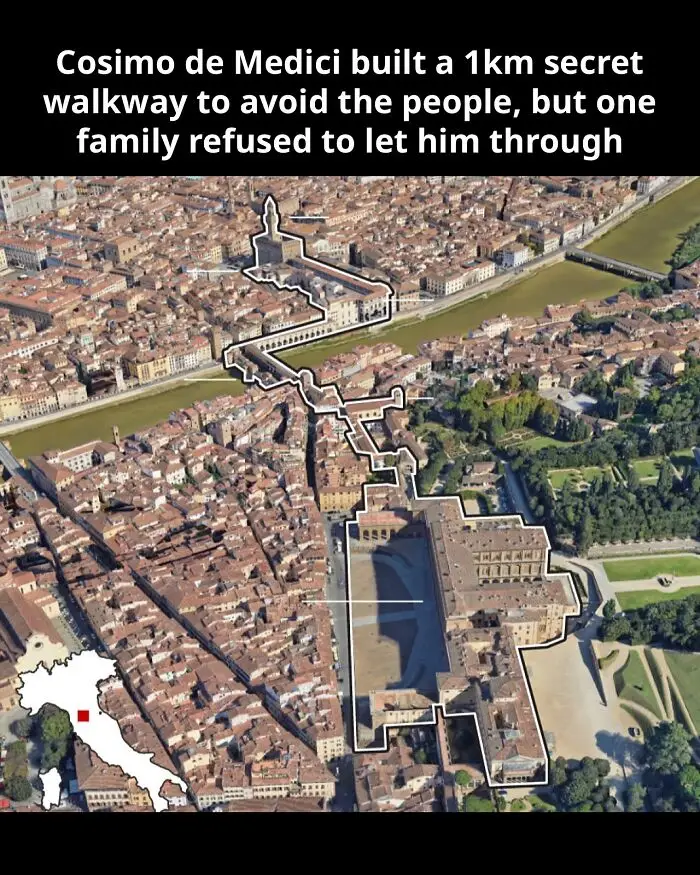
In 1565, Cosimo de Medici had a problem. As the ruler of Florence, he needed to travel daily between his residence at Palazzo Pitti and his office at Palazzo Vecchio, but walking through the city streets meant being exposed to the public.
So he ordered a private elevated corridor above the city. 1km long (0.6 mi), passing through buildings, above the Ponte Vecchio, across the Arno river.
Architect Giorgio Vasari built the entire structure in just 5 months.
But one family stood in the way. The Mannellis refused to have their tower demolished to make room for the corridor. Not even Cosimo de Medici could force them out.
So Vasari had no choice but to build around it. The detour is still visible today, a small bump in an otherwise straight corridor, 500 years later.
Some things even the most powerful men in history couldn’t control.
Report
1point
#60
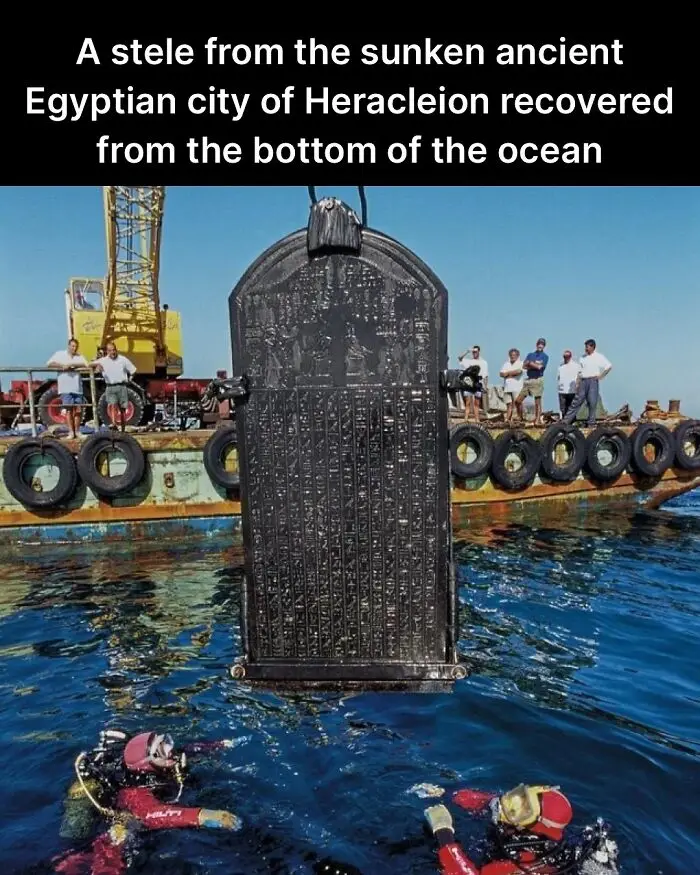
The Lost City Of Heracleion, which was once the largest port in Egypt, was discovered underwater after more than 2,000 years. Its legendary beginnings go back to as early as the 12th century BC, and it has many links to Ancient Greece.
Flourishing as long ago as the waning days of the Pharaohs, the city was destroyed over time, as it was weakened by a combination of earthquakes, tsunamis, and rising sea levels, according to archaeologists.
At the end of the 2nd century BC, most likely after a severe flood, the monumental buildings of Heracleion collapsed into the water. Some of its inhabitants stayed in what was left of the city during the Roman era and the beginning of Arab rule, but by the end of the eighth century AD, the rest of Heracleion had sunk beneath the Mediterranean.
The “Stele of Heracleion,” specifically referring to the one discovered in the sunken city of Thonis-Heracleion, is a black granodiorite stele inscribed with a royal decree by Pharaoh Nectanebo I. The stele depicts King Nectanebo I making offerings to the goddess Neith. It was found in 2000 by the IEASM and is dated to 380 BC.
A stele, or occasionally stela, when derived from Latin, is a stone or wooden slab, generally taller than it is wide, erected in the ancient world as a monument. The surface of the stele often has text, ornamentation, or both. These may be inscribed, carved in relief, or painted. Stelae were created for many reasons. Grave stelae were used for funerary or commemorative purposes. Stelae as slabs of stone would also be used as ancient Greek and Roman government notices or as boundary markers to mark borders or property lines. Stelae were occasionally erected as memorials to battles.
Report
1point