



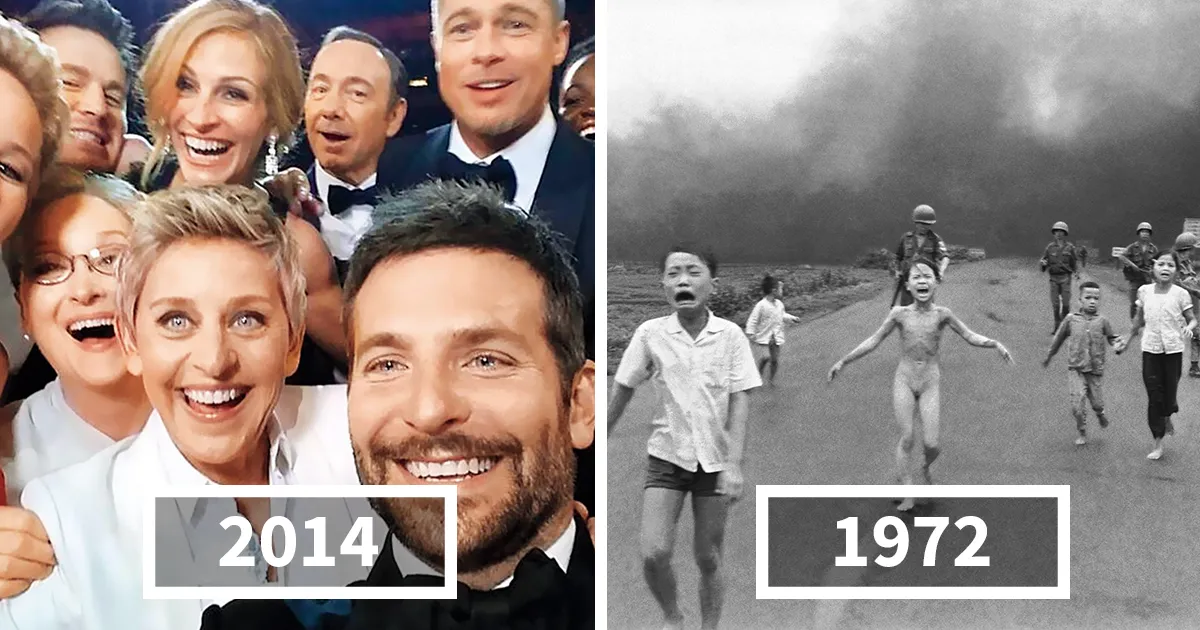

With millions of pictures taken every day, we can easily get lost in the vast world of images. That's why TIME magazine decided to create a list of the 100 most influential pictures ever taken. They teamed up with curators, historians, photo editors, and famous photographers around the world for this task. And now, you can find all of the most famous photos in one place, together with descriptions as to why these famous historical photos are such an important part of our legacy.
"No formula makes for iconic photos," the editors said. "Some rare historical photos are on our list because they were the first of their kind, others because they shaped the way we think. And some cut because they directly changed the way we live. What all of the 100 famous photos share is that they are turning points in our human experience."
The result they ended up with is not only a collection of superb historical photos but incredible human experiences as well. "The best photography is a form of bearing witness, a way of bringing a single vision to the larger world."
Ready to explore the world in a new view through the most famous photos of all time? If so, grab a cup of your favorite beverage and prepare for a journey that might just change the way you look at the world. The photo gallery of the most famous pictures of our age is right at your fingertips!
More info: time.com
#61 Bosnia, Ron Haviv, 1992
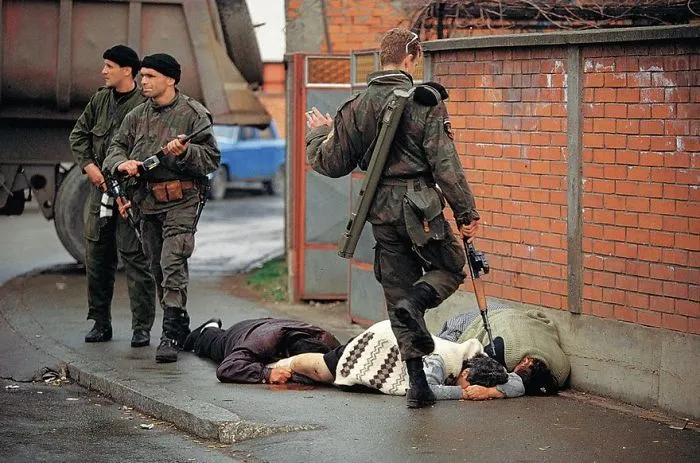
It can take time for even the most shocking images to have an effect. The war in Bosnia had not yet begun when American Ron Haviv took this picture of a Serb kicking a Muslim woman who had been shot by Serb forces. Haviv had gained access to the Tigers, a brutal nationalist militia that had warned him not to photograph any killings. But Haviv was determined to document the cruelty he was witnessing and, in a split second, decided to risk it. TIME published the photo a week later, and the image of casual hatred ignited broad debate over the international response to the worsening conflict. Still, the war continued for more than three years, and Haviv—who was put on a hit list by the Tigers’ leader, Zeljko Raznatovic, or Arkan—was frustrated by the tepid reaction. Almost 100,000 people lost their lives. Before his assassination in 2000, Arkan was indicted for crimes against humanity. Haviv’s image was used as evidence against him and other perpetrators of what became known as ethnic cleansing.
Report
20points
#62 Boulevard Du Temple, Louis Daguerre, 1839
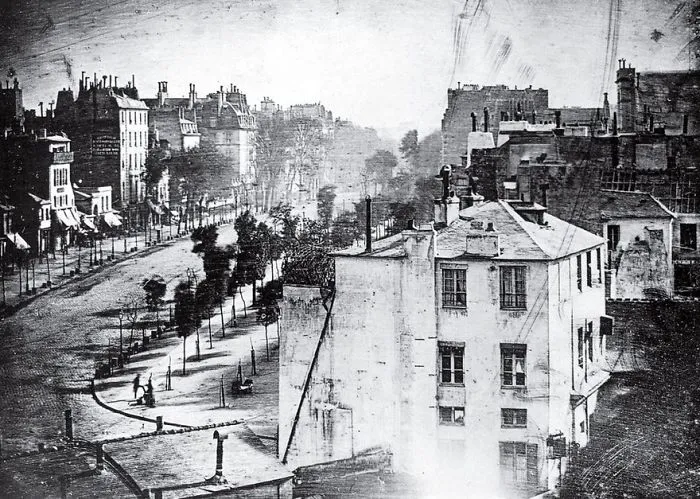
The shoe shiner working on Paris’ Boulevard du Temple one spring day in 1839 had no idea he would make history. But Louis Daguerre’s groundbreaking image of the man and a customer is the first known instance of human beings captured in a photograph. Before Daguerre, people had only been represented in artworks. That changed when Daguerre fixed his lens on a Paris street and then exposed a silver-plated sheet of copper for several minutes (though others came into the frame, they did not stay long enough to be captured), developed and fixed the image using chemicals. The result was the first mirror-image photograph.
Unlike earlier efforts, daguerreotypes were sharp and permanent. And though they were eventually outpaced by newer innovations—daguerreotypes were not reproducible, nor could they be printed on paper—Daguerre did more than perhaps anyone else to show the vast potential of the new medium of photography.
Report
19points
#63 The Dead Of Antietam, Alexander Gardner, 1862
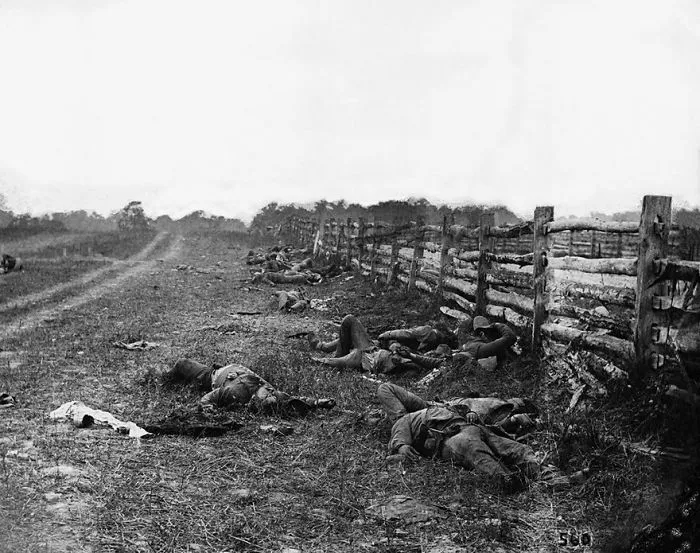
It was at Antietam, the blood-churning battle in Sharpsburg, Md., where more Americans died in a single day than ever had before, that one Union soldier recalled how “the piles of dead ... were frightful.” The Scottish-born photographer Alexander Gardner arrived there two days after the September 17, 1862, slaughter. He set up his stereo wet-plate camera and started taking dozens of images of the body-strewn countryside, documenting fallen soldiers, burial crews and trench graves. Gardner worked for Mathew Brady, and when he returned to New York City his employer arranged an exhibition of the work. Visitors were greeted with a plain sign reading “The Dead of Antietam.” But what they saw was anything but simple. Genteel society came upon what are believed to be the first recorded images of war casualties. Gardner’s photographs are so sharp that people could make out faces. The death was unfiltered, and a war that had seemed remote suddenly became harrowingly immediate. Gardner helped make Americans realize the significance of the fratricide that by 1865 would take more than 600,000 lives. For in the hallowed fields fell not faceless strangers but sons, brothers, fathers, cousins and friends. And Gardner’s images of Antietam created a lasting legacy by establishing a painfully potent visual precedent for the way all wars have since been covered.
Report
19points
#64 Winston Churchill, Yousuf Karsh, 1941
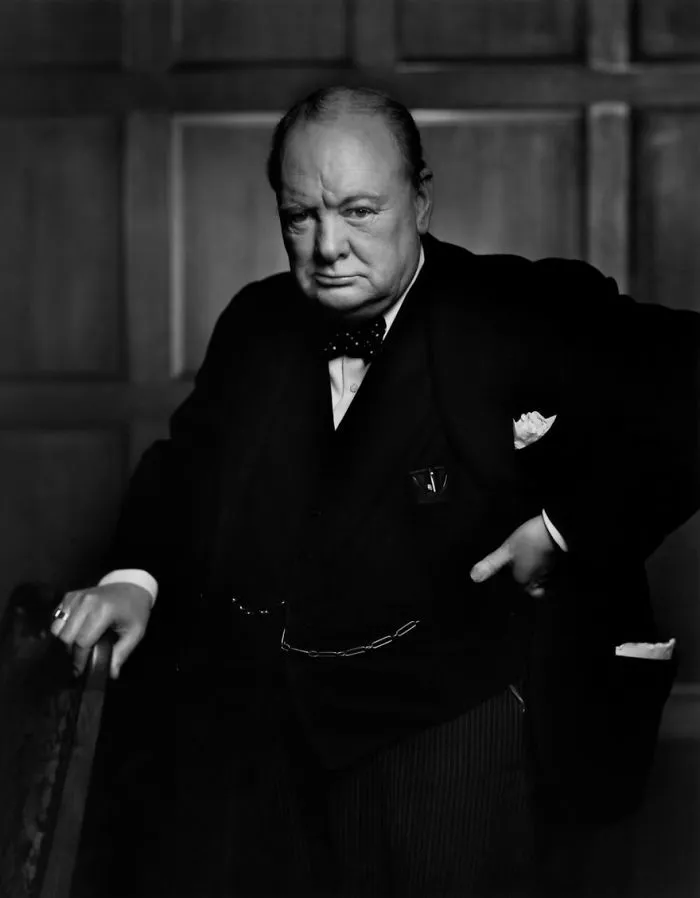
Britain stood alone in 1941. By then Poland, France and large parts of Europe had fallen to the Nazi forces, and it was only the tiny nation’s pilots, soldiers and sailors, along with those of the Commonwealth, who kept the darkness at bay. Winston Churchill was determined that the light of England would continue to shine. In December 1941, soon after the Japanese attacked Pearl Harbor and America was pulled into the war, Churchill visited Parliament in Ottawa to thank Canada and the Allies for their help. Churchill wasn’t aware that Yousuf Karsh had been tasked to take his portrait afterward, and when he came out and saw the Turkish-born Canadian photographer, he demanded to know, “Why was I not told?” Churchill then lit a cigar, puffed at it and said to the photographer, “You may take one.” As Karsh prepared, Churchill refused to put down the cigar. So once Karsh made sure all was ready, he walked over to the Prime Minister and said, “Forgive me, sir,” and plucked the cigar out of Churchill’s mouth. “By the time I got back to my camera, he looked so belligerent, he could have devoured me. It was at that instant that I took the photograph.” Ever the diplomat, Churchill then smiled and said, “You may take another one” and shook Karsh’s hand, telling him, “You can even make a roaring lion stand still to be photographed.”
The result of Karsh’s lion taming is one of the most widely reproduced images in history and a watershed in the art of political portraiture. It was Karsh’s picture of the bulldoggish Churchill—published first in the American daily PM and eventually on the cover of LIFE—that gave modern photographers permission to make honest, even critical portrayals of our leaders.
Report
19points
#65 Munich Massacre, Kurt Strumpf, 1972
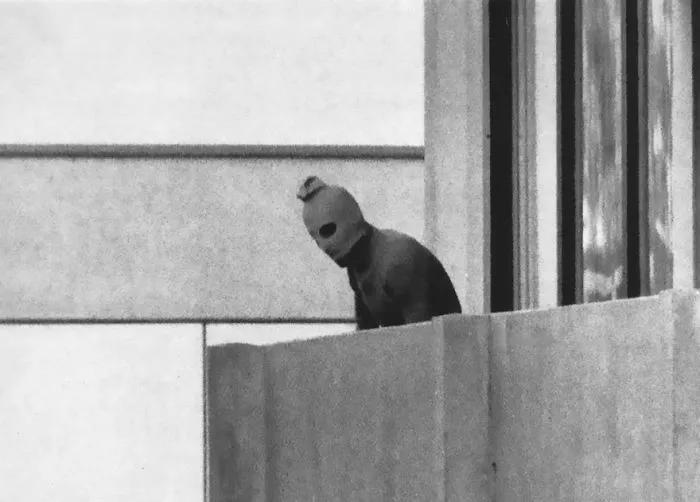
The Olympics celebrate the best of humanity, and in 1972 Germany welcomed the Games to exalt its athletes, tout its democracy and purge the stench of Adolf Hitler’s 1936 Games. The Germans called it “the Games of peace and joy,” and as Israeli fencer Dan Alon recalled, “Taking part in the opening ceremony, only 36 years after Berlin, was one of the most beautiful moments in my life.” Security was lax so as to project the feeling of harmony. Unfortunately, this made it easy on September 5 for eight members of the Palestinian terrorist group Black September to raid the Munich Olympic Village building housing Israeli Olympians. Armed with grenades and assault rifles, the terrorists killed two team members, took nine hostage and demanded the release of 234 of their jailed compatriots. The 21-hour hostage standoff presented the world with its first live window on terrorism, and 900 million people tuned in. During the siege, one of the Black Septemberists made his way out onto the apartment’s balcony. As he did, Associated Press photographer Kurt Strumpf froze this haunting image, the faceless look of terror. As the Palestinians attempted to flee, German snipers tried to take them out, and the Palestinians killed the hostages and a policeman. The already fraught Arab-Israeli relationship became even more so, and the siege led to retaliatory attacks on Palestinian bases. Strumpf’s photo of that specter with cut-out eyes is a sobering reminder of how we were all diminished when the world realized that nothing was secure.
Report
18points
#66 JFK Assassination, Frame 313, Abraham Zapruder, 1963
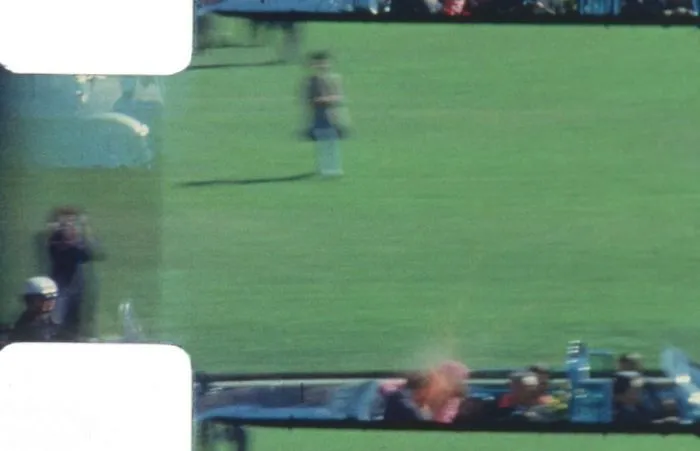
It is the most famous home movie ever, and the most carefully studied image, an 8-millimeter film that captured the death of a President. The movie is just as well known for what many say it does or does not reveal, and its existence has fostered countless conspiracy theories about that day in Dallas. But no one would argue that what it shows is not utterly heartbreaking, the last moments of life of the youthful and charismatic John Fitzgerald Kennedy as he rode with his wife Jackie through Dealey Plaza. Amateur photographer Abraham Zapruder had eagerly set out with his Bell & Howell camera on the morning of November 22, 1963, to record the arrival of his hero. Yet as Zapruder filmed, one bullet struck Kennedy in the back, and as the President’s car passed in front of Zapruder, a second one hit him in the head. LIFE correspondent Richard Stolley bought the film the following day, and the magazine ran 31 of the 486 frames—which meant that the first public viewing of Zapruder’s famous film was as a series of still images. At the time, LIFE withheld the gruesome frame No. 313—a picture that became influential by its absence. That one, where the bullet exploded the side of Kennedy’s head, is still shocking when seen today, a reminder of the seeming suddenness of death. What Zapruder captured that sunny day would haunt him for the rest of his life. It is something that unsettles America, a dark dream that hovers at the back of our collective psyche, an image from a wisp of 26.5 seconds of film whose gut-wrenching impact reminds us how everything can change in a fraction of a moment.
Report
17points
#67 Kent State Shootings, John Paul Filo, 1970
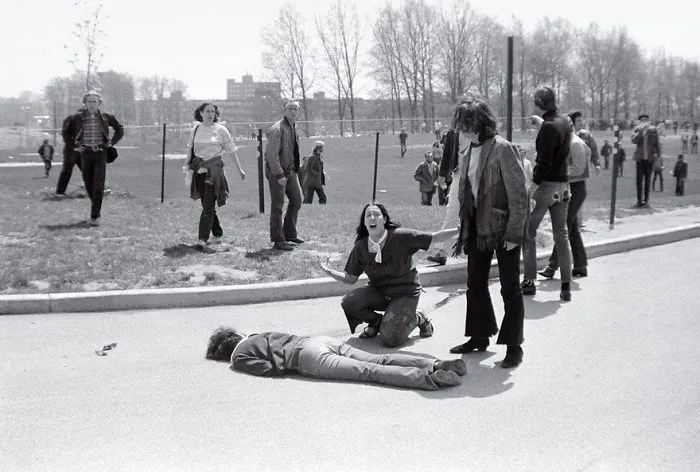
The shooting at Kent State University in Ohio lasted 13 seconds. When it was over, four students were dead, nine were wounded, and the innocence of a generation was shattered. The demonstrators were part of a national wave of student discontent spurred by the new presence of U.S. troops in Cambodia. At the Kent State Commons, protesters assumed that the National Guard troops that had been called to contain the crowds were firing blanks. But when the shooting stopped and students lay dead, it seemed that the war in Southeast Asia had come home. John Filo, a student and part-time news photographer, distilled that feeling into a single image when he captured Mary Ann Vecchio crying out and kneeling over a fatally wounded Jeffrey Miller. Filo’s photograph was put out on the AP wire and printed on the front page of the New York Times. It went on to win the Pulitzer Prize and has since become the visual symbol of a hopeful nation’s lost youth. As Neil Young wrote in the song “Ohio,” inspired by a LIFE story featuring Filo’s images, “Tin soldiers and Nixon coming/ We’re finally on our own/ This summer I hear the drumming/ Four dead in Ohio.”
Report
17points
#68 The Falling Soldier, Robert Capa, 1936
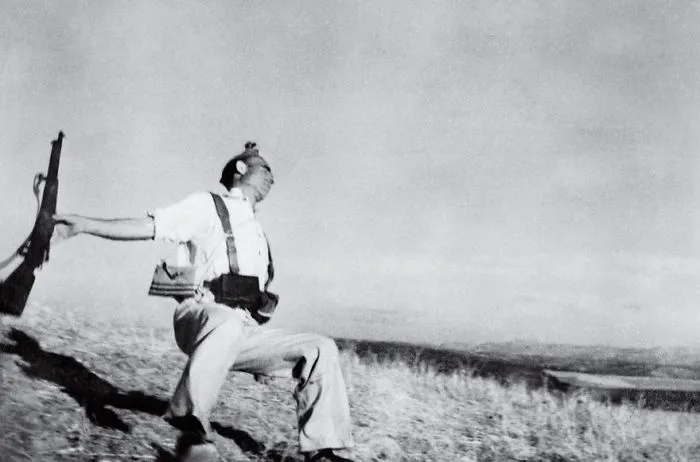
Robert Capa made his seminal photograph of the Spanish Civil War without ever looking through his viewfinder. Widely considered one of the best combat photographs ever made, and the first to show battlefield death in action, Capa said in a 1947 radio interview that he was in the trenches with Republican militiamen. The men would pop aboveground to charge and fire old rifles at a machine gun manned by troops loyal to Francisco Franco. Each time, the militiamen would get gunned down. During one charge, Capa held his camera above his head and clicked the shutter. The result is an image that is full of drama and movement as the shot soldier tumbles backward.
In the 1970s, decades after it was published in the French magazine Vu and LIFE, a South African journalist named O.D. Gallagher claimed that Capa had told him the image was staged. But no confirmation was ever presented, and most believe that Capa’s is a genuine candid photograph of a Spanish militiaman being shot. Capa’s image elevated war photography to a new level long before journalists were formally embedded with combat troops, showing how crucial, if dangerous, it is for photographers to be in the middle of the action.
In the 1970s, decades after it was published in the French magazine Vu and LIFE, a South African journalist named O.D. Gallagher claimed that Capa had told him the image was staged. But no confirmation was ever presented, and most believe that Capa’s is a genuine candid photograph of a Spanish militiaman being shot. Capa’s image elevated war photography to a new level long before journalists were formally embedded with combat troops, showing how crucial, if dangerous, it is for photographers to be in the middle of the action.
Report
16points
#69 Grief, Dmitri Baltermants, 1942
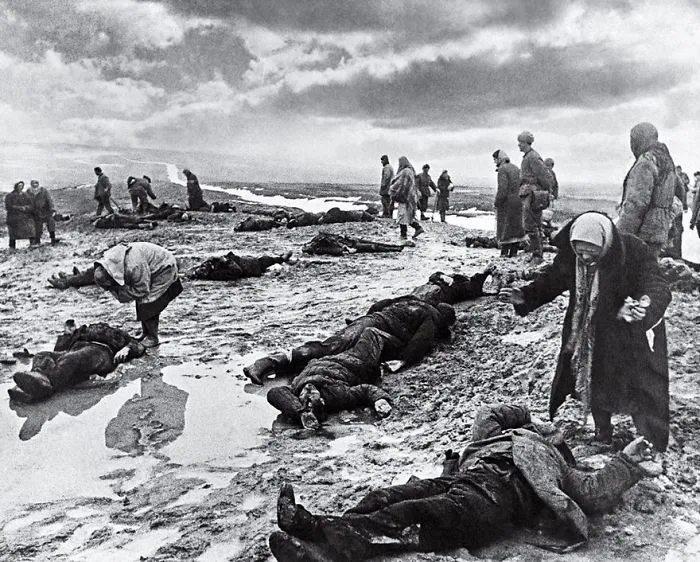
The Polish-born Dmitri Baltermants had planned to be a math teacher but instead fell in love with photography. Just as World War II broke out, he got a call from his bosses at the Soviet government paper Izvestia: “Our troops are crossing the border tomorrow. Get ready to shoot the annexation of western Ukraine!” At the time the Soviet Union considered Nazi Germany its ally. But after Adolf Hitler turned on his comrades and invaded the Soviet Union, Baltermants’ mission changed too. Covering what then became known as the Great Patriotic War, he captured grim images of body-littered roads along with those of troops enjoying quiet moments. In January 1942 he was in the newly liberated city of Kerch, Crimea, where two months earlier Nazi death squads had rounded up the town’s 7,000 Jews. “They drove out whole families—women, the elderly, children,” Baltermants recalled years later. “They drove all of them to an antitank ditch and shot them.” There Baltermants came upon a bleak, corpse-choked field, the outstretched limbs of old and young alike frozen in the last moment of pleading. Some of the gathered townspeople wailed, their arms wide. Others hunched in paroxysms of grief. Baltermants, who witnessed more than his share of death, recorded what he saw. Yet these images of mass Nazi murders on Soviet soil were too graphic for his nation’s leaders, wary of displaying the suffering of their people. Like many of Baltermants’ photos, this one was censored, being shown only decades later as liberalism seeped into Russian society in the 1960s. When it finally emerged, Baltermants’ picture allowed generations of Russians to form a collective memory of their great war. “You do your work the best you can,” he somberly observed, “and someday it will surface.”
Report
16points
#70 Birmingham, Alabama, Charles Moore, 1963
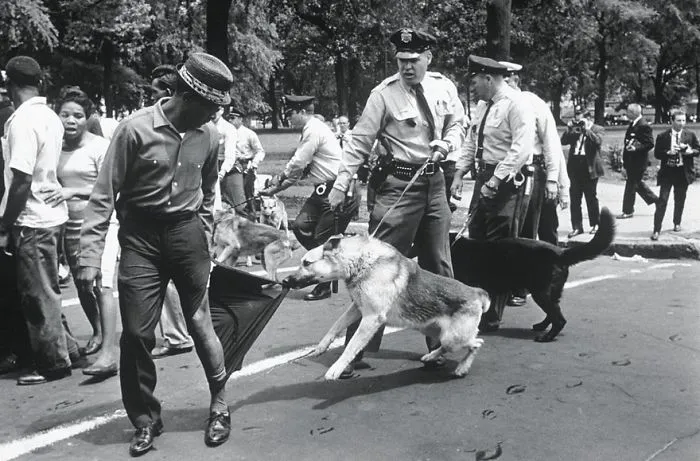
Sometimes the most effective mirror is a photograph. In the summer of 1963, Birmingham was boiling over as black residents and their allies in the civil rights movement repeatedly clashed with a white power structure intent on maintaining segregation—and willing to do whatever that took. A photographer for the Montgomery Advertiser and life, Charles Moore was a native Alabaman and son of a Baptist preacher appalled by the violence inflicted on African Americans in the name of law and order. Though he photographed many other seminal moments of the movement, it was Moore’s image of a police dog tearing into a black protester’s pants that captured the routine, even casual, brutality of segregation. When the picture was published in life, it quickly became apparent to the rest of the world what Moore had long known: ending segregation was not about eroding culture but about restoring humanity. Hesitant politicians soon took up the cause and passed the Civil Rights Act of 1964 nearly a year later.
Report
16points
#71 Camelot, Hy Peskin, 1953
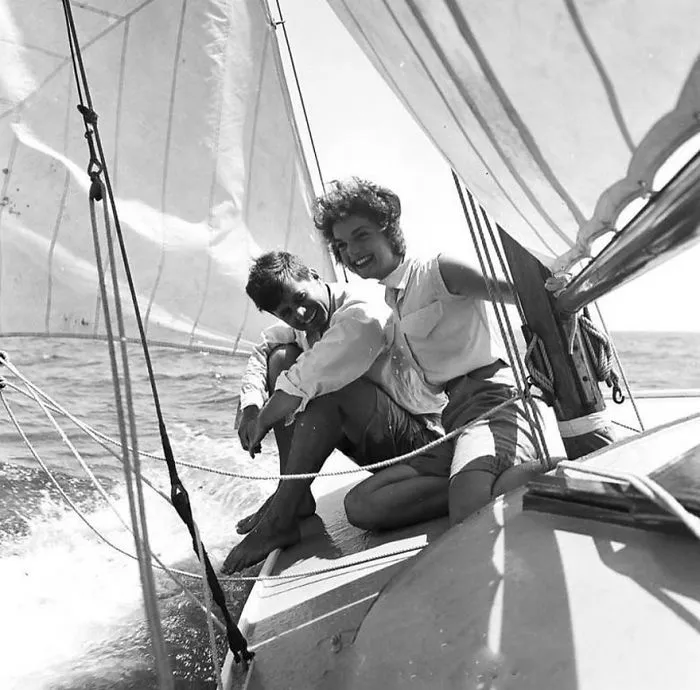
Before they could become American royalty, America needed to meet John Fitzgerald Kennedy and Jacqueline Lee Bouvier. That introduction came when Hy Peskin photographed the handsome politician on the make and his radiant fiancée over a summer weekend in 1953. Peskin, a renowned sports photographer, headed to Hyannis Port, Mass., at the invitation of family patriarch Joseph Kennedy. The ambassador, eager for his son to take the stage as a national figure, thought a feature in the pages of LIFE would foster a fascination with John, his pretty girlfriend and one of America’s wealthiest families. That it did. Peskin put together a somewhat contrived “behind the scenes” series titled “Senator Kennedy Goes A-Courting.” While Jackie bristled at the intrusion—John’s mother Rose even told her how to pose—she went along with the staging, and readers got to observe Jackie mussing the hair of “the handsomest young member of the U.S. Senate,” playing football and softball with her future in-laws, and sailing aboard John’s boat, Victura. “They just shoved me into that boat long enough to take the picture,” she later confided to a friend.
It was pitch-perfect brand making, with Kennedy on the cover of the world’s most widely read photo magazine, cast as a self-assured playboy prepared to say goodbye to bachelorhood. A few months later LIFE would cover the couple’s wedding, and by then America was captivated. In the staid age of Dwight David Eisenhower and Richard Milhous Nixon, Peskin unveiled the face of Camelot, one that changed America’s perception of politics and politicians, and set John and Jackie off on becoming the most recognizable couple on the planet.
It was pitch-perfect brand making, with Kennedy on the cover of the world’s most widely read photo magazine, cast as a self-assured playboy prepared to say goodbye to bachelorhood. A few months later LIFE would cover the couple’s wedding, and by then America was captivated. In the staid age of Dwight David Eisenhower and Richard Milhous Nixon, Peskin unveiled the face of Camelot, one that changed America’s perception of politics and politicians, and set John and Jackie off on becoming the most recognizable couple on the planet.
Report
15points
#72 The Babe Bows Out, Nat Fein, 1948
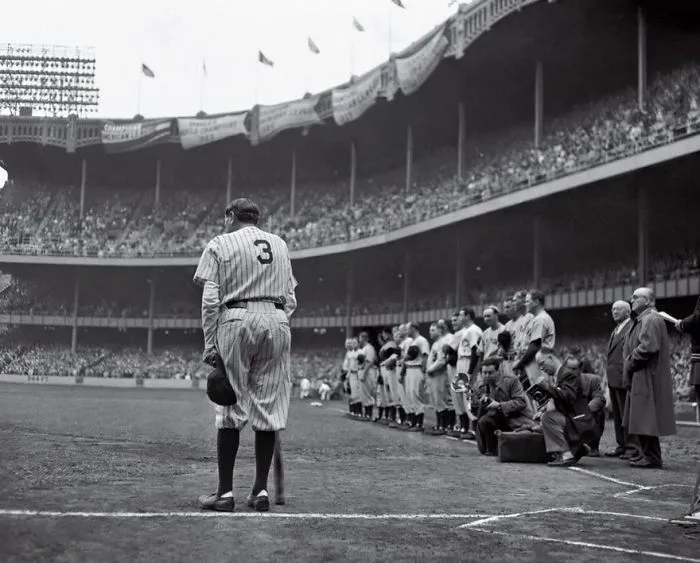
He was the greatest ballplayer of them all, the towering Sultan of Swat. But by 1948, Babe Ruth had been out of the game for more than a decade and was struggling with terminal cancer. So when the beloved Bambino stood before a massive crowd on June 13 to help celebrate the silver anniversary of Yankee Stadium—known to all in attendance as the House That Ruth Built—and to retire his No. 3, it was clear this was a final public goodbye.
Nat Fein of the New York Herald Tribune was one of dozens of photographers staked out along the first-base line. But as the sound of “Auld Lang Syne” filled the stadium, Fein “got a feeling” and walked behind Ruth, where he saw the proud ballplayer leaning on a bat, his thin legs hinting at the toll the disease had wreaked on his body. From that spot, Fein captured the almost mythic role that athletes play in our lives—even at their weakest, they loom large. Two months later Ruth was dead, and Fein went on to win a Pulitzer Prize for his picture. It was the first one awarded to a sports photographer, giving critical legitimacy to a form other than hard-news reportage.
Report
14points
#73 Country Doctor, W. Eugene Smith, 1948
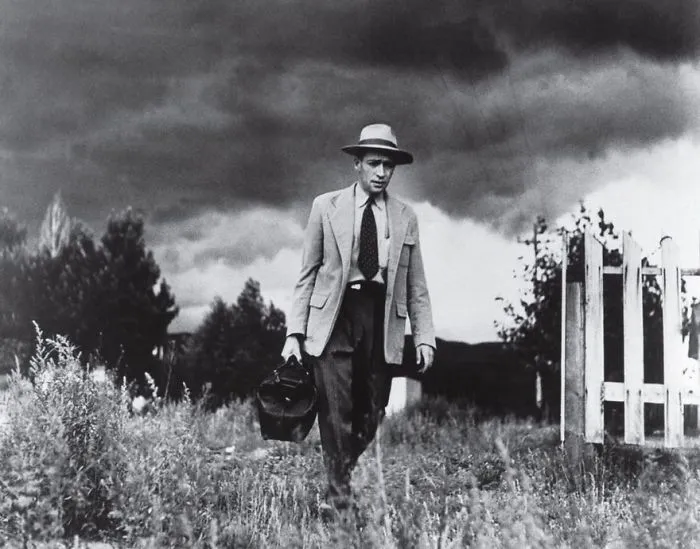
Although lauded for his war photography, W. Eugene Smith left his most enduring mark with a series of midcentury photo essays for LIFE magazine. The Wichita, Kans.–born photographer spent weeks immersing himself in his subjects’ lives, from a South Carolina nurse-midwife to the residents of a Spanish village. His aim was to see the world from the perspective of his subjects—and to compel viewers to do the same. “I do not seek to possess my subject but rather to give myself to it,” he said of his approach. Nowhere was this clearer than in his landmark photo essay “Country Doctor.” Smith spent 23 days with Dr. Ernest Ceriani in and around Kremmling, Colo., trailing the hardy physician through the ranching community of 2,000 souls beneath the Rocky Mountains. He watched him tend to infants, deliver injections in the backseats of cars, develop his own x-rays, treat a man with a heart attack and then phone a priest to give last rites. By digging so deeply into his assignment, Smith created a singular, starkly intimate glimpse into the life of a remarkable man. It became not only the most influential photo essay in history but the aspirational template for the form.
Report
14points
#74 Boat Of No Smiles, Eddie Adams, 1977
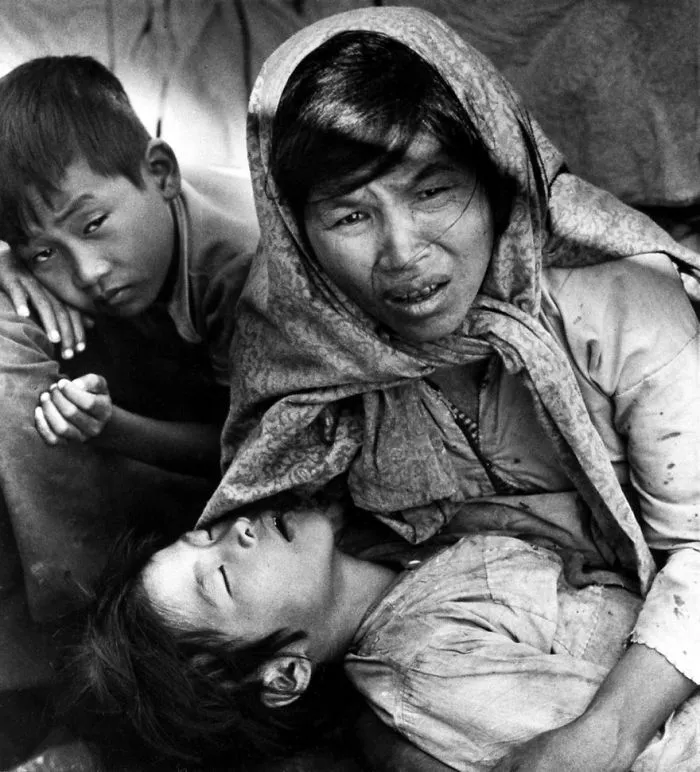
It’s easy to ignore the plight of refugees. They are seen as numbers more than people, moving from one distant land to the next. But a picture can puncture that illusion. The sun hadn’t yet risen on Thanksgiving Day in 1977 when Associated Press photographer Eddie Adams watched a fishing boat packed with South Vietnamese refugees drift toward Thailand. He was on patrol with Thai maritime authorities as the unstable vessel carrying about 50 people came to shore after days at sea. Thousands of refugees had streamed from postwar Vietnam since the American withdrawal more than two years earlier, fleeing communism by fanning out across Southeast Asia in search of safe harbor. Often they were pushed back into the abyss and told to go somewhere else. Adams boarded the packed fishing boat and began shooting. He didn’t have long. Eventually Thai authorities demanded that he disembark—wary, Adams believed, that his presence would create sympathy for the refugees that might compel Thailand to open its doors. On that score, they were right. Adams transmitted his pictures and wrote a short report, and within days they were published widely. The images were presented to Congress, helping to open the doors for more than 200,000 refugees from Vietnam to enter the U.S. from 1978 to 1981. “The pictures did it,” Adams said, “pushed it over.”
Report
14points
#75 Firing Squad In Iran, Jahangir Razmi, 1979
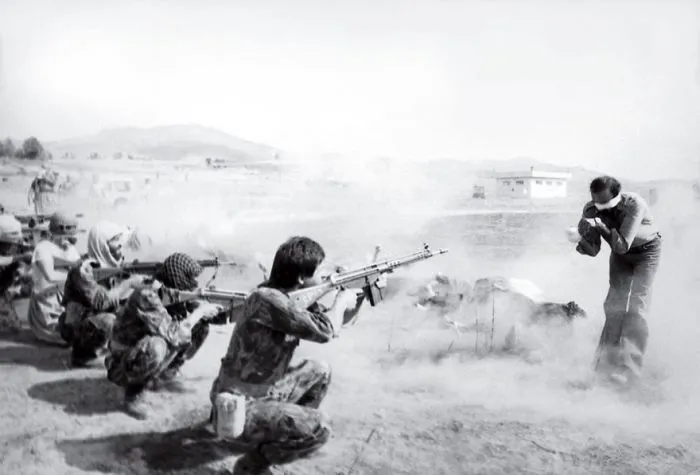
Few images are as stark as one of an execution. On August 27, 1979, 11 men who had been convicted of being “counterrevolutionary” by the regime of Iranian ruler Ayatullah Ruhollah Khomeini were lined up on a dirt field at Sanandaj Airport and gunned down side by side. No international journalists witnessed the killings. They had been banned from Iran by Khomeini, which meant it was up to the domestic press to chronicle the bloody conflict between the theocracy and the local Kurds, who had been denied representation in Khomeini’s government. The Iranian photographer Jahangir Razmi had been tipped off to the trial, and he shot two rolls of film at the executions. One image, with bodies crumpled on the ground and another man moments from joining them, was published anonymously on the front page of the Iranian daily Ettela’at. Within hours, members of the Islamic Revolutionary Council appeared at the paper’s office and demanded the photographer’s name. The editor refused. Days later, the picture was picked up by the news service UPI and trumpeted in papers around the world as evidence of the murderous nature of Khomeini’s brand of religious government. The following year, Firing Squad in Iran was awarded the Pulitzer Prize—the only anonymous winner in history. It was not until 2006 that Razmi was revealed as the photographer.
Report
14points
#76 Coffin Ban, Tami Silicio, 2004
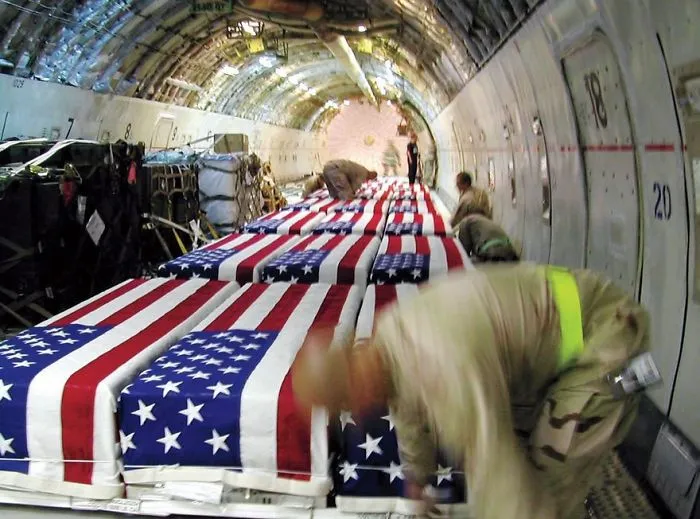
By April 2004, some 700 U.S. troops had been killed on the battlefield in Iraq, but images of the dead returning home in coffins were never seen. The U.S. government had banned news organizations from photographing such scenes in 1991, arguing that they violated families’ privacy and the dignity of the dead. To critics, the policy was simply a way of sanitizing an increasingly bloody conflict. As a government contractor working for a cargo company in Kuwait, Tami Silicio was moved by the increasingly human freight she was loading and felt compelled to share what she was seeing. On April 7, Silicio used her Nikon Coolpix to photograph more than 20 flag-draped coffins as they passed through Kuwait on their way to Dover Air Force Base in Delaware. She emailed the picture to a friend in the U.S., who forwarded it to a photo editor at the Seattle Times. With Silicio’s permission, the Times put the photo on its front page on April 18—and immediately set off a firestorm. Within days, Silicio was fired from her job and a debate raged over the ethics of publishing the images. While the government claimed that families of troops killed in action agreed with its policy, many felt that the pictures should not be censored. In late 2009, during President Barack Obama’s first year in office, the Pentagon lifted the ban.
Report
14points
#77 Dovima With Elephants, Paris, August, Richard Avedon, 1955
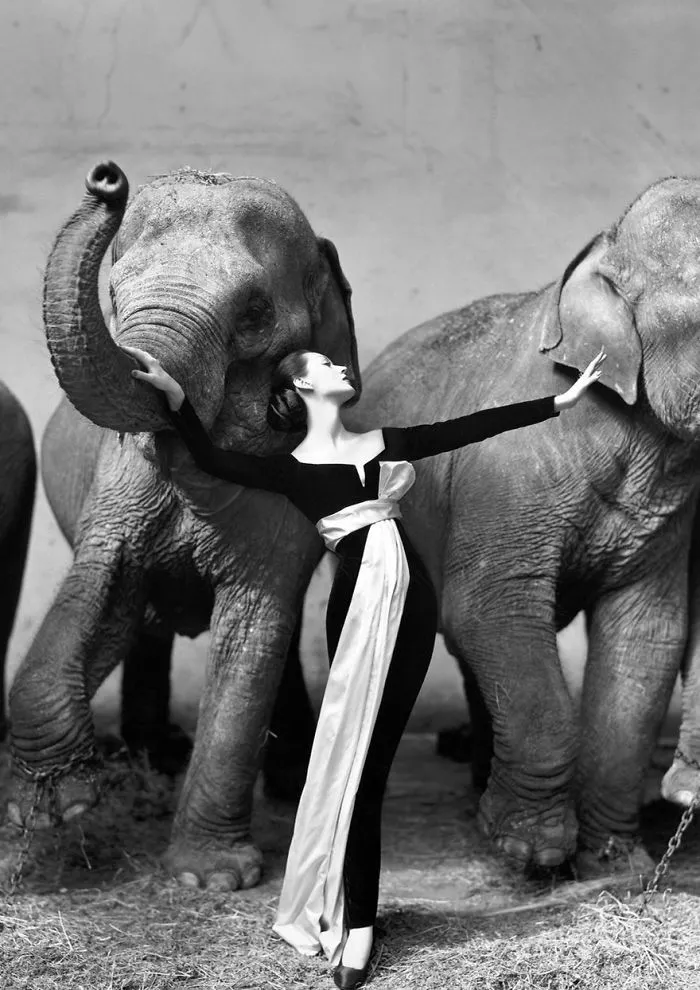
When Richard Avedon photographed Dovima at a Paris circus in 1955 for Harper’s Bazaar, both were already prominent in their fields. She was one of the world’s most famous models, and he was one of the most famous fashion photographers. It makes sense, then, that Dovima With Elephants is one of the most famous fashion photographs of all time. But its enduring influence lies as much in what it captures as in the two people who made it. Dovima was one of the last great models of the sophisticated mold, when haute couture was a relatively cloistered and elite world. After the 1950s, models began to gravitate toward girl-next-door looks instead of the old generation’s unattainable beauty, helping turn high fashion into entertainment. Dovima With Elephants distills that shift by juxtaposing the spectacle and strength of the elephants with Dovima’s beauty—and the delicacy of her gown, which was the first Dior dress designed by Yves Saint Laurent. The picture also brings movement to a medium that was previously typified by stillness. Models had long been mannequins, meant to stand still while the clothes got all the attention. Avedon saw what was wrong with that equation: clothes didn’t just make the man; the man also made the clothes. And by moving models out of the studio and placing them against exciting backdrops, he helped blur the line between commercial fashion photography and art. In that way, Dovima With Elephants captures a turning point in our broader culture: the last old-style model, setting fashion off on its new path.
Report
13points
#78 Michael Jordan, Co Rentmeester, 1984
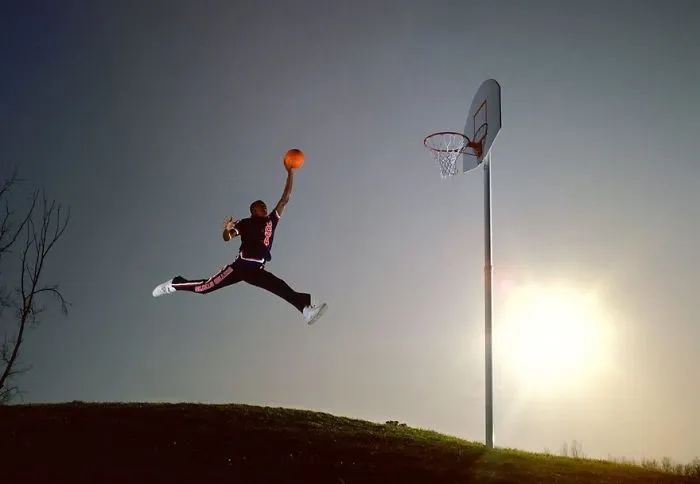
It may be the most famous silhouette ever photographed. Shooting Michael Jordan for LIFE in 1984, Jacobus “Co” Rentmeester captured the basketball star soaring through the air for a dunk, legs split like a ballet dancer’s and left arm stretched to the stars. A beautiful image, but one unlikely to have endured had Nike not devised a logo for its young star that bore a striking resemblance to the photo. Seeking design inspiration for its first Air Jordan sneakers, Nike paid Rentmeester $150 for temporary use of his slides from the life shoot. Soon, “Jumpman” was etched onto shoes, clothing and bedroom walls around the world, eventually becoming one of the most popular commercial icons of all time. With Jumpman, Nike created the concept of athletes as valuable commercial properties unto themselves. The Air Jordan brand, which today features other superstar pitchmen, earned $3.2 billion in 2014. Rentmeester, meanwhile, has sued Nike for copyright infringement. No matter the outcome, it’s clear his image captures the ascendance of sports celebrity into a multibillion-dollar business, and it’s still taking off.
Report
13points
#79 The Death Of Neda, 2009
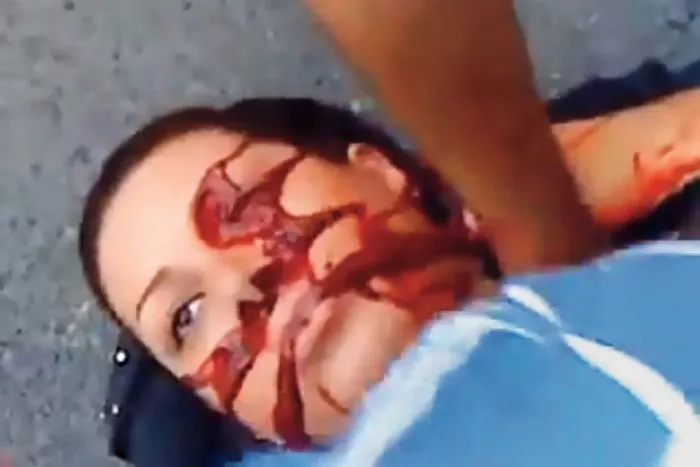
Neda Agha-Soltan was an unlikely viral icon. On June 20, 2009, the 26-year-old stepped out of her car on a Tehran street near where Iranians were massing in protest of what was seen as the farcical re-election of President Mahmoud Ahmadinejad. The Islamic Republic was experiencing its worst unrest since the 1979 revolution. The state made it illegal to join the demonstrations and barred most foreign media, which meant the burden of bearing witness was largely left to the citizens who waded in, cell phones in hand. It was around 6:30 p.m. when Agha-Soltan was struck in the chest by a single bullet, said to originate from a progovernment sniper, though no one was ever charged. Men struggled to save her as others focused their cameras on the unfolding tragedy. One frame from the footage freezes her final gaze as streaks of deep red formed a web on her face. The image, among the earliest and easily the most significant to ever go viral, commanded the world’s attention. Within hours, footage uploaded anonymously to YouTube had been viewed by the President of the United States—proof that our new digital age could not only connect people; it could pry open even the staunchest of regimes.
Report
13points
#80 The Valley Of The Shadow Of Death, Roger Fenton, 1855
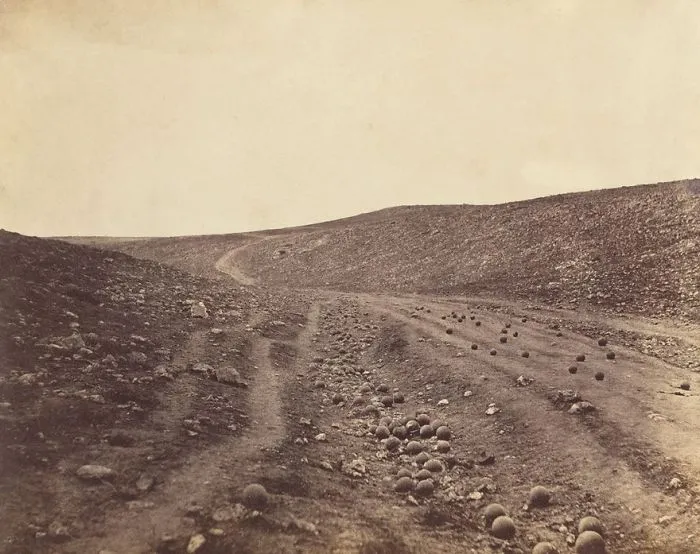
While little is remembered of the Crimean War—that nearly three-year conflict that pitted England, France, Turkey and Sardinia-Piedmont against Russia—coverage of it radically changed the way we view war. Until then, the general public learned of battles through heroic paintings and illustrations. But after the British photographer Roger Fenton landed in 1855 on that far-off peninsula on the Black Sea, he sent back revelatory views of the conflict that firmly established the tradition of war photography. Those 360 photos of camp life and men manning mortar batteries may lack the visceral brutality we have since become accustomed to, yet Fenton’s work showed that this new artistic medium could rival the fine arts. This is especially clear in The Valley of the Shadow of Death, which shows a cannonball-strewn gully not far from the spot immortalized in Alfred, Lord Tennyson’s “The Charge of the Light Brigade.” That haunting image, which for many evokes the poem’s “Cannon to right of them,/ Cannon to left of them,/ Cannon in front of them” as the troops race “into the valley of Death,” also revealed to the general public the reality of the lifeless desolation left in the wake of senseless slaughter. Scholars long believed that this was Fenton’s only image of the valley. But a second version with fewer of the scattered projectiles turned up in 1981, fueling a fierce debate over which came first. That the more recently discovered picture is thought to be the first indicates that Fenton may have been one of the earliest to stage a news photograph.
Report
12points