






#21

Eradicating a parasitic disease that infected millions of people every year.
Guinea worm disease is contracted primarily by drinking contaminated water. About a year later, a female worm can emerge painfully through the skin, sometimes reaching several feet in length. There is no vaccine to prevent the disease and no medicine that simply cures it.
In 1986, when the Carter Center began leading the international eradication campaign, an estimated 3.5 million people were infected every year across 21 countries in Africa and Asia.
The solution wasn't a miracle medicine
Instead, Carter and an enormous network of governments, health organizations and local volunteers attacked the parasite's life cycle.
Communities were taught to filter drinking water. Contaminated water sources were treated. People with emerging worms were kept from entering drinking water and spreading the parasite. Villages received safer sources of water, while volunteers tracked infections one by one.
Carter also used something unusual for a public health campaign: diplomacy.
In 1995, he helped negotiate a temporary ceasefire during Sudan's civil war that allowed health workers to reach communities affected by Guinea worm and other diseases.
Slowly, the numbers collapsed.
From an estimated 3.5 million cases a year in 1986, the world fell below 100,000 by 2001.
By 2025, there were just 10 reported human cases worldwide.
A reduction of more than 99.99%.
Jimmy Carter once hoped he would live to see the last Guinea worm disappear.
He didn't quite make it.
But the campaign he helped lead brought humanity extraordinarily close to eradicating an ancient disease without a vaccine or curative medicine.
London had its own unforgettable moment in the summer of 1858, when hot weather turned the River Thames into such a powerful stench that Parliament, which sits right on its banks, could barely get anything done, and Punch magazine had a field day drawing Father Thames as a grumpy old man.
#22
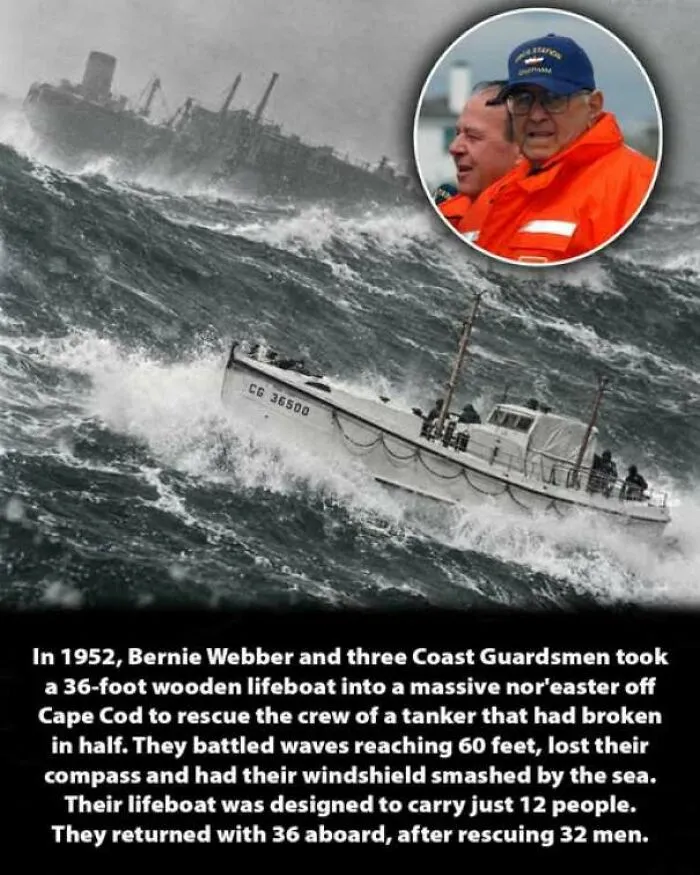
#23
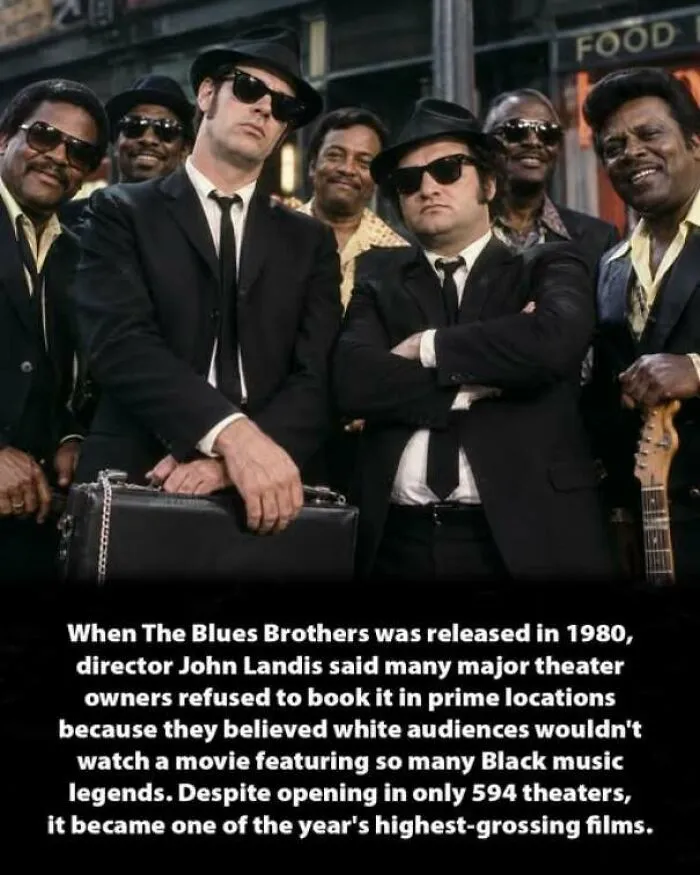
The movie starred John Belushi and Dan Aykroyd, but its cast also featured an extraordinary collection of Black musical legends, including Aretha Franklin, James Brown, Ray Charles, Cab Calloway and John Lee Hooker.
According to director John Landis, that became an unexpected problem when Universal began trying to book the movie into theaters.
Landis recalled that many exhibitors viewed it as a “Black movie” and believed white audiences wouldn't come to see it.
He said many prime theaters consequently refused to book the film.
One major theater owner told Landis that he would show the movie in Compton, but not in the prestigious theaters of Westwood, Los Angeles.
As a result, The Blues Brothers opened in just 594 theaters, far fewer than a major production would normally receive.
Audiences showed up anyway.
The movie earned more than $57 million at the domestic box office and became one of the highest-grossing films released that year.
Decades later, The Blues Brothers remains a comedy and musical classic.
#24
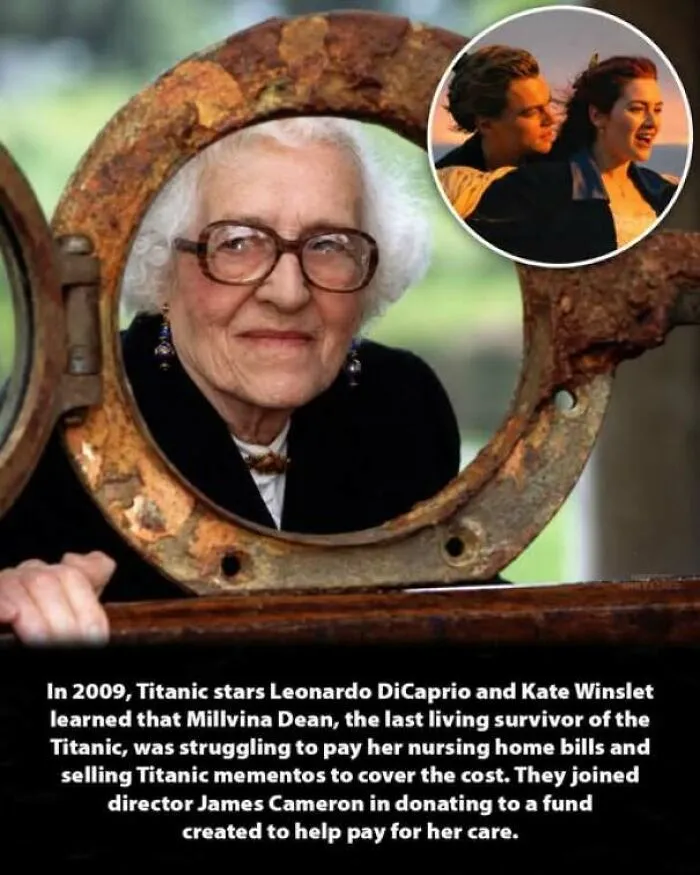
Millvina Dean was just nine weeks old when she boarded the Titanic with her parents and older brother in April 1912.
She was the youngest passenger aboard.
When the ship struck an iceberg, Millvina, her mother and her brother were placed into a lifeboat and survived.
Her father did not.
Millvina was too young to remember the disaster, but she would ultimately become its final living survivor.
Nearly a century later, however, she found herself struggling with the cost of nursing home care.
After breaking her hip, Millvina moved into a private nursing home. By 2008, she began selling possessions connected to the Titanic to help pay her bills.
Among them was a small suitcase that had been filled with donated clothing and given to her family after they survived the disaster.
In 2009, a campaign called the Millvina Fund was established to help cover the cost of her care.
Leonardo DiCaprio and Kate Winslet, whose performances in the 1997 film Titanic had made them international stars, contributed to the fund.
Director James Cameron also donated.
It was an extraordinary connection between the history and the movie it inspired.
The actors who became famous portraying fictional passengers aboard Titanic had helped care for the last surviving person who had actually been there.
Millvina Dean passed away on May 31, 2009.
She was 97 years old.
Lawmakers soaked the curtains in chloride of lime to fight the smell, which did not work, but as Historic UK explains, the Great Stink finally pushed politicians to act. The fix was a massive sewer network designed by engineer Joseph Bazalgette, and much of it is still doing its job today.
#25

When Kennedy entered the House of Representatives in 1947, he began donating his government pay to charity.
He continued the practice throughout six years in the House, eight years in the Senate and his presidency.
Kennedy came from a wealthy family and did not depend on his government salary for his income.
When he became president in 1961, the job paid $100,000 a year.
Kennedy continued giving the money away.
In 1961, his partial-year presidential salary of about $94,600 was distributed among six charities. The following year, his entire $100,000 salary was again designated for charitable purposes.
Contemporary reports estimated that by the end of 1962, Kennedy had donated nearly $500,000 in government salaries since first entering Congress.
#26

A demolition crew was preparing to tear down a century-old house in Thurmont, Maryland, when Peter Hill learned about the remarkable wallpaper hanging inside. Created in France in 1834, the panoramic mural was titled Views of North America and depicted scenes including Boston Harbor, West Point, Niagara Falls and New York.
Hill bought the entire set for just $50, with one condition: he had to remove it quickly before the house was demolished. Using a putty knife and razor blade, he carefully peeled the historic panels from the walls.
Hill contacted the Smithsonian Institution, where an expert recognized what he had found. At the time, First Lady Jacqueline Kennedy was leading an ambitious effort to restore the historic character of the White House.
In April 1961, Hill brought the wallpaper to the White House and showed it to Kennedy. She admired it, and Hill suggested that it would be perfect for the Diplomatic Reception Room.
The National Society of Interior Designers ultimately purchased the wallpaper from Hill for $12,500 and donated it to the White House. Artists repaired the damaged edges, and a team of specialists spent weeks installing it around the oval room.
More than six decades later, the $50 wallpaper rescued from a house awaiting demolition still covers the walls of the White House Diplomatic Reception Room.
#27
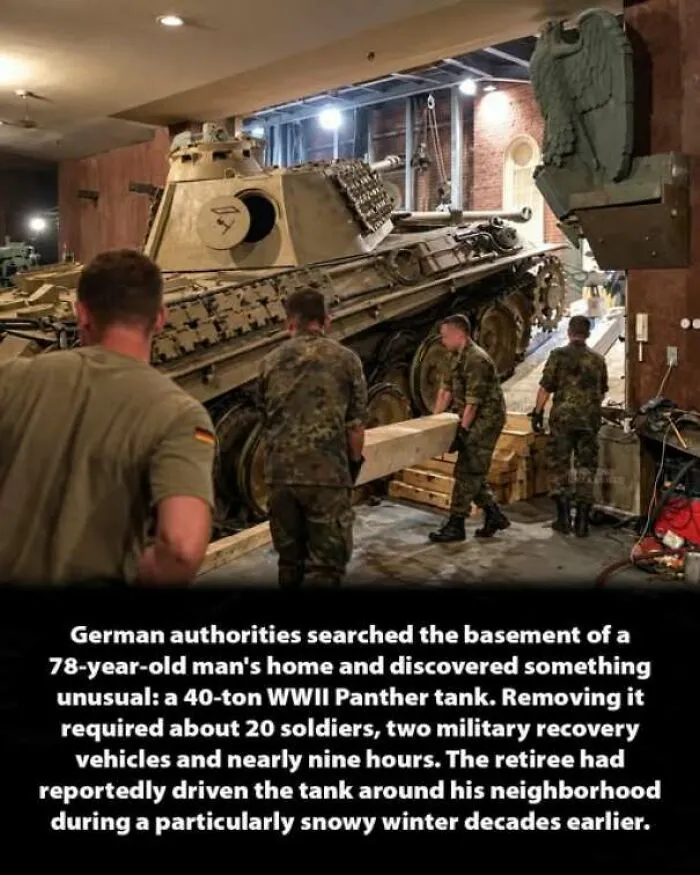
The tank belonged to a 78-year-old collector living in Heikendorf, near Kiel in northern Germany. Authorities were investigating his collection of military equipment when they discovered the Panther stored beneath his home.
Getting it out was another problem entirely.
The German military was called in to help, and roughly 20 soldiers spent nearly nine hours extracting the enormous vehicle. Two military recovery vehicles were used to pull the tank from the property.
And according to the town's mayor, the Panther hadn't always stayed hidden underground.
During the particularly harsh winter of 1978–79, the owner reportedly drove it around the neighborhood in the snow. The mayor recalled that an elderly resident had even complained about the man driving around in a tank.
Authorities also seized other military items from the property, including an anti-aircraft gun and a torpedo.
The case eventually went to court over whether the collection violated Germany's War Weapons Control Act. In 2021, the owner received a suspended sentence and was ordered to sell or donate the tank and anti-aircraft gun.
For decades, one German neighborhood apparently had a Panther tank sitting beneath an ordinary house.
Every now and then, an accident turns into science. In 1992, a cargo ship hit a storm in the North Pacific and lost a shipping container full of bath toys, sending 28,800 rubber ducks, turtles, beavers and frogs into the sea. Oceanographer Curtis Ebbesmeyer and a network of beachcombers tracked where the toys washed up, which turned out to be everywhere from Alaska to Scotland, and the Friendly Floatees, as they became known, taught researchers a great deal about how ocean currents move.
#28
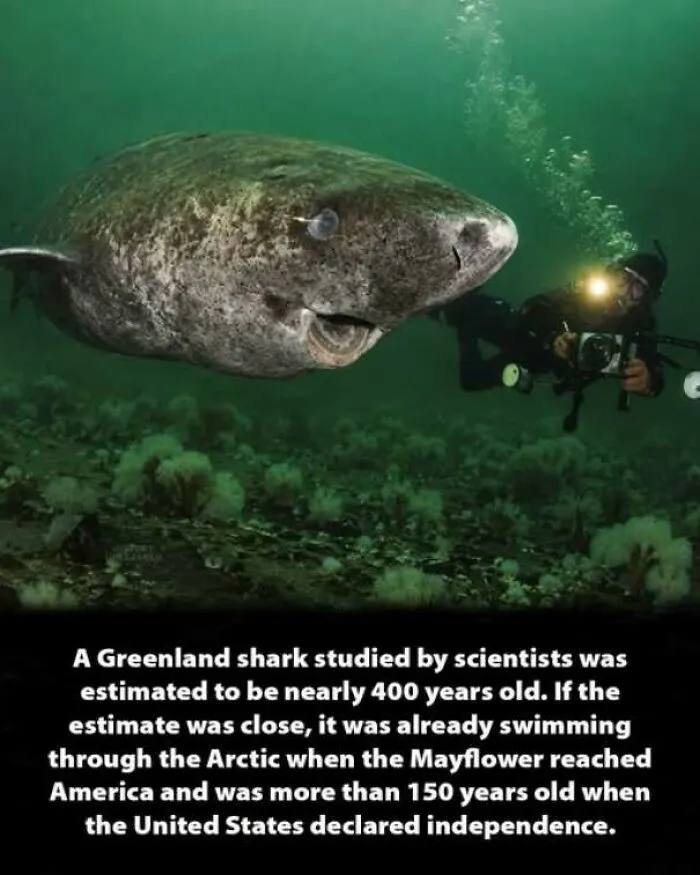
For years, scientists suspected that Greenland sharks lived extraordinarily long lives.
The animals grow incredibly slowly, inhabit the cold depths of the North Atlantic and Arctic oceans, and can reach more than 16 feet in length.
But determining their age presented a problem.
Unlike many fish, Greenland sharks don't have the hard structures scientists normally use to count growth layers.
So researchers tried something different.
In a landmark 2016 study, scientists radiocarbon dated proteins found in the centers of the eye lenses of 28 female Greenland sharks.
The results were astonishing.
The largest shark was estimated to be approximately 392 years old.
There was considerable uncertainty in that number. Scientists calculated that the animal was likely somewhere between 272 and 512 years old.
But even the conservative estimates revealed something remarkable.
Greenland sharks are the longest-lived vertebrates known to science.
If the central estimate for that shark was close, it would have been born around the early 1600s.
It could have already been swimming through the North Atlantic when the Mayflower reached America in 1620.
It would have been more than 150 years old during the American Revolution.
And Greenland sharks themselves don't appear to reach maturity until roughly 150 years of age.
Scientists still don't know exactly how long the oldest members of the species can survive.
But somewhere in the cold, dark waters of the North Atlantic, there may be sharks alive today that have been swimming there for centuries.
#29
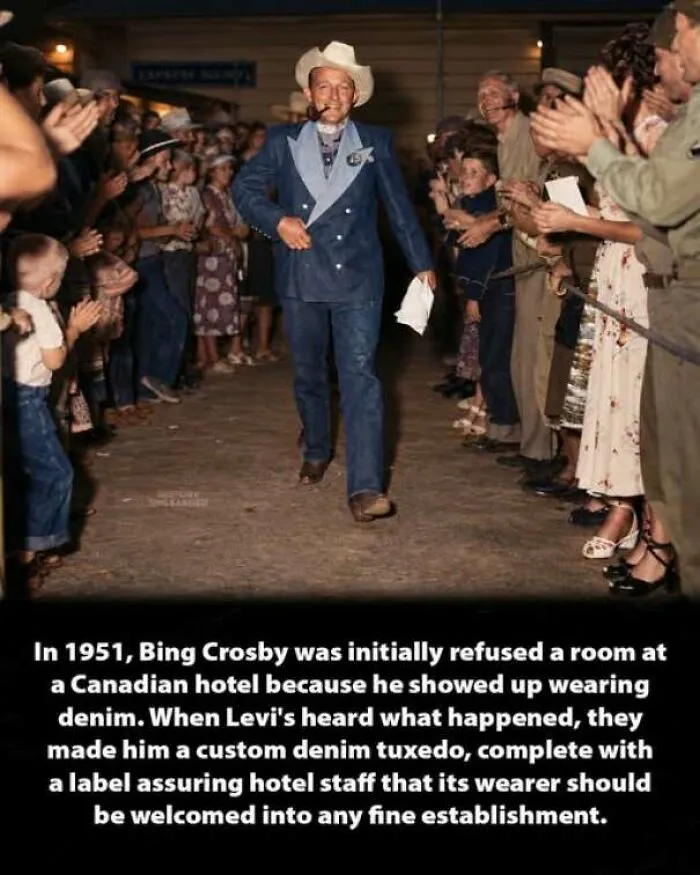
Crosby and a friend had been on a hunting trip in Canada when they arrived at a hotel in Vancouver dressed in denim.
The desk clerk didn't recognize one of America's most famous entertainers and initially refused to give them a room because their clothing wasn't considered appropriate for the hotel.
Another employee eventually recognized Crosby, and the situation was resolved.
But word of the incident reached Levi Strauss & Co.
The company's designers decided to make sure Crosby would never have the same problem again.
They created a custom tuxedo jacket from the same denim used for Levi's jeans, complete with copper rivets and a corsage made from red Levi's tabs.
Inside, they added a large leather label addressed to hotel staff declaring the denim appropriate for even the finest establishments.
Levi's presented the tuxedo to Crosby later that year.
The story became closely associated with the denim-on-denim look eventually known as the “Canadian tuxedo.”
#30
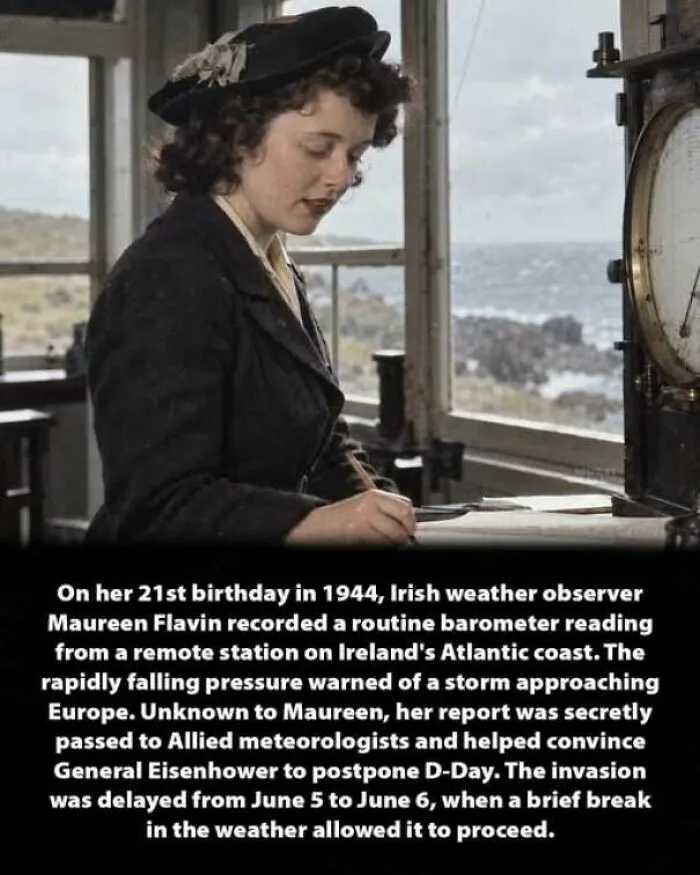
Maureen worked at the remote Blacksod weather station on Ireland's Atlantic coast. Every hour, day and night, weather observations were recorded and sent to Dublin.
That morning, Maureen noticed something concerning. The barometer was falling rapidly, the wind was increasing and the weather was deteriorating.
She reported the readings as usual.
What Maureen didn't know was that her information wasn't stopping in Dublin. Although Ireland remained neutral during World War II, Irish weather observations were secretly being shared with Britain.
And just across the Irish Sea, Allied commanders were preparing for the largest amphibious invasion in history.
D-Day was originally planned for June 5.
Maureen's observations from Blacksod provided crucial evidence that a storm was approaching. Allied meteorologist James Stagg used the incoming weather data to warn General Dwight D. Eisenhower that conditions on June 5 could be disastrous for the thousands of ships, aircraft and landing craft preparing to cross the English Channel.
Eisenhower postponed the invasion.
Then the weather changed again.
Observations from Blacksod showed atmospheric pressure beginning to rise as the front passed, helping forecasters identify a short window of improved conditions.
On June 6, 1944, Eisenhower gave the order.
More than 150,000 Allied troops landed in Normandy.
Maureen continued doing her job without knowing that the routine numbers she had recorded from a tiny weather station on Ireland's western edge had helped influence one of the most consequential military decisions of World War II.
She wouldn't learn the significance of her weather reports until years later.
Our final story belongs to Wojtek, a Syrian brown bear adopted as a cub by Polish soldiers during the Second World War. He reportedly helped carry heavy ammunition boxes, and he was officially enlisted as a private so he could travel with his unit, eventually earning a promotion to corporal. After the war he retired to Edinburgh Zoo, where he lived until 1963, and a bronze statue of him now stands in Princes Street Gardens. History is full of serious moments, but it clearly has a soft spot for the strange ones too.
#31
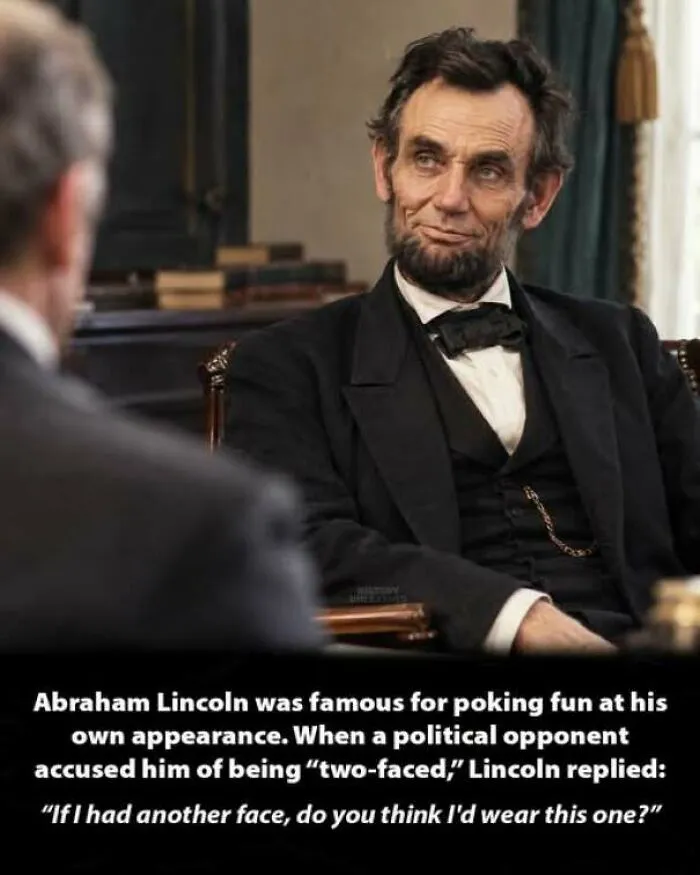
Lincoln's appearance was frequently mocked by political opponents and even commented upon by friends and contemporaries.
Rather than avoiding the subject, Lincoln often used self-deprecating humor to disarm people.
One of the most famous stories involves someone accusing him of being “two-faced.”
Lincoln reportedly responded:
“If I had another face, do you think I'd wear this one?”
The exact exchange is difficult to verify from Lincoln's surviving writings, so historians generally treat it as an attributed anecdote rather than a firmly documented quotation.
But the joke certainly fits a well-documented part of Lincoln's personality.
He frequently joked about his unusual appearance and once referred to his own “poor, lean, lank face.”
For Lincoln, humor wasn't simply entertainment.
It was often a way to handle criticism, connect with people and occasionally turn an insult back on the person delivering it.
#32
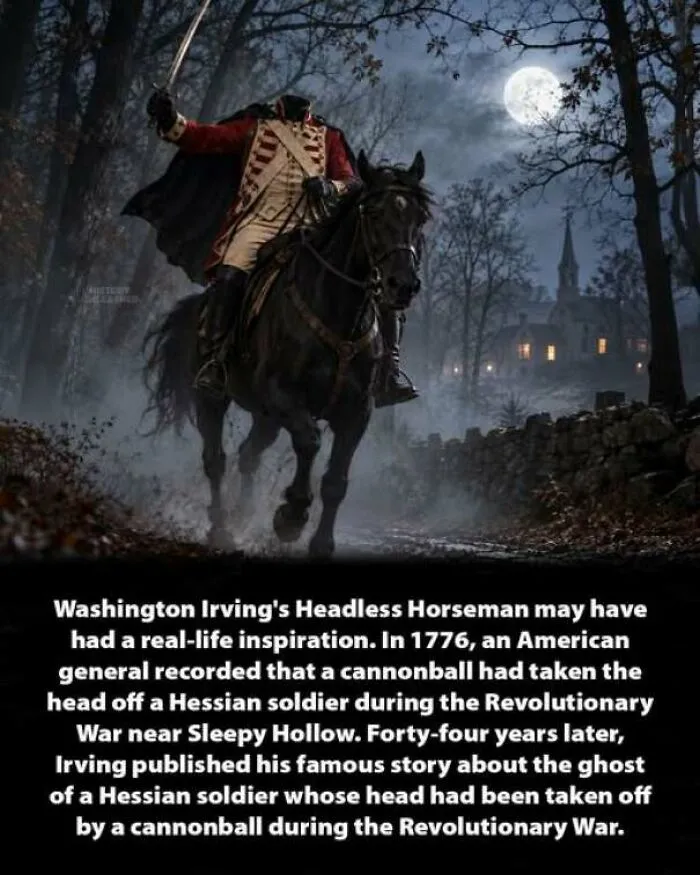
In 1820, Washington Irving published The Legend of Sleepy Hollow.
In the story, residents of Sleepy Hollow tell of a terrifying apparition riding through the countryside at night.
They say he is the ghost of a Hessian soldier who fought alongside the British during the American Revolution.
According to the legend, the soldier's head had been taken off by a cannonball during battle.
It sounds like pure fiction.
But something remarkably similar really happened.
During the Revolutionary War, Hessian troops fought near Sleepy Hollow at the Battle of White Plains in 1776.
American Major General William Heath recorded an incident from the fighting in his journal.
On November 1, 1776, Heath wrote that American cannon fire had taken the head off a Hessian artilleryman.
The incident occurred only several miles from Sleepy Hollow.
Decades later, Irving would describe his fictional Headless Horseman as a Hessian soldier who had lost his head to a cannonball during the Revolutionary War.
Whether Irving knew about this particular soldier is impossible to prove.
Stories of headless riders had existed in European folklore long before The Legend of Sleepy Hollow, and Irving drew upon folklore, local history and his own imagination when creating the tale.
But the historical record confirms one eerie detail.
Not far from Sleepy Hollow, during the very war described in Irving's story, a real Hessian soldier did lose his head to a cannonball.
#33

Ebeling worked for Morton Thiokol, the company responsible for Challenger's solid rocket boosters.
On January 27, 1986, temperatures at the launch site were expected to fall unusually low.
Ebeling and several fellow engineers were deeply concerned about how the cold would affect the rubber O-rings that sealed joints in the boosters.
During a lengthy conference with NASA, Thiokol engineers initially recommended that Challenger not launch in the unusually cold conditions.
Management ultimately reversed that recommendation and approved the launch.
Ebeling went home devastated.
He told his wife, Darlene:
“It's going to blow up.”
The following morning, Challenger lifted off.
Seventy-three seconds later, the shuttle broke apart, it took all seven crew members' lives.
The investigation found that an O-ring in the right solid rocket booster had failed to seal properly in the unusually cold conditions.
Ebeling spent decades blaming himself for not doing more, despite having argued against the launch.
#34
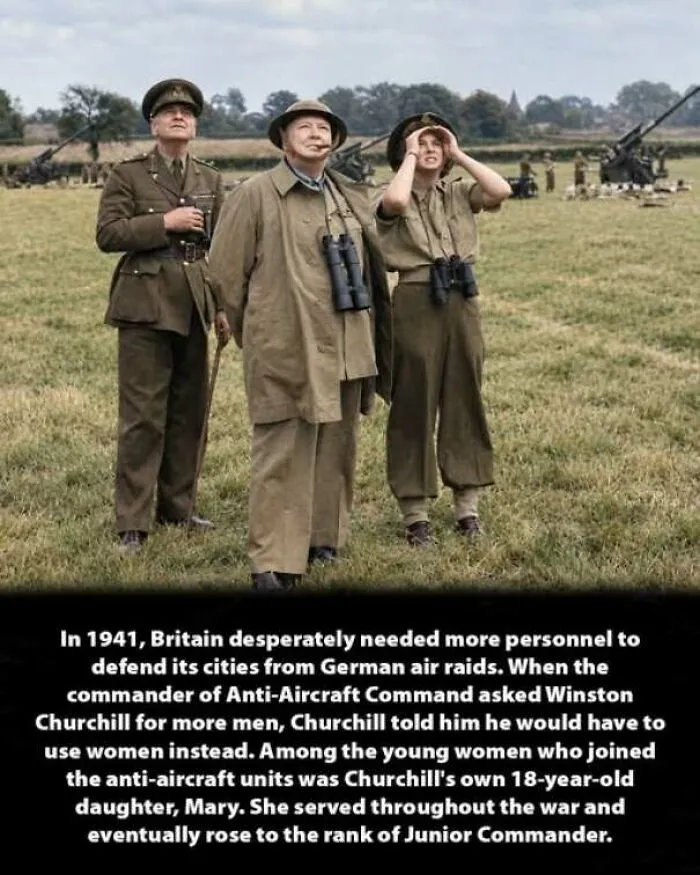
In 1941, Britain was struggling to find enough manpower for its enormous anti-aircraft defenses. General Frederick Pile, head of Anti-Aircraft Command, later recalled asking Churchill for thousands more men. Churchill refused and told him he would have to make greater use of women instead.
That same year, Churchill's youngest daughter, Mary, joined the Auxiliary Territorial Service at age 18. She was assigned to mixed anti-aircraft batteries, where women worked alongside male soldiers operating the sophisticated equipment used to locate enemy aircraft and direct the guns defending Britain.
Mary wasn't given a ceremonial position because she was the prime minister's daughter. She trained and served with anti-aircraft units during the war, including batteries protecting London from German attacks. She eventually rose to the rank of Junior Commander, equivalent to an Army captain.
By the end of the war, the prime minister who had told his generals to use women in Britain's defenses had watched his own daughter spend years serving among them.
#35
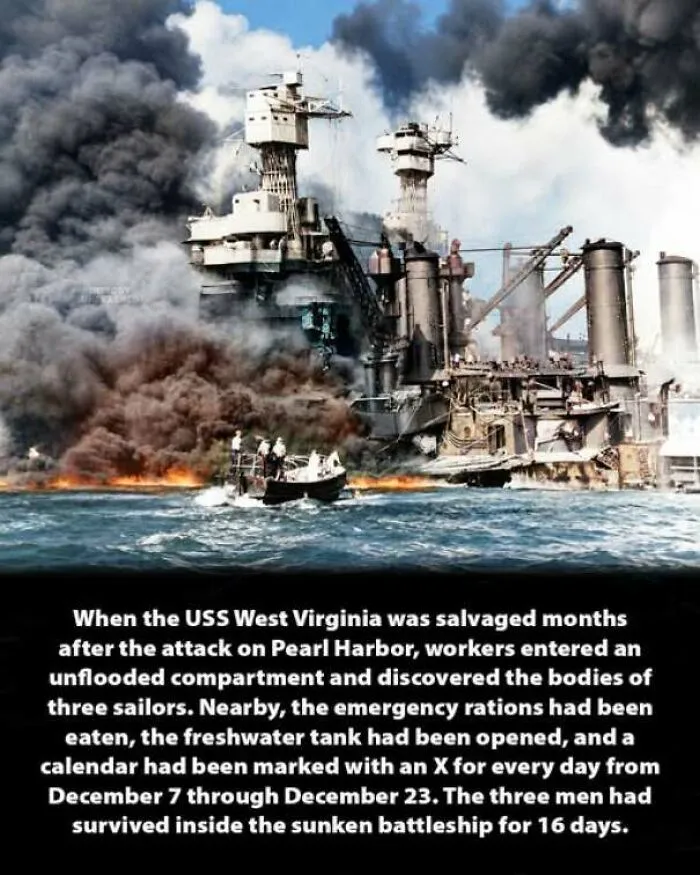
On December 7, 1941, Japanese aircraft attacked Pearl Harbor.
The battleship USS West Virginia was struck repeatedly before settling onto the bottom of the harbor.
More than 100 members of her crew passed away.
But for three sailors trapped deep inside the ship, December 7 was apparently not the end.
Months later, salvage crews began pumping water from the damaged battleship.
Inside an unflooded storeroom, workers discovered the bodies of three sailors.
The compartment told the story of what had happened.
The emergency rations had been consumed.
A manhole leading to freshwater tanks had been opened.
And nearby was a calendar.
Someone had marked an X across every date beginning on December 7.
The marks continued through December 8.
December 9.
December 10.
And onward.
The final X was placed on December 23, 1941.
Sixteen days after the attack.
The Navy's official salvage report concluded that the evidence showed the men had remained alive for a considerable period after the ship sank.
The three sailors are generally identified as Ronald Endicott, Clifford Olds and Louis “Buddy” Costin.
They had apparently found themselves trapped inside one of the few spaces that remained dry, with emergency food and access to fresh water.
Eventually, however, the air inside the sealed compartment appears to have run out.
When USS West Virginia was finally refloated on May 17, 1942, the calendar remained behind as evidence of what the three sailors had endured beneath the decks of the battleship.
Its final mark was December 23.
#36
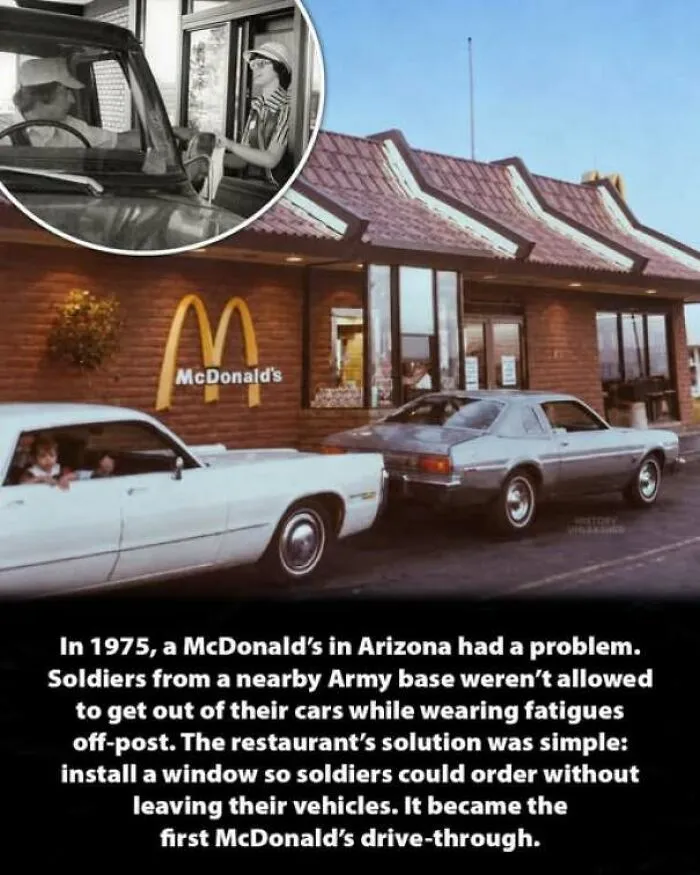
In the early 1970s, McDonald’s still didn’t have drive-throughs, even though some competing fast-food restaurants already did.
That changed in Sierra Vista, Arizona, near Fort Huachuca.
The local McDonald’s was popular with soldiers stationed at the Army base, but there was a problem.
According to McDonald’s, soldiers wearing their fatigues were required to remain in their vehicles while off base.
That meant they couldn’t simply park, walk inside, and order food while dressed in uniform.
Franchisee David Rich came up with a solution.
He installed a sliding window in the restaurant wall that allowed soldiers to place and receive their orders without ever leaving their vehicles.
On January 24, 1975, the Sierra Vista restaurant opened what McDonald’s recognizes as the company’s first drive-through.
The idea quickly spread.
A feature originally adopted in response to soldiers from a nearby Army base would eventually become one of the defining features of McDonald’s restaurants around the world.
#37
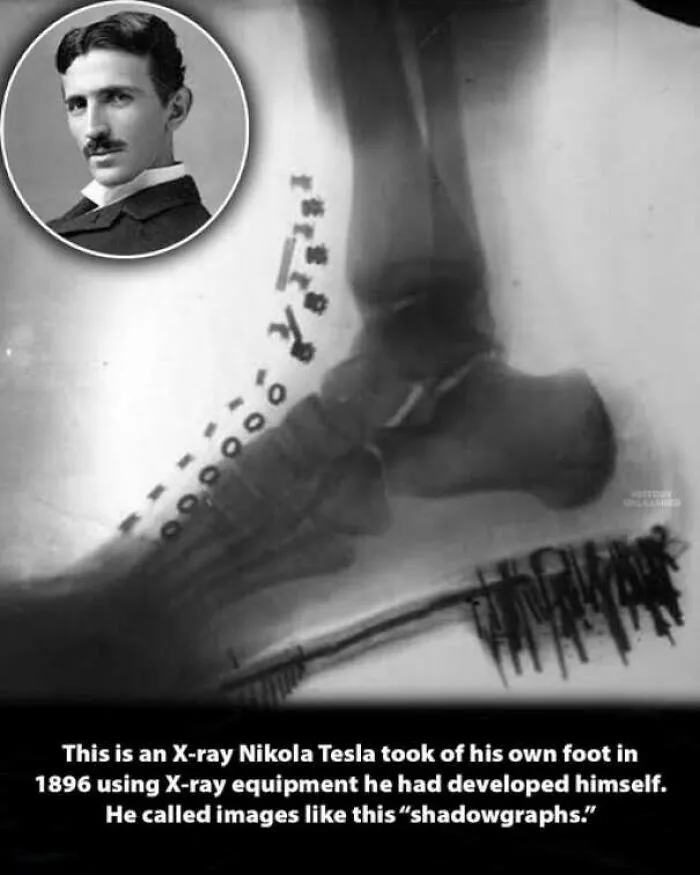
X-rays had only recently been announced to the world.
German physicist Wilhelm Röntgen discovered them in 1895, but scientists and inventors quickly began experimenting with the mysterious new form of radiation.
Among them was Nikola Tesla.
Tesla developed his own experimental X-ray equipment, including a special vacuum tube powered using the high-voltage technology he had been developing.
He referred to the resulting X-ray photographs as “shadowgraphs.”
In 1896, Tesla produced this remarkable image of a human foot still inside its shoe.
The image is identified by the Nikola Tesla Museum as Tesla's own foot.
You can clearly see the bones of his foot through the shoe, along with the metal components used in its construction.
Tesla produced the image using X-rays generated by his own vacuum tube from a distance of approximately eight feet.
His experiments weren't limited to producing unusual photographs.
Tesla investigated how X-rays behaved, experimented with different equipment and even began recognizing the dangers associated with prolonged exposure to the radiation.
More than 130 years later, the original shadowgraph survives in the collection of the Nikola Tesla Museum.
An X-ray of Nikola Tesla.
Taken by Nikola Tesla.
Using equipment developed by Nikola Tesla.
In 1896.
#38
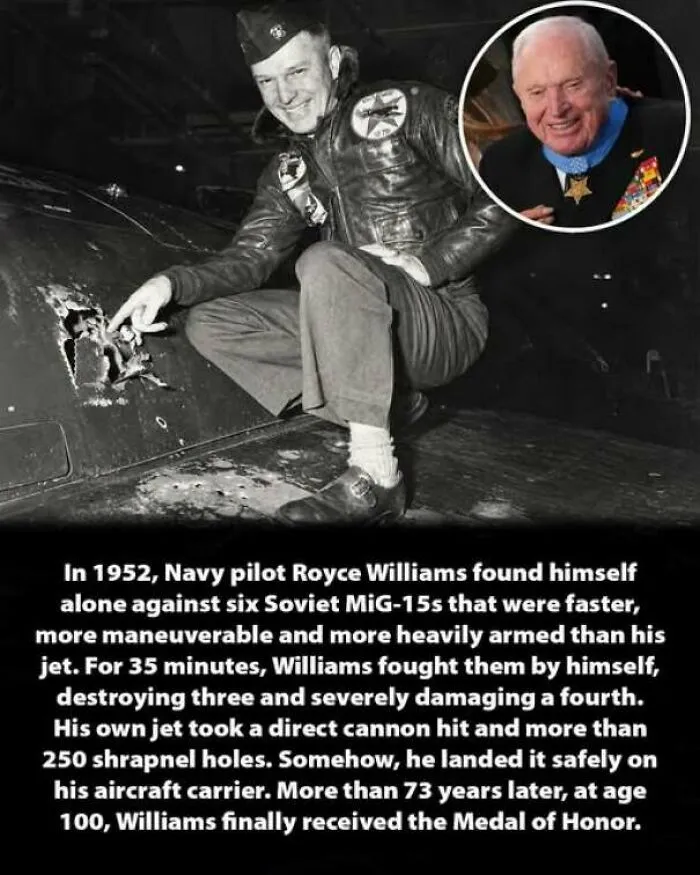
On November 18, 1952, during the Korean War, Navy Lieutenant Royce Williams took off from the USS Oriskany in an F9F-5 Panther. His group soon encountered seven Soviet MiG-15 fighters. The Soviet jets were faster, more maneuverable, climbed faster and carried heavier weapons than the American Panthers.
After the engagement began, Williams's wingman pursued a damaged MiG away from the fight. Williams suddenly found himself alone against six Soviet fighters.
For roughly 35 minutes, he fought them.
Williams constantly turned his Panther to prevent the MiGs from getting a clean shot while firing whenever one crossed his sights. He eventually exhausted all 760 rounds of his 20mm ammunition.
Then his own aircraft was hit. A 37mm cannon round tore a large hole near the wing root, while more than 250 pieces of shrapnel perforated the jet.
Williams somehow escaped into the clouds and headed back toward the Oriskany. His Panther was so badly damaged that he couldn't slow to a normal landing speed, yet he managed to catch the carrier's arresting wire and land safely.
For decades, important details of the battle remained classified because the United States had secretly confirmed that the attacking aircraft were Soviet jets operating from a Soviet base.
Later Russian records helped reveal the scale of what Williams had accomplished. The Navy now assesses that he destroyed at least three and probably four Soviet MiGs. His Medal of Honor citation officially credits him with destroying three and severely damaging a fourth.
Williams received the Silver Star in 1953. It was upgraded to the Navy Cross in 2023.
Then, on February 24, 2026, more than 73 years after the battle, 100-year-old Royce Williams was finally presented with the Medal of Honor.
#39
Robson had moved from Wales to Australia, but quickly became homesick.
The problem was that he couldn't afford the airfare back to Britain.
Inspired by an Australian athlete who had previously shipped himself across the world as freight, Robson came up with an extraordinary plan.
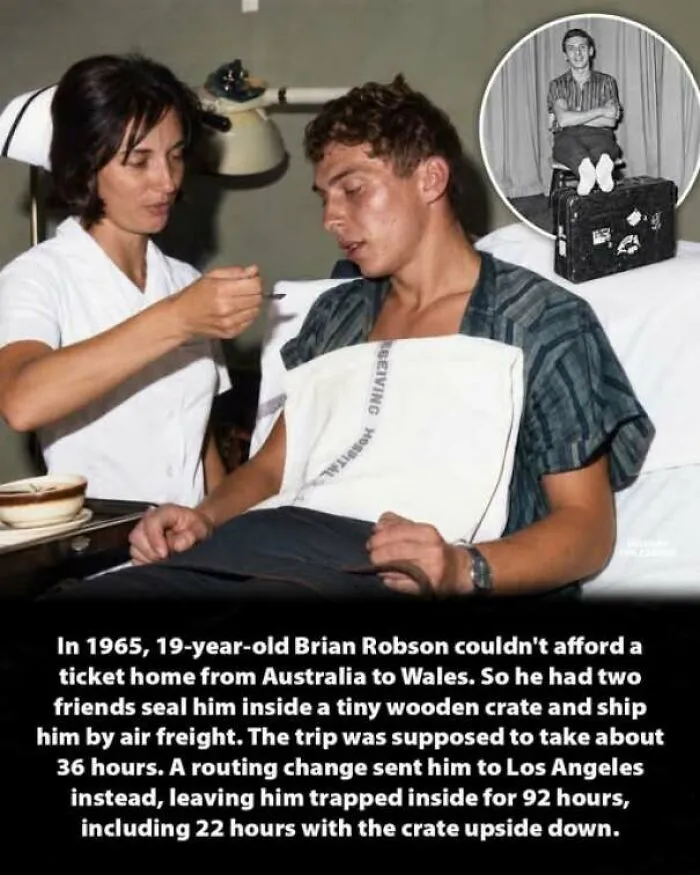
With the help of two friends, he climbed inside a wooden crate measuring roughly three feet in each direction.
He packed a small amount of water, a flashlight, pillows, a suitcase and an empty bottle.
Then his friends sealed the crate and sent him as air freight.
Robson expected the journey to London to take about 36 hours.
It didn't.
A connecting flight was full, throwing his carefully planned route into chaos.
At one point, his crate was left upside down for roughly 22 hours.
Instead of traveling directly toward Britain, he was eventually placed aboard a Pan Am flight bound for Los Angeles.
Robson drifted in and out of consciousness during the ordeal.
By the time airport workers in Los Angeles discovered him, he had spent roughly 92 hours inside the box.
He was taken to a hospital, where he spent several days recovering.
Robson eventually made it back to Britain, although thankfully not inside the crate.
Decades later, he described the experience in a book appropriately titled The Crate Escape.
#40
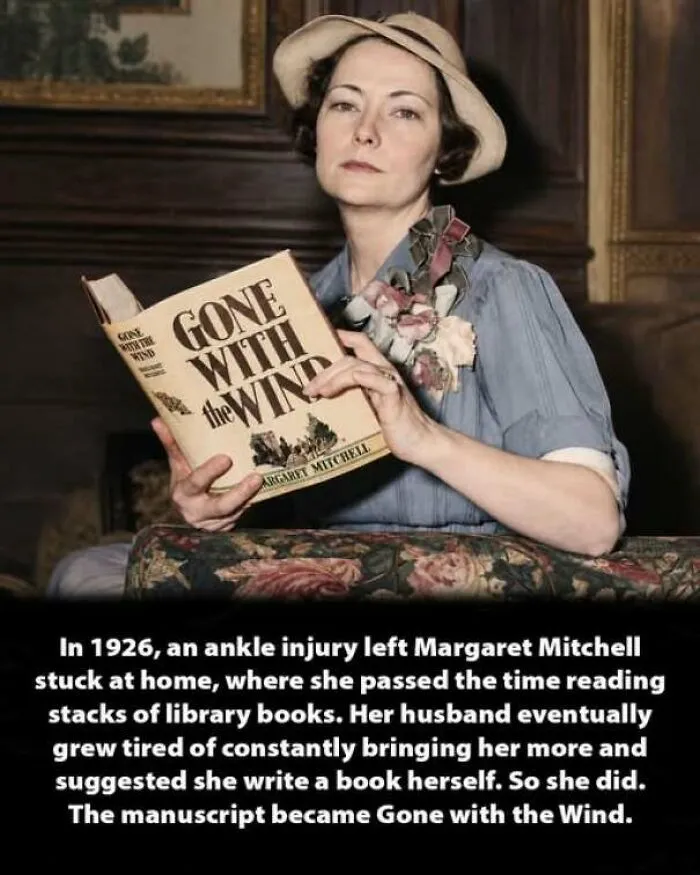
In 1926, Mitchell was recovering from an ankle injury that had left her largely confined to her Atlanta apartment.
Unable to continue her usual routine, she began reading.
A lot.
Her husband, John Marsh, repeatedly traveled to Atlanta's Carnegie Library to bring home stacks of books for her.
Eventually, Mitchell had read her way through so much of the library that Marsh suggested a different solution.
Instead of reading another book, why didn't she write one herself?
He brought her copy paper, and Mitchell began writing the next morning.
She started with the ending.
Over the next several years, Mitchell wrote chapters in no particular order, storing them in large manila envelopes around their apartment and largely keeping the project secret from friends.
The manuscript sat unfinished and unpublished for years.
Then, in 1935, Mitchell reluctantly allowed a visiting editor from Macmillan to take the manuscript.
After months of revisions, Gone with the Wind was published in June 1936.
It became a publishing phenomenon and won Mitchell the Pulitzer Prize for Fiction the following year.
Three years after the book appeared, its enormously successful film adaptation arrived in theaters.
And it all began while an injured Margaret Mitchell was running out of things to read.
