






#1
#2
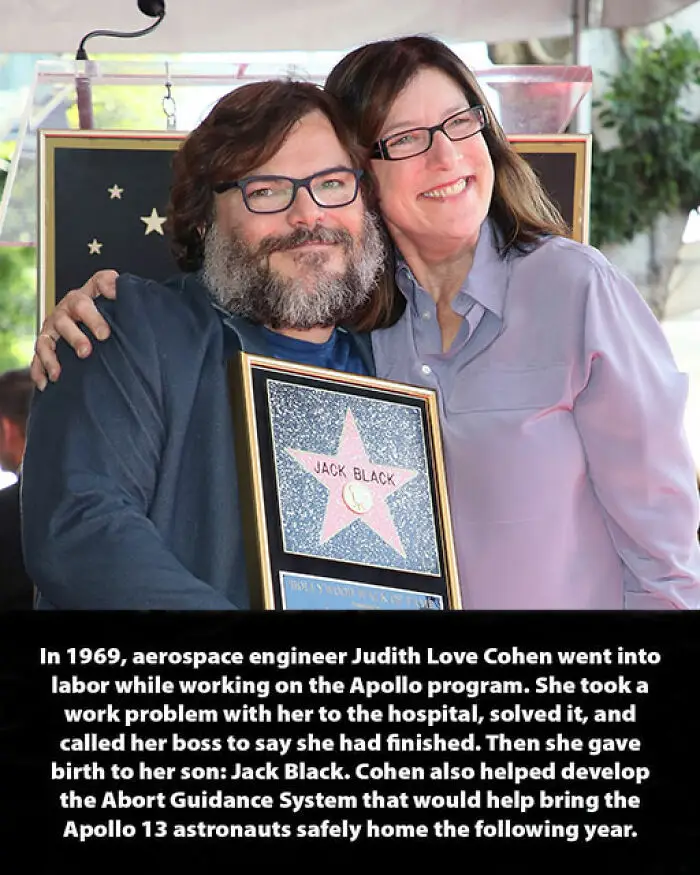
Cohen had built an impressive career in an industry where female engineers were still extremely rare.
Among her most important projects was the Abort Guidance System used aboard the Apollo Lunar Module.
Then, on August 28, 1969, Cohen went into labor.
According to her son Neil Siegel, she took a computer printout of an engineering problem with her to the hospital.
She continued working on it there.
Before giving birth, Cohen called her boss and told him she had solved the problem.
Then she had her fourth child.
That baby was Jack Black.
Less than eight months later, an oxygen tank exploded aboard Apollo 13, crippling the spacecraft on its journey to the Moon.
The astronauts were forced to use their Lunar Module as a lifeboat, and the Abort Guidance System Cohen had helped develop played an important role in navigating the spacecraft during its journey home.
All three astronauts survived.
Cohen later considered her work on Apollo among the greatest accomplishments of her engineering career.
She went on to work on other major aerospace projects, including systems connected to the Hubble Space Telescope.
After retiring, she also became an author and publisher, producing children's books intended to encourage girls to pursue careers in science and engineering.
So yes, Jack Black's mother really was an aerospace engineer who helped develop technology that played a role in saving Apollo 13.
And apparently, even giving birth wasn't enough to stop her from finishing an engineering problem.
#3
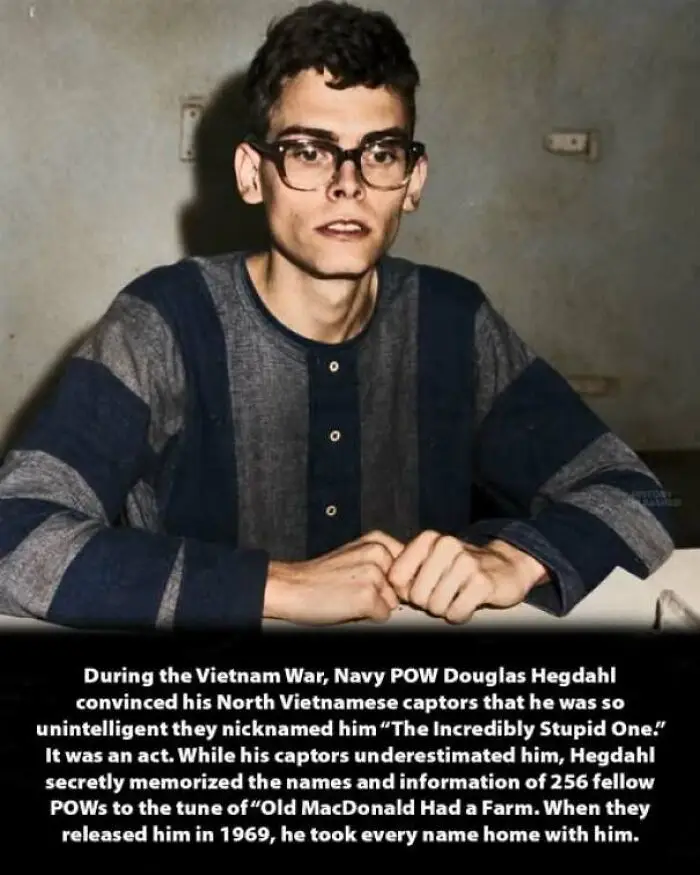
That was exactly what Douglas Hegdahl wanted them to believe.
In April 1967, 19-year-old Navy seaman apprentice Douglas Hegdahl was serving aboard the USS Canberra off the coast of Vietnam when the blast from the ship's guns knocked him overboard.
After spending hours alone in the water, he was picked up by North Vietnamese fishermen and eventually taken to a POW camp in Hanoi.
Hegdahl quickly realized that being underestimated could be useful.
He pretended that he couldn't read or write and deliberately played the part of a simple, inexperienced young sailor.
His captors fell for it.
They nicknamed him “The Incredibly Stupid One” and allowed him considerably more freedom than many of the other prisoners.
But Hegdahl was paying attention.
Working with fellow POW Joe Crecca, he began memorizing information about the Americans being held prisoner.
Names. Ranks. Capture dates. Methods of capture. Personal details that could later help confirm their identities.
To keep the enormous list straight in his head, Hegdahl turned the information into a rhythm based on “Old MacDonald Had a Farm.”
By the time he was finished, he had memorized information on 256 American POWs.
He also reportedly used his increased freedom to sabotage five prison trucks by putting dirt in their fuel tanks.
In 1969, North Vietnam selected Hegdahl for early release as a propaganda gesture.
His fellow POWs normally refused early releases, insisting that prisoners should return in the order they had been captured.
But this time, senior prisoners ordered Hegdahl to go.
They knew what was inside his head.
On August 5, 1969, Hegdahl walked free.
His captors believed they were releasing an insignificant young sailor who knew little of value.
Instead, he returned home carrying one of the most valuable collections of information to leave the POW camps.
All of it memorized.
Time is a slippery thing, and nothing proves it quite like the fact that Oxford University is older than the Aztec Empire. Teaching was already happening in Oxford by 1096, while the Aztec capital of Tenochtitlan was not founded until 1325, so students had been studying for more than two centuries before it existed.
By the middle of the 1200s, Oxford even had residence halls where those students could live. Smithsonian Magazine adds that the White House has now been standing longer than the Aztecs held their capital, which is the kind of detail that makes your brain wobble a little.
#4
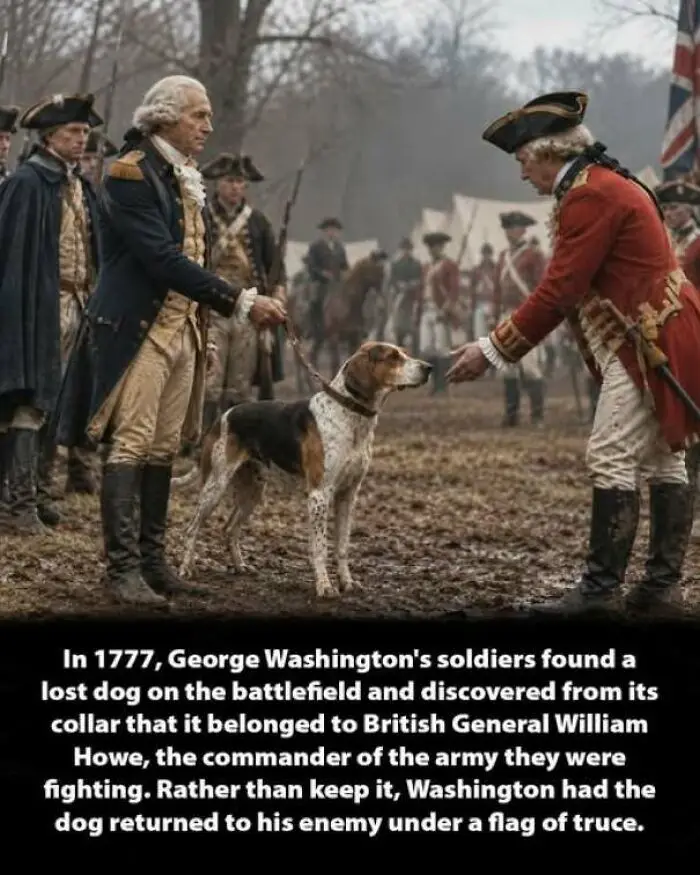
On October 4, 1777, Washington's Continental Army attacked British forces commanded by General Sir William Howe at the Battle of Germantown.
The Americans were ultimately forced to retreat.
But amid the confusion surrounding the battle, American soldiers came across a wandering dog.
The inscription on its collar revealed that it belonged to Howe, the British commander Washington had just fought.
Instead of keeping the dog, Washington arranged for it to be returned to the British.
Two days after the battle, he sent a short note across the lines:
“General Washington's compliments to General Howe. He does himself the pleasure to return him a dog, which accidentally fell into his hands, and by the inscription on the Collar, appears to belong to General Howe.”
Even in the middle of a war, Washington made sure his enemy got his dog back.
#5
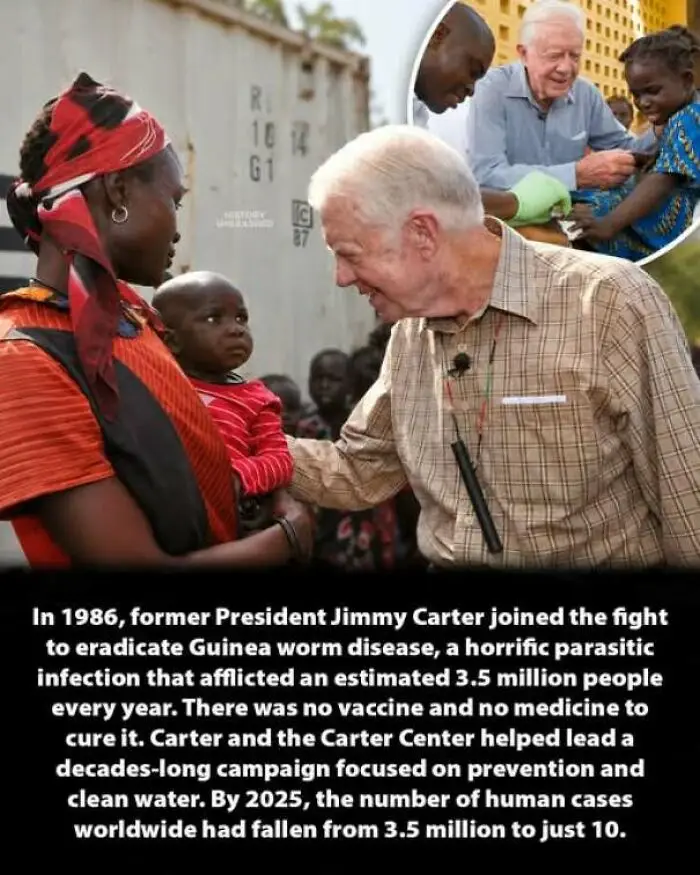
Eradicating a parasitic disease that infected millions of people every year.
Guinea worm disease is contracted primarily by drinking contaminated water. About a year later, a female worm can emerge painfully through the skin, sometimes reaching several feet in length. There is no vaccine to prevent the disease and no medicine that simply cures it.
In 1986, when the Carter Center began leading the international eradication campaign, an estimated 3.5 million people were infected every year across 21 countries in Africa and Asia.
The solution wasn't a miracle medicine
Instead, Carter and an enormous network of governments, health organizations and local volunteers attacked the parasite's life cycle.
Communities were taught to filter drinking water. Contaminated water sources were treated. People with emerging worms were kept from entering drinking water and spreading the parasite. Villages received safer sources of water, while volunteers tracked infections one by one.
Carter also used something unusual for a public health campaign: diplomacy.
In 1995, he helped negotiate a temporary ceasefire during Sudan's civil war that allowed health workers to reach communities affected by Guinea worm and other diseases.
Slowly, the numbers collapsed.
From an estimated 3.5 million cases a year in 1986, the world fell below 100,000 by 2001.
By 2025, there were just 10 reported human cases worldwide.
A reduction of more than 99.99%.
Jimmy Carter once hoped he would live to see the last Guinea worm disappear.
He didn't quite make it.
But the campaign he helped lead brought humanity extraordinarily close to eradicating an ancient disease without a vaccine or curative medicine.
#6
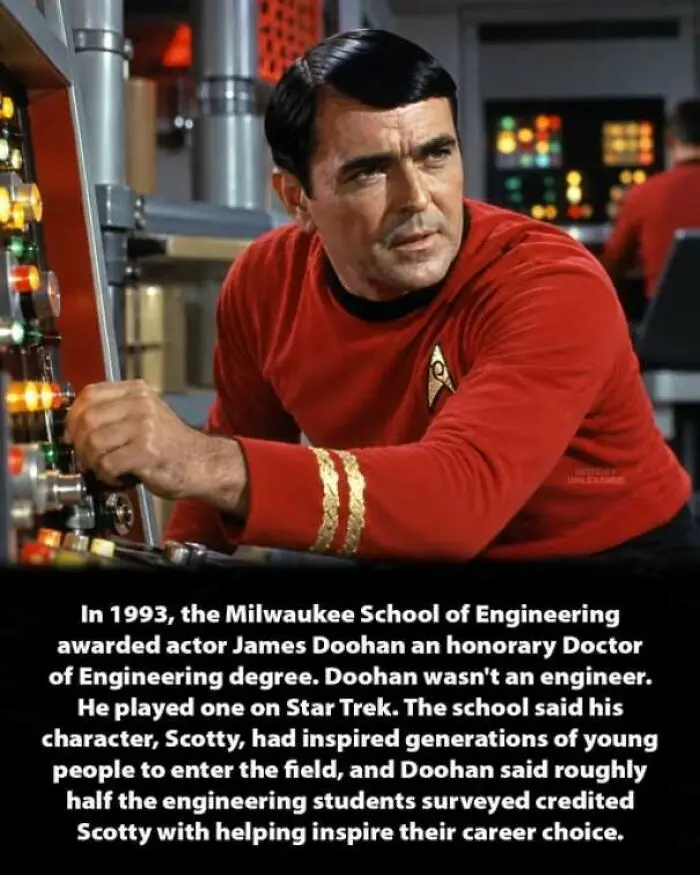
Beginning in 1966, Doohan played Montgomery “Scotty” Scott, chief engineer of the USS Enterprise on Star Trek. Whenever the ship was damaged, losing power or facing some seemingly impossible technical problem, Scotty was usually the man expected to solve it.
Decades later, Doohan discovered that his fictional engineer had influenced thousands of young viewers in the real world.
In February 1993, the Milwaukee School of Engineering awarded Doohan an honorary Doctor of Engineering degree. School officials credited his portrayal of Scotty with helping inspire generations of young people to pursue engineering.
Doohan later recalled that when students at the school were asked what had inspired them to enter the field, roughly half said Scotty had given them the idea.
He was thrilled.
Doohan said he heard similar stories from engineers across the country who had grown up watching Star Trek and decided they wanted to solve problems the way Scotty did.
For years, audiences watched a fictional engineer keep a fictional starship flying.
Some of the children watching grew up and became engineers themselves.
Some conflicts are far less dignified. In 1932, Australia sent soldiers with machine guns to Western Australia to deal with thousands of emus that were trampling wheat farms, and the birds simply refused to play along. They split into small groups, scattered in every direction, and made the whole operation look so silly that the press cheerfully declared the emus the winners. The troops withdrew after a short campaign, and although the farmers asked for military help again in later years, the government said no.
#7
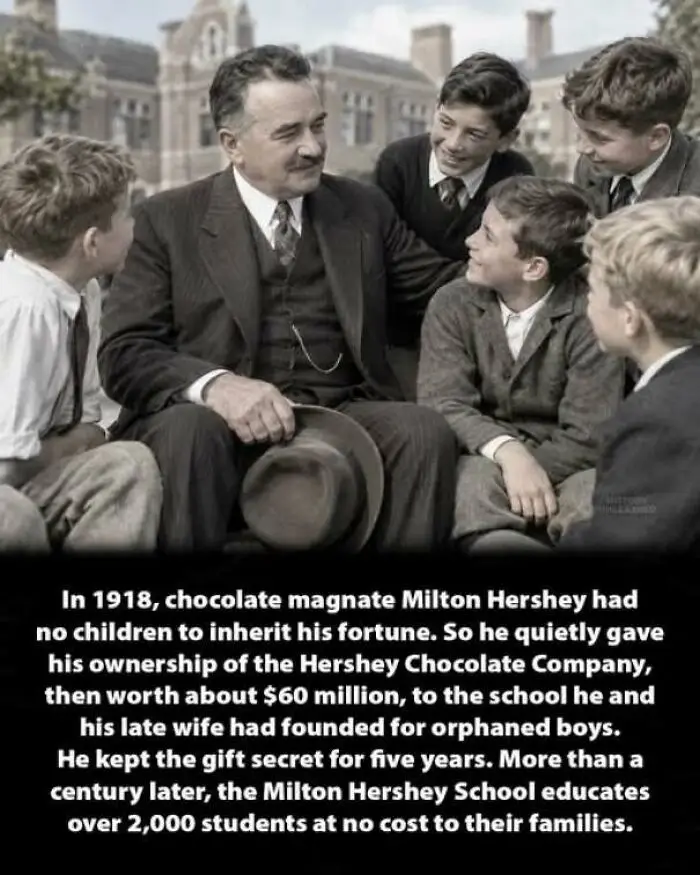
Milton and his wife Catherine “Kitty” Hershey had no children of their own. In 1909, they founded the Hershey Industrial School to provide a home and education for orphaned boys. After Kitty passed away in 1915, Hershey decided to secure the school's future permanently.
On November 13, 1918, he quietly transferred his ownership of the Hershey Chocolate Company to the school's trust. The stock was valued at roughly $60 million at the time, an extraordinary fortune. Hershey didn't publicly announce what he had done. The gift remained largely unknown until 1923.
His generosity didn't end there. During the Great Depression, Hershey launched an enormous construction campaign in his Pennsylvania company town, building a hotel, theater, sports arena and other projects while employing hundreds of workers.
According to a story preserved by the Hershey archives, when a foreman proudly told Hershey that two steam shovels could do the work of 40 men, Hershey replied, “Take them off. Hire forty men.”
Today, the school he and Kitty founded is the Milton Hershey School. More than 2,000 students attend, with housing, meals, clothing, health care, school supplies and education provided at no cost to qualifying families.
Hershey had once explained his decision simply: with no children of his own, he had decided to make orphaned boys his heirs.
#8
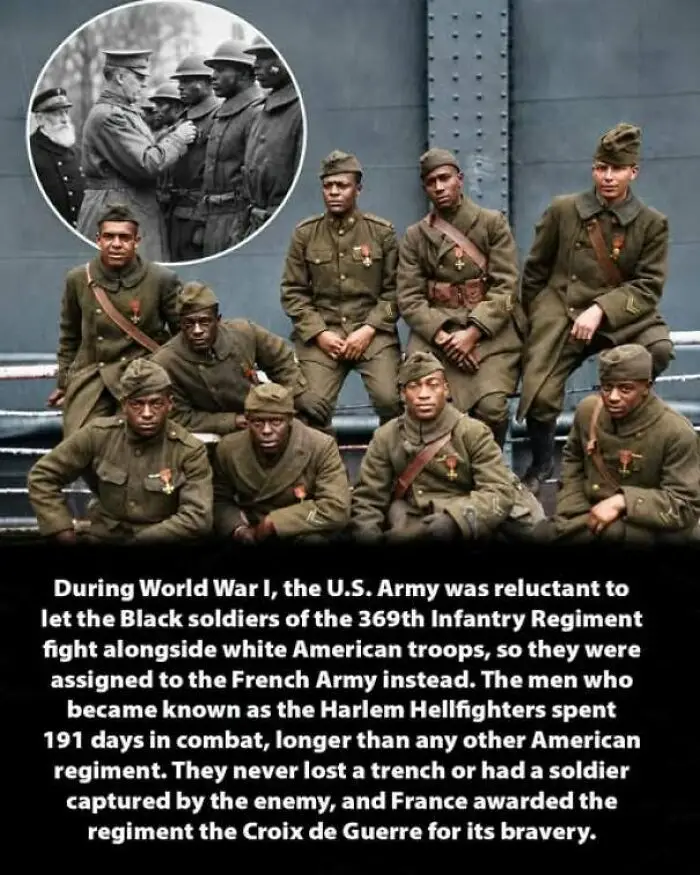
So they were assigned to fight with the French instead.
The French Army equipped the men with French rifles, helmets and other gear and sent them into combat on the Western Front.
What followed became one of the most remarkable records of any American regiment in the war.
The men who became known as the Harlem Hellfighters spent 191 days in combat, longer than any other American regiment. They fought in major campaigns including the Meuse-Argonne offensive and earned a reputation for refusing to give ground.
According to U.S. Army histories, during their 191 days in combat the regiment never lost a trench and never had a soldier captured by the enemy.
France recognized their service by awarding the entire regiment the Croix de Guerre, while more than 170 individual members also received the French decoration.
One of the regiment's most famous soldiers, Henry Johnson, fought off a German raiding party while wounded and prevented a fellow American soldier from being captured. France decorated Johnson for his bravery, but the United States did not award him the Medal of Honor until 2015, nearly a century later.
The Hellfighters also left their mark away from the battlefield. Their celebrated regimental band, led by James Reese Europe, helped introduce American jazz to audiences across France.
They had been sent to fight with another country's army because of segregation at home.
They returned to the United States as one of the most celebrated American units of World War I.
#9
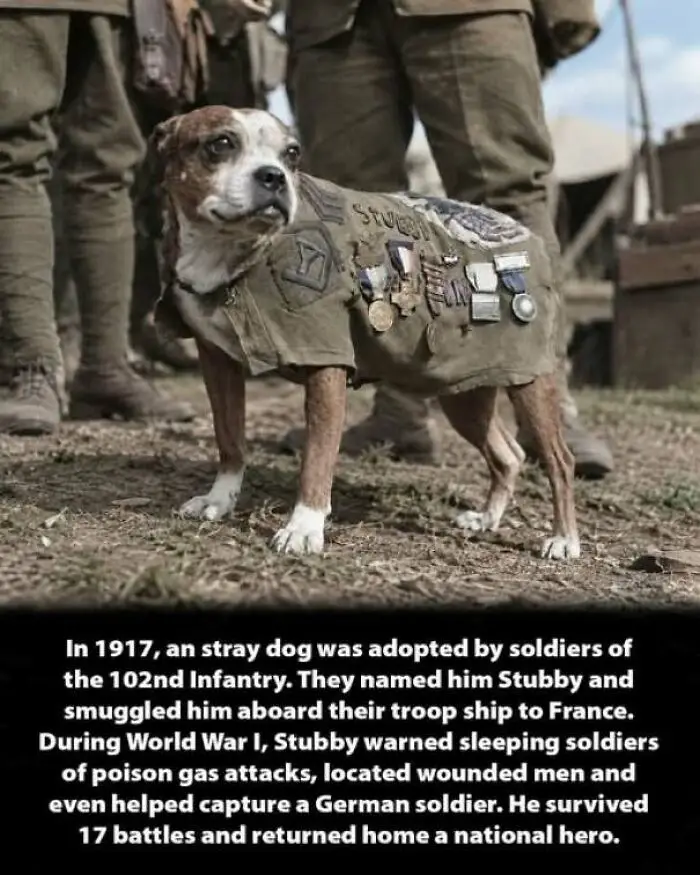
Soldiers of the 102nd Infantry were training at Yale when the stray puppy appeared and befriended Private J. Robert Conroy.
They named him Stubby.
When the regiment was sent to France, Conroy smuggled Stubby aboard the troop ship.
Stubby eventually accompanied the soldiers into the trenches, where he proved to be much more than a mascot.
After surviving a gas attack himself, Stubby became extremely sensitive to the smell of poison gas. During a later attack, he ran through the trenches barking and waking sleeping soldiers before the gas reached them.
He also located wounded men on the battlefield and barked until medics arrived.
Late in the war, Stubby even helped capture a German soldier near the Allied trenches.
By the end of World War I, Stubby had participated in 17 battles and survived both gas exposure and shrapnel wounds.
He returned to the United States a national hero.
Technology can start in humble places too. In 1991, a group of researchers at the University of Cambridge grew tired of trekking to a shared coffee pot only to find it empty, so they pointed a camera at it and sent the picture to their desktop computers. The image was grayscale and refreshed only a few times a minute, but it did the job.
#10
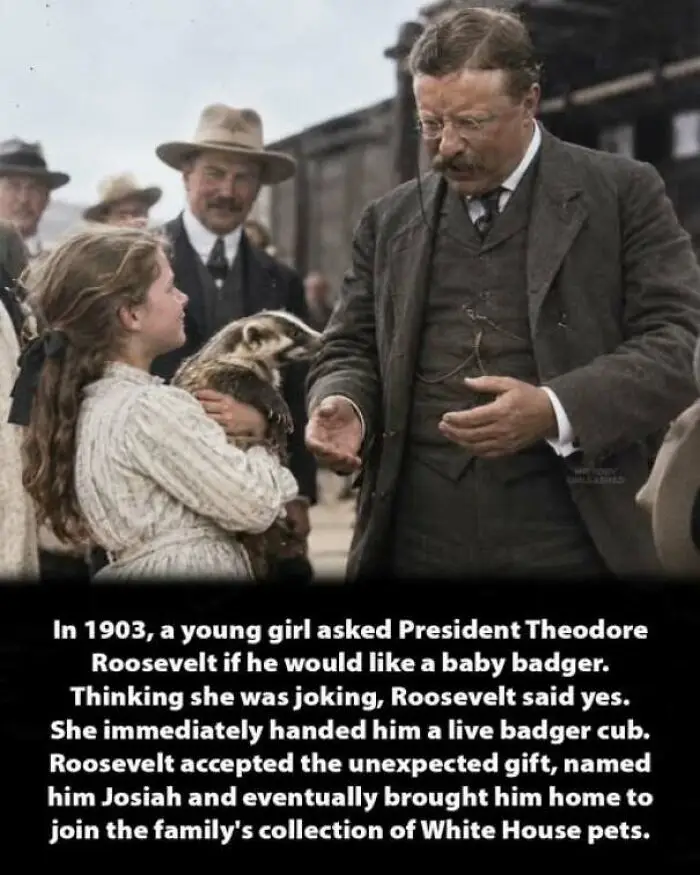
Roosevelt apparently thought she was joking.
He said yes.
The girl promptly presented him with an actual badger cub.
Roosevelt accepted the unexpected gift and named him Josiah, reportedly after the girl who had given him the animal. Josiah traveled with the presidential party before eventually joining the Roosevelt family's extraordinary collection of animals.
The Roosevelts were already famous for keeping an assortment of pets. Their children cared for dogs, cats, guinea pigs, ponies, snakes, birds and numerous other animals during Roosevelt's presidency.
Josiah apparently developed a personality of his own.
In a letter to his son Archie, Roosevelt described the young badger as “very friendly and affectionate.” Josiah enjoyed being held and would sometimes nip at people's ankles when he wanted attention.
Eventually, the family decided the White House wasn't the ideal permanent home for a growing badger. Josiah was given to the Bronx Zoo, where Roosevelt could still visit him.
It was perhaps the most Theodore Roosevelt outcome possible: someone jokingly offered the president a wild animal, and he actually took it home.
#11
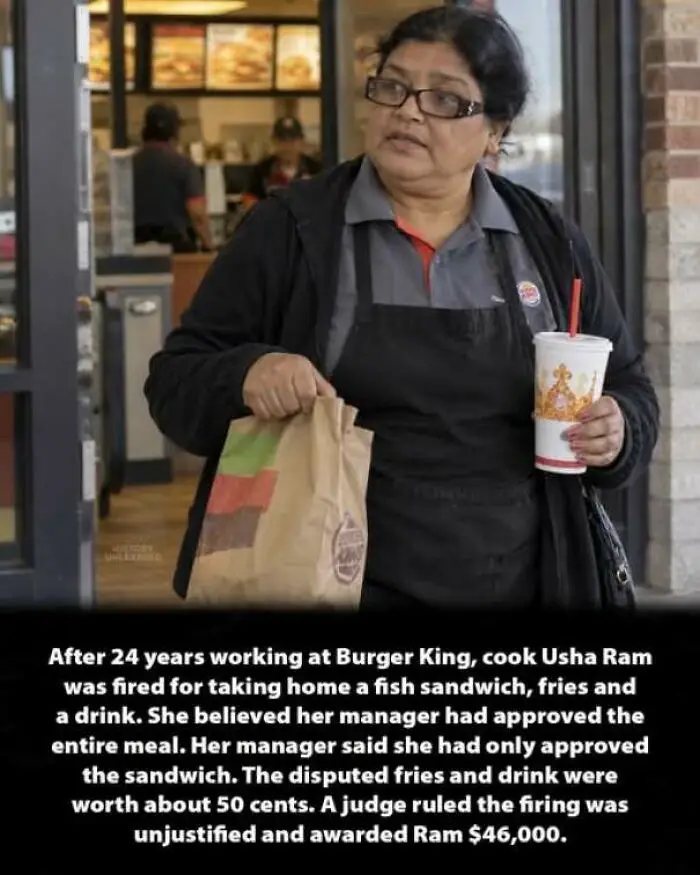
Ram had worked at Burger King restaurants around Vancouver, Canada, since 1989.
By 2013, she was 55 years old, working full-time as a cook and earning minimum wage.
She also had no formal disciplinary record.
On December 27, 2013, Ram realized she had forgotten her wallet and asked her manager if she could take some food home after her shift.
Ram believed she had been given permission to take a fish sandwich, fries and a drink.
Her manager remembered the conversation differently.
She said she had only given Ram permission to take the fish sandwich.
Ram left the restaurant with the full meal without paying.
Management considered the fries and drink theft.
After 24 years with the company, Ram was fired.
The value of the disputed food was tiny.
Taking Burger King's employee discounts and food policies into account, the restaurant's loss from the fries and drink amounted to roughly 50 cents.
Ram sued for wrongful dismissal.
In 2017, a British Columbia Supreme Court judge concluded there was no evidence that Ram had planned to steal the food or attempted to conceal what she had taken.
The judge also considered her 24 years of service and lack of formal disciplinary history, ruling that immediate dismissal was a disproportionate punishment.
Ram was awarded $21,000 in lost wages.
She received another $25,000 in aggravated damages.
Altogether, the misunderstanding over roughly 50 cents worth of food ended with a $46,000 judgment.
#12
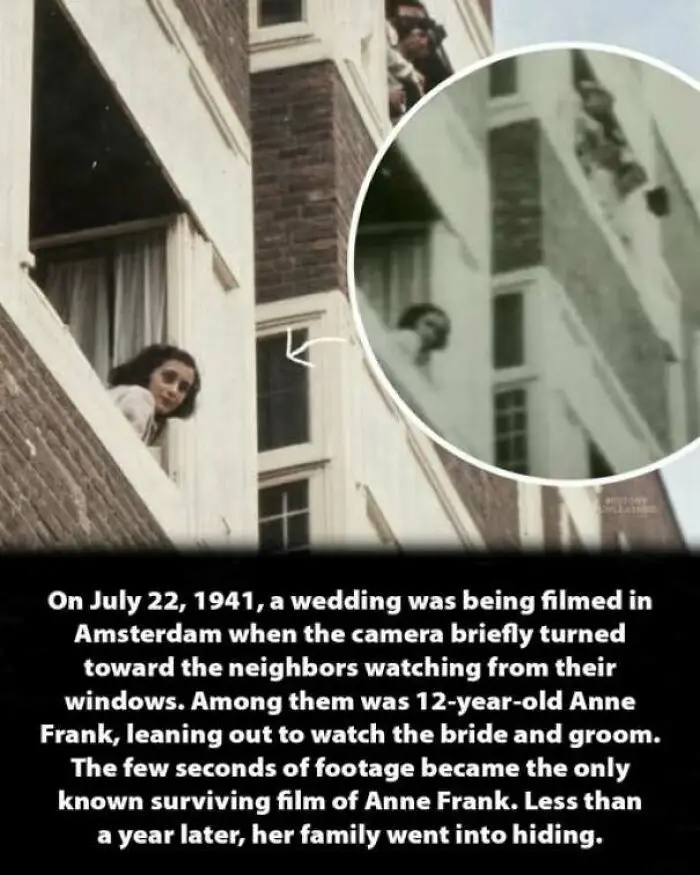
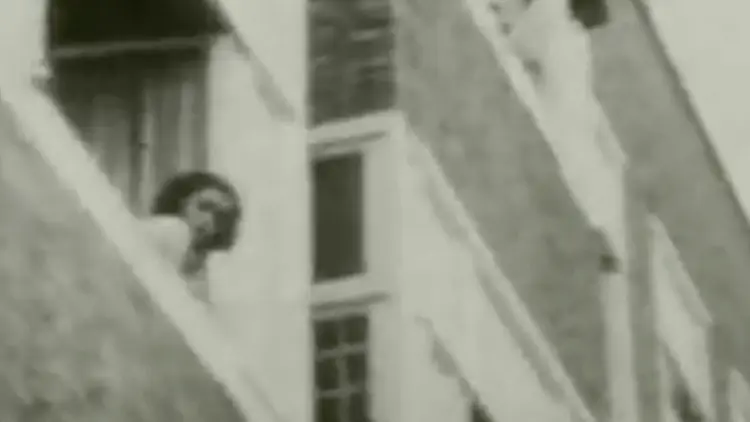
Anne was 12 years old and living with her family at Merwedeplein 37. Their next-door neighbor, Tiny Burger, was getting married, and an acquaintance had brought a 16mm camera to film the occasion.
As the bride and groom prepared to leave, the cameraman briefly turned toward the open windows of the surrounding apartments.
There, leaning out of a second-floor window to get a better look at the wedding, was Anne Frank.
She appears for only a few seconds. At the time, she was simply another neighborhood girl watching the excitement outside her home. No one filming the wedding could have known that those fleeting images would become historically significant.
Less than a year later, in July 1942, the Frank family went into hiding.
Today, the short wedding film contains the only known surviving moving images of Anne Frank.
The image shown here is a digital reconstruction based on a frame from that original 1941 footage.
Once it reached the web in 1993, the Trojan Room coffee pot became the first webcam, and one of its creators tells the whole tale on a Cambridge page that reads like a classic office story. When the lab moved in 2001, a coffee machine from the camera’s glory days even sold on eBay for £3,350.
#13
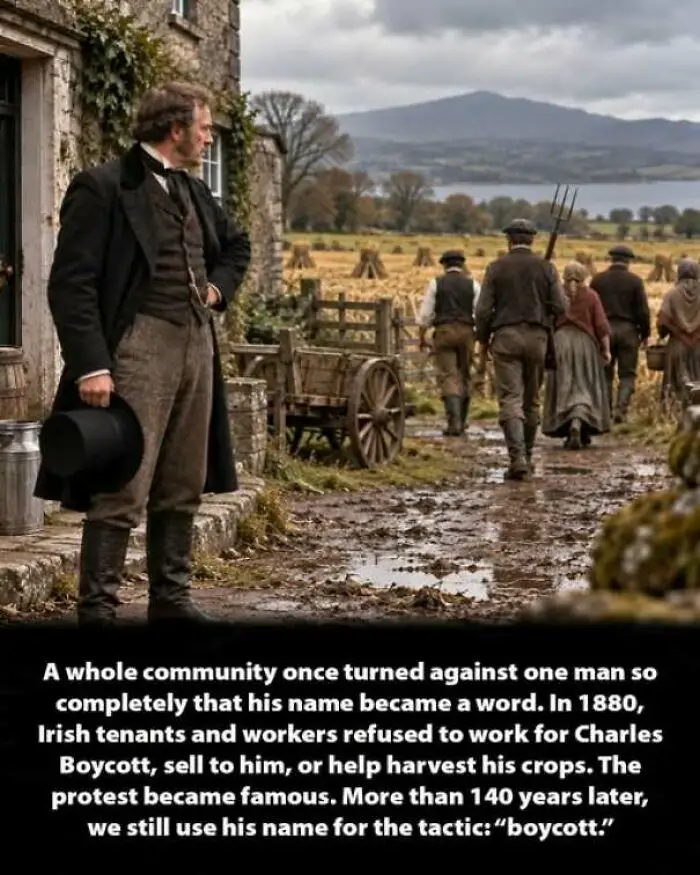
His name was Charles Cunningham Boycott.
In 1880, Boycott worked as a land agent for Lord Erne on an estate in County Mayo, Ireland.
It was a difficult year for local tenant farmers.
After a poor harvest, Lord Erne offered his tenants a 10% reduction in their rents.
The tenants wanted 25%.
When the larger reduction was refused, Boycott attempted to serve eviction notices on 11 tenants who had fallen behind.
Ireland was already in the middle of a growing movement for land reform.
Irish Land League leaders encouraged communities to fight back without resorting to violence.
Instead, they could simply refuse to have anything to do with the person they opposed.
The people around Boycott put that idea into practice.
His servants left.
Farm laborers refused to work his land.
Local tradespeople wouldn't do business with him.
Shopkeepers refused to provide supplies.
Even getting his mail became difficult.
When harvest time arrived, Boycott couldn't find local workers willing to bring in his crops.
Eventually, outside laborers had to be brought in under the protection of nearly 1,000 troops.
The operation reportedly cost around £10,000 to save crops worth only a fraction of that amount.
The confrontation attracted enormous attention in newspapers.
And people needed a word for what the community was doing.
According to contemporary accounts, local priest Father John O'Malley suggested using the land agent's own name.
Instead of saying someone should be “ostracized,” they could simply say:
“Boycott him.”
The word spread remarkably quickly.
By the end of 1880, “boycott” was appearing in newspapers as both a noun and a verb.
More than 140 years later, Charles Boycott's name is still used around the world for the very tactic once used against him.
#14
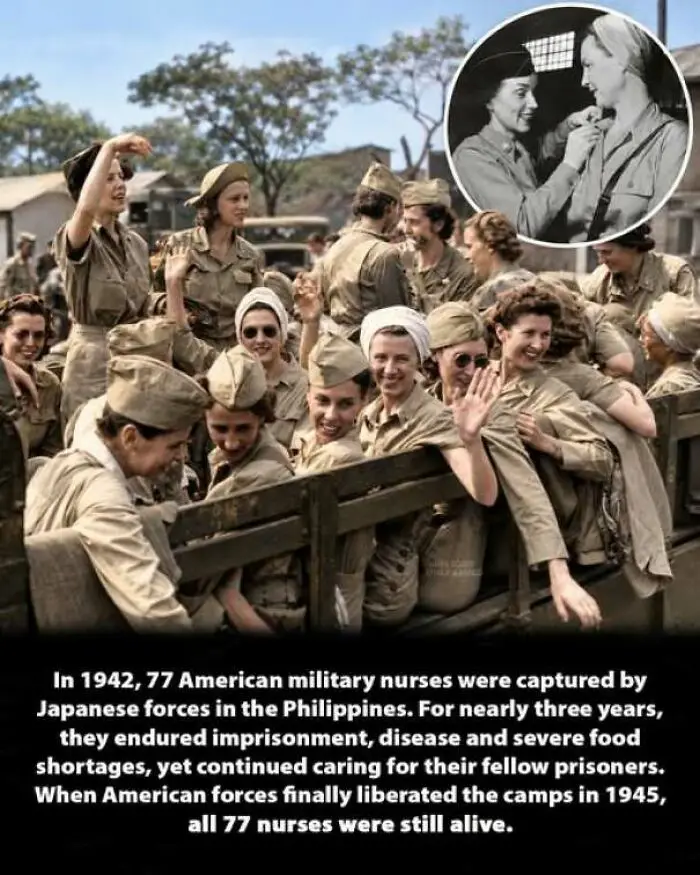
Every one of them survived.
The women, 66 Army nurses and 11 Navy nurses, had been stationed in the Philippines when Japan invaded shortly after the attack on Pearl Harbor.
As American and Filipino forces fought desperately to hold Bataan and Corregidor, the nurses worked under increasingly brutal conditions. Hospitals designed for roughly 1,000 patients became overwhelmed with thousands of wounded and sick men. Medical supplies dwindled while malaria, dysentery and other diseases spread.
When American forces surrendered in 1942, the nurses were captured.
But they didn't stop being nurses.
The women were eventually imprisoned at camps including Santo Tomas and Los Baños. Surrounded by thousands of other prisoners and civilians, they organized themselves into regular nursing shifts and continued caring for the sick.
As the war dragged on, conditions deteriorated.
Food became desperately scarce. Disease spread. The nurses themselves grew weak from malnutrition, but they continued reporting for duty and caring for other prisoners.
Their leaders believed maintaining their nursing routine gave the women something enormously important in captivity: purpose.
For nearly three years, they kept going.
In February 1945, American and Filipino forces liberated the camps.
The nurses emerged sick, exhausted and severely underweight.
But when they were counted, something remarkable became clear.
All 77 had survived.
They became known as the Angels of Bataan and Corregidor.
#15
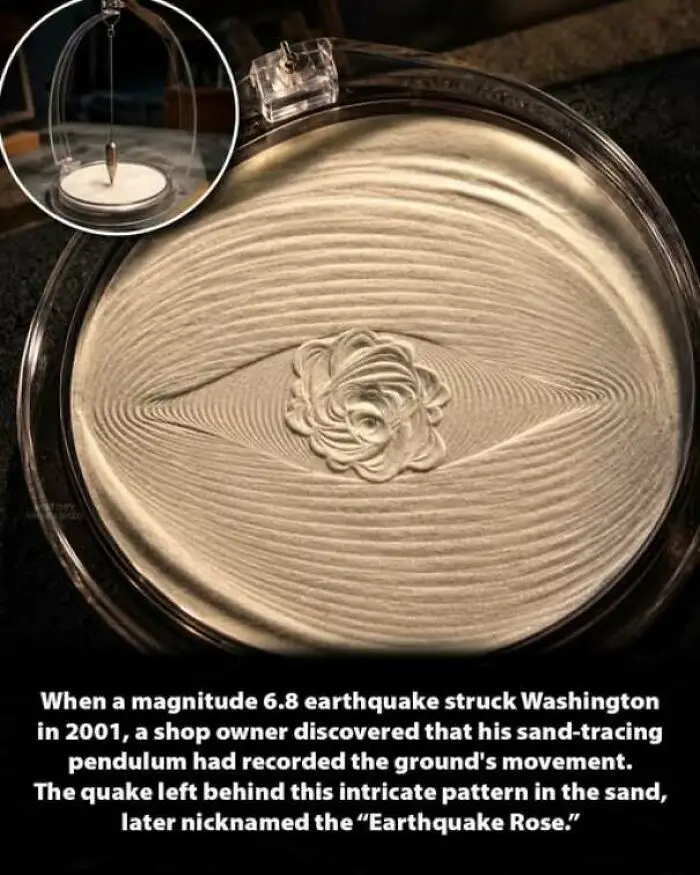
On February 28, 2001, the Nisqually earthquake shook Washington state for more than half a minute.
In Port Townsend, shop owner Jason Ward had a sand-tracing pendulum suspended over a tray of sand.
As the ground moved, the pendulum began tracing the earthquake's vibrations.
When the shaking ended, Ward discovered that it had left behind an intricate pattern resembling a flower or rose.
Seismologists explained that the pattern had actually preserved different components of the earthquake's motion.
The tighter flower-like pattern recorded higher-frequency waves that arrived earlier, while the larger outer oscillations reflected lower-frequency waves that arrived later.
The unusual recording became known as the “Earthquake Rose.”
Unfortunately, the original didn't survive for long.
Before Ward could make a mold of it, his three-year-old son accidentally bumped the pendulum and erased the pattern.
Fortunately, photographs had already been taken.
Even the mightiest leaders can lose to something fluffy. In 1807, after signing a peace treaty with Russia, Napoleon decided to celebrate with a rabbit hunt, and his chief of staff arranged for hundreds of rabbits to be delivered.
#16
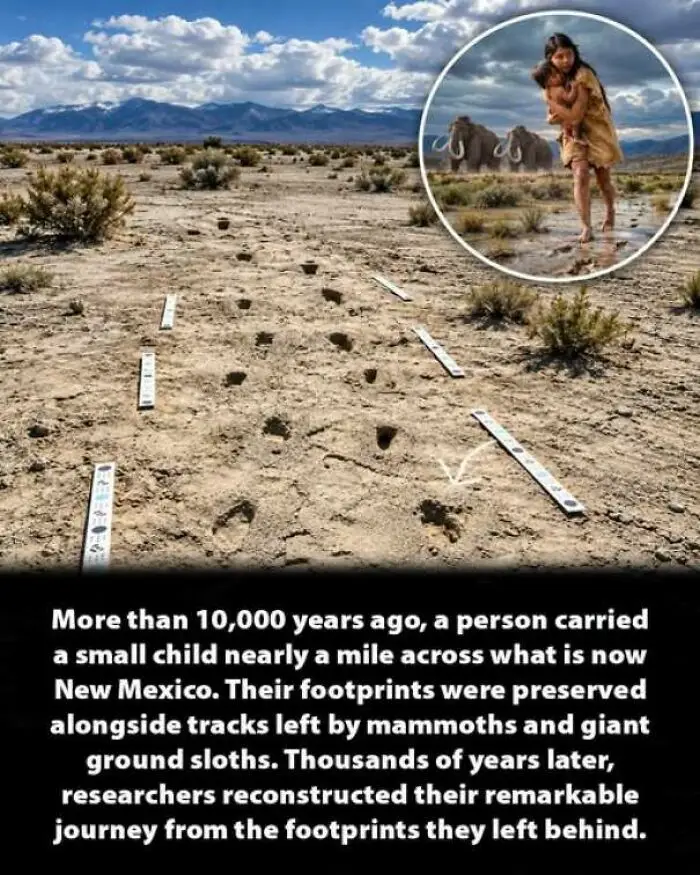
At White Sands National Park, researchers discovered an extraordinary human trackway stretching for nearly a mile across what was once the muddy shore of an ancient lake.
The footprints appear to have been made by an adolescent or small adult, likely female, traveling while carrying a child under the age of 3.
Researchers could even see evidence of the traveler shifting the child from one side of their body to the other.
At several points, tiny footprints appear beside the larger ones, suggesting the child was briefly placed on the ground before being picked up again.
Then something remarkable happened.
After the pair passed through, a Columbian mammoth and a giant ground sloth crossed their trail.
Several hours later, the same human traveler appears to have returned along the same route, this time without the child.
Altogether, the out-and-back journey created more than 1.5 kilometers of preserved tracks, making it the longest known Late Pleistocene human double trackway.
Thousands of years later, individual footprints still preserve moments from one person's journey across an Ice Age landscape.
#17
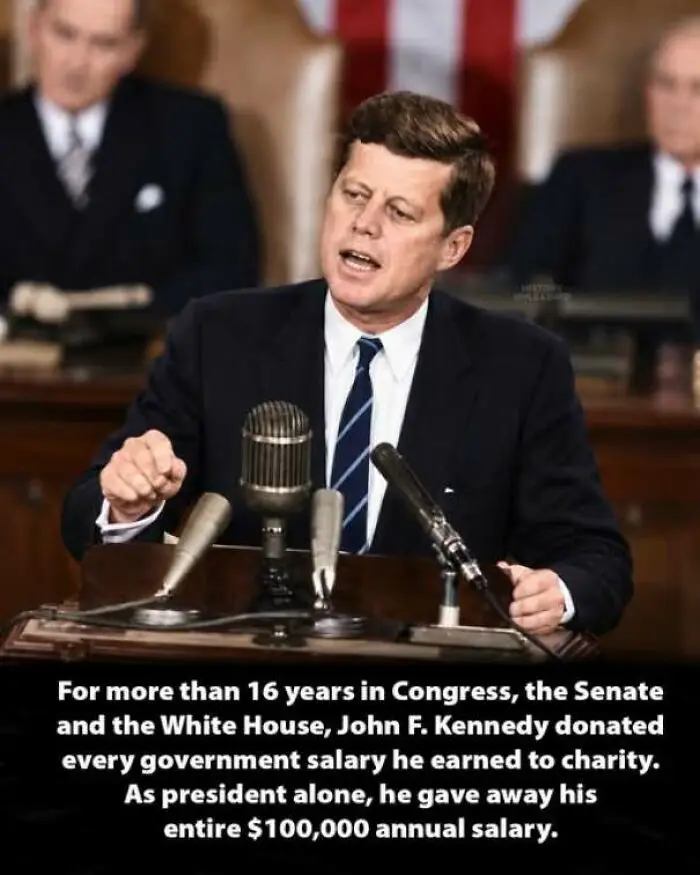
When Kennedy entered the House of Representatives in 1947, he began donating his government pay to charity.
He continued the practice throughout six years in the House, eight years in the Senate and his presidency.
Kennedy came from a wealthy family and did not depend on his government salary for his income.
When he became president in 1961, the job paid $100,000 a year.
Kennedy continued giving the money away.
In 1961, his partial-year presidential salary of about $94,600 was distributed among six charities. The following year, his entire $100,000 salary was again designated for charitable purposes.
Contemporary reports estimated that by the end of 1962, Kennedy had donated nearly $500,000 in government salaries since first entering Congress.
#18
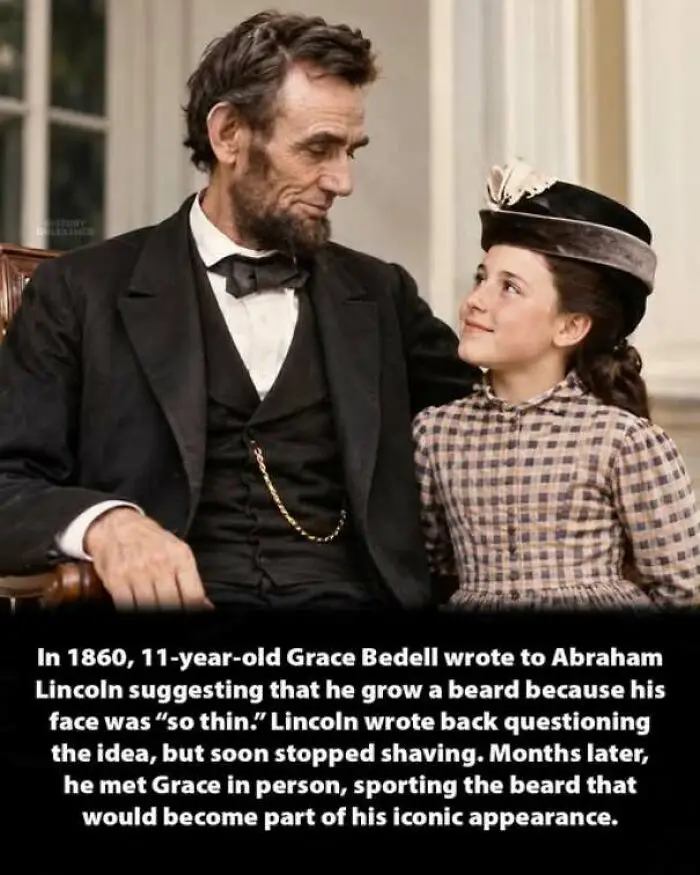
In October 1860, Grace Bedell of Westfield, New York, saw a campaign portrait of presidential candidate Abraham Lincoln and decided he could improve his appearance.
So she wrote him a letter.
Grace told Lincoln that his face was “so thin” and suggested that he grow whiskers.
She also argued that women liked whiskers and might encourage their husbands to support him.
Four days later, Lincoln personally wrote back.
He wasn't convinced.
Having never worn whiskers before, Lincoln wondered whether suddenly growing them would look like a “silly affectation.”
But about a month after receiving Grace's letter, Lincoln began growing a beard.
After winning the election, the president-elect traveled through Westfield on his journey to Washington in February 1861.
By then, his beard was unmistakable.
Lincoln asked for Grace in the crowd, met her face to face and acknowledged that he had acted partly upon her suggestion.
The beard remained for the rest of his life and became part of one of the most recognizable faces in American history.
The catch was that they were tame farm rabbits rather than wild ones, so instead of fleeing, they raced straight toward the emperor, apparently expecting dinner. According to a general’s memoir, which Mental Floss recounts, Napoleon ended up retreating to his carriage while the bunnies chased after him. The tale stayed quiet for decades, since that memoir was not published until 1895.
#19
#20
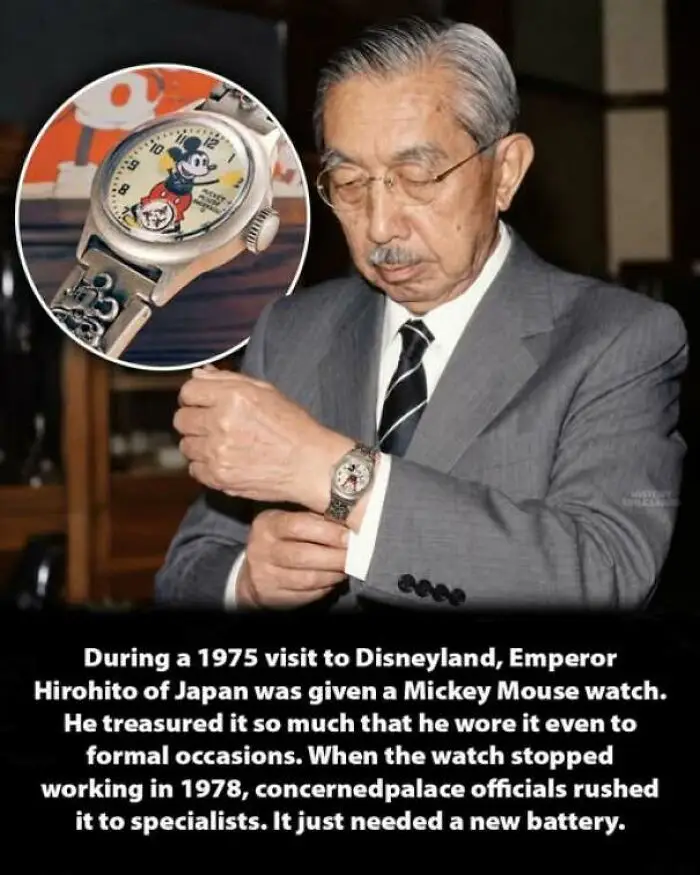
It was a Mickey Mouse watch.
In October 1975, the Japanese emperor and Empress Nagako visited the United States on a goodwill tour.
Their trip included a stop at Disneyland in California.
During the visit, Hirohito was presented with a Mickey Mouse wristwatch.
And apparently, he loved it.
The emperor continued wearing the watch after returning to Japan and was reportedly seen wearing it even during formal occasions.
Then, a few years later, Mickey stopped ticking.
According to TIME magazine, the malfunction caused enough concern inside the Imperial Household that palace officials sent the watch to Tokyo specialists familiar with American timepieces.
After examining the emperor's treasured watch, they discovered the problem.
It needed a new battery.
Mickey was soon ticking again and returned to Hirohito's wrist.
When Hirohito passed in 1989, contemporary reports claimed that the Mickey Mouse watch was among the personal possessions buried with him.
That final detail has never been officially confirmed. The Imperial Household Agency declined to reveal exactly which personal items were placed in his tomb.
But Hirohito's affection for the Mickey Mouse watch itself is well documented.
For years, one of the world's most formal monarchs could occasionally be seen wearing Mickey Mouse on his wrist.
