





Even if you happened to hate history in school, there are always parts of it you haven’t heard that you might find fascinating. It just takes finding the right examples, because fiction doesn’t have a monopoly on good narratives.
So we’ve gathered some of the best posts and stories from the “History Unleashed” Facebook page, which is dedicated to sharing interesting pieces of history. Get comfortable as you scroll through, upvote your favorites and be sure to share your own examples below.
More info: Facebook
#41
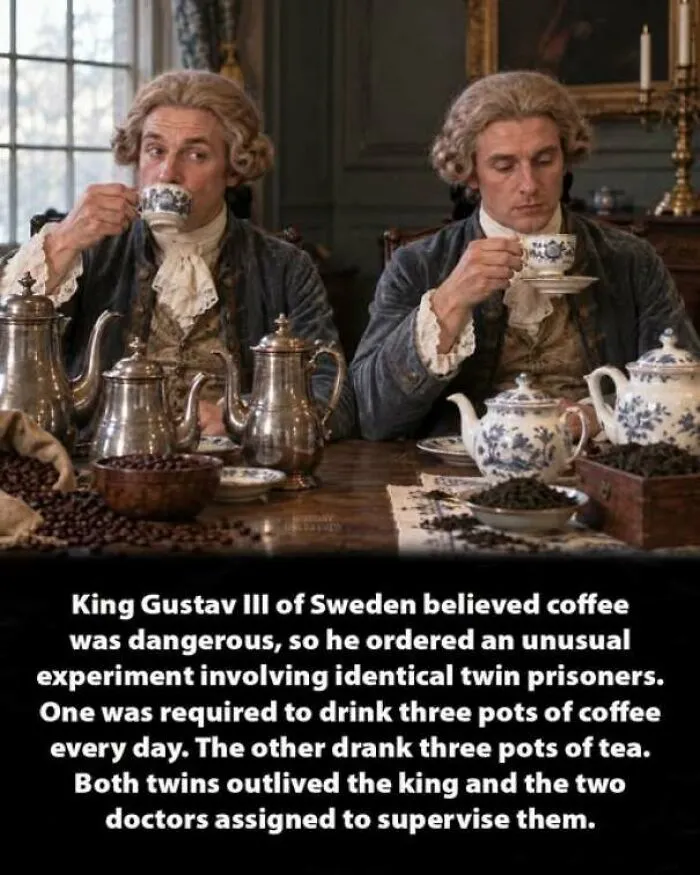
A Swedish king who believed coffee was dangerous reportedly tried to prove it with one of history's strangest experiments.
During the 18th century, coffee became increasingly popular in Sweden.
Not everyone was pleased.
Swedish authorities worried about the drink's effects on health and society, and coffee was subjected to taxes, restrictions and eventually outright bans.
King Gustav III was reportedly convinced that coffee was particularly harmful.
So he ordered an unusual experiment.
According to the traditional account, identical twin brothers who had been sentenced to d***h had their sentences reduced to life imprisonment.
There was one condition.
One brother was required to drink three pots of coffee every day.
The other was required to drink three pots of tea.
Two physicians were assigned to monitor the brothers and determine what effect the drinks had on their health.
Then the experiment took an unexpected turn.
Both doctors passed away before either of the twins.
Gustav III didn't live to see the results either.
The king was shot at a masquerade ball in 1792 and passed away from his wounds less than two weeks later.
The twins kept drinking.
According to later accounts, the brother assigned to drink tea eventually passed away at the age of 83.
The coffee drinker reportedly survived even longer.
The experiment obviously wouldn't meet modern scientific standards, and many details survive through later historical accounts rather than complete experimental records.
But Gustav III's attempt to demonstrate the dangers of coffee certainly didn't produce the result he expected.
The doctors passed.
The king passed.
The coffee drinker kept drinking coffee.
Report
4points
#42
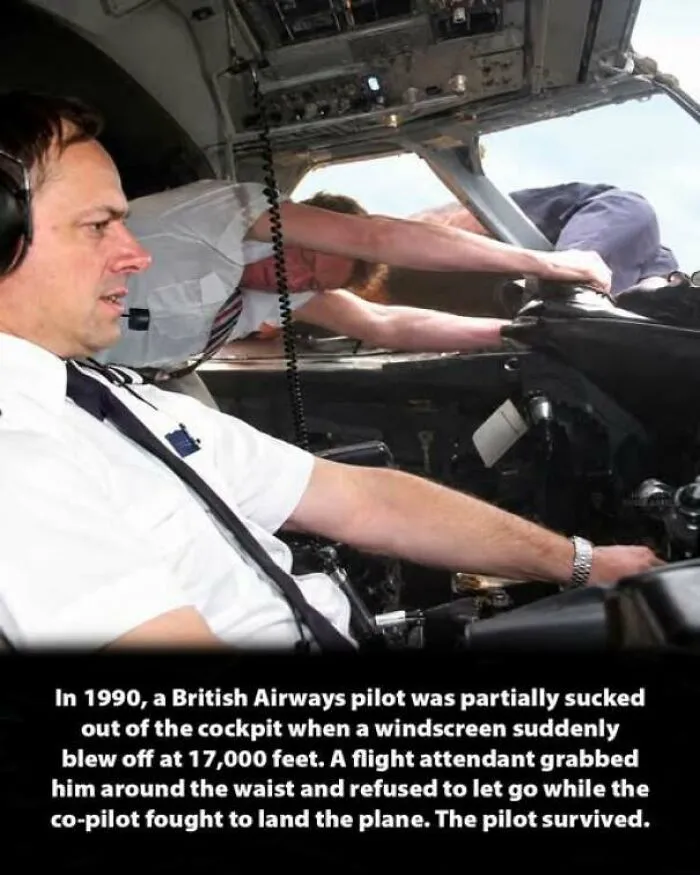
At 17,000 feet, the cockpit windscreen suddenly disappeared and the captain was pulled halfway out of the airplane.
On June 10, 1990, British Airways Flight 5390 departed Birmingham, England, carrying 81 passengers and six crew members on a flight to Málaga, Spain.
Everything appeared normal until the aircraft climbed through approximately 17,300 feet.
Suddenly, there was a loud bang.
The cockpit filled with condensation as the cabin rapidly decompressed.
The left windscreen had separated from the aircraft.
Captain Tim Lancaster was partially sucked through the opening.
Flight attendant Nigel Ogden, who had been near the cockpit, rushed forward and grabbed Lancaster around the waist.
He held on as the captain remained trapped partly outside the aircraft in the freezing, high-speed airflow.
Other members of the cabin crew soon helped restrain Lancaster while co-pilot Alastair Atchison took control of the aircraft.
Atchison began an emergency descent while struggling with the tremendous noise inside the damaged cockpit and difficulty communicating by radio.
The crew initially feared Lancaster was already d**d.
They held onto him anyway.
Atchison eventually diverted the aircraft to Southampton and landed safely.
There were no fatalities.
And remarkably, Tim Lancaster was alive.
He suffered fractures, frostbite and other injuries, but survived the ordeal.
Investigators eventually discovered that the windscreen had been replaced before the flight using incorrectly sized bolts. Many of the bolts securing it were slightly too small, allowing the windscreen to fail under the pressure difference as the aircraft climbed.
Lancaster later recovered and returned to flying.
A cockpit windscreen disappeared at more than 17,000 feet.
The captain went through it.
And everyone aboard survived.
Report
4points
#43
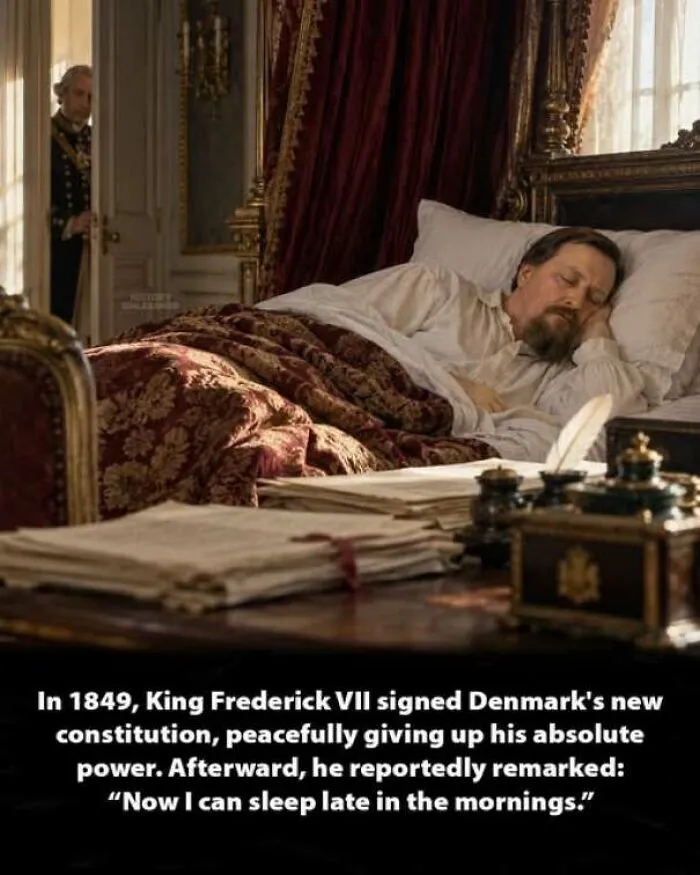
In 1849, Denmark's king gave up absolute power and reportedly found an immediate upside: he could finally sleep in.
Denmark had been governed as an absolute monarchy for nearly two centuries when Frederick VII inherited the throne in 1848.
Across Europe, demands for political reform were growing, and Denmark was no exception.
Rather than attempt to preserve absolute royal rule, Frederick accepted a constitutional system.
On June 5, 1849, he signed Denmark's new constitution, ending the absolute monarchy and establishing a constitutional system with an elected parliament and protections for individual rights.
According to a story that became associated with the king, Frederick reacted to surrendering his absolute authority with a remarkably casual observation:
“Now I can sleep late in the mornings.”
Different versions of the remark survive, so the exact wording is uncertain.
But Frederick VII's decision marked one of the most important political changes in Danish history.
June 5 is still celebrated in Denmark as Constitution Day.
Report
4points
#44
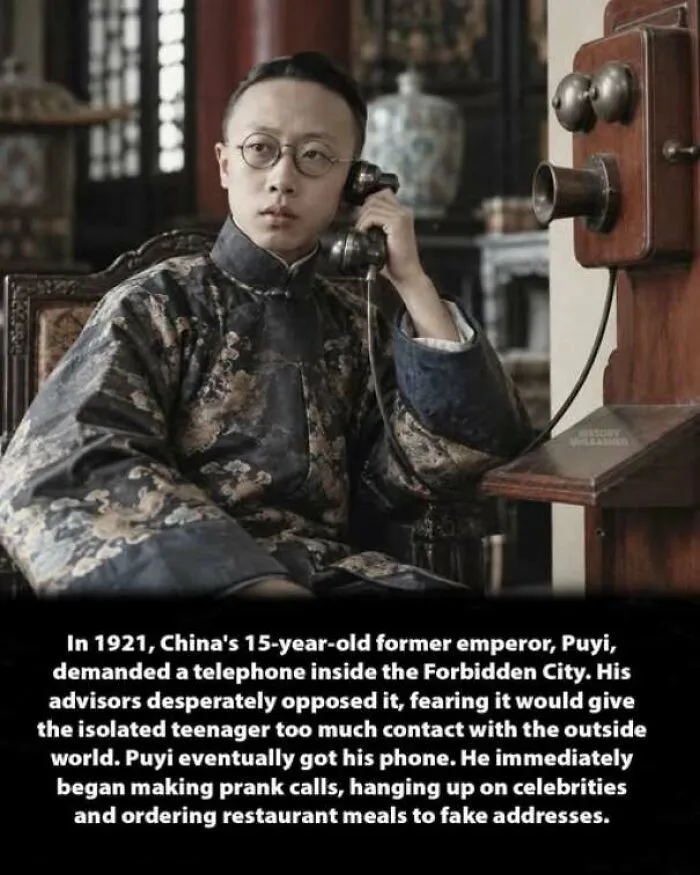
In 1921, China's 15-year-old former emperor, Puyi, discovered the telephone.
He immediately wanted one.
Although Puyi had been forced to abdicate as a child, he was still allowed to live inside Beijing's Forbidden City, where the remnants of the imperial court continued treating him as emperor.
When his Scottish tutor, Reginald Johnston, explained how telephones worked, Puyi became fascinated. He soon learned that his own father already had one and ordered palace officials to install a telephone for him too.
His advisors were horrified.
They argued that telephones had no place in imperial tradition and worried that allowing ordinary outsiders to speak directly to the emperor would damage his dignity.
Puyi later believed they were worried about something else.
For most of his childhood, he had been extraordinarily isolated from the outside world. Newspapers and his foreign tutor were already giving him access to information palace officials couldn't completely control.
A telephone would give him another direct connection.
Puyi refused to back down.
The telephone was installed.
Then the 15-year-old emperor received a telephone directory.
He began calling people around Beijing for fun.
Puyi later recalled calling a famous Peking opera performer and an acrobat, then hanging up without identifying himself. He also called a restaurant and ordered a meal to be delivered to a fake address.
Eventually he called prominent intellectual Hu Shih and challenged him to guess who was calling.
When Hu couldn't, Puyi revealed his identity.
The scholar was so surprised that he later checked with Puyi's tutor to make sure the Emperor of China really had just randomly called him.
More than a century ago, palace officials worried about what might happen if a teenager gained unrestricted access to the latest communication technology.
He got it and immediately started making prank calls.
Report
4points
#45
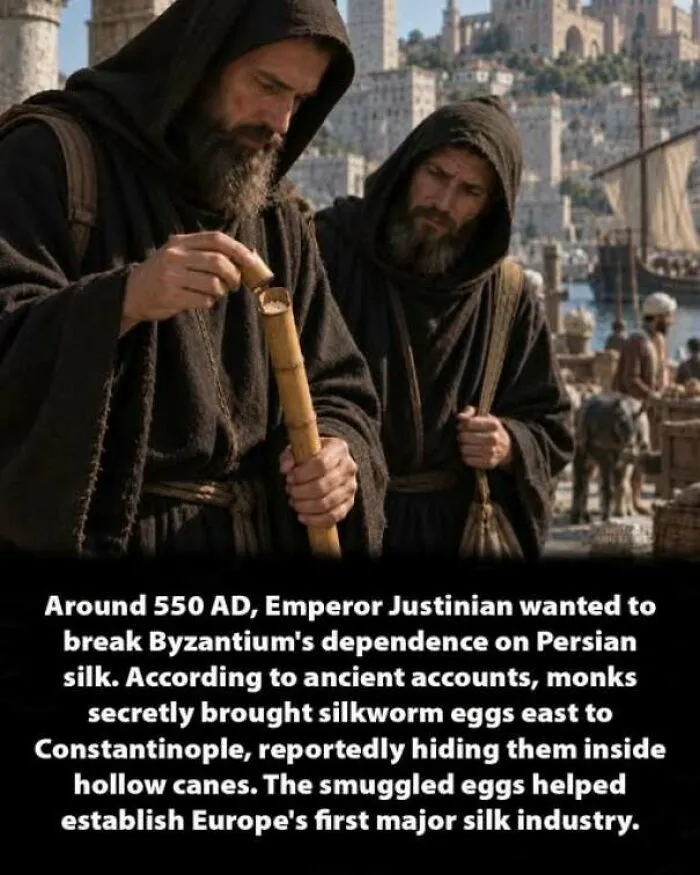
One of the most valuable secrets of the ancient world was reportedly smuggled into the Byzantine Empire inside hollow canes.
For centuries, silk traveled west from Asia through a vast network of traders.
By the sixth century, the Byzantine Empire still depended heavily on foreign sources for the luxury fabric, with its Persian rivals controlling important parts of the trade.
Emperor Justinian I wanted another option.
According to the Byzantine historian Procopius, monks who had spent time in the East told Justinian they knew how silk was actually produced.
The secret was silkworms.
The monks explained that transporting the worms themselves would be difficult, but their eggs could survive the journey.
Justinian promised to reward them if they succeeded.
The monks traveled east and eventually returned to Constantinople carrying silkworm eggs. Another ancient account describes the eggs being transported inside the hollow stem of a plant, giving rise to the famous story that they were smuggled inside hollow canes.
The eggs hatched successfully.
The silkworms were fed mulberry leaves, and for the first time the Byzantine Empire could produce its own raw silk rather than relying entirely on imports.
A handful of tiny eggs had helped establish an industry that would become one of Byzantium's most famous luxury trades.
Report
4points
#46
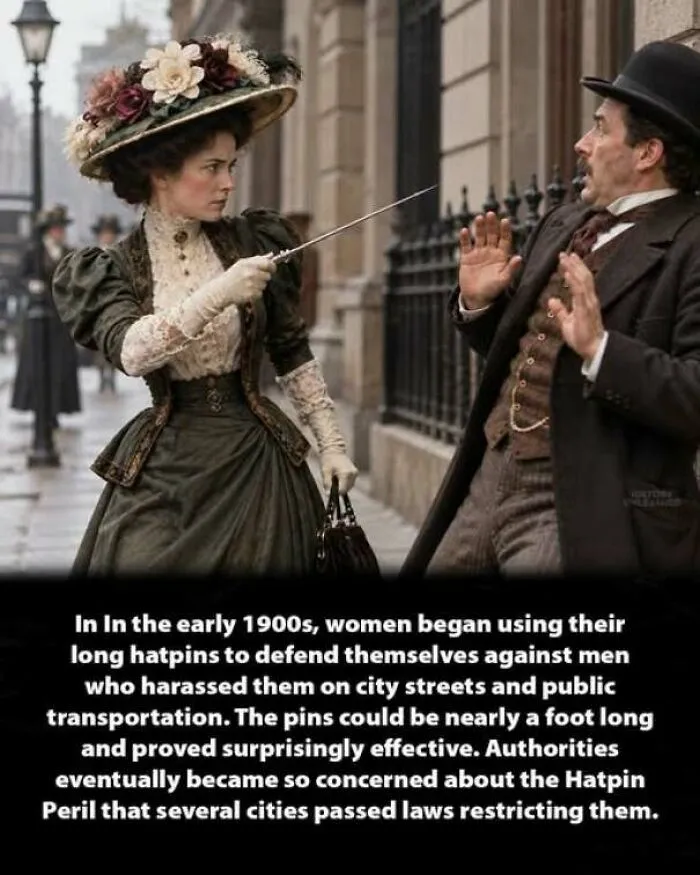
In the early 1900s, one of the most effective weapons a woman could carry was already holding her hat in place.
Women's hats had become enormous and elaborate, and keeping them securely attached sometimes required hatpins approaching a foot in length.
They were essentially long, thin pieces of metal ending in a sharp point.
At the same time, growing numbers of women were traveling through American cities independently.
Street harassment was common.
Men who approached, grabbed or otherwise harassed women in public were often called “mashers.”
Women quickly discovered that the enormous pins holding their hats in place could serve another purpose.
Self-defense.
Newspapers began reporting incidents of women pulling out their hatpins when men refused to leave them alone.
In New York in 1903, Leoti Blaker was riding in a crowded stagecoach when a man sitting beside her repeatedly moved closer and eventually put his arm around her.
Blaker pulled out her nearly foot-long hatpin and drove it into his arm.
The man screamed and got off at the next stop.
Other stories followed.
The hatpin became so closely associated with women defending themselves that newspapers began warning of the “Hatpin Peril.”
Soon, authorities began worrying about the pins themselves.
In 1910, Chicago lawmakers debated restricting long hatpins in public.
Women were not amused.
During the debate, women's club representative Nan Davis reportedly told officials:
“If the men of Chicago want to take the hatpins away from us, let them make the streets safe.”
Chicago passed its ordinance anyway.
Similar restrictions appeared in several other cities.
For a brief period in the early 20th century, an ordinary piece of women's fashion had become something else entirely.
A means of self-defense.
Report
3points
#47
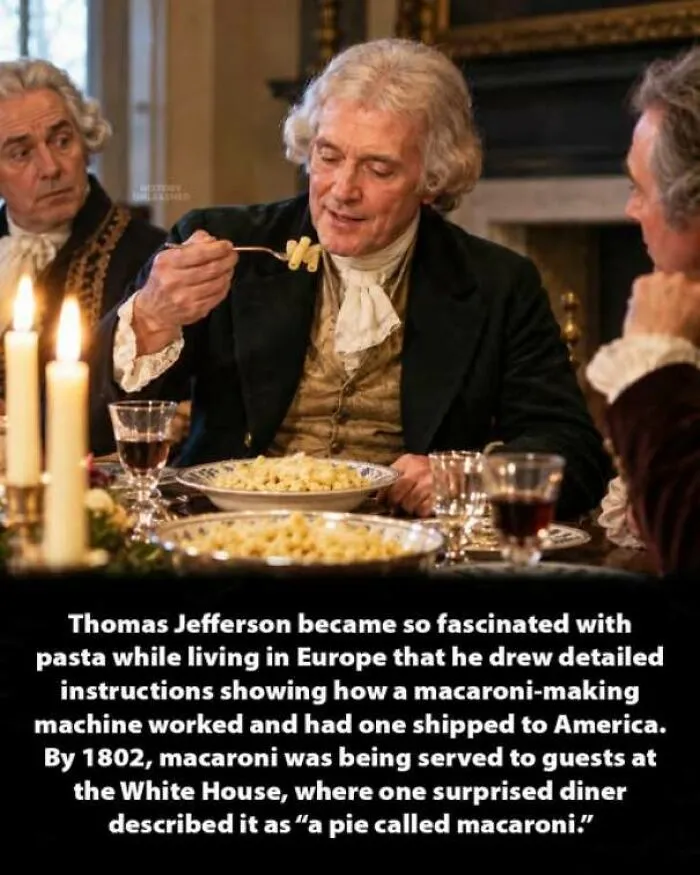
Thomas Jefferson liked pasta so much that he once drew detailed instructions explaining how a macaroni-making machine worked.
Jefferson developed a fascination with European food while serving as the American minister to France during the 1780s.
Pasta particularly caught his attention.
During his travels, Jefferson recorded detailed notes describing how macaroni was produced by forcing dough through holes in an iron plate.
He even drew a diagram of the machine used to make it.
In 1789, Jefferson asked his secretary, William Short, to obtain a “mould for making maccaroni” from Naples.
The machine was eventually shipped to America and later appeared among Jefferson's household possessions at Monticello.
Jefferson also preserved a recipe for macaroni in his own handwriting, although historians believe it was likely dictated to him by one of the enslaved chefs who prepared his food.
One of the most important was James Hemings.
Jefferson had brought Hemings to France, where he received extensive training in French cuisine before returning to the United States.
Pasta dishes eventually became a regular part of Jefferson's table.
In 1802, while Jefferson was president, Massachusetts congressman Manasseh Cutler attended a dinner at the President's House.
Among the beef, turkey, mutton, ham, eggs and other dishes was something Cutler apparently found rather unusual.
He called it:
“A pie called macaroni.”
Cutler wasn't particularly impressed.
But Jefferson continued eating and serving pasta for years afterward and even imported macaroni from Europe when he couldn't obtain enough domestically.
Thomas Jefferson didn't invent macaroni and cheese, nor was he the first person to bring pasta to America.
But his enthusiasm for European cuisine helped introduce dishes that were still novelties to many Americans of his era.
Report
3points
#48
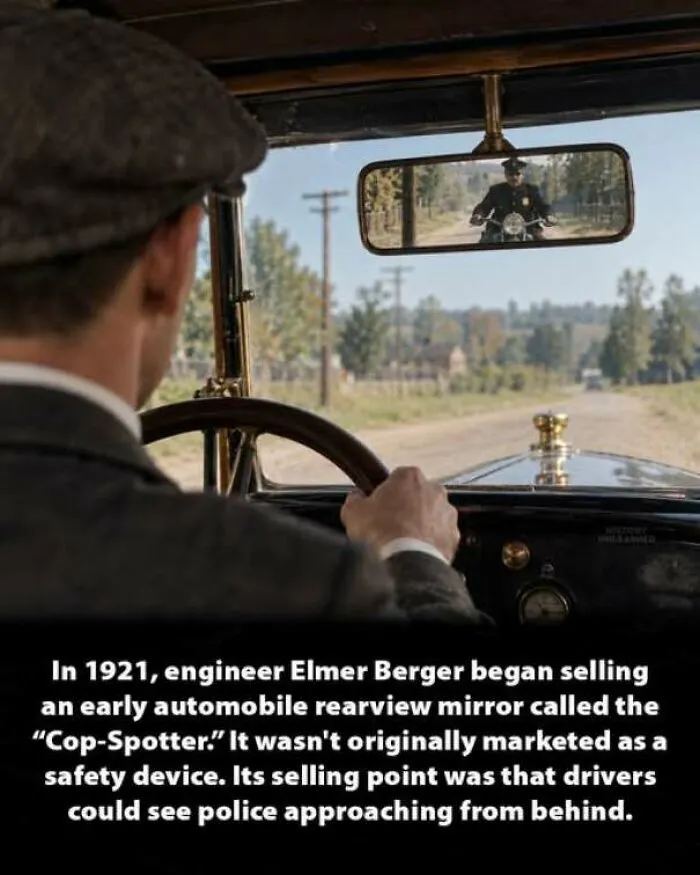
One of the earliest commercially successful rearview mirrors had a very different selling point: spotting the police.
Rearview mirrors weren't entirely new by the 1920s. Drivers and inventors had experimented with them for years, and racer Ray Harroun famously mounted one on his car for the first Indianapolis 500 in 1911.
But in 1921, engineer Elmer Berger began selling an aftermarket automobile mirror with an unforgettable name:
The “Cop-Spotter.”
Rather than emphasizing road safety, the name advertised another advantage of being able to see behind your car: drivers could spot police approaching from the rear.
Berger's adjustable plate-glass mirror measured roughly 3 by 7 inches, attached near the top of the windshield and sold for around $3.50.
Rearview mirrors would eventually become an essential piece of automotive safety equipment.
But one of the products that helped popularize them had a much more mischievous appeal.
Report
3points
#49
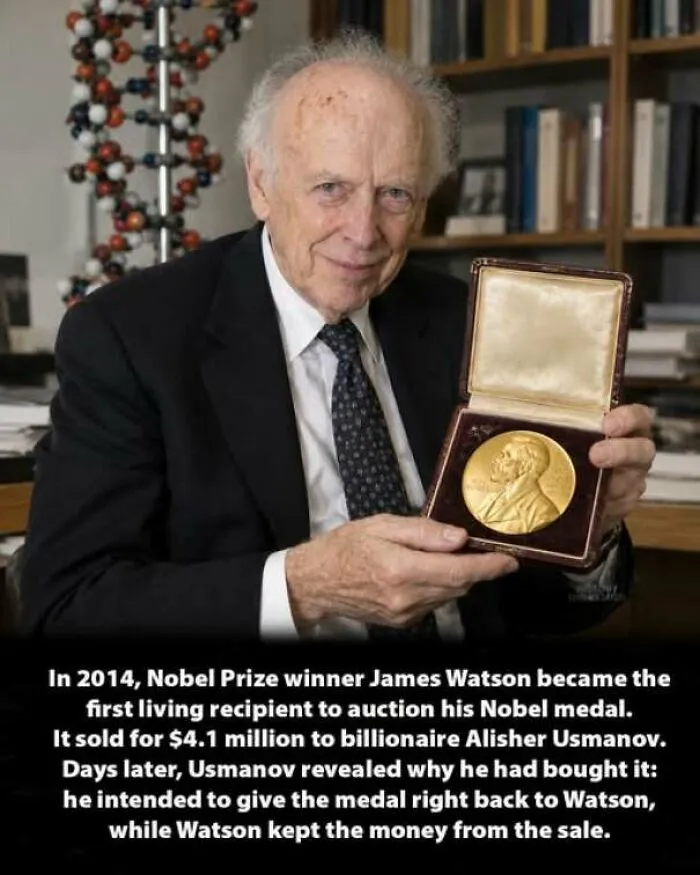
In 2014, a billionaire spent millions on a Nobel Prize medal just so he could give it back to the man who sold it.
James Watson had received the 1962 Nobel Prize in Physiology or Medicine alongside Francis Crick and Maurice Wilkins for their work concerning the molecular structure of DNA.
More than 50 years later, Watson decided to auction his gold Nobel medal.
The sale made him the first living Nobel laureate to put his medal up for auction.
At Christie's in New York, bidding climbed to $4.1 million, with the final price reaching $4.757 million after the buyer's premium.
The winning bidder was later revealed to be billionaire Alisher Usmanov.
But Usmanov hadn't bought the medal because he wanted to keep it.
Days after the auction, he announced that he intended to return the medal to Watson, while allowing the scientist to keep the proceeds from its sale.
Usmanov said he believed the medal should remain with the person who had earned it and wanted the money he spent to support scientific research.
Watson got his Nobel medal back.
And the millions from its sale remained available for the causes he wanted to support.
Report
3points
#50
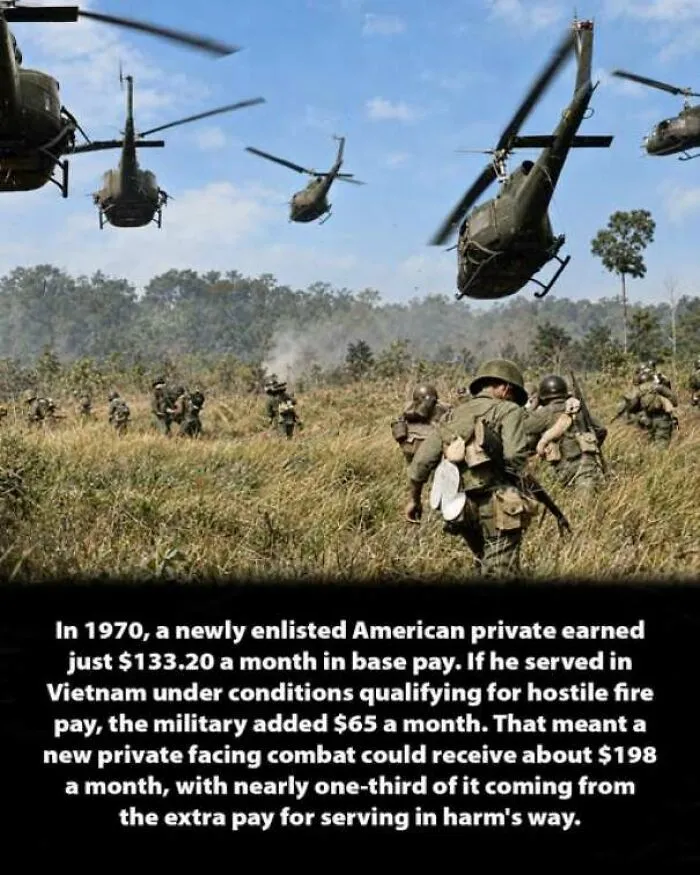
In 1970, the U.S. military paid qualifying service members an additional $65 a month for facing hostile fire. For a newly enlisted private, that was a substantial addition to his paycheck.
At the time, an E-1 with less than four months of service earned $133.20 per month in basic pay. After four months, his basic pay increased to $143.70.
Service members who qualified for hostile fire pay received another $65 per month. For a brand-new private, that could bring monthly military pay to about $198.20 before considering other allowances or special pays.
Hostile fire pay was intended to compensate personnel subjected to hostile fire, explosions of hostile mines or other qualifying dangers. During the Vietnam War, large numbers of American service members qualified.
The $65 payment may sound small today, but for a new private it was equivalent to nearly half his basic monthly salary.
It was an additional payment for one thing no ordinary paycheck could really compensate for: serving where the enemy was shooting back.
Report
3points
#51
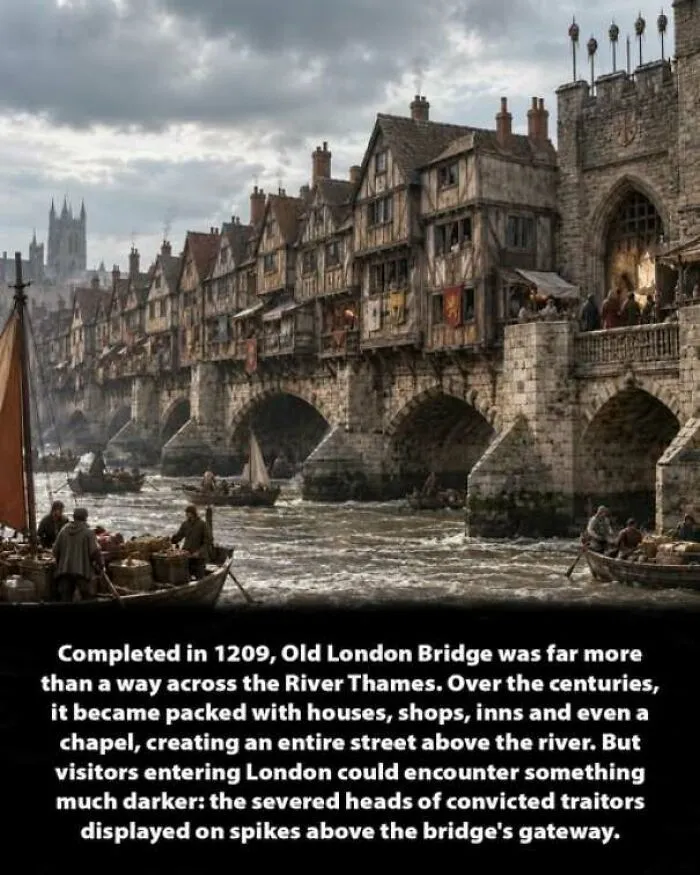
For centuries, crossing London Bridge meant passing through an entire neighborhood built above the River Thames. It could also mean walking beneath the severed heads of convicted traitors.
Completed in 1209, the medieval stone London Bridge became one of the great landmarks of the city.
For hundreds of years, it was London's only bridge across the Thames, making it one of the busiest routes into the city.
But this was nothing like the London Bridge we know today.
Homes and businesses were constructed directly on the bridge.
By 1358, records show 138 houses and shops standing along it.
People lived, worked, shopped and worshipped above the river. The bridge contained businesses, inns and a chapel dedicated to Thomas Becket.
In places, the buildings rose several stories high, making the crossing resemble a crowded London street more than a bridge.
But people approaching the city from the south could also encounter a far darker sight.
For centuries, the heads of people convicted as traitors were displayed on spikes near the bridge's gateway as a warning to anyone entering London.
Among the famous figures whose heads were displayed there were Scottish knight William Wallace, rebel leader Wat Tyler and statesman Thomas More.
Some heads remained exposed for extraordinary lengths of time.
The medieval bridge survived fires, freezing winters and centuries of constant use. Its buildings were eventually removed, and the bridge itself was replaced in the 19th century.
By the time Old London Bridge was finally demolished in 1831 and 1832, it had stood across the Thames for more than 600 years.
Report
3points
#52
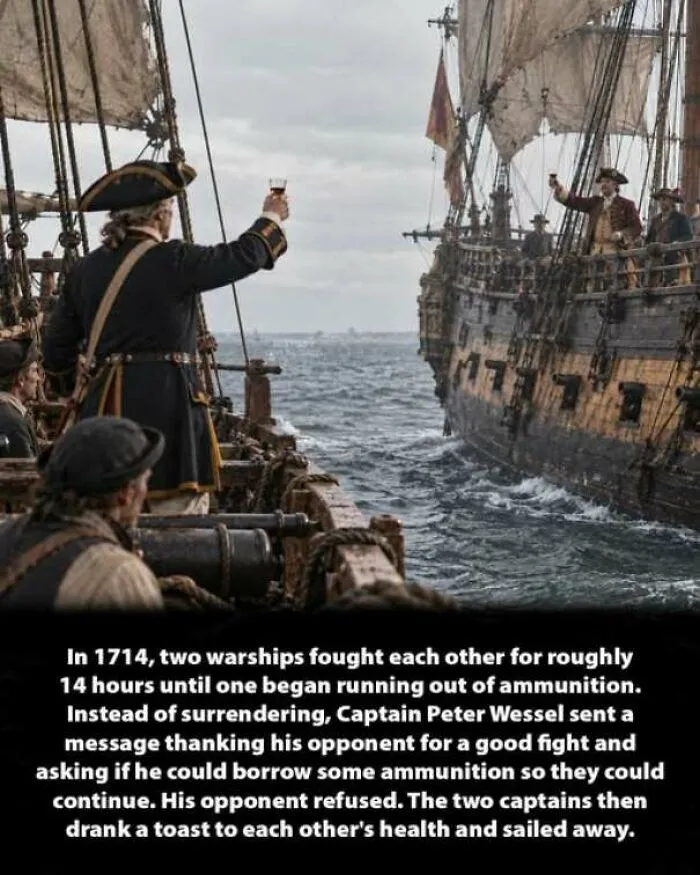
In 1714, a naval captain ran out of ammunition during a battle, so he asked his enemy if he could borrow some more to keep fighting.
During the Great Northern War, Peter Jansen Wessel commanded the Dano-Norwegian warship Løvendals Gallej. In July 1714, he encountered the larger De Olbing Galley, an English-crewed vessel headed for Swedish service.
The two ships opened fire and fought intermittently for roughly 14 hours across two days. Both vessels were badly damaged, but Wessel eventually faced a problem. He was nearly out of ammunition.
Instead of surrendering, Wessel sent an envoy to the opposing captain. He thanked him for a good fight and asked if he would be willing to provide some ammunition so the battle could continue.
The answer was no.
With neither side in a good position to continue, the two captains reportedly drank a toast to each other's health before sailing away from one another.
Wessel's superiors weren't nearly as amused. He was court-martialed for the incident, partly because he had revealed his ammunition shortage to the enemy and risked his ship against a superior force.
He defended himself successfully and was acquitted.
Less than two weeks later, he was promoted to captain.
Report
3points
#53
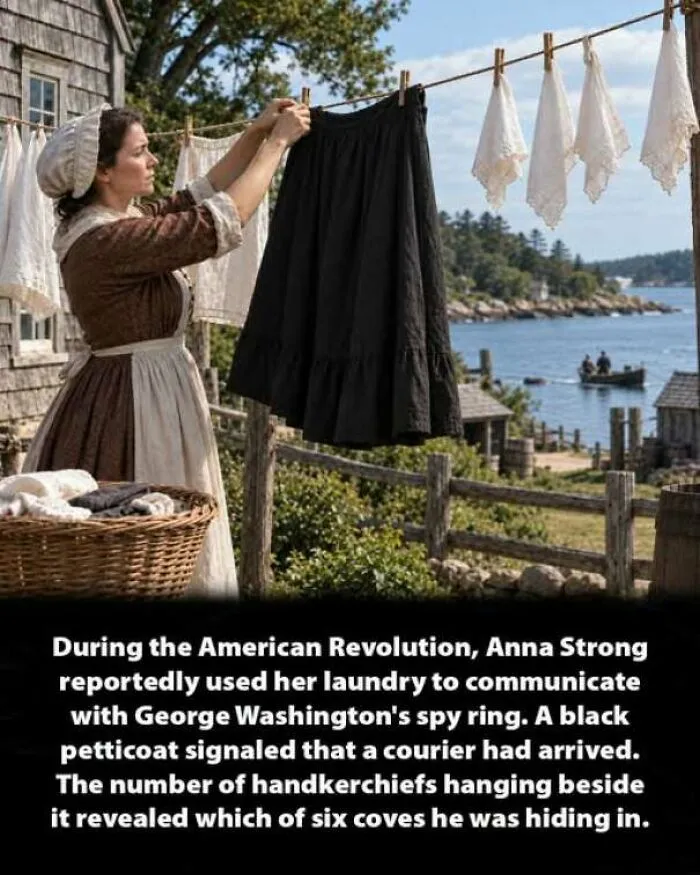
During the American Revolution, an ordinary clothesline reportedly became part of George Washington's secret intelligence network.
Anna Strong lived in Setauket, New York, where members of the Culper Spy Ring secretly moved information about British forces out of occupied New York.
According to the traditional account, Strong developed an ingenious way to communicate without attracting attention.
She hung laundry outside her home.
A black petticoat on the clothesline signaled that Caleb Brewster, a Culper courier who traveled by whaleboat across Long Island Sound, had arrived.
But Abraham Woodhull, another member of the spy ring, still needed to know where to meet him.
Strong reportedly hung between one and six handkerchiefs beside the petticoat.
The number indicated which of six coves Brewster was using.
To anyone else, it looked like laundry drying in the wind.
To Washington's spies, it was a coded message telling them exactly where their courier was waiting.
The story of Strong's clothesline has been passed down through local and family tradition and is repeated by several historical institutions, although historians still debate how firmly the signaling system can be documented.
Report
2points
#54
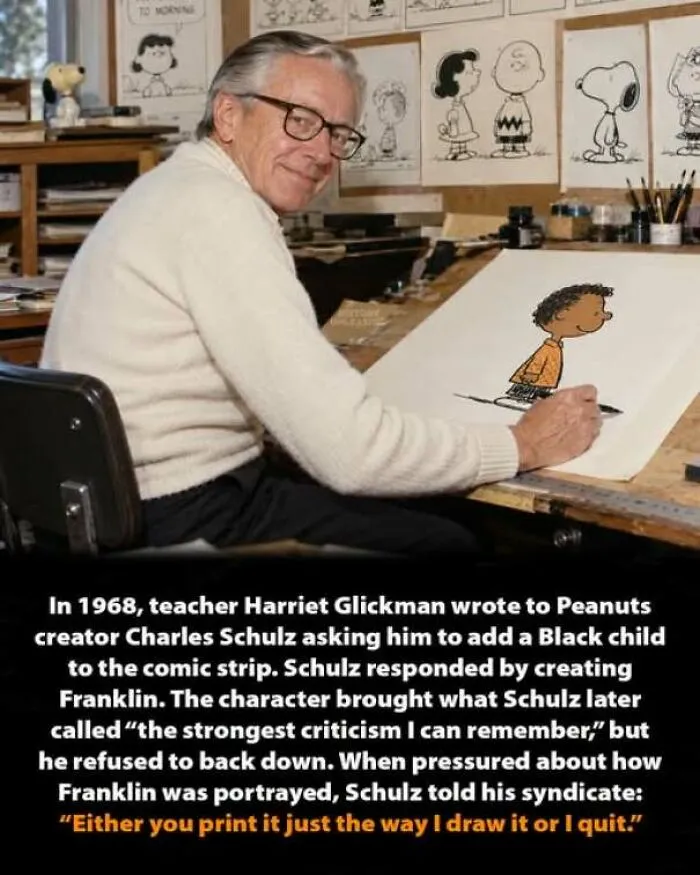
In 1968, a schoolteacher wrote Charles Schulz a letter that helped bring a new character into Peanuts.
Los Angeles teacher Harriet Glickman believed that adding a Black child to one of America's most popular comic strips could have a positive influence on children.
She wrote Schulz and asked him to consider the idea.
Schulz was initially hesitant. He worried that introducing a Black character could appear patronizing.
Glickman continued corresponding with him and encouraged Black friends to share their thoughts with Schulz as well.
He eventually decided to move forward.
On July 31, 1968, Franklin made his first appearance in Peanuts, simply meeting Charlie Brown at the beach.
Although much of the response was positive, Schulz also received angry criticism. He later described it as some of the strongest criticism he could remember.
When objections arose over Franklin being shown alongside white children at school, Schulz refused to change how he portrayed him.
He later recalled telling his syndicate:
“Either you print it just the way I draw it or I quit.”
Franklin remained part of the Peanuts world for the rest of Schulz's career.
Report
2points
#55
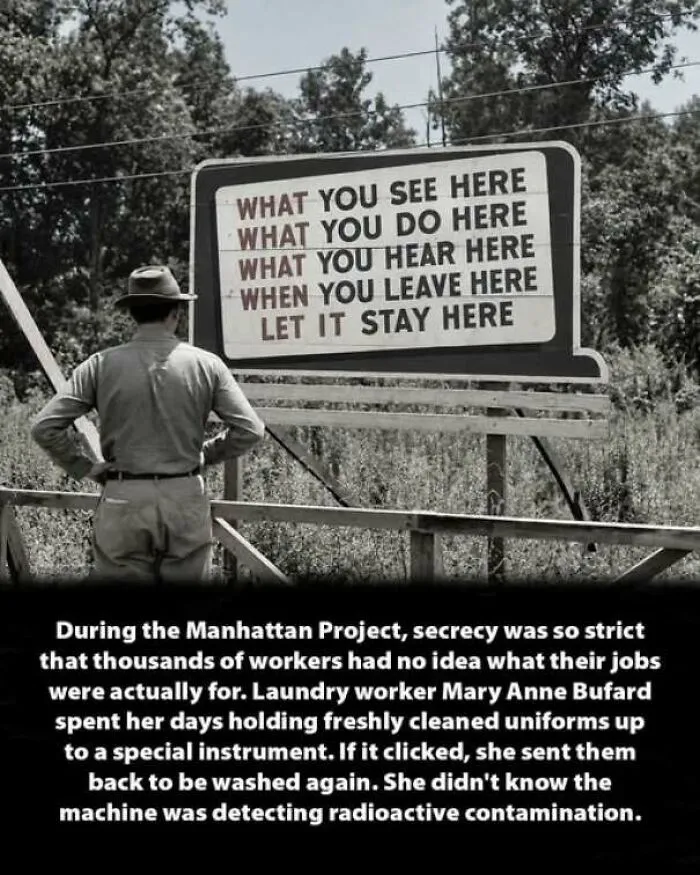
Thousands of people worked on the Manhattan Project without knowing what they were actually helping to build.
Mary Anne Bufard was one of them.
During World War II, Bufard worked in a laundry operation connected to the massive secret facilities at Oak Ridge, Tennessee.
Her job included one particularly strange task.
After workers' uniforms had been washed, ironed and repaired, Bufard would hold each one up to a special instrument.
If the instrument began clicking, she sent the uniform back to be washed again.
Then she checked another.
And another.
She knew what she was supposed to do.
What she apparently wasn't told was why.
The instrument was being used to detect radioactive contamination on the clothing.
Oak Ridge was one of the key sites of the Manhattan Project, the secret American effort to develop the atomic missile.
At its peak, tens of thousands of people worked and lived there. But information was deliberately compartmentalized. Workers were generally told only what they needed to know to perform their particular jobs.
Some operated enormous machines without knowing what the machines were producing.
Others handled materials without understanding how they fit into the larger project.
Bufard checked uniforms without knowing what the clicking instrument was actually detecting.
Signs around Oak Ridge constantly reminded workers not to discuss what they saw or did.
One famous message read:
“WHAT YOU SEE HERE
WHAT YOU DO HERE
WHAT YOU HEAR HERE
WHEN YOU LEAVE HERE
LET IT STAY HERE”
For many workers, it wasn't until the atomic missile became public in August 1945 that they finally understood what their seemingly ordinary jobs had been part of.
Report
2points
#56
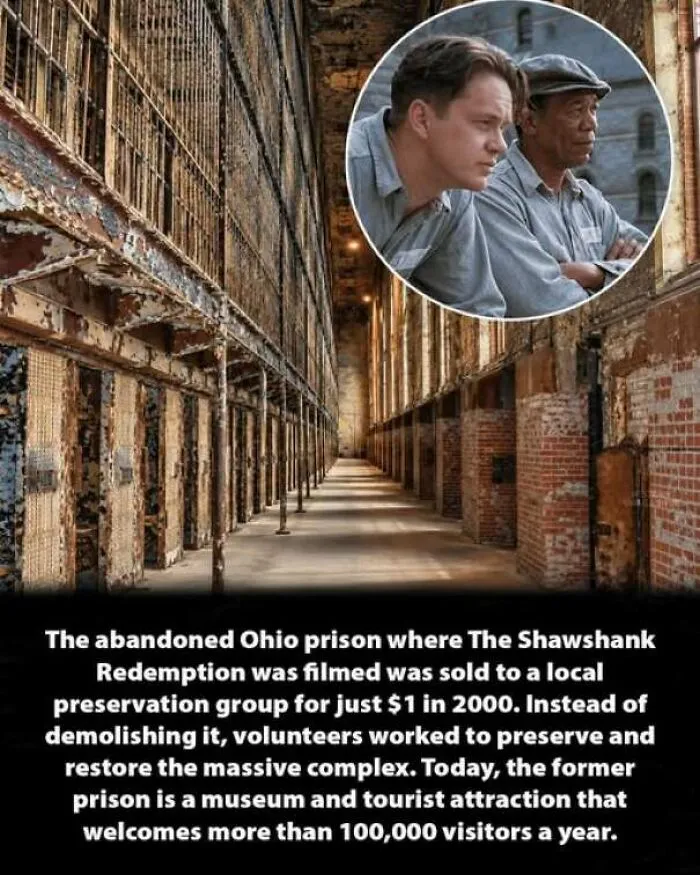
The prison made famous by The Shawshank Redemption was once sold for just $1.
The Ohio State Reformatory in Mansfield opened in the late 1800s and operated as a prison until 1990, when it closed after years of deteriorating conditions. A few years later, filmmakers transformed portions of the abandoned complex into Shawshank State Penitentiary for the 1994 film The Shawshank Redemption. But the enormous historic building faced an uncertain future. Local preservationists formed the Mansfield Reformatory Preservation Society and fought to save it. In 2000, the State of Ohio transferred the building to the City of Mansfield, which sold it to the preservation group for just $1. Volunteers and preservationists then continued the enormous task of repairing and restoring the former prison. Today, the Ohio State Reformatory is a museum and tourist attraction where visitors can explore its history, walk through locations used in The Shawshank Redemption and tour its enormous cell blocks. The Reformatory has reported welcoming more than 120,000 visitors in a year. A building once facing demolition was given a second life for the price of a single dollar.
The Ohio State Reformatory in Mansfield opened in the late 1800s and operated as a prison until 1990, when it closed after years of deteriorating conditions. A few years later, filmmakers transformed portions of the abandoned complex into Shawshank State Penitentiary for the 1994 film The Shawshank Redemption. But the enormous historic building faced an uncertain future. Local preservationists formed the Mansfield Reformatory Preservation Society and fought to save it. In 2000, the State of Ohio transferred the building to the City of Mansfield, which sold it to the preservation group for just $1. Volunteers and preservationists then continued the enormous task of repairing and restoring the former prison. Today, the Ohio State Reformatory is a museum and tourist attraction where visitors can explore its history, walk through locations used in The Shawshank Redemption and tour its enormous cell blocks. The Reformatory has reported welcoming more than 120,000 visitors in a year. A building once facing demolition was given a second life for the price of a single dollar.
Report
1point
