





We live on a pretty incredible planet, surrounded by beautiful nature everywhere we look. Yet despite seeing it every day, most of us probably know far less about the world around us than we think. There’s always something new to discover, no matter how much you’ve learned already.
So, we’ve rounded up some interesting facts shared by the Instagram page “Explaining The Wild.” From surprising animal habits to fascinating scientific findings, scroll down to read them and upvote your favorites.
#41

The Shiba Inu nearly went extinct during World War II due to a devastating combination of severe food shortages, wartime bombing raids, and a post-war outbreak of distemper. By the end of the conflict, the ancient breed was nearly wiped out entirely, leaving only a handful of dogs scattered across remote mountainous regions. To save the breed from permanent erasure, dedicated preservationists painstakingly tracked down the remaining survivors, ultimately rebuilding the entire modern population from just three distinct surviving bloodlines, known as San’in, Mino, and Shinshu.
Today, every single Shiba Inu in existence traces its ancestry directly back to those three heroic canine lineages. In recognition of their deep cultural significance, incredible resilience, and ancient heritage, Japan officially declared the Shiba Inu a precious national treasure. This prestigious status ensures the breed is legally protected and celebrated as a symbol of national pride, transforming them from the brink of total extinction into one of the most beloved and recognizable dog breeds in the world.
Report
22points
#42

The “Saffina” Chrysanthemum is a stunning example of how nature can create shapes that look almost delicious. These flowers are often called the “whipped cream” variety because their petals curve inward in thick, fluffy layers that look exactly like a swirl of topping on a dessert. This specific look is the result of centuries of selective breeding, where gardeners focused on a trait called “incurved” petals to create a bloom that is dense, perfectly round, and incredibly soft to the eye.
While they look like a treat, this design actually serves a purpose in the garden. The tight, overlapping layers of petals help protect the center of the flower from rain and wind, keeping the reproductive parts dry and safe. These blooms can grow to be surprisingly large and heavy, requiring strong, sturdy stems to hold up their “fluffy” heads. It is a beautiful reminder that plants don’t just grow for survival—they can also create patterns that are purely mesmerizing and show off the incredible diversity of the floral world.
Report
21points
#43

Broccoli is actually a dense cluster of hundreds of immature flower buds that is harvested right before it has a chance to bloom. The thick central stalk supports tight green clusters, called florets, which are tightly packed head-to-head. If a farmer leaves a head of broccoli alone in the field instead of cutting it down for harvest, those tiny green bumps will slowly swell, separate, and burst open into a vibrant blanket of small yellow flowers.
Once the plant enters this blooming stage, the transformation changes its entire composition. The thick stalk becomes incredibly woody and tough, while the natural sugars redirect into growing the flowers, leaving the rest of the plant bitter and completely unpalatable. This natural lifecycle is why timing is everything in agriculture, as farmers must pick the vegetable during a very strict window while the buds are still dormant, closed, and packed with nutrients.
Report
21points
#44

Deep in a valley of the Italian Alps, the tiny village of Viganella used to spend nearly three months of every year in total darkness. From mid-November to early February, the surrounding peaks are so steep that the sun never rises high enough to clear the ridgeline, leaving the town square in a freezing, perpetual shadow. In 2006, the town’s mayor and a local architect implemented a brilliant engineering solution: a 40-square-meter steel mirror installed on the mountainside 870 meters above the village to catch and reflect the sun’s rays.
This “computerized sun” is programmed to track the sun’s path across the sky, tilting and rotating in real-time to precisely aim a beam of light onto the town’s main piazza. While it doesn’t warm the entire valley, it provides enough light and heat to transform the square into a communal gathering spot during the harshest winter months. This project has since inspired other “dark” towns, such as Rjukan in Norway, proving that with a bit of mirrors and physics, humans can overcome even the most daunting geographical barriers.
Report
21points
#45

Forest air feels instantly refreshing because trees release a natural compound called alpha-pinene, an aromatic chemical found in high concentrations within conifer trees like pines, firs, and spruces. This organic compound belongs to a class of defensive chemicals known as phytoncides, which plants secrete to protect themselves from harmful microbes and insects. When you breathe in the crisp air of a dense pine forest, you inhale these airborne molecules, giving the environment its distinct, sharp, and invigorating woody scent.
Once inside your body, alpha-pinene acts as a highly effective natural bronchodilator, meaning it relaxes the muscle bands around your airways and causes them to dilate. This opening of the air passages allows your lungs to take in significantly more oxygen with less physical effort, directly mimicking the physiological effects of modern asthma treatments. This immediate biological response clears the respiratory system, reduces inflammation, and triggers a deep sense of physical relief, proving that the soothing effect of a forest walk is a concrete chemical reaction.
Report
21points
#46

The white-tufted grebe, Rollandia rolland, is a small diving bird found across much of South America. Its most striking features are the bright red iris and the white fan of feathers behind each eye.
It spends much of its time on freshwater lakes and ponds, diving underwater to catch small aquatic invertebrates and fish. Despite those intimidating-looking eyes, this bird is only around 20 to 30 cm long.
Report
21points
#47

Quokkas are small marsupials found mainly on Rottnest Island and a few isolated areas of Western Australia. Their upturned mouths and relaxed facial features give them a permanent smile, earning them the nickname “the world’s happiest animal,” even though they’re not actually smiling like humans.
Despite their cheerful appearance, quokkas face real challenges in the wild, including habitat loss and introduced predators such as foxes and cats. Thanks to conservation efforts and protected habitats, their populations have remained stable in key areas, allowing these adorable marsupials to continue charming people from around the world.
Report
20points
#48

The crested caracara is a member of the falcon family, but it behaves very differently from the fast-flying falcons most people picture. It regularly walks around on the ground, searches for insects and small animals, and joins vultures at carcasses to feed on carrion.
It is found from the southern United States through Mexico, Central and South America, with its range extending as far south as Tierra del Fuego. Its strange combination of falcon ancestry, scavenging behavior and long-legged ground hunting makes it one of the most unusual raptors around.
Report
20points
#49

At sunrise, when the Sun is behind Mount Rainier, the mountain can cast a huge triangular shadow through the atmosphere. From the right viewpoint, the shadow appears to rise into the sky behind the mountain.
The effect is especially striking when clouds are lit by the rising Sun, making the dark outline of the mountain stand out against the glowing sky.
Report
20points
#50

Beekeepers in Ribeauvillé, France, were shocked when some of their hives started producing honey in unusual shades of blue, green and even brown. After investigating, they traced the problem to a nearby biogas plant processing sugary waste from a Mars confectionery facility.
The bees had been feeding on the exposed candy waste instead of sticking to flowers. The resulting honey was considered unsellable, and the facility later changed how the waste was stored to keep the bees away.
Report
20points
#51

Point Nemo, officially known as the Oceanic Pole of Inaccessibility, is the most isolated location on Earth. It’s located in the South Pacific Ocean, about 2,688 kilometers (1,670 miles) from the nearest islands in every direction. Because the International Space Station orbits roughly 400 kilometers (250 miles) above Earth, astronauts have occasionally been closer to Point Nemo than any person standing on land.
Its extreme isolation has also made Point Nemo the world’s “spacecraft cemetery.” Since there are no shipping lanes or permanent residents nearby, dozens of retired satellites and spacecraft have been deliberately guided to crash into these waters, making it one of the most unusual places on the planet.
Report
19points
#52

Female squirrels are pregnant for only about 38 to 46 days, but during the final weeks their tiny bodies become noticeably round as their babies grow. Most litters contain between two and six young, though larger litters can happen when food is plentiful.
Not long after giving birth, the mother raises the babies alone in a nest called a drey, feeding and protecting them until they’re ready to explore the world on their own. Seeing a pregnant squirrel in the wild is uncommon because they spend much of this time hidden away and staying cautious.
Report
18points
#53

The Empusa mantis is a master of floral mimicry, utilizing delicate pink hues and jagged, leafy textures to blend into Mediterranean shrubs. This camouflage allows it to remain invisible to unsuspecting pollinators.
Its striking “horned” crest and slender, alien-like anatomy are specialized tools for survival. These features break up the insect’s silhouette, confusing birds while providing the mantis a clear advantage as an ambush predator.
Report
17points
#54

Hummingbirds possess an exceptional memory due to an enlarged hippocampus, the specific region of the brain responsible for spatial learning and memory. Relative to their overall body size, their hippocampus is significantly larger than that of any other bird species. This advanced brain structure allows them to map out and remember the exact geographic location of specific hummingbird feeders and patch works of flowers along their immense migration paths.
This precise mental map is absolutely vital for their survival as they travel thousands of miles from North America down to Mexico, the Caribbean, and Central America. Hummingbirds have an incredibly high metabolic rate, requiring them to consume up to double their body weight in nectar every single day. By remembering which yards have reliable feeders and exactly when specific flowers bloom from year to year, they can refuel efficiently without wasting precious energy searching blindly for food during their exhausting journey.
Report
17points
#55

Telling the difference between a crow and a raven usually comes down to scale and silhouette. Ravens are significantly larger, roughly the size of a red-tailed hawk, with a thick, heavy beak that looks like it belongs on a much bigger bird. When they are in flight, the easiest way to identify them is by looking at the tail; a raven’s tail feathers grow in a distinct wedge or “V” shape, while a crow’s tail is much shorter and rounded like a fan.
Their behavior and “voices” are also completely different. Crows are social city-dwellers that travel in large groups and make the classic, high-pitched “caw-caw” sound. Ravens, on the other hand, are more solitary or travel in pairs, preferring wilder landscapes like deep forests or mountains. Instead of a caw, they produce a deep, croaking “gronk” sound that vibrates through the air. If you see a bird performing acrobatic flips or soaring like a hawk, it’s almost certainly a raven, as crows tend to flap more consistently and rarely glide.
Report
16points
#56

Many sea urchins practice a behavior called covering. Using their tube feet and tiny pincer-like structures called pedicellariae, they place shells, rocks, seaweed, and other objects on top of their bodies. This extra cover helps camouflage them from predators and can also protect them from strong sunlight and waves.
Scientists have even discovered that if you offer them tiny hats or other lightweight objects, they’ll often pick them up and wear them just like they would a shell. They don’t know they’re wearing a hat, of course. They’re simply following one of nature’s clever survival instincts.
Report
16points
#57
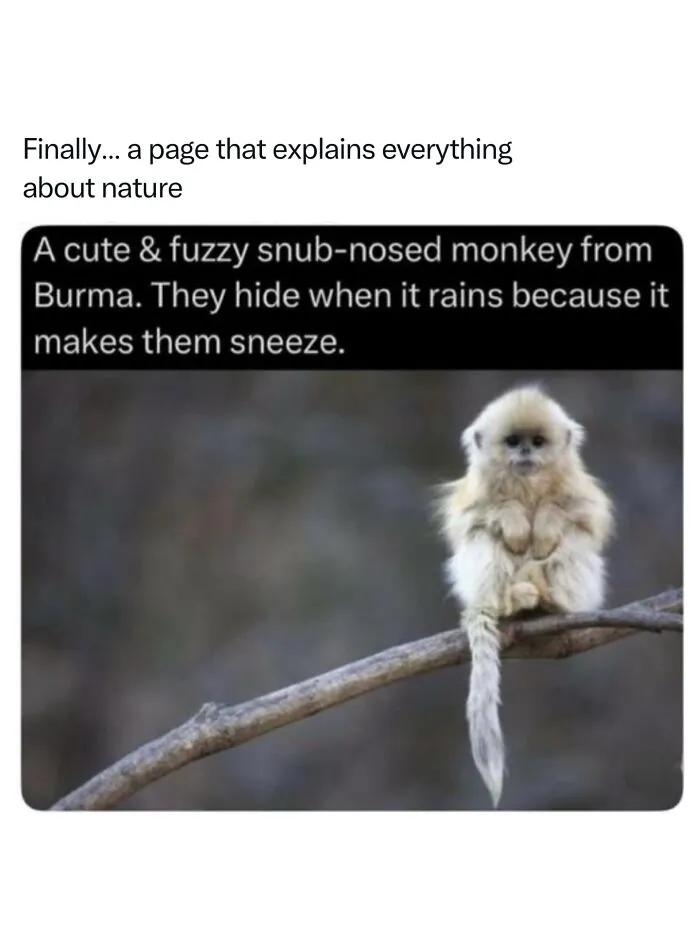
The Myanmar snub nosed monkey is one of the most unique primates on the planet. Its most striking feature is its upturned nose with nostrils that face directly upward. This physical trait presents a major challenge during the monsoon season. When it rains, water easily falls straight into their nose, causing uncontrollable and loud sneezing fits.
To avoid being detected by predators while sneezing, these monkeys have developed a clever survival tactic. During rainstorms, they tuck their heads between their knees or hide deep within thick tree branches to keep their faces dry. They live in high altitude forests and are incredibly rare, making every sighting of these fuzzy creatures a significant event for conservationists.
Report
15points
#58

Carina is a Nelore cow from Brazil and is considered the most valuable cow ever sold. Her extraordinary value comes from decades of selective breeding, exceptional genetics, fertility, and the ability to pass desirable traits to future generations through breeding programs. The Nelore breed is famous for thriving in hot climates, resisting parasites, and producing high-quality beef. For elite animals like Carina, their genetic potential is often worth far more than the animal itself, making them some of the most valuable livestock on Earth.
Report
15points
#59

One of the rarest and most visually stunning phenomena in geology is the creation of opalized fossils. While most fossils are formed through “permineralization”—where minerals like silica or calcite turn bone into stone—opalized fossils undergo a much more complex chemical transformation. This happens when silica-rich water seeps into the cavities left by decaying organic matter, such as shells, wood, or even dinosaur bones, and slowly solidifies into precious opal
The biological “blueprint” of the creature is preserved, but the material is replaced by a lattice of microscopic silica spheres. The way these spheres are stacked determines how they diffract light, creating the iconic “play of color” that opal is famous for. Because this process requires very specific environmental conditions—usually involving ancient inland seas and volcanic activity—the majority of the world’s opalized fossils are found in the Australian Outback, particularly in places like Coober Pedy and Lightning Ridge.
These specimens are not just beautiful; they are high-definition records of prehistoric life. Scientists have discovered entire “ghost” skeletons of marine reptiles and prehistoric pinecones that have been turned into shimmering, rainbow-colored gems. It is a masterclass in natural engineering, proving that under the right pressure and time, the remains of the past can be transformed into the Earth’s most brilliant treasures.
Report
15points
#60

Every time you dip a teaspoon into a jar of honey, you are looking at the combined life’s work of twelve individual honeybees. A single worker bee only produces about one-twelfth of a teaspoon of honey in her entire lifetime, which lasts just a few weeks during the busy summer months. To gather the nectar required for that one small spoonful, bees have to visit roughly 30,000 flowers, flying a combined distance of about 800 miles. It is a staggering amount of physical labor for a creature that weighs less than a gram.
The process is an incredible display of natural teamwork and chemistry. Bees don’t just collect nectar; they transport it back to the hive and pass it from mouth to mouth, adding enzymes that break down complex sugars. Once stored in the honeycomb, they fan the liquid with their wings to evaporate the water until it thickens into the honey we know. This liquid gold is the colony’s essential fuel for survival, and knowing that it takes a dozen lives to fill just one spoon puts the immense value of these tiny pollinators into perspective.
Report
13points
