






We live on a pretty incredible planet, surrounded by beautiful nature everywhere we look. Yet despite seeing it every day, most of us probably know far less about the world around us than we think. There’s always something new to discover, no matter how much you’ve learned already.
So, we’ve rounded up some interesting facts shared by the Instagram page “Explaining The Wild.” From surprising animal habits to fascinating scientific findings, scroll down to read them and upvote your favorites.
#61

Researchers in Thailand discovered an extraordinarily rare spider with a condition called bilateral gynandromorphism. The spider developed with male characteristics on one side of its body and female characteristics on the other, making it one of the most unusual animals ever documented. This isn’t the same as being intersex.
Gynandromorphism happens because of an error during the earliest stages of development, causing different cells to develop as male or female. It has been recorded in butterflies, birds, crustaceans, and a few spiders, but it’s exceptionally rare.
Gynandromorphism happens because of an error during the earliest stages of development, causing different cells to develop as male or female. It has been recorded in butterflies, birds, crustaceans, and a few spiders, but it’s exceptionally rare.
Report
12points
#62

If you think this looks like a scene straight out of a sci-fi movie or Jurassic Park, you are not alone. This surreal photograph from 1924 shows a man completely dwarfed by massive plants on the island of Maui, Hawaii.
How do plants get this ridiculously big? Hawaii provides the ultimate recipe for extreme botanical growth. The islands boast a perfect combination of heavy tropical rainfall, consistent warm temperatures, and incredibly nutrient-rich volcanic soil. This volcanic earth acts as a natural super-fertilizer, allowing certain tropical plants, like giant elephant ears, to grow leaves large enough to easily be used as actual umbrellas.
Report
12points
#63

Pigeons are surprisingly curious birds, and they’ll peck, investigate, and poke at unfamiliar objects they come across. In this case, two pigeons seem very interested in a coconut — although there’s no evidence they’ve actually developed some special “coconut extraction technique.”
Still, watching pigeons confidently do completely random things never gets old.
Report
12points
#64

In the Amazon rainforest, survival often requires a bit of unusual teamwork. Butterflies are frequently seen clustering around the eyes of caimans to drink their tears—a behavior known as lachryphagy.
The butterflies aren’t there for comfort; they are seeking essential salts and minerals, particularly sodium, which are scarce in their nectar-heavy diet but abundant in the reptiles’ secretions. While it might look like a spa day for the caiman, it is a vital nutritional boost for the butterflies that helps them stay healthy and find mates. It’s a stunning example of how even the smallest creatures find ingenious ways to thrive in a competitive ecosystem.
Report
12points
#65

Hummingbirds are the world’s most high-performance aerial machines, but their extreme “speed-tech” comes with a massive biological cost: they are incredibly vulnerable to heavy rain. Because their feathers are so small and specialized for hovering, a single large raindrop can hit with the force of a falling brick relative to their body mass. To survive a storm, these birds enter a state of clinging torpor, finding a sheltered branch where they can tuck their heads and remain motionless to prevent their wings from becoming waterlogged and heavy.
The engineering behind this survival strategy is centered on heat conservation. During a heavy downpour, a hummingbird’s internal “engine” can’t keep up with the cooling effect of the water, so they seek out micro-climates under broad leaves or dense canopies. By huddling together or staying perfectly still, they minimize the surface area exposed to the elements. This “standby mode” allows them to wait out the weather without burning through their limited nectar reserves, proving that even the fastest pilots in the sky know when it’s time to ground the fleet.
Report
11points
#66
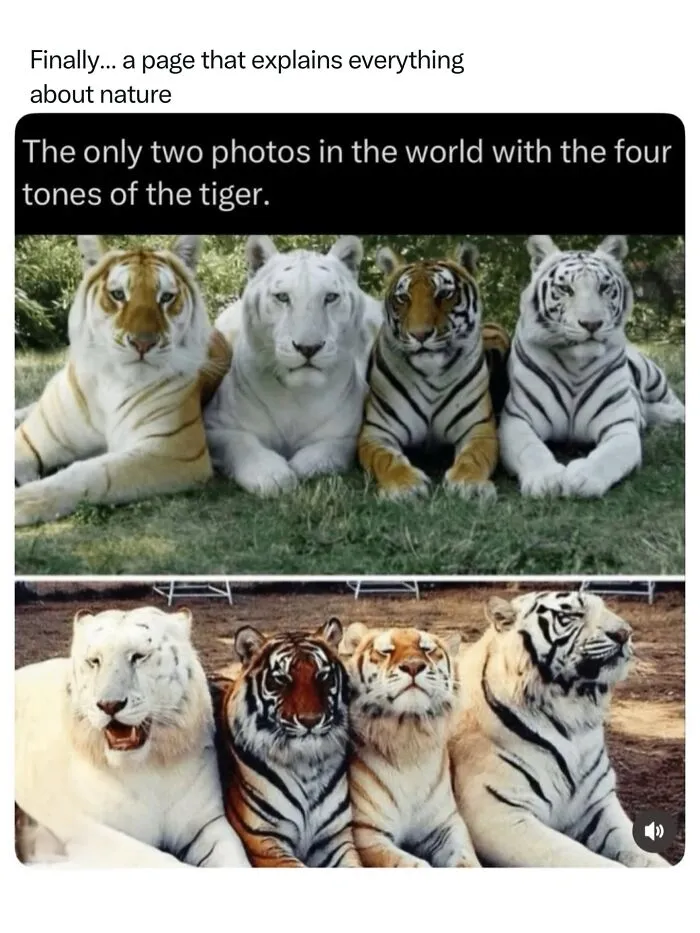
The tiger is a masterpiece of mammalian genetics, and seeing all four of its known color variations in a single frame is one of the rarest events in wildlife photography. These four tones—Standard Orange, White, Golden Tabby, and Snow White (Stripeless)—are not separate species, but the result of specific recessive genes interacting within the Bengal tiger lineage. While the standard orange coat provides high-definition camouflage in the dappled forest light, the other three variations are biological anomalies that rarely survive in the wild due to their high visibility to prey.
The “Golden Tabby” is perhaps the most unique, featuring a strawberry-blonde hue and faded stripes caused by a “wide-band” gene that suppresses the production of black pigment. On the other end of the spectrum, the “Snow White” or “Pure White” tiger lacks almost all striping, a result of double-recessive alleles that strip away the classic “disruptive coloration” technology tigers use to hide. Seeing these four together highlights the incredible diversity tucked away in a single DNA strand, proving that nature’s “code” can produce a stunning spectrum of beauty from a single ancestral blueprint.
Report
10points
#67

The 1972 image is NASA’s famous “Blue Marble,” photographed by the Apollo 17 crew on their way to the Moon. The 2026 image comes from the Artemis era, when astronauts once again photographed Earth from deep space.
The two images aren’t scientifically comparable as a before-and-after picture of Earth’s condition. They were taken from different missions, at different times, with different cameras and viewing conditions. But seeing them side by side is still a pretty striking reminder of how far our ability to photograph and study Earth has come.
Report
9points
#68

Dolphins are widely considered some of the most intelligent creatures in the ocean, but they also have a surprisingly rebellious side. While most marine animals avoid the toxic pufferfish at all costs, dolphins have been observed intentionally nipping at them to trigger a defense mechanism. When the pufferfish “puffs up” in distress, it releases a potent toxin called tetrodotoxin, which dolphins seem to use for a playful, high-inducing experience.
Rather than eating the fish, the dolphins carefully pass the inflated pufferfish around to their friends in what looks like a coordinated social circle. This behavior suggests that dolphins are capable of complex, recreational activities that go far beyond simple survival. It is a fascinating look at the intricate social lives and high-level brain function of these aquatic mammals!
Report
9points
