





Historical photos are way more than just subject matter in school. They are also time capsules of a bygone era, giving us a glimpse of what life was like when many of us weren’t even born yet.
Just take a look at these photos from the History Feels Instagram page. Each one provides a palpable sense of nostalgia, which is always welcome. At the same time, each image's backstory is compelling enough to make you want to go down a rabbit hole.
The account has a million followers and counting, and scrolling through should explain why.
#41

Created for NATO’s 40th anniversary, this poster imagined the “perfect NATO member” by assigning every country a quality that humorously contradicted a familiar national stereotype.
The ideal member would be “calm as a Canadian,” “flexible as an American,” “generous as a Dutchman,” “sober as a Norwegian” and “discreet as a Dane.” The jokes continue around the poster: reserved as an Italian, straightforward as a Briton, active as a Spaniard, organized as a Greek, relaxed as a Turk, conspicuous as a Luxembourger, intelligible as an Icelander, humble as a Frenchman, technical as a Portuguese, available as a Belgian and humorous as a German.
The illustrations make the sarcasm unmistakable. The “sober” Norwegian appears intoxicated, the “discreet” Dane embraces a woman, the “organized” Greek is buried beneath papers and the “straightforward” British figure appears to be concealing questionable activities.
Although built around exaggerated and sometimes outdated stereotypes, the poster was presented as affectionate military humor. A message along the bottom states that it was “dedicated, with good humour,” suggesting that the alliance was comfortable enough to laugh at the cultural differences within its own ranks.
Its timing was remarkable: NATO marked its anniversary in 1989, the same year communist governments began collapsing across Eastern Europe and the Berlin Wall fell.
Added fact: NATO had 16 members in 1989. Spain, represented here as “active,” was the newest, having joined the alliance in 1982.
Report
15points
#42
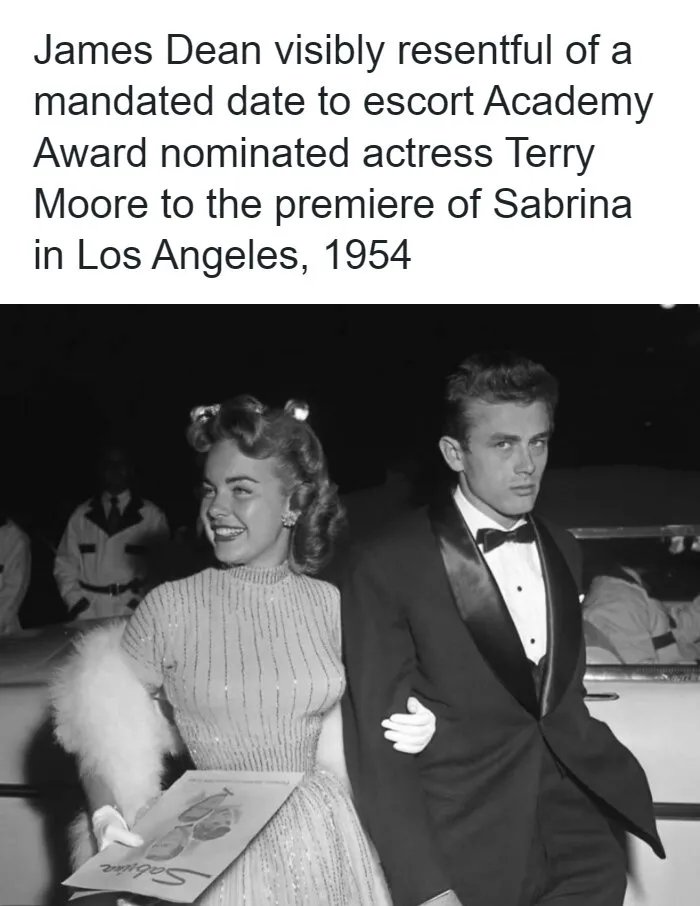
James Dean and Terry Moore arrived together at the Los Angeles premiere of Sabrina on Sept. 22, 1954. Their appearance was reportedly an arranged publicity date rather than a genuine romantic outing, a routine practice during Hollywood’s studio era.
Studios and publicists regularly paired actors at premieres, restaurants and nightclubs to generate photographs and magazine coverage. Moore was already an established star who had received an Academy Award nomination for her performance in Come Back, Little Sheba. Dean, meanwhile, was still an emerging actor whose first leading film had not yet reached theaters.
Moore later recalled taking Dean to the premiere and getting him into a tuxedo. In this particular photograph, she appears delighted by the attention while Dean looks conspicuously tense and uncomfortable.
However, describing him as “resentful” remains an interpretation. A photograph captures only a fraction of a second, and other images from the evening show the pair conversing with fellow guests more normally.
Dean was known for disliking Hollywood formality and carefully manufactured publicity. His visible discomfort therefore fits his reputation, even if nobody can determine his precise thoughts from this image alone.
Added fact: When this photograph was taken, Dean had recently completed filming East of Eden. The movie was released in March 1955, giving him only about six months of major public fame before his death that September.
Report
15points
#44
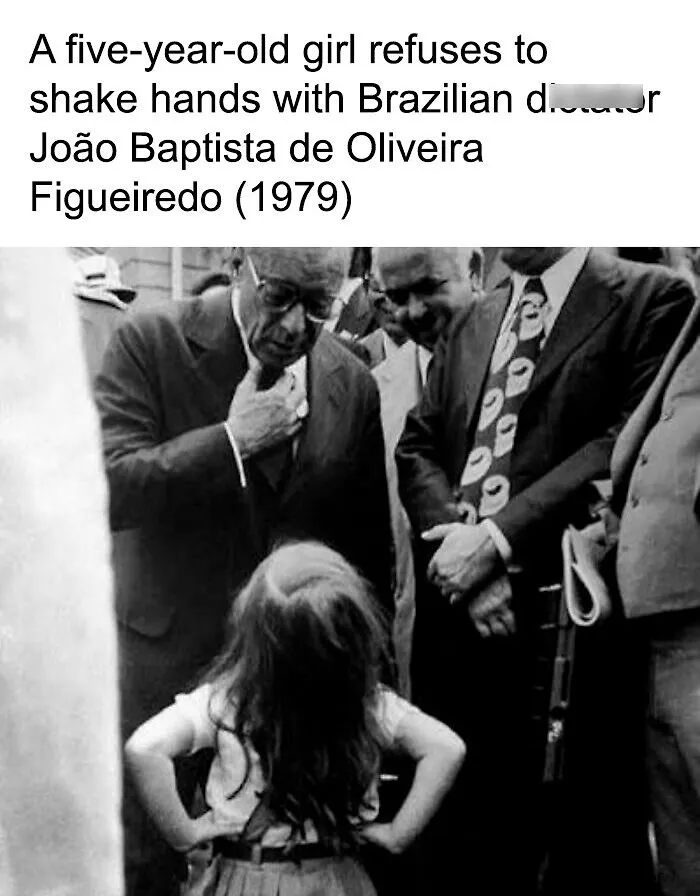
The girl in this famous photograph was five-year-old Rachel Coelho Menezes de Souza, later known as Rachel Clemens.
The encounter occurred on Sept. 5, 1979, at the Palácio da Liberdade in Belo Horizonte, only months after General João Figueiredo became Brazil’s president.
As Figueiredo leaned forward and extended his hand, Rachel planted her hands firmly on her hips and refused to respond.
Photographer Guinaldo Nicolaevsky captured the perfectly timed moment.
Newspapers and magazines around the world soon published the image, which became a powerful symbol of resistance to Brazil’s military dictatorship.
The photograph appeared especially meaningful because Figueiredo had promised to extend his hand in reconciliation as Brazil slowly moved toward democracy.
Here, however, a small child seemed to reject that hand completely.
Rachel later explained that her refusal had not been a planned political protest. She was simply irritated, behaving stubbornly and resisting the adults around her.
Yet photographs can take on meanings far beyond the intentions of the people inside them. To many Brazilians, Rachel’s defiant pose represented an exhausted public standing up to military authority.
Figueiredo remained in power until 1985 and became the final president of Brazil’s 21-year military dictatorship.
Added fact: Rachel was not publicly identified as the girl in the photograph until decades later. She died in Belo Horizonte in 2015 at the age of 40.
Report
14points
#45
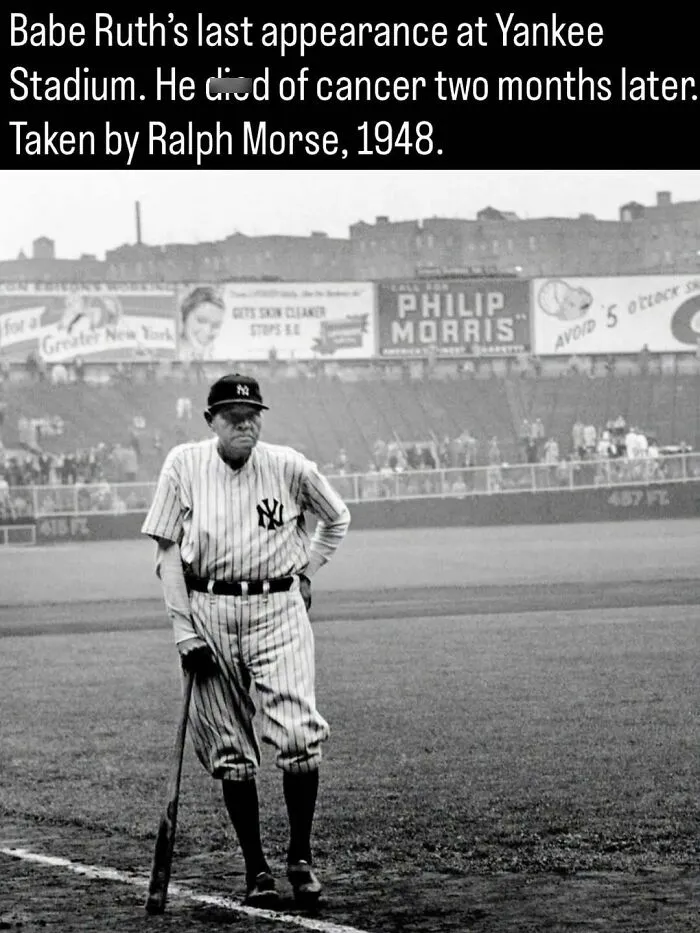
Ruth returned to Yankee Stadium on June 13, 1948, for a ceremony celebrating the ballpark’s 25th anniversary and officially retiring his famous No. 3.
By then, the once-powerful athlete had been severely weakened by cancer.
Wearing his Yankees uniform for the final time, Ruth walked onto the field using a bat borrowed from Cleveland pitcher Bob Feller as a cane.
The contrast was heartbreaking. Ruth had helped transform the Yankees into baseball’s most famous franchise and had hit hundreds of towering home runs before enormous crowds.
Now, at 53, he appeared thin, tired and barely able to speak. Nevertheless, thousands of fans rose to honor the man whose popularity had helped make Yankee Stadium “The House That Ruth Built.”
Ruth had retired as a player in 1935 with 714 career home runs, a record that remained unbroken until Hank Aaron surpassed it in 1974. He died on Aug. 16, 1948, almost exactly two months after this final appearance. Tens of thousands of people later filed past his coffin as it lay in state at Yankee Stadium.
Added fact: Another photograph taken that day, Nat Fein’s famous rear-view image “The Babe Bows Out,” became the first sports photograph to win a Pulitzer Prize.
Report
14points
#46
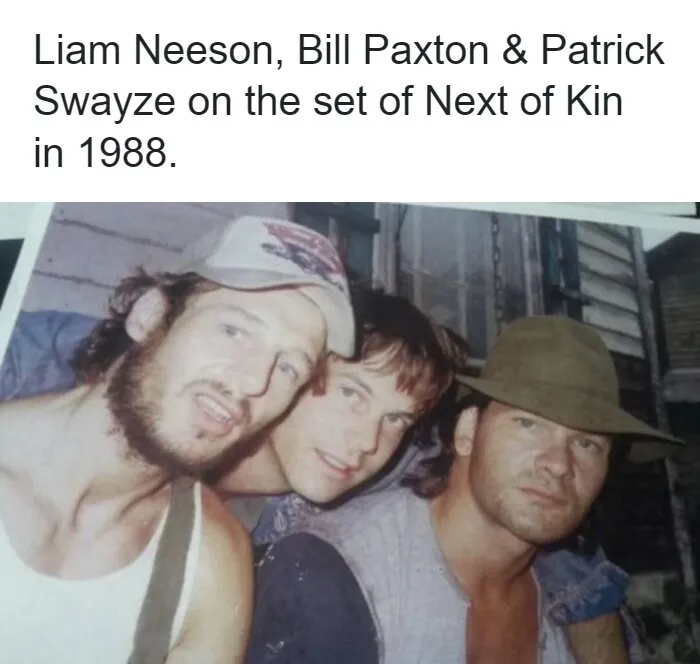
These three legends here are at very different stages of their careers while filming Next of Kin, an action thriller released the following year in 1989.
Swayze was already becoming one of Hollywood’s biggest stars. He had recently exploded into worldwide fame with Dirty Dancing and would release both Road House and Next of Kin in 1989.
In the film, Swayze plays Truman Gates, a Kentucky-born Chicago police officer whose younger brother Gerald, played by Bill Paxton, is m******d by members of organized crime.
Neeson plays their older brother Briar, who leaves rural Kentucky and heads to Chicago determined to avenge Gerald’s death.
It was years before Neeson became internationally associated with action films through movies like Taken. At this point, he was still largely known for dramatic roles and was building his career in American cinema.
The movie also featured Helen Hunt, Adam Baldwin and a young Ben Stiller, giving it a surprisingly stacked cast in retrospect.
Parts of the production were filmed in Kentucky, including communities in Perry and Letcher counties, while the story largely unfolds in Chicago.
Added fact: Next of Kin arrived during an extraordinary year for Patrick Swayze. Just months earlier, he had starred as James Dalton in Road House, meaning two of the films that helped establish his late-1980s screen persona were released in the same year.
Report
14points
#47
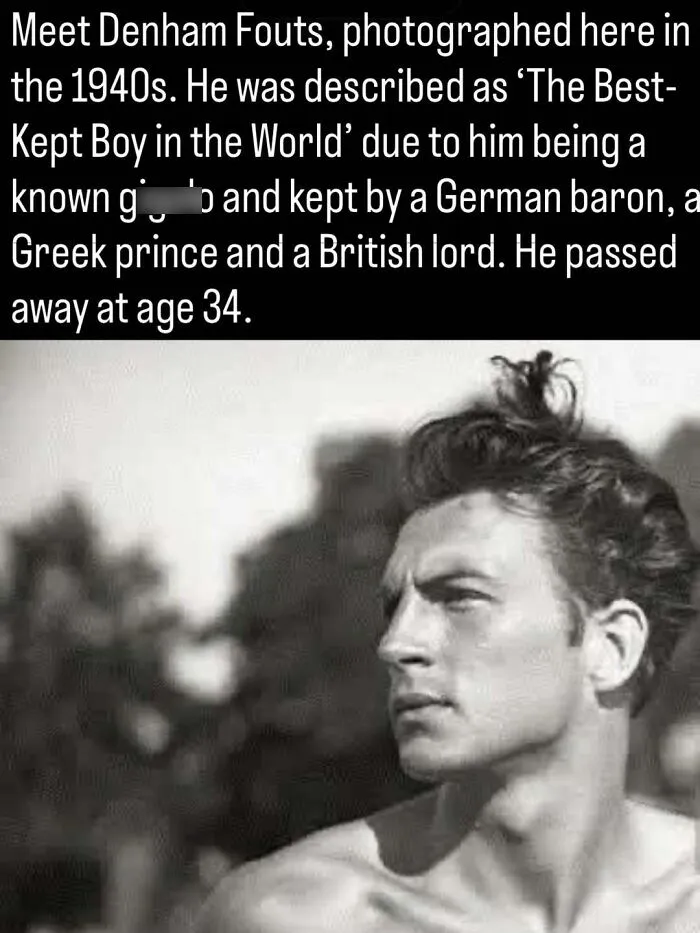
Born Louis Denham Fouts in Jacksonville, Florida, in 1914, “Denny” left an ordinary upbringing for a remarkable life among Europe’s wealthy, royal and literary circles. By his twenties, he had become one of the era’s most famous male escorts. Christopher Isherwood called him “the most expensive male prostitute in the world,” while Truman Capote dubbed him the “Best-Kept Boy in the World.”
Among those linked romantically to Fouts were Evan Morgan, 2nd Viscount Tredegar, wealthy art patron Peter Watson, and Prince Paul of Greece, who became King Paul in 1947. His circle included Capote, Isherwood, Gore Vidal, Jane and Paul Bowles and photographer George Platt Lynes.
His later years were marked by opium addiction. Fouts died in Rome on December 16, 1948, from a congenital heart abnormality involving a hypoplastic aorta and enlarged left ventricle. He was only 34.
Added Fact: Fouts claimed that he and Prince Paul of Greece, the future King Paul, once went together to a tattooist in Vienna and had matching small blue symbols tattooed above their hearts. Truman Capote later repeated the story. Fouts was notorious for embellishing his adventures, so historians cannot confirm it, but the alleged relationship between the American hustler and the future king became one of the most extraordinary stories attached to his life.
Report
13points
#49

Kierkegaard, the 19th-century Danish philosopher often regarded as one of the founders of existentialism.
This quote appears in Either/Or, published in 1843, in a passage built around the seemingly unavoidable nature of regret.
Kierkegaard writes that whether you marry or remain unmarried, laugh at the world or weep over it, you will regret either choice.
His point was not simply that every decision ends badly. Instead, he was exposing the frustrating structure of human choice: choosing one path means permanently surrendering another.
Even a good decision can leave a person wondering what might have happened if they had chosen differently.
Refusing to decide offers no escape, because inaction is itself a decision with consequences.
The line captures the anxiety created by freedom, the knowledge that we must make choices without ever knowing exactly where the alternatives would have led.
There is also a layer of irony. The passage is deliberately exaggerated and written from the perspective of an “aesthetic” personality who avoids commitment by endlessly analyzing every possibility. Kierkegaard ultimately believed that a meaningful life required choosing and committing, despite uncertainty.
Added Fact: Kierkegaard published Either/Or under the pseudonym Victor Eremita, Latin for “victorious hermit,” and presented himself as the editor of writings supposedly discovered inside a secret drawer.
Report
12points
#50
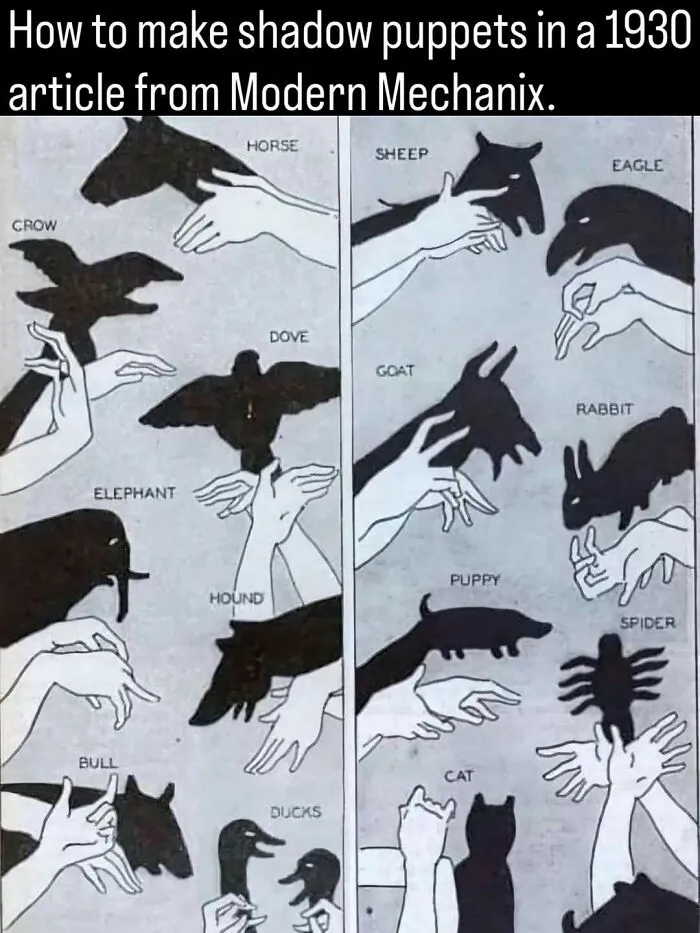
Long before televisions became common household fixtures, shadow puppets offered an easy form of entertainment requiring nothing more than a pair of hands, a light and a blank wall.
This illustrated guide showed readers how to position their fingers and arms to create recognizable silhouettes of animals.
The designs ranged from familiar creatures such as a horse, rabbit and cat to more complicated figures, including an elephant, eagle and spider. Some required only one person’s hands, while others depended on two people coordinating their movements to complete the illusion.
When placed between a bright lamp and a wall or sheet, the hands blocked the light and transformed into enlarged animal shadows.
The spirit of early popular mechanics magazines was to teach readers how to build household gadgets, perform tricks, conduct experiments and create inexpensive entertainment.
During the early years of the Great Depression, activities that required little or no money would have been especially appealing to families looking for ways to entertain themselves at home.
Added Fact: Shadow puppetry is far older than this 1930 guide. Elaborate traditions using carved figures developed centuries ago in parts of Asia, particularly China, India and Indonesia. The Indonesian form known as wayang kulit uses intricately decorated leather puppets positioned behind a screen and illuminated from behind.
Report
11points
#51

On the left is King Carl XVI Gustaf of Sweden, who has reigned since 1973. In the center is Harald’s son and successor, the newly ascended King Haakon VIII of Norway. On the right is King Frederik X of Denmark, who became king following the abdication of his mother, Queen Margrethe II, in 2024.
The three kings were photographed as Norway honored Harald after his death at age 89. A 21-gun salute marked the beginning of the funeral procession, which carried his coffin from the Royal Palace to Oslo Cathedral. Members of the Norwegian royal family walked behind it as tens of thousands of people filled the streets of the capital.
Harald had occupied the Norwegian throne for 35 years, beginning his reign in 1991 after the death of his father, King Olav V. He became widely respected for modernizing the monarchy while remaining a stable and unifying presence during periods of national celebration and tragedy.
Following the cathedral service, Harald was laid to rest during a private ceremony at the Royal Mausoleum inside Akershus Fortress.
Added Fact: Harald V was the first prince born in Norway in 567 years, arriving in 1937 after generations of Norwegian monarchs and heirs had been born abroad.
Report
11points
#52

Irwin died on Sept. 4, 2006, while filming a documentary called Ocean’s Deadliest near Australia’s Great Barrier Reef. During a break in production, Irwin and cameraman Justin Lyons entered shallow water to film a large stingray for a separate television program featuring Irwin’s daughter, Bindi.
As Irwin approached, the stingray suddenly raised its tail and struck him repeatedly in the chest. Lyons continued recording because the crew had been instructed to keep filming whenever someone was in danger. Once Irwin was returned to the boat, the camera was finally turned off. Despite attempts to save him, the injuries proved fatal.
The footage was provided to the authorities as part of the official investigation. John Stainton, Irwin’s close friend and longtime producer, strongly opposed it ever being shown publicly, describing it as deeply disturbing. Reports concerning what eventually happened to every copy have varied, although Terri Irwin later said the footage had been destroyed after the investigation.
It has never been released to the public—a decision that protected Irwin’s dignity and allowed the world to remember him for his extraordinary life rather than his death.
Added fact: According to Lyons, Steve Irwin’s final words were, “I’m dying.”
Report
11points

#54
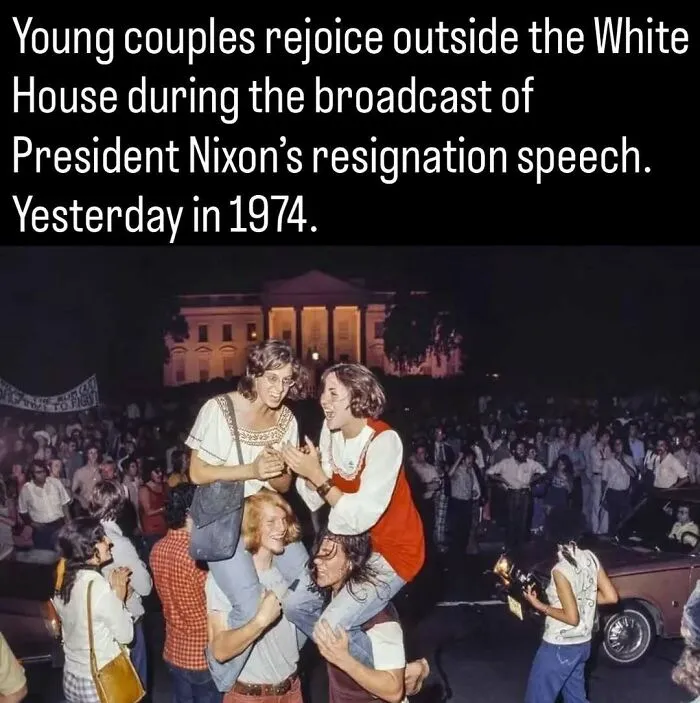
On the evening of August 8, 1974, Richard Nixon addressed the nation from the Oval Office and announced that he would resign the presidency at noon the following day.
Outside the White House, crowds gathered as the historic announcement was broadcast, with people cheering, waving signs and celebrating in the streets.
Nixon’s resignation brought the Watergate scandal to its dramatic conclusion.
The scandal had begun with the 1972 break-in at Democratic National Committee headquarters in the Watergate complex, but the subsequent investigation uncovered a much broader campaign of political espionage, abuse of power and efforts by members of the Nixon administration to obstruct the investigation.
By the summer of 1974, Nixon’s political support in Congress had collapsed. Facing almost certain impeachment in the House and the likelihood of conviction in the Senate, he decided to leave office.
Many of the people outside the White House were celebrating because Nixon’s resignation felt like the end of a long and exhausting political crisis.
Watergate had dominated American life for more than two years, steadily revealing illegal activity, political espionage, secret recordings and attempts to obstruct the investigation. As more evidence emerged, public trust in Nixon collapsed.
For his opponents, the resignation was not simply the fall of a president they disliked; it was proof that even the most powerful person in the country could be held accountable. The cheering reflected a sense of relief that the scandal was finally ending and, for many, a belief that the constitutional system had ultimately worked.
Added fact: Nixon officially left office at noon on August 9, 1974. Gerald Ford was sworn in shortly afterward as the 38th president of the United States, becoming the only person to become president without having been elected president or vice president.
Report
11points
#55

The accident occurred while the two Royal Navy warships were escorting Arctic Convoy PQ 15 to the Soviet Union.
Thick fog reduced visibility to almost nothing when HMS Punjabi unexpectedly crossed the battleship’s path.
Despite attempts to avoid a collision, the 42,000 ton King George V struck the much smaller destroyer with tremendous force, c*****g deeply into her hull.
Punjabi sank within minutes. Of her crew of 219 officers and sailors, 49 lost their lives, while the survivors were rescued by nearby escort vessels. King George V suffered extensive damage to her bow but remained seaworthy. After temporary repairs in Iceland, she returned to Britain, where a completely new bow section was fitted before rejoining the fleet.
The loss of Punjabi was a sobering reminder that even outside enemy action, the Arctic convoys were extraordinarily dangerous. Crews faced freezing temperatures, violent seas, drifting ice, and poor visibility while protecting vital supplies destined for the Soviet Union.
Added Fact: After her repairs, HMS King George V went on to serve in the Mediterranean and Pacific. On September 2, 1945, she was present in Tokyo Bay for the formal Japanese surrender that ended the Second World War.
Report
11points
#56

By the late 1950s, New York police were confronting a rapidly changing city. Puerto Rican migration had transformed neighborhoods across Manhattan, Brooklyn and the Bronx, creating an obvious practical problem for thousands of officers who spoke only English.
Training sometimes focused on the phrases an officer would need immediately on the street. Instead of beginning with Spanish grammar, English speaking officers could memorize phonetic approximations such as “COH MOH” for cómo and “OO STEHD” for usted.
The effort coincided with broader changes inside the department. The NYPD Hispanic Society had been incorporated in 1957 to support officers of Spanish descent and improve relations between police and New York’s growing Latino population.
Police training itself was becoming increasingly professionalized. In September 1958, the NYPD hosted an international training institute attended by 170 law enforcement officials from the United States and abroad.
Added Fact: In the mid 1950s, the entire NYPD reportedly had fewer than 40 Hispanic officers. Four decades later, it had nearly 5,000.
Report
10points
#57

Oscar Niemeyer was already internationally famous for designing many of the futuristic government buildings in Brasília when Brazil’s military dictatorship forced him into exile during the 1960s.
A committed communist since 1945, he settled in Paris and agreed to design a new headquarters for the French Communist Party as an act of political solidarity. He accepted no architectural fee for the work.
Construction began in 1968. The curved, glass-fronted office block opened in 1971, while the underground entrance hall, plaza and distinctive white dome were completed in 1980.
That phased construction accounts for the project’s 13-year timeline.
The building rejected the heavy, rigid appearance commonly associated with communist architecture. Its offices rise on only five concrete supports, making the enormous S-shaped structure appear to float above the ground. Beneath it lies a sweeping underground hall with flowing white walls and almost no sharp corners.
As the French Communist Party declined in membership and revenue, it began renting portions of the building to private companies and event organizers. Prada held a fashion show there in 2000, followed by designers including Thom Browne, Jean Paul Gaultier, Stella McCartney and Yeezy.
Added fact: Niemeyer said the building’s white dome, which covers the party’s main council chamber, was shaped to resemble the belly of a pregnant woman. The complex was officially designated a French historic monument in 2007.
Report
10points
#58
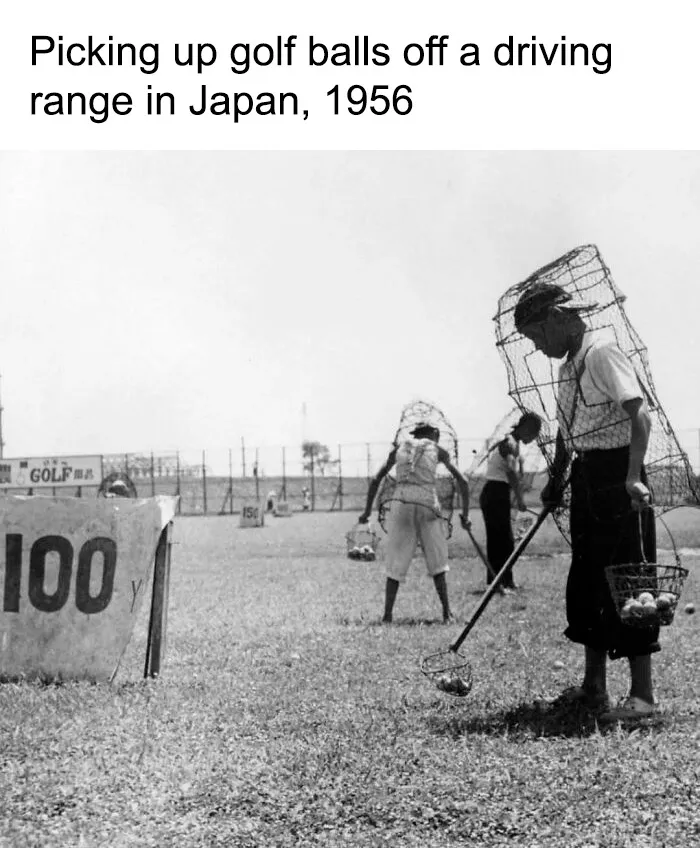
Imagine the stingers off the shin here. Before automated range-picking machines became common, collecting golf b***s from a busy driving range could be a surprisingly dangerous job.
Workers had to walk directly onto the range while golfers continued hitting, leaving them exposed to b***s traveling at h**h speed from dozens of different directions.
The solution seen in this photograph was simple: protective wire cages worn over the head and upper body.
The cages acted as crude shields, allowing workers to bend down and retrieve b***s while absorbing or deflecting shots that came their way. Using long-handled baskets and scoops, they could gather hundreds of b***s without forcing the entire range to shut down.
Golf had already been played in Japan for decades by the time this photograph was taken, but the sport expanded rapidly during the postwar economic boom. Driving ranges became particularly useful in crowded Japanese cities, where finding enough land for a full 18-hole course was difficult.
Eventually, many urban ranges began building the enormous nets and multi-level hitting bays that are now closely associated with golf in Japan.
Mechanical ball collectors gradually eliminated jobs like the one pictured, using rotating discs or rollers to sweep b***s from the turf while protected inside a small vehicle.
Added fact: Japan’s first golf course opened at Kobe Golf Club in 1903, more than half a century before this photograph was taken.
Report
10points
#59
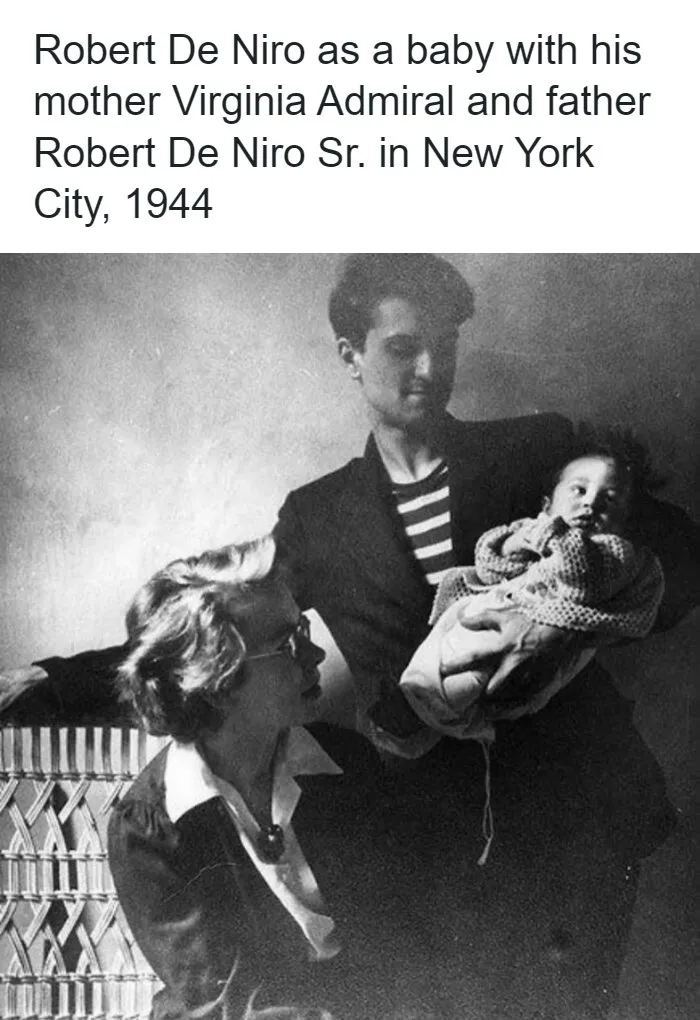
Long before Robert De Niro became one of the most celebrated actors of his generation, he was growing up in a deeply artistic household in New York City.
De Niro was born in Manhattan in August 1943 to two accomplished painters, Virginia Admiral and Robert De Niro Sr. Both had immersed themselves in New York’s emerging modern art scene, surrounding their son with artists, writers and other creative figures from an early age. His father eventually became particularly respected for his expressive figurative paintings and is now represented in the collections of several major American museums.
De Niro’s parents separated when he was still very young, and he was primarily raised by his mother in Manhattan’s Greenwich Village and Little Italy neighborhoods. His father remained nearby, however, and continued to be part of his life.
Growing up around the theaters, cinemas and artistic culture of downtown Manhattan helped shape De Niro’s own creative interests. He began acting as a child and later studied under legendary acting teacher Stella Adler before developing the intense, immersive approach that became his trademark.
Within three decades of this photograph, the baby pictured here would be starring in films such as Mean Streets, The Godfather Part II and Taxi Driver.
Added fact: Robert De Niro won his first Academy Award at just 31 years old for playing the young Vito Corleone in The Godfather Part II.
Report
10points
#60

Before magnetic strips, computer chips and contactless payments, many shoppers carried metal charge plates containing their names, addresses and account numbers in raised lettering.
At checkout, a Sears employee placed the plate inside a manual imprinting machine and covered it with a multipart sales slip separated by carbon paper. Sliding a heavy roller across the device pressed the raised information onto every copy, producing a record for the customer, the store and Sears’ accounting department.
The familiar “ka-chunk” sound later associated with plastic credit-card imprinters came from essentially the same process.
This plate advertised Sears’ “Revolving Charge” program. Unlike older store accounts that generally required customers to pay their entire balance each month, revolving credit allowed shoppers to carry part of the debt forward while continuing to make purchases, usually in exchange for interest or finance charges.
It was not a universal credit card. The plate was connected to a Sears account and could normally be used only for purchases from Sears. Nevertheless, it offered many of the basic features modern credit-card users would recognize.
The exact year of this particular plate is uncertain, so “1950s” is safer than 1950. Its address lacks a ZIP Code, indicating that it was likely issued before the nationwide ZIP Code system began in 1963.
Added fact: Sears later entered the general-purpose credit-card industry by launching Discover in 1985, allowing customers to make purchases far beyond Sears stores.
Report
10points