



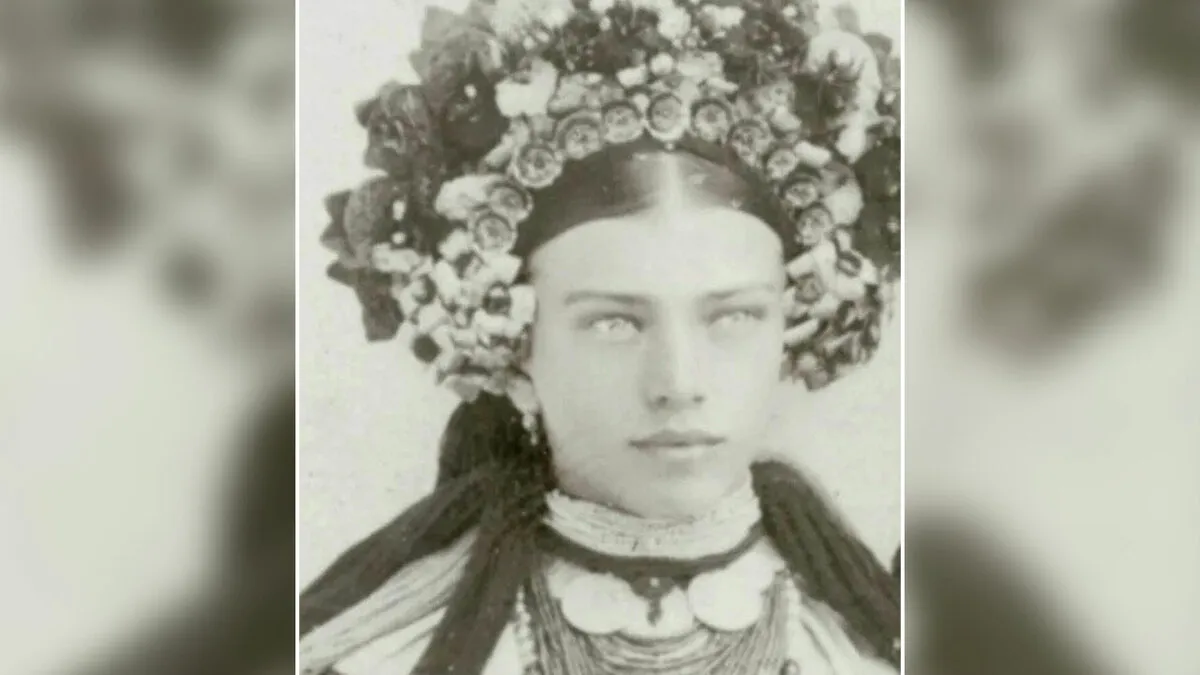


Historical photos are way more than just subject matter in school. They are also time capsules of a bygone era, giving us a glimpse of what life was like when many of us weren’t even born yet.
Just take a look at these photos from the History Feels Instagram page. Each one provides a palpable sense of nostalgia, which is always welcome. At the same time, each image's backstory is compelling enough to make you want to go down a rabbit hole.
The account has a million followers and counting, and scrolling through should explain why.
#61
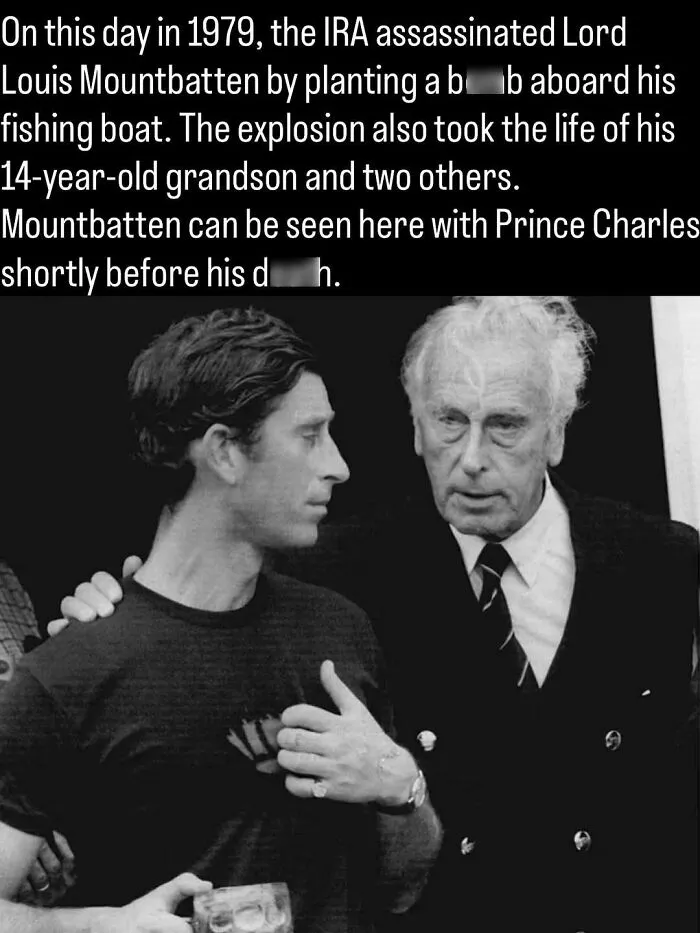
On August 27, 1979, Lord Louis Mountbatten boarded his fishing boat, Shadow V, near his vacation home in Mullaghmore. Members of the Provisional Irish Republican Army had secretly placed a remotely operated b**b aboard the vessel. It exploded after the boat traveled into Donegal Bay.
Mountbatten, 79, was pulled from the water but died from his injuries. Three others were also k****d: his 14-year-old grandson Nicholas Knatchbull; 15-year-old crew member Paul Maxwell; and 83-year-old Doreen Knatchbull, the Dowager Lady Brabourne. Several surviving passengers suffered serious injuries.
One geographical detail in the original caption is incorrect: the bombing occurred off County Sligo in the Republic of Ireland, not Northern Ireland.
Mountbatten had served as Britain’s final viceroy of India, overseeing the transition to independence and partition in 1947. He was also a senior Royal Navy commander and an influential mentor to the future King Charles III, who regarded him as an honorary grandfather.
The IRA claimed responsibility, presenting the assassination as an attack on a prominent representative of the British establishment. Hours later, another IRA attack at Warrenpoint k****d 18 British soldiers, making August 27, 1979, one of the deadliest days of the Troubles.
Added fact: Thomas McMahon was convicted of m*******g Mountbatten and sentenced to life imprisonment, but was released in 1998 under the Good Friday Agreement.
Report
10points
#62
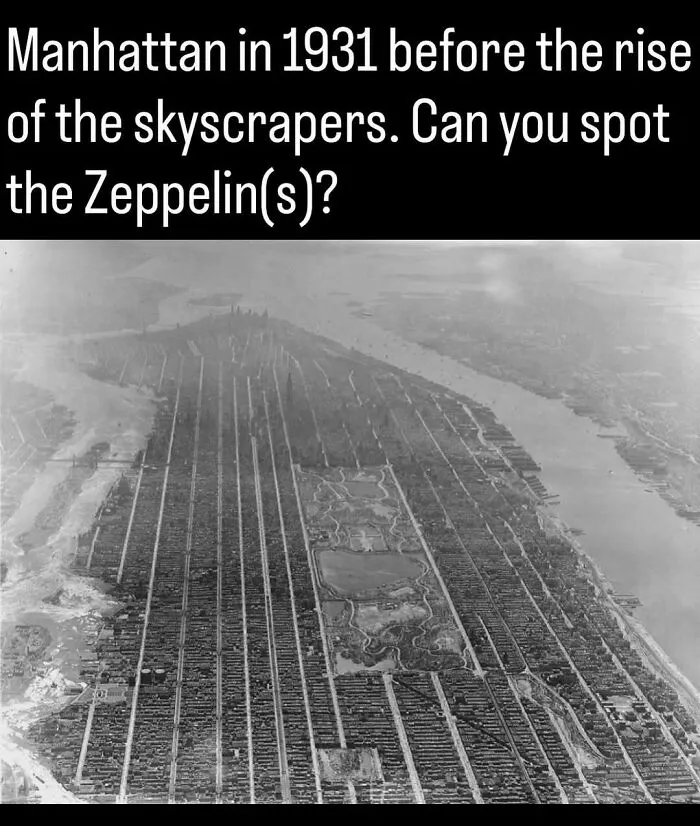
This remarkable aerial view shows Manhattan in 1931, with Central Park c*****g a huge rectangular opening through an otherwise densely packed island.
Look closely above the city and you can make out an airship, a sight that was far less unusual in the skies of the early 20th century than it would be today.
Manhattan was already kind of in the middle of its great skyscraper boom by 1931.
The Chrysler Building had opened the previous year, while the Empire State Building was completed in 1931 and immediately became the tallest building in the world.
There were a few earlier landmarks such as the Woolworth Building had already been reshaping the skyline for decades.
Airships were part of that same futuristic atmosphere.
They were enormous lighter-than-air craft used for military purposes, passenger travel and publicity flights.
The Library of Congress photograph actually shows two airships flying above Manhattan with Central Park below, demonstrating just how surreal the city’s skies could look during this period.
One of the most amazing things about New York City, in my opinion, is the fact that Central Park, which opened in the 19th century, has been able to remain in fact, a park.
Added Fact: The Empire State Building originally included a mooring mast at its summit that was promoted as a potential docking point for airships, although the idea proved impractical and was quickly abandoned.
Report
10points
#63
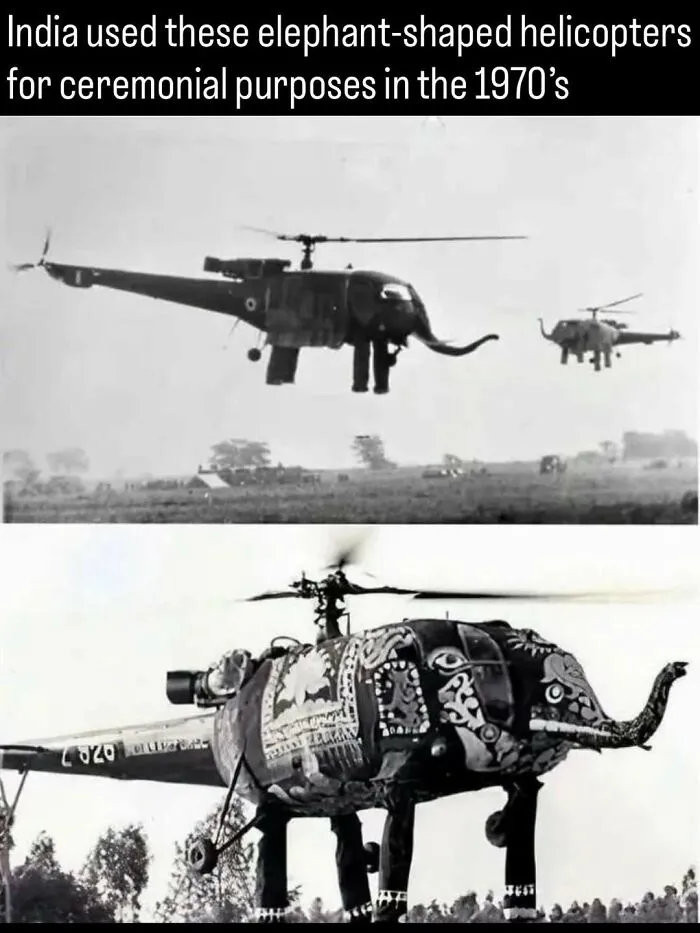
These were Indian Air Force Chetak helicopters, Indian-built versions of the French Aérospatiale Alouette III. During Republic Day celebrations, helicopters from No. 116 Helicopter Unit were transformed into enormous flying elephants for displays over New Delhi.
The transformation was surprisingly low-tech. A tailor was brought to the air base weeks before the event and created fabric panels forming the elephant’s body, ears, legs, trunk and decorative coverings. Much of the helicopter’s cockpit was concealed, leaving narrow openings through which the pilot could see.
Flying the aircraft required unusual precautions. Pilots generally kept speeds around 40–45 knots because higher speeds risked tearing away the fabric or allowing it to become entangled in the tail rotor. During displays, the “elephant” descended to roughly 910 feet over Rajpath and performed a short aerial “dance” before climbing away.
The Indian Air Force used the elephant display during several Republic Day flypasts between 1970–73 and again from 1979–85.
Added Fact: The elephant wasn’t the only disguise. Chetak helicopters were also transformed into a giant flying fish, and in 1993 one was dressed as a dodo for Mauritius’s Independence Day celebrations.
Report
9points
#64

While the cast-iron columns heated the room, the enclosed cabinet captured some of that warmth and used it to keep bread, plates and prepared food warm until they were needed.
Often called dining-room radiators, designs like this appeared during the late 19th and early 20th centuries, when central heating was becoming increasingly common in middle- and upper-class homes.
Hot water or steam circulated through the heavy iron sections, which slowly released heat into the surrounding room. Inside the ventilated cabinet, perforated shelves allowed warm air to circulate without placing food directly against the hottest metal.
The compartment was especially useful when meals were served in several courses or when members of a household arrived at different times. Instead of letting bread and dishes grow cold, servants or family members could place them inside the radiator until the table was ready.
Its decorative ironwork also reflects an era when manufacturers treated household machinery as furniture. Even practical heating equipment was often covered with floral patterns, scrollwork and ornamental details intended to complement the room.
Added fact: Cast-iron radiators remained warm long after a boiler stopped running because the dense metal retained and gradually released heat. This made warming compartments particularly effective, even as the fire or steam pressure began to fall.
Report
9points
#65
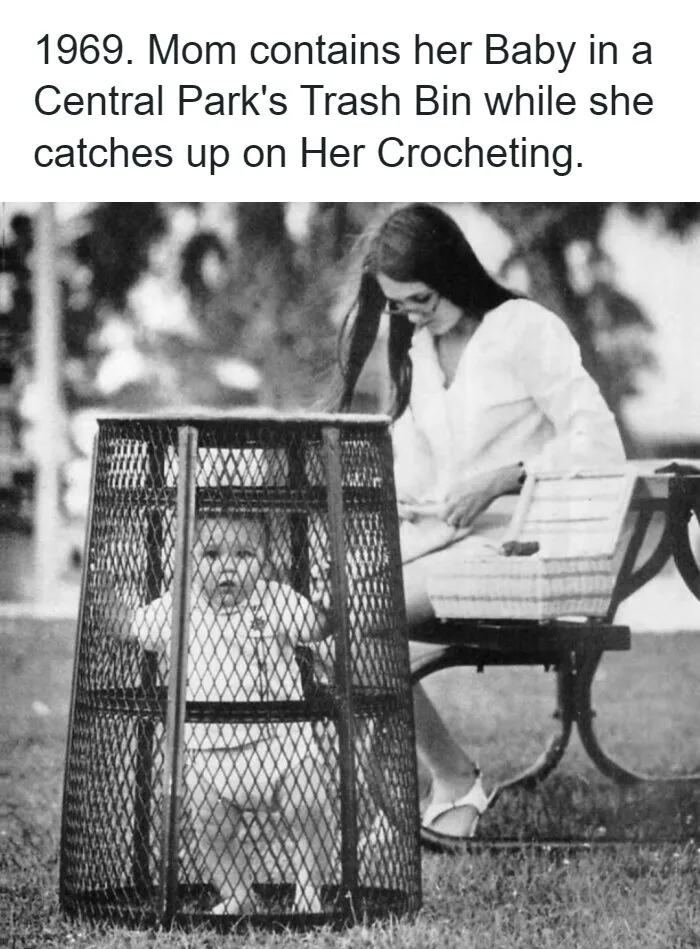
The photograph captures a mother calmly working on her crocheting while her baby sits beneath an overturned metal trash basket being used as an improvised playpen.
Although the scene looks alarming by modern standards, the open metal framework allowed the child to see outside and receive fresh air while preventing the baby from crawling away. The mother remained seated only a few feet behind the child.
The image appeared in the May 30, 1969, issue of LIFE magazine, which regularly devoted its final page to photographs considered unusual, humorous or thought-provoking. LIFE reportedly presented the picture beneath the joking title, “Lady, Is This Your Litter?”
The photograph reflects a period when attitudes toward supervision, public safety and parenting differed considerably from those of today. Children commonly experienced levels of independence that would now be considered unusual, while improvised solutions frequently took the place of specialized products.
By 1969, portable playpens were already available, but they were often made from wood or metal and could be heavy and inconvenient to transport. Faced with an energetic baby and a quiet afternoon in the park, this mother apparently used what was immediately available.
Added fact: The photograph was taken by Ricardo Ferro, a staff photographer associated with Florida’s St. Petersburg Times and Evening Independent newspapers.
Report
9points
#66
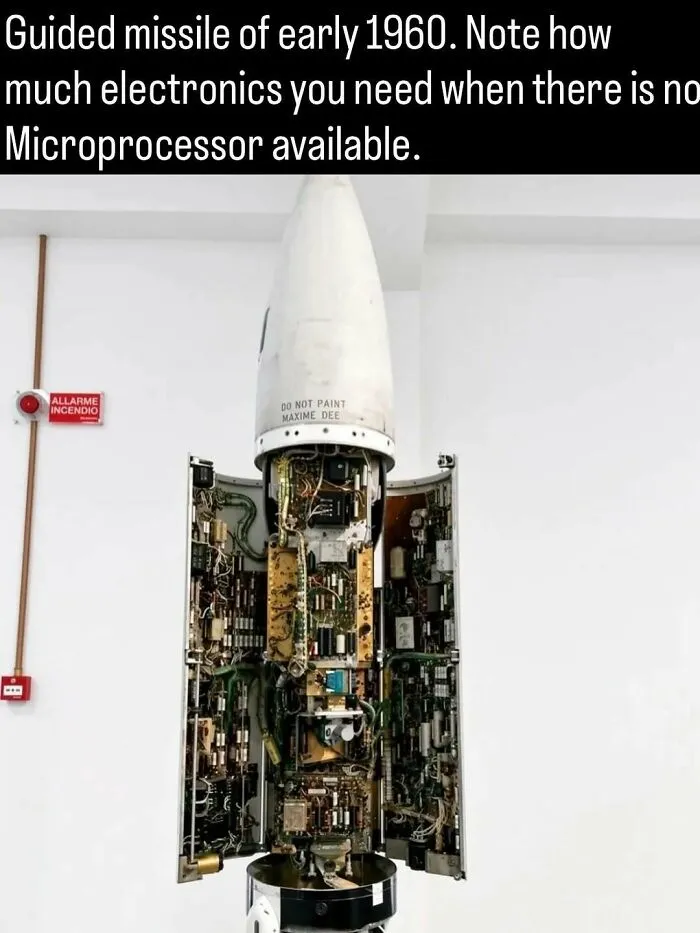
Before microprocessors, making a missile guide itself required an extraordinary amount of dedicated hardware.
Engineers had to perform navigation, stabilization and control functions using combinations of transistors, diodes, resistors, capacitors, gyroscopes, amplifiers and electromechanical components, all connected by dense bundles of wiring.
The electronics had to continually determine the missile’s orientation and movement, compare that information with its intended flight path, and send corrections to the control surfaces or steering system.
Modern processors can perform enormous numbers of these calculations on a tiny chip, but early guidance systems often divided those tasks among numerous individual circuits.
Reliability was an equally difficult problem. Missile electronics had to survive intense vibration, acceleration and rapid changes in temperature while still functioning accurately.
Components were therefore carefully secured, protected and tested because a single failure could make the entire weapon useless.
The first commercial microprocessor, Intel’s 4004, would not appear until 1971. By then, military and aerospace engineers had already spent years developing increasingly compact digital guidance computers using discrete electronic components and early integrated circuits.
Added fact: The guidance computer used in the early Minuteman I missile contained more than 1,500 transistors, 6,000 diodes, 5,000 resistors and 1,100 capacitors, yet the entire computer still had to fit inside the missile.
Report
8points
#67
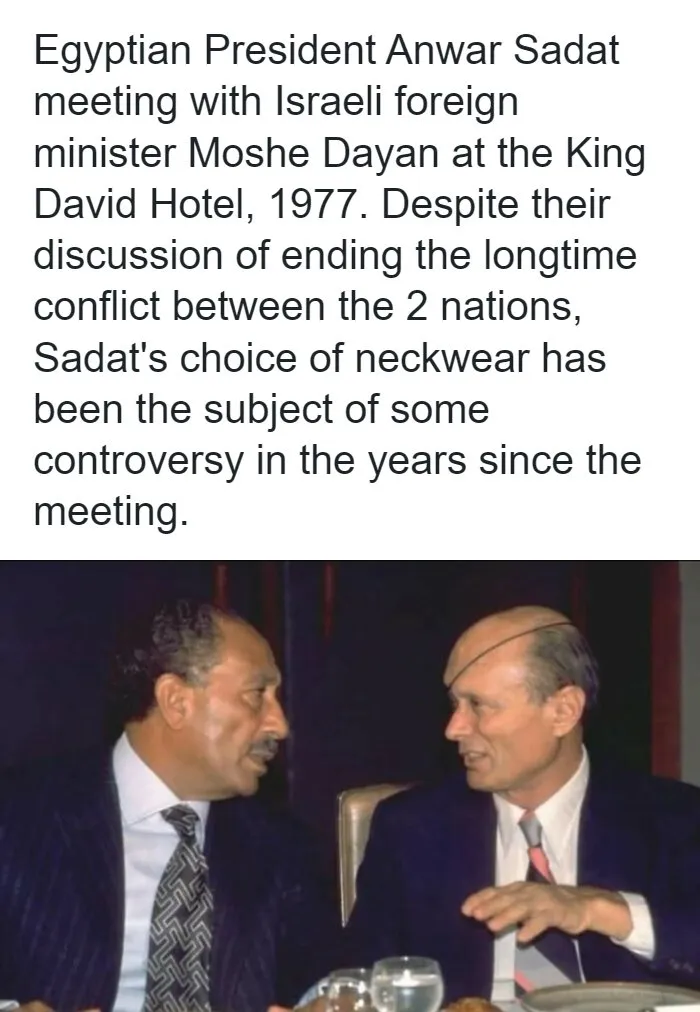
Anwar Sadat meeting Israeli Foreign Minister Moshe Dayan in Jerusalem, November 1977. Look closely at Sadat’s tie.
Its repeating geometric pattern bears an unmistakable resemblance to swastikas — an extraordinary visual detail considering where he was and whom he was meeting.
But there is an important distinction: while claims have circulated for years that Sadat deliberately wore the tie as a provocation, there does not appear to be reliable historical evidence proving that was his intention.
The larger story surrounding the photograph was remarkable enough.
On November 19, 1977, Sadat landed in Israel, becoming the first Arab head of state to officially visit the country. Only four years earlier, Egypt and Israel had been fighting each other in the Yom Kippur War.
The trip was so unexpected that even some Israeli military leaders initially questioned whether Sadat’s peace initiative could somehow be a deception.
Sadat stayed at Jerusalem’s King David Hotel and met Israeli Prime Minister Menachem Begin, Foreign Minister Moshe Dayan and other officials. The following day, he addressed the Knesset, telling Israelis directly that he was prepared to pursue peace while also demanding Israeli withdrawal from territories captured in 1967 and recognition of Palestinian rights.
Perhaps the most remarkable contrast with the tie came elsewhere during the same trip.
Sadat visited Yad Vashem, Israel’s H*******t memorial, where he viewed exhibits documenting the m****r of six million Jews under N**i Germany.
His visit helped break a psychological barrier that had existed between Egypt and Israel for decades and eventually contributed to the 1978 Camp David Accords and the Egyptian-Israeli peace treaty signed in 1979.
Added Fact: Before Sadat made the trip, the idea seemed so improbable that his own foreign minister resigned in protest. Syria opposed the visit, Libya threatened to sever relations with Egypt, and protests erupted elsewhere in the Arab world. Sadat went anyway.
Report
8points
#68
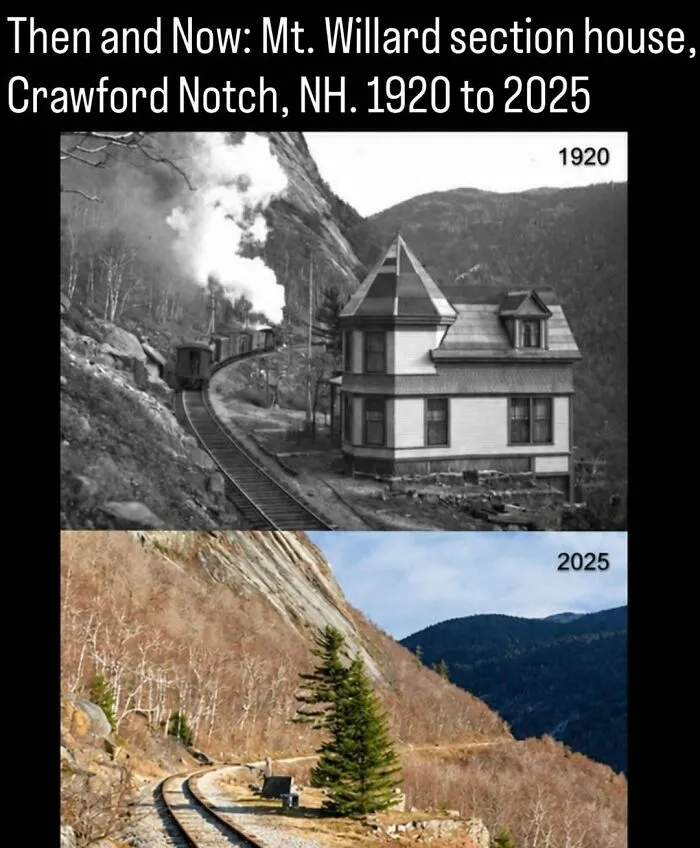
The Mount Willard Section House once stood beside the railroad tracks running through Crawford Notch, one of the most dramatic mountain passes in New Hampshire’s White Mountains.
Built in 1887, the house provided living quarters for the railroad foreman, his family and members of the maintenance crew. They were responsible for inspecting the rails, replacing damaged ties, clearing snow and rockfalls, and keeping trains moving safely through the notch.
It was an especially demanding place to maintain a railroad. The tracks followed a narrow shelf cut into the side of Mount Willard, with steep slopes rising above the line and the valley dropping away below it. During winter, crews faced heavy snow, freezing temperatures and the constant danger of falling rocks and avalanches. Living beside the tracks allowed workers to respond quickly whenever the line became blocked or damaged.
The house remained occupied by railroad families into the 1960s. By roughly 1967, changing maintenance practices had made it unnecessary, and its final residents moved away. The abandoned building soon deteriorated and became a repeated target for vandalism.
Rather than continue maintaining the empty structure, the Maine Central Railroad deliberately burned it to the ground on December 13, 1972. More than half a century later, sections of its stone foundation remain beside the tracks—the last physical evidence of the families who once lived and worked in this isolated location.
Added fact: The railway through Crawford Notch opened in 1875, conquering terrain that had once been considered nearly impossible for a railroad to cross.
Report
8points
#69
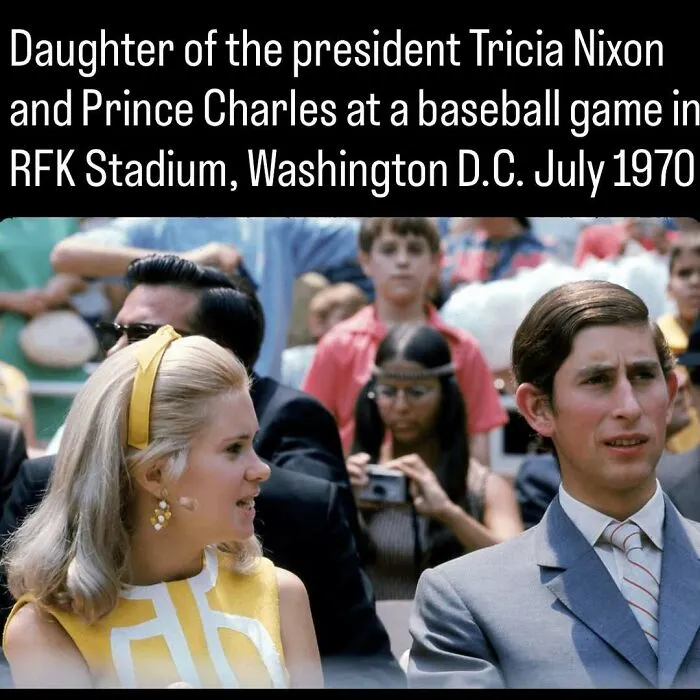
Prince Charles was 21 years old and making his first visit to the United States when he attended a Washington Senators game at RFK Stadium with President Richard Nixon’s daughter Tricia.
Charles had come to Washington with his younger sister, Princess Anne, for an official visit that included stops at the White House, Capitol Hill, Camp David and several museums. The baseball outing was arranged in part by David Eisenhower, President Dwight Eisenhower’s grandson and the husband of Nixon’s other daughter, Julie, who was working for the Senators that summer.
The game itself was Washington against the California Angels. The Senators won 4-0 in front of only about 8,000 fans, and Charles apparently had almost no idea how baseball worked.
When Washington’s Mike Epstein hit a foul ball into the stands, Charles reportedly could not understand why it was not considered a home run. David Eisenhower had to point out the foul poles and explain the rule.
The July heat did not help. The group initially sat in the sun before moving to covered seats and eventually leaving early.
The most interesting part, though, was the attention surrounding Charles and Tricia. They had danced together three times at a White House event the previous evening, fueling press speculation that the Nixons might be trying to play matchmaker.
Added fact: Charles later joked about the visit himself, saying, “That was the time when they were trying to marry me off to Tricia Nixon.”
Report
8points
#70

For decades, streets, parking lots and highways were illuminated by sodium-vapor lamps, which produced the unmistakable orange glow seen in the lower photograph. These lights became widely used because they were efficient, long-lasting and relatively inexpensive compared with earlier forms of street lighting.
Their unusual color came from electricity passing through vaporized sodium inside the bulb. Sodium naturally emits light concentrated around a yellow-orange wavelength, bathing nearly everything beneath it in the same warm color.
Under the strongest low-pressure sodium lamps, distinguishing colors could be surprisingly difficult. A blue car, red coat or green street sign might all appear as different shades of gray or brown.
Beginning in the 2010s, cities increasingly replaced sodium lamps with LEDs. The newer lights consumed less electricity, lasted longer and produced clearer white light that made colors, road markings and faces easier to recognize. Cities could also dim or remotely monitor them, reducing maintenance costs.
Yet the transition quietly transformed how nighttime looked and felt. The soft amber glow associated with late-night bus stops, empty parking lots and long highway drives largely disappeared, replaced by the sharper white or bluish light now common across modern cities.
Added fact: On cloudy nights, orange streetlight reflected from low clouds could make the entire sky above a city glow orange, not merely the streets beneath it.
Report
7points
#72

Although not every neighborhood looked like this, sections of New York, especially the South Bronx, experienced extraordinary destruction during these decades. Entire blocks were scarred by abandoned buildings, rubble-filled lots and burned-out apartments.
The crisis had developed over many years. Manufacturing jobs disappeared, discriminatory lending practices restricted investment, and middle-class residents increasingly moved to the suburbs.
Aging buildings deteriorated as landlords stopped making repairs, while some owners abandoned properties that no longer generated a profit. Others deliberately burned buildings to collect insurance money.
New York City’s near-bankruptcy in 1975 made conditions even worse. Thousands of municipal employees were laid off, public services were reduced and several fire companies closed. With fewer fewer firefighters covering neighborhoods already filled with neglected buildings, fires spread rapidly and sometimes consumed several adjoining properties.
By the 1980s, the crack epidemic, violent crime and homelessness placed additional pressure on struggling communities.
Yet this was also when residents, nonprofit organizations and local activists began reclaiming abandoned buildings and rebuilding devastated blocks.
Their work, combined with billions of dollars in later public investment, helped create one of the largest urban housing recoveries in American history.
Added fact: President Jimmy Carter visited the ruined Charlotte Street area of the South Bronx in 1977. Ronald Reagan returned to the same neighborhood during his 1980 presidential campaign, turning it into a national symbol of urban collapse.
Report
7points
#73

When construction of the Typhoon class began in the late 1970s, it represented the Soviet Union’s most ambitious submarine program of the Cold War. Built at the Sevmash shipyard in Severodvinsk, the massive vessels were designed to carry 20 R-39 intercontinental ballistic missiles, each equipped with multiple nuclear warheads capable of striking targets thousands of miles away.
At nearly 576 feet (175 meters) long and displacing about 48,000 tons submerged, the Typhoon remains the largest class of submarines ever built. Its unusual twin pressure hull design provided greater buoyancy and survivability while allowing it to operate beneath thick Arctic ice, where it could remain hidden and launch missiles if nuclear war erupted.
Only six Typhoon class submarines were completed between 1981 and 1989. Following the collapse of the Soviet Union, most were retired and dismantled under international arms reduction agreements.
Added Fact: The Typhoon class inspired the fictional submarine Red October in Tom Clancy’s 1984 novel The Hunt for Red October, although the book’s nearly silent propulsion system, known as the “caterpillar drive,” was entirely fictional.
Report
6points
#74
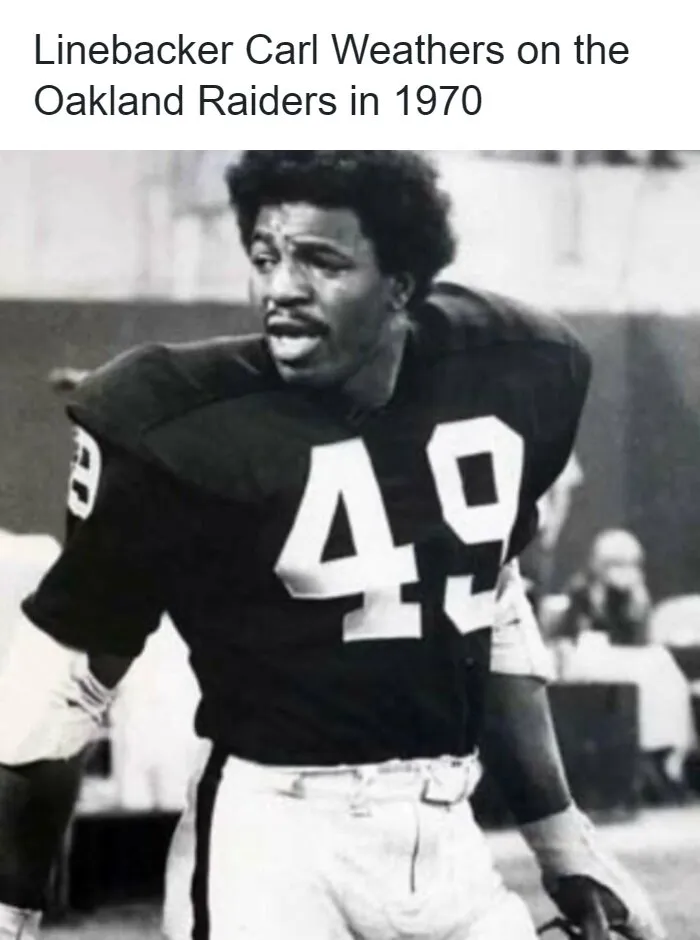
Long before he became Apollo Creed, Carl Weathers was a professional football player. After playing at San Diego State, he went undrafted in 1970 but earned a roster spot with the Oakland Raiders as a free agent linebacker.
Weathers appeared in seven regular season games that year as Oakland won the AFC West and advanced to the first AFC Championship Game. He returned in 1971 but was released after one game. His NFL career totaled just eight regular season appearances.
He then joined the BC Lions of the Canadian Football League and continued playing while studying drama during the offseason. By 1974, he had earned his degree and left professional football to pursue acting full time. Two years later, he landed the role that transformed his life, heavyweight champion Apollo Creed in Rocky.
Weathers later starred in Predator, Action Jackson, Happy Gilmore and The Mandalorian, earning an Emmy nomination for the latter.
Added Fact: Weathers once said Raiders coach John Madden cut him because he was “too sensitive.” Decades later, Weathers said that same sensitivity was exactly what he needed to become a successful actor.
Report
6points
#75
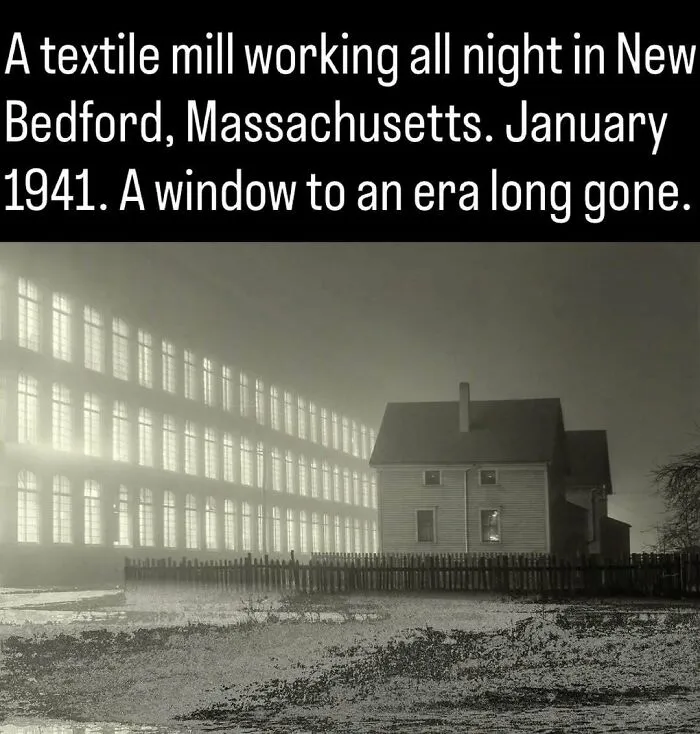
The mill’s illuminated windows reveal an industry that once shaped nearly every aspect of life in New Bedford. Although the city had first grown wealthy through whaling, textile manufacturing became increasingly important after the Civil War. By the early 20th century, enormous brick mills filled with spinning frames and power looms employed thousands of local residents, including large numbers of immigrants from Portugal, French Canada, Poland and other parts of Europe.
Working conditions could be punishing. Mill employees endured deafening machinery, airborne cotton dust and long hours governed by the relentless pace of production. Night shifts allowed factories to keep their expensive equipment running nearly continuously. The small house beside the glowing mill shows just how closely industrial and domestic life existed: families often lived within sight and sound of the factories where they worked.
By January 1941, however, New Bedford’s textile industry had already entered a long decline. Southern mills offered lower operating costs, while the Great Depression had weakened many northern manufacturers. America’s approaching entry into World War II would temporarily revive demand for cloth and industrial production, but it could not permanently reverse the movement of textile manufacturing away from New England.
Added fact: The photograph was taken by Jack Delano for the Farm Security Administration, whose photographers documented American life during the final years of the Great Depression.
Report
6points
#76
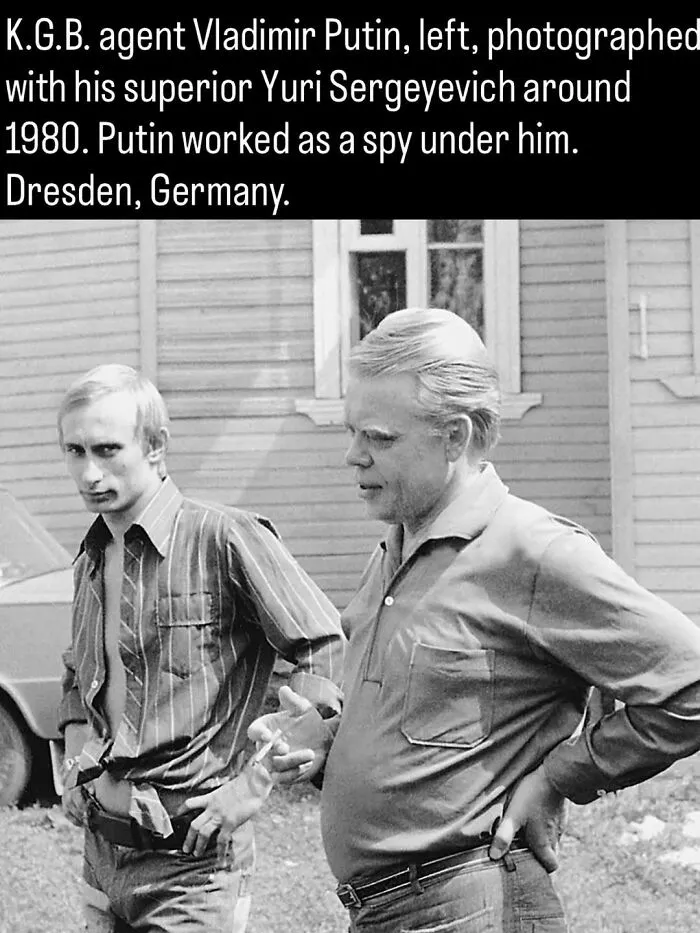
Putin’s Dresden assignment appears to have involved relatively ordinary intelligence work rather than an illustrious career as an elite super-spy.
But he was still a genuine KGB officer involved in intelligence collection, liaison work and attempted recruitment—not simply a secretary, as some like to argue.
Putin joined the KGB in 1975 after graduating from Leningrad State University with a law degree. He initially worked in counterintelligence before moving into foreign intelligence and receiving additional training in Moscow.
In 1985, he was assigned to Dresden in communist East Germany. Working from a KGB office located near the regional headquarters of the Stasi, Putin helped maintain relations between the two intelligence services.
His responsibilities reportedly included identifying East Germans who could travel to Western countries under believable cover stories and potentially provide information to the Soviet Union.
Much of this work appears to have been bureaucratic and methodical rather than cinematic. There is no publicly documented evidence that Putin carried out daring missions or achieved a major intelligence breakthrough while stationed in Dresden. Nevertheless, he was a trained intelligence officer serving within one of the Cold War’s most powerful security organizations.
Putin remained in Dresden until early 1990, returning to the Soviet Union as East Germany collapsed and German reunification approached. Less than a decade later, he became Russia’s prime minister—and then its president.
Added fact: An East German Stasi identification card issued to Putin was discovered in a Dresden archive in 2018. It allowed him to enter Stasi offices without repeatedly identifying himself as a KGB officer.
Report
6points
#77
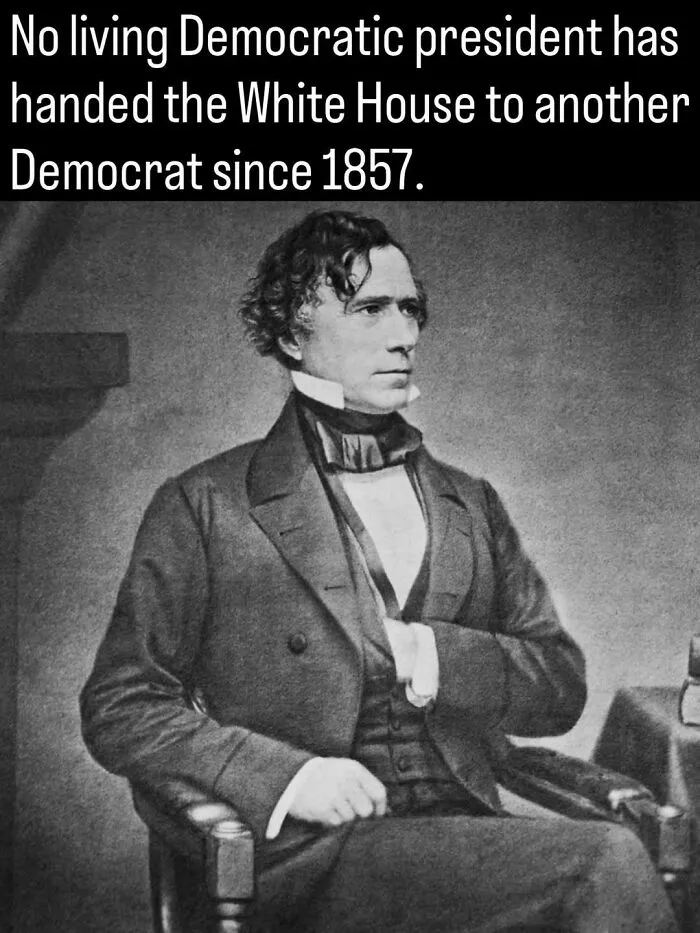
The last time this happened was when Franklin Pierce left office and James Buchanan was inaugurated on March 4, 1857.
Both men were Democrats, and Pierce was very much alive when his successor took office.
Since then, Democrats have certainly succeeded other Democrats, but never under those exact circumstances.
Andrew Johnson succeeded Abraham Lincoln after Lincoln’s assassination, but Lincoln was a Republican and Johnson had been a Democrat running on the National Union ticket. Harry Truman succeeded Franklin D. Roosevelt after Roosevelt died in office. Lyndon B. Johnson succeeded John F. Kennedy following Kennedy’s assassination.
When Democrats have completed their terms alive, their party has repeatedly failed to retain the presidency. Woodrow Wilson was followed by Republican Warren G. Harding. Truman was followed by Dwight Eisenhower. Jimmy Carter lost to Ronald Reagan. Bill Clinton was followed by George W. Bush. Barack Obama was followed by Donald Trump. Joe Biden was then followed by Trump in 2025 after Kamala Harris lost the 2024 election.
That makes the Pierce-to-Buchanan transition an extraordinary political streak stretching back nearly 170 years.
Added Fact: Pierce actually sought another term in 1856, but his own party declined to renominate him. Democrats instead selected Buchanan, who had been serving as U.S. minister to Britain and was therefore relatively removed from the increasingly explosive domestic battle over slavery.
Report
6points
#78
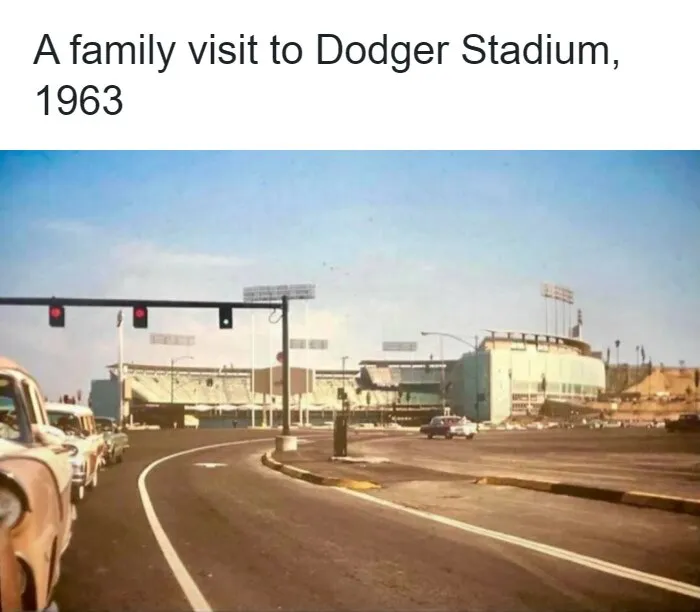
This family visit came just one year after Dodger Stadium officially opened in Los Angeles in 1962.
At the time, it was one of the newest and most modern ballparks in Major League Baseball, built into the hills of Chavez Ravine overlooking downtown Los Angeles.
The Dodgers had only moved west from Brooklyn a few years earlier, arriving in Los Angeles for the 1958 season.
For their first four seasons in California, they played at the Los Angeles Memorial Coliseum while their permanent stadium was being constructed. By 1963, Dodger Stadium was already becoming one of the city’s defining landmarks.
The photographs also capture how new the entire complex still looked. The parking areas, roadways and landscaping surrounding the stadium were far less developed than they are today, while inside, the distinctive pastel-colored seating gave the ballpark a look that became closely associated with early 1960s Los Angeles.
And 1963 turned out to be an incredible year to visit. Led by Sandy Koufax, Don Drysdale and Maury Wills, the Dodgers won the National League pennant before facing the New York Yankees in the World Series.
via r/user dittidot
Added fact: The Dodgers swept the Yankees four games to none in the 1963 World Series, with Koufax winning two games and being named World Series MVP.
Report
4points
#79
Band of Brothers was one of the most ambitious television productions ever attempted when it was created by HBO, Tom Hanks and Steven Spielberg.
The 10-part miniseries followed Easy Company of the 506th Parachute Infantry Regiment from its training in Georgia through D-Day, Operation Market Garden, the Battle of the Bulge and the occupation of Germany.
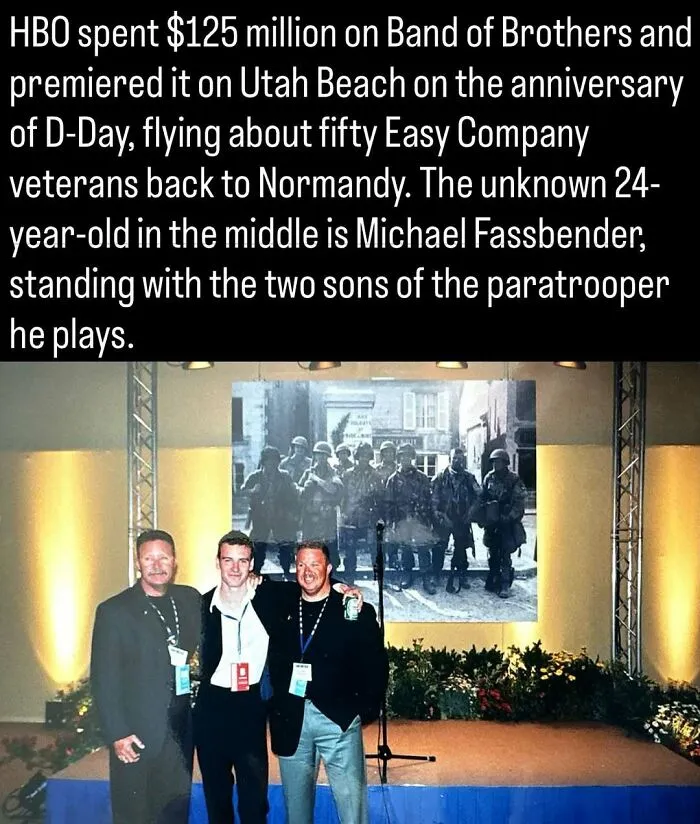
The series cost approximately $125 million to produce, with millions more devoted to its promotion. In June 2001, HBO brought 47 surviving Easy Company veterans, their relatives and members of the cast to Normandy. They traveled to Utah Beach for an emotional outdoor premiere near the ground where American troops had landed in 1944.
Michael Fassbender, then largely unknown to audiences, portrayed Technical Sgt. Burton “Pat” Christenson. The production became Fassbender’s first major screen role, years before he achieved international fame through films including Hunger, Inglourious Basterds, Shame and X-Men: First Class.
Christenson had served with Easy Company throughout its European campaign before returning home and working for a telephone company until his retirement. He died in 1998, before the miniseries was completed, meaning he never saw Fassbender portray him. His sons, however, met the young actor during the Normandy gathering and remembered him as respectful and generous toward their family.
Added fact: Band of Brothers premiered on HBO on Sept. 9, 2001, just two days before the 9/11 attacks caused the network to suspend its promotional campaign.
Report
4points