



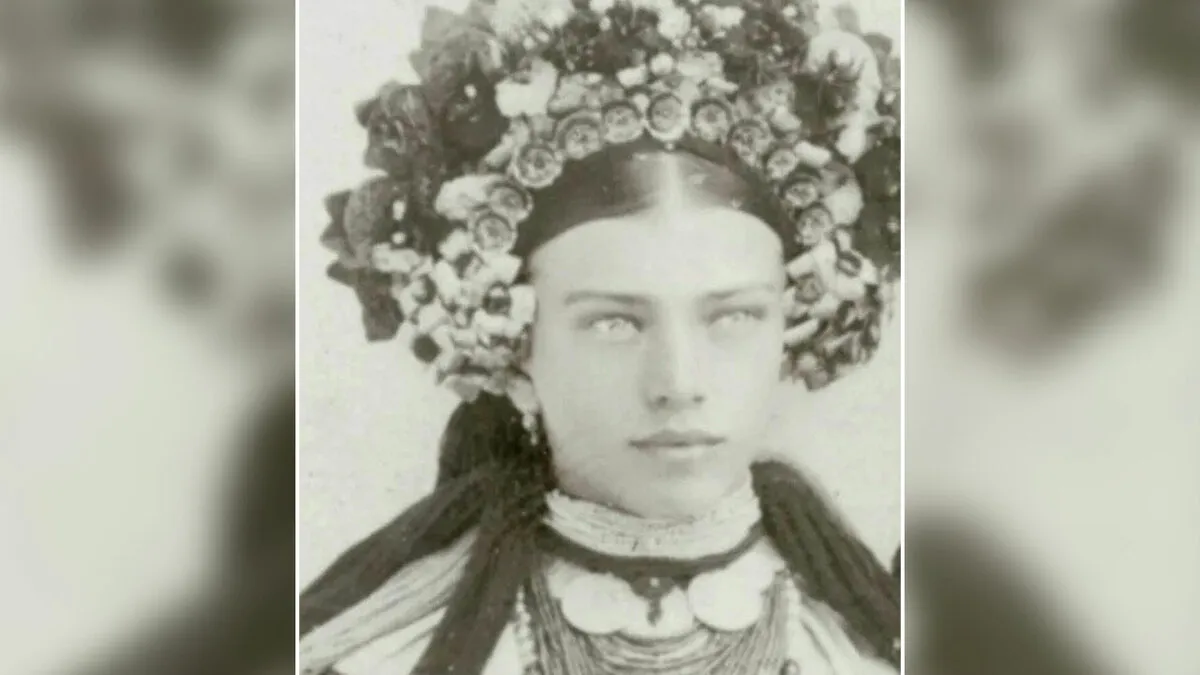


Historical photos are way more than just subject matter in school. They are also time capsules of a bygone era, giving us a glimpse of what life was like when many of us weren’t even born yet.
Just take a look at these photos from the History Feels Instagram page. Each one provides a palpable sense of nostalgia, which is always welcome. At the same time, each image's backstory is compelling enough to make you want to go down a rabbit hole.
The account has a million followers and counting, and scrolling through should explain why.
#22
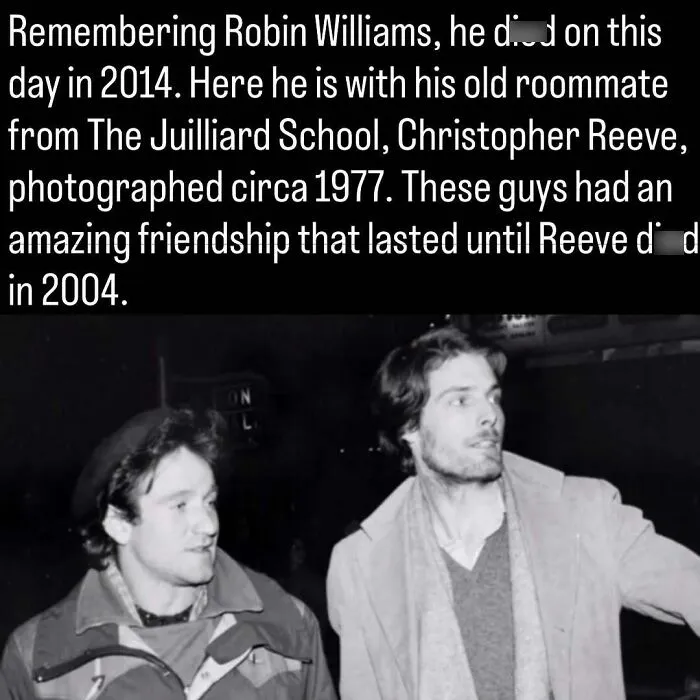
Robin Williams and Christopher Reeve met as students at Juilliard in New York in the early 1970s, where they became close friends long before either was famous. Their personalities were almost opposites. Reeve was disciplined and classically trained, while Williams was already known for the unpredictable humor and improvisation that would eventually make him one of the most recognizable comedians in the world.
Their friendship continued as their careers exploded. Reeve became Superman, while Williams broke through with Mork & Mindy before building an extraordinary career in comedy and film.
Their bond became especially important after Reeve was paralyzed in a 1995 horseback-riding accident. While Reeve was hospitalized and facing an uncertain future, Williams arrived pretending to be an eccentric Russian doctor preparing to perform a rectal examination. Reeve later recalled that it was the first time after his accident that he truly laughed, and the visit helped remind him that life could still contain joy.
Reeve died in 2004 at 52. Williams died ten years later, on August 11, 2014, at 63.
Added Fact: Reeve and Williams became so close that they reportedly referred to one another as “brother,” and their families remained closely connected long after their Juilliard years.
Report
20points
#23
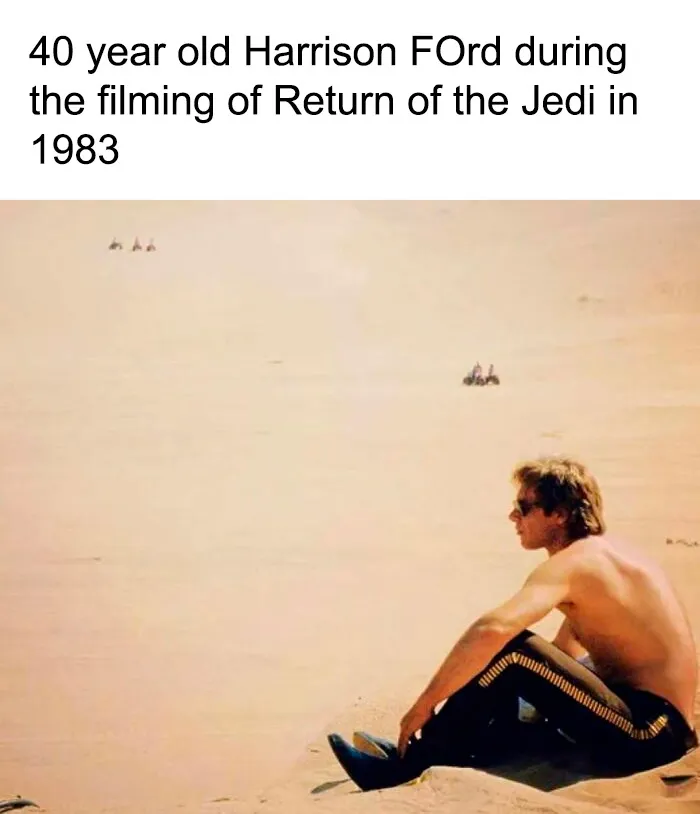
Ford is pictured taking a break in the desert during production of Return of the Jedi, the final film in the original Star Wars trilogy.
He had turned 40 in July 1982, when much of the movie was actually being filmed, before its theatrical release in May 1983.
The desert sequences involving Jabba the Hutt’s sail barge and the Sarlacc were filmed among the Imperial Sand Dunes near Yuma, along the Arizona California border.
The enormous dunes doubled for the desert planet Tatooine, where Han Solo, Luke Skywalker and Chewbacca are sentenced to be thrown into the Sarlacc pit.
Filming there was a major undertaking. A huge full scale exterior representing Jabba’s sail barge was constructed in the dunes, while hundreds of cast and crew members worked in intense desert conditions.
Ford had already become one of Hollywood’s biggest stars by this point, playing both Han Solo and Indiana Jones within the span of just a few years.
Added fact: To keep the production secret, Return of the Jedi was filmed under the deliberately misleading working title “Blue Harvest,” complete with fake signage describing it as a horror movie.
Report
19points
#24
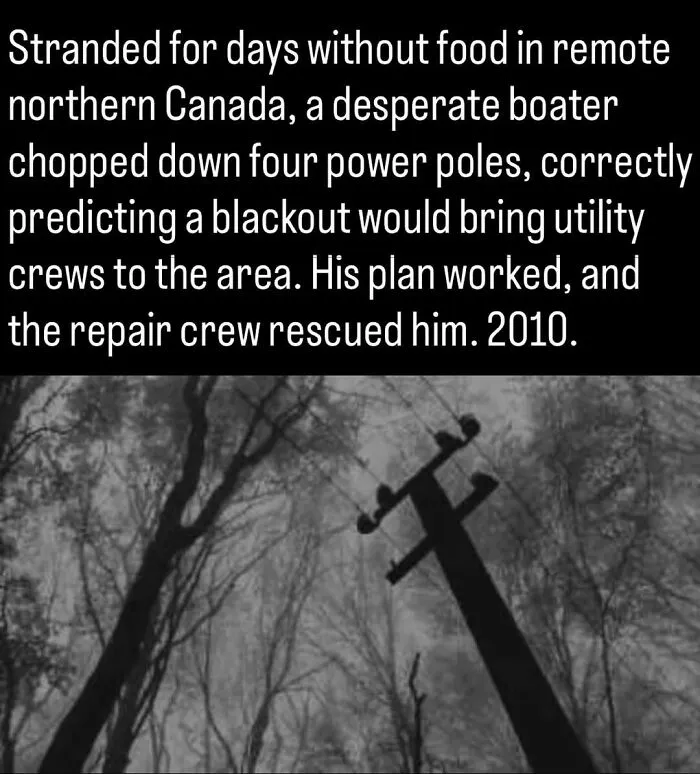
In May 2010, an unidentified man from Wollaston Lake became stranded while boating in the remote wilderness of northern Saskatchewan.
Rough weather prevented him from returning home, leaving him trapped for several days without food or any reliable way to contact rescuers.
Realizing that a nearby electrical line was his best chance of attracting attention, he began chopping through its wooden poles with an axe. Four poles eventually fell, c*****g the only electrical connection serving Wollaston Lake and plunging the isolated community into darkness.
The plan worked. SaskPower knew that a major failure had occurred somewhere along the remote line and sent a crew by helicopter to locate the damage. When the workers arrived, they discovered the four fallen poles—and the exhausted man sheltering beneath his overturned boat.
The repair crew escorted him to safety, and police later confirmed that he had returned home unharmed. SaskPower acknowledged that his actions were driven by desperation but strongly warned others against attempting anything similar. Downed electrical lines may remain energized and can k**l anyone who approaches or touches them.
It was an extraordinarily dangerous decision, but also one built on a remarkably accurate prediction of how the utility company would respond.
Added Fact: The outage reportedly cut electricity to roughly 1,200 people in Wollaston Lake, and the community remained without power for approximately 30 hours.
Report
19points
#25
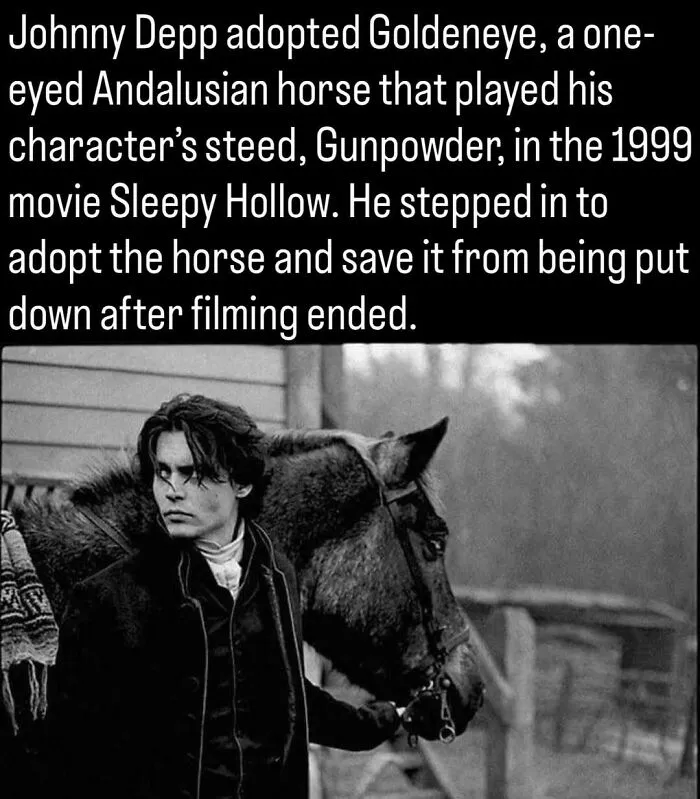
Tim Burton’s Sleepy Hollow was released in 1999 and starred Johnny Depp as Ichabod Crane, a New York constable sent to investigate a series of mysterious m*****s in the isolated village of Sleepy Hollow.
Because the film is set in 1799, horses were essential to creating the period setting. Depp’s character spends much of the story traveling on horseback, with Gunpowder becoming one of the most recognizable animals in the movie.
Goldeneye reportedly had only one eye and had already worked as a trained movie horse by the time filming began. After production wrapped, Depp learned that the horse’s future was uncertain and decided to take responsibility for him rather than allow him to be euthanized.
It became one of those unusual cases in which the relationship between an actor and an animal used on set continued long after the cameras stopped rolling.
Sleepy Hollow itself became a major success, earning more than $200 million worldwide and winning the Academy Award for Best Art Direction.
Added fact: Much of Sleepy Hollow was filmed on elaborate sets constructed in England, including an entire artificial village built specifically to give Tim Burton complete control over the movie’s eerie, late-18th-century appearance.
Report
19points
#26

On Sept. 4, 2026, the United Nations General Assembly overwhelmingly endorsed a resolution encouraging wider use of the Equal Earth projection. The resolution received support from 164 countries, with six abstentions and the United States casting the only opposing vote.
The familiar Mercator projection was created by Flemish cartographer Gerardus Mercator in 1569. It was designed primarily for maritime navigation because it preserves compass directions, allowing sailors to plot straight courses across the ocean. However, stretching the curved surface of Earth onto a rectangle severely enlarges land near the poles.
This distortion makes Greenland appear roughly comparable in size to Africa, even though Africa is approximately 14 times larger. Russia, Canada, Europe and North America are also shown much larger relative to regions near the equator, including Africa and South America.
Created by cartographers Bojan Šavrič, Tom Patterson and Bernhard Jenny in 2018, Equal Earth is an “equal-area” projection. This means countries and continents retain their correct sizes relative to one another, although their shapes, angles and distances are still distorted.
The UN resolution is nonbinding, so it does not ban Mercator maps or require governments, schools and technology companies to replace them. Instead, it encourages organizations to use equal-area maps whenever accurately comparing the sizes of countries and continents is important.
Added Fact: No flat world map can perfectly preserve size, shape, distance and direction simultaneously. Every map projection must distort at least one of those features because Earth is curved.
Report
18points
#27
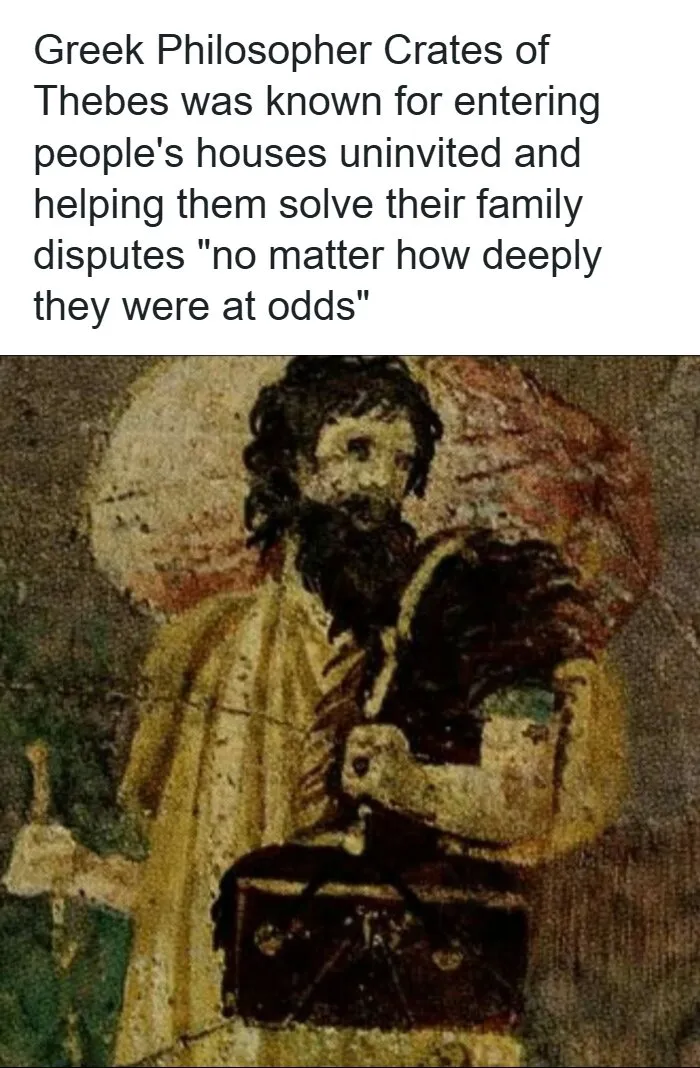
Crates of Thebes was one of the strangest and most beloved philosophers of ancient Athens.
Born into a wealthy family around 365 BC, Crates eventually gave away his fortune and embraced the radical simplicity of Cynic philosophy.
He became a follower of Diogenes of Sinope, living with few possessions and openly rejecting wealth, status and many of the social conventions of Greek society.
But Crates developed a reputation that went beyond philosophy. Ancient accounts say he became known as the “Door-Opener” because he had a habit of walking directly into people’s homes, often without being invited, and offering advice. Somehow, instead of resenting the intrusion, Athenians reportedly welcomed him. Later traditions describe him helping settle arguments and family disputes before simply moving on to the next house.
His cheerful personality was a major reason. Unlike the famously abrasive Diogenes, Crates seems to have practiced Cynicism with humor and warmth, using his own poverty as an example rather than merely attacking others.
Added fact: Crates became the teacher of Zeno of Citium, who went on to found Stoicism. That makes this eccentric philosopher who wandered into strangers’ homes one of the important links between Cynicism and one of the most influential philosophical schools in Western history.
Report
18points
#28
Diana died in Paris on August 31, 1997, from injuries sustained in a car crash inside the Pont de l’Alma tunnel. She was 36 years old.
Her companion, Dodi Fayed, and the car’s driver, Henri Paul, were also k****d.
News of her death triggered an extraordinary public response across Britain.
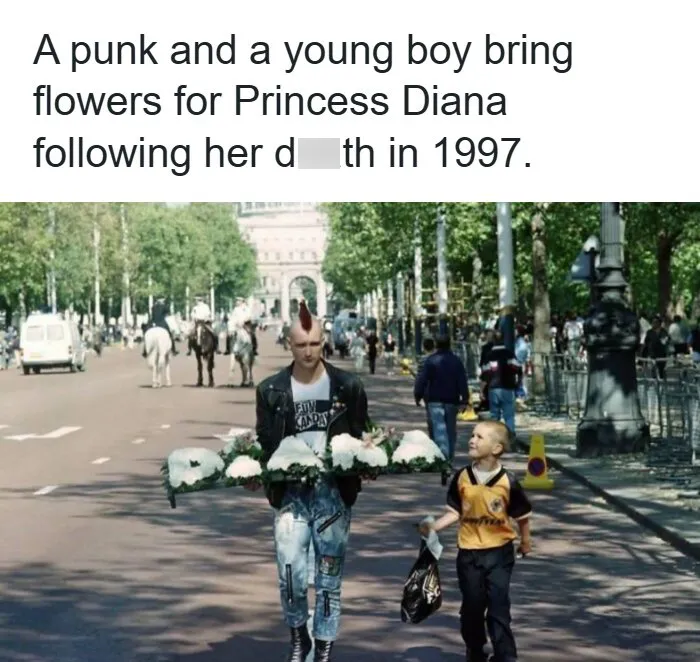
Mourners gathered outside Buckingham Palace, Kensington Palace and St. James’s Palace, carrying flowers, photographs, candles and handwritten messages. The tributes soon covered enormous sections of pavement and fencing.
This photograph captures a British p**k carrying a large floral arrangement toward Buckingham Palace. The image stood out because p**k culture had emerged partly in opposition to Britain’s class system, traditional institutions and royal pageantry. Yet Diana’s appeal often crossed those boundaries.
Her public work with AIDS patients, people experiencing homelessness and landmine survivors had given her a reputation for approaching people whom society frequently ignored. Many mourners felt a personal connection to her despite never having met her.
Diana’s funeral was held at Westminster Abbey on September 6. As her coffin passed through London, people threw flowers into the road and filled the route in near silence. The scale of the mourning revealed how deeply her death had affected people from vastly different generations, backgrounds and subcultures.
Added Fact: More than one million bouquets were reportedly left outside Britain’s royal residences in the days following Diana’s death.
Report
18points
#29
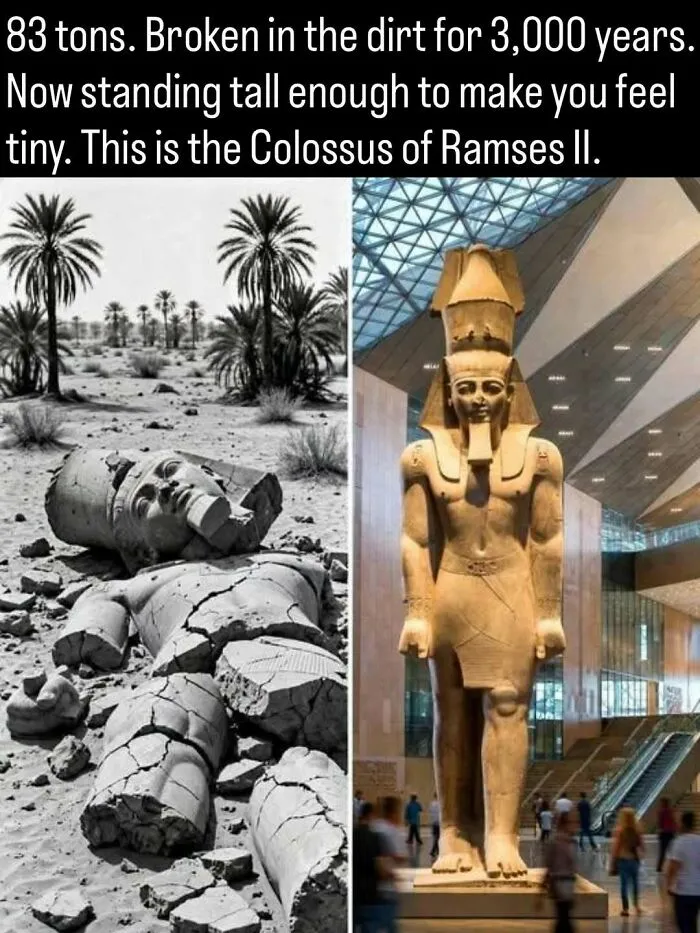
The colossal statue was discovered in 1820 at Mit Rahina, the site of ancient Memphis, by Italian explorer Giovanni Battista Caviglia. Carved from red granite more than 3,000 years ago, it had broken into several large pieces near the ruins of the great temple of Ptah.
Moving it initially proved so difficult and expensive that the statue remained at Memphis for more than a century. In 1955, its fragments were transported to Cairo, reassembled and erected outside the city’s main railway station. The surrounding plaza soon became known as Ramses Square.
For roughly 50 years, the pharaoh stood above one of Cairo’s busiest intersections. Traffic vibrations, exhaust fumes and pollution, however, threatened the ancient granite. In August 2006, engineers moved the 83-ton statue through Cairo during an elaborate nighttime operation watched by thousands of people.
It was placed temporarily near the Giza pyramids while the Grand Egyptian Museum was being constructed. In January 2018, the statue made its final journey into the museum’s enormous entrance atrium, where it now greets visitors.
Ramses II ruled Egypt for approximately 66 years and commissioned statues, temples and monuments across the kingdom, ensuring that his image would survive for millennia.
Added Fact: The statue originally formed part of a pair that stood near the eastern entrance of the temple of Ptah at Memphis. Its companion remains displayed lying down at the open-air museum in Mit Rahina.
Report
18points
#30
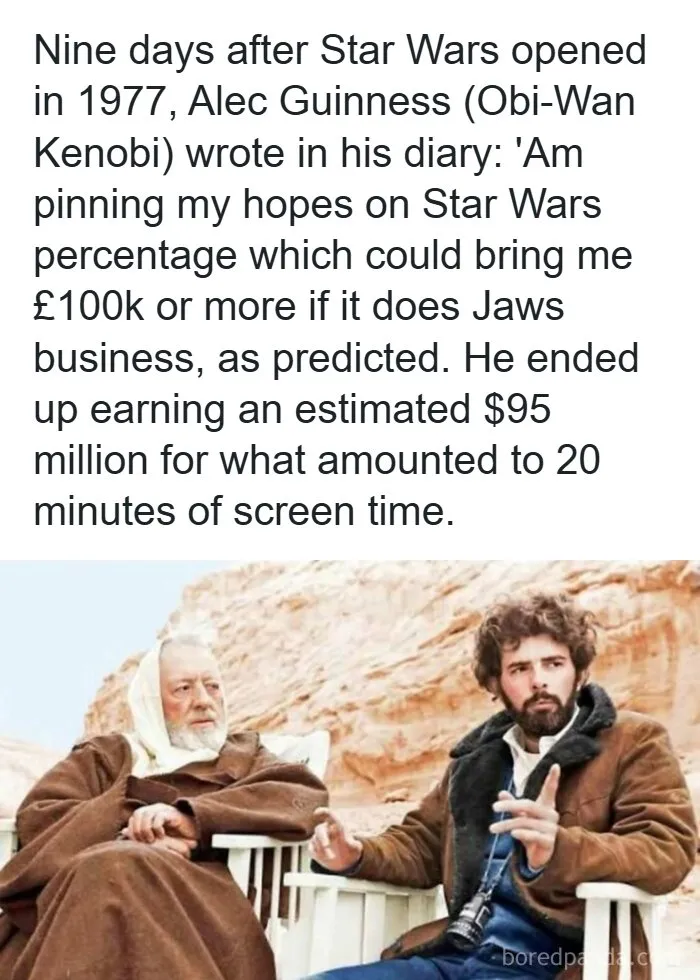
Guinness was already one of Britain’s most respected actors when George Lucas approached him to play Obi-Wan Kenobi.
An Academy Award winner for The Bridge on the River Kwai, he initially viewed Star Wars as little more than a strange children’s fantasy. In private letters, he criticized its dialogue and admitted that he struggled to understand the story’s terminology.
Still, Guinness recognized the film’s potential. Instead of accepting only a conventional salary, he negotiated a percentage connected to George Lucas’ share of the profits. That decision became extraordinarily lucrative when Star Wars grew from a risky science-fiction production into one of the most commercially successful franchises in history.
His performance also gave the unfamiliar film a sense of authority. Surrounded by younger actors, invented planets and groundbreaking special effects, Guinness played Obi-Wan with the gravity of a classical stage character. Although he later became frustrated that younger audiences associated him almost exclusively with Star Wars, the role introduced him to an entirely new generation.
The precise total Guinness earned remains disputed, but estimates commonly run into the tens of millions of dollars—far beyond the £100,000 he cautiously hoped to receive in 1977.
Added fact: Guinness received an Academy Award nomination for Best Supporting Actor for playing Obi-Wan, making him the franchise’s first acting nominee. His June 3 diary entry contains the quoted prediction. The Hollywood Reporter
Report
17points
#31
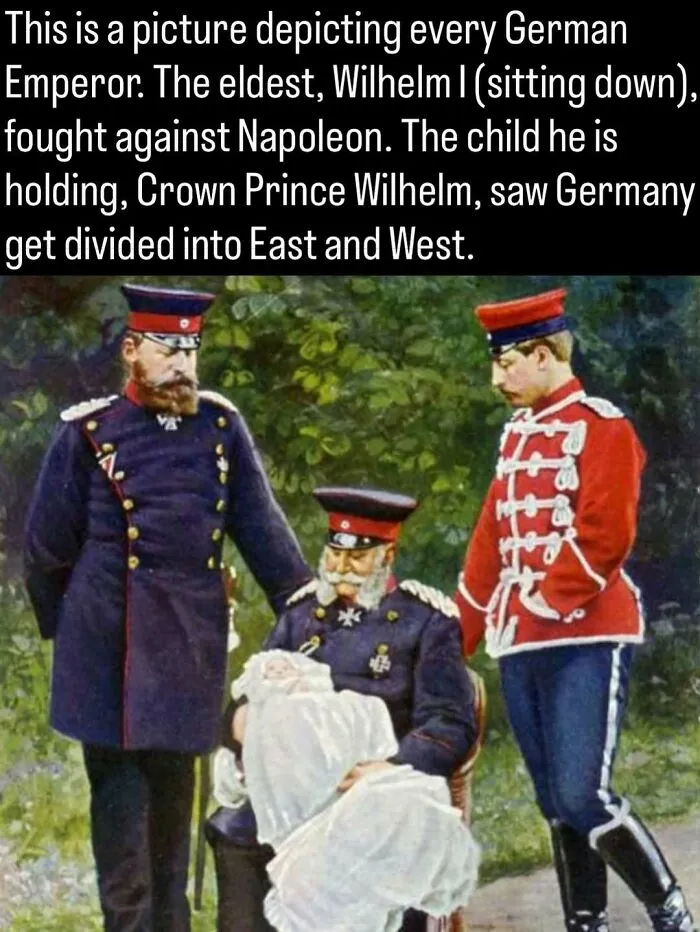
Taken in Potsdam in 1882, it captures four generations of the House of Hohenzollern. Seated at the center is Wilhelm I, the first emperor of a unified Germany.
As a young Prussian prince, he served during the Napoleonic Wars and received the Iron Cross for his actions during the 1814 campaign in France. Decades later, he became German emperor following unification in 1871.
Standing on the left is Wilhelm’s son, Crown Prince Frederick, who eventually became Emperor Frederick III. By the time he inherited the throne in 1888, Frederick was suffering from throat cancer and reigned for only 99 days.
On the right is Frederick’s son, the future Wilhelm II. He succeeded his father in 1888 and became the final German emperor.
His reign included Germany’s rapid industrial and military expansion, but ended with defeat in World War I and the collapse of the monarchy in 1918.
The infant is Wilhelm II’s eldest son and future heir, Crown Prince Wilhelm. He never became emperor. Born during the German Empire, he lived through two world wars, the N**i era and Germany’s 1949 division into East and West before dying in 1951.
Added fact: Because Wilhelm I, Frederick III and Wilhelm II all occupied the throne during 1888, Germans remembered it as the “Year of the Three Emperors.”
Report
17points
#32
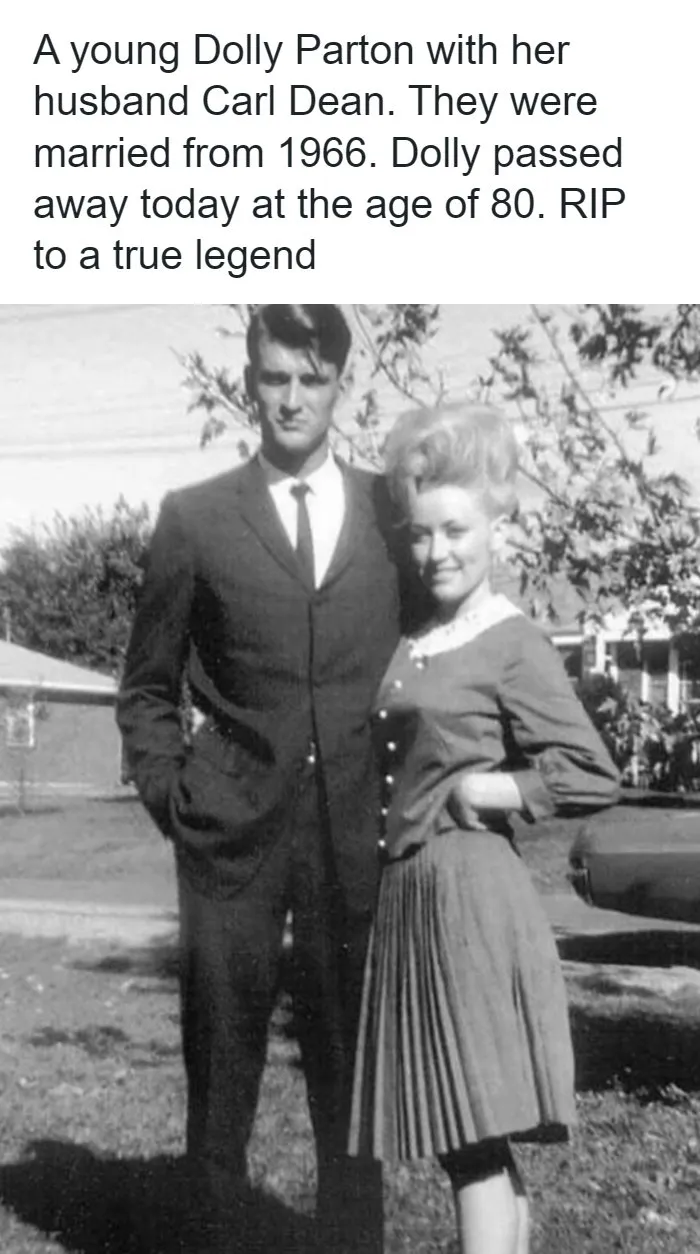
Dolly met Carl outside the Wishy Washy Laundromat in Nashville in 1964, on the first day she arrived in the city to pursue a career in music. She was 18, and he was 21. Two years later, they married in a small ceremony in Ringgold, Georgia, attended only by Dolly’s mother, the minister and the minister’s wife.
Their marriage endured for nearly six decades, even as Dolly became one of the most recognizable entertainers in the world. Carl avoided the spotlight, rarely attended public events and largely declined interviews. Dolly often joked that his privacy led some people to question whether he existed at all.
Behind her glamorous public persona, their relationship remained one of the most private and enduring marriages in entertainment. They never had children, but Dolly helped raise several of her younger siblings and became affectionately known as “Aunt Granny” within her family.
Carl died on March 3, 2025, at age 82. Dolly later spoke openly about the physical and emotional toll of losing the man who had been beside her since before she became famous.
On August 25, 2026, Dolly Parton’s family announced that the country music legend had died at age 80.
Added fact: Dolly wrote “Jolene” after a young bank teller began paying unusually close attention to Carl. She borrowed the name from a little girl she met after a concert because she loved the way it sounded.
Report
16points
#33
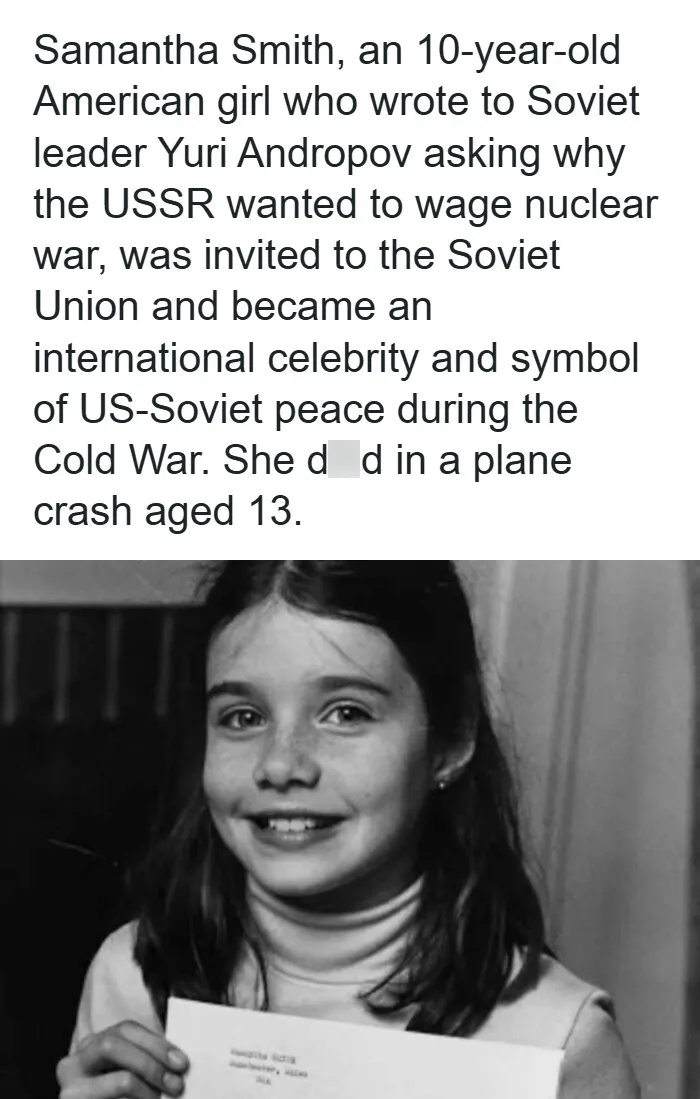
Samantha wrote the letter in November 1982 from her home in Manchester, Maine. Frightened by escalating Cold War tensions, she asked Andropov why the Soviet Union wanted war and whether he would help prevent one.
To almost everyone’s surprise, Andropov answered personally. He assured her that Soviet citizens wanted peace and invited Samantha and her family to visit the USSR. In July 1983, she spent two weeks touring Moscow, Leningrad and the Artek children’s camp in Crimea.
Her simple questions made her an international symbol of citizen diplomacy at a time when nuclear tensions between the superpowers were extremely h**h.
Tragically, on August 25, 1985, Samantha and her father were among eight people k****d when their commuter plane crashed in Maine. Investigators primarily attributed the accident to pilot error.
Added Fact: Samantha never actually met Andropov. His declining health prevented a meeting during her Soviet visit, and he died the following year.
Report
16points
#34

The man wearing the novelty sailor’s hat is Robert Francis Prevost, photographed celebrating his 40th birthday in 1995, three decades before he would become Pope Leo XIV.
At the time, Prevost was an Augustinian priest living and working in Peru. Born in Chicago on Sept. 14, 1955, he had first traveled to Peru as a missionary during the 1980s before returning for a longer assignment in Trujillo.
There, he helped train future priests, taught canon law and served in several administrative and pastoral roles.
Prevost later became head of the worldwide Augustinian order, bishop of Chiclayo in Peru and prefect of the Vatican office responsible for advising the pope on the appointment of bishops. He was elevated to the College of Cardinals by Pope Francis in 2023.
On May 8, 2025, the papal conclave elected Prevost as pope. He chose the name Leo XIV, becoming the first American-born pontiff in the Church’s history.
Added Fact: Pope Leo XIV also holds Peruvian citizenship, which he received in 2015 after spending much of his religious life serving communities in Peru.
Report
16points
#35

The bird had apparently taken shelter inside the wheel well of an F/A-18 Hornet, one of the carrier’s strike fighters. On a warship packed with machinery, jet noise, and constant flight operations, the discovery stood out as one of those strange moments that sailors never forget.
The nickname “Fod” was especially fitting. In naval aviation, “foreign object debris,” or FOD, is taken very seriously because even a small loose object can damage aircraft, engines, or equipment. In this case, though, the “debris” turned out to be a living stowaway.
The stranger part was simply where the owl had managed to hide. An F/A-18’s landing gear compartment is surrounded by hydraulic lines, wiring, structural components and moving machinery, and it is not somewhere a bird would be expected to survive for long.
Before carrier aircraft launch, sailors perform detailed inspections specifically looking for anything that could interfere with the aircraft or become hazardous during flight.
That routine inspection is what makes the photograph so memorable: instead of finding a loose bolt, t**l or piece of debris, the sailors discovered an owl tucked inside one of the Navy’s frontline combat aircraft.
Fod was removed safely, giving the crew one of the more unusual maintenance stories to come out of a carrier deployment.
Added fact: Carrier flight decks are routinely walked by crews searching for tiny pieces of FOD because even something as small as a nut, stone or fragment of metal can be sucked into a jet engine and cause serious damage.
Report
16points

#37
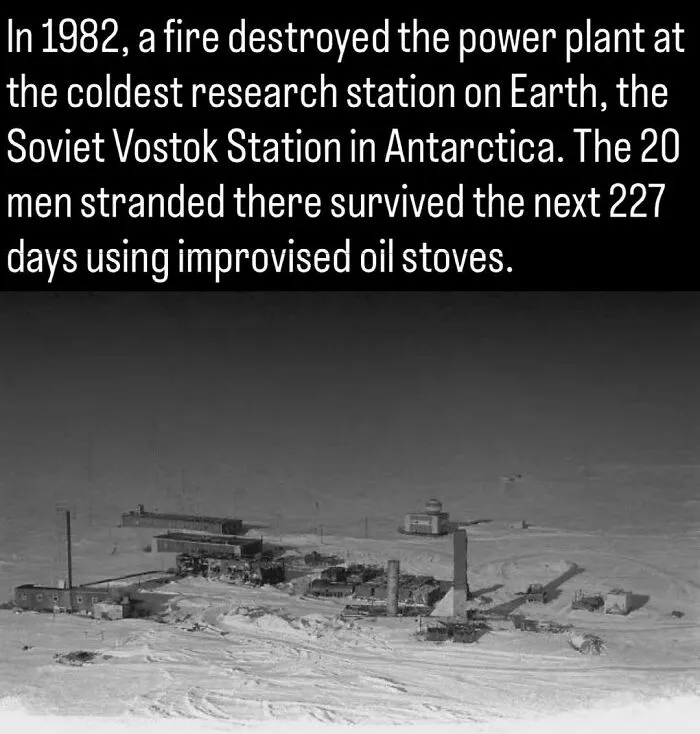
The fire broke out on April 12, just as Antarctica was entering its long, sunless winter. Vostok’s chief mechanic, Aleksei Karpenko, died while attempting to fight the flames, and the station’s main diesel generators were destroyed.
The remaining expedition members were suddenly left without the electricity required for normal heating, lighting and melting ice for water. Evacuation was impossible. Vostok sits deep within the Antarctic interior, more than 800 miles from the geographic South Pole, and aircraft could not safely reach the station during the winter.
The men recovered an old backup generator, but it could provide only enough electricity for limited lighting and radio communication. To conserve warmth, they abandoned much of the station and crowded together inside a few small rooms.
They constructed basic stoves using wicks soaked in diesel fuel, leaving their living quarters cold and filled with soot.
For 227 days, the crew endured extreme temperatures, constant darkness and almost complete physical isolation. Their ordeal finally ended in November, when an overland tractor convoy reached Vostok with replacement equipment and supplies.
Added fact: In July 1983, Vostok recorded a temperature of −128.6 degrees Fahrenheit—the lowest air temperature ever directly measured at Earth’s surface.
Report
16points
#38

When Walt Disney World opened on October 1, 1971, an adult admission ticket to the Magic Kingdom cost $3.50. However, that ticket worked differently from today’s admission. It allowed guests to enter the park, but most rides required separate coupons.
Disney used a lettered ticket system inherited from Disneyland. Attractions were classified from “A” through “E.” A-tickets covered smaller experiences such as the Main Street vehicles, while E-tickets were reserved for the park’s biggest attractions, including the Haunted Mansion, Jungle Cruise and 20,000 Leagues Under the Sea.
Guests could purchase individual coupons or ticket books containing a selection of rides.
That system produced the expression “an E-ticket ride,” which became shorthand for any especially exciting experience. Disney gradually moved away from ride coupons as its parks expanded. On October 1, 1982—the day EPCOT opened—the company introduced an all-inclusive passport covering admission and nearly every attraction. The old ticket books disappeared, although the “E-ticket” phrase survived.
Modern Disney tickets operate differently again. Prices now vary according to the park and date, with the most popular days costing more. The $189 ticket shown here includes standard attractions, although services such as Lightning Lane can cost extra.
Added fact: Unused vintage Disney ride coupons never technically expired, and Disney reportedly continued accepting them at face value toward admission purchases for decades after the ticket-book system ended.
Report
15points
#39
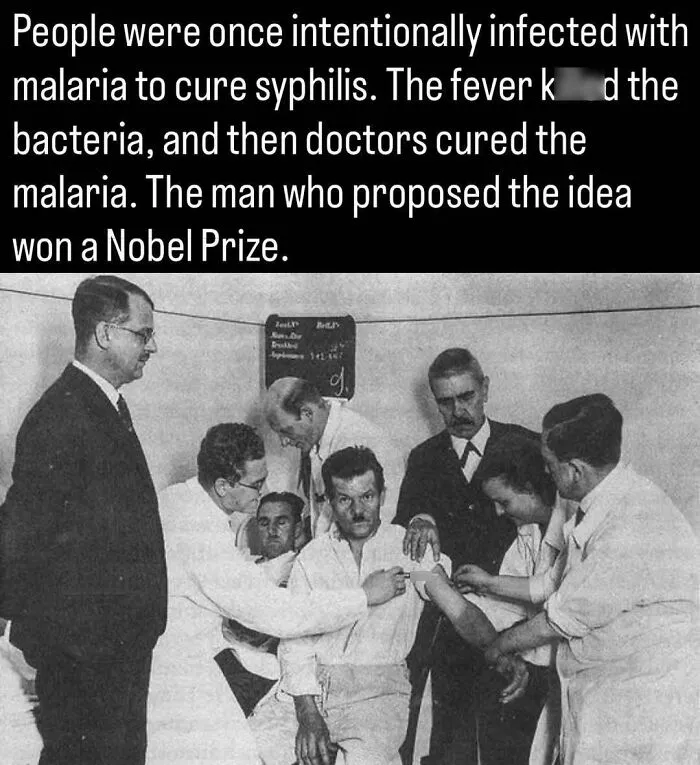
Before antibiotics, a syphilis infection could become a devastating and sometimes fatal disease. In its later stages, the infection could attack the brain and nervous system, causing paralysis, seizures, personality changes, dementia and eventually death. Doctors had few reliable options for patients who reached this point.
In 1917, Austrian psychiatrist Julius Wagner-Jauregg introduced a treatment that sounds almost unthinkable today: deliberately infecting patients suffering from neurosyphilis with malaria.
His reasoning was based on an observation that h**h fevers sometimes seemed to improve psychiatric conditions. Malaria could repeatedly push a patient’s body temperature above 104°F, and the heat could damage the Treponema pallidum bacteria responsible for syphilis. Doctors would allow several cycles of malarial fever before treating the malaria, typically with quinine.
Known as malariotherapy, the procedure was dangerous and some patients died from the treatment itself. But before penicillin existed, it offered hope against a disease for which doctors had very few effective treatments.
Wagner-Jauregg received the 1927 Nobel Prize in Physiology or Medicine for developing the therapy. Malariotherapy largely disappeared after penicillin became widely available in the 1940s.
Added Fact: Wagner-Jauregg remains the only psychiatrist to have received the Nobel Prize in Physiology or Medicine for a treatment developed specifically for a psychiatric condition.
Report
15points
#40
The collapse happened remarkably quickly, especially for a dynasty that had ruled 623 years. After the Ottoman Empire was defeated in World War I, Allied powers occupied parts of its territory, including Constantinople. Sultan Mehmed VI remained on the throne, but his government was increasingly seen as powerless and too willing to cooperate with the occupying powers.
At the same time, Mustafa Kemal (later known as Atatürk) built a rival nationalist government in Ankara and led the Turkish War of Independence from 1919 to 1922. After nationalist forces defeated their opponents and regained control of much of Anatolia, the political future of the sultanate was effectively decided.
On Nov. 1, 1922, the Grand National Assembly abolished the Ottoman sultanate, declaring that sovereignty belonged to the Turkish nation rather than the monarch. Mehmed VI left Constantinople aboard a British warship later that month. The Republic of Turkey was formally declared in 1923.
The dynasty itself was not expelled immediately. The religious office of caliph survived briefly under Abdülmecid II, but on March 3, 1924, Turkey abolished the caliphate as well and ordered members of the Ottoman imperial family into exile.
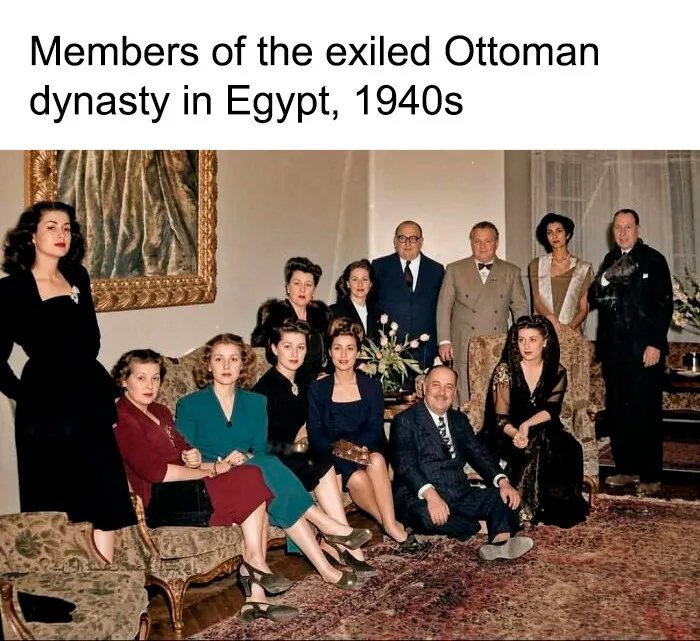
The family scattered across Europe and the Middle East, with several members eventually settling in Egypt. Ottoman princesses also married into the Egyptian royal house, strengthening ties between two dynasties whose histories had been intertwined for centuries.
Neslişah Sultan, a granddaughter of the last Ottoman sultan Mehmed VI, married Egyptian Prince Muhammad Abdel Moneim in 1940. In a remarkable twist, after Egypt’s monarchy was overthrown in 1952, she and her husband were eventually forced into exile too, meaning she lived through the collapse of two royal worlds in a single lifetime.
Added fact: Turkey allowed female members of the Ottoman dynasty to return beginning in 1952, while male members remained barred until 1974.
Report
15points