





You only meant to look up one quick question. The initial explanation went right over your head. Ten minutes later, you're still reading, three tabs deep and wondering how you got there. It happens because a clear, plain answer makes learning feel easy, so you keep going just to see what else you can understand.
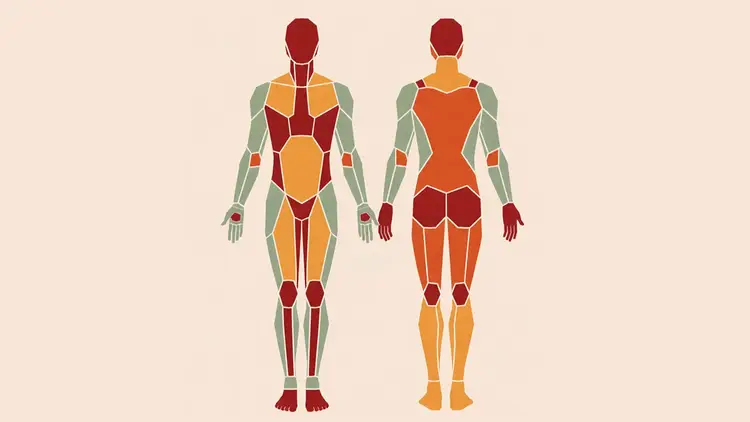
That's the idea behind the “Explain Like I'm Five” Instagram page, where the goal is the simple version without the jargon. Just look at the explanations people have shared online, from how swimsuit colors can save a life to what shirts help actually keep you cool in the sun and why tattoos hurt more in some places than others.
#21

Throughout history, medical breakthroughs have transformed the way diseases are diagnosed, treated, and prevented. Some of the most important advancements in medicine began with unexpected discoveries, while others resulted from years of scientific research and experimentation.
The introduction of anesthesia in 1846 made it possible to perform complex surgical procedures without patients experiencing unbearable pain. The discovery of X-rays in 1895 allowed doctors to examine the inside of the human body without surgery, revolutionizing medical diagnosis.
The development of insulin treatment in 1922 transformed type 1 diabetes from an almost universally fatal disease into a manageable condition. Vaccination, pioneered by Edward Jenner in 1796, established the foundation for preventing infectious diseases and eventually contributed to the global eradication of smallpox.
The discovery of penicillin in 1928 marked the beginning of the antibiotic era, making countless bacterial infections treatable and saving millions of lives.
Together, these five breakthroughs helped shape modern medicine, significantly improved survival rates, and continue to influence healthcare around the world.
Image Credits
Penicillin sample: Science Museum, London (CC BY-SA 4.0).
Robert Liston performing surgery using ether anesthesia, 21 December 1846 (M0005603): Wellcome Collection (CC BY 4.0).
Cases before and after insulin treatment (Source - Wellcome Collection).
All remaining images: Wikimedia Commons (Public Domain).
Report
3points
#22

Confidence is not about knowing everything, never feeling nervous, or always being the loudest person in the room. It is about becoming comfortable with yourself, your abilities, and your imperfections.
Building confidence often begins with small changes in everyday behavior. Learning to say "I don't know" without apologizing encourages honesty and reduces the pressure to appear knowledgeable all the time. Similarly, improving your posture can influence how you present yourself and how comfortable you feel in social situations.
Simple habits like speaking clearly, maintaining a relaxed posture, acknowledging your limitations, and expressing your thoughts without constantly seeking approval can gradually strengthen your self-assurance.
Confidence is not something that develops overnight. It grows through experience, self-awareness, and repeated moments of choosing to act despite uncertainty.
The goal isn't to become someone who never doubts themselves, but someone who doesn't let those doubts control every decision.
Save this post as a reminder that confidence is built through small everyday actions, or share it with someone who needs a little encouragement to believe in themselves.
Report
3points
#23

A bald eagle does not simply hatch with the iconic white head we recognize. Its plumage changes dramatically during the first several years of life, and these changes can help estimate its age. The first juvenile plumage is the darkest and least variable, with an overall dark-brown body and subtle white flecking on the belly and underwings. This first plumage is typically retained for about six months after leaving the nest.
After that, the eagle enters its immature or sub-adult stages, where things become much less predictable. Around 1½ years, lighter brown feathers and increasing white flecking begin to appear, while the beak is still mostly dark. At around 2½ years, the plumage can vary enormously between individuals, with different combinations of brown and white mottling. The eyes and beak also gradually begin changing color.
By about 3½ years, the transformation toward adulthood becomes more obvious. The head and tail begin turning white, although they remain heavily flecked with brown, while a darker band through and behind the eye can be noticeable. The beak becomes mostly yellow and the body gradually returns to a more uniform dark brown.
Around 4½ to 5½ years, the familiar adult appearance finally emerges: a dark-brown body, white head and tail, bright yellow beak, and pale yellowish-white eyes. Most bald eagles acquire their definitive adult plumage by about 5½ years, although a few brown flecks can persist longer. Once acquired, this adult plumage remains for the rest of the bird’s life.
So, the “bald” head is not something a bald eagle is born with. It is the final result of years of gradual feather and coloration changes. And because immature plumage can vary so much between individual birds, age estimates are best treated as approximate rather than exact.
Report
3points
#24

During the 1960s, Soviet police reportedly used a collection of illustrated facial sketches to help identify suspects based on their presumed ethnic or national backgrounds.
Developed by Soviet criminologists around 1960–1965, these charts featured drawings of supposedly typical facial characteristics associated with different ethnic groups across the Soviet Union. The illustrations were reportedly based on collections of police mugshots and intended to help investigators narrow down the possible backgrounds of unidentified individuals.
At the time, the Soviet Union was home to more than 100 ethnic groups, including Russians, Ukrainians, Armenians, Georgians, Kazakhs, Uzbeks, and many others.
Soviet identification documents distinguished between citizenship and nationality. While citizens shared Soviet citizenship, their officially recorded nationality generally referred to their ethnic background rather than their place of residence.
The facial charts reflected an attempt to classify this enormous diversity through physical appearance, relying on assumptions about facial structure, features, and ancestry.
However, such classifications had significant limitations. Facial characteristics vary widely within ethnic groups, and physical appearance alone cannot reliably establish someone's ethnicity or nationality.
Today, these surviving illustrations offer a fascinating glimpse into Soviet-era criminology, identification practices, and the historical use of physical appearance in police investigations.
Save this post for this unusual piece of Soviet history, or share it with someone interested in historical policing methods and how identification techniques have evolved.
Image credits - State Archive of the Russian Federation.
Report
3points
#25

WHERE SHOULD YOU PET A TIGER?
NOWHERE.
Even if a tiger appears calm, friendly or accustomed to humans, it is still a powerful wild predator with natural instincts that can change without warning. There is no body part that is considered a safe place for an ordinary person to pet a tiger.
Tigers may tolerate human contact in some captive settings, but tolerance is not the same as domestication. A sudden movement, unfamiliar smell, loud noise, territorial response or hunting instinct can trigger an unpredictable reaction.
Unlike a domestic cat, a tiger has enormous strength, powerful jaws and claws designed for taking down large prey. Even what looks like playful behavior can cause serious injury.
The safest way to interact with a tiger is from a safe distance, following the instructions of trained wildlife professionals. Admire the animal without touching it.
The rule is simple: DON'T PET THE TIGER - not its head, back, belly, tail or anywhere else.
Report
3points
#26

HOW TO TELL WHEN A DOG IS NEARING THE END OF LIFE
There is no single sign that can tell you a dog is d***g. Instead, several changes may appear as the body begins to slow down, especially in dogs with advanced age or serious illness.
A dog may sleep much more and lose interest in walks, play or things it normally enjoys. Appetite and water intake can decrease, and weight loss may become noticeable. Movement can become difficult, with weakness, stiffness or trouble standing and walking.
You may also notice changes in breathing, such as slower, faster or irregular breathing. Some dogs become confused, withdrawn or unusually restless. They may stop grooming themselves, have accidents indoors or seek unusual amounts of solitude or comfort.
Pain can sometimes show through panting, trembling, whining, difficulty settling, changes in posture or avoiding touch. However, dogs often hide pain, so subtle changes in behavior can be important.
These signs do NOT always mean d***h is near. Many can also occur with conditions that may be treatable. A veterinarian can assess pain, organ function and overall quality of life and help determine what is happening.
The most important question isn't simply “Is my dog d***g?” but “Is my dog still comfortable and able to enjoy life?” When comfort can no longer be maintained, a veterinarian can discuss compassionate end-of-life options.
Report
3points
#27

There was a time when gaming wasn't about high-speed internet, online matchmaking, or massive digital libraries. It was about gathering your friends in one room, connecting computers with Ethernet cables, and spending entire nights playing together.
The 1990s and 2000s were the golden age of LAN parties. Heavy CRT monitors, tangled wires, noisy keyboards, pizza boxes, and rooms filled with laughter created memories that an entire generation of gamers still treasures.
Games like Counter-Strike 1.6, Quake III Arena, Unreal Tournament, Warcraft III, and Age of Empires II weren't just games. They were friendships, rivalries, inside jokes, and unforgettable late-night battles.
There were no Discord calls or endless online friend lists. Your teammates were sitting right beside you, celebrating every victory and making sure you never forgot a defeat.
Technology has come a long way, but something about those crowded rooms and glowing monitors can never truly be recreated.
We didn't realize we were living through the golden days. We were just having fun.
Save this post if you miss those LAN party nights, and share it with the friend you'd give anything to play one more match with.
Report
3points
#28

The evolution of video game consoles reflects decades of technological innovation, changing entertainment habits, and the continuous development of the gaming industry.
From the earliest home gaming systems of the 1970s to today's powerful consoles, each generation has introduced new possibilities in graphics, processing power, gameplay, and connectivity. What began with simple electronic games gradually developed into an industry capable of delivering highly detailed virtual worlds and immersive interactive experiences.
Over the decades, companies such as Atari, Nintendo, Sega, Sony, and Microsoft have played important roles in shaping the industry, introducing technologies and gaming experiences that influenced generations of players.
Beyond technological progress, video game consoles have become an important part of popular culture, creating countless memories and bringing people together through entertainment.
Explore the evolution of gaming consoles across nine generations, and save this visual timeline for reference or share it with someone who grew up playing these systems.
Report
3points
#29

The spectacular colours of fireworks are actually a fascinating display of chemistry in action.
Every burst of red, green, blue, or gold comes from specific chemical compounds that produce characteristic colours when heated during a firework's explosion.
Strontium compounds create brilliant reds, calcium produces orange, sodium gives off intense yellow, barium creates vivid greens, and copper is responsible for beautiful blue shades. Purple is typically achieved by combining red-producing strontium compounds with blue-producing copper compounds.
Meanwhile, metals such as magnesium, aluminium, and titanium produce the dazzling white flashes and silvery sparks that make fireworks even more spectacular.
The colours we see depend on how different substances emit light when heated, turning chemical reactions into breathtaking displays across the night sky.
Save this guide to understand the chemistry behind fireworks, or share it with someone who loves watching the night sky light up!
Report
3points
#30

Scientists can’t know exactly what dinosaurs sounded like, because sound doesn’t fossilize. Instead, they reconstruct the most likely sounds by studying the anatomy dinosaurs left behind and comparing it with their closest living relatives.
One of the biggest clues comes from the skull. CT scans can reveal the shape of nasal passages, airways, inner ears, and hollow spaces inside the head. These structures affect how sound is produced, amplified, and heard. Some dinosaurs had long or complex nasal cavities that may have acted like resonance chambers, creating deep, booming calls.
Scientists also look at birds and crocodilians, the two living groups most closely related to dinosaurs. Crocodiles can produce powerful low-frequency rumbles without making the classic mammal-style roar, while birds use a vocal organ called the syrinx. Fossil evidence suggests that at least some prehistoric species may have produced bird-like or low, resonant sounds rather than the huge roaring noises we hear in movies.
For many dinosaurs, researchers think closed-mouth sounds - deep booms, hoots, rumbles, hisses, or vibrations - may have been more realistic than a lion-like roar. Large dinosaurs could also have produced very low frequencies that travelled long distances, useful for communication, warnings, mating displays, or keeping contact with a group.
So when you hear a T. rex roaring in a movie, remember: it’s an artistic interpretation. The real prehistoric world may have sounded stranger, deeper, and far more eerie than Hollywood ever imagined.
Save this post for your next dinosaur deep dive, and share it with someone who still thinks every dinosaur sounded like a movie monster.
Report
3points
#31

Achromatopsia is a rare inherited vision disorder that affects the way people perceive the world. Unlike common forms of color blindness, people with complete achromatopsia cannot distinguish colors and experience their surroundings in shades of black, white, and gray.
The condition occurs when the cone cells in the retina, which are responsible for color vision and sharp vision in bright light, do not function properly. It affects approximately 1 in 30,000 people worldwide.
However, achromatopsia involves more than the absence of color. People with the condition often experience reduced visual acuity, extreme sensitivity to bright light (photophobia), and involuntary eye movements known as nystagmus. Everyday activities such as recognizing traffic signals, reading signs, or spending time outdoors in bright sunlight can present additional challenges.
Although there is currently no cure for achromatopsia, tinted lenses, visual aids, and other supportive measures can help people manage its symptoms.
The photographs in this carousel offer an approximate grayscale simulation of complete achromatopsia. Individual visual experiences may vary, and these images cannot fully reproduce the effects of reduced visual acuity or light sensitivity.
Save this post for later and share it to spread awareness about achromatopsia.
Report
3points
#32

If you unexpectedly encounter a tiger in the wild, do not run. Running can trigger its instinct to chase. Stay as calm as possible, avoid sudden movements, and never turn your back on the animal.
If the tiger is at a distance, give it plenty of space. Slowly back away while keeping track of where it is. Do not approach it, crouch down, or block its escape route. Avoid prolonged direct eye contact and allow the tiger a clear way to leave.
If you are with other people, stay together rather than scattering. Keep children close and follow the instructions of forest officials or guides.
If a tiger approaches or charges, do not try to outrun it. Stand your ground, make yourself noticeable, shout loudly, and make deliberate movements to discourage the animal. Never turn around and sprint away.
If you are inside a safari vehicle, remain inside, keep your arms and legs in, stay quiet, and let the driver or guide move away safely.
Most wild tigers prefer avoiding people, so preventing an encounter is always safer than trying to survive one.
Save this post if you visit tiger country, or share it with someone who should know what not to do if they ever see a tiger in the wild.
Report
3points
#33

The Statue of Liberty was not originally green. When it was completed in 1886, its outer skin was made of copper, so it had a shiny reddish-brown color.
Once exposed to air, rain, salt and pollution, the copper slowly began reacting with oxygen. First, copper oxides formed on the surface, making the statue darker. Over time, water, carbon dioxide and sulfur compounds in the atmosphere reacted with those copper compounds, producing a blue-green layer called a patina.
This patina contains compounds such as copper carbonate, copper sulfate and copper hydroxide. Instead of simply destroying the metal, the layer acts like a protective coating, slowing further corrosion by separating the copper underneath from the environment.
The color change happened gradually over several decades, with much of the statue becoming visibly green by the early 1900s. Unlike rust on iron, which can keep flaking away and weaken the metal, copper patina is relatively stable and protective.
So the Statue of Liberty’s famous green color is essentially the result of decades of controlled surface oxidation and chemical weathering.
Save this post if you never knew Lady Liberty started out copper-colored, or share it with someone who thought the green was just paint.
Report
3points
#34

Wasps: Water isn't a safe escape from a swarm. Get away and seek shelter instead. Fishy smell: Overheating electrical insulation can release unusual odors before a fire starts. Square waves: Crossing ocean swells can create unpredictable, dangerous conditions for swimmers. Pan fire: Water can turn into steam and violently scatter burning oil, spreading flames.
Rip currents: They pull swimmers offshore, so fighting against them causes exhaustion. Swim parallel or float and signal for help. Floodwater: Even shallow moving water can sweep vehicles away. Thunder: Lightning can strike before rain reaches you. Burns: Cool running water removes heat, while ice can worsen tissue damage. Snakebites: Movement may accelerate venom spread, while suction and tourniquets can cause additional harm.
Retreating sea: A tsunami may expose the seabed before a powerful wave arrives. Gas leaks: Electrical switches can produce sparks that ignite escaping gas. Carbon monoxide: This odorless gas prevents the body from getting enough oxygen. Smoke: Hot, toxic gases rise, making the air near the floor relatively safer during escape.
Burning clothes: Rolling helps smother flames by cutting off oxygen. Severe bleeding: Direct pressure reduces blood loss. Cardiac arrest: CPR keeps blood flowing to vital organs, while an AED can correct certain dangerous heart rhythms. Stroke: Brain cells begin d***g when their blood supply is interrupted, making immediate treatment essential.
Save these explanations and share them with someone who may need them in an emergency.
Report
3points
#35

In 1790, Benjamin Franklin left behind one of the most remarkable financial gifts in American history. In his will, the Founding Father set aside $2,000, divided equally between Boston and Philadelphia, with instructions designed to benefit future generations long after his d***h.
Rather than allowing the cities to spend the money immediately, Franklin established a 200-year plan. The funds would initially provide low-interest loans to young tradesmen, helping them establish businesses and become financially independent.
After 100 years, the cities could withdraw a portion of the accumulated money for public improvements, while the remaining funds would continue growing for another century.
By 1990, two centuries after Franklin's d***h, his original bequest had grown to approximately $6.5 million.
The money eventually supported educational scholarships, vocational training, scientific institutions, and charitable programs. Some grants helped fund women's healthcare, firefighting services, and assistance for children with disabilities.
Franklin's unusual arrangement demonstrated the extraordinary potential of long-term investment and compound interest. A relatively modest sum, carefully managed across generations, had grown into millions of dollars capable of supporting thousands of people.
Perhaps the most remarkable part was that Franklin deliberately planned to help people who would not even be born until long after his lifetime.
His legacy became a powerful example of how generosity, patience, and financial foresight can continue benefiting society centuries after someone is gone.
Report
3points
#36
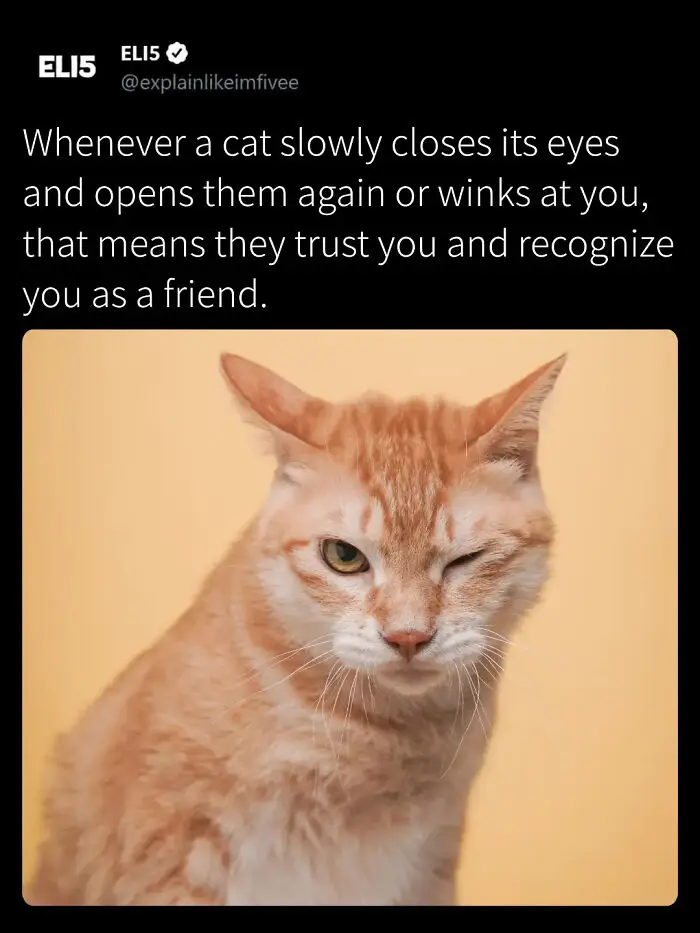
WHEN A CAT SLOWLY BLINKS AT YOU, IT MAY BE SHOWING THAT IT FEELS SAFE AROUND YOU.
Cats often communicate through body language rather than obvious gestures. A slow blink — gently closing and reopening their eyes — can be a sign of relaxed, non-threatening behavior.
In a 2020 study, researchers found that cats were more likely to slow-blink at humans who slow-blinked at them first. Cats were also more likely to approach an unfamiliar person after a slow-blinking interaction than after a neutral expression.
This suggests that slow blinking can be a form of positive communication between cats and humans. When a cat looks at you with relaxed eyes and slowly closes them, it may indicate comfort and trust.
However, a blink isn't a guaranteed declaration of love. Context matters: relaxed posture, soft facial expressions and a calm environment help you understand what your cat is communicating.
Want to try it? Look at your cat gently, slowly close your eyes for a moment, then open them again without staring. Let your cat decide whether to respond.
Sometimes, friendship doesn't need words — just a slow blink.
Report
3points
#37

In Japan, eating sushi with your hands is not considered bad manners. In fact, it is one of the traditional ways to enjoy sushi, particularly nigiri, the familiar style featuring a slice of fish or seafood placed over a small mound of seasoned rice.
During Japan's Edo period, nigiri sushi became popular as a convenient form of fast food. It was commonly sold by street vendors and eaten directly with the hands, long before sushi became associated with elegant restaurants and elaborate dining experiences.
Even today, some traditional sushi restaurants, including high-end establishments, welcome guests eating nigiri with their fingers.
One reason is the delicate construction of the sushi itself. Skilled sushi chefs carefully shape the rice with just enough pressure to hold it together while preserving a light, airy texture. Picking it up with chopsticks can sometimes squeeze the rice too tightly or cause the piece to break apart.
Using your fingers allows you to lift the sushi gently while keeping its shape intact. Traditionally, nigiri is also eaten in one bite, with the fish side lightly dipped in soy sauce rather than soaking the rice.
However, chopsticks are perfectly acceptable too, and other varieties, such as sashimi, are generally eaten with chopsticks.
Ultimately, Japanese sushi etiquette is less about rigid rules and more about appreciating the chef's craftsmanship and enjoying the food as intended.
Save this post for your next sushi experience, or share it with someone who thinks eating sushi with your hands is bad table manners.
Report
3points
#38

Your dog's gums can reveal important information about their overall health. Healthy gums are usually moist and pink, although some dogs naturally have dark pigmentation.
Pink gums: Generally indicate healthy circulation and oxygen levels.
Blue or purple gums: May indicate dangerously low oxygen levels or poor circulation. This is a medical emergency requiring immediate veterinary attention.
Pale or white gums: Can signal anemia, blood loss, shock, or poor circulation and require urgent veterinary assessment.
Yellow gums: May indicate jaundice, which can result from liver disease, red blood cell destruction, or bile duct problems.
Red or swollen gums: Often indicate inflammation, gingivitis, periodontal disease, or infection.
Other warning signs include persistent bad breath, bleeding gums, and unusual lumps or growths.
To maintain healthy gums, brush your dog's teeth daily using dog-safe toothpaste, provide appropriate dental chews, ensure fresh water, feed a balanced diet, and schedule regular veterinary dental checkups.
Save this guide to recognize warning signs early and share it with other dog owners.
Report
3points
#39
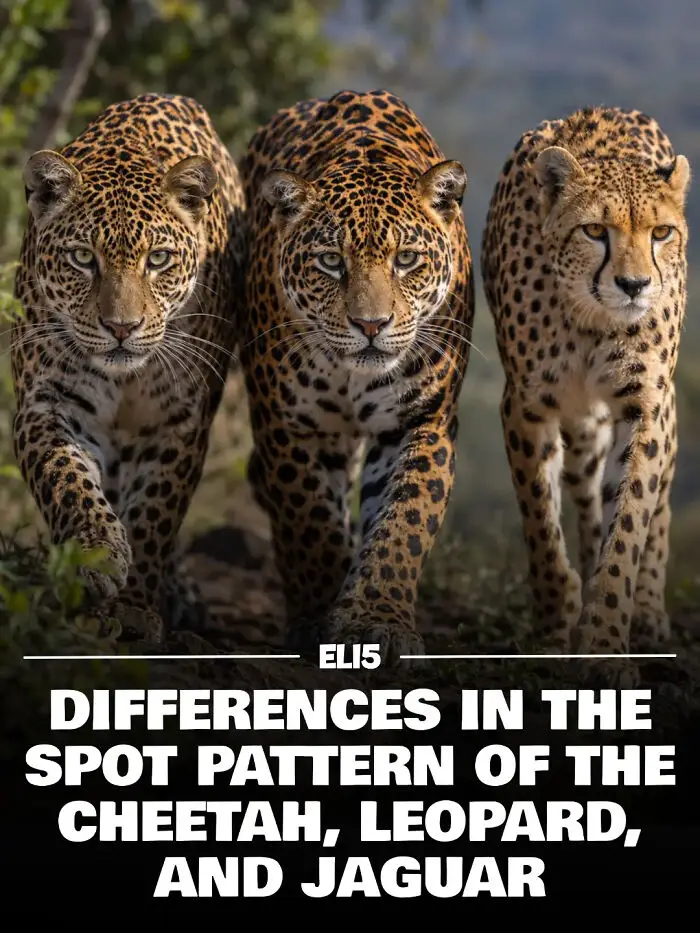
Cheetahs, leopards, and jaguars may look similar at first, but their coat patterns are one of the easiest ways to tell them apart.
Cheetahs have simple, solid black spots scattered across a golden coat. Their spots do not form rings or clusters. Think of them like black dots drawn with a marker. Cheetahs also have distinctive black “tear marks” running from the inner corners of their eyes down toward the mouth.
Leopards have spots called rosettes. These look like small black rings or flower-shaped clusters, usually with lighter fur in the middle. The rosettes are relatively small and closely packed, and they normally do not contain a black dot in the center.
Jaguars also have rosettes, but theirs are usually larger, darker, and more widely spaced. The biggest clue is that many jaguar rosettes contain one or more black spots inside the ring.
So the quick trick is: Cheetah = solid dots. Leopard = small empty rosettes. Jaguar = large rosettes with dots inside.
Save this post if you’ve ever mixed up these three big cats, or share it with a friend who’ll never look at their spots the same way again.
Report
3points
#40

A whale’s tail is more than just a way to move through the ocean - it can be a fingerprint.
The shape of the flukes, the depth of the central notch, the trailing edge, pigmentation, scars and even the texture of the tail stock can help identify different whale species. In some species, these patterns can even help researchers recognize individual whales.
Humpbacks are especially famous for this. Their black-and-white fluke patterns are so unique that scientists use photographs to identify and track the same whale over many years.
But there’s a catch: not every whale gives you a good look at its tail. Fin and minke whales, for example, often dive without lifting their flukes clearly above the surface.
Swipe through and see if you can learn to tell them apart by their tails.
Which whale tail would you recognize first?
Report
3points


