



Saying that our planet is beautiful almost feels like an understatement. We often forget to appreciate the nature around us, but if we take a moment to look closer, we can see just how complex and incredible it really is. For many photographers around the world, this beauty is a constant source of inspiration and the reason they dedicate their work to capturing it.
Nature Photographer of the Year (NPOTY) brings together photographers from around the world who capture everything from breathtaking landscapes and remote corners of the planet to the incredible wildlife that inhabits them. Looking through the competition's photos, it's hard not to be amazed by the moments these photographers manage to capture.
While we wait for this year's People's Choice Award winner to be announced, we thought it would be the perfect time to look back at some of the most remarkable wildlife photos featured in the competition between 2021 and 2025.
Scroll down to check out these captivating shots, and get ready to be reminded of just how wonderful our planet is!
#41 Under The Northern Lights By Liron Gertsman
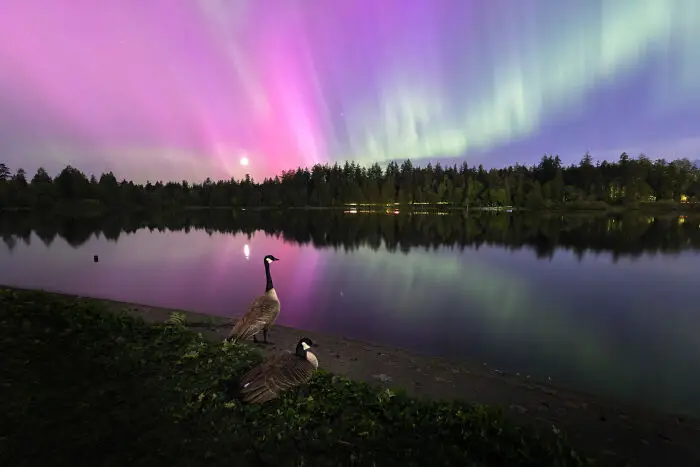
On the night of May 10, 2024, we witnessed something I never thought I’d ever experience from my hometown of Vancouver, Canada: the Northern Lights dancing across the sky all night long, from horizon to horizon! Vancouver is relatively far south for a Northern Lights viewing event, so this was a very rare occurrence. Knowing that a “geomagnetic storm” was expected, I began planning photo ideas for the coming night. I’d long dreamed of photographing birds with the Northern Lights, so that’s what I focused my attention on. Knowing that a wide-angle lens would be best for photographing the Northern Lights, I needed to find a bird that typically behaves indifferently toward human presence. I thought the city’s Canada geese would be the perfect birds to photograph, and I finally had some success photographing this pair of geese as the Northern Lights danced across the sky. In the background, during the 1.3-second exposure, you can see some lights from cars driving through the park. It was worth losing a night’s sleep! The geese are completely illuminated by the light from the nearby city buildings.
6points
#42 Fruiting Spider By Ronald Zimmerman
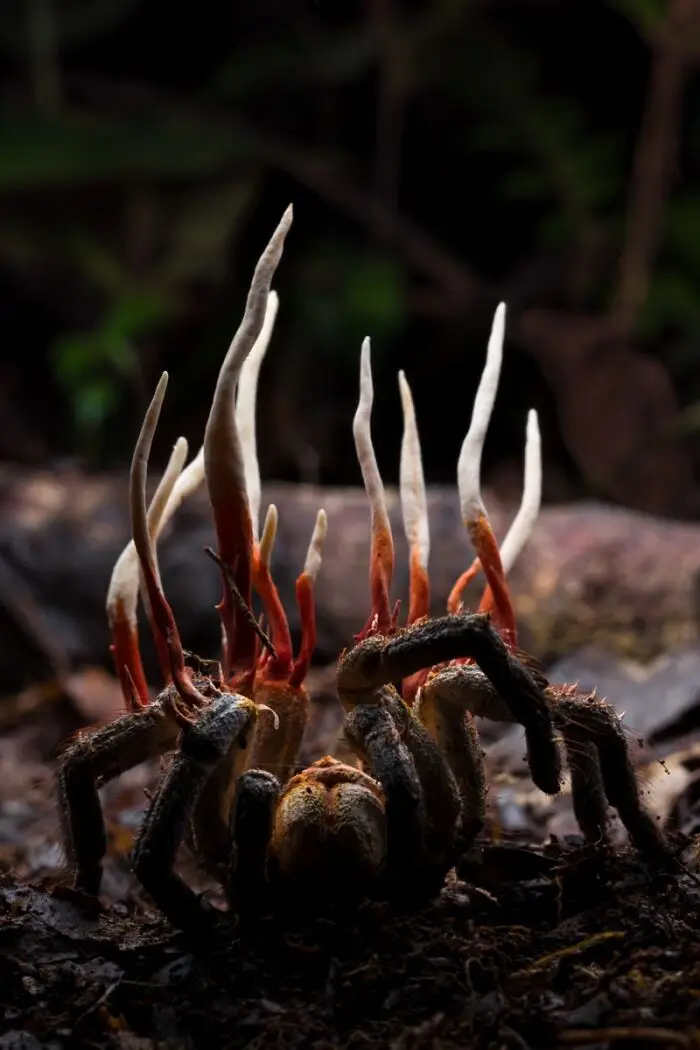
Tarantula Killed by Parasitic Fungi in the Rainforest near the Tambopata River, Peru (March 2022)
During my stay in the Peruvian Amazon, I went on numerous night hikes, and this discovery was among the most spectacular, thanks to the sharp eyes of a friend.
In the Amazon, insects and spiders are often hijacked by parasitic fungi that control their every move. This particular tarantula fell victim to a mind-controlling fungus known as Tarantula cordyceps (Cordyceps caloceroides). The fungus infects spiders through spores that attach to and penetrate the body, gradually taking control of the host’s behavior.
As the infection progresses, the “mind-controlled” spider is compelled to move to a microclimate favorable for the fungus’s growth. Meanwhile, the fungus feeds on the spider’s innards until the final stage of its life cycle. At this point, the spider moves to a specific location where it dies slowly.
Several days after the spider dies, the fungus’s fruiting bodies, or mushrooms, emerge from its shriveled corpse, turning it into a launchpad from which the spores can spread. These spores travel widely and infect new spiders.
To capture the eerie atmosphere, I used a low-angle shot with an off-camera flash, held by another friend, enhancing the dramatic and otherworldly mood of the scene.
6points
#43 The Beaver House By Rémi Masson
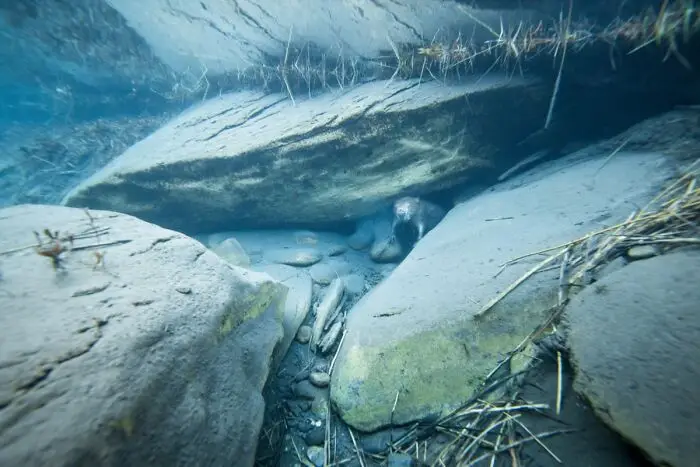
In the French Alps, July 2023. I’ve been waiting motionless against the bank in a rather uncomfortable position for over an hour now. Doubts are slowly creeping into my mind. Is this really the entrance to a beaver burrow? Situated between two rocks, the submerged cavity has a well-defined opening and looks relatively deep. But is it inhabited, or just a temporary shelter?
Absorbed in my thoughts, I pay no attention at first to the fine particles of sediment escaping from the gaping hole like tiny flakes. But a larger movement of water suddenly brings me back to reality. A beaver is emerging from the hole—the moment I’ve been hoping for is about to become real!
I can now clearly make out its head. It stops at the entrance and looks in my direction. Has it seen me? Possibly, but it’s hard to be sure. I huddle even closer to the bank. The animal extricates itself completely from its burrow, swims a few meters underwater before surfacing and heading toward the vegetation along the edge.
Its night has just begun. In all, this encounter will have lasted only a handful of seconds but felt like an eternity.
6points
#44 Aerial Acro-Bats By Imre Potyó
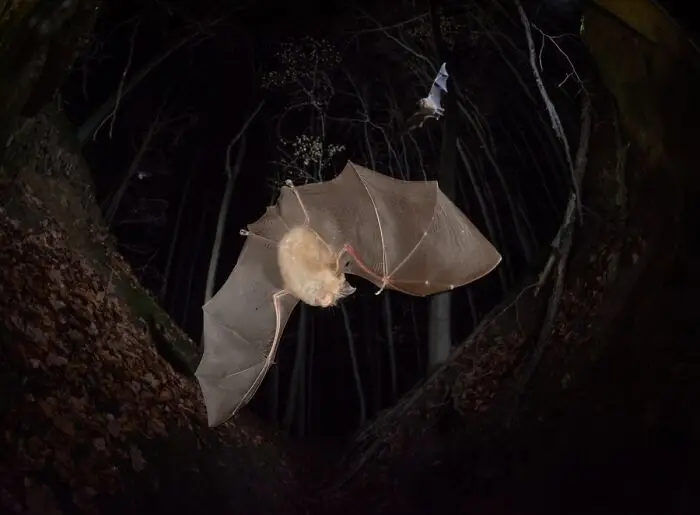
Outside, it is freezing cold winter, but the 10°C temperature and the unique environment of the mine attract animals. Lesser horseshoe bats (Rhinolophus hipposideros) winter in an abandoned iron ore mine in the Börzsöny Mountains (Hungary). Researchers have pointed out that lesser horseshoe bats also move during the winter, meaning their strategy differs from other bats. This behavior is amazing and unusual. We wouldn’t expect insect-eating bats to fly in winter.
During winter, the bats often fly out from their mines into the bare trees. Occasionally, they break their hibernation and fly out to feed in the winter forest, hunting winter moths. Sometimes, they even fly into the snowy woods. I’ve experienced something similar myself. It’s truly amazing to see bats take flight among the bare trees.
During these moments, you might have the chance to capture them near the entrance to their underground hibernation site using a camera trap. I created this image without any disturbance or artificial guidance. I have been photographing them in this mine for ten years without causing any harm, strictly following ethical guidelines. I don’t use distractions, such as curtains or sheets, to herd them.
It was magical. Witnessing their winter flight and feeling the air currents created by their wings on our faces is one of the most beautiful experiences. I would like to draw attention to the hidden, nightly wonders of a wintry forest.
6points
#45 Three’s A Crowd By Ian Wood
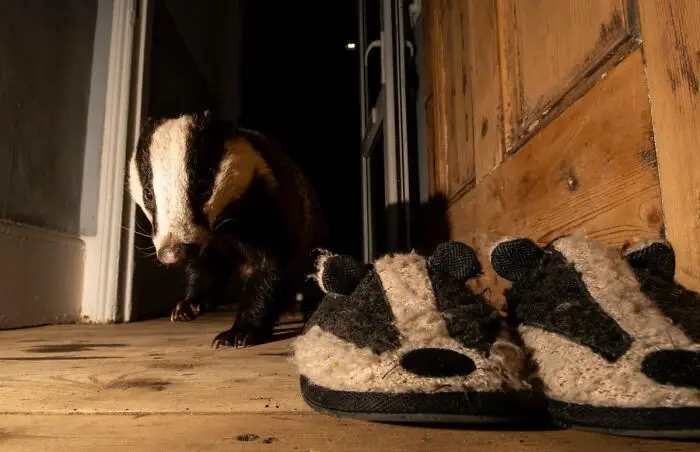
I have a badger sett quite close to my house in St Leonards on Sea, East Sussex, England, and I regularly see them foraging outside at night. During a hot summer, I started leaving my front door open to let some air into the house, and I was amazed to see a badger come into my porch for a sniff around while I was cooking one evening. Badgers have poor eyesight but an incredible sense of smell, so I presume it was the scent of my food that made it so curious.
I love badgers, and my partner gave me these slippers as a Christmas gift, which I had used to help keep the door open. I set up my camera with a wide-angle lens, a homemade motion sensor, and an extremely low-powered flash in case any badgers ever returned. I also left the light in my porch on and kept my front door open every night. For the next three weeks, I checked the camera every morning with no results until one day I woke up to find several images of this badger having a sniff around. I liked this image the most, as it looks like the badger is pausing with one paw raised near my slippers.
6points
#46 Conflict Between Two Clans By Borisov Evgeny
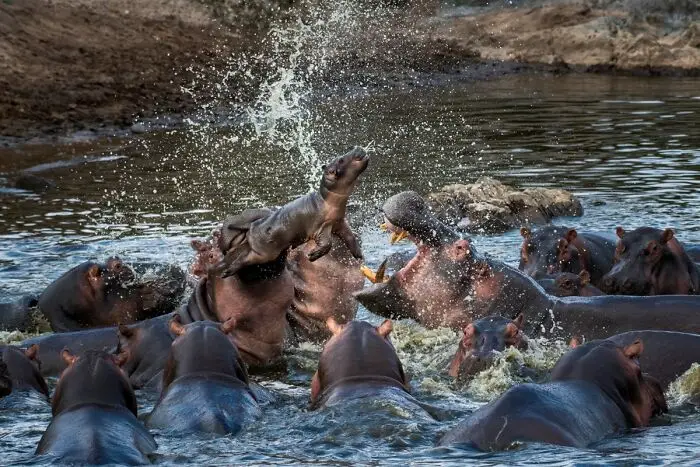
The photo was taken in Serengeti National Park in Tanzania. The filming was done from an ambush, where I observed two nearby clans of hippopotamuses. The territorial battle lasted 15 minutes.
It was an emotional and noisy scene, as the two clans fought fiercely. Hippos are most aggressive when protecting their young or defending territory, but this case was an exception. In this showdown, the young were ultimately the last to be involved. The males gave the babies a fair beating, but fortunately, all survived.
6points
#47 Face To Face By Jan Piecha
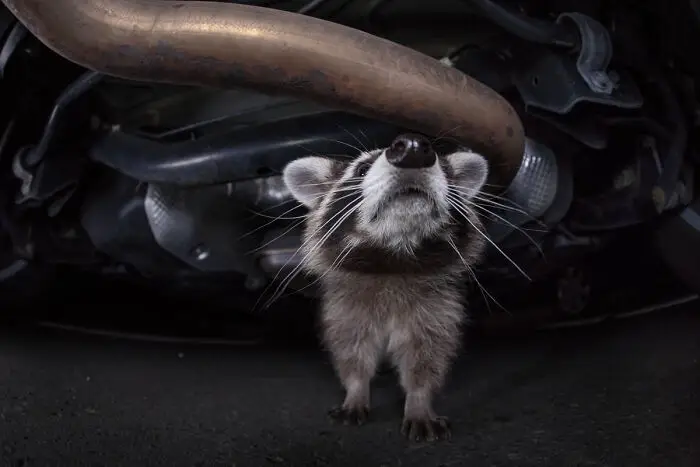
For several years now, I have been working on a photo project about raccoons with a friend. In this context, we also accompanied them on their forays into urban areas. Here they often use parked cars to hide underneath. We wanted to capture this behavior in the picture.
6points
#48 Heart Of The Sea By Liang Fu
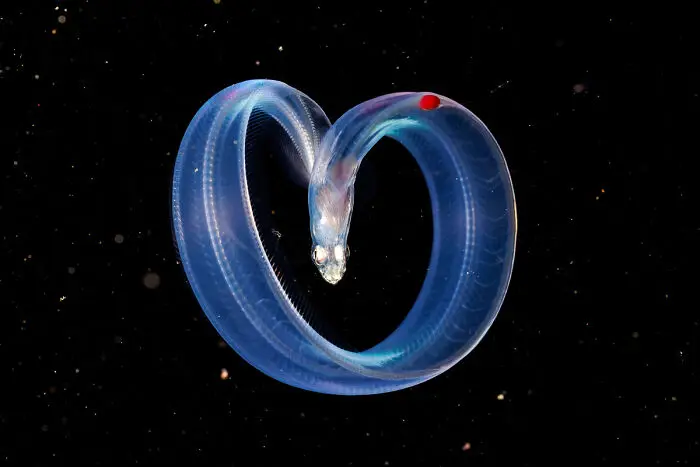
The photograph was taken during a blackwater dive in Romblon, Philippines. Blackwater diving is a type of scuba diving that takes place at night in the open ocean, with thousands of meters of water below the boat. Divers descend a rope with underwater lights as their only orientation system. When the tide and moon phases are right, creatures from the deep migrate to shallower waters. This vertical migration is one of the most remarkable natural phenomena. During the dive, I saw something shining under my searchlight at 28 meters deep. As I swam closer to investigate, I found a lava moray eel curled into a heart shape. I was extremely fortunate to capture this moment with my camera. The eel remained at that depth for less than 10 seconds before swimming down and disappearing into the darkness.
6points
#49 Flash Climb By Paul Goldstein
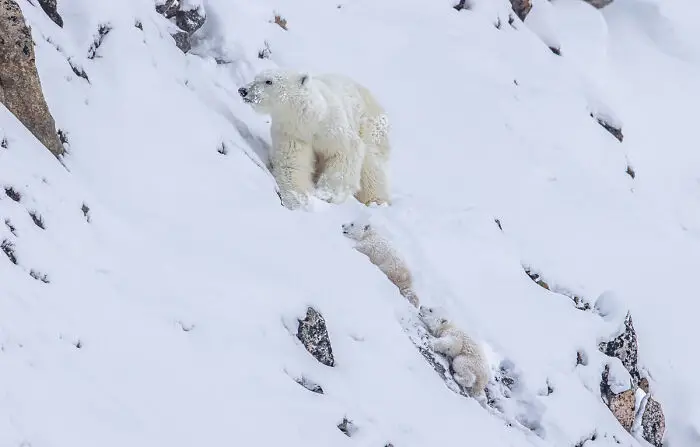
Baffin Island in early April is brutally cold, particularly when on a Skidoo. This was a moment when a mother was struggling with the sheer wall of a grounded iceberg looking for her yearling cub. Unsurprisingly she tumbled back among the broken ice. I had just enough time to fetch the tripod and set it up before this happened. She had been hunting and fortunately found her youngster soon after. I have photographed polar bears extensively but have never seen anything like this before in what is, surely, the most sublime area to photograph them.
6points
#50 Glassy Goose By Alex Pansier
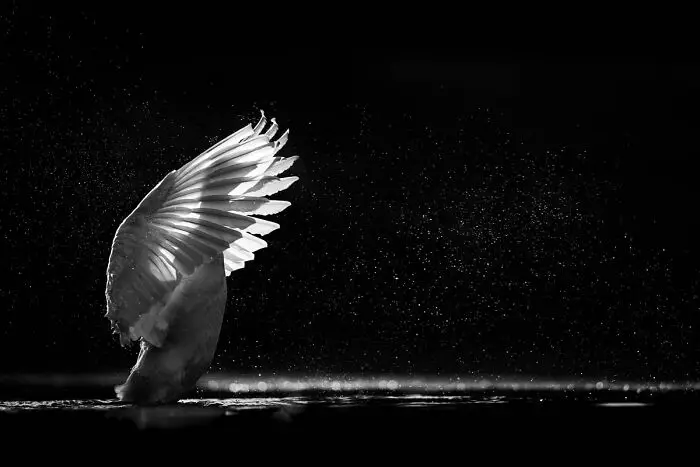
There’s something about the chill in the Dutch air that gets my pulse racing maybe, just maybe, we’ll get some snow! That’s exactly how I felt last December (2022) when I found a local pond that had completely frozen over. While there was no snow to be seen, I wasn’t disappointed. The thin layer of ice on the pond had driven all the ducks and geese to a single opening in the ice, perfectly positioned between the sun and me. Talk about a golden opportunity for some backlit shots, one of my go-to photography styles. After hanging around for a few days, I started to get the hang of the geese’s behavior. So, the moment I started stretching, my camera was already up and ready. That’s how I captured this shot. A white goose flapped its wings, sending droplets flying all around. I was pretty chuffed with that already, but when I reviewed the shots on my computer, one stood out. You could see the goose’s head as a shadow in the feathers, giving the photo that extra kick.
6points
#51 Winter Curse By Yuto Hirasawa
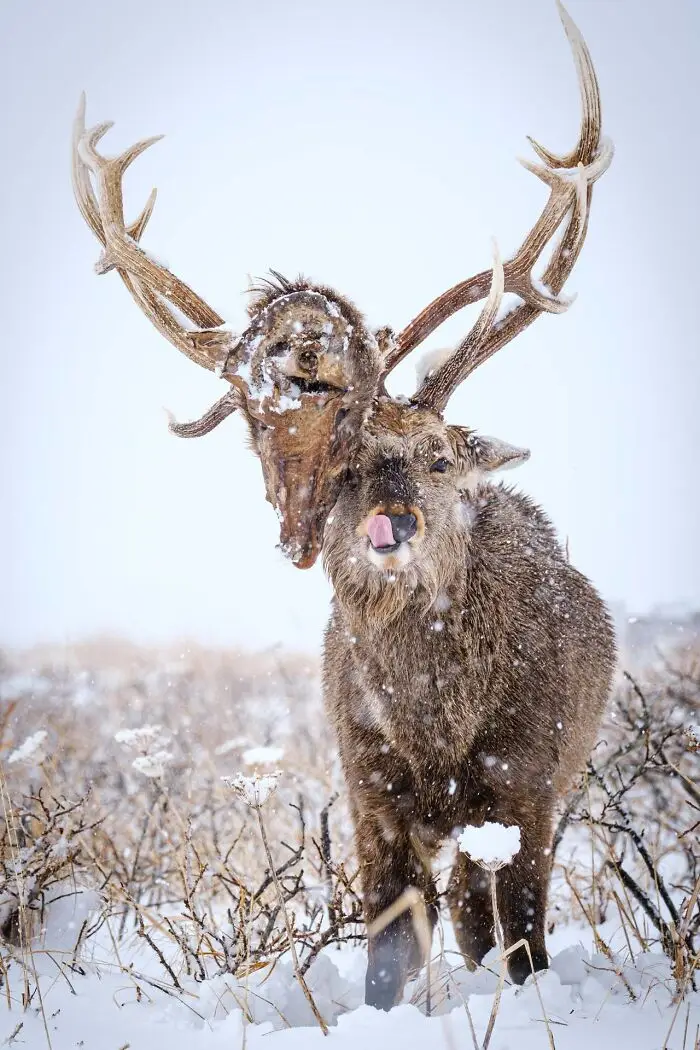
I took this image in eastern Hokkaido, Japan. This Ezo sika deer was the talk among photographers, and I also wanted to take pictures of him. I drove to the east and looked for this double-headed deer. It did not take much time to find him, and he walked towards me in a snowstorm. At first sight, I was shocked because this poor deer has to live through a harsh winter with a rotting skull locked in his antlers. At the same time, I was touched by his will to live. I don’t know if he is still alive or not. But I will never forget this encounter.
6points
#52 Scale Spectrum By Bernhard Schubert
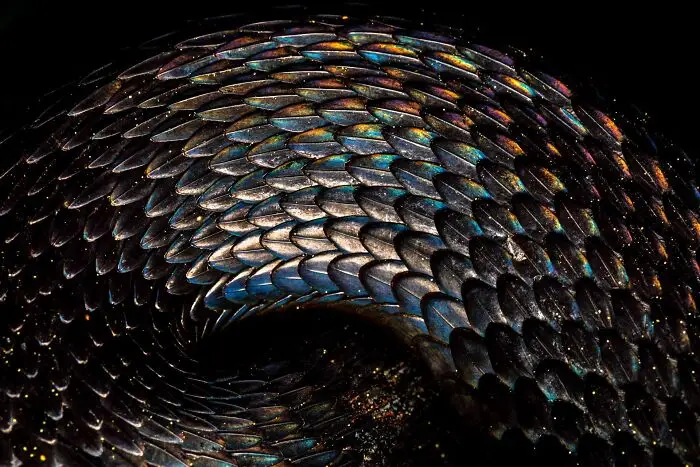
Pitch-black, so-called melanistic common adders (Vipera berus) can be found in the Alps just as frequently as normally colored individuals. This specific animal was crossing a meadow surrounded by forest in the very Eastern part of the Alps. During wintertime, this area is used as a ski slope. It coiled up and stayed in position for a couple of minutes, giving me enough time to pull out my camera. For the first time, I used a flash during daylight for photographing a diurnal snake. I positioned the flash below the camera, and that allowed me to eliminate the daylight and show this interesting gleam, caused by the light, which split into many different colors as it reflected on the scales.
6points
#53 Window To The Salt Pan By Mano Aliczki
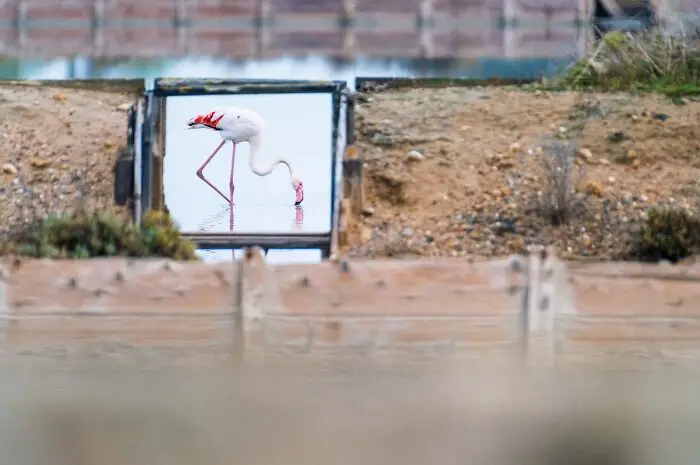
Greater flamingo feeding in an artificial salt pan seen through a ‘window’ on the levee in Sardinia, Italy. The former salt evaporating site turned regional nature park in Sardinia is home to one of the largest breeding colonies of greater flamingos in Europe. I spotted the lonely flamingo on the water from the opposite bank and had to move quickly into position, anticipating (or rather hoping) it would line up with the wooden frame for a shot. The flamingo lifted its head from under the water for a split second when reaching the frame, allowing only one shot, before carrying on with feeding.
6points
#54 Escape By Johan Van Wyk
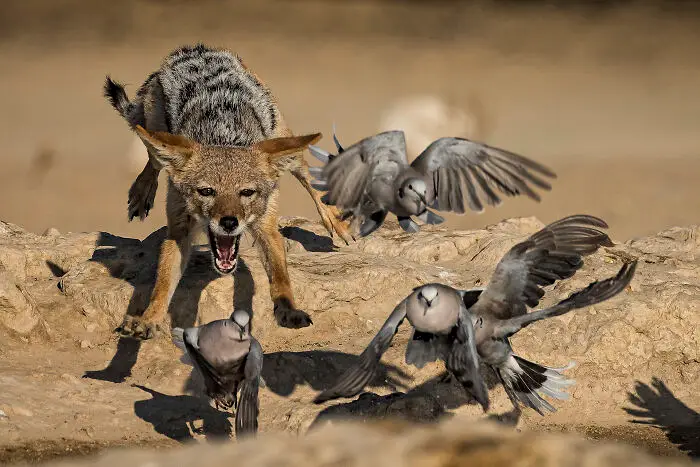
The Kgalagadi National Park is the second largest Nature Reserve in north west South Africa, and borders Namibia. It is one of the Country’s “Arid” parks, and consists mainly of desert and sand dunes. It is home to all of the large African cats, and big herds of springbok, wildebeest, ostrich and many smaller antelopes. To assist survival of these animals during the extremely hot summer months (daytime often above 45C), some waterholes have been created in strategic spots. The sparse vegetation gives great opportunities for wildlife photographers, especially around the few waterholes. The Blackbacked Jackal have learnt to ambush the Cape Turtle Dove and Namaqua Sandgrouse at some waterholes. Both bird species have a ritual of early morning drinking with its hundreds, and that’s when the Jackal tries to catch some food. The hunt is only successful now and then, but this “game” can last for hours. At the cost of extreme patience, it does provide the photographer with some excitement, and the odd rewarding shot.
6points
#55 Cutie Daughter By Alex Zozulya
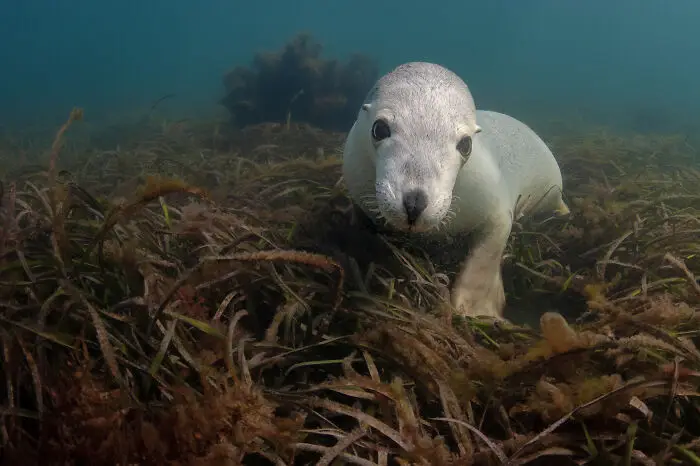
This photo was taken during a visit to the islands of South Australia. White capped sea lions are local endemics and a vulnerable species, but otherwise they behave much like sea lions everywhere in the oceans: curious, friendly, and playful.
They do not mind human contact. What matters most is that they have something to keep them engaged. Although they may first show interest only from a distance, lying quietly on the seabed and watching without moving, they slowly begin to relax. Gradually, they behave more boldly and eventually open up completely. The photo captures the moment of their very first encounter, the instant of first eye contact.
5points
#56 Gorilla By Tom Way
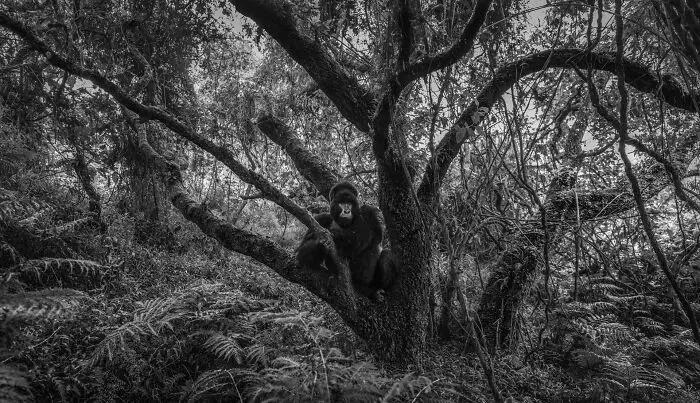
I’ve been gorilla trekking for over 10 years and have completed more than 75 mountain gorilla treks. During this time, I’ve primarily focused on taking portraits of gorillas with a longer lens, but when I reviewed my portfolio, I realized it could also be important to photograph the gorillas in their habitat.
5points
#57 UV Baby Transport By Michael Schreiber
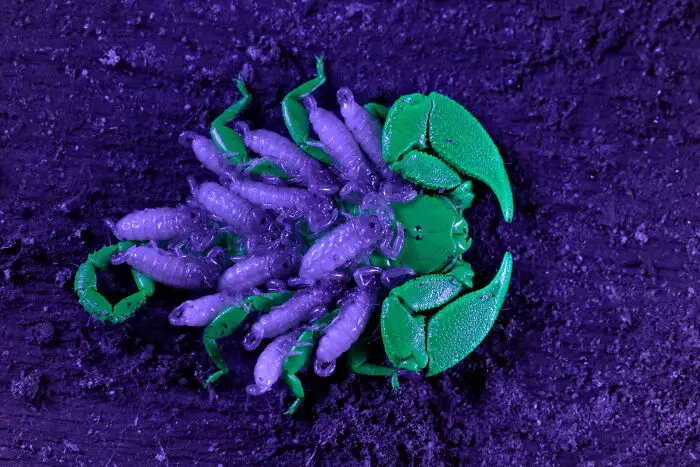
A scorpion glows with its young under the light of two UV lamps. After birth, the mother scorpion carries her young on her back and remains motionless in case of imminent or potential danger. The young remain on their backs for protection until their exoskeletons have hardened. Found on the dead wood of a fallen tree in Bogani Nani Wartabone National Park, near Gorontalo, Sulawesi, Indonesia.
5points
#58 Hermine In The Snow By Frank Jacobs
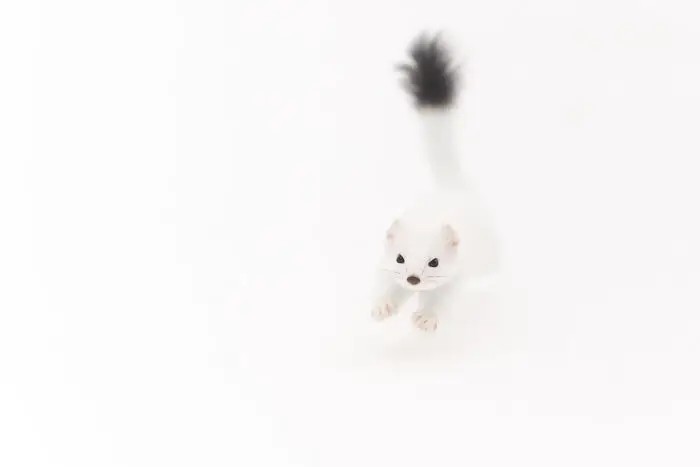
During my photo trip to Kuusavo, Finland, in March 2025, I had the chance to capture a small stoat darting through the snow. It was a magical moment: the animal moved swiftly, weaving back and forth across the white landscape in search of food. Its sleek white winter coat blended almost perfectly with the snow, making it both a challenge and a thrill to track with my camera. Every pause, every sudden leap offered a fleeting opportunity to press the shutter, and the combination of speed, light, and the sheer beauty of this tiny creature made the encounter unforgettable. After this trip, I still call it my “Little Star.”
5points
#59 Together In Light And Shadow By Rahul Sachdev
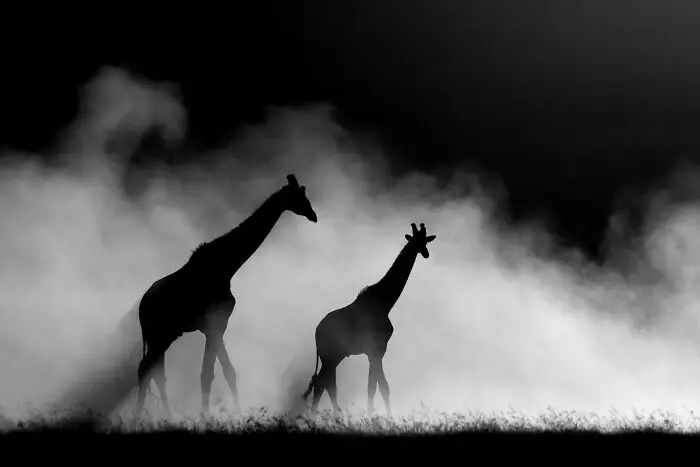
This photograph captures two giraffes moving together through a haze of dust, their elegant silhouettes standing out sharply against the monochrome background. The contrast between their towering forms and the billowing dust creates a dreamy, almost surreal atmosphere — a blend of grace, strength, and vulnerability that speaks of camaraderie and resilience in the wild, where every movement is part of a larger rhythm of survival and coexistence.
I made this image in Solio Game Reserve in Kenya, a private reserve nestled between Mount Kenya and the Aberdare Mountains. Solio is world-renowned not only for its rhino conservation but also for the abundance of other wildlife, including the reticulated giraffe (Giraffa camelopardalis reticulata), easily recognized by its sharp, polygonal coat pattern edged in white.
The idea for this frame emerged as I watched a small group of giraffes crossing a dry patch of land where loose dust drifted through the air. I realized that by positioning myself with the light behind the dust clouds, I could transform the moment into something more abstract and artistic. Rendering the photograph in black and white removed distractions and emphasized the sculptural forms of the giraffes and the ethereal texture of the dust. By slightly underexposing and using a longer focal length, I achieved the strong silhouettes and atmosphere I had envisioned.
The two giraffes walked quietly together, likely moving between feeding grounds. With each step, their steady gait lifted small clouds of dust from the dry earth, creating the natural backdrop that completes this scene. Their calm companionship highlights the subtle social bonds giraffes often maintain, whether between females and their offspring or smaller groups traveling within a larger herd.
5points
#60 Rest Easy By Tom Way
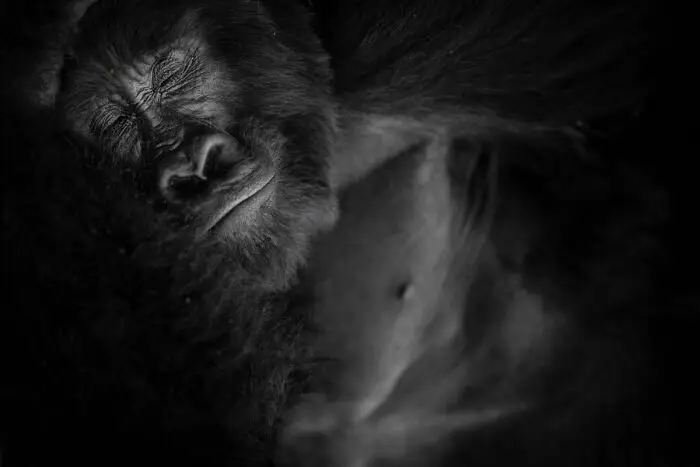
The conservation success story surrounding mountain gorillas is extremely positive. Although there were fears that gorillas might become extinct due to habitat loss and poaching, increased permit fees and better protection have led to gorilla populations almost doubling in the last 30 years. With close monitoring by anti-poaching units and ranger teams on a daily basis, these groups of gorillas can now rest a little easier.
Mountain gorillas generally spend their day either eating or sleeping, needing to consume up to 20kg of vegetation a day. This silverback had just finished his breakfast before settling down for a morning nap.
5points

