



Saying that our planet is beautiful almost feels like an understatement. We often forget to appreciate the nature around us, but if we take a moment to look closer, we can see just how complex and incredible it really is. For many photographers around the world, this beauty is a constant source of inspiration and the reason they dedicate their work to capturing it.
Nature Photographer of the Year (NPOTY) brings together photographers from around the world who capture everything from breathtaking landscapes and remote corners of the planet to the incredible wildlife that inhabits them. Looking through the competition's photos, it's hard not to be amazed by the moments these photographers manage to capture.
While we wait for this year's People's Choice Award winner to be announced, we thought it would be the perfect time to look back at some of the most remarkable wildlife photos featured in the competition between 2021 and 2025.
Scroll down to check out these captivating shots, and get ready to be reminded of just how wonderful our planet is!
#61 Flight Of The Night Hunter By Neil Aldridge
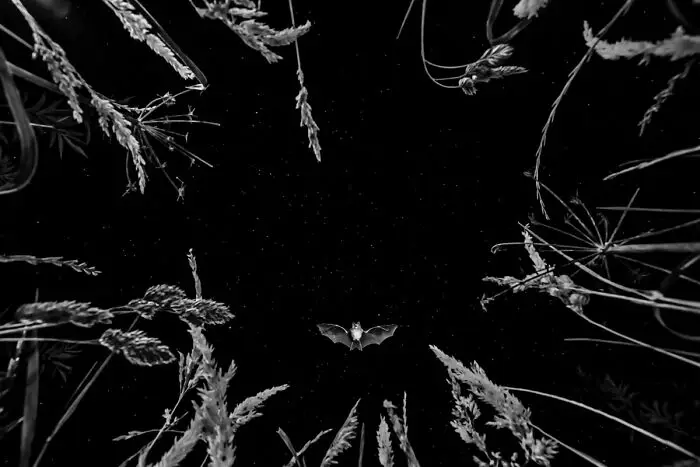
A lesser horseshoe bat (Rhinolophus hipposideros) takes flight on a starry night, hunting over grassland vegetation on an organic farm in Devon, England.
Intensive agriculture and development have decimated habitats such as meadows and native woodlands, leading to a significant decline in lesser horseshoe bat populations in Britain. To highlight the bat’s connection to this crucial habitat while minimizing disturbance, I used red filters on low-powered flashes for the image exposure.
I positioned the camera and trigger to face upwards along the route the bats typically follow from their roost. The camera was set to f14 with a 30-second exposure to capture both the bat and the starry night sky in intricate detail.
The lesser horseshoe bat was a focal species in the Back from the Brink project, a collaborative conservation initiative aimed at saving England’s most threatened species and habitats. I worked on this project in partnership with The Bat Conservation Trust.
5points
#62 In The Shadow Of Mont Blanc By Francesco Guffanti
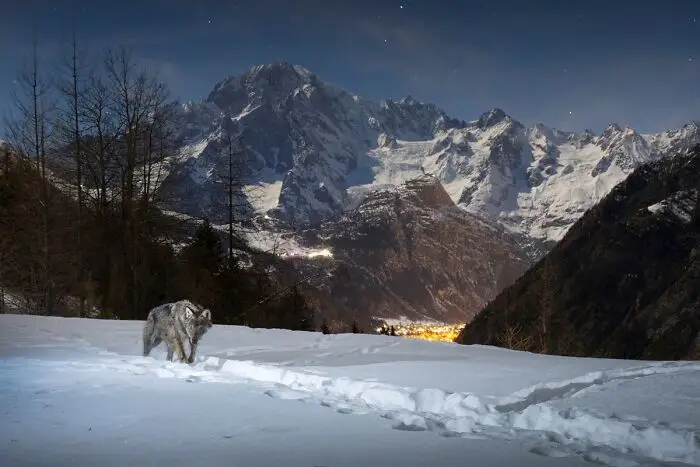
The wolf (Canis lupus italicus) has returned to the shadow of Mont Blanc. In recent years, I have followed the life of the pack, observing its hunting trips, the growth of the pups, and the social dynamics between them. It has been a unique privilege, for which I will always be grateful.
I discovered that wolves occasionally use this panoramic path during their hunting trips, so I set up a camera trap with the help of a PIR sensor and two flashes to capture their passage at the foot of the majestic Mont Blanc.
After several attempts and dealing with malfunctions caused by the freezing winter, I finally managed to get the shot I had long desired.
This photo is part of the project and photographic book Nuovi Equilibri, developed in collaboration with my friend André Roveyaz, documenting the return of the wolf to the upper Aosta Valley.
5points
#63 The Haunted Wreck By Andrea Izzotti
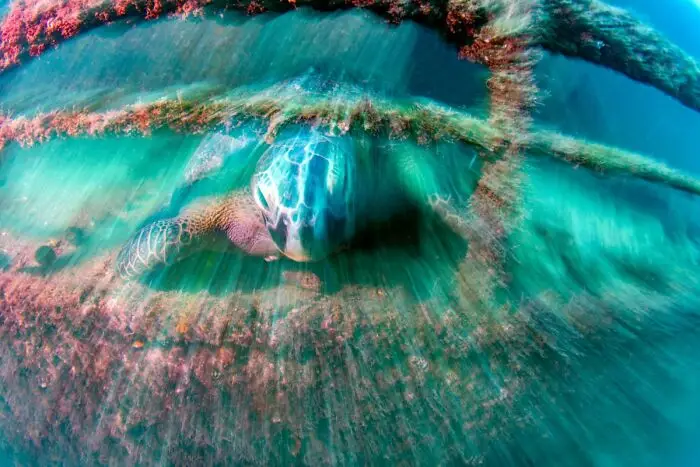
After arriving in La Paz, Baja California, Mexico, to dive in the biodiversity-rich waters of the Sea of Cortez, the area was hit by Hurricane Norma, which churned up the sea and the coast with very strong winds, forcing me to take shelter for two days in a safe location. It wasn’t possible to dive until a few days later, and the consequences of the powerful storm were evident, even underwater: destroyed corals and visibility reduced to just a few meters, with the sea turned green and full of suspended particles.
I attempted a wreck dive, and the sunken ship suddenly appeared to my eyes, as if shrouded in fog. When we encountered a turtle relaxing on the deck of the submerged wreck, I realized it was time to use a creative technique before the animal surfaced to breathe.
I chose a slow shutter speed and a backward camera movement, hoping to convey the eerie atmosphere I was experiencing—a nearly haunted wreck, where the turtle seemed like a phantom guardian of the deep.
5points
#64 Companions By Jomtup Charoenlapnumchai
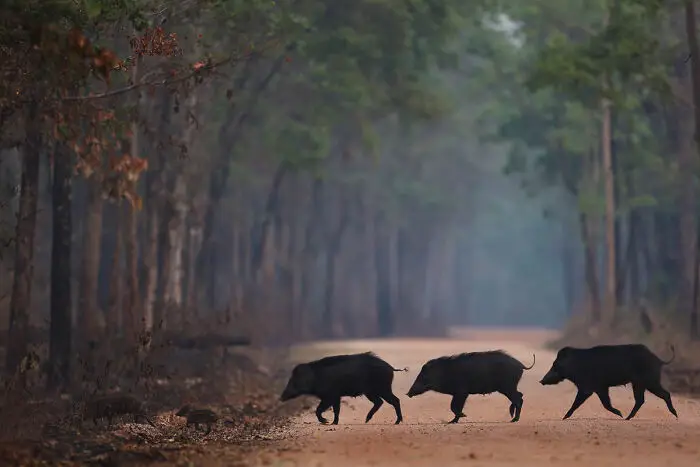
In the early morning at Huai Kha Khaeng Wildlife Sanctuary, wild animals are walking through the streets almost every day. Whether it’s a deer or a wild boar. The next morning, I went and waited in the same place to wait for an animal to cross the path. I kept waiting until about seven o’clock, when a herd of wild boars ran across the path in front of me, so I hurriedly took a picture.
5points
#65 Out Of The Snow By Kurt Jay Bertels
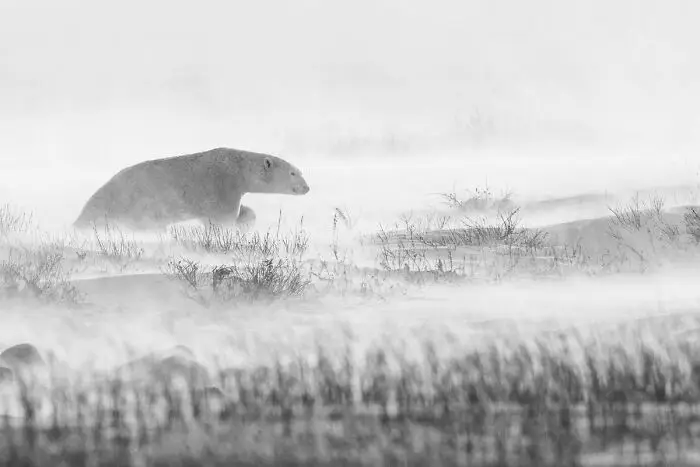
Experiencing the high Arctic gives you an immediate understanding of just how well-built polar bears really are! The conditions would quickly kill us but don’t faze the bears at all. This polar bear was moving along the coast of Hudson Bay in Canada looking for any source of food while waiting for the sea ice to form. The wind picked up, whipping the snow all around and dropping the temperatures considerably, but the bear just kept going without even slowing down. It was spectacular to see!
5points
#66 Magical Moment With Moon Jellyfish In The Kelp Forest By Mayumi Takeuchi-Ebbins
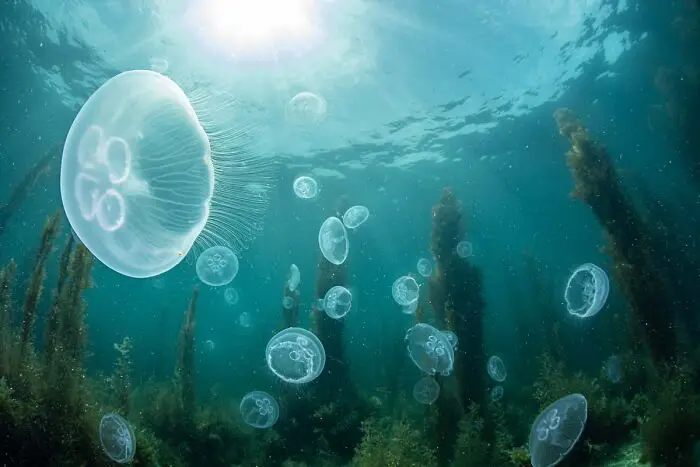
This is a small school of Moon jellyfish and Japanese kelp.
I took this image from the Minamata Sea, Kumamoto Prefecture, Japan, in April 2022. There is a phenomenon where lots of Moon jellyfish gather close to shore between April and May in the Minamata Sea; also, Japanese kelp grows in cold water from winter to spring in Japan. But it is very difficult to see these two subjects together unless you know when and where to dive for aiming. I was looking for these subjects together for two years, and finally, I succeeded in shooting Moon jellyfish in the kelp forest. The kelp forest will disappear by the middle of April due to water temperature, and Moon jellyfish won’t turn up until a certain temperature. It was very difficult to read the right timing to shoot this magical moment for collaboration with Jellyfish and the kelp forest. I have chosen the correct date for this and checked high tide and low tide and the sun’s direction before diving and choosing the right time to see them. I spent a week finding jellyfish, and finally, I could shoot this image after all my efforts.
There were not many jellyfish at that time, but I carefully chose the best composition so I could get as many jellyfish as possible into the frame in the kelp forest and Snell’s window effect. I never forget how it was such a beautiful time to see some moon jellyfish floating in the kelp forest, and it was a magical time.
5points
#67 Road Block By Vince Burton
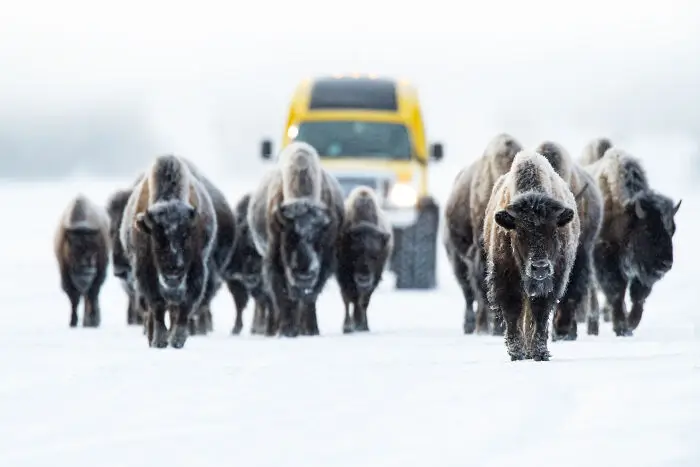
For many years, it has been on my bucket list to visit Yellowstone National Park. I decided to visit during the winter months, expecting there to be fewer people and therefore hopefully witness more wildlife in its natural environment. During the winter, there can be a lot of snowfall in Yellowstone, and therefore the wildlife often uses the roads to move around on the packed snow roads rather than the deeper powdery snow off-road. This image made me smile as it just made me think of a Road Block, Yellowstone style, with this herd of bison moving slowly. It was an impressive sight to see as they moved passed us.
5points
#68 Elephant Shadows By Patrick Bentley
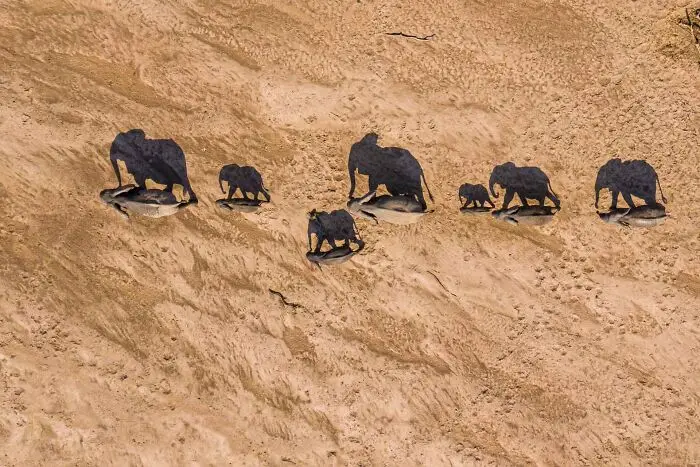
Having crossed the Luangwa River, an elephant matriarch leads her herd across the sandy riverbank into the National Park. Creatures of habit, they have used this same crossing point for decades. Photographed from a licensed drone in South Luangwa National Park, Zambia.
5points
#69 Hunting Bear By Lassi Rautiainen
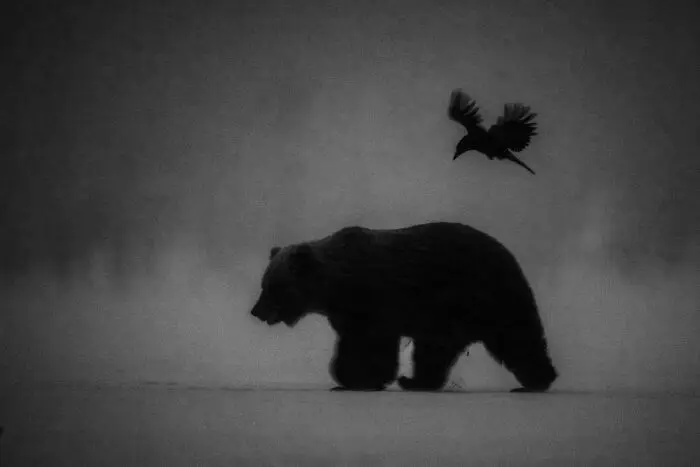
In April snow cover is so hard that even humans can walk on snow because it’s cold at night but warm by daytime. And first bears awake in April. Every April I try to take shots if some interesting happens. In that case, the raven “attacked” pushing the bear back. Ravens do it to other mammals too hoping that they will go away. The picture was taken in Finland in Kuhmo near the Russian border.
5points
#70 Unity Is Strength By Yuan Minghui
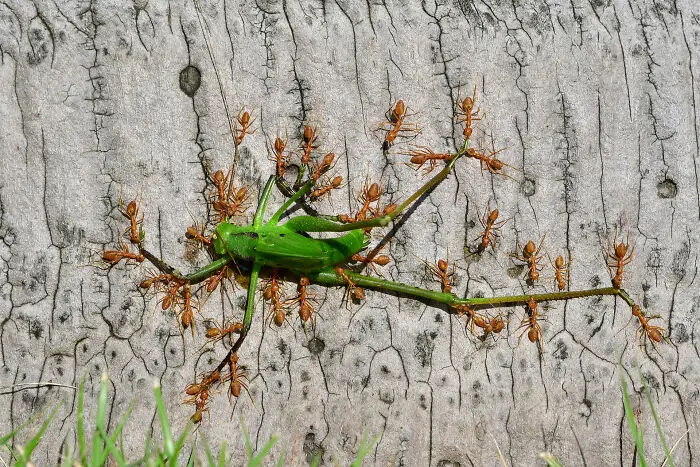
In Xishuangbanna Tropical Botanical Garden in Yunnan Province, there are several big trees near my hotel. The nest of Oecophylla smaragdina is built in the crown of the tree. They are ferocious by nature and are good at catching all kinds of insects. When the weather is fine, the workers will divide into several groups to hunt for insects. One morning, I found that they were working together to subdue a green katydid and carried it to a tree. Every kingdom of Oecophylla smaragdina will build a castle of its own. Although the kingdom of Oecophylla smaragdina maintained hostility and did not contact other similar kingdoms, there was a little war between their kingdoms. War usually only takes place with animals of other races. I knelt on the ground and shot this work at a low angle close to the ground in order to obtain the best focal plane.
5points
#71 Life Cycle By Franco Banfi
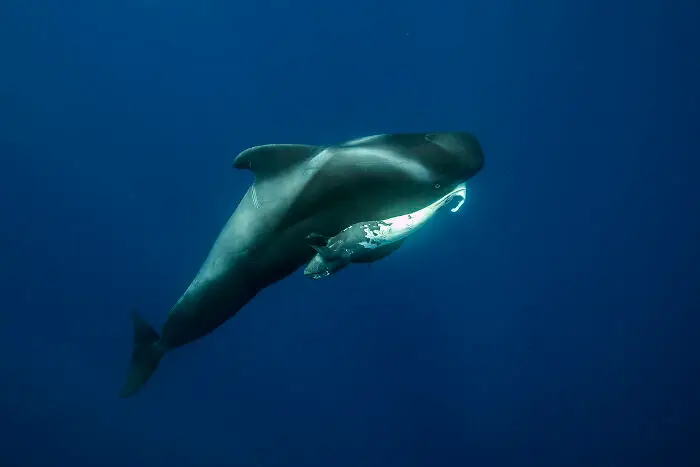
While I was documenting a group of short-finned pilot whales (Globicephala macrorhynchus), I spotted this female carrying her dead calf. She was surrounded by other members of the group, escorting and consoling the mother during her endless swim. Short-finned pilot whales are very social marine mammals and have inquisitive attitudes. Each member of the pod is strongly bonded to each other, and they do everything together: resting, hunting, socializing, playing, traveling… and burial.
After some days of research, the researchers spotted two females carrying their two new-borns baby (dead at birth) in the open ocean for days, reluctant to let go. The male kept the other researchers and me at a safe distance from the two females. He was never aggressive, but his intentions in protecting the two mothers were clear. It was heartbreaking to witness the behavior of the entire group. In this situation, one difficult thing was to deal with my emotions.
Picture taken with the approval of the Portugues Ministerio para la Transicion Ecologica, Secretaria de Estado de Medio Ambiente. In Tenerife, nobody can freely swim with cetaceans without having previously obtained a special license issued by the Government. This kind of photograph can only be taken while snorkeling or free-diving, holding our breath and swimming at the same time. It is forbidden to use underwater equipment such as scuba tanks, rebreathers, underwater scooters, etc.
Species: Short-finned pilot whale (Globicephala macrorhynchus)
Location: Tenerife island, Canary archipelago, Atlantic Ocean
Conservation status (IUCN): Least Concern
5points
#72 The Lion Going Down By Hong Chen
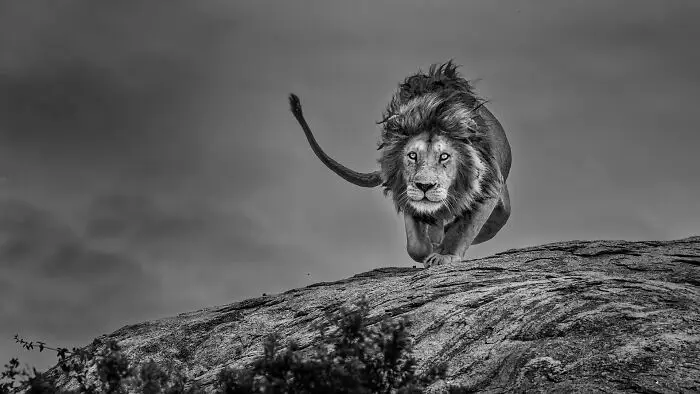
When we were photographing a lion sitting on a big rock in the Serengeti (Tanzania), suddenly another lion under the rock roared. The lion on the rock instantly got up and rushed down… I was excited when I saw this and quickly pressed the shutter.
5points
#73 Alien Invasion By Ripan Biswas
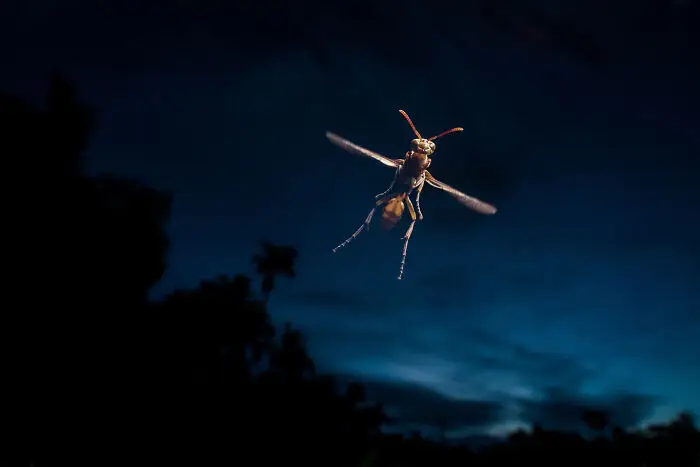
There was a seasonal swamp near my home in Coochbehar (India). Every monsoon, the swamp is full of different types of insects and amphibians. I visit that place regularly, almost every day, during the monsoon. One day I came across a group of plant-hopper nymphs that found shelter in the grass blades of a bush in the swamp. The bush was in the middle of the swamp. There was knee-deep mud around the bush. I started observing them and found that there were some paper wasps visiting the bush. The wasps came and took the helpless nymphs into their mandibles.
It was a challenge to take pictures of the paper wasps. I was in knee-deep mud; my movements were restricted. The mud was slippery; standing became difficult, and it was hot and humid. I used a C-type bracket and attached a remote control to it. This is how I used my camera with one hand. On the other hand, I held a flash that was remotely controlled by a transmitter. I used a wide angle-macro lens to take both the wasp and the environment in a single picture. The lens is a manual lens, so you cannot focus automatically. I pre-focused at a certain distance and tried to move the camera towards the flying wasp to get the wasp in focus. It was a ‘trial and error’ method, and 99% of my pictures were out of focus. To get the ambient light, I used a slower shutter speed, a flash to freeze the subject, and a lower angle. So the wasp looked like an alien who came down to attack us. I worked there for a week and got only a handful of photos.
5points
#74 Curious Neighbors By Yaron Schmid
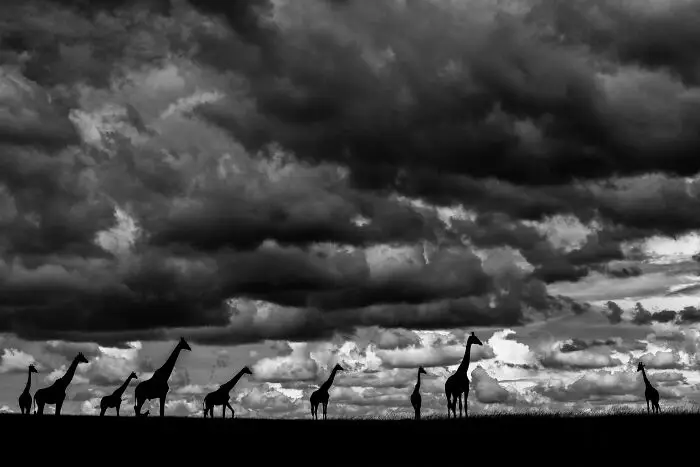
Giraffes have amazing eyesight, and being tall is definitely an advantage. Add to that their curious nature, and you've got yourself one of the best spotters in the bush. When they see a cat, they will often stop what they do and stare in the cat’s direction. Often they will, against what most will imagine, start walking towards the cat, getting very close to it at times, to show the cat that they’ve seen it. So when our guide saw a herd of giraffes standing and staring in the same direction, he knew that there must be a cat in the area. All we had to do was drive towards the giraffes, look in the direction they were all looking, and spot the lioness…
5points
#75 Goats In Fake Snow By Carlos Pérez Naval
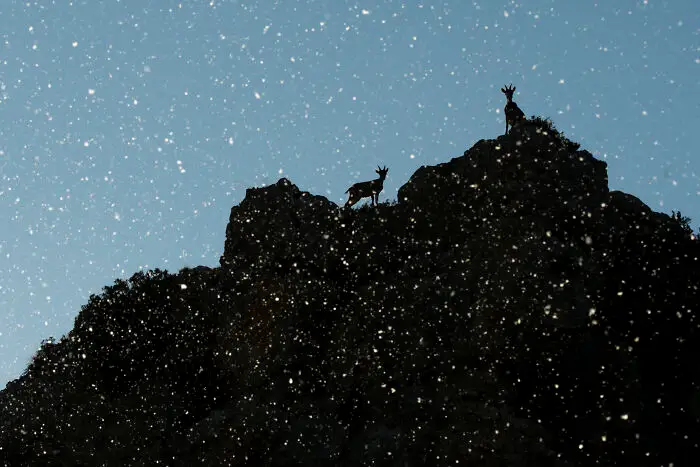
I took this image in Teruel (Spain). I had taken a lot of pictures of Iberian Ibex. And a few years ago, I tried to take a few photos of the seeds of the poplar that were spread by the wind. After taking some photos, I realized that it was really interesting. So the next year I went there every afternoon when the seeds were spreading (which is not too many days), and I took some photographs like this one. It was a really short moment, because the sun had to lie just behind the rocks and the Ibex had to stand on top of the mountains, creating an enchanting moment in which the seeds seemed to be stars or snow.
4points
#76 Stuck In Life By Alex Pansier
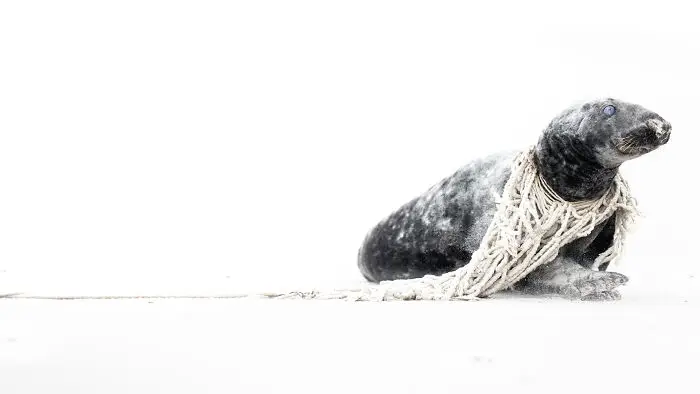
This photo of a seal, taken last May on the island of Dune (next to Helgoland), touches me. The animal seems to have cataracts and has also become entangled in a fishing net. Literally Stuck in Life.
It’s a heart-wrenching scene that highlights the devastating impact of human activity on marine life. Fishing nets are designed to catch fish, but they can also unintentionally trap other marine animals like seals, dolphins, and turtles. When a seal becomes entangled in a net, it can’t swim or move properly, making it difficult for it to breathe, eat, or avoid predators. Yet it is as if the creature has a smile on its face, and it seems used to the net. This contrast appealed to me. Taking the photo in high key allowed me to approach this contrast even more.
2points

