



Saying that our planet is beautiful almost feels like an understatement. We often forget to appreciate the nature around us, but if we take a moment to look closer, we can see just how complex and incredible it really is. For many photographers around the world, this beauty is a constant source of inspiration and the reason they dedicate their work to capturing it.
Nature Photographer of the Year (NPOTY) brings together photographers from around the world who capture everything from breathtaking landscapes and remote corners of the planet to the incredible wildlife that inhabits them. Looking through the competition's photos, it's hard not to be amazed by the moments these photographers manage to capture.
While we wait for this year's People's Choice Award winner to be announced, we thought it would be the perfect time to look back at some of the most remarkable wildlife photos featured in the competition between 2021 and 2025.
Scroll down to check out these captivating shots, and get ready to be reminded of just how wonderful our planet is!
#21 Image Of An Ibis By Jian Hu
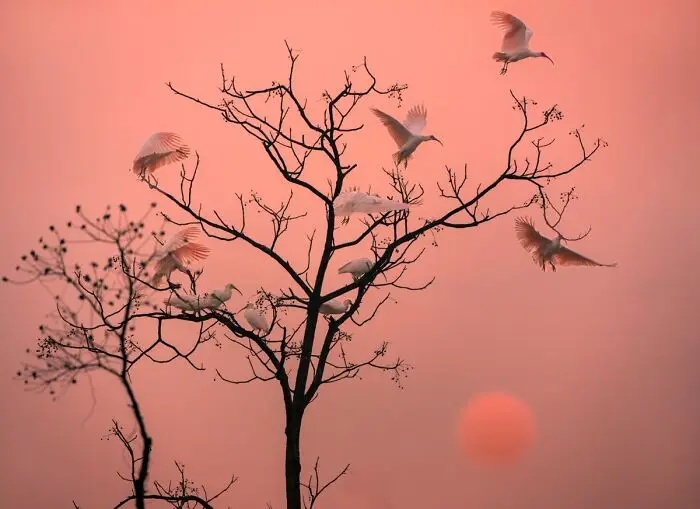
The crested ibis, once widely distributed across Japan, Korea, Russia, and most parts of China, is known as the “Oriental gem” and the “auspicious bird.” From 1963 to 1981, the species became extinct in three regions: Russia, Japan, and the Korean Peninsula. In 1981, only seven wild crested ibises were found in Hanzhongyang County, China. Thanks to the tireless efforts of countless individuals over the decades, the population has now grown to more than 10,000 crested ibises.
Winter is the most beautiful season for the crested ibis. Its feathers become dazzlingly white, and its head takes on a jewel-like red hue. This photo was taken on an early morning in Yang County, China, in December 2023.
9points
#22 In The Tree Hollow By Jan Piecha
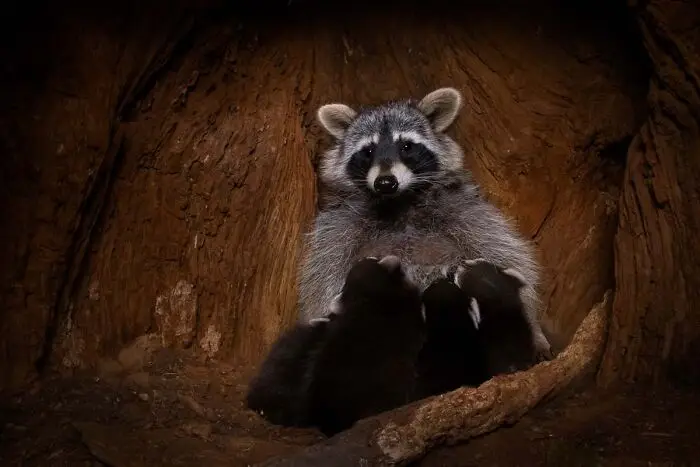
For several years now, I have been working on a photo project about raccoons with a friend. The photo of the female and her offspring was also taken in this context. I observed the family for many days and the female was not shy towards me, which is why I had the chance to document intimate insights into her family life. I didn’t use a flash to take the photo.
9points
#23 Coexistence By Byron Grobler
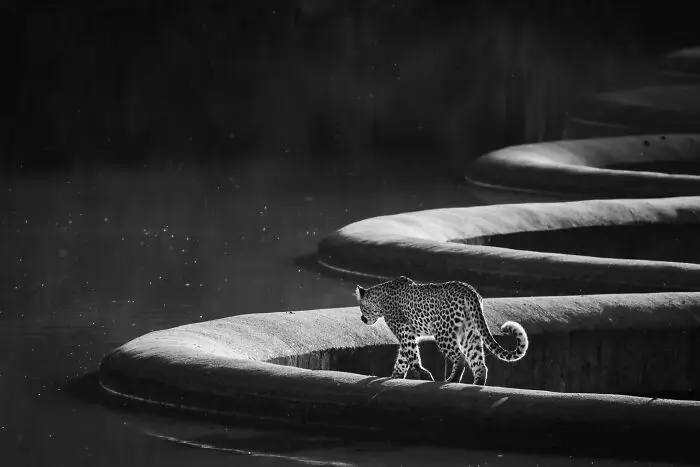
The Pilanesberg National Park in South Africa has a rich human history that dates back to the Stone Age. For centuries, people coexisted here with leopards and a diverse range of other wildlife. Imagine it’s the 13th century. You’re a hunter-gatherer in this ancient volcanic complex and your job is to find and provide food for your community while avoiding dangerous encounters with lions, leopards, buffaloes, and elephants.
Now imagine you’re a leopard and your job is to provide food for yourself and potentially a cub or two while avoiding dangerous encounters with humans and other predators. These are some of the things that cross my mind when photographing wildlife. It sounds like a tough life either way, but this is all a part of co-existing within a healthy ecosystem.
This image tells a story of co-existence in today’s world. Where the newly defined lines of human architecture meet something as wild and unpredictable as a leopard. Well before Pilanesberg became a protected area, dam walls were built to support farming and ranching. To this day, these dams remain a vital source of life for a large population of wildlife. In this case, it was simply a shortcut for a female leopard on a territorial patrol. We may not be as immersed in nature as we once were, but we surely are still a part of it. I can only hope for us to co-exist like this in more areas around the world.
The key to making this shot possible was an understanding of the subject and its behavior. Guiding in an area for a while allows you to begin to identify and notice certain habits from different individuals. This particular leopard is very relaxed in the presence of vehicles to start, which made it easy for me to maneuver into positions without disturbing her. As she made her way towards the dam wall, I positioned myself in line with the wall in case she crossed over it, and of course, she did.
9points
#24 The Little Hunter By Winfried Wisniewski
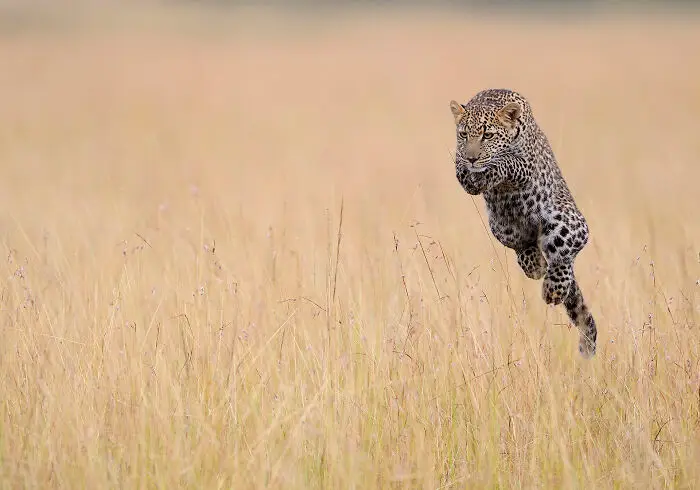
For several years, I was photographing for a new book, “Der richtige Augenblick” (“The right moment”). I tried to find the right moment in the behavior of birds and mammals, for example, fighting ruffs and black grouse, and hunting eagles. I spent a long time in Africa trying to photograph the fascinating hunt of cheetahs and leopards. One day in March 2016, I followed a leopard mother with her half-grown cub in the high grass of Mara Masai Preserve. The young leopard played with its mother and stalked her again and again and jumped on her back. It was very difficult to photograph, because you couldn’t see the young in the high grass at all. When you saw the cub, it was already in the air. So you had to anticipate where the young leopard was and rely on your autofocus system to focus on the animal. At least once it worked. In the end, it was luck.
9points
#25 The Whale By Stephane Granzotto
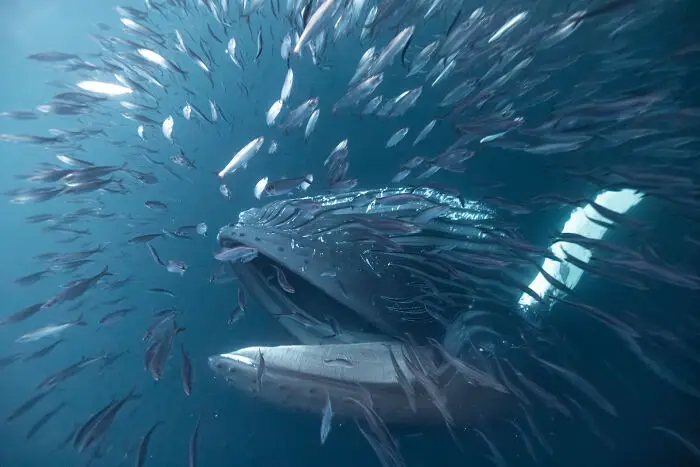
I’ll never forget the moment I pressed the shutter. Right in front of me, a humpback whale suddenly shot up, its enormous mouth wide open. It swallowed an entire school of herring in one dramatic gulp. The scene unfolded north of the Arctic Circle in Norway during the winter. What makes the photo even more remarkable is the invisible teamwork behind it: a pod of orcas had spent minutes herding the fish into a tight ball, herding them with precision. And then, from the depths, the humpback whale suddenly appeared, taking advantage of the chaos to feed.
Through my lens, I captured not only the power of this moment but also the complexity of ocean life: a web of competition and cooperation, of survival and opportunity. It reminded me that every photo is more than a frozen image; it tells a story about connection, timing, and the fragile balance that sustains marine life.
8points
#26 Massive Migration By Barrett Hedges
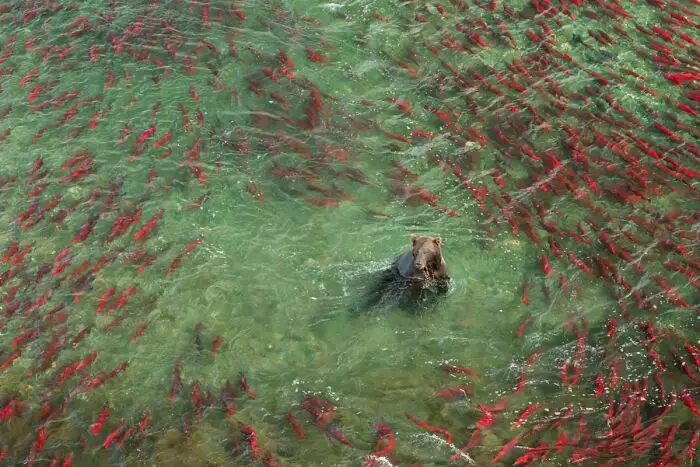
The salmon migration is one of the greatest migrations on Earth. Every year, I have the opportunity to witness the salmon run and photograph it, and it’s always exciting. I had been photographing brown bears chasing after salmon for many years and was happy with the photos I was getting. However, I started to seek a new perspective beyond just eye level with the bears. Finding an area that could provide the shot I envisioned was challenging. I explored many locations where brown bears chase fish, but none of them offered the perspective I was looking for.
When I found this cliff, so close to the river, I was thrilled by the possibilities that vantage point could offer. However, salmon runs vary each year in terms of how many fish return and when they return, so you never know what the salmon run will be like until you arrive on location. With salmon runs dwindling in many parts of Alaska, I wasn’t sure if the type of shot I was hoping for would even be possible. But when the day finally came and all the elements aligned—the salmon at peak migration, a large return of fish, the weather, and a brown bear swimming by—it was an incredible moment. I was able to capture so many sockeye salmon swimming around the brown bear in the river as it tried to catch them!
Taken in Katmai National Park. Ursus arctos horribilis and Oncorhynchus nerka.
8points
#27 Fierce Encounter By Bo Wang
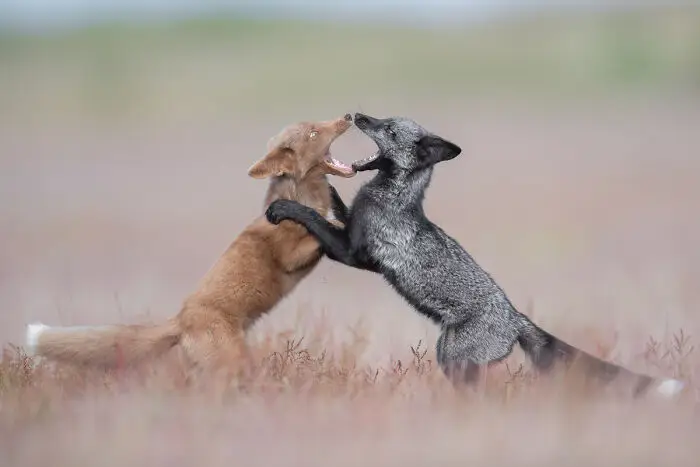
In this captivating photograph titled “Fierce Encounter”, the raw energy and intensity of the natural world come to life. At the heart of the image, two Red Fox kits, one sleek silver-colored and the other striking cinnamon-colored engage in a thrilling confrontation that evokes a sense of primal power.
The process of capturing this photograph involved immersing myself in the territory of the foxes, assuming the role of a nature photographer and respectfully blending into their natural habitat. On San Juan Island in the state of Washington, I spent several days studying the behavior patterns of the foxes as well as the surrounding area. Then, I selected a location where the foxes were frequently seen for shoot.
One day, I took my position amidst the island’s thickets and chose the best background and foreground for better results, patiently awaiting the appearance of the foxes. Finally, the moment arrived as the two fox kits engaged in their fierce encounter right before my eyes. Swiftly adjusting my camera settings, I aimed to capture the heightened expressions and intricate details of the foxes. Every movement presented a potentially singular opportunity, and I remained fully absorbed in capturing the essence of that fleeting moment, seeking the most authentic and vibrant composition. This process encompassed more than just technical challenges; it was a unique experience of merging with nature. I deeply felt the power of the natural world and the untamed allure of the foxes.
8points
#28 Sticky Situation By Anton Sorokin
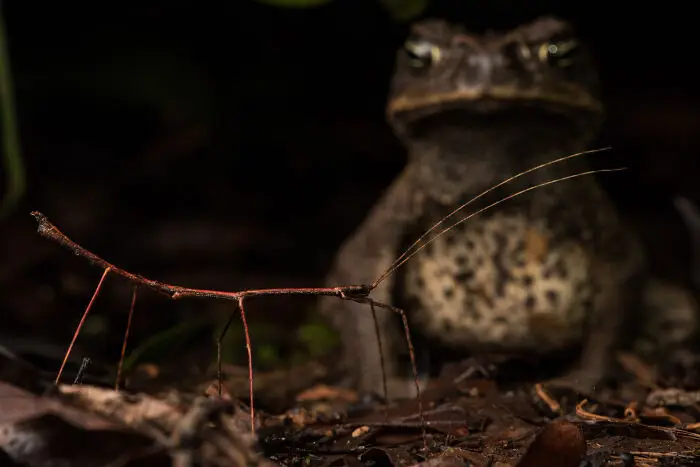
A dramatic moment on the Amazonian forest floor as this stick insect has wandered into a precarious position in front of the cane toad (Rhinella marina). Voracious predators, these toads are known for eating any smaller animals that fit into their mouths.
As I hiked through the Amazonian forest at night, I saw the toad from a distance, leaning forward and slightly angled at the forest floor – its body language told me something had caught its interest. I very slowly approached so as not to disturb the toad, and as I got closer, I could make out a stick insect that had wandered into a very dangerous situation on the forest floor in front of the amphibian.
The insect, realizing the danger, holds completely still, hoping its camouflage will save it. The toad knows its prey is nearby but is unsure of where and watches for any sign of movement to betray the location.
I lay down on the forest floor to get an intimate perspective of the scene – I waited for a long time, but of the 3 participants, my patience was the first to run out as I was being bitten by sandflies and mosquitoes. As a result, I was not able to see the resolution of this life -or- death game of patience and do not know how it ended.
8points
#29 Two Owls On The Church By Simone Baumeister
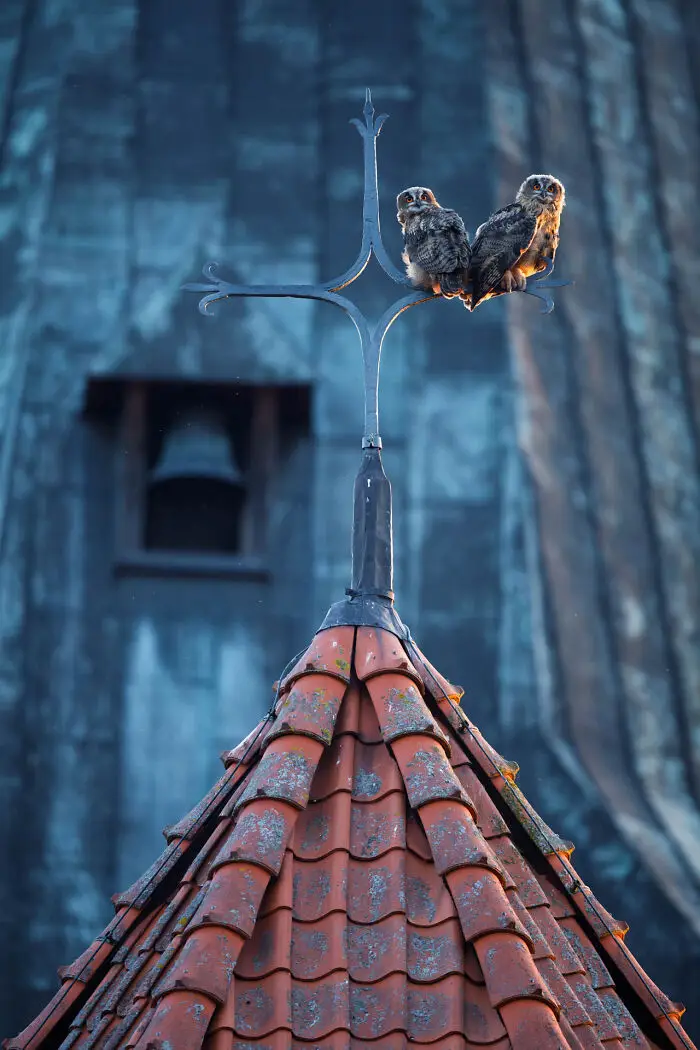
In this area, there is a very large population of Eagle owls. There are Eagle owls in every quarry, sandpit, gravel pit, and also at some churches. In recent years, I have visited the areas where many walkers spend their leisure time. So the animals there are less shy of people.
As soon as the adult birds leave the breeding grounds after about 5 weeks to keep watch from surrounding trees or houses, and the chicks start to explore the territory on their own, it is a good time to take pictures.
The young animals made their first flight exercises and the first hunting attempts in my unhidden presence. They flew at the church roof, crashed during their first landing attempts at the high cross at the church, and cleaned their feathers before taking a nap. All in the presence of the likewise relaxed old animals and me.
These two young sibling Eagle owls lived at a church in northern Germany – Emsland. After a few weeks, the young owls learned to fly. While sitting at the cross in the evening, the owlets were waiting for their mother.
8points
#30 My New Toy By Celia Kujala
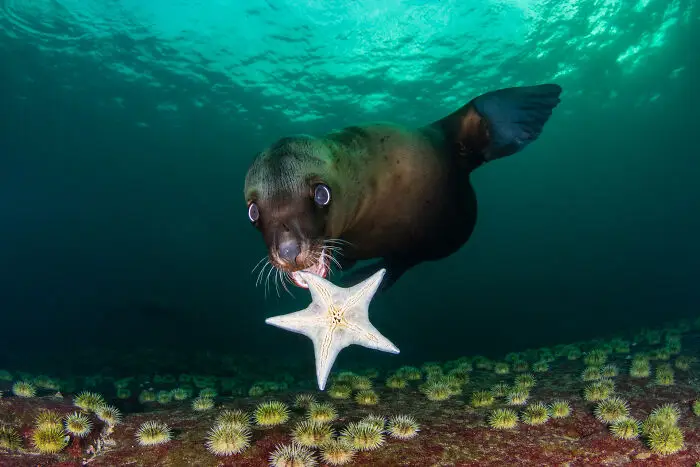
Play is very important in the development of young Steller sea lions and they love playing with anything they find in their environment. When I was diving at Norris Rocks off Hornby Island, British Columbia, Canada, I watched this young sea lion play with a starfish. As I watched her, she swam over to me to show me her beautiful toy. I was able to capture the image just as she was presenting the starfish to me. Sadly, Steller sea lions are listed as Near Threatened on the IUCN Red List. By observing their playful nature, I hope people will feel a connection with them and want to protect them and their environment.
8points
#31 Patterns Of Africa By Mateusz Piesiak
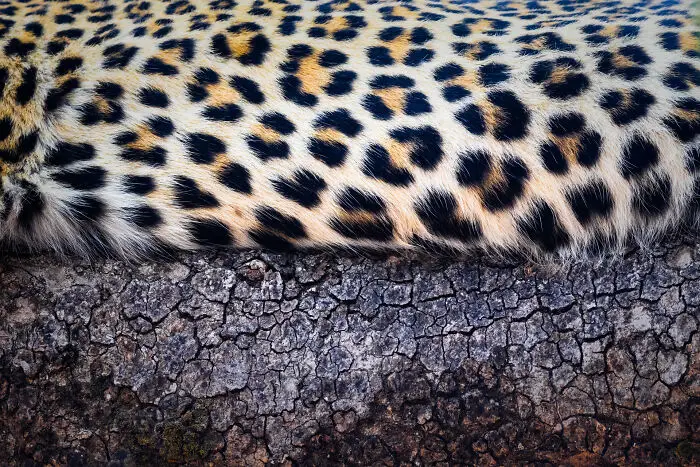
During an expedition to the South Luangwa River in Zambia, I came across a leopard resting on a tree branch. He seemed clearly content after enjoying a hearty meal. We spent several hours with him, quietly watching him sleep in the warm afternoon light. After a while, I decided to capture the scene from a different perspective. I attached a teleconverter and framed the shot so that the leopard’s fur and the texture of the tree trunk completely filled the frame. The result was an intriguing composition that emphasized the diverse textures and natural patterns of Africa.
7points
#32 Marble Theatre By Massimo Zannini
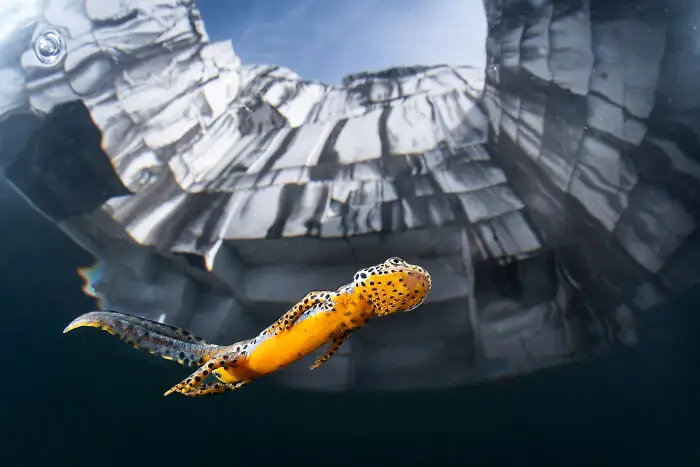
In spring, salamanders, like all amphibians, begin their breeding season. During this period, they inhabit various aquatic habitats, including springs, small ponds, and sometimes even old abandoned reservoirs.
This photo was taken in a unique setting: the Valsora quarries in Tuscany, in the province of Carrara, which take their name from the famous white marble.
It’s a surreal environment where the impermeable material has created natural pools, sometimes as deep as ten meters. Here, these beautiful, colorful creatures have found a permanent home.
7points
#33 La Dama Blanca By Stanislao Basileo
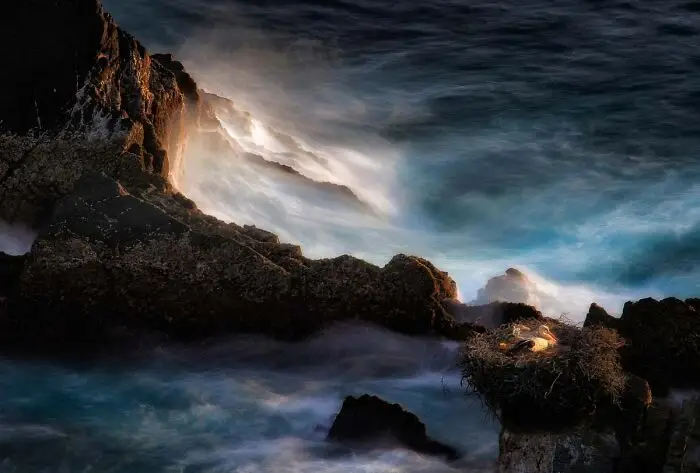
There are places in the world where nature still puts on a show. I’m talking about the Alentejo region in Portugal. Towards the beginning of April, the storks arrive to nest on the cliffs in the middle of the ocean, a unique event in the world. It took me several days to take this shot, waiting for the right light and the right waves.
7points
#34 Small Doctor, Big Patient By Gaetano Gargiulo
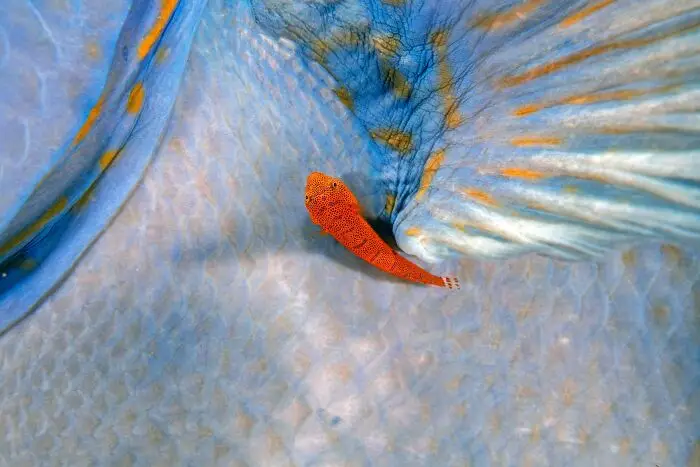
I took this picture at a popular Sydney (New South Wales) dive site called “Bare Island”.
Little known to many divers is the location of a cleaning station where you can often find large fish getting serviced by several Eastern Cleaner Clingfishes (Cochleoceps orientalis Hutchins). In this case, a very friendly and relaxed Blue Groper (Achoerodus viridis) was having the gills and the mouth cleaned, using strobes at minimal power, the red focus light, and low shutter speed I was able to shoot several pictures including several details of the cleaning action without disturbing the cleaning.
7points
#35 Wild Flight In Manhattan By Pascal Beaudenon
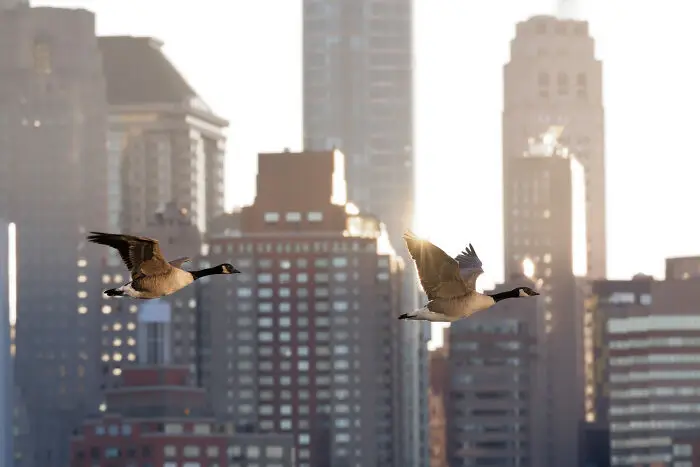
What a magnificent show of these flights of Canadian geese (Branta Canadensis) in the heart of New York City, one of the world’s largest megalopolis. They have made the city and its surroundings their home all year long. According to the NY Department of Environmental Conservation, 200,000 geese reside all year round in the state. A century ago, there were no resident geese, apart from a few descendants of captive birds set free.
Migrating geese were only seen between October and April, but in the ’50s and ’60s, the department intentionally released this species in the region of Albany to establish resident flocks for hunters. « You gotta know what you’re doing when you let something go », said Tait Johansson, naturalist-in-residence at the Bedford Audubon Society. Ever since, and after the 1990s, the birds have been considered a nuisance for some, and the population is regulated through eradication measures.
On January 15, 2009, a few minutes after taking off from La Guardia, US Airways flight 1549 made an emergency landing on the Hudson River after a flock of geese collided involuntarily with the plane. The idea behind this series is to show these two worlds from the angle of aesthetics, uniting the space and its urban structures with the local wildlife and its beauty.
This photograph was taken on November 23, 2019, at 8:29 am from the docks of Jersey City which faces the western side of downtown Manhattan. These two Canadian geese are flying at sunrise over the Hudson River towards Liberty Park, one of the places where they gather in peace…
7points
#36 Puffins In Storm By Knut-Sverre Horn
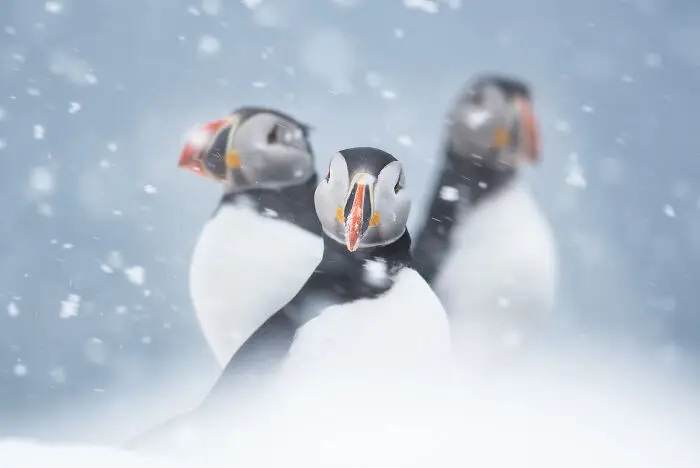
I have spent several days on the famous bird cliff on the island of Hornøya in Varanger, Northern Norway (slightly north of 70 degrees). Hoping for some heavy snow showers to make their magic work in my photos of the seabirds. Falling snow always breathes an illusion of life and presence in still images, and I will take snow photos whenever I can. (I also do this from people or dogs, too, if there’s no wildlife around.) However, the weather forecast was not very accurate though, and I returned home disappointed. After a few days, the weather reports were favourable again, and I rushed back to the island. This time, luck was on my side: dense clouds rolled from the Barents sea and shrouded the seabirds in white. I knew the shower would probably not last long. I shuttled frantically between shags, guillemots and puffins, taking flight shots and portraits as fast as I could. The island was flooded in sunlight again 34 minutes later. This puffin shot is one of the best images of the day. Nothing special – just a regular documentary photo – like 98 percent of my photos.
7points
#37 Flamingo Fly Over Lake Magadi By Richard Li
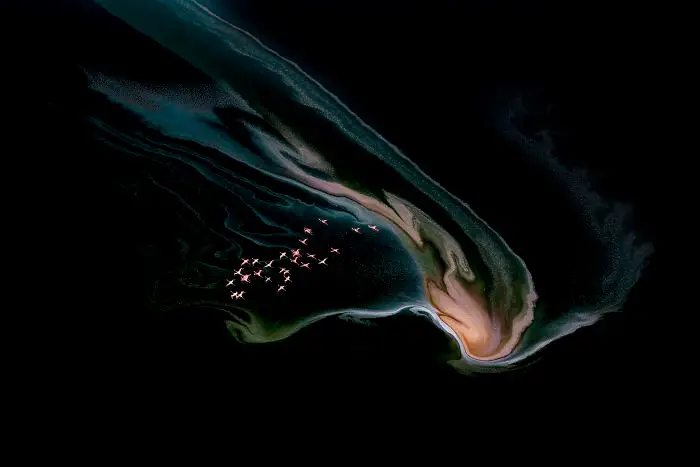
On January 10th, 2020, I flew over Lake Magadi in Kenya by helicopter, hoping to see the colorful patterns formed by various minerals floating on the water. When I found an area with particularly beautiful patterns, I asked the pilot to circle around this area for a few more laps to give me time to enjoy the rare beauty. Several flocks of flamingos flew leisurely during the period. When they flew to the appropriate position, I shot hundreds of photos with my Nikon D850 set to 200 second. This is one of them.
7points
#38 A Leopard Named Olimba Just Killed A Baboon By Igor Altuna
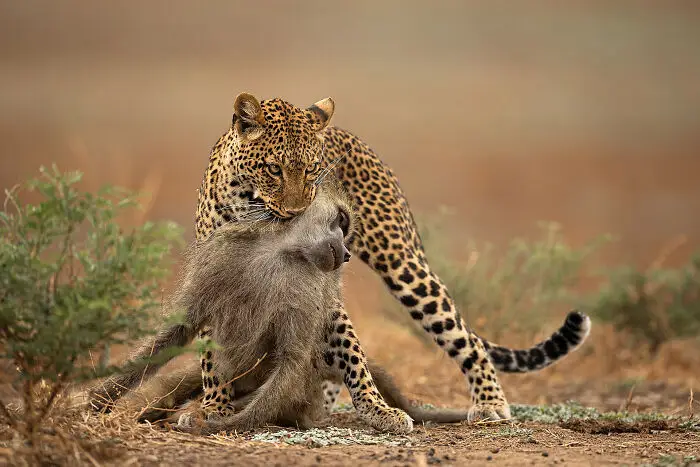
This photo was taken in Zambia, in the South Luangwa Nsufe Sector National Park. The leopard had hunted a small baboon; the baboon's older brother took the baboon with him for about 5 hours, released it, left it, and then came back. The leopard wanted to eat the baboon, but this other baboon wouldn’t let her. In the end, there was a confrontation between the two, and the older brother of the baboon also died.
7points
#39 Passenger And The Giant By Craig Parry
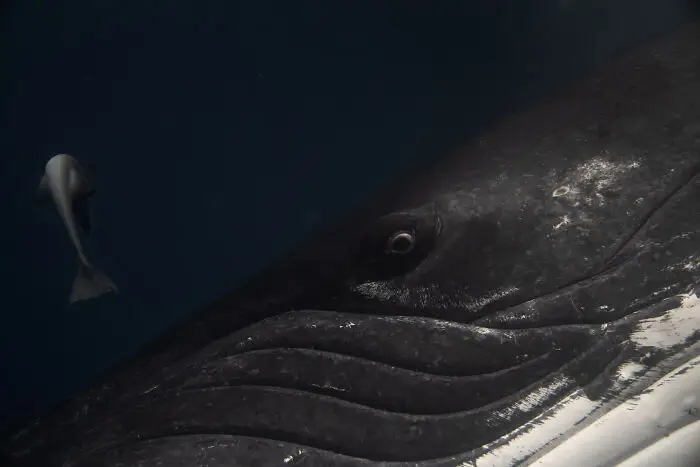
This photo, taken in August 2019 in the Kingdom of Tonga, captures the behavioral interaction between a humpback whale and a remora. When the whale approached curiously, closing the distance between us, its movement provoked an immediate reaction from the remora, which immediately darted to the other side of its body for cover. Such moments highlight the sensitivity and awareness of marine life, from the largest mammals to the smallest fish, and the complex relationships that exist within the ocean ecosystem.
6points
#40 Gorilla Greens By Richard Peters
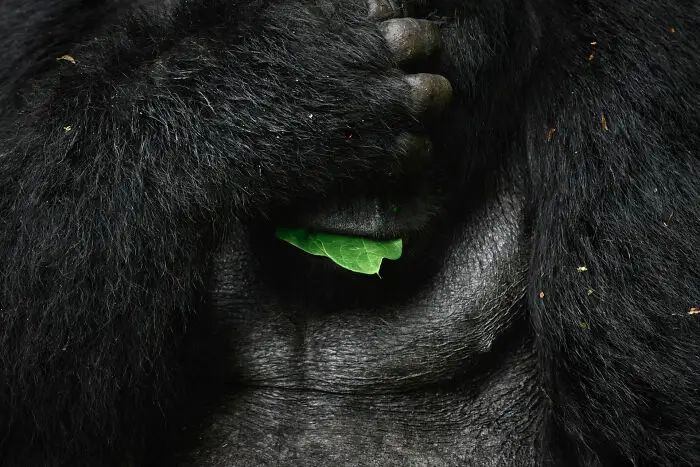
After a typical trek in Uganda’s Impenetrable Forest National Park, we found our family of mountain gorillas. After observing them for some time, this silverback walked to a fresh patch of vegetation, sat down, and began eating the leafy greens. Keeping a safe distance, when he momentarily put his hand up, the act of blocking his face as he rubbed it put all the focus of the scene on the green of the leaf. With no eyes to drawn the viewer away I loved that splash of colour becoming the focal point of the image.
6points

