



Photographing wildlife takes patience, a good eye, and often a lot of luck. The Nature Photographer of the Year (NPOTY) contest brings together photographers who manage to capture fascinating moments in the wild, showcasing the beauty and diversity of the animals and environments that make our planet so special.
While we wait for this year's winners to be announced, we thought it would be a good time to look back at some of our favorite wildlife photos that made the finalists' lists between 2016 and 2025. Earlier, we also shared a selection of photos from the contest's People's Choice Award, so make sure to check out that post if you haven't already!
Now, scroll down to revisit some of our favorite wildlife photography moments from the past ten years. Which one stands out to you the most?
#51 A Curious Nose By Laura Dyer
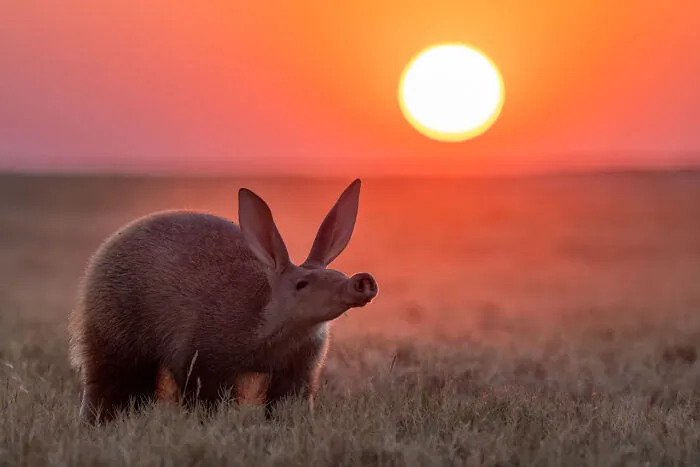
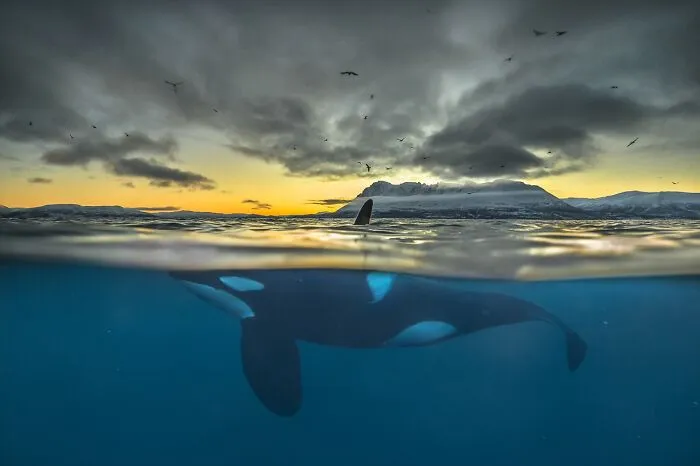
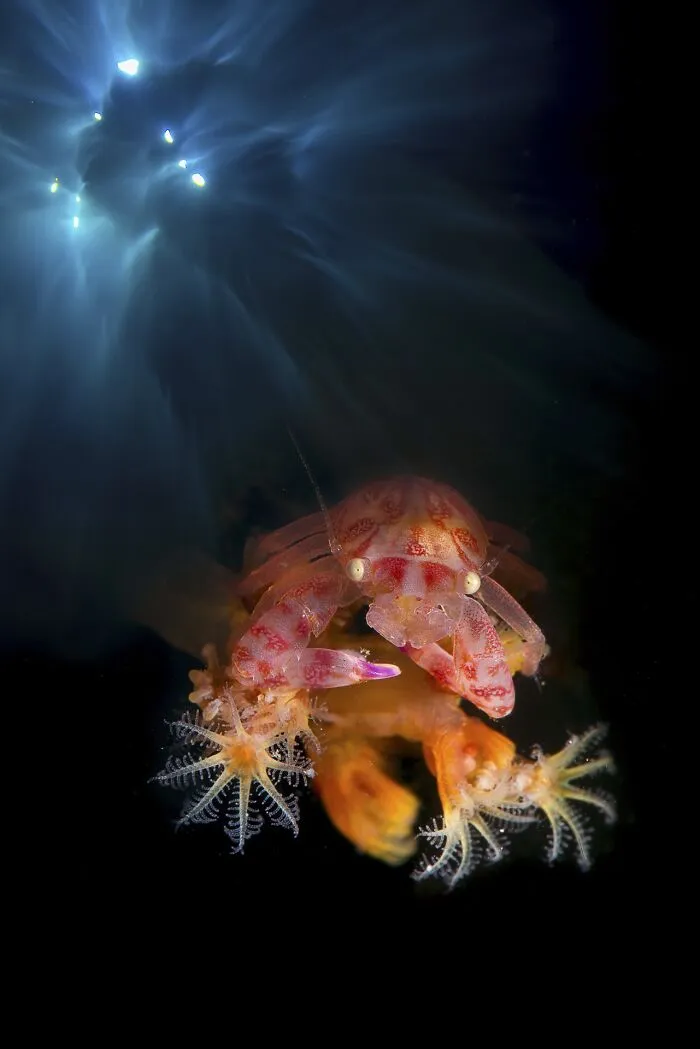
One of the rarer African finds and a lifelong dream for many is seeing an aardvark. These nocturnal creatures are notoriously difficult to spot and even rarer to photograph, as they emerge under the cover of darkness to search for ants, of which they can eat up to 50,000 in one night. Feeding at night allows them to feel safer, as they are harder to spot by predators, against whom their only defence is a quick retreat into their burrow or a battle with their very sharp claws.
Aardvarks, however, are very sensitive to the cold, feeding in bursts and returning to their burrows to both digest and keep warm. On this particular visit to the Makgadikgadi Pans, a sudden cold snap in the central Kalahari meant that night-time temperatures plummeted well below zero, lower than what the aardvark can comfortably handle. This meant its night-time feeding schedule was not long enough to meet its food requirements.
As a result, on this rare occasion, a sunset aardvark existed on Earth. He left the burrow before dark to lengthen the time he had to feed, and you can imagine my joy as I was able to spend time watching this curious-looking creature, digging for termites and using those long ears to listen intently to their underground activity. It was a truly special experience to observe an aardvark out in the open, calmly feeding and completely relaxed in our presence. It was also a once-in-a-lifetime opportunity to showcase this rare species and to see, in such sunlit detail, all that makes up one of Africa’s most remarkable mammals.
3points
#52 Silent Scream By Bence Máté
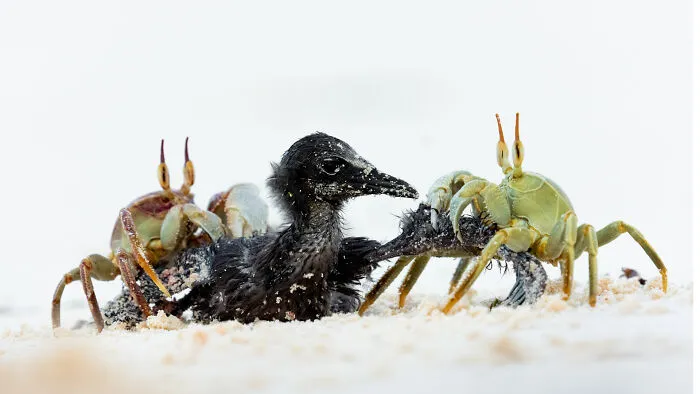
I am grateful for every moment my work allowed me to spend on Bird Island, part of the Seychelles, a tiny island of two kilometres in width made of coral sand. Its wildlife, atmosphere, and overall essence were so vastly different from what I was accustomed to back home that I felt as if I had stepped into a parallel world.
The island is privately owned, and thanks to the dedicated efforts of its caretakers, the last rat, introduced by humans, was eradicated in the 1980s. Combined with controlled vegetation management, this has allowed the island to become home to more than seven hundred thousand pairs of sooty terns today. However, I arrived outside their breeding season and saw only a handful of individuals, though other bird species were still nesting, even in November.
While waiting to photograph white terns, I suddenly heard a distress call. Not far from me, an adult brown noddy was tormenting a helpless chick of its own species for reasons I could not understand. Within moments, the struggling chick, now lying defenseless on the ground, was swarmed by crabs that began devouring it alive. It was heartbreaking to witness, but I chose not to interfere with the natural order.
In no time, nearly ten crabs had surrounded the chick, dragging it into the bushes, one of nature’s rawest moments, a silent scream lost in the vastness of the island.
3points
#53 Besties By Marcia Walters
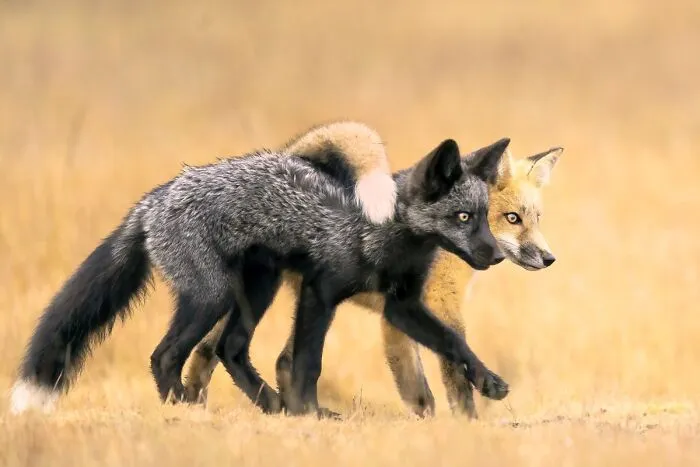
Vulpus Vulpus, Red Fox Kit Siblings
These spring fox siblings were walking together side by side in the evening. It was quiet, just these 2 fox kits and myself. I stayed at a low level. They slowly moved closer to each other. As they were walking, the tawny male kit threw his tail over the back of the female silver-phase kit. He then gently pulled her towards him using his tail. I can only think of this behavior as a show of affection. It lasted for less than a minute. They then slowly separated and continued to walk together.
I have been observing and photographing Red Foxes for 13 years. I enjoy capturing images that show their essence and their different behaviors. My goal is that the images are impactful to those who see them. This particular behavior is one that I have not seen prior or since this day. I have seen them since, on rare occasions, flip their tails over another fox but more as a playful gesture and not what I observed here, it looked to me like an affectionate hug.
Image was taken in NW Washington State.
3points
#54 Emerald Gem By Louis Guillot
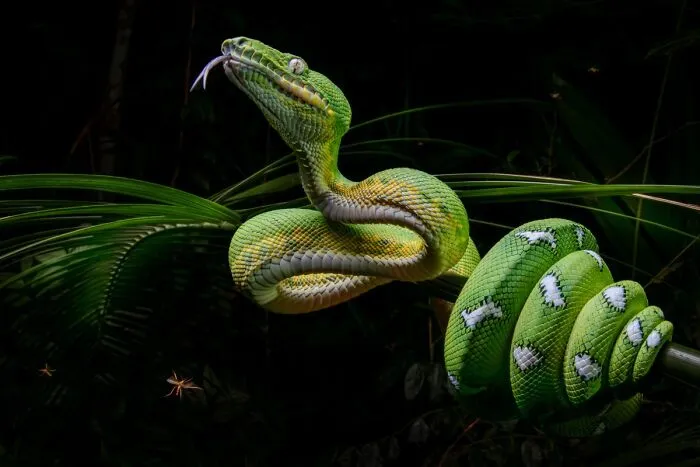
For eight months, from November 2023 to July 2024, I lived in the heart of the Peruvian Amazon rainforest in Madre de Dios. Volunteering with tourist lodges and conservation NGOs allowed me to immerse myself in this incredible ecosystem, documenting its wildlife and experiencing unforgettable moments. One of those moments came after a grueling nine-hour trek outside the Tambopata National Reserve.
As the day ended, I climbed a canopy tower to witness a breathtaking sunset over the endless expanse of jungle. Once the sun dipped below the horizon, fatigue and dehydration began to set in, and I was eager to return to camp. But as I walked along the trail with my headlamp on, a flash of vivid green about five meters away stopped me in my tracks. The intensity of the color seemed almost unreal. Intrigued, I moved closer, and my heart raced as I realized what I was seeing: an emerald tree boa, the snake of my dreams.
For five months, I had searched for this arboreal jewel during countless night walks. And here it was, just 1.5 meters above the ground, low enough to allow for perfect photography. My exhaustion was replaced by a rush of adrenaline and pure joy. This was my moment.
Despite feeling dizzy and drained after 10 hours of trekking without water, I knew I had to make the most of this opportunity. I pulled out my camera and flash, ready to capture this rare sight. The jungle had other plans, though: mosquitoes descended upon me in relentless swarms. Over 40 minutes, I amassed more than 150 bites across my body, including my face, lips, and ears. The discomfort was extreme, but I hardly cared. I had just found the treasure of the rainforest. In fact, I grew to appreciate the mosquitoes, as they added a sense of authenticity to the image.
Using a 15mm fisheye lens and an off-camera flash, I worked carefully to avoid disturbing the snake. Instead of setting up a tripod, which might have shifted vegetation and startled the boa, I handheld my camera and flash. I clipped a small torch to a nearby plant to aid with focusing in the pitch-black jungle. Then came the waiting game: I wanted to capture the snake in its natural environment, its tongue flicking out, with mosquitoes in flight around it.
Patience paid off. Eventually, I captured the perfect shot, an emerald tree boa with its tongue extended, framed by two mosquitoes in the foreground and two in the background. It was a rollercoaster of a night, but one I’ll never forget.
In post I made a mask and increased the exposure on the mosquitoes to make them more visible. More generally I increased the exposure of the whole photo as my flash didn’t fire at the correct power when I took the photo.
3points
#55 Between The Stars By Litauszki Tibor
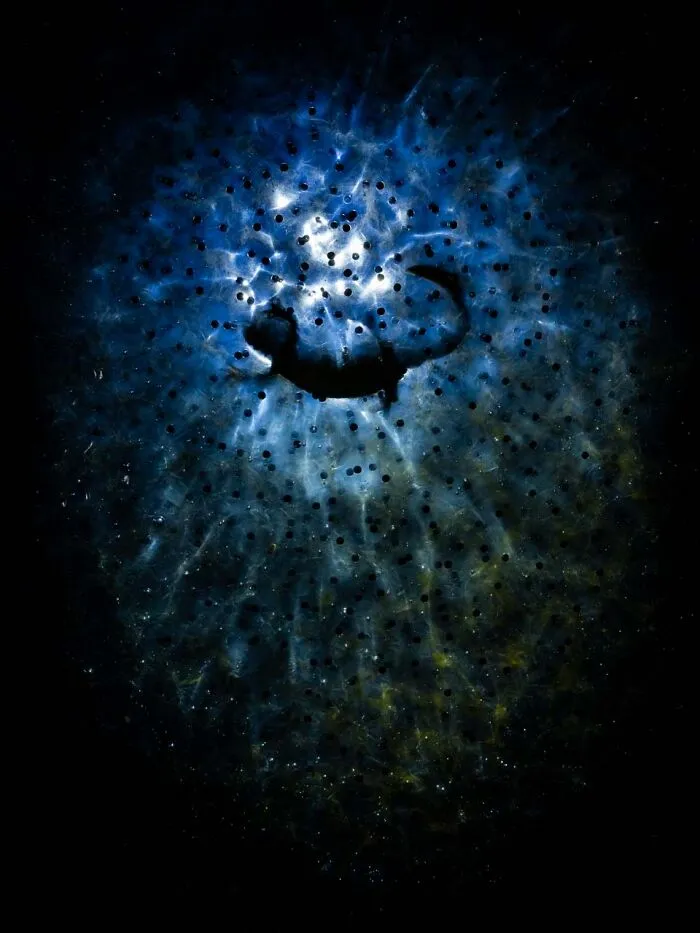
In Germany, where I live, there are many clean and slow-flowing streams nearby, which provide excellent habitat for Alpine newts. For years, I have been observing their lives closely, and this year was no exception. As soon as the frogs lay their eggs, a few days later, at dusk, the newts appear and feast on them throughout the night. Sometimes multiple newts compete for the same prey. I attempted to capture this moment underwater this year. To do this, I placed my camera in an underwater housing, secured it with weights, and positioned it beneath the frog eggs. At first, I was a bit nervous because I wasn’t sure if the underwater housing (Ewa Marine) was completely waterproof. But I thought that if no bubbles appeared, my camera would remain dry. I manually set the focus on the lens beforehand and relied on luck to ensure everything was in the right place. I waited nearby for it to get dark, and when the first newt appeared, I illuminated it with an LED lamp while exposing the shot. I initiated the camera using a homemade wired remote release. I spent four evenings with them this year, trying to capture the best possible shots. Unfortunately, there weren’t more days available because all the frog eggs were consumed, resulting in only 1-2 sharp images.
3points
#56 Follow The Leader By Torie Hilley
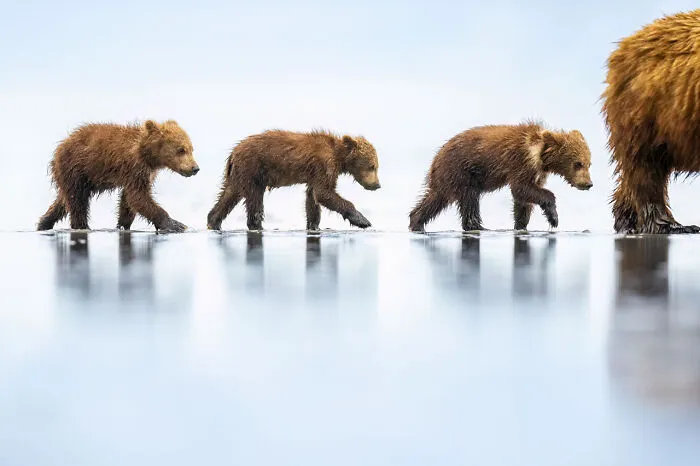
Mother coastal brown bears (Ursus arctos gyas) and cubs are constantly on the lookout for male bears that will kill the cubs to mate with the mother to pass on their own genes. To see a bear cub is special, but to see THREE with one mother is extra special. I had the privilege to encounter these three little ones in Lake Clark National Park and Preserve in Alaska, USA. While with a professional bear guide, I followed them with their mother on the mudflats as they dug for clams, hoping to catch them in a line. For several days, I trudged through the thick, sticky mud in hopes of this shot. On the last day, I saw the cubs start to line up. I dropped to one knee into the mud and hovered my massive lens over the mudflat to blur out the foreground, creating an other-worldly feel. Patience can pay off, and I was thrilled to capture this behavior, especially with all three in step with one another. Back home and ecstatic to have achieved my goal, I, unfortunately, heard that all three cubs didn’t survive the upcoming weeks. Heartbroken to hear this, it reminded me to never take anything for granted and to enjoy nature’s beauty as much as possible in that moment because you never know what happens next.
3points
#57 My City Whale By Jomtup Charoenlapnumchai
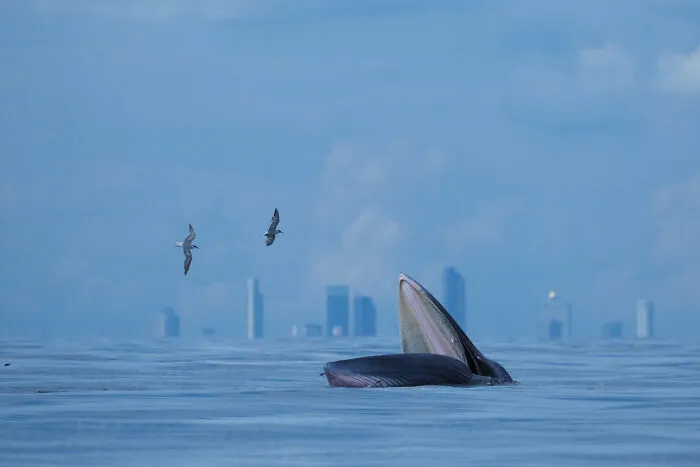
I had been at sea for 10 hours looking for the whales. It was raining and cloudy. Everything was quiet and there were no whales. When I was leaving, the rain stopped, the sea calmed and this Bryde’s whale appeared near my boat. It was a special moment. The sea was calm, the light was perfect and I hardly used any special effects. I was trying to get the camera as close to the sea surface as possible. Bryde’s whales are eating small fish by opening their mouths to let the fish in. And use the baleen to filter the fish. I took this image in the shallow waters of the Gulf of Thailand (Samut Sakhon Province in Thailand). The background is a tall building located in Bangkok, the capital city of my country.
3points
#58 Head First By Till Clémence
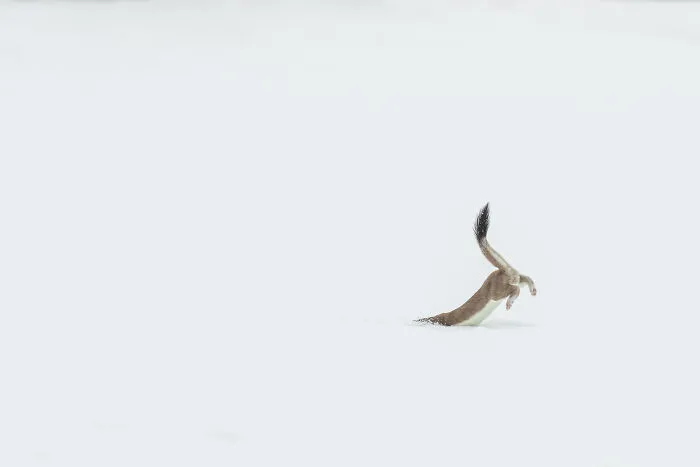
Near the town where I live, La Chaux-de-Fonds, situated in the Swiss part of the Jura mountain range, there are pastures at one-thousand meters high where some ermines, also named stoats, live. Their scientific name is Mustela erminea. Their coat changes from brown to white at the arrival of winter and becomes brown again in spring. One winter I spotted one, there had been a warm spell that had melted the snow, so its white coat contrasted completely with the green grass. After that, I went back several times to its territory, very often without seeing this beautiful animal. A few weeks later, with the arrival of spring, the ermine’s coat had turned brown. But at the end of March, the stoat was surprised by the late snow that covered the fields with white. Thanks again to this contrast, this time reversed, that I spotted the little mammal more easily.
This is also a time of vulnerability for them and they become more cautious as well. I was able to observe it from a distance before approaching it with velvet steps once it had dived into one of its prey’s galleries. I lay down in the snow, behind a small pile to remain hidden, my lens placed on a small sandbag. I then waited, staying still, for about an hour until the stoat came out and started running, diving, and jumping around again. This is how ermines hunt, non-stop for several minutes. So I stood there and photographed it in all sorts of extraordinary positions. After a good hour of activity, the stoat returned to his holes under the snow. I took the opportunity to leave.
A few days later, the snow had disappeared and the brown ermines became more difficult to observe. During this photographic experience, I was able to observe a small predator that when hunting pays little attention to anything other than its prey and potential dangers. This is why I was able to photograph it without frightening it, but I kept a certain distance so as not to disturb it in its search for food. Since then, every year I return to these fields to observe and try to photograph the ermines around my town.
3points
#59 Adelie Penguin By Zhengze Xu
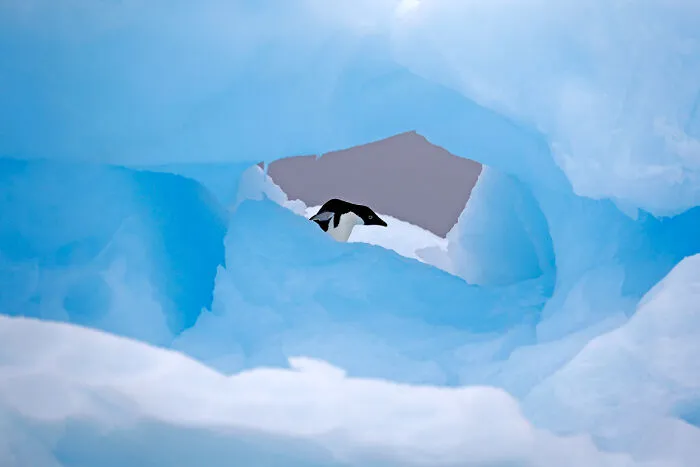
I took this photo of the Adelie penguin portrait in the Antarctica Peninsula in January 2020. It was summertime in Antarctica and all the penguin adults are busy eating krill in the sea and returning back to feed their chicks on land. This Adelie penguin was resting on one big blue iceberg while we were approaching it on a zodiac. The penguin was hiding behind and looked very curious about us tourists on a zodiac, but it did not escape. I had two lenses at that time, 500mm and 100-400mm, and I chose a 100-400mm lens to include more iceberg background and took this photo at 241mm. The blue iceberg looked like a huge fortress for the penguin and this “Host” looked at us through a big hole as a “window”.
3points
#60 Mesmerizing Cross Fox By Zita Quentin
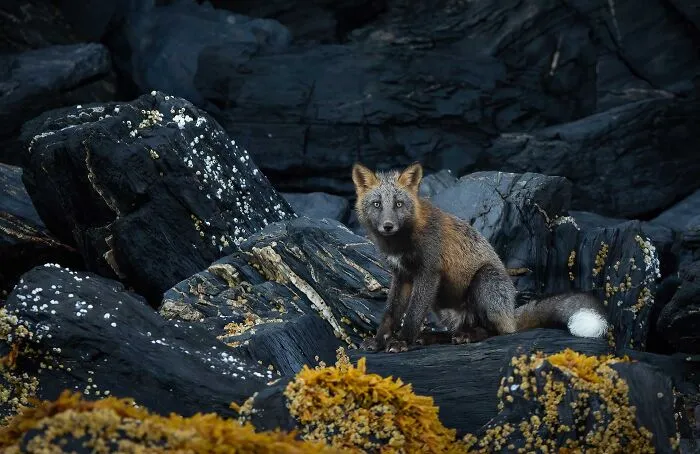
I captured this image of a cross fox handheld from a rocking boat in a remote area on Kodiak Island, Alaska. Red foxes are native to Kodiak Island and the Kodiak red fox belongs to a separate subspecies, Vulpes vulpes harrimani. There are three common color variations of them: red, silver/black, and cross, the latter with a black/brown cross on the back and shoulders. In the mornings, we went out on the boat towards the ocean to look for whales and some animals on the shore. We photographed bald eagles, black-tailed deer, and red foxes along the way. All of a sudden, we spotted a cross fox on some huge, beautiful black rock formations further away from the beach. We approached the fox slowly so that we don’t disturb him or scare him away. Luckily, he stayed on the seaweed covered rocks and I could take some shots while he was sitting in a great spot and he even looked straight into my camera for a brief moment. Looking at the scene with this beautiful cross fox in the perfect landscape made me feel like I was looking at a painting. In Alaska, foxes prefer to eat voles but they also hunt for squirrels, rabbits, or other small mammals. This cross fox was down at the beach digging for worms, fish, or sea urchins during the low tide which is normal behavior for the Kodiak foxes, especially in the morning or evening.
3points

