Photographing wildlife takes patience, a good eye, and often a lot of luck. The Nature Photographer of the Year (NPOTY) contest brings together photographers who manage to capture fascinating moments in the wild, showcasing the beauty and diversity of the animals and environments that make our planet so special.
While we wait for this year's winners to be announced, we thought it would be a good time to look back at some of our favorite wildlife photos that made the finalists' lists between 2016 and 2025. Earlier, we also shared a selection of photos from the contest's People's Choice Award, so make sure to check out that post if you haven't already!
Now, scroll down to revisit some of our favorite wildlife photography moments from the past ten years. Which one stands out to you the most?
#61 Confinement In The Seventh Left By David Jerez
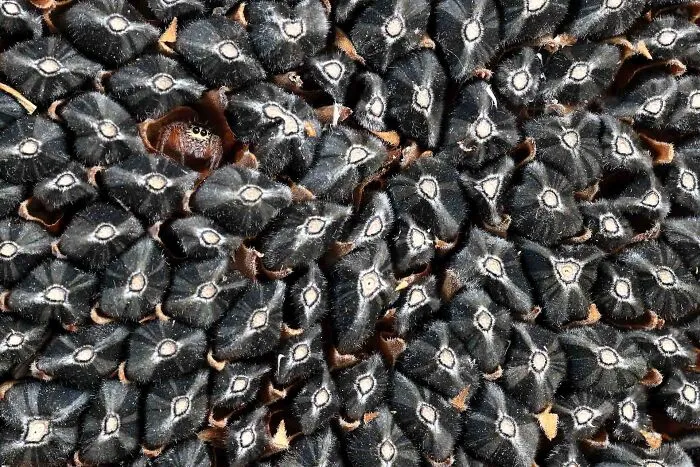
The photograph was taken in a field of sunflowers in Guadalajara, Spain, very close to my house. The objective of those days was to photograph birds feeding and bathing among the sunflowers. This little jumping spider was found, day after day, on the same sunflower. She watched me a bit strangely while I worked with the birds. When the ripe sunflower, some seeds fell. The spider took refuge in the hole, using it as a hunting ground, and that’s when this photo was revealed in front of me. This shows a natural simile. Regarding the confinement that we all suffered and that kept us in our homes, with the only connection to the outside through a tiny window.
3points
#62 High Jump By Zsolt Moldovan
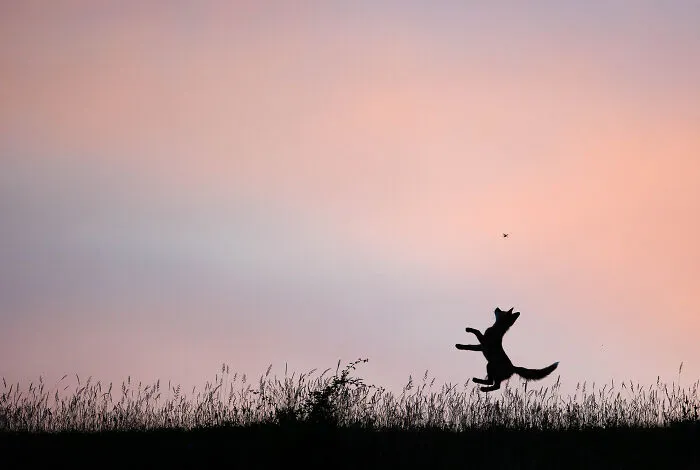
I’m working as a farmer, and luckily nature is my office. In the afternoons, after finishing my work, I spent a lot of time nearby Cernat village, taking pictures of bee-eaters and foxes. In my imagination, I have already taken several pictures, mostly of bee-eaters, as my main goal was to capture the life of our colorful little birds. Unfortunately, I didn’t manage to capture anything for a long time, but finally, my patience paid off. I set up my hide on a field next to the loess wall (where the bee-eater’s nest was), and I also managed to have a good view of the red fox family’s life. I could say it was a coincidence, but I don’t believe in coincidences. That’s the reason why the autofocus of the camera was on the fox, my finger on the shutter button, and my eye on the camera viewfinder before the jump. The scab beetle migration is a natural phenomenon that can be seen every four years in our country. I managed to catch a moment I have never seen before. The little fox showed me interesting and special behavior. That was an amazing day.
3points
#63 Last Embracec By Roie Galitz
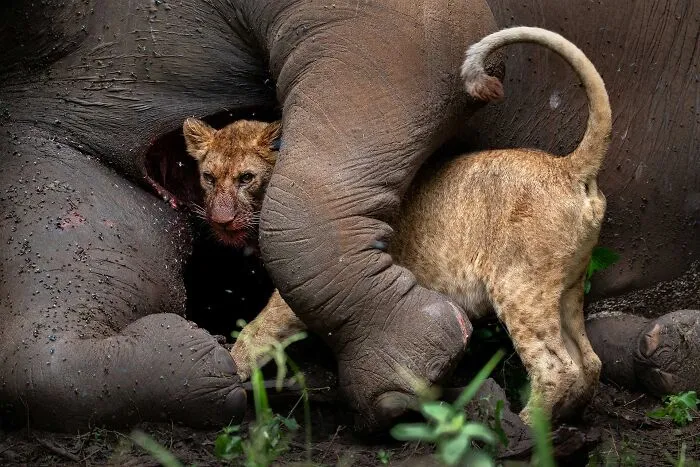
A female African elephant has died of natural causes, mainly old age. A pride of lions have found her and enjoyed the big feast. Suddenly, a young lioness, only 7 months old, came to the elephant and started working her way around her, moving between the elephant’s front legs, in a way that resembles a hug.
One of the things I like about the image, besides the composition and lighting, is the viewer’s experience with the image, which is a bipolar one. I like to watch people’s reaction to this, when they first respond with “awww, they are hugging” and after a few seconds they realize that something else is going on. This kind of engagement creates an interesting relationship with the frame.
This image was taken in Tarangire National Park, Tanzania.
3points
#64 Walking Among Fennels By Ruben Perez Novo
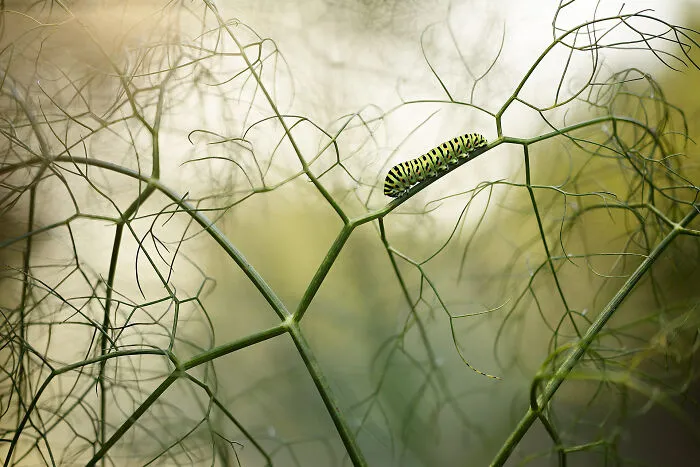
The machaon butterfly is one of the most beautiful diurnal butterflies in Europe. They have a large wingspan in relation to other butterflies within Europe. Unfortunately, a consequence of its beauty is that the species are very popular by collectors.
The caterpillar of this butterfly, the one that appears in the photo, is also very striking because of its color in green and yellow with black stripes and orange points. These caterpillars are very common to be found among fennels (Foeniculum vulgare) and they love to feed on this plant.
When I found this little machaon caterpillar it was already a little late and the sun was beginning to set. On the horizon were a few trees where the sunlight was shining through, creating a beautiful background between their leaves. To illuminate and give volume to the caterpillar I used a small led panel and with combining natural and artificial light I created this image. The photo was taken on a hot summer afternoon in mid-August in Ares – Coruña – Spain.
3points
#65 Winter Migration By Terje Kolaas
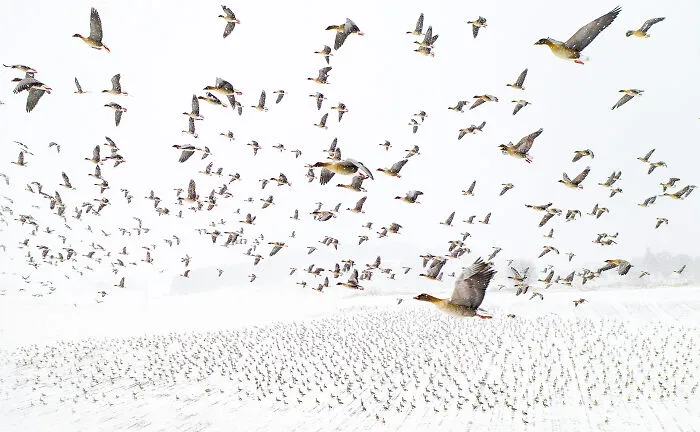
I’m priviliged enough having thousands of Pink-footed Geese litterally in my garden several months a year. More than 80.000 make a stopover here in the Trondheim fiord wetland system on their way between the wintering grounds in Denmark and Netherlands and the breeding grounds in Spitsbergen every spring and autumn and the whole scenario is simply spectacular. I have been photographing them for more than 20 years, and at at one point I kind of ran out of ideas and got the feeling that «everything» with geese was already done. So what now?!
Thanks to the amazing drone technology the element of air opened up a few years ago, and the wet dream of photographing the geese as being on of them, a part of the flock, up in the air actually became possible. Dozens of failed attempts during the last years, partly because of fragmented landscapes, disturbing buildings, human artifacts and messy backgrounds. But during the strange and rare events of blizzards and heavy snowfalls in late April 2020, I realized that the photos of my dreams were within reach; photographing the geese from the air against a pure and clean snowy landscape. I positioned myself close to a field where I knew that the geese would feed regulary and waited for them there. As soon as I heard incoming geese, I took off with the drone and waited for them in the air. Most of the shots did as always have something inperfect to them; like being too far away, being unbalanced, having a wing or a head cut or some birds overlapping wrong. But this particular one I`m very happy with. And I`m very happy that the jury of the NPOTY 2021 liked it too!
3points
#66 Living In The Moment By Amit Eshel
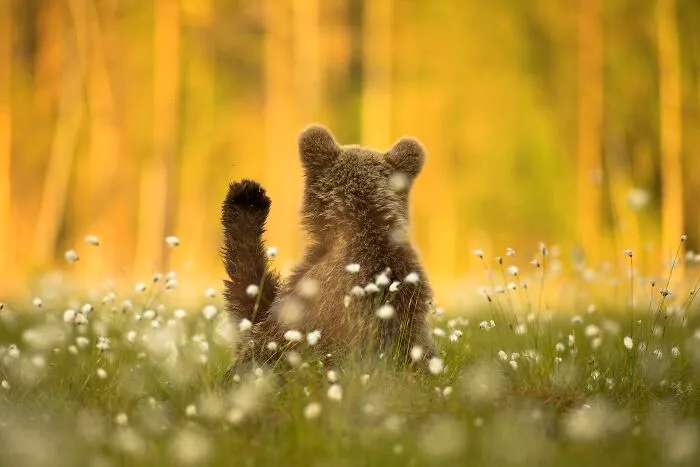
This image was taken in east Finland. Every early summer some small, unremarkable brown and green flowers develop distinctive white bristle-like seed-heads that resemble tufts of cotton. I planned my photography project to be there at the right time for the bloom. Peak flowering lasts only two weeks a year and varies from year to year depending on the weather.The bears in this area are pretty shy and afraid of people so they are mostly active at dusk and dawn. I spent a few days laying down in a tiny claustrophobic one person hide, hoping for something to come out to an open wetland.
One evening I was fortunate to witness a beautiful family of mother and triplet Eurasian Brown Bears stepping out of the forest and playing in the beautiful golden light. When one of the cubs got tired of playing he left his siblings and sat down to rest in a special way with his leg lifted up.
He seemed enjoying the moment watching the beauty of his environment while the golden rays of the sun painted the forest in gold. I liked the way he was sitting with his back to me like someone who has no worries in the world and shooting from this angle tells his story with the environment in an unconventional way.
He seemed enjoying the moment watching the beauty of his environment while the golden rays of the sun painted the forest in gold. I liked the way he was sitting with his back to me like someone who has no worries in the world and shooting from this angle tells his story with the environment in an unconventional way.
As photographers we are often fixated on photographing the animal looking at us and not away from us. So it is good to try and think out of the box sometimes. There is always a surprise in a bear and I think this is why so many people including myself feel a special connection with this animal and a strong need to protect them in order to make sure they stay on our planet for good.
3points
#67 I Can Pass? By Adriana Claudia Sanz
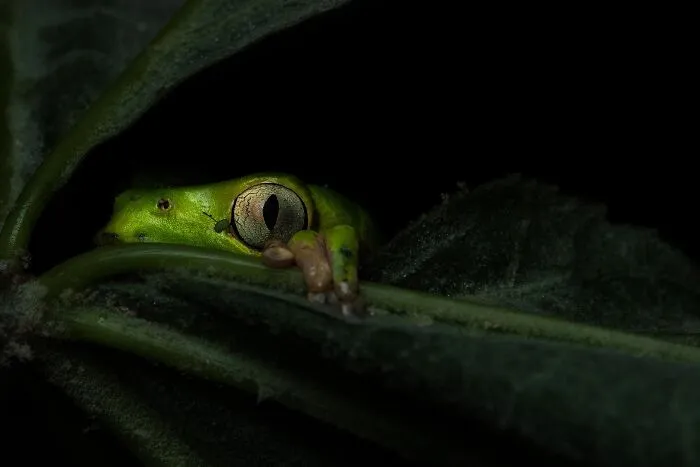
Frogs are commonly associated with tales of witches and curses, and this makes us look down on them. Children are told: “if you touch a frog, your hands will be covered in warts …”. This creates a sad myth generation after generation that promotes its contempt, abuse and annihilation that this especies. Today around the world, the number of frogs is decreasing alarmingly and that must change. These beautiful beings, so important in our ecosystems, must be dignified. Through photography I seek to dignify them, that they look almost human, that their image impacts, that people fall in love with them. In my photo, my frog just shyly appears on the scene, even in fear of being destroyed, hoping that we will finally start loving it. We must love all living beings, they are all masterpieces of nature that must be respected and loved as much as we love ourselves.
This photo was taken in october, in Misiones (NE of Argentina), one night in spring when they planned to mate. The Missionary Monkey Frog (Phyllomedusa tetraploidea) is a tree frog that moves very slowly. This female carried the male on her back, that made her even slower. It only took a flash to illuminate her slightly as she moved very slowly through the vegetation. This allowed me to generate a climate of intimacy, mystery and fragility where I show her scared and afraid of being seen.
3points
#68 The Ice Grin By Dmitry Kokh
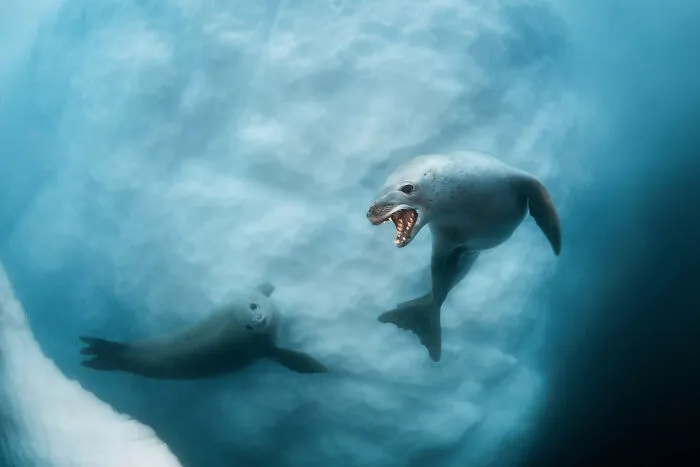
One fine day of our Antarctica trip we were diving next to a beautiful iceberg. Our expedition was coming to an end, and we already made nice leopard seal’s shots, which was our main target. I didn’t expect much from this dive – the weather got worse and there were no animals around. So, our plan was just to make some underwater pictures of each other next to an intricate ice formation.
In the middle of the dive my strobes ran out of batteries, and I switched to static lights. Just minutes later I saw two Crabeater seals making circles around us and coming closer and closer. They were in very playful and curious mood and I’m very sure they were attracted with those lights. Then one of the seals showed me teeth, it looks a bit scary on the picture, but I’d consider this gesture as a sign of curiosity and excitement.
3points
#69 Big Blue By Paul Goldstein
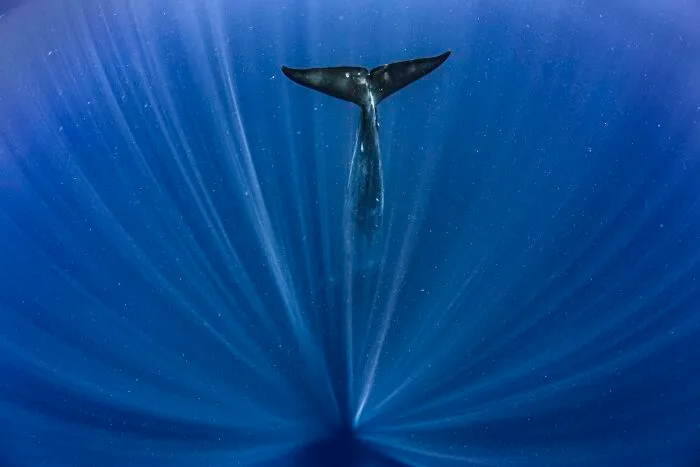
This image was taken in the East Coast of Trincomalee Sri Lanka. I have guided several wildlife tours to Sri Lanka in the past but my colleague in Colombo had mentioned this East Coast swimming tour to me and it became a staple for a few years. The subjects are super-pods of sperm whales and the occasional blue. There are days with no whales and you are many nautical miles from shore looking for distant blows. It is a long and often hot quest but with small boats and very good local guides.
You also need to be a strong swimmer, something I had trained for, as well as most of my clients. It is critical to be sensitive in the water. Too much splashing and bubbles scares the cetaceons and this is exactly the reason that no oxygen tanks are permitted, fortunately. That morning we first spotted this Blue whale and during the second dive I was determined to get something special in front of my lens.
There is something humble, enchanting and also terrifying about such a huge mammal the size of six double decker buses, when it passes below you. But I pulled myself together, took a deep breath and followed it down. Not easy when the camera housing is acting as a life jacket! My ears were protesting as were my lungs and I pointed the rig down and squeezed off a couple of images as the leviathan dropped vertically into 3000 feet of deep blue.
Just being in the water with whales is something close to maritime witchcraft, but when it is a Blue it takes some recovery time, in this case physically and mentally!
3points
#70 Jurassic Park By Roberto Marchegiani
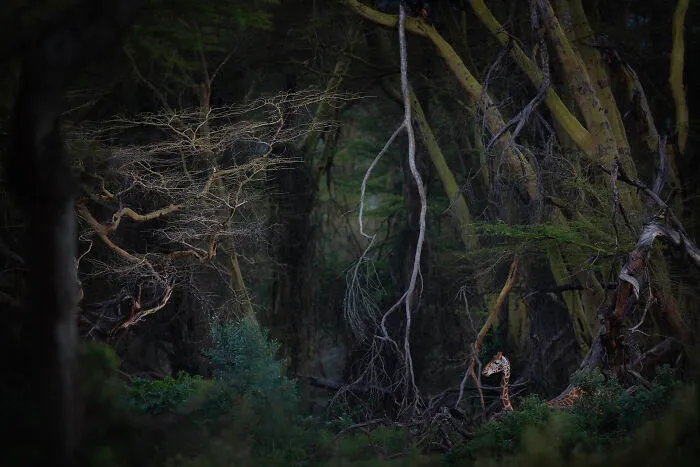
I took this photo in Nakuru National Park, Kenya. To have a better chance of finding good light I went on a deliberately organized safari during the rainy season. Just before sunset my friends and I noticed a group of giraffes passing in front of the forest. With a long lens (600mm) I found a magnificent glimpse into the forest that stroke me a lot. So instead of taking pictures to the giraffes passing by, I kept my post still hoping for a glimpse of the giraffes walking past at that point. The angle was narrow, there was a lot of vegetation in the foreground that could damage the image. So I used an aperture as wide as possible.
In the end, I was rewarded by my stubbornness: the giraffes passed exactly in the right place. The scene reminded me of a Jurassic landscape, with a herbivorous dinosaur in the same position as the giraffe.
3points