







The Natural History Museum has announced the winners of its 57th edition of the Wildlife Photographer of the Year competition. More than 50,000 images were reviewed by the jury, but only 100 finalists were selected. Bored Panda has already shared the marvelous winner shots, which you can check here, so this time we want to encourage you to become a judge yourself and select, in your opinion, the most stunning photograph!
The Natural History Museum chose additional 25 photographs, from which they ask the public to select the recipient of the People's Choice Award. Look through the amazing pictures below and pick your favorite ones! You can vote for the best image here. Voting closes on 2 February 2022 and the winner and four runners-up will be announced on 9 February 2022.
#21 The Jump By Karl Samitsch
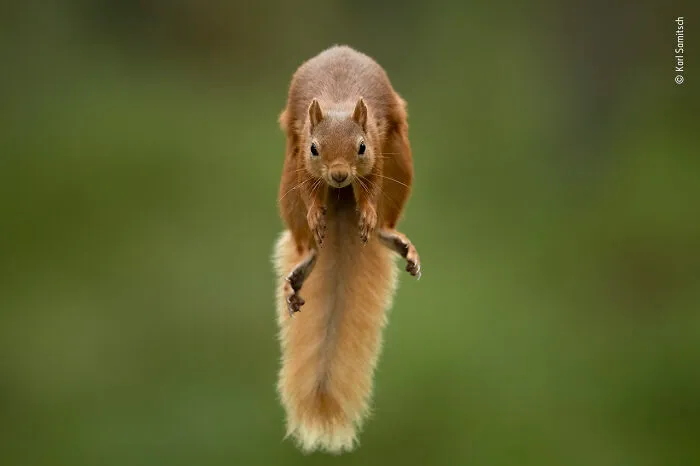
"Karl was in the Cairngorms, Scotland, with a friend who took him to a forest where red squirrels were used to being fed.
They placed hazelnuts on opposite branches of two trees and Karl then positioned his camera on a tripod between the branches facing the direction a squirrel might jump. Setting his camera to automatic focus, he waited in camouflage gear behind a tree, holding a remote control. After less than an hour, two squirrels appeared. As they leapt between the branches, he used the high-speed burst mode on his camera, and of the 150 frames, four were sharp, and this one perfectly captured the moment."
Report
60points
#22 Building An Egg Case By Javier Aznar González De Rueda
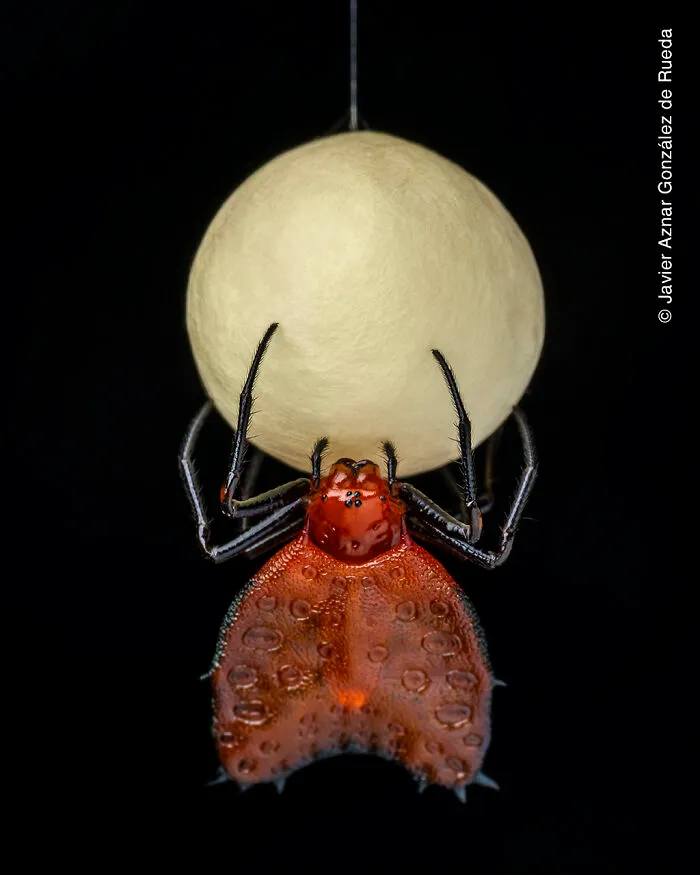
"While out on a night walk in the Amazon rainforest near Tena, Ecuador, Javier spotted this little female thorned heart orb weaver spider delicately constructing her egg case.
Hanging from a strong silk thread, these female spiders spend hours encasing their eggs in a silken cocoon, which may contain up to several hundred eggs. On this dark night, the egg case resembled a pearly white full moon."
Report
55points
#23 Dolphin Hug By Jaime Rojo
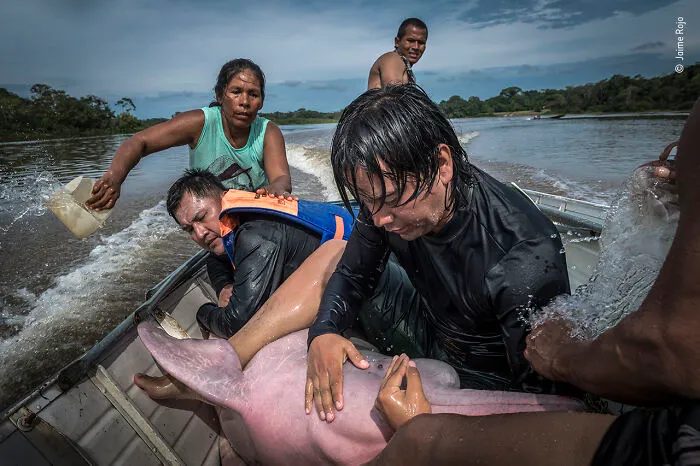
"Jaime watched on as Federico Mosquera, a biologist from the Omacha Foundation, Colombia, soothed an Amazon river dolphin.
These dolphins are extremely tactile animals and direct contact calms them – keeping them hydrated when out of the water is also extremely important. The team from Omacha and WWF were transporting the dolphin to a temporary veterinarian facility in Puerto Nariño, Colombia, to install a GPS tag in its dorsal fin. The project is part of a broader scientific attempt to understand river dolphin health and migratory patterns. The goal was to tag five individuals, but high waters gave the dolphins a wider roaming range than usual, and the crew struggled, tagging only one during the expedition."
Report
52points
#24 Living Together By Dhritiman Mukherjee
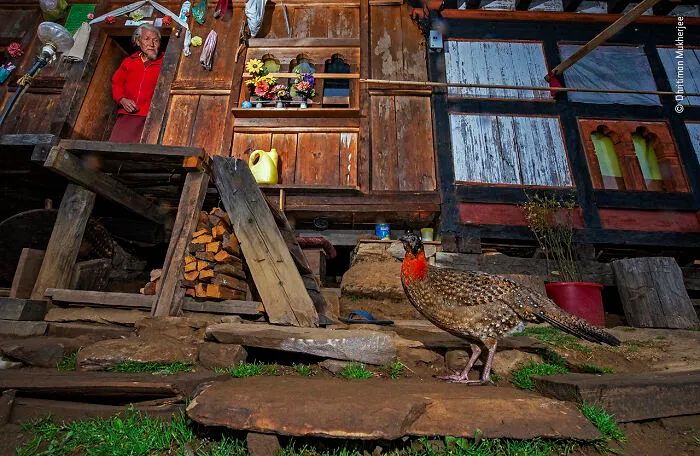
"For Dhritiman, Bhutan is an amazing place.
He loves how most of the people try to live together with nature. Satyr tragopans, a rare species of Asian pheasant, are widely hunted for food and plumage, and are normally skittish and very shy. But in this village near Punakha, the birds appear at ease and perfectly relaxed in the presence of the people who live there. Before he captured this image, Dhritiman had been trying to photograph the satyr tragopan in India since 2008, but the birds would always run away the minute they spotted him. Upon hearing of communities in Bhutan coexisting harmoniously with the species he knew he had to witness it for himself."
Report
46points
#25 Working Together By Minghui Yuan
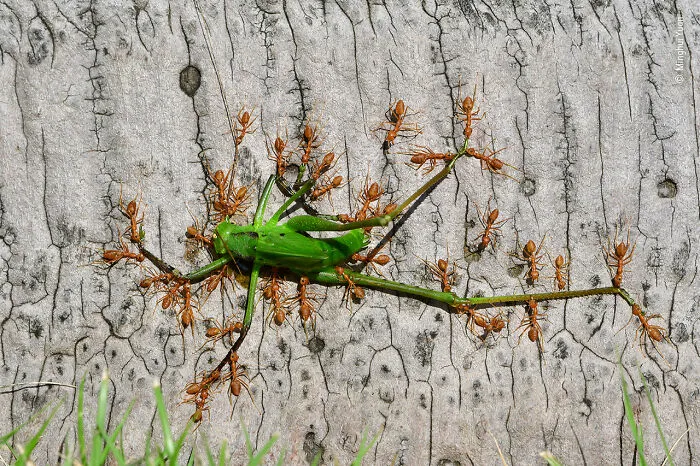
"There were several big trees near Minghui’s hotel in the Xishuangbanna Tropical Botanical Garden in Yunnan Province, China, and he’d noticed green tree ants on the trunks and was fascinated by their behavior.
This species of ant builds its nest in the tree crown, are ferocious by nature and good at catching all kinds of insects. One morning Minghui noticed a group of ants working together in perfect unity to restrain a green katydid. These remarkable ants don’t always kill, they have been observed ‘farming’ certain types of insects, including leafhoppers. The ants offer leaf hoppers protection from predators and parasites so that they can feed on the sweet sap the leafhoppers excrete."
Report
41points


