




The Natural History Museum has just announced the winners of its Wildlife Photographer of the Year competition, and the images are as stunning as always.
The 57th edition of the contest saw 50,000 entries from 95 countries chasing the prize, with shots ranging from a reindeer battle to a venomous spider hiding under a bed.
However, it was the French underwater photographer and biologist Laurent Ballesta who was crowned this year's Wildlife Photographer of the Year for his enigmatic picture, Creation, that captures camouflage groupers exiting their milky cloud of eggs and sperm in Fakarava, French Polynesia.
Every year, for five years, Laurent and his team returned to this lagoon, diving day and night so as not to miss the annual spawning that is so rare, it only takes place around the full moon in July. In total, Ballesta has spent around 3,000 hours trying to capture it.
Continue scrolling to check it out together with the other marvelous shots.
More info: nhm.ac.uk
#1 Category Winner. Animal Portraits: 'Reflection' By Majed Ali
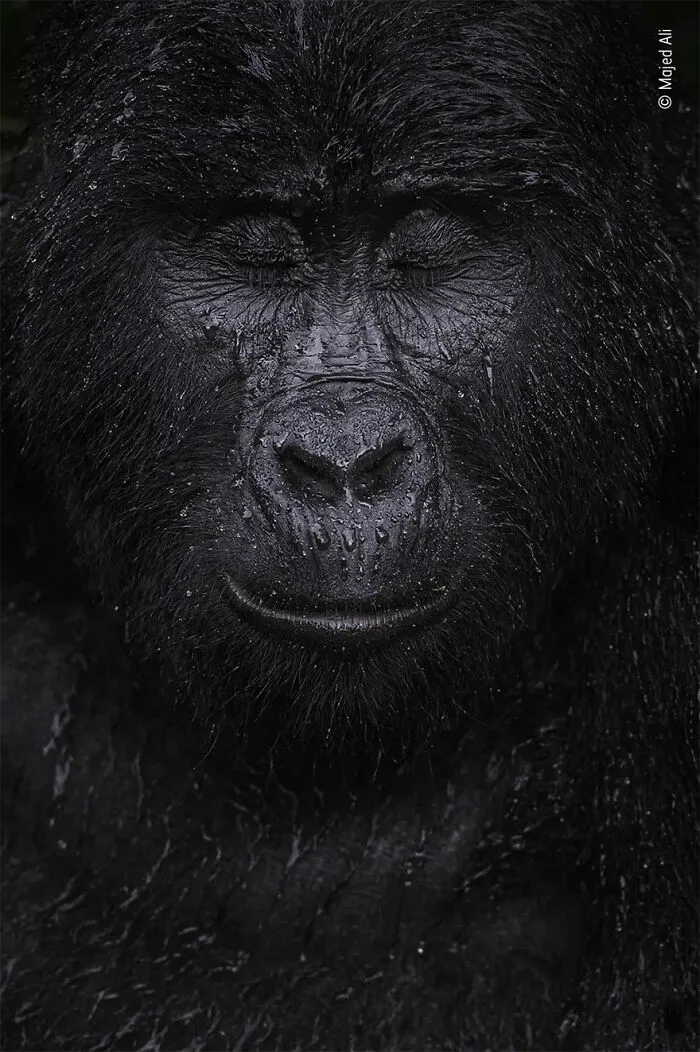
"Majed trekked for four hours to meet Kibande, an almost-40- year-old mountain gorilla. ‘The more we climbed, the hotter and more humid it got,’ Majed recalls. As cooling rain began to fall, Kibande remained in the open, seeming to enjoy the shower.
Mountain gorillas are a subspecies of the eastern gorilla, and are found at altitudes over 1,400 metres in two isolated populations – at the Virunga volcanoes and in Bwindi. These gorillas are endangered due to habitat loss, disease, poaching and habitat disruption caused by human activity."
Report
129points
#2 Highly Commended. Natural Artistry: 'Stardust' By Christian Spencer
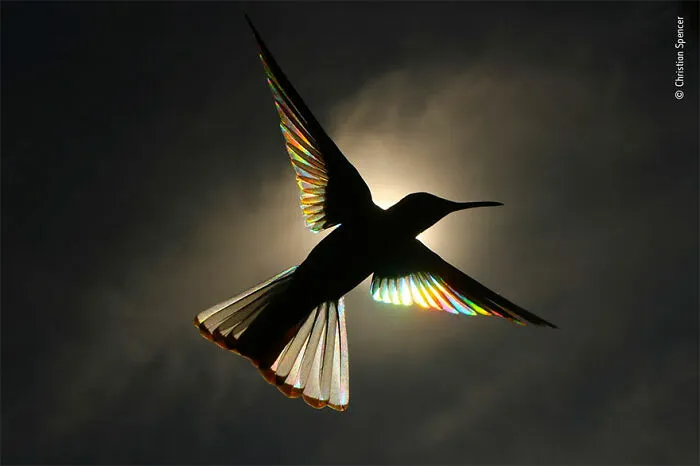
"A black jacobin hovers in front of the morning sun and as the light penetrates its wings the feathers become ‘filled with rainbows’. Christian used the high clouds as a secondary filter to reveal this prism effect, otherwise invisible to the naked eye.
Hummingbirds have the fastest wingbeats in the bird world – up to 90 beats per second. As light passes through the narrow gaps in-between feathers, it is split – or diffracted – into the colours of the rainbow, creating a shimmer."
Report
119points
#3 Category Winner. Behaviour: Birds: 'The Intimate Touch' By Shane Kalyn
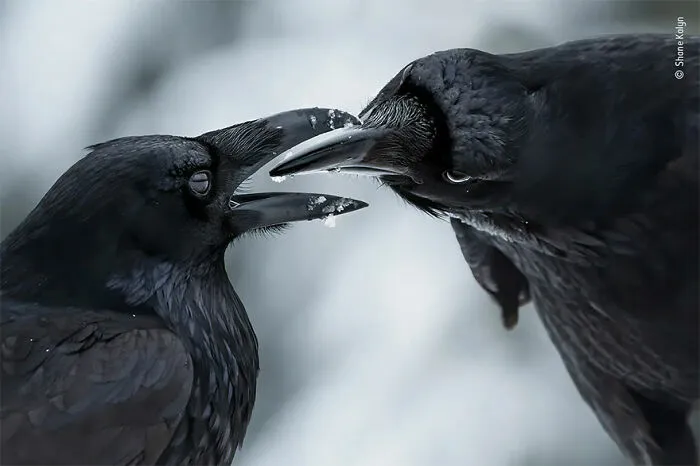
"It was midwinter, the start of the ravens’ breeding season. Shane lay on the frozen ground using the muted light to capture the detail of the ravens’ iridescent plumage against the contrasting snow to reveal this intimate moment when their thick black bills came together.
Ravens probably mate for life. This couple exchanged gifts – moss, twigs and small stones – and preened and serenaded each other with soft warbling sounds to strengthen their relationship or ‘pair bond’."
Report
115points
#4 Category Winner. Photojournalist Story Award: 'Flying Rescue' By Brent Stirton
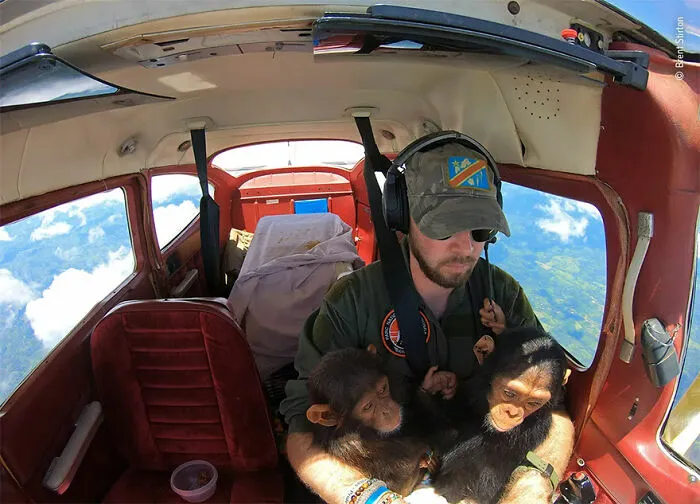
"Virunga National Park pilot Anthony flies two orphan chimpanzees to safety at the rehabilitation centre.
The babies were rescued from traffickers following a tip-off from locals. Baby chimps have little meat value, but are often sold as pets or for animal shows. At this stage they are unlikely to survive without specialist care, needing formula milk and regular balanced meals."
Report
104points
#5 Highly Commended. Wetlands - The Bigger Picture: 'Turtle In Paradise' By Henley Spiers

"A red-eared slider turtle swims peacefully among the water lilies in the Aktun Ha cenote in Mexico.
The limestone rock of Mexico's Yucatán Peninsula is dotted by thousands of cenotes, freshwater pools linked by an underground river system. Some cenotes are underground caves while others, where the rock has fallen in, are open air pools.
Henley was spellbound by the marine world below the surface. 'It was only later that I found out this beautiful scene has a more troubling backstory,' he says.
This unique environment is home to many species of flora and fauna including fish and turtles, but what Henley didn't realise at the time is that the slider turtle in his image is not a native Meso-American slider, but a red-eared slider (native to the USA and northeastern Mexico).
It is likely that this turtle was once a pet, or the offspring of a former pet which was then released back into the wild. An increase in wild releases as a result of the booming pet trade has meant that slider turtles have now been successfully introduced to nearly every continent. They are now among the world's 100 most invasive species due to their interbreeding, altering freshwater habitats and carrying pathogens.
How you can help
-Learn about the world's wildlife and pet trade and the impact it has on the welfare of both humans and nature.
-Consider adopting a pet carefully, and never release your pets back into the wild. If you have to give them up, call a local wildlife organisation.
-Look after your local ecosystems, and learn about the species that keep them balanced."
Report
102points
#6 Highly Commended. Plants And Fungi: 'The Fantastical Rainforest' By Daniel Rosengren
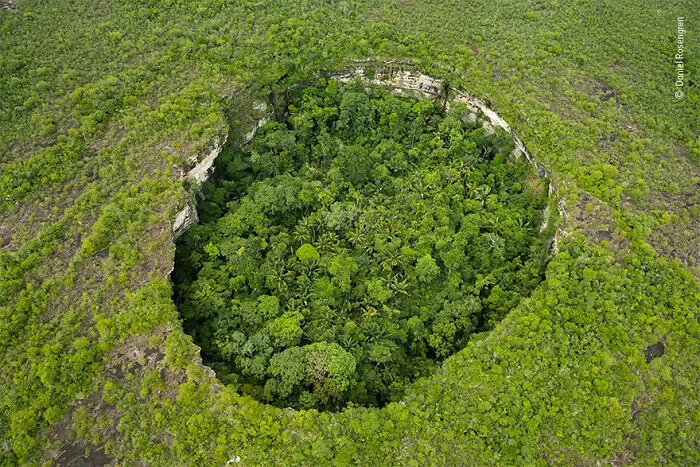
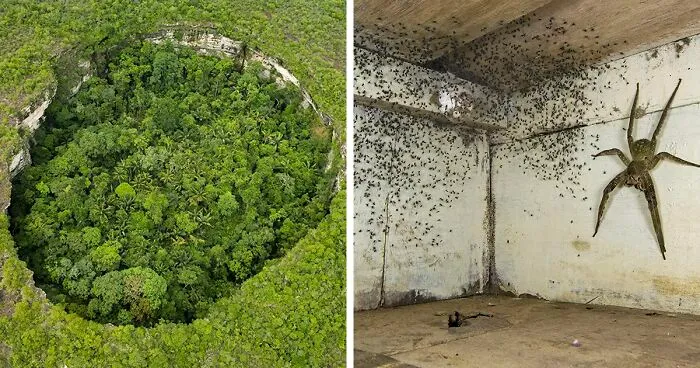
"From a plane, Daniel noticed this almost perfectly round hole in the ground. Inside, huge trees were thriving – a lush mix of palms, broad-leaved trees and climbers – like a ‘full-blown rainforest in a bowl’.
Chiribiquete National Park boasts an exceptional diversity of native wildlife but it is threatened by deforestation and mercury pollution from gold mining. Thanks to public and political mobilisation, the park was added to the UNESCO World Heritage list in 2018, becoming Colombia’s largest protected area."
Report
96points
#7 Highly Commended. Animals In Their Environment: 'Snow Leopard Summer' By Xiaoyun Luo
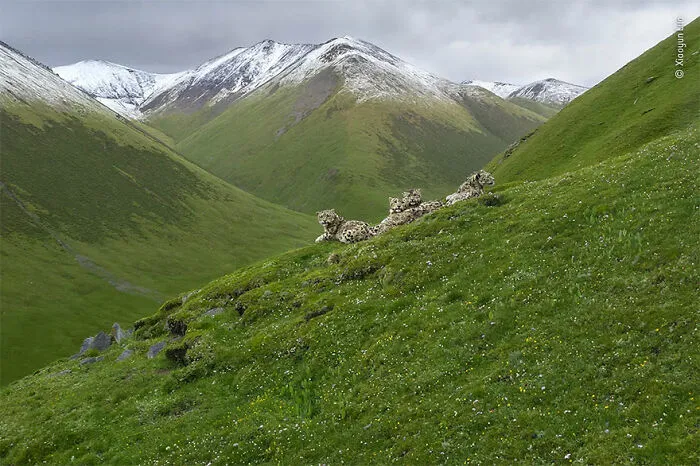
"Following a tip-off from local yak herders, Xiaoyun began a daily six-hour round trip to this mountain site. On the ninth day he spotted a snow leopard and three cubs sleeping among rocks. While observing the leopards with his drone, Xiaoyun noticed the remains of a blue sheep on which they had likely just fed.
Snow leopards are a vulnerable species. However, the illegalisation of firearms in China in 1989, along with hunting bans in key provinces, seems to be helping stabilise population numbers."
Report
90points
#8 Highly Commended. Oceans - The Bigger Picture: 'A Distressing Matter' By Michael Watson

"A young grey seal cries out in pain as lengths of plastic fishing rope cut deeper into its body.
Michael was photographing a seal colony along the Lincolnshire beach when he heard the agonising screams of the seal. The unlucky animal probably became entangled in this rope when it was just a pup, and it has cut deeper and deeper into its body as it grew.
Michael says, 'The suffering and pain can be seen on its face as it screams in pain.'
He and two other photographers quickly called the local Wildlife Trust and Seal Sanctuary to free the seal and treat its wounds so that it could be released safely.
The Donna Nook National Nature Reserve on the Lincolnshire coast in the UK is a major breeding colony, with more than 2,000 pups born every year.
Cases like this are becoming increasingly common around the world as discarded fishing gear, including rope, nets and traps fill the oceans, entangling marine life such as whales and turtles.
How you can help
-If you see any marine life caught up in plastic waste, call the local wildlife trust or other nature organisation and alert them to the situation.
-Reduce the amount of plastic that you use. While most plastic in the ocean is discarded fishing gear, household items such as toothbrushes and plastic razors also contribute.
-Participate in a beach clean-up to help remove plastic from the ocean before it can cause harm to marine life."
Report
88points
#9 Highly Commended. Photojournalism: 'A Caring Hand' By Douglas Gimesy

"This orphaned grey-headed flying fox pup was about three weeks old when it was found on the ground, probably after a fall, and taken to the Black Rock Animal Shelter. After a week of round-the-clock care, the youngster started to recover.
Female grey-headed flying foxes carry their pup during foraging flights for the first three weeks, after which they leave them behind. Young are capable of flying at three months old but are not weaned until five to six months"
Report
83points
#10 Category Winner. Urban Wildlife: 'The Spider Room' By Gil Wizen
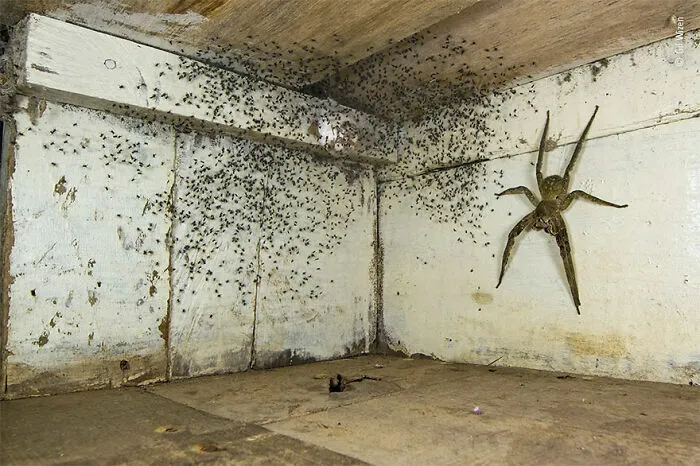
"After noticing tiny spiders all over his bedroom, Gil looked under his bed. There, guarding its brood, was one of the world’s most venomous spiders. Before safely relocating it outdoors, he photographed the human-hand-sized Brazilian wandering spider using forced perspective to make it appear even larger.
Brazilian wandering spiders roam forest floors at night in search of prey such as frogs and cockroaches. Their toxic venom can be deadly to mammals including humans, but it also has medicinal uses"
Report
81points
#11 Highly Commended. Plants And Fungi: 'Mushroom Magic' By Juergen Freund
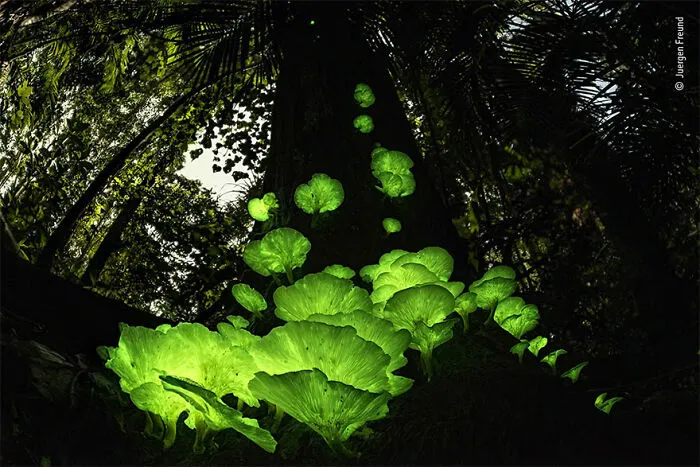
"On a summer’s night Juergen searched the rainforest for bioluminescent ghost fungus. Scanning the darkness for the strange glow, faint to the naked eye, he was rewarded with this magical sight: clusters of ghost fungus seeming to climb the base of a dead tree.
The bioluminescence of ghost fungus results from a chemical interaction between a compound known as luciferin and the luciferase enzyme in the presence of oxygen. The function of this glow remains a mystery to be solved."
Report
74points
#12 Category Winner. Rising Star Portfolio Award: 'Family At Ease' By Martin Gregus

"Polar bear cubs are born in winter and may suckle for two years.
Once accustomed to Martin’s boat-based camp, the bears often lingered close by. Judging the mother and cubs were untroubled by his presence, Martin left the boat and crept closer. Keeping a respectful distance, he was near enough to hear the cubs suckling and purring, ‘an unbelievable sound, like little helicopters buzzing away’."
Report
73points
#13 Highly Commended. Photojournalism: 'Imprisoned' By Celina Chien

"A male Bornean orang-utan in China's Yunnan Wild Animal Park grips the bars on the door between the indoor and outdoor enclosures.
Celina says, 'The sight of him immediately brought me to tears as I stood there, helplessly watching him shake the barred hatch in the door.'
Orang-utans are a common sight in zoos and wildlife parks around the world, many of which are taken from the wild as infants. Once in captivity, they are confined to small enclosures a fraction of their usual habitat, without the stimuli needed to keep their capable brains content and happy.
This male only had a metal bed frame with a wooden plank for a mattress and a plastic bottle of flavoured drink. It had no opportunity for stimulation and appeared numb to the crowd of visitors peering into the glass enclosure.
In the wild, orang-utans spend most of their days foraging for food in the forest canopy. They use things they find in the forest to extract insects and honey for food.
How you can help
-Be an animal-friendly tourist. Don't visit places that make money off the exploitation of animals. Instead, support local businesses that protect and care for nature.
-Protect the livelihoods of wild orang-utans by supporting organisations that conserve their rainforest habitats.
-Consider supporting an orang-utan rehabilitation project in Borneo or Sumatra which helps previously captive animals return to life in the wild."
Report
72points
#14 Highly Commended. Urban Wildlife: 'Lynx On The Threshold' By Sergio Marijuán
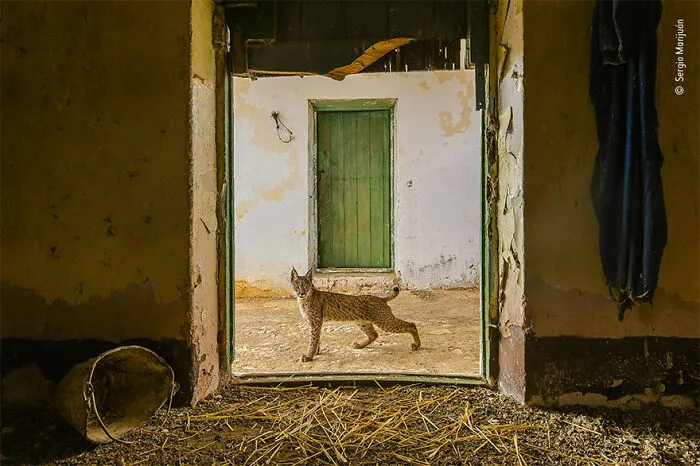
"After months of waiting, Sergio’s carefully set camera trap finally gave him the picture he wanted: a young Iberian lynx perfectly framed in the doorway of an abandoned hayloft on a farm in Spain.
Lynx were widespread on the Iberian Peninsula before the early 1900s. Hunting and habitat loss pushed this species to the brink of extinction by 2002, when fewer than 100 lynx could be found in Spain. Today, thanks to ongoing conservation efforts, numbers of Iberian lynx are on the rise."
Report
67points
#15 Category Winner. Animals In Their Environment: 'Grizzly Leftovers' By Zack Clothier
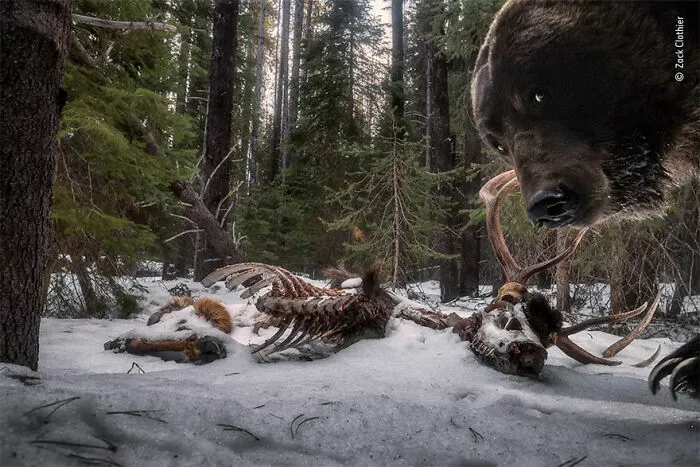
"Zack decided these bull elk remains were an ideal spot to set a camera trap. Returning to the scene was challenging. Zack bridged gushing meltwater with fallen trees, only to find his setup trashed. This was the last frame captured on the camera.
Grizzlies, a subspecies of brown bears, spend up to seven months in torpor – a light form of hibernation. Emerging in spring, they are hungry and consume a wide variety of food, including mammals."
Report
64points
#16 Category Winner. 15-17 Years: 'High-Flying Jay' By Lasse Kurkela
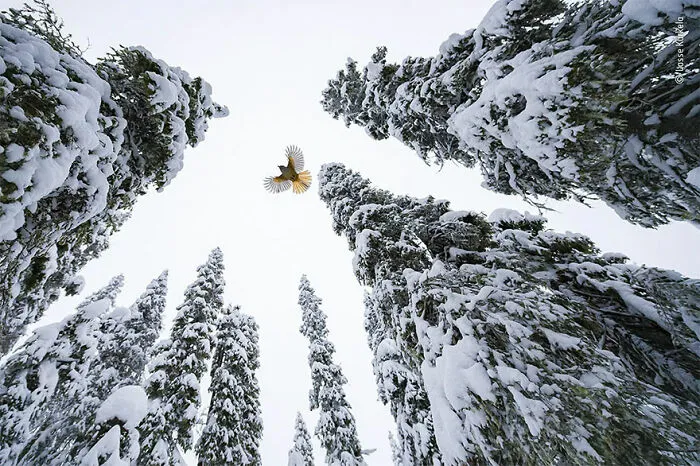
"Lasse wanted to give a sense of scale in his photograph of the Siberian jay, tiny among the old-growth spruce-dominated forest. He used pieces of cheese to get the jays accustomed to his remotely controlled camera and to encourage them along a particular flight path.
Siberian jays use old trees as larders. Their sticky saliva helps them glue food such as seeds, berries, small rodents and insects high up in the holes and crevices of the bark and among hanging lichens."
Report
64points
#17 Highly Commended. Oceans - The Bigger Picture: 'Death Of A Reef' By David Doubilet
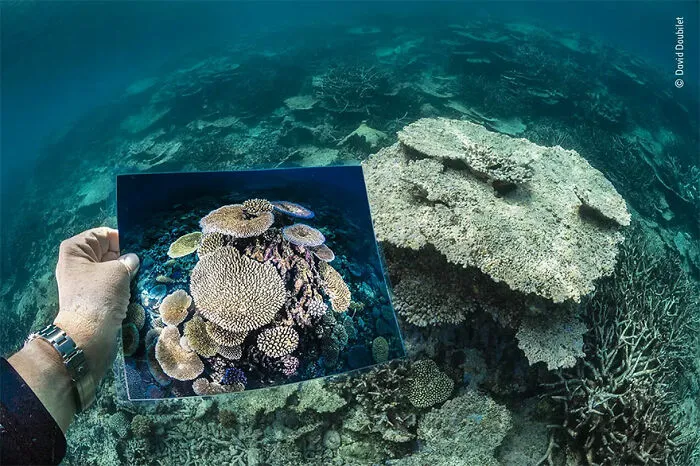
"David has been diving here for more than 30 years. His images show coral ‘through the lens of time and climate change’ and are likely to become records of a vanished world.
Coral colonies are formed by thousands of tiny animals called polyps, each secreting calcium carbonate to build its own home. Polyps are fuelled by food produced by the algae living within their cells. When corals are stressed by overheating they become bleached, expelling their algae and turning white"
Report
61points
#18 Highly Commended. 11-14 Years: 'Apollo Landing' By Emelin Dupieux
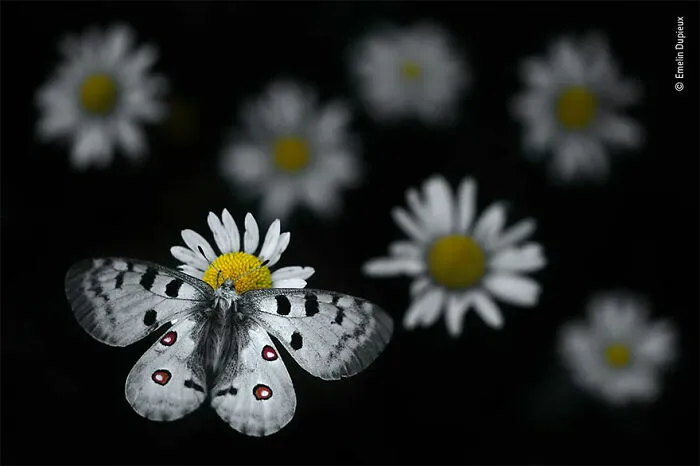
"Flower-filled meadows full of fluttering Apollo butterflies surrounded Emelin’s family’s holiday cottage. Discovering the butterflies’ resting spot in wooded hills above the meadows, Emelin achieved his dream of photographing ‘the magnificent Apollo’.
Found at high altitudes across the mountains of Europe, Apollo butterflies are vulnerable to climate change because their life cycle relies on snow. Snow forms an insulating layer over the butterflies’ eggs, preventing them from freezing, which means that reduced snowfall can impact the butterflies’ survival."
Report
59points
#19 Highly Commended. Animal Portraits: 'Storm Fox' By Jonny Armstrong
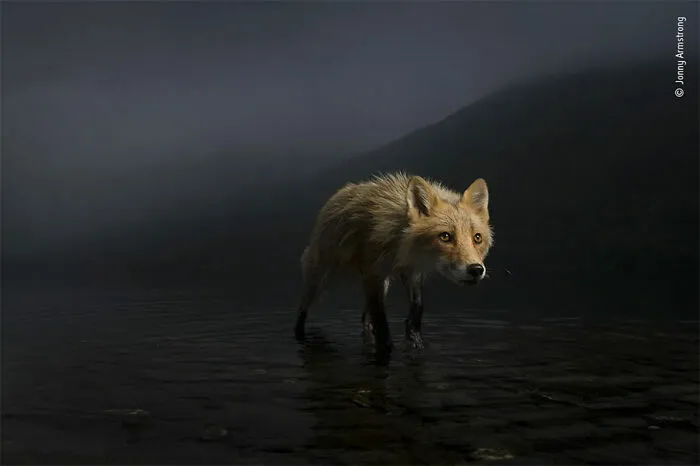
"Jonny and his colleague willed the red fox to reach them before the heavens opened. ‘Adjusting the manual flash was awkward,’ he says, so he pre-set the power for a soft spotlight – just enough to bring out the texture of the fox’s coat at a relatively close range.
Red foxes live in diverse habitats across the world. Jonny had followed this fox over several days, watching it forage for berries, pounce after songbirds, and playfully nip at the heels of a young brown bear."
Report
56points
#20 Category Winner. Portfolio Award: 'The Nursery Mouth' By Angel Fitor
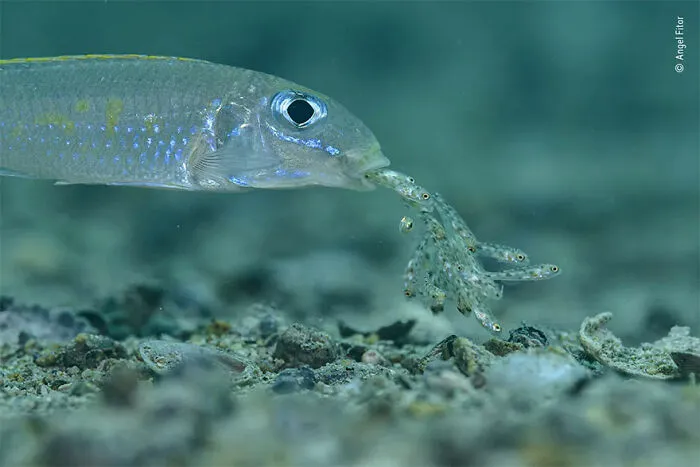
"A female yellow sand cichlid releases its fry from the shelter of its mouth.
After spawning, a female carries the eggs in its mouth for about three weeks as the fry develop. Once they are ready to swim, the fry are released. From that moment onward, parents will shelter the fry in their mouths when they need rest or protection."
Report
56points
