



The wait is over. Everyone who was enjoying 2017, 2016 and 51 earlier 'Wildlife Photographer of the Year' (WPY) competitions has just received this year's biggest treat. London's Natural History Museum announced the winners of the 2018 photo contest, and the beautiful pictures reveal the abundance, beauty, resilience, and vulnerability of life on Earth.
The winning wildlife photography stills were chosen from more than 45,000 entries from 95 countries for their artistic composition, technical innovation and accurate interpretation of the natural world. The international jury awarded the grand title to Dutch photographer Marsel van Oosten for his shot, titled "The Golden Couple." The breathtaking picture features a pair of endangered golden snub-nosed monkeys in central China’s Qin Ling Mountains. "It is a symbolic reminder of the beauty of nature and how impoverished we are becoming as nature is diminished," Roz Kidman Coz, the chair of the judging panel, said in a press release. "It is an artwork worthy of hanging in any gallery in the world." Golden snub-nosed monkeys only live in this particular part of China, and their numbers are steadily decreasing, mainly because of habitat loss from commercial logging and firewood collection.
"As we were going through the pictures of animals and nature, we just kept coming back to this one," Roz Kidman Coz added. "It's almost like a stage set. I think what makes it are the colors and the lighting. These monkeys normally feed in the trees, but somehow Marsel managed to catch them on the ground, and he's carefully thrown a very gentle flash on to the scene to illuminate that amazing fur."
"This image was shot on my first trip to the Qinling mountains," Marsel van Oosten told Bored Panda. "I spent five days on this location. Since then I have been there two more times."
"I was planning to visit China for landscape photography but decided to check out what kind of wildlife China has apart from pandas. After doing some research, I stumbled across the snub-nosed monkeys. There are two main species; the golden snub-nosed monkeys and the black snub-nosed monkeys, and they both look amazing. Not only that, [but] they're also endangered species, so all the more reason to photograph them."
"My main objective for the golden snub-nosed monkeys was to show the beautiful long guard hairs on the back of one of the males," the photographer added. "To show those hairs I needed to be slightly behind the monkey, which made it difficult to show the face. Luckily, both monkeys in this image looked up at an altercation in the larger group of 50 monkeys - the perfect moment for me to get the animal photography shot I wanted."
"What makes this image better than most of the other ones I've shot is the fact that the background is near perfect: there is some light shining through the canopy in the upper right corner, the rock on which the male is sitting has some beautiful texture, and the trees to the left really complement the scene. Very often when the subjects adopt the perfect pose, the background is not great, or vice versa. What takes this image to the next level for me, is the light. I used an off-camera flash to bring out the color and the texture in the fur. My wife Daniella was standing on the right, just outside the frame, holding the flash which I controlled remotely. The almost painterly light was exactly what I wanted."
Van Oosten wanted to direct everyone's attention to the current mass extinction of plants and animals, too. "Unlike past mass extinctions, caused by events like asteroid strikes, volcanic eruptions, and natural climate shifts, the current crisis is almost entirely caused by humans. Ninety-nine percent of currently threatened species are at risk because of human activities."
"If current rates of human destruction of the biosphere continue, half of all plant and animal species of life on earth will be extinct within 100 years."
"If current rates of human destruction of the biosphere continue, half of all plant and animal species of life on earth will be extinct within 100 years."
"Perhaps one of the most striking elements of the present extinction crisis is the fact that the majority of our closest relatives - the primates - are severely endangered. About 90 percent of them lives in tropical forests, which are disappearing quickly. The IUCN estimates that almost 50 percent of the world's primate species are at risk of extinction. Overall, the IUCN estimates that half the globe's 5,491 known mammals are declining in population and a fifth are clearly at risk of disappearing forever with no less than 1,131 mammals across the globe classified as endangered, threatened, or vulnerable."
"The golden snub-nosed monkey is endangered due to habitat loss. For instance, lichens are the main staple of the monkey's diet and dead trees contain the most lichen. Unfortunately, dead trees are harvested, thus reducing the quality of the habitat and availability of food. The monkey is a highly selective feeder, so damage to its habitat seriously impacts the species. There are less than 4,000 of these animals left."
"Successful wildlife conservation starts with awareness, and most people don’t even know this species exists. I hope that my photograph will help to spread awareness about this species and that people will realize that not only the rhinos, tigers and polar bears are worth worrying about."
More info: nhm.ac.uk
#81 Duck Of Dreams By Carlos Perez Naval, Spain, Winner 2018 11–14 Years Old
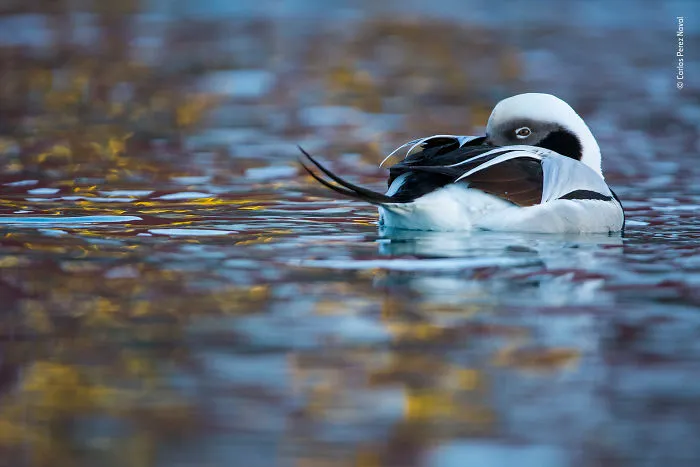
Early one morning during his Easter holiday, Carlos slipped off the side of the boat and settled himself into a floating hide – it was the perfect spot to observe Arctic bird species. As morning broke, dozens of long-tailed ducks emerged, and as the light reflected off the water, Carlos captured this portrait of one dozing.
The Barents Sea supports one of the largest concentrations of seabirds in the world, including the long-tailed duck. This male still has its winter plumage – a less vibrant version of its summer colours. It is thought that its mainly white appearance might help to reduce aggression between males, who tend to live together in large flocks during the winter.
Report
32points
#82 "Crossing Paths" By Marco Colombo, Italy, Winner 2018 Urban Wildlife
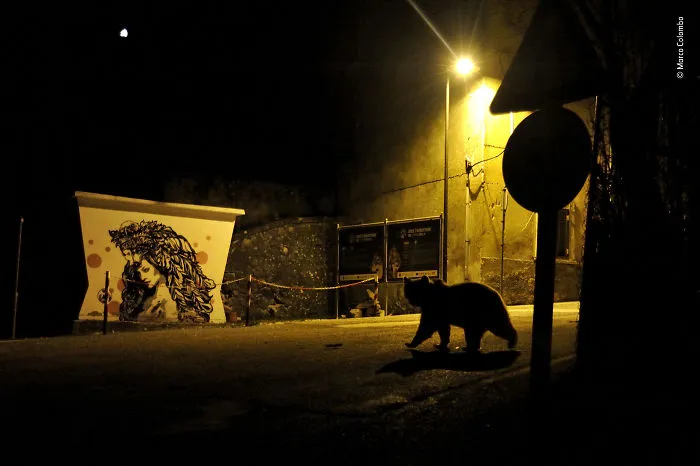
As Marco drove through the village late one evening he spotted a rare Marsican brown bear in the road. Immediately, he switched off his engine and lights so as not to disturb it, and watched as the bear strode across the street. With just seconds to spare he managed to photograph the female through the windscreen before it slipped into the shadows.
Marsican bears are an isolated and critically endangered sub-species of brown bear. With their habitat fragmented and threatened, they often come into contact with humans as they raid vegetable gardens and orchards to prepare for winter hibernation. Sadly on rare occasions humans poison them in retaliation.
Report
32points
#83 "Beach Waste" By David Higgins, Uk, Highly Commended 2018 Wildlife Photojournalism
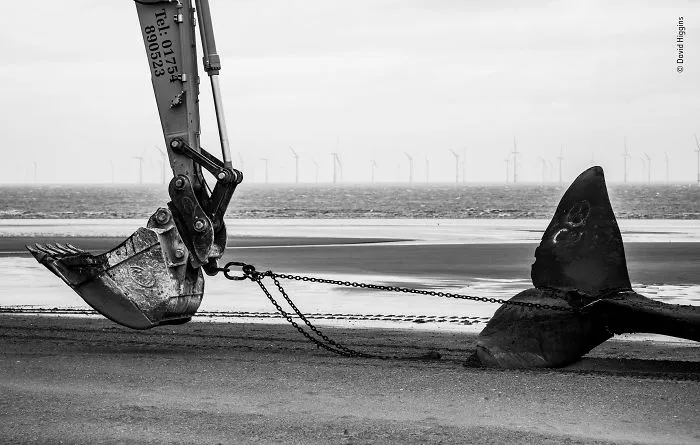
David surveyed the subdued scene: a dead sperm whale being moved across a beach by a digger. The whale was one of five that had stranded on the UK coast, attracting people from far and wide to gaze at the huge bodies slumped on the sand. ‘It was miserable to watch this majestic animal being dragged by a mechanical monster,’ says David.
Sperm whales use echolocation to navigate, sending out pulses of sound to ‘read’ their surroundings. These signals are difficult to interpret in shallow water, with a gently sloping seabed, and so the whales can become confused and end up stranded. Illness and collisions with ships are other causes, but why whales beach is still not fully understood.
Report
32points
#84 Simple Beauty By Theo Bosboom, The Netherlands, Highly Commended 2018 Creative Visions
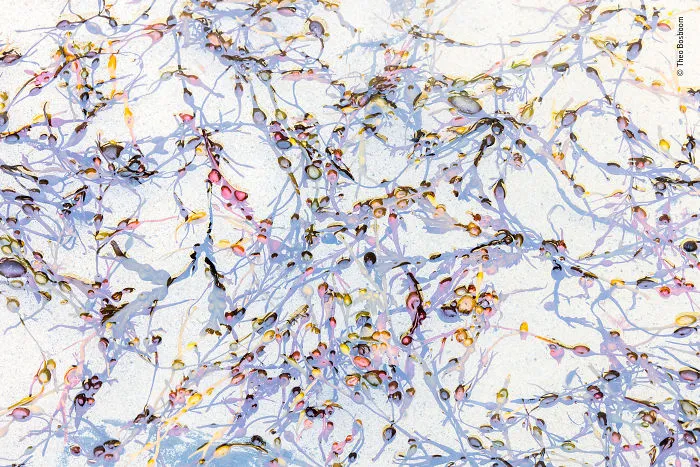
Theo discovered this collection of algae in a small rock pool on an exposed beach. Experimenting with different focal lengths, and using a polarising filter to avoid reflections, he waited for calm waters before he captured this simple, subtle composition. For Theo, the image shows ‘the simple beauty of structures and patterns created by nature’.
Wracks are a type of marine alga that contain a series of spherical air bladders, providing buoyancy. This allows the plant to float nearer to the water’s surface in order to catch stronger rays of sunlight. In areas with turbulent waves, some wracks have developed fewer air bladders so as to reduce buoyancy and therefore protect themselves.
Report
30points
#85 "The Antpecker" By Oliver Richter, Germany, Highly Commended 2018 Behaviours Birds
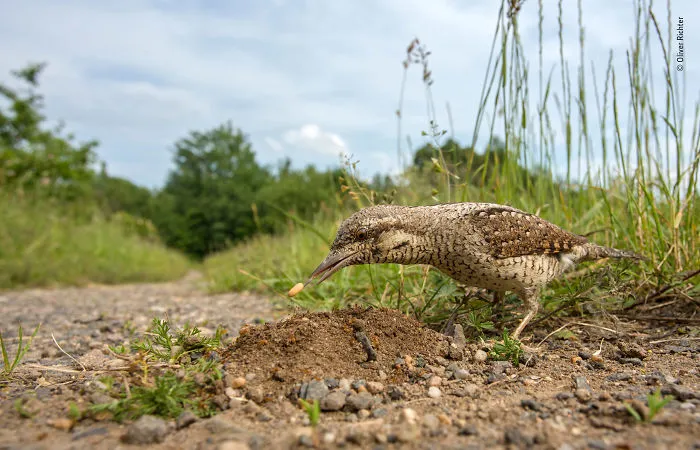
Oliver camouflaged his camera close to an ant nest before retreating with the wireless remote. A pair of Eurasian wrynecks approached and began unearthing pupae in their pale cocoons, feeding them tirelessly to their hungry young nearby. Oliver captured the precise moment one bird retrieved a pupa on the tip of its sticky tongue.
Eurasian wrynecks are a type of woodpecker, but instead of powerful bills to make holes in wood, these birds have shorter, more slender beaks suited to plucking. They use their incredibly long tongues to pick out pupae and ants from deep holes or underground and are armed with a sticky saliva.
Report
28points
#86 "Night Watch" By Kavier Aznar González De Rueda, Spain, Highly Commended 2018 Behaviours Invertebrates
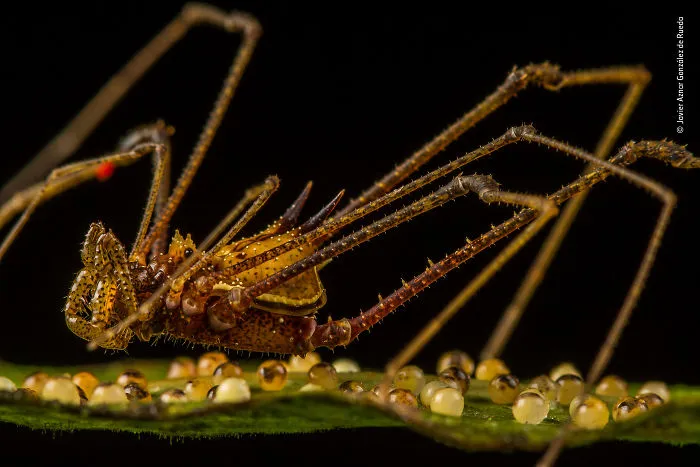
Despite a long and exhausting night in the forest, Javier couldn’t resist stopping to photograph ‘behaviour that I had never seen before,’ he explains. Using a small aperture and flash to maximise the amount in focus, and diffusers to soften the light, he captured the attentive parent harvestman watching over its precious clutch.
Guarding its eggs, this harvestman is part of a widespread and diverse group closely related to spiders, with more than 6,500 species worldwide. Some species like this one invest in parental care, protecting their eggs and young against predators. A hitchhiking red mite is clinging to one of this parent’s legs.
Report
28points
#87 Desert Relic By Jen Guyton, Germany / Usa, Winner 2018 Plants And Fungi
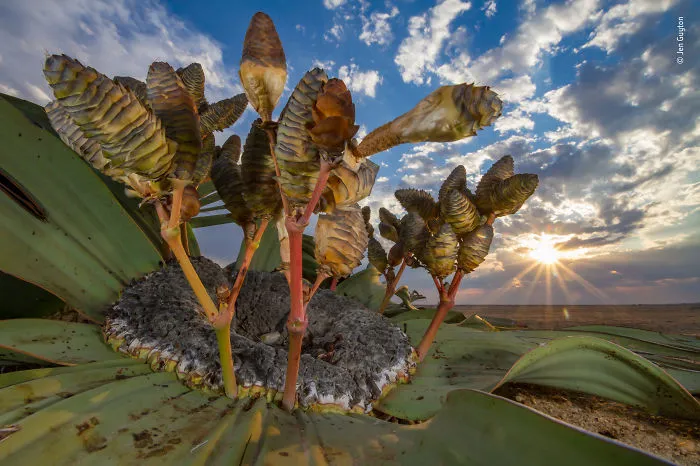
Jen had trekked all day across the Namib Desert looking for the perfect welwitschia plant to photograph before finally spotting this ragged-leaved subject. Adopting a low, wide angle, she caught the plant’s architecture and vibrant tones against the expansive landscape, just as the Sun was going down. ‘It’s like something out of a Dr Seuss book,’ she says.
The weird and wonderful welwitschia plant can live for up to 1,000 years. Growing from the base, it is comprised of just two slow-growing leaves that creep over the desert throughout the lifetime of the plant. As the centuries take their toll, the leaf ends fray and split taking on the appearance of multiple leaves.
Report
27points
#88 A Rock In A Hard Place By Stefano Baglioni, Italy, Highly Commended 2018 Plants And Fungi
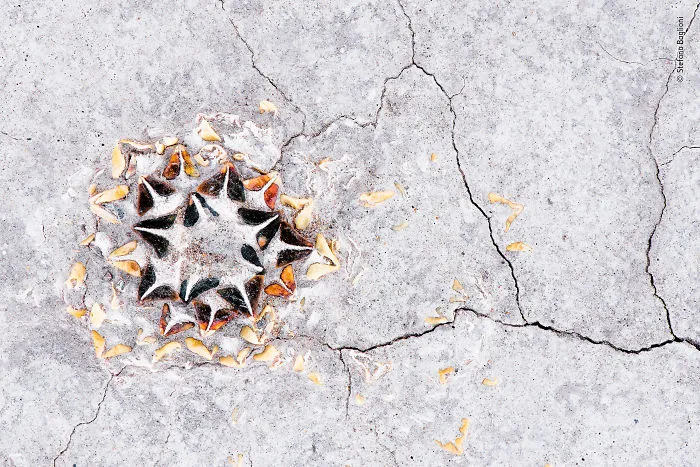
With temperatures topping 40 degrees Celsius that day, the ground was scorching as Stefano knelt to set up his camera. He had decided to stop just as the Sun set over the parched plains of Coahuila. As the soft light enhanced the form and colour of this unusual plant, Stefano saw ‘a rose emerging from the white soil’.
This rare and slow-growing cactus, Ariocarpus kotschoubeyanus, is difficult to spot in the alluvial plains of Mexico. During the rainy season it can even become submerged for days. Yet once the water recedes, its delicate mauve blossoms create a splash of colour on the ground. So attractive are the blooms that the species is now under threat from over-collection.
Report
27points
#89 Shark Sex In The Shallows By Shane Gross, Canada, Highly Commended 2018 Under Water
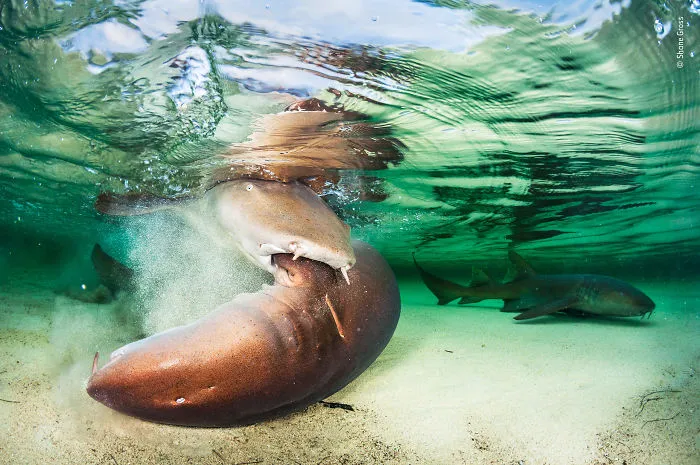
Shane woke at dawn to the sound of splashing. Scrambling out of his tent, he spotted ‘a pile of 14 nurse sharks thrashing around in knee-deep water’. He had seen them heading for the shallows the evening before, and so had camped out on the beach. He managed to capture the gaze from the tiny eyes of the mating pair amid the chaos.
Nurse shark mating is not a gentle affair. The male bites the female’s pectoral fin, rolling her over and pinning her to the seabed. Many males often attempt to mate with a single female, who in turn tries to avoid them by swimming into very shallow water, where she can bury her pectoral fins safely in the sand.
Report
27points
#90 Javier Aznar González De Rueda, Spain, Winner 2018 Wildlife Photographer Portfolio Award
Sugar on Tap
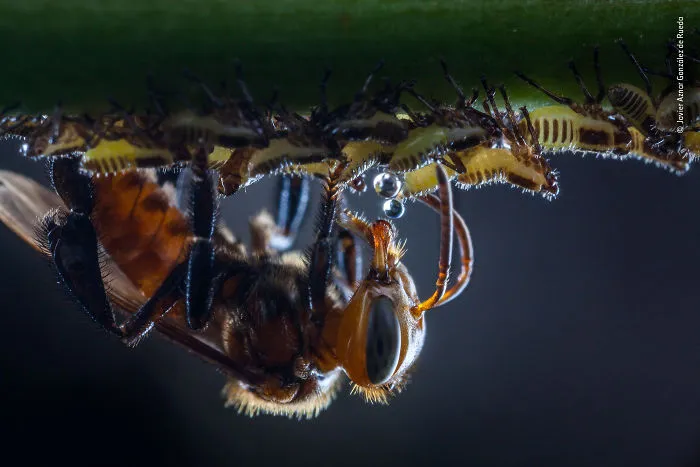
It took several days for Javier to capture this precise moment. ‘When a bee touched a nymph on the back of the abdomen with its antennae,’ he explains, ‘the nymph was stimulated to release a drop of honeydew, which the bee quickly sucked in’. The behaviour has rarely been observed in such detail, an intricate but easily missed story.
It took several days for Javier to capture this precise moment. ‘When a bee touched a nymph on the back of the abdomen with its antennae,’ he explains, ‘the nymph was stimulated to release a drop of honeydew, which the bee quickly sucked in’. The behaviour has rarely been observed in such detail, an intricate but easily missed story.
Juvenile treehoppers, or nymphs, feed on sugary plant sap, and expel any excess from the ends of their abdomens as a sweet liquid. This carbohydrate-rich secretion attracts stingless bees, who in return for sustenance protect the treehoppers from predators. They also reduce the risk of fungal attack by cleaning up excess honeydew.
Report
24points
#91 Javier Aznar González De Rueda, Spain, Winner 2018 Wildlife Photographer Portfolio Award
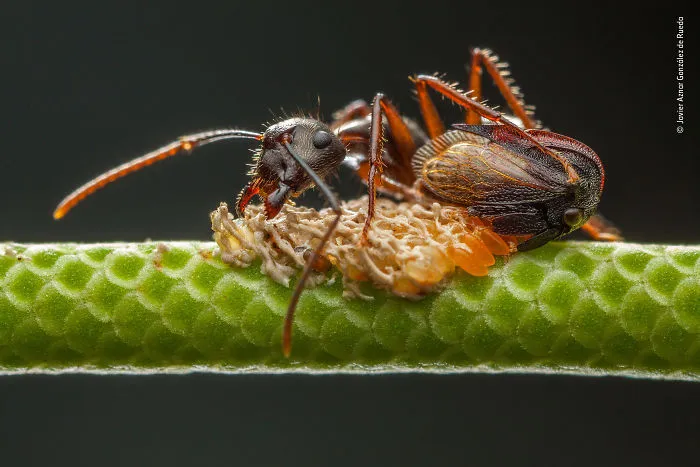
The Odd Couple
While watching the relationship between treehoppers and ants, Javier noticed that ‘an individual ant would look after a particular treehopper’. At such a high magnification, the depth of field, or amount in focus, was narrow. ‘It took me days to capture the ant’s head and the treehopper aligned in the same plane,’ he says.
While watching the relationship between treehoppers and ants, Javier noticed that ‘an individual ant would look after a particular treehopper’. At such a high magnification, the depth of field, or amount in focus, was narrow. ‘It took me days to capture the ant’s head and the treehopper aligned in the same plane,’ he says.
The female treehopper is to the right of this image, and the ant to the left. Just three millimetres long, with a distinctive helmet along her thorax, the treehopper enlists the help of the larger ant, and its jaws, to see off any threats. For added protection, the treehopper lays a hard secretion over her precious brood of eggs.
Report
19points
#92 Javier Aznar González De Rueda, Spain, Winner 2018 Wildlife Photographer Portfolio Award
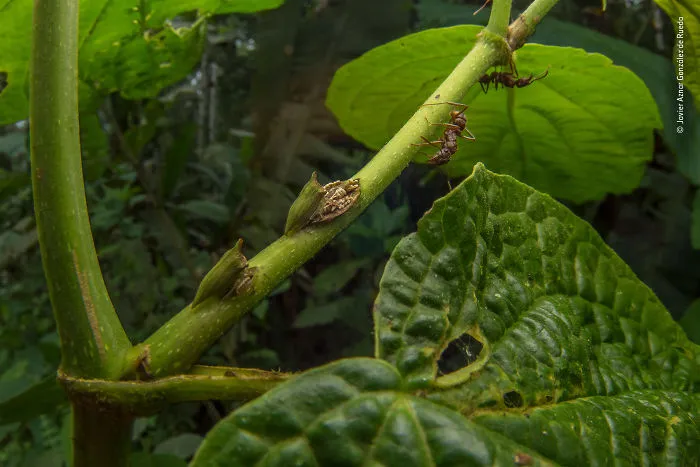
Rainforest Relations
Javier was fascinated by the insect behaviours he saw here. The female treehoppers were watching over their eggs, while in turn being guarded by ants. It was a challenge to capture the action of tiny animals amid a dense forest, so Javier chose a wide angle to reveal the miniature players, absorbed in the duties of their small world.
Javier was fascinated by the insect behaviours he saw here. The female treehoppers were watching over their eggs, while in turn being guarded by ants. It was a challenge to capture the action of tiny animals amid a dense forest, so Javier chose a wide angle to reveal the miniature players, absorbed in the duties of their small world.
The female treehoppers physically shield their eggs, while ants guard from a distance. The ants protect the young in exchange for being able to drink the sweet sap they excrete. Finding egg-guarding females close to each other is not unusual, perhaps because more young produce more sap, which attracts more ant guards.
Report
17points
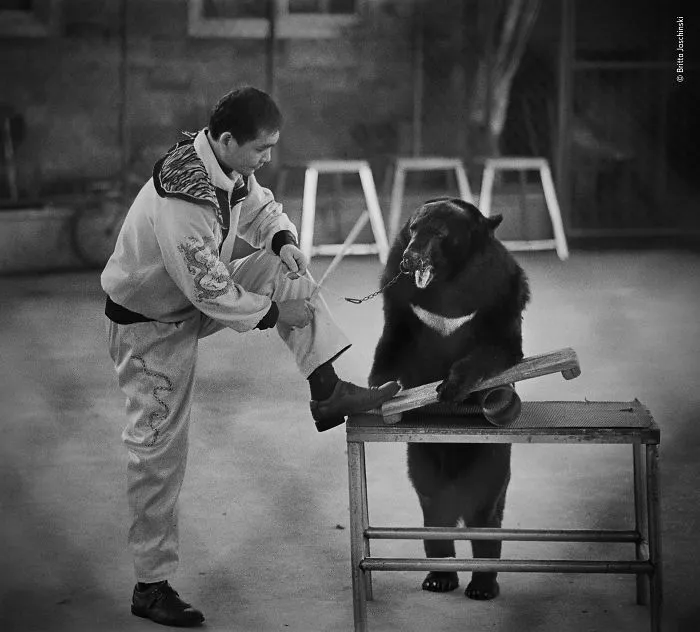
#93 "Unbearable" By Britta Jaschinski, Germany / Uk, Highly Commended 2018 Wildlife Photojournalism
Report
4points