






#1
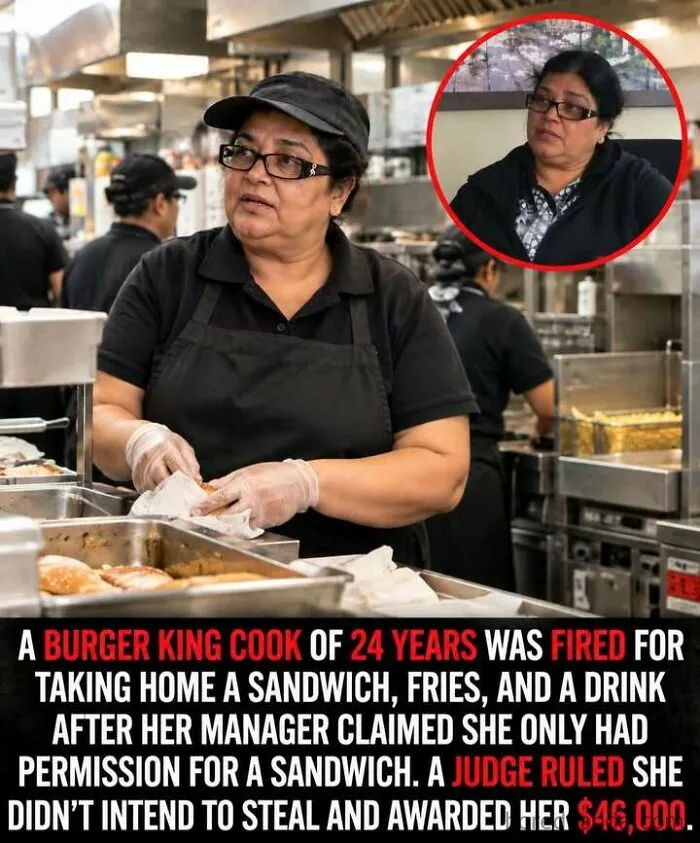
One day, she finished her shift starving and realized she'd left her wallet at home. She'd eaten nothing all day, so she asked her supervisor if she could take a meal and pay on her next shift.
She heard a yes. She walked out with a fish sandwich, fries, and a drink. With her employee discount, the whole thing came to under a dollar.
Then came the twist. The manager claimed she'd only approved the sandwich.
When Usha came back for her next shift, she wasn't handed an apron. She was accused of stealing and fired on the spot under the company's "zero tolerance" policy.
English isn't her first language. Her lawyers argued this was an honest misunderstanding, not a crime, and that 24 years of spotless service should count for something.
The judge agreed.
Justice Miriam Warren ruled there was no intent to steal, called the firing excessively harsh, and said the employer acted in an insensitive, bad-faith way toward a long-serving worker.
The verdict: $46,000
$21,000 in lost wages
$25,000 in aggravated damages for emotional distress
Twenty-four years of loyalty, tossed over fries worth pennies. The employer paid for it.
Ideally, you’ll find the right balance between intellectual humility on the one hand and healthy skepticism on the other.
Being completely objective and unbiased is impossible. And yet, we can (and should) be more objective while avoiding misinformation and disinformation as much as possible.
That’s easier said than done, though, with a veritable flood of iffy ‘facts,’ fake content, and propaganda online. And some individuals are more prone to believing misinformation.
The American Psychological Association points out that detecting false info is difficult. “When we encounter new information, we tend to focus on understanding it and deciding what to do next, rather than evaluating it for accuracy.”
#2
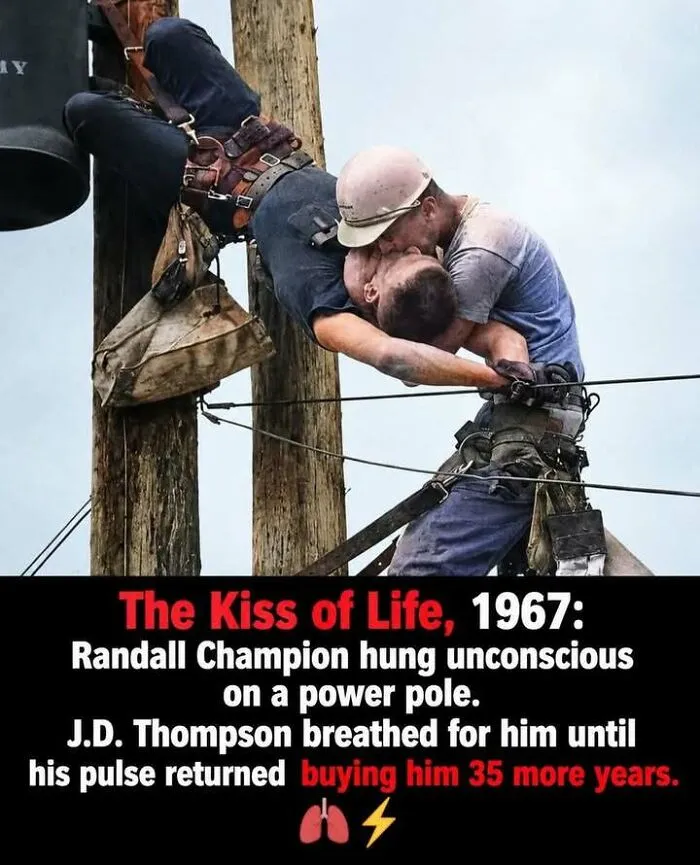
The only thing keeping him from falling is a belt buckle.
It's 1967. Randall Champion and J.D. Thompson are just doing routine maintenance the kind of job they'd done a hundred times before. Then Champion's hand brushes a live wire.
In an instant, he's unconscious. No pulse. No time.
Thompson can't get him down. There's no room to do CPR up there. So he does the only thing he can: he presses his mouth to his partner's and breathes for him. Again. Again. Again.
Somewhere below, a photographer named Rocco Morabito happens to be driving by. He hears the shouting, looks up, and lifts his camera not knowing he's about to capture one of the most powerful images in photography history.
Thompson feels a pulse. Unbuckles his own harness. Carries Champion down the pole on his shoulder like a fireman. Starts CPR on the ground with another lineman at his side.
By the time the ambulance arrives, Champion is breathing on his own.
He would go on to live another 35 years.
That split-second decision to keep breathing air into a man everyone else might've given up on bought him three and a half more decades of life. Birthdays. Holidays. Time with people he loved.
This is why CPR training exists. This is why knowing what to do in those first few minutes matters more than almost anything else you'll ever learn.
You don't need to be a hero. You just need to know what to do.
Get certified. You never know whose 35 years you're holding in your hands.
#3
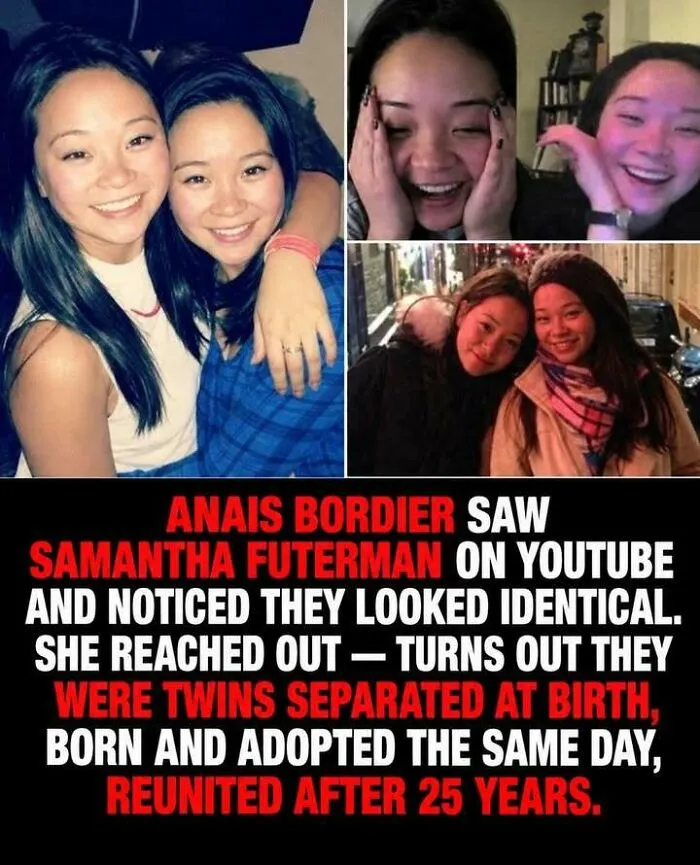
Two women. Same face. Same birthday. Two completely different lives until a random video clip collided them back together.
In November 1987, in Busan, South Korea, two identical twin girls were born and then separated almost immediately, sent through different adoption agencies to different corners of the world. One, Anaïs Bordier, grew up in Paris as an only child. The other, Samantha Futerman, grew up in New Jersey with two brothers. Neither had the faintest idea a twin sister existed. As far as either of them knew, they were simply adopted only children living ordinary lives.
Fast forward to December 2012. Bordier, then a fashion student in London, was shown a YouTube video by a friend. In it was an aspiring LA-based actress named Samantha Futerman who looked, unmistakably, exactly like her. Not "sisters could be sisters" similar. Identical. Bordier couldn't shake it. She dug a little deeper online and found something that made her stomach drop: same birthday, same birth country. November 19, 1987. Busan.
In February 2013, she took a chance and messaged Futerman on Facebook.
What followed was a Skype call neither of them will ever forget two strangers on opposite sides of the world, laughing at the same jokes, catching themselves making identical hand gestures, finishing each other's sentences without even trying. It was less "getting to know you" and more "recognizing someone you already knew."
Still, they needed proof. So they did what anyone would do in a story this wild: they took a DNA test. In May 2013, they met face-to-face for the first time in London and shortly after, the results came back. 99.99% probability of being identical twins.
Their story didn't stop there. The two went on to co-write the memoir Twinsters and starred in the award-winning 2015 documentary of the same name, following their discovery, their emotional first meeting, and an unforgettable trip back to South Korea to trace their origins.
Separated at birth. Reunited by YouTube. Proven by science.
Sometimes truth really is stranger and more beautiful than fiction.
“It takes effort to compare new information with what we already know; when new information is false but plausible, we can learn it as fact.”
According to the APA, several factors can increase your susceptibility to misinformation.
First of all, individuals are more likely to believe misinformation if it comes from in-group sources versus out-group sources. They are also more likely to believe sources they perceive as credible.
“The emotional content of misinformation plays a role as well: People are more likely to believe false statements that appeal to emotions such as fear and outrage. They are also more likely to believe misinformation that paints opponents in a negative light than they are to believe misinformation that is negative about their own in-group,” the APA explains.
#4
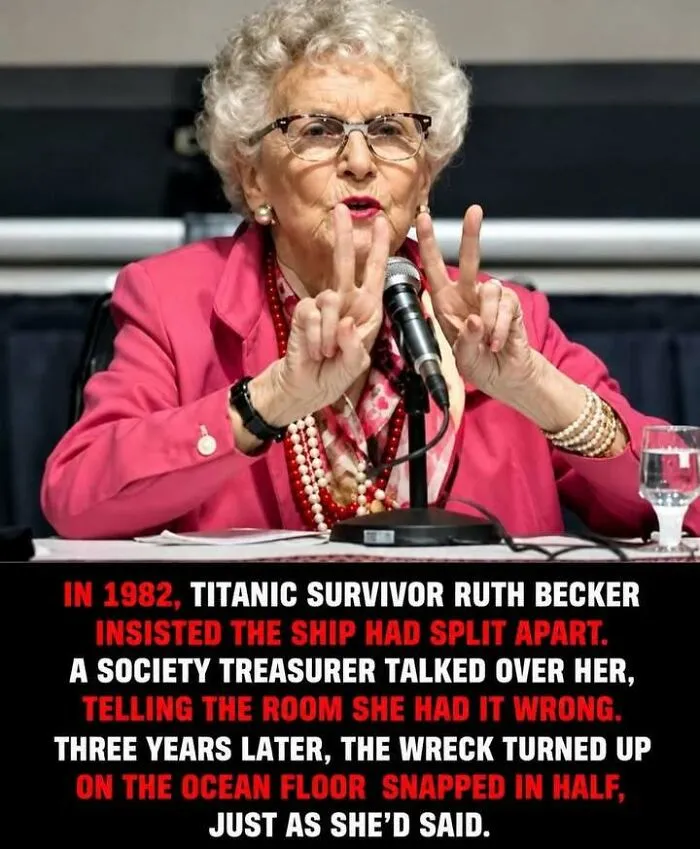
In 1982, an elderly woman stood up at a Titanic Historical Society convention and used her hands to show exactly how the ship went down snapping in half before it sank.
The event's compere took the microphone from her mid-sentence. He was a THS treasurer named Louis Gorman, and he told the room she was mistaken that she'd probably confused a falling funnel with a break in the hull. Officially, everyone "knew" Titanic sank in one piece.
That woman was Ruth Becker. She'd been 12 years old on April 14, 1912, watching from lifeboat 13 as Titanic went under, its decks still lined with people jumping into the ocean in its final moments. She'd carried that image for 70 years. She knew what she saw.
Three years later, in 1985, Robert Ballard's expedition found the wreck. Two massive pieces of hull, separated by a debris field hundreds of meters wide.
Ruth Becker was right. She'd been right the entire time.
She died in 1990, and her ashes were scattered in the Atlantic at the exact spot where Titanic went down.
#5
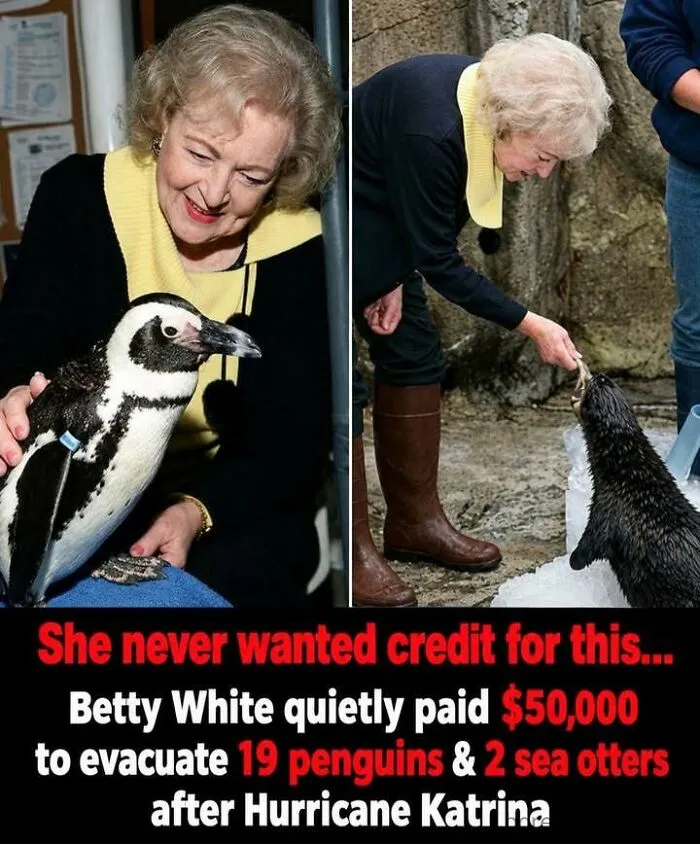
New Orleans, August 2005. Hurricane Katrina had just torn through the city, and the power grid was gone. At the Aquarium of the Americas, backup generators were running dry, temperatures were climbing, and oxygen was disappearing from the tanks. Staff fought around the clock to save what they could. Thousands of fish didn't make it.
But 19 African penguins and two sea otters, Buck and Emma, survived the worst of it. The only way to save them now was to get them out fast. Monterey Bay Aquarium in California agreed to take them in, which meant one thing: a private charter flight out of Baton Rouge, in the dead of night, at a cost that ran into the tens of thousands of dollars.
That's when an anonymous donor stepped in and covered half the bill $50,000 so the flight could happen. The aquarium staff who flew with the animals didn't find out who it was. Even the director who thanked the donor was told only that they wished to stay unnamed.
The animals made it to California safely. All 21 of them. They stayed at Monterey Bay for nine months while Audubon rebuilt, then flew home to New Orleans in May 2006 aboard a donated FedEx cargo plane.
The identity of the donor didn't come out until years later, after she passed away: it was Betty White.
A staff member who'd cared for the birds for over two decades finally shared the story, saying she'd never wanted anyone to know.
That was who she was. Decades of quiet checks to animal causes, no press releases, no photos just help, given because it was needed.
#6
Nine months later, everything changed in an instant. A steel pole fell and struck Laura in the back of the head while she was setting up for an event. The traumatic brain injury erased years of her memory including her husband, and the wedding they'd just had.
She woke up feeling like a teenager again. The man sleeping beside her? A stranger. Some nights she panicked, unsure why he was even in her house.
For almost two years, they lived like roommates. Laura relearned how to read and write. She fought through chronic pain. And she wrestled with real resentment trapped, in her eyes, inside a marriage she never remembered agreeing to.
Through all of it, Brayden stayed. No pressure. No ultimatums. Just quiet, steady care, day after day.
Eventually, something in Laura shifted. She wasn't going to walk away from a man who never walked away from her.
So she took off her wedding ring.
And asked him out on a first date.
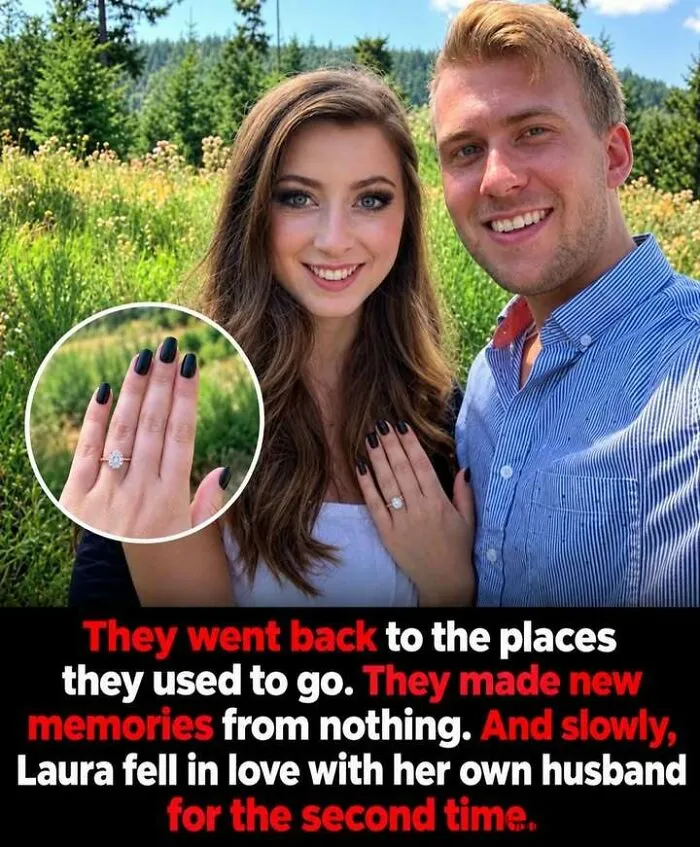
They went back to the places they used to go. They made new memories from nothing. And slowly, Laura fell in love with her own husband for the second time.
In August 2019, Brayden got down on one knee again. They renewed their vows and started a new chapter this time, both of them choosing it.
Laura says it best: love is a choice.
You don't just fall into it once and coast. Sometimes you choose it again. And again. Even when memory fails you.
Furthermore, repetition strengthens the perceived reliability of any information. This, unfortunately, is something that anyone can fall prey to. Even incredibly well-educated and bright individuals, as well as people aware of the power of repetition.
“People are more likely to believe repeated information, even when it contradicts their prior knowledge,” the APA states, emphasizing that this is why it is so important to stop misinformation early.
All of that being said, the APA stresses that education, analytical reasoning, and numeracy skills can, generally, increase a person’s resistance to misinformation.
On the flip side, anxiety can increase an individual’s susceptibility to misinformation.
“Older adults may be better at identifying misinformation than younger adults, yet older adults are also more likely to see and share false information on social media,” the APA states.
#7
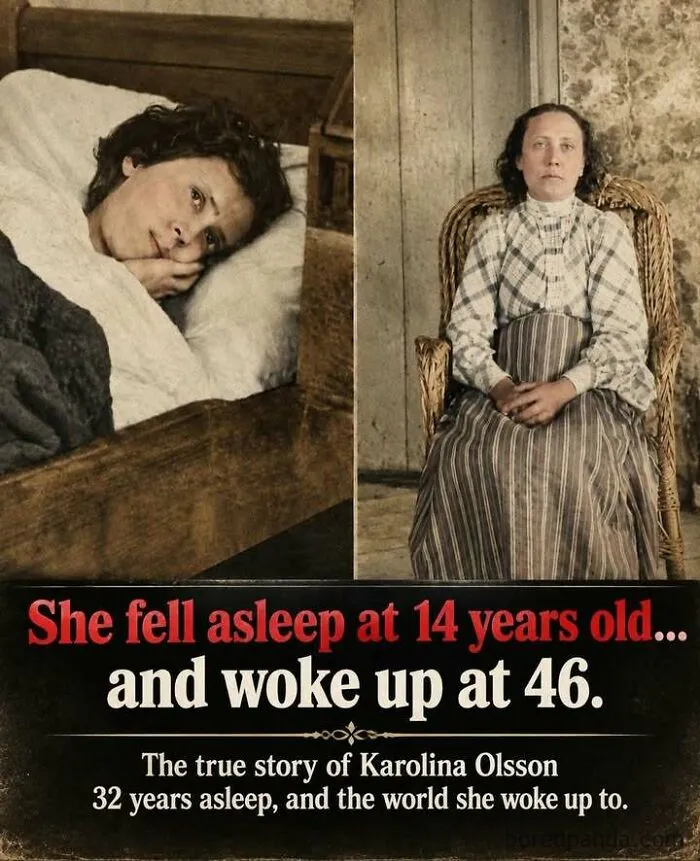
In between, an entire generation grew up, married, and had children of their own and Karolina Olsson never noticed a single day pass.
It started with a toothache. Sweden, 1876. A poor fisherman's daughter came home complaining of pain in her jaw, and her family suspicious of doctors, more trusting of folk remedies put her to bed to sleep it off.
She never really got up again. Not for 32 years.
Her pulse slowed to a crawl. She stopped responding to pain. But her body didn't waste away like every doctor expected it to no muscle atrophy, no dramatic aging, just... stillness. Her family fed her two glasses of milk a day and kept her at home, refusing to let anyone commit her to an institution.
And here's the part that still gives people chills: she wasn't fully gone. In 1904, when her mother died, Karolina wept. Somewhere inside that decades-long sleep, something in her still knew.
Then, on April 3, 1908 with no warning, no medical intervention, nothing she opened her eyes. Crying. Asking for her brothers. Forty-six years old in body, but frozen in the last moment she remembered at fourteen.
Doctors later called it a severe catatonic psychosis, likely triggered by a hysterical episode a psychological shutdown so complete it mimicked a decades-long coma. But in 1908, in a small Swedish fishing village, it looked a lot more like a miracle, or a curse.
She went on to live another 42 ordinary, conscious years, dying in 1950 at 88 having somehow lost three decades and gained a lifetime anyway.
#8
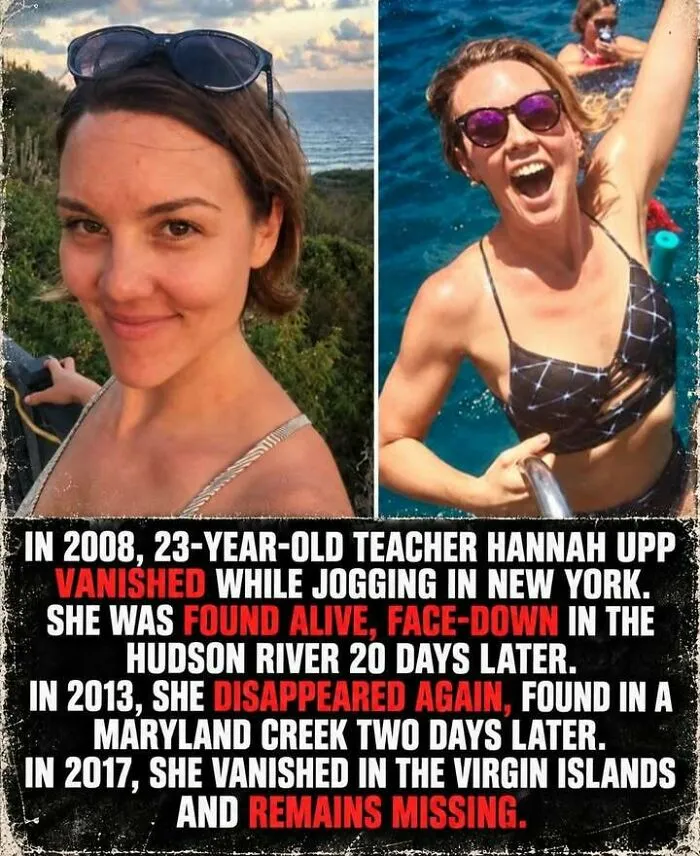
Hannah Upp was a 23-year-old teacher in New York City when she went out for a run in August 2008 and never came home.
Her disappearance made headlines. Days turned into weeks, and nobody could explain where she was.
Then, after about three weeks, she was found alive in the water, dehydrated and with no memory of what had happened.
Doctors later diagnosed her with dissociative fugue, a rare condition in which a person loses their sense of identity and wanders without awareness, often after intense stress or trauma. Many people think it only happens in movies.
Hannah's story proves it doesn't.
In 2013, it happened again. She disappeared and was found about two days later in Maryland.
Between those episodes, she kept going. She worked, built a life, and eventually moved to the U.S. Virgin Islands.
In 2017, she vanished one more time.
This time there was no happy ending. Despite extensive searches, she has never been found.
What makes this case so haunting is that her own mind seemed to be behind the first two disappearances, sending her walking into the unknown with no memory of why.
How well do we really know our own minds?
If you've ever lost time or felt disconnected from yourself, talk to a doctor or someone you trust.
Somewhere, a family is still waiting for the knock on the door that never came.
Hannah wasn't lost because she wanted to be. Her mind simply went somewhere no one could follow, and the people who loved her never stopped hoping she'd walk back in one more time.
#9

The trip reportedly cost around $12,300, covering expenses such as fuel, accommodation, food, and ferry crossings. But for Malik, the journey was about more than the distance traveled or the money spent. It was about finally experiencing the natural wonder he had long hoped to see. When the Northern Lights appeared across the Arctic sky, the miles behind him became part of a remarkable story about determination, patience, and following a dream all the way to its destination.
Meanwhile, the NATO Association of Canada explains that misinformation exploits “the same psychological architecture that allows communities to make meaning together.”
True resilience to misinformation requires more than just correcting false claims. Rather than suspicion (which can lead to generalized cynicism), you may want to aim for discernment.
“Skills-based methods such as lateral reading, which train individuals to cross-check sources and situate claims within wider evidentiary contexts, have been shown to substantially improve people’s capacity to judge credibility in practice.”
#10
#11
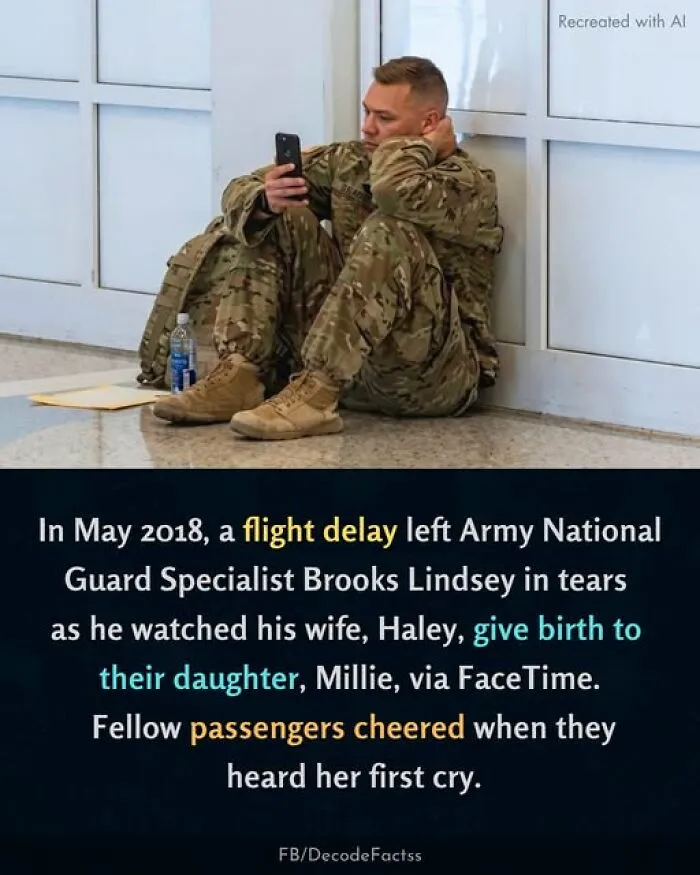
The moment touched the people around him at the airport. Fellow passenger Tracy Dover captured a photograph of Brooks watching the birth, and reports described passengers cheering when they heard Millie’s first cry. The image spread widely on social media, drawing attention to the emotional experience of a father witnessing his daughter’s arrival from a distance. Brooks eventually reunited with Haley and Millie and held his daughter in his arms. Although a flight delay kept him from the delivery room, the kindness of strangers helped make an unforgettable moment a little less lonely.
#12
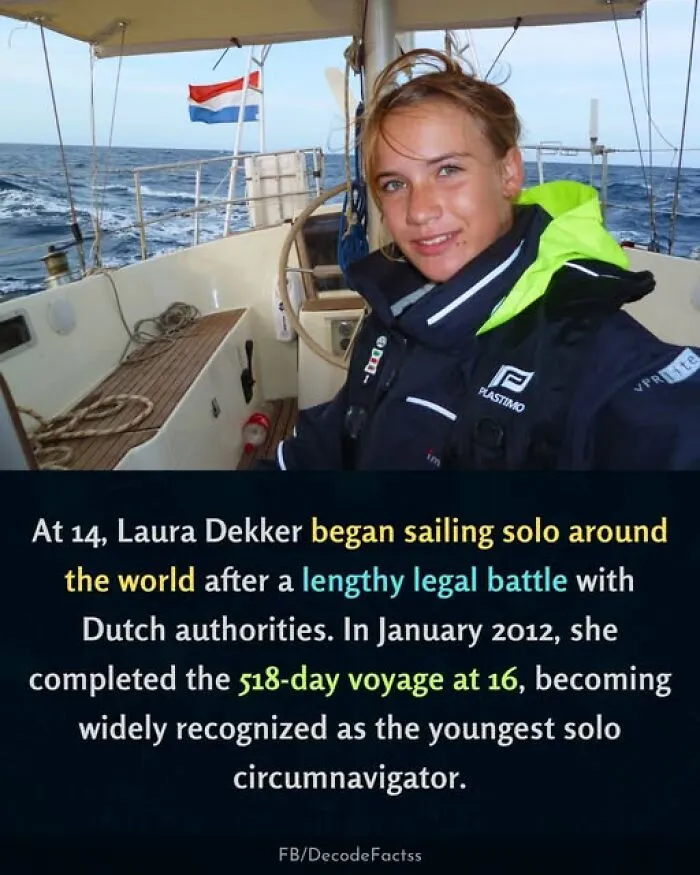
On August 21, 2010, at age 14, Laura departed from Gibraltar aboard her yacht, Guppy. Over the following 518 days, she crossed oceans, navigated challenging weather and stopped at ports along the way. On January 21, 2012, she arrived in Sint Maarten in the Caribbean, completing her solo circumnavigation at age 16. Her achievement attracted international attention and made her widely known for completing the journey at such a young age.
However, Laura's achievement was not an official Guinness World Records title. By August 2010, news reports were already stating that Guinness World Records and the World Sailing Speed Record Council had stopped recognizing records based on the youngest age of solo sailors, citing concerns about encouraging dangerous attempts by young people. Guinness later published a statement explaining its policy in January 2012. Laura is therefore widely recognized as the youngest person to complete a solo circumnavigation by sail, but the distinction is unofficial rather than a Guinness-certified record.
However, to combat misinformation, you need to go beyond even that.
“Any long-term response must grapple with the emotional and social conditions that make misinformation appealing in the first place. Loneliness, declining trust in institutions and feelings of exclusion all make people more receptive to narratives that promise certainty and recognition.”
#13
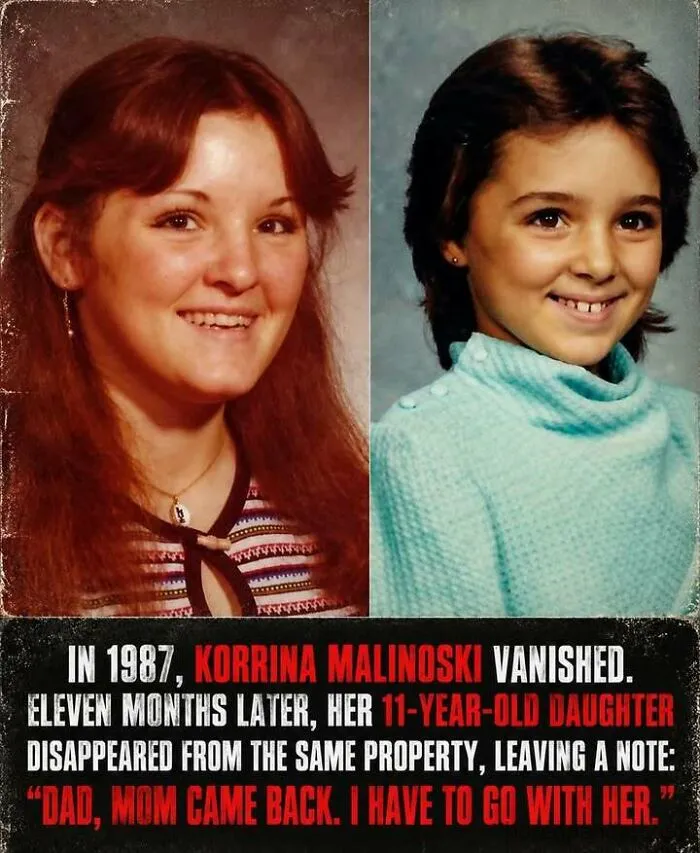
At 7:00 on the morning of October 4, 1988, a school bus driver passed a wooden shelter outside Mount Holly Plantation in South Carolina. An 11-year-old girl named Annette Sagers stood there with her dog. Twenty minutes later the bus came back, and the dog was alone.
Annette's stepfather didn't realize she was missing until that afternoon, when she never came home from a school she'd never reached. Then he found a penciled note at the bus stop: "Dad, Mom came back."
The only person who could have come back was Korrina, Annette's mother. She had vanished from the same spot on November 21, 1987. That night, her husband told deputies, she left their cabin on the 6,000-acre plantation between 11:00 and 11:30 p.m. The next morning her boss found her car locked and parked at the plantation gate. Searchers found nothing. There was no sign of a struggle and no sign of her.
Investigators brought in handwriting experts, who confirmed Annette wrote the note. That answered one question and raised a worse one. Did a girl who missed her mother choose to walk away? Or did someone stand over her while she wrote?
Korrina's family never believed it. Her relatives in Iowa and Illinois had heard nothing from her in a year, and they couldn't accept that she'd return for one child and leave her two young sons behind. They were also making their own plans. Because Steve wasn't Annette's biological father, they intended to seek custody, and a visit to the plantation was set for a week after she disappeared.
Several months later, Steve moved to Florida and gave up his rights to his two sons. He has never been charged in connection with either disappearance. Korrina's sons grew up and went looking for answers themselves. In 2019, the sheriff's office began working with the College of Charleston to map where two bodies might be buried on the property.
Investigators believe neither of them ever left. Nearly four decades on, there is still no grave, no suspect in custody, and no explanation for the note.
#14
#15
“Efforts that strengthen community ties, create space for dialogue, and encourage civic participation may therefore be just as important for long-term resilience as any technical or informational intervention,” the NATO Association of Canada points out.
“Overall, these strategies point to a simple but demanding conclusion: countering misinformation is not only about improving the quality of information, but about tending to the human conditions through which people decide what, and whom, to believe.”
#16
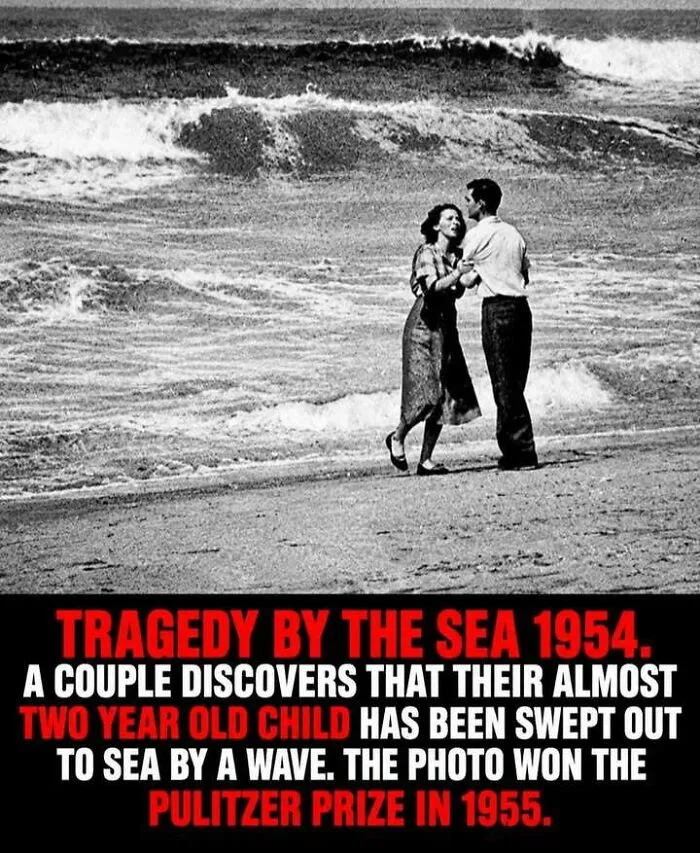
On April 2, 1954, John and Lillian McDonald took their 19-month-old son, Michael, to Hermosa Beach, California. He was playing at the water's edge when a sudden surge of surf pulled him from the shallows. In seconds, he was gone.
His parents ran toward the waves, then back, helpless, clinging to each other. There was nothing they could do but wait and pray.
The search lasted days. John and Lillian kept a vigil on the sand, refusing to leave the shore that had taken their son. On April 12, ten days after he vanished, a woman spotted Michael's small body in the surf near Manhattan Beach, more than a mile from where he was lost.
The family's heartbreak was not over. A 19-month-old who had been laughing at the water's edge was gone forever, and two parents had to face life without him.
Nearby, Los Angeles Times photographer John L. Gaunt captured the couple holding each other beside the crashing waves. His photo, "Tragedy by the Sea," won the 1955 Pulitzer Prize.
#17

University of Ibadan Zoo, Nigeria.
A man named Daniel Abodunrin self-declared prophet, robed in red, Bible tucked under his arm stood outside the lion enclosure and told zoo staff to let him in.
They said no. Obviously.
He begged. He pushed. He wouldn't leave.
Eventually, they gave in.
He believed he was about to recreate one of the most famous stories in the Bible — the prophet Daniel, thrown into a den of lions, walking out without a scratch because God shut the animals' mouths.
He thought faith alone would do the same for him.
So he climbed in.
Bystanders froze. Some thought it was theater. Some genuinely expected a miracle. Nobody expected what came next.
He began praying out loud, reciting scripture, calling on "the God of Daniel" to perform wonders in front of the crowd.
For a few seconds the lions backed off.
Then everything changed.
The lions turned. They circled him. And within moments, they attacked.
There was no angel. No shut mouths. No miracle.
He turned unlike right there, in front of witnesses, before anyone could intervene.
The story spread across Nigeria almost instantly and never really left. Decades later, people still bring it up not to mock faith, but as a hard lesson about the line between belief and blind risk.
Abodunrin's story isn't really about religion. It's about what happens when conviction overrides caution when someone is so certain they're right that no warning can reach them.
Faith moves people. But lions don't read scripture.
#18
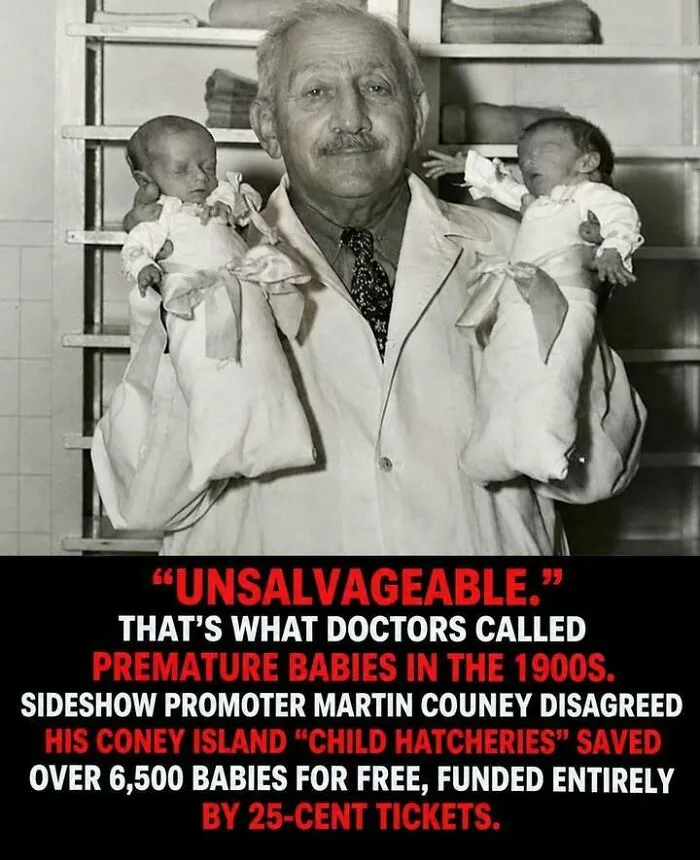
In the early 1900s, doctors didn't just fail to save premature babies they didn't even try. Preemies were written off as "weak stock," not worth the effort. No specialized care. No real intervention. Just left to die.
Then a man named Dr. Martin Couney did something no one expected: he put premature infants on display at Coney Island. For 25 cents, visitors could walk through rows of glass incubators and watch these tiny babies fight for their lives.
It sounds exploitative. It wasn't.
Couney had studied under a French incubator pioneer and knew something American hospitals refused to accept: these babies didn't need to be saved by genetics or luck. They needed warmth, isolation, and proper feeding until their bodies caught up. That's it.
Hospital boards wouldn't fund the equipment. So Couney funded it himself through ticket sales. Every cent went toward nurses, wet nurses, formula, and state-of-the-art incubators. The parents? Never charged a dime.
For 40 years, while the medical establishment scoffed at him as a showman, Couney quietly ran one of the most effective infant care operations in the country. His survival rate: over 80%. His number saved: roughly 6,500.
He didn't stop until 1943 when hospitals finally built their own incubator units, essentially copying the "sideshow" that had outperformed them for decades.
Couney never got a formal medical degree. He got results instead. And in doing so, he quietly laid the groundwork for the NICU the Neonatal Intensive Care Unit, the specialized hospital ward that today cares for premature and critically ill newborns around the world.
The ‘Extremely Weird’ Facebook page has 66k followers and describes itself as “your best source of weird stuff.”
Meanwhile, the ‘Weird Facts’ Facebook group boasts a mind-melting 903.9k members. The group sees itself as “the ultimate community for curious minds who love exploring the odd, bizarre, and fascinating aspects of our world.”
#19
#20
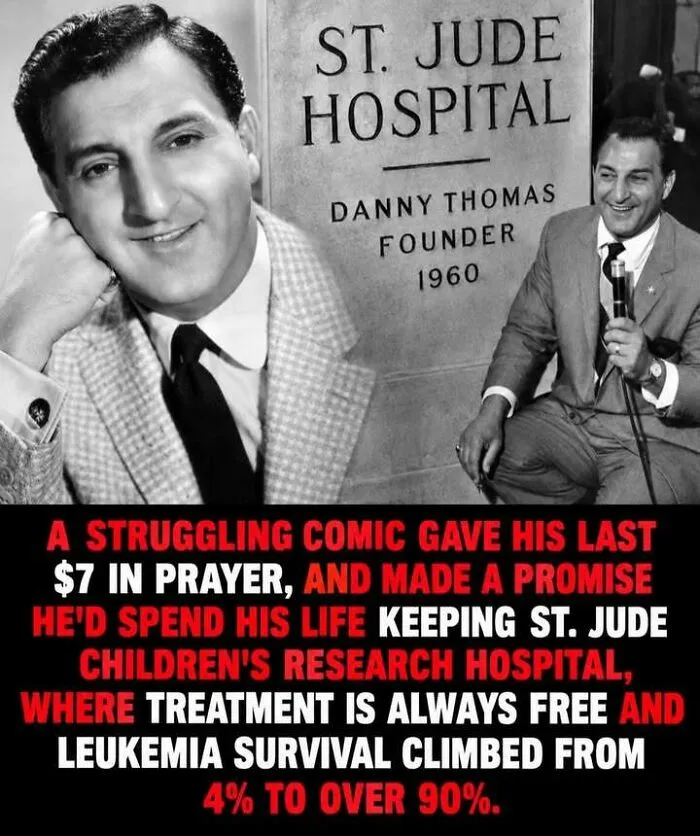
Danny Thomas wasn't famous yet. He wasn't even stable. In 1940 he was a struggling nightclub comic in Detroit, barely scraping by, with a new baby at home and no idea how he'd support her. Out of options, he walked into a church, emptied his pockets, dropped his last seven dollars into the collection box, and made a desperate bargain with St. Jude Thaddeus, the patron saint of lost causes: help me find my way, and I'll build something in your name.
The very next day, he landed a job paying ten times what he'd just given away.
His career exploded after that. Radio, television, film. Danny Thomas became a household name. But the promise he'd whispered in that Detroit church never faded into the past. It grew into something bigger: not just a shrine, but a place where the most hopeless medical cases in childhood could find a fighting chance.
He picked Memphis. He spent years fundraising, calling in favors from celebrities, and building a mission around one radical idea. In 1962, St. Jude Children's Research Hospital opened with a rule no one in American medicine had tried before: families would never pay. Not for treatment, not for travel, not for housing, not for food.
It shouldn't have worked. It did.
St. Jude became a global force in pediatric research. When it opened, a child diagnosed with leukemia had roughly a 4% chance of survival. Today, that number is above 90%, a shift St. Jude helped engineer through decades of research shared freely with hospitals worldwide.
Danny Thomas is buried on the hospital grounds today, resting next to the vow that shaped his entire life: "No child should die in the dawn of life."