
Some facts are fun for a moment. You know the type. Those well-worn favorites that pop up in every quiz night or pop out of every Christmas cracker. Others come with a story attached—a name, a face, some texture. Those, in my mind at least, are the ones that really stick. Maybe it’s a remarkable moment that almost slipped through history’s cracks. A small win that deserves more attention than it ever got. A record that’s finally been set straight. Or maybe a strange, unexpected reminder that humanity isn’t completely horrible after all.
These are exactly the kinds of interesting facts shared by the “Weird Facts” accounts on Instagram and Threads. From lessons hidden in history to straight-up curiosities, we’ve rounded up some of the best. Keep reading for a few you might just find weirdly hard to forget.
#1
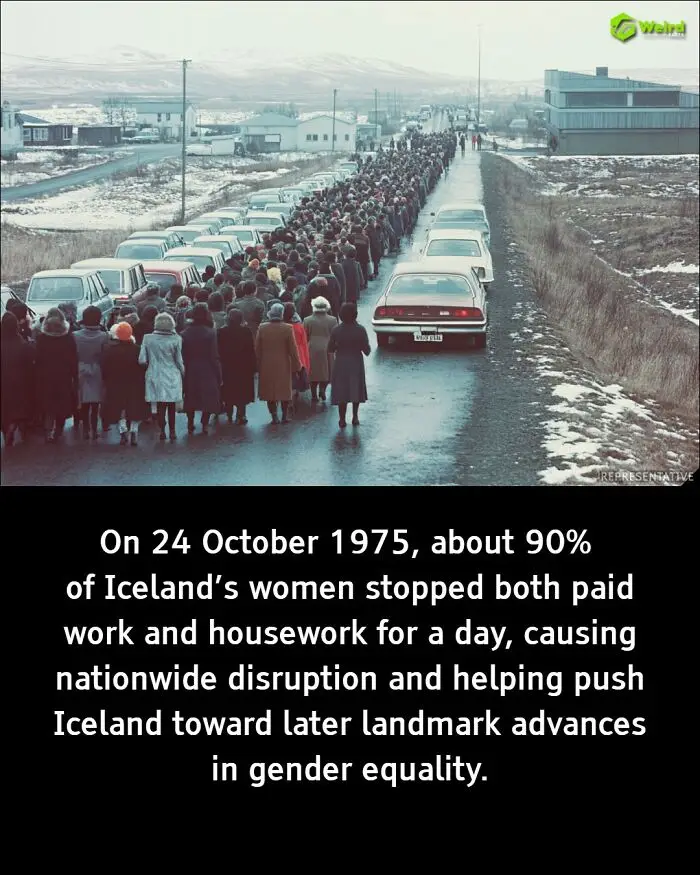
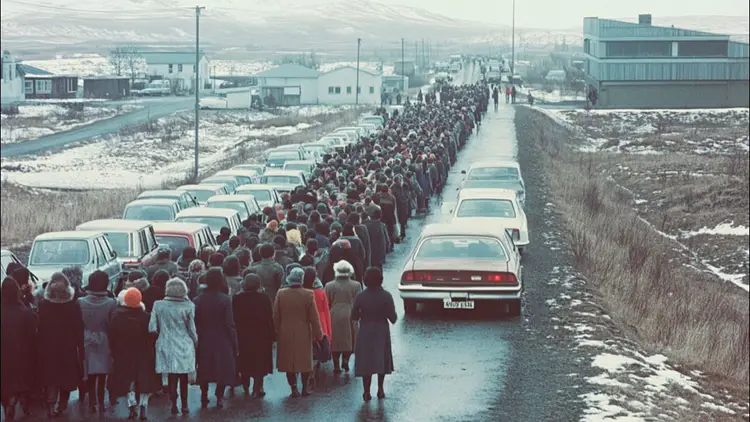
On 24 October 1975, women across Iceland took part in a mass walkout known as Women’s Day Off.
About 90% stopped both paid work and unpaid domestic labor to protest inequality and show how essential women were to Icelandic society. The action caused widespread disruption: schools and nurseries were affected, many workplaces ran at reduced capacity, and fathers often had to bring children to work.
In 1976, Iceland passed its first Gender Equality Act, establishing a formal framework for equal rights and opportunities for women and men. Five years after the strike, in 1980, Iceland elected Vigdís Finnbogadóttir, the world’s first democratically elected woman president.
Today, Iceland ranks first in the World Economic Forum’s Global Gender Gap Index.
Report
10points
#2
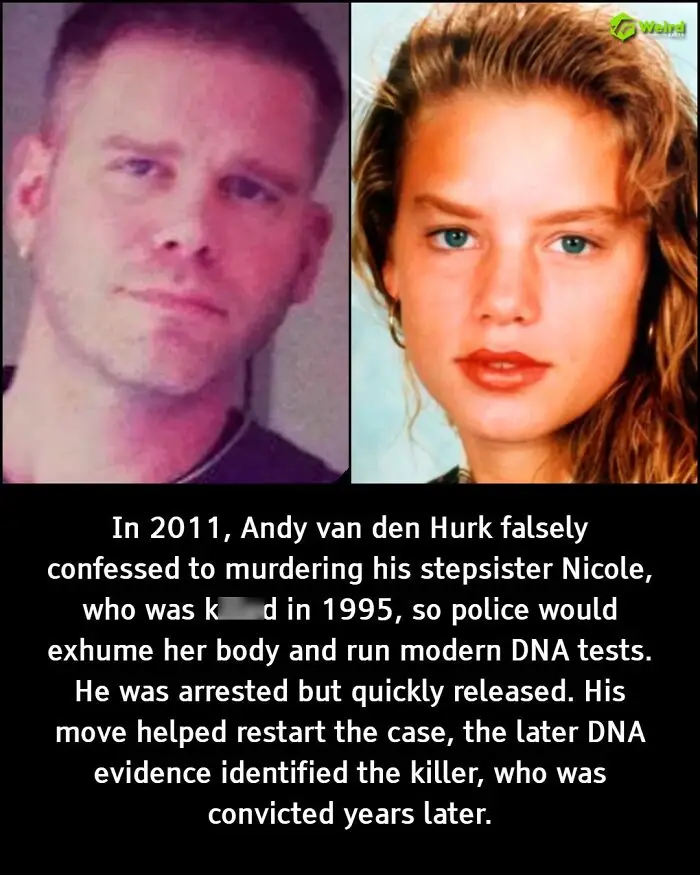
A heartbroken stepbrother confessed to his sister’s m****r – but it was a lie that helped restart her 16-year-old cold case.
Nicole, 15, vanished while cycling to work in Eindhoven, the Netherlands, on 6 October 1995. Her body was found in the woods between Lierop and Mierlo nearly seven weeks later, with a fatal st*b wound. The case went cold despite extensive attention and a large funeral.
Andy van den Hurk, Nicole’s stepbrother living in England, posted a Facebook confession in March 2011 saying he had confessed to her m****r. He later said the confession was false and that he wanted Nicole’s body exhumed for DNA testing. British police arrested Andy, extradited him, but freed him after five days.
In September 2011, police exhumed Nicole’s body as the reopened investigation continued. DNA later linked s**en traces to Jos de G., then 46, a man with prior r**e convictions. Jos was charged in 2014.
After years of trials, he was first acquitted of manslaughter but convicted of r**e and jailed for five years; on appeal in 2018, he was convicted of r**e and mansl**ghter and sentenced to 12 years, a verdict the Dutch Supreme Court left in place in 2020.
Report
9points
#3
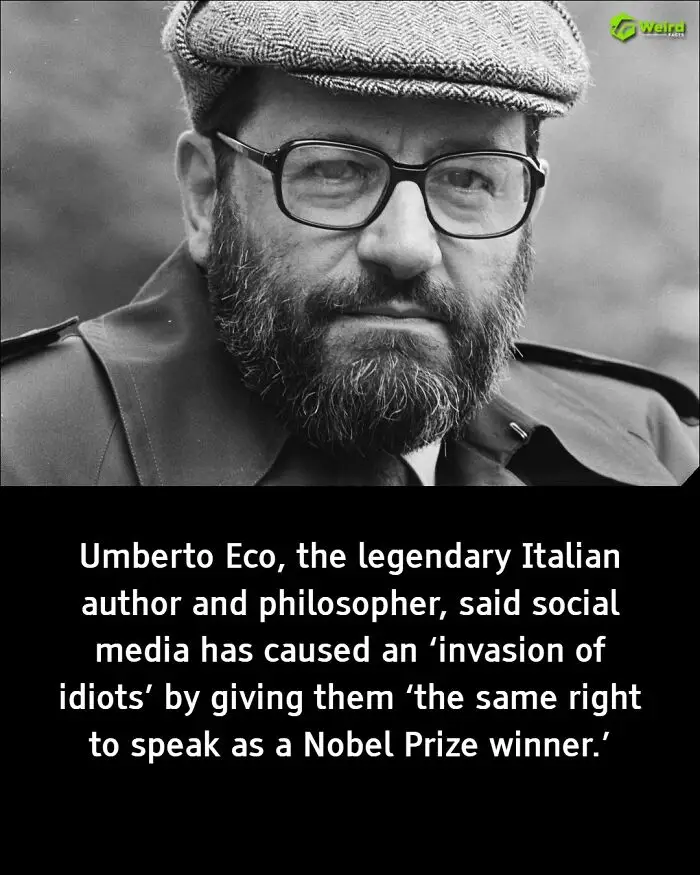
Umberto Eco, the legendary Italian author and philosopher, had a blunt warning about social media back in 2015: it caused an “invasion of idiots.”
He said it gave everyone, even those with zero expertise, the same right to speak as Nobel Prize winners. Before, those folks only spoke in bars after a glass of wine and were quickly silenced. Now their voices are amplified far more widely. He shared this right after getting an honorary degree in Turin.
Spot on then, even more relevant today.
9points
#4
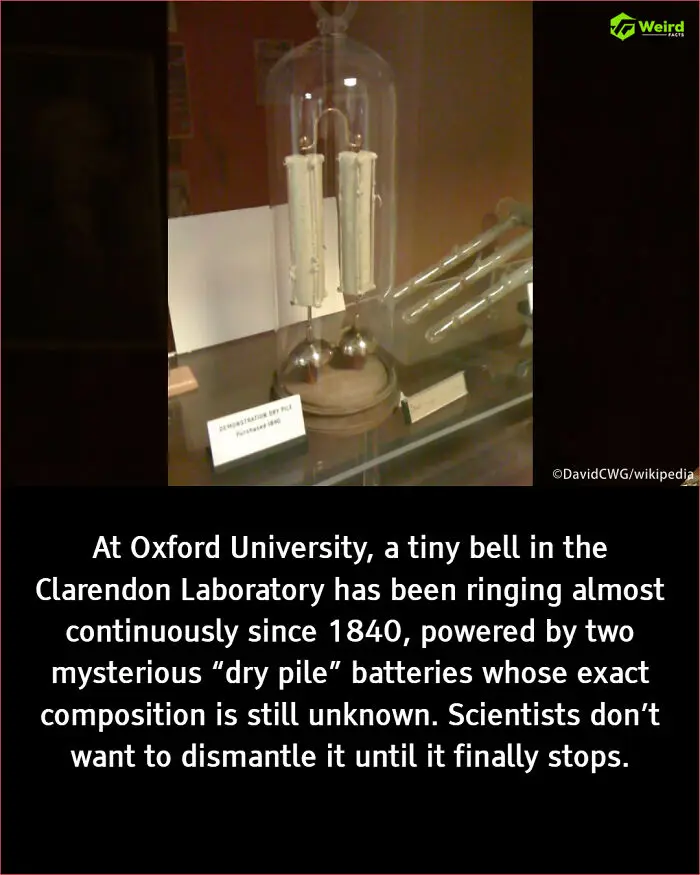
At the Clarendon Laboratory of the University of Oxford, a small device known as the Oxford Electric Bell has been operating since it was set up in 1840.
It uses two early “dry pile” batteries to drive a 4 mm metal ball that swings between a pair of bells about twice per second, producing billions of rings over its lifetime. Oxford’s records note the label “Set up in 1840,” and researchers report that, apart from short pauses caused by humidity, it has rung continuously since then.
The exact internal construction of the batteries is still uncertain, though documents suggest a Zamboni-type stack of metal and paper discs sealed in sulphur. Because opening the device could end the run, scientists plan to leave it intact until the bell eventually stops, even though it currently holds a Guinness World Record as the world’s most durable battery.
8points
#5
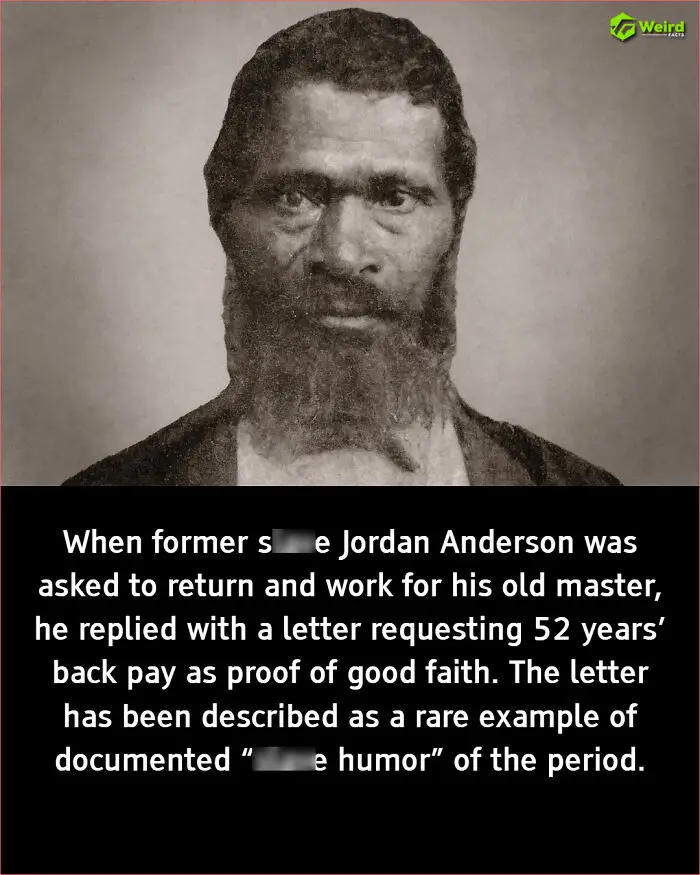
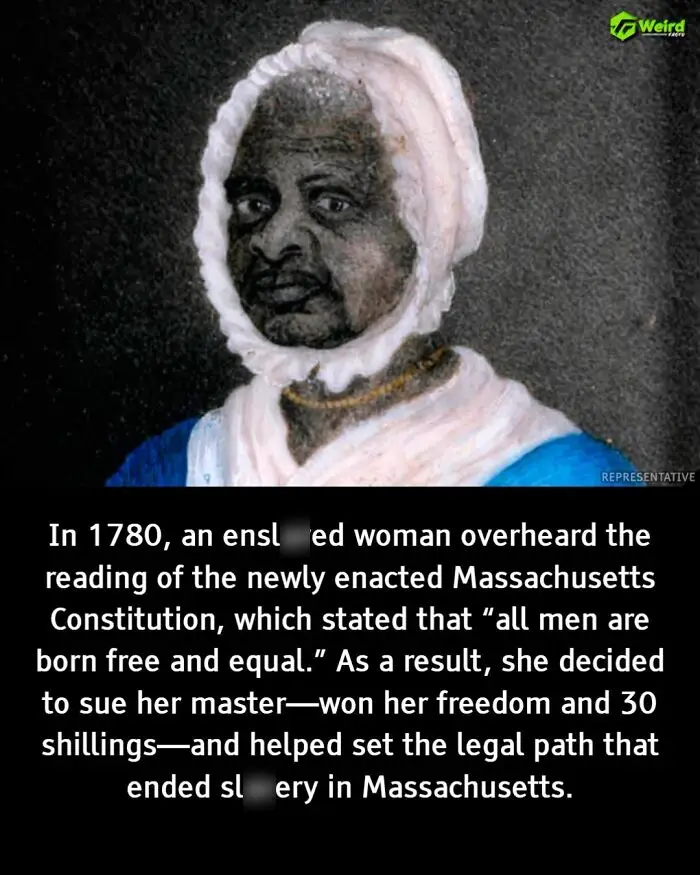
In August 1865, Jourdon Anderson, a formerly ensla**d man living in Dayton, Ohio, replied to his ex-ensl**er, Colonel P.H. Anderson, who had asked him to return to the Tennessee plantation.
In a dry, pointed letter, Anderson described his new life in Ohio—regular wages, a home, and children attending school—and then set a condition for any return: payment of back wages for 32 years of his work and 20 years of his wife Mandy’s, calculated at $11,680 plus interest. He also asked whether his daughters would be safe and whether schools for Black children existed nearby.
The letter, published in the Cincinnati press, has been noted for its sharp wit and moral clarity as it captured the realities and tensions of the immediate post-emancipation era.
Report
8points
#6
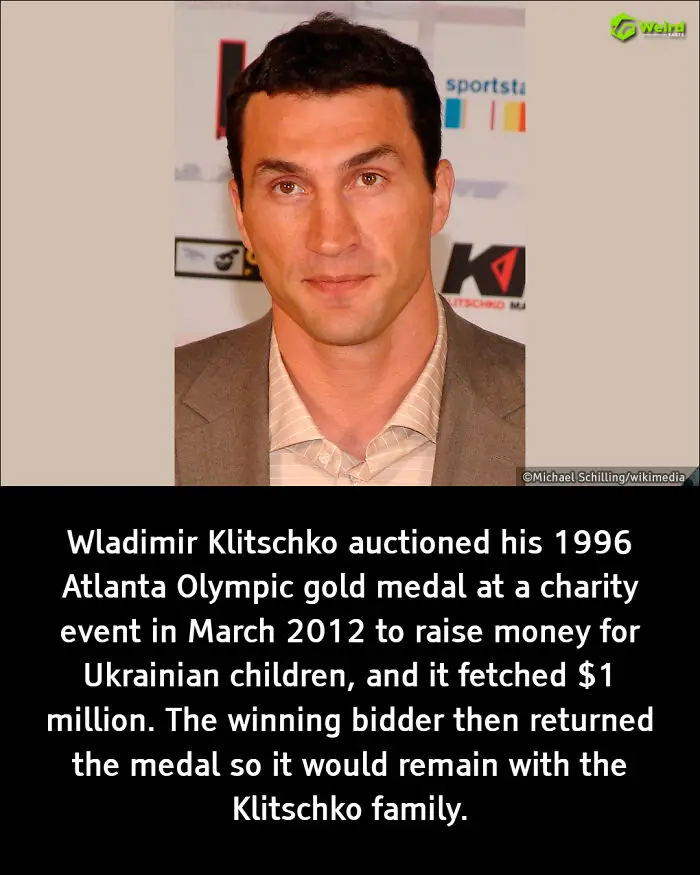
Wladimir Klitschko auctioned his 1996 Atlanta Olympic gold medal at a charity event in Kyiv in March 2012 to raise funds for Ukrainian children. The winning bid was $1 million, with proceeds going to the Klitschko brothers’ charitable work focused on supporting and inspiring young people.
Shortly after the sale, the buyer’s representative said the medal should remain with the Klitschko family, and the medal was returned to Wladimir. The story is often shared as an example of both Klitschko’s commitment to children’s causes and the donor’s symbolic show of respect.
Shortly after the sale, the buyer’s representative said the medal should remain with the Klitschko family, and the medal was returned to Wladimir. The story is often shared as an example of both Klitschko’s commitment to children’s causes and the donor’s symbolic show of respect.
Report
8points
#7
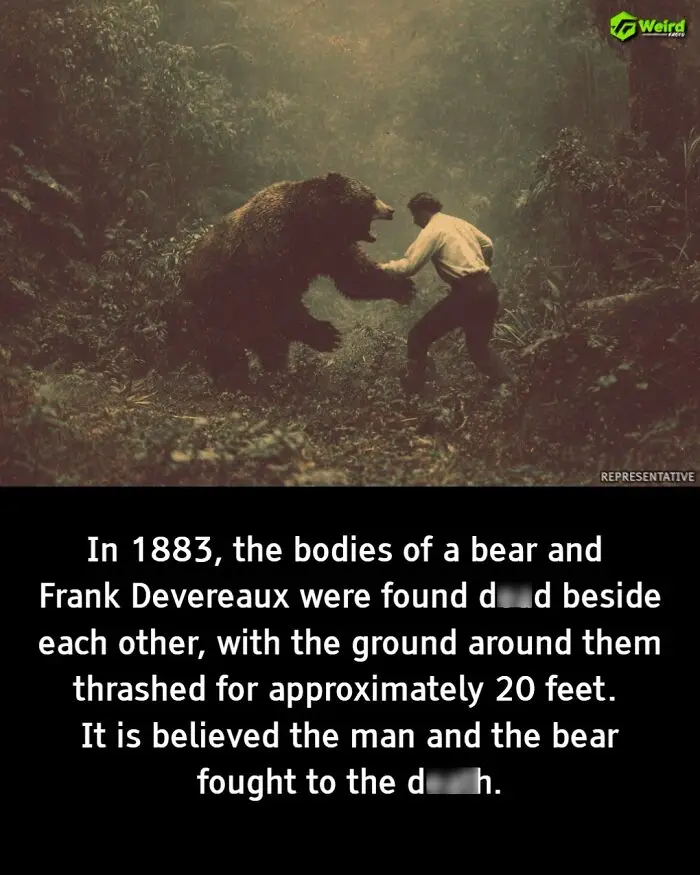
In September 1883, near Cheboygan, Michigan, searchers found a grim scene in the woods: Frank Devereaux’s body lying close to a d**d bear.
The ground around them was torn up for about 20 feet, like a fight had exploded in the dirt and brush. With no witnesses, the best guess from historical accounts was that Devereaux met the bear alone, likely wounded it first, and then got fatally mauled—before the bear finally collapsed and d**d too.
A brutal, eerie reminder of what the “frontier” could mean back then: sometimes you didn’t just encounter wildlife… you didn’t walk away from it.
Report
7points
#8
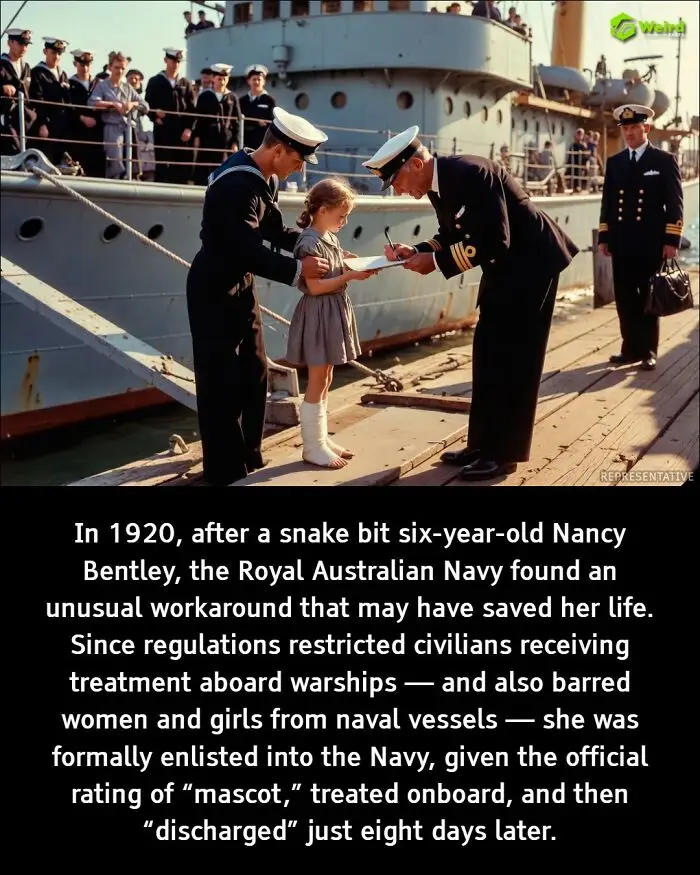
The incident involving Nancy Bentley took place in 1920, when she was just six years old. After being bitten by a snake near a coastal area, she urgently needed medical care. At the time, Australian naval regulations were strict: civilians were not permitted to receive treatment aboard naval vessels.
Faced with a child’s life at risk, the Royal Australian Navy improvised an unusual solution. Nancy was formally enlisted so she could legally remain onboard and receive treatment from the ship’s medical staff. She was given the official naval rating of “mascot,” making her, on paper, the youngest person known to have been enlisted in the Australian forces.
She stayed onboard for eight days, during which she received care from the ship’s medical staff. She was formally “discharged” from service after eight days, completing an eight-day “career” that remains a record for the youngest known enlistment.
The story is often cited as an example of how rigid rules were bent, turning a bureaucratic loophole into a potentially lifesaving act.
Report
7points
#9
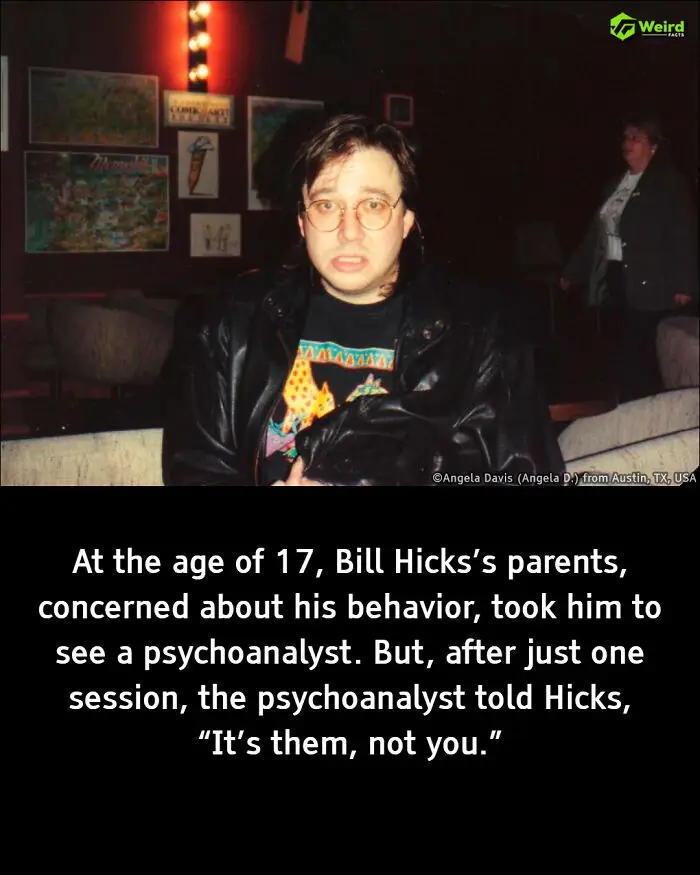
When comedian Bill Hicks was about 17 years old, his parents, concerned by his rebellious behaviour, brought him to see a psychoanalyst. After the initial session with the family and Hicks, the analyst pulled Hicks aside and told him: “You can continue coming if you want to … But it’s them, not you.”
The remark resonated with Hicks’s feelings of alienation from his upbringing and family environment, and he later referenced it as a turning point in accepting his outsider identity and focusing on his comedy.
The remark resonated with Hicks’s feelings of alienation from his upbringing and family environment, and he later referenced it as a turning point in accepting his outsider identity and focusing on his comedy.
6points
#10
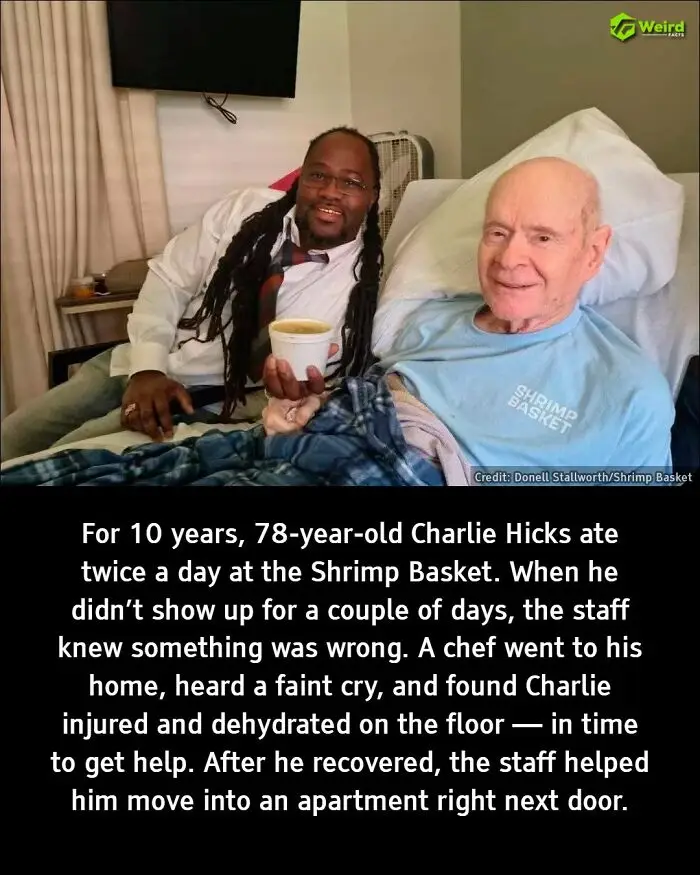
Charlie Hicks wasn’t just a customer at the Shrimp Basket — he was part of the daily rhythm. For nearly a decade, the 78-year-old veteran stopped in every day for lunch and dinner.
Staff knew his order, his routine, and the fact that he never missed a day. So when Charlie didn’t show up for a couple of days, Chef Donnell Stallworth felt uneasy. Trusting his instincts, Stallworth went to Charlie’s apartment to check on him.
Inside, he heard a faint cry for help. Charlie had fallen and been lying on the floor— it was unclear how long — suffering from broken ribs and severe dehydration. Charlie was rushed to the hospital and eventually recovered — and the story didn’t end there.
Wanting to make sure he was never isolated again, the restaurant staff helped him relocate to an apartment right next door to the Shrimp Basket, where familiar faces could keep an eye on him every day.
It’s a reminder that sometimes the people who save our lives aren’t doctors or paramedics — they’re the ones who notice when you don’t show up.
Photo courtesy: Donnell Stallworth/Shrimp Basket.
Report
6points
#11
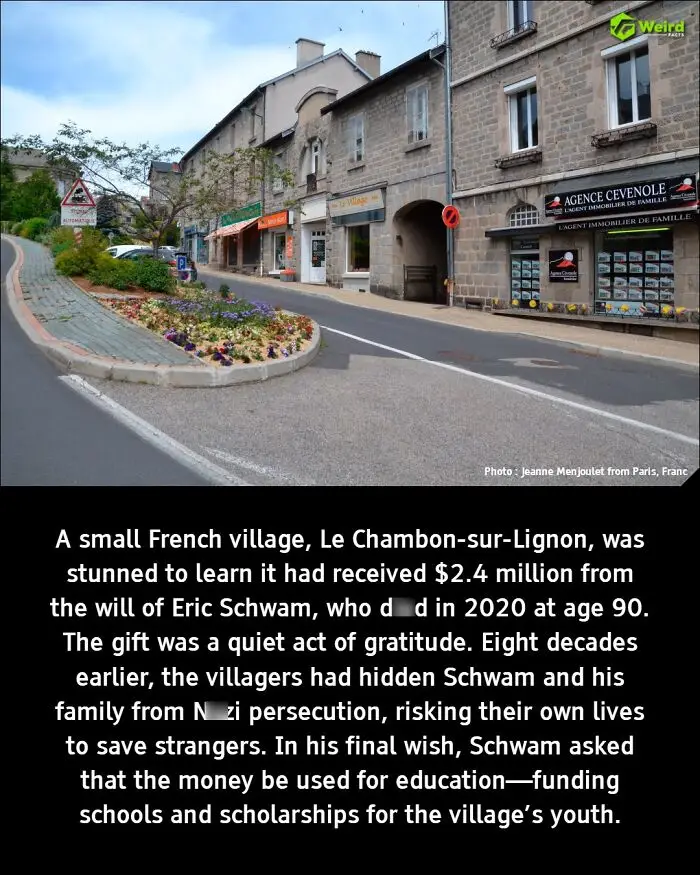
A quiet village in France, Le Chambon-sur-Lignon, received an unexpected legacy.
In late 2020, officials learned that a 90-year-old Austrian man named Erich Schwam had left the village about €2 million (about $2.4 million) in his will. At first, no one understood why. Then the story surfaced.
More than eight decades earlier, during World War II, the people of Chambon-sur-Lignon quietly risked their lives to shelter Jewish families fleeing N**i persecution. Erich Schwam was one of the children they saved. The village hid refugees in homes, farms, and schools, offering shelter along the way. Schwam never forgot.
His final wish was for the future. He asked that the money be used for education—funding schools, scholarships, and opportunities for the village’s young people. It was a thank-you written across generations. A debt repaid after 80 years. And proof that kindness, even in the darkest times, can echo forever.
Report
6points
#12
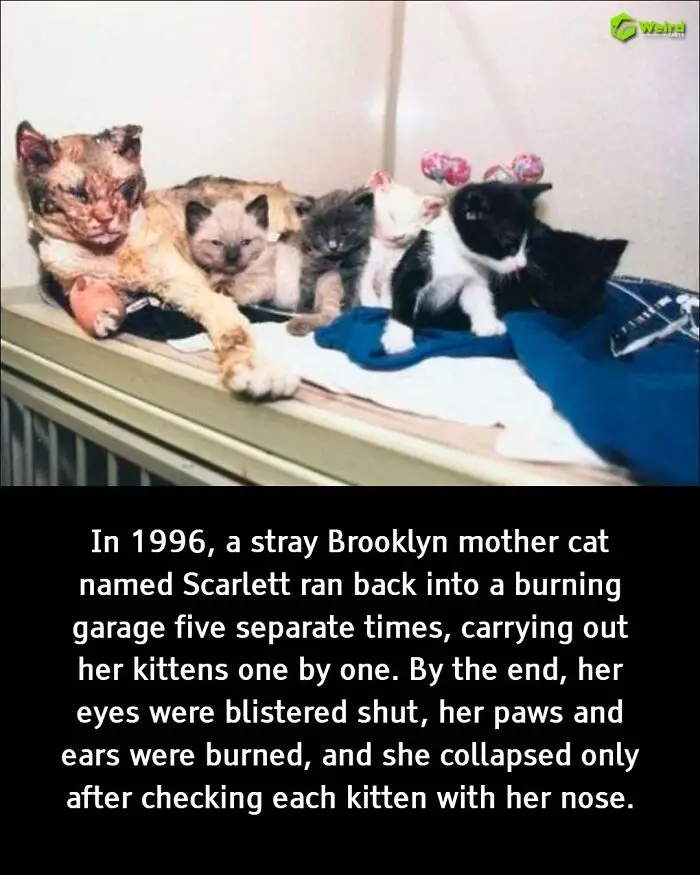
In 1996, a stray cat in Brooklyn did something incredible during a fire.
She had been hiding in an abandoned garage with her five kittens when the building caught fire. Instead of running away, the mother cat rushed back in again and again, carrying her babies out one by one.
By the time firefighters found her, she was badly burned. Her eyes were swollen shut, and her paws and ears were badly hurt. Even then, she used her nose to check each kitten before finally collapsing.
She was later named Scarlett, and her story touched people around the world. She and her kittens were taken in for treatment, and her bravery led to headlines, awards, books, and thousands of people wanting to adopt her.
Scarlett later found a safe home and lived there until 2008.
Report
6points
#13
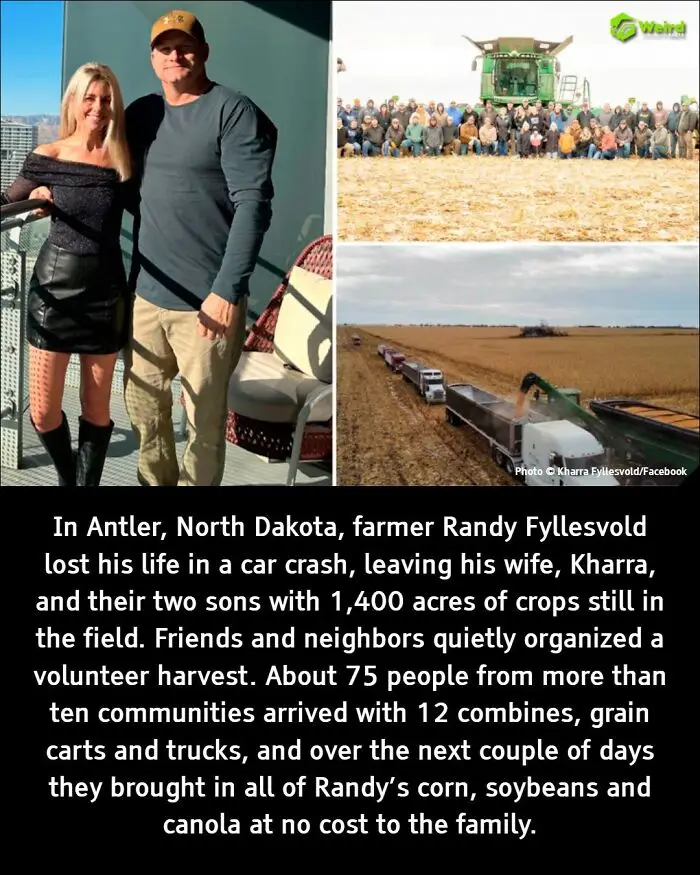
In September 2025, North Dakota farmer Randy Fyllesvold lost his life in a vehicle crash near Maxbass, leaving his wife, Kharra, and their two sons with about 1,400 acres of unharvested corn, soybeans, and canola near Antler.
Facing winter weather and limited time, friends Wyatt Thompson and Andy Gates realized the family could not finish the harvest alone. They contacted neighboring communities and organized a volunteer effort. Roughly 75 farmers answered the call, arriving with around 12 combines, several grain carts, and more than 40 trucks. Over the next couple of days, they worked together to harvest Randy’s entire crop at no cost to his family. Participants described the effort as “just friends helping friends,” saying it was simply what rural communities do in times of crisis.
Kharra later called the community’s response “nothing short of breathtaking” and said she believed Randy would have been proud to see how many people came to support his family in their hardest days.
Report
5points
#14
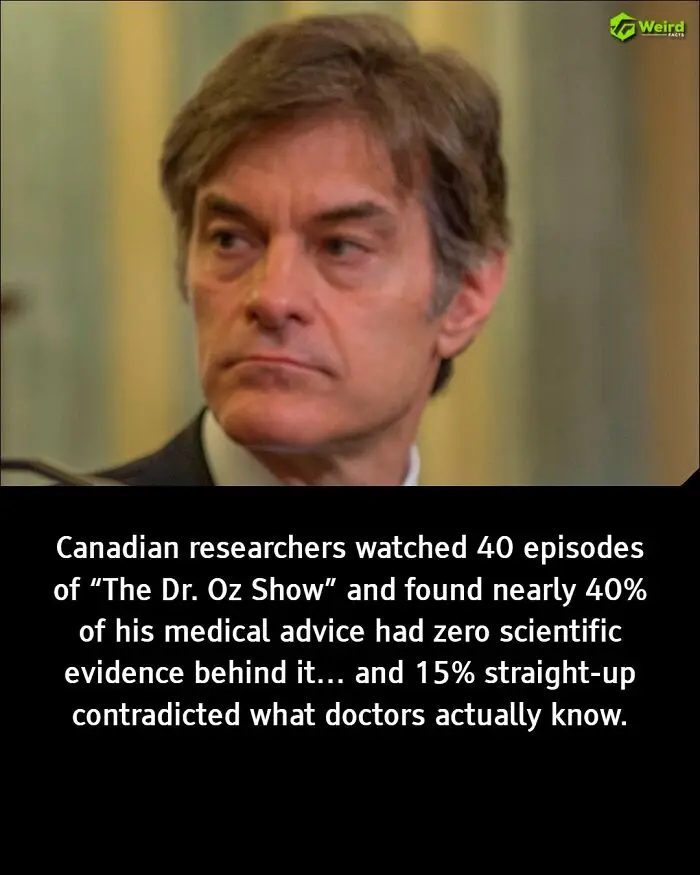
You know those days you’re watching Dr. Oz, and he drops some “miracle” tip that sounds too good to be true?
Turns out… a lot of them kinda are.
A team of Canadian doctors from the University of Alberta analyzed 40 full episodes. Their verdict? Almost 4 out of every 10 recommendations lacked any real scientific backing, and another 15% went directly against established medical evidence.
It’s wild how one of the most watched health shows on TV was pushing advice that didn’t always hold up.
Have you ever tried a “Dr. Oz recommendation” that turned out to be total hype… or actually worked...
Report
5points
#15
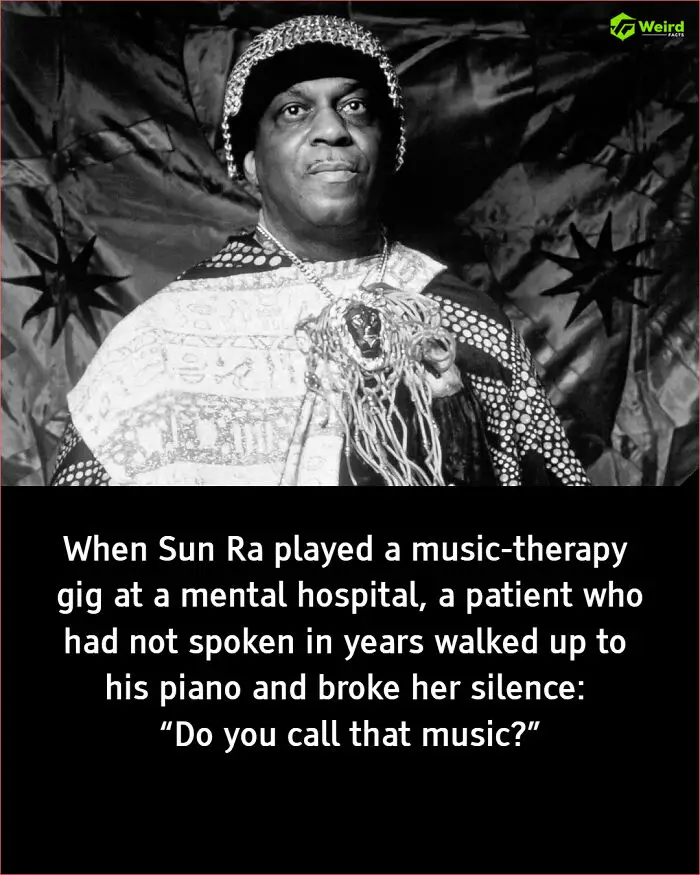
In the late 1950s, Sun Ra played a music-therapy set at a Chicago psychiatric hospital. According to John F. Szwed’s biography, staff said one woman in the group hadn’t moved or spoken in years. During the performance, she stood, walked to the piano, and broke her silence by asking, “Do you call that music?” Sun Ra later repeated the story as proof that challenging sounds can still reach people and provoke a response, even in difficult clinical settings.
Report
5points
#16
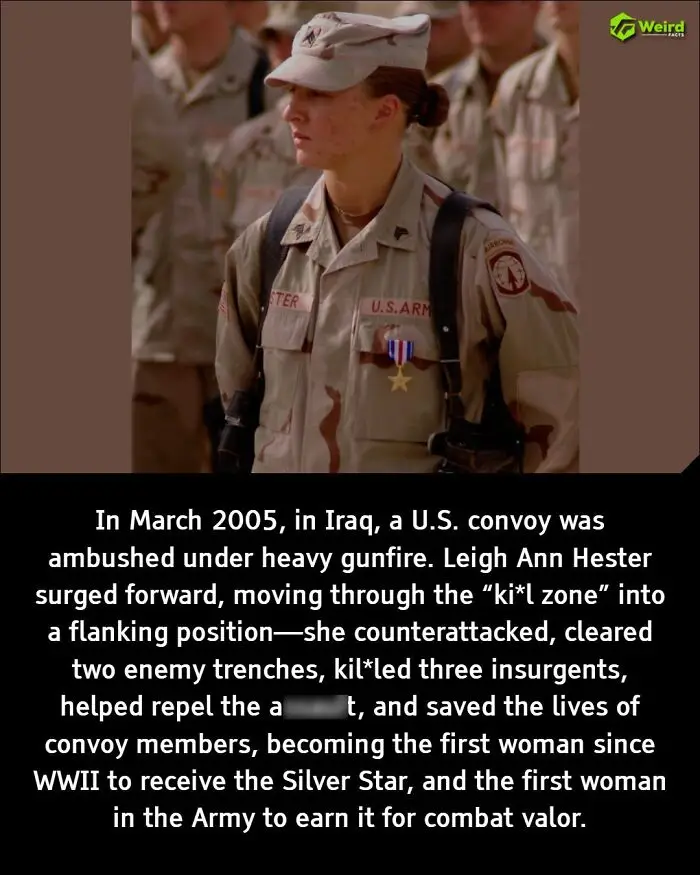
On March 20, 2005, Sgt. Leigh Ann Hester was serving with the 617th Military Police Company, a Kentucky Army National Guard unit, shadowing a supply convoy near Salman Pak, just southeast of Baghdad, Iraq. The convoy was ambushed by roughly 50 insurgents using AK-47 fire, RPK machine-gun fire, and rocket-propelled grenades, creating a deadly “ki*ll zone.”
Instead of taking cover, Hester and her squad moved through the ki*ll zone to flank the attackers. With her squad leader, she led a counterattack against the insurgents’ trench lines, using hand grenades and M203 g*****e-launcher rounds. During the ensuing firefight, she cleared two enemy trenches and personally ki*led at least three insurgent fighters with her M-4 rifle.
For her extraordinary bravery and combat valor, she was awarded the Silver Star Medal — the third-highest U.S. military combat decoration — on June 16, 2005, becoming the first woman since World War II to receive the Silver Star for combat actions in Iraq.
Report
5points
#17
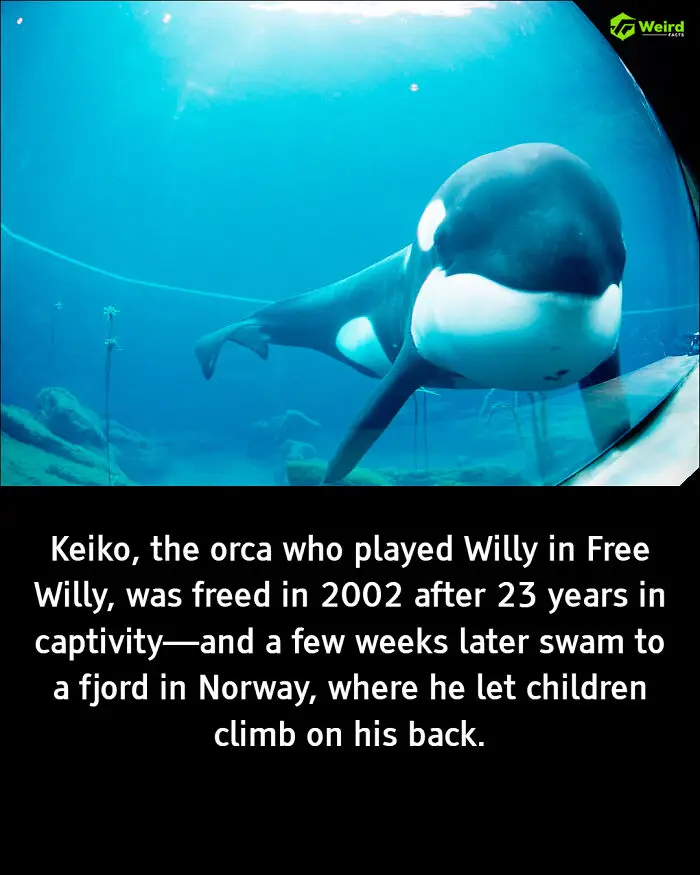
Keiko was a male orca famous for his role in the 1993 film Free W***y. Captured in 1979, he spent about 23 years in captivity before being relocated and rehabilitated for release.
On 15 July 2002, he was released from an Icelandic sea pen and became the first captive orca to be fully released back into the ocean. A few weeks later, he travelled about 1500 km to Norway’s Skålvik Fjord where, despite his freedom, he continued seeking human contact. In that fjord he became a sensation—visitors observed him allowing children to climb on his back and interact with him in water.
His story remains one of the most high-profile attempts to return a captive marine mammal to the wild.
Report
5points
#18
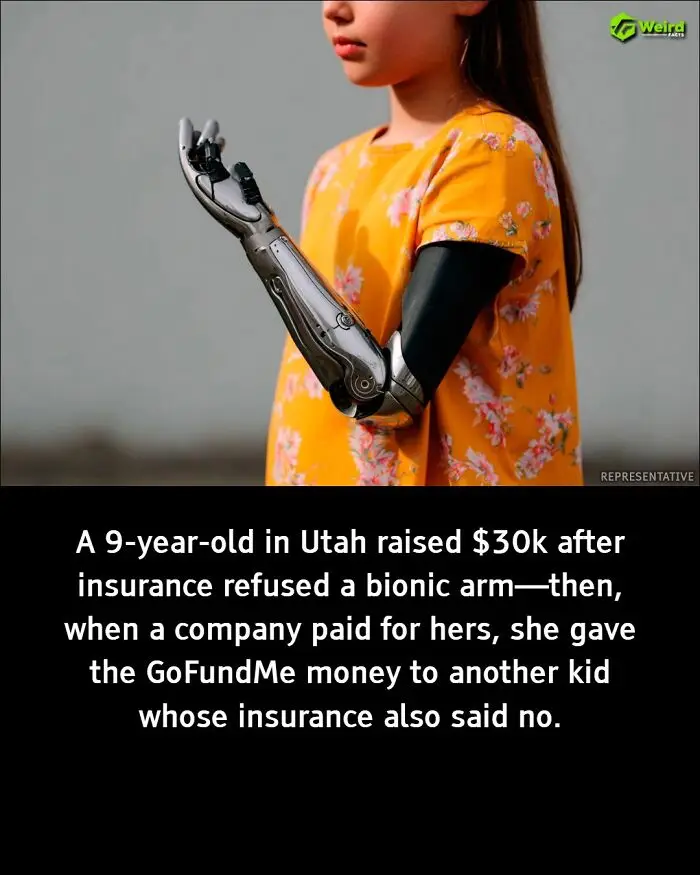
In 2024, 9-year-old Remi Bateman from Utah was denied health insurance coverage for a ~$24,000 Hero Arm bionic prosthetic.
Her family started a GoFundMe that quickly raised more than $30,000. Shortly afterward, Andy Schoonover, CEO of CrowdHealth, offered to pay the full cost of Remi’s arm.
With her prosthetic now covered, Remi and her family chose to redirect the GoFundMe donations to help another child facing the same problem: Tyraun “Taj” Johnson of Maryland, whose insurance had also refused to cover his Hero Arm.
The kind act helped get both children’s Hero Arms funded and spotlighted how often insurers deny coverage for high-tech limbs that families say greatly improve daily life and long-term health.
Report
5points
#19
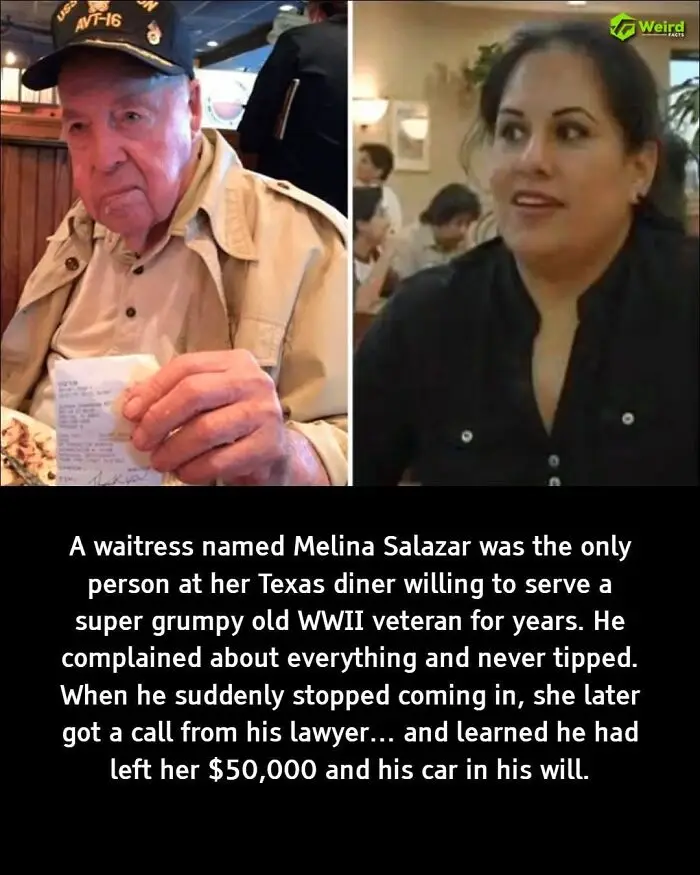
For nearly seven years, Melina Salazar was a waitress at Luby’s Cafeteria in Brownsville, Texas.
She regularly served Walter “Buck” Swords, an 89-year-old WWII veteran known for being grumpy and demanding about his food. Despite his difficult behavior, Salazar treated him with patience and kindness.
Swords d**d in July 2007. About five months later, just before Christmas, Salazar learned from his lawyer that he had left her $50,000 and his 2000 Buick in his will, apparently as thanks for the kindness she had shown him.
Report
5points