




Some facts are fun for a moment. You know the type. Those well-worn favorites that pop up in every quiz night or pop out of every Christmas cracker. Others come with a story attached—a name, a face, some texture. Those, in my mind at least, are the ones that really stick. Maybe it’s a remarkable moment that almost slipped through history’s cracks. A small win that deserves more attention than it ever got. A record that’s finally been set straight. Or maybe a strange, unexpected reminder that humanity isn’t completely horrible after all.
These are exactly the kinds of interesting facts shared by the “Weird Facts” accounts on Instagram and Threads. From lessons hidden in history to straight-up curiosities, we’ve rounded up some of the best. Keep reading for a few you might just find weirdly hard to forget.
#1
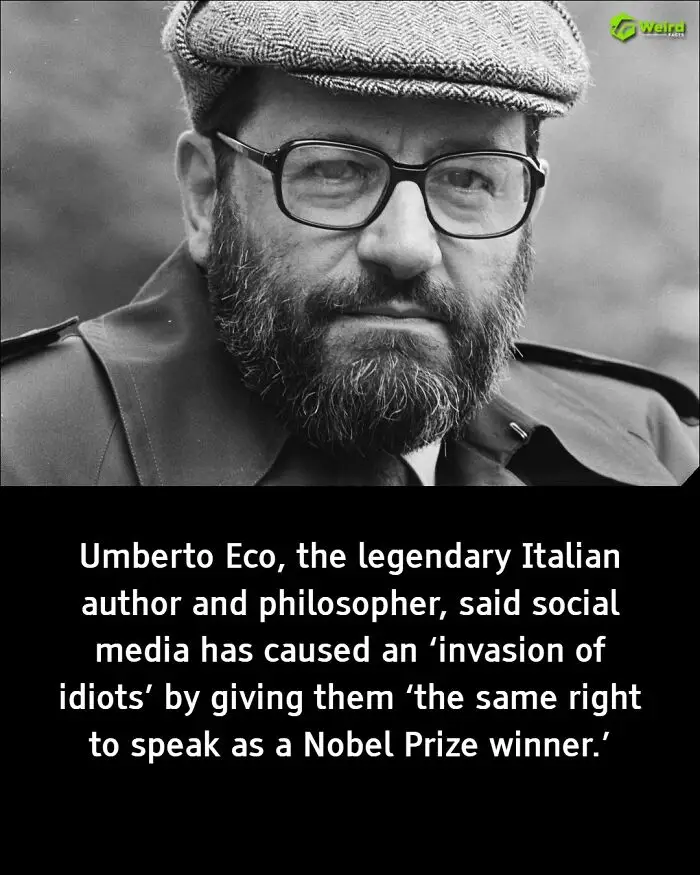
Umberto Eco, the legendary Italian author and philosopher, had a blunt warning about social media back in 2015: it caused an “invasion of idiots.”
He said it gave everyone, even those with zero expertise, the same right to speak as Nobel Prize winners. Before, those folks only spoke in bars after a glass of wine and were quickly silenced. Now their voices are amplified far more widely. He shared this right after getting an honorary degree in Turin.
Spot on then, even more relevant today.
47points
#2
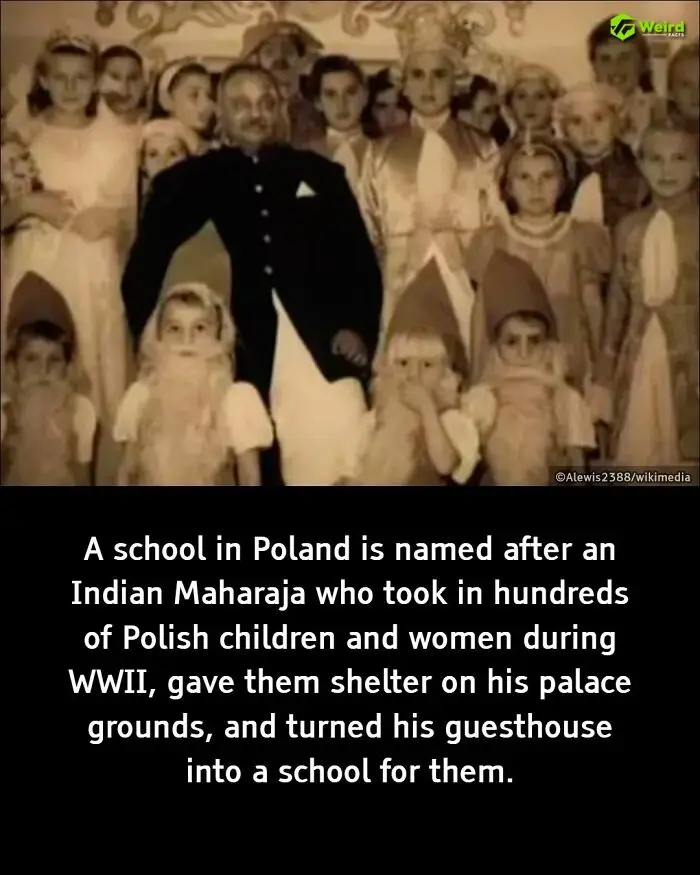
During World War II, one Indian Maharaja became a real-life father to over 600 Polish children, many of them orphans, in one of history’s most heartwarming rescues.
After the Soviet invasion of eastern Poland in 1939, thousands of Polish children were sent to brutal camps and orphanages deep inside the USSR. Starving, sick, and d***g, they had almost no hope.
Then in 1941, an amnesty let some leave. The Maharaja of Nawanagar, Jam Saheb Digvijaysinhji, offered them a home. India became the first place to offer them a safe home.
In early 1942, the exhausted children arrived in Balachadi near his palace. The Maharaja greeted them personally and said: “You are no longer orphans. From now on you are Nawangarians, and I am Bapu, father of all Nawangarians, so I’m your father as well.’ ”
He turned his palace guest house into a school, built dormitories, and gave them food, clothes, medical care, a Polish library, sports and plays. They lived safely there through the war years, and many remained until 1946.
When it was finally time to return to Europe, both the children and the Maharaja were heartbroken. He never asked for financial compensation – only that a street in Warsaw be named after him.
After Poland became a democracy, the country honoured him. A square in Warsaw was named after him, and in 2012, a park in Warsaw’s Ochota district was named the Square of the Good Maharaja. A monument was added in 2014, he received a high Polish honour after his d***h, and a school in Warsaw now carries his name.
What an extraordinary hero. His legacy of love still shines brightly today.
Report
47points
#3
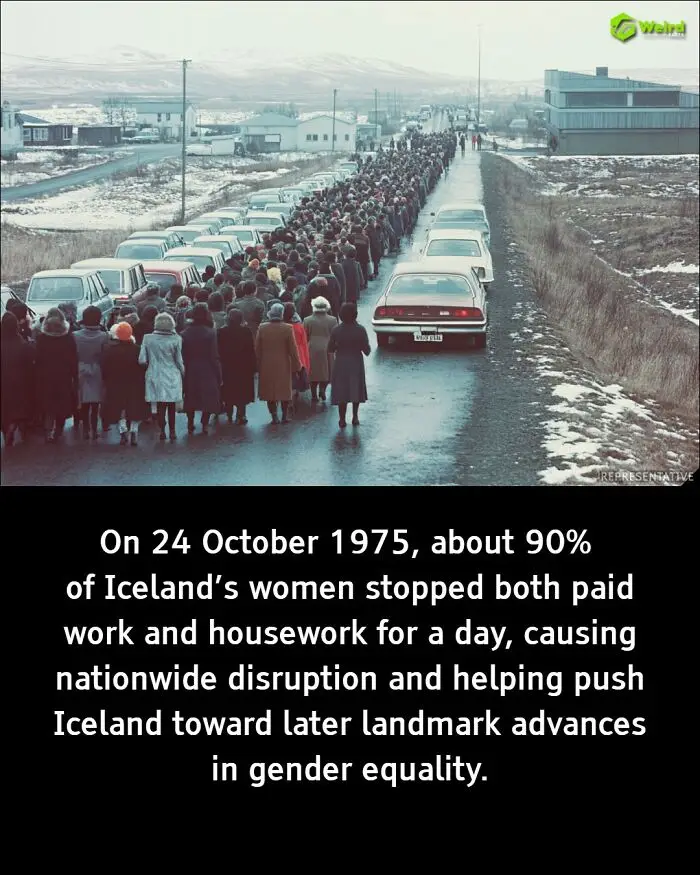
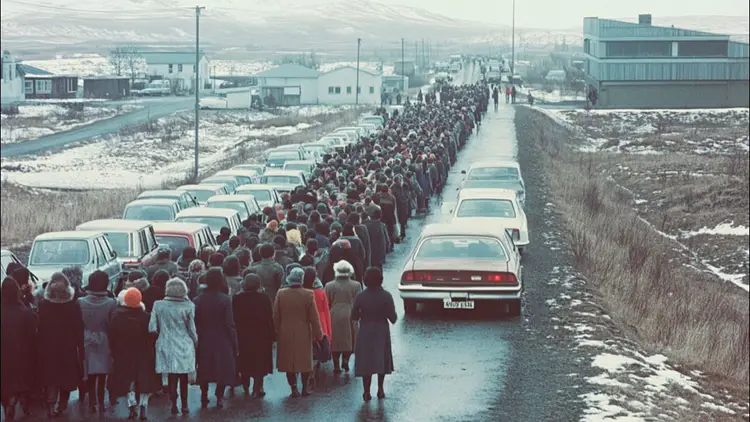
On 24 October 1975, women across Iceland took part in a mass walkout known as Women’s Day Off.
About 90% stopped both paid work and unpaid domestic labor to protest inequality and show how essential women were to Icelandic society. The action caused widespread disruption: schools and nurseries were affected, many workplaces ran at reduced capacity, and fathers often had to bring children to work.
In 1976, Iceland passed its first Gender Equality Act, establishing a formal framework for equal rights and opportunities for women and men. Five years after the strike, in 1980, Iceland elected Vigdís Finnbogadóttir, the world’s first democratically elected woman president.
Today, Iceland ranks first in the World Economic Forum’s Global Gender Gap Index.
Report
46points
#4
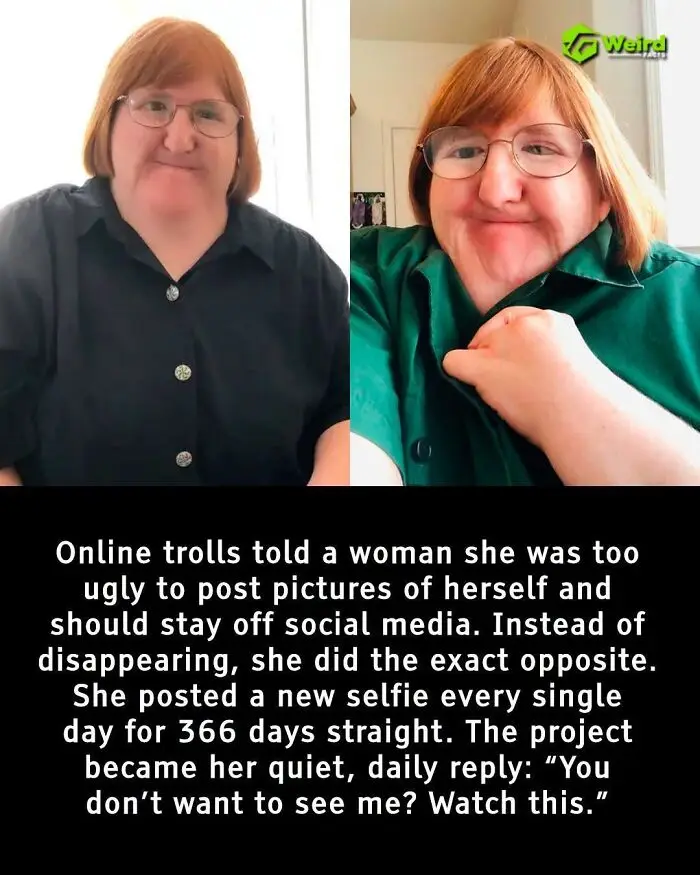
In 2019, writer and disability advocate @melissablake81 published an op-ed online. Instead of debating her ideas, some people attacked something far more personal: her appearance.
Trolls flooded social media with cruel comments. Some said Blake was “too ugly” to post photos of herself and suggested she should stop sharing selfies altogether.
She could have disappeared from view. Instead, she did the opposite.
Blake began posting a selfie every single day under the hashtag #MyBestSelfie. What started as a response to online cruelty soon became a year-long project.
Day after day, she showed up on social media exactly as she was. No hiding. No giving strangers the power to decide whether she deserved to be seen.
She kept going for 366 days, a full year that included February 29, 2020.
Later, Blake explained that taking and sharing those daily photos changed the way she felt about herself. The project helped her become more comfortable with her body and challenged the idea that people with disabilities should make themselves less visible simply because others may judge their appearance.
Her selfies also reached far beyond her own social media accounts. News outlets covered the project, and many people responded with messages of encouragement and support.
The people trying to make her hide ended up inspiring her to make herself more visible.
Report
46points
#5
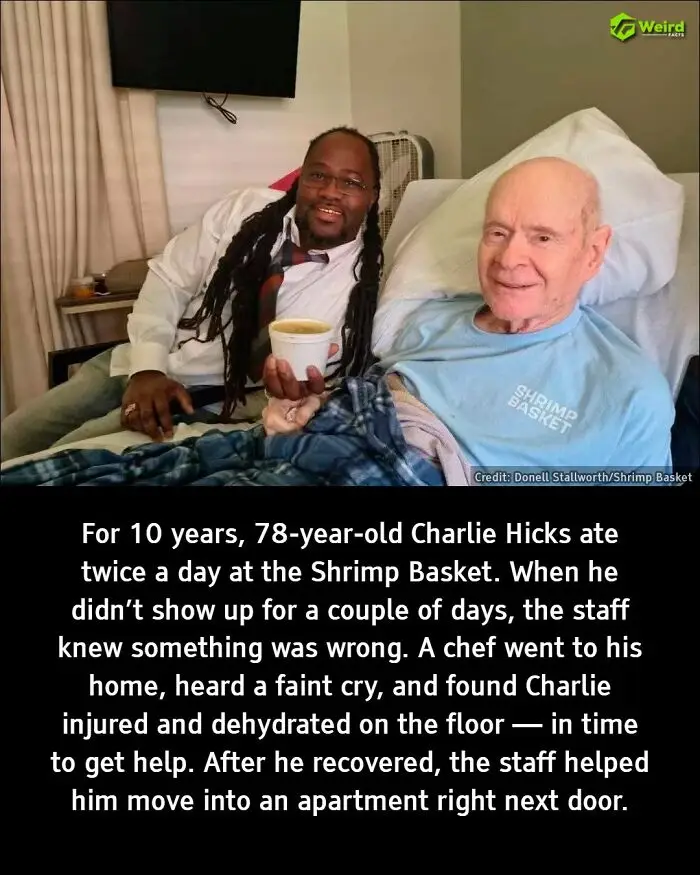
Charlie Hicks wasn’t just a customer at the Shrimp Basket — he was part of the daily rhythm. For nearly a decade, the 78-year-old veteran stopped in every day for lunch and dinner.
Staff knew his order, his routine, and the fact that he never missed a day. So when Charlie didn’t show up for a couple of days, Chef Donnell Stallworth felt uneasy. Trusting his instincts, Stallworth went to Charlie’s apartment to check on him.
Inside, he heard a faint cry for help. Charlie had fallen and been lying on the floor— it was unclear how long — suffering from broken ribs and severe dehydration. Charlie was rushed to the hospital and eventually recovered — and the story didn’t end there.
Wanting to make sure he was never isolated again, the restaurant staff helped him relocate to an apartment right next door to the Shrimp Basket, where familiar faces could keep an eye on him every day.
It’s a reminder that sometimes the people who save our lives aren’t doctors or paramedics — they’re the ones who notice when you don’t show up.
Photo courtesy: Donnell Stallworth/Shrimp Basket.
Report
45points
#6
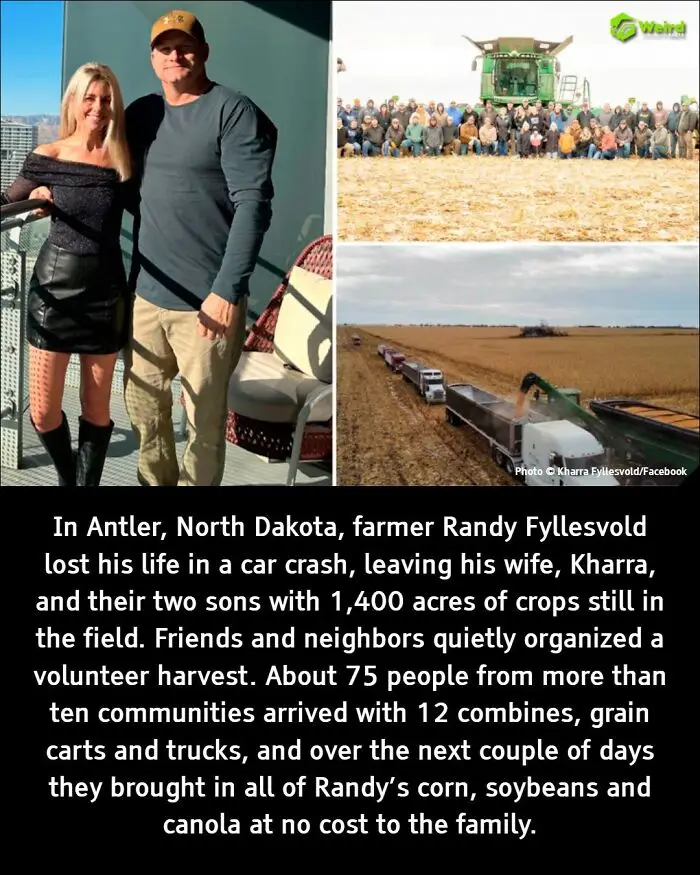
In September 2025, North Dakota farmer Randy Fyllesvold lost his life in a vehicle crash near Maxbass, leaving his wife, Kharra, and their two sons with about 1,400 acres of unharvested corn, soybeans, and canola near Antler.
Facing winter weather and limited time, friends Wyatt Thompson and Andy Gates realized the family could not finish the harvest alone. They contacted neighboring communities and organized a volunteer effort. Roughly 75 farmers answered the call, arriving with around 12 combines, several grain carts, and more than 40 trucks. Over the next couple of days, they worked together to harvest Randy’s entire crop at no cost to his family. Participants described the effort as “just friends helping friends,” saying it was simply what rural communities do in times of crisis.
Kharra later called the community’s response “nothing short of breathtaking” and said she believed Randy would have been proud to see how many people came to support his family in their hardest days.
Report
40points
#7
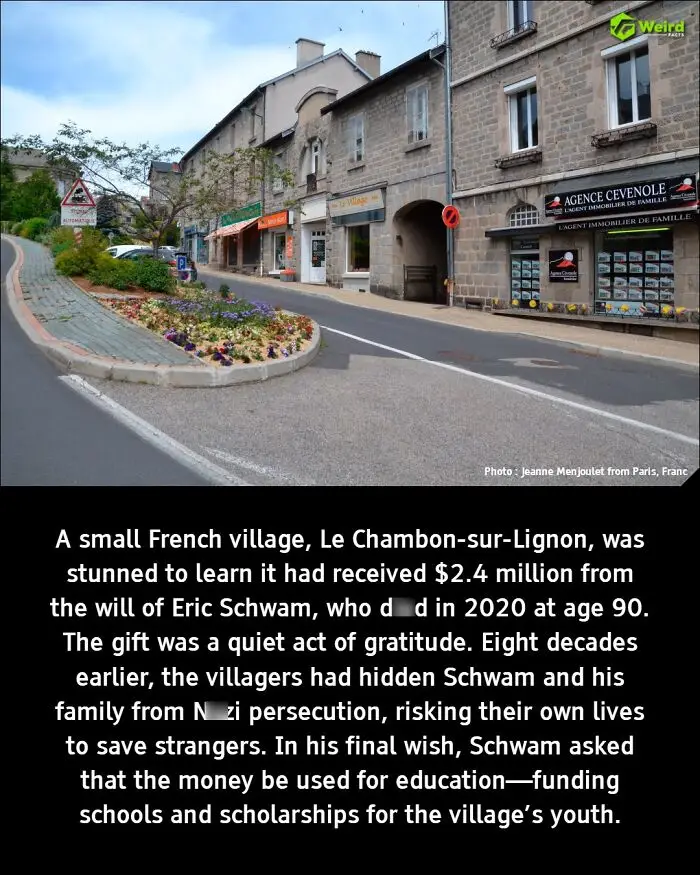
A quiet village in France, Le Chambon-sur-Lignon, received an unexpected legacy.
In late 2020, officials learned that a 90-year-old Austrian man named Erich Schwam had left the village about €2 million (about $2.4 million) in his will. At first, no one understood why. Then the story surfaced.
More than eight decades earlier, during World War II, the people of Chambon-sur-Lignon quietly risked their lives to shelter Jewish families fleeing N**i persecution. Erich Schwam was one of the children they saved. The village hid refugees in homes, farms, and schools, offering shelter along the way. Schwam never forgot.
His final wish was for the future. He asked that the money be used for education—funding schools, scholarships, and opportunities for the village’s young people. It was a thank-you written across generations. A debt repaid after 80 years. And proof that kindness, even in the darkest times, can echo forever.
Report
39points
#9
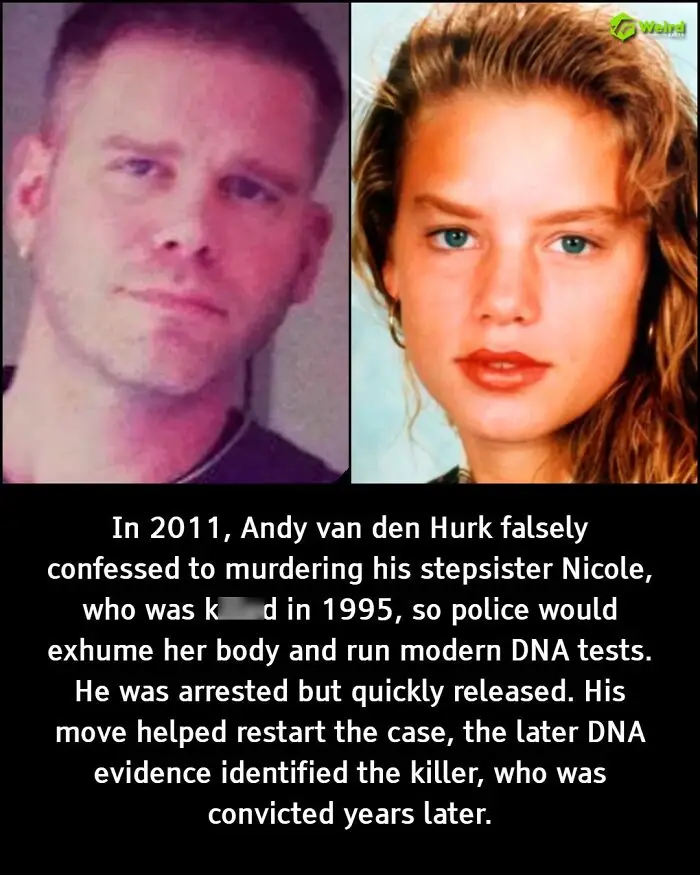
A heartbroken stepbrother confessed to his sister’s m****r – but it was a lie that helped restart her 16-year-old cold case.
Nicole, 15, vanished while cycling to work in Eindhoven, the Netherlands, on 6 October 1995. Her body was found in the woods between Lierop and Mierlo nearly seven weeks later, with a fatal st*b wound. The case went cold despite extensive attention and a large funeral.
Andy van den Hurk, Nicole’s stepbrother living in England, posted a Facebook confession in March 2011 saying he had confessed to her m****r. He later said the confession was false and that he wanted Nicole’s body exhumed for DNA testing. British police arrested Andy, extradited him, but freed him after five days.
In September 2011, police exhumed Nicole’s body as the reopened investigation continued. DNA later linked s**en traces to Jos de G., then 46, a man with prior r**e convictions. Jos was charged in 2014.
After years of trials, he was first acquitted of manslaughter but convicted of r**e and jailed for five years; on appeal in 2018, he was convicted of r**e and mansl**ghter and sentenced to 12 years, a verdict the Dutch Supreme Court left in place in 2020.
Report
35points
#10
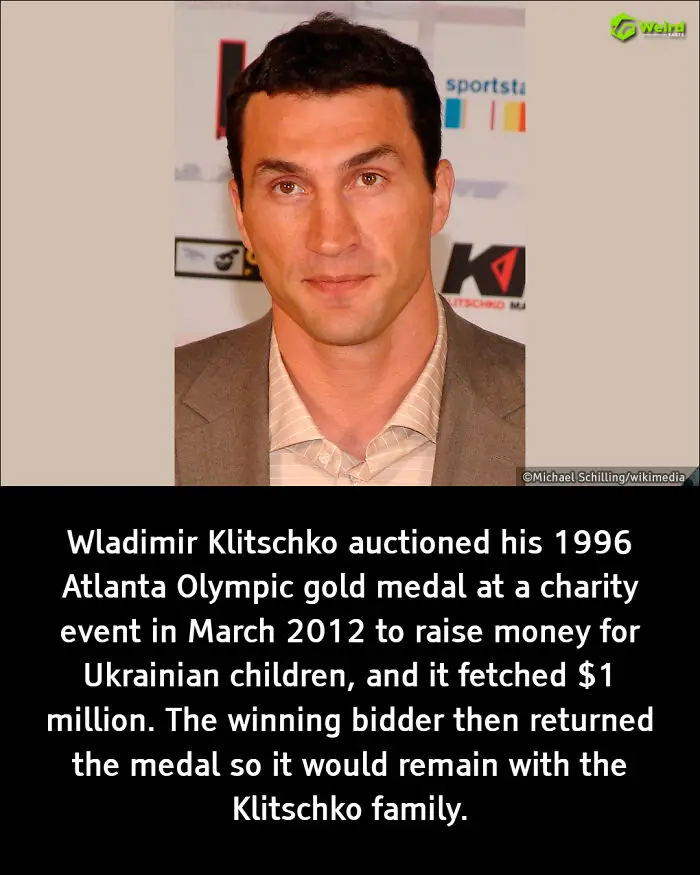
Wladimir Klitschko auctioned his 1996 Atlanta Olympic gold medal at a charity event in Kyiv in March 2012 to raise funds for Ukrainian children. The winning bid was $1 million, with proceeds going to the Klitschko brothers’ charitable work focused on supporting and inspiring young people.
Shortly after the sale, the buyer’s representative said the medal should remain with the Klitschko family, and the medal was returned to Wladimir. The story is often shared as an example of both Klitschko’s commitment to children’s causes and the donor’s symbolic show of respect.
35points
#11
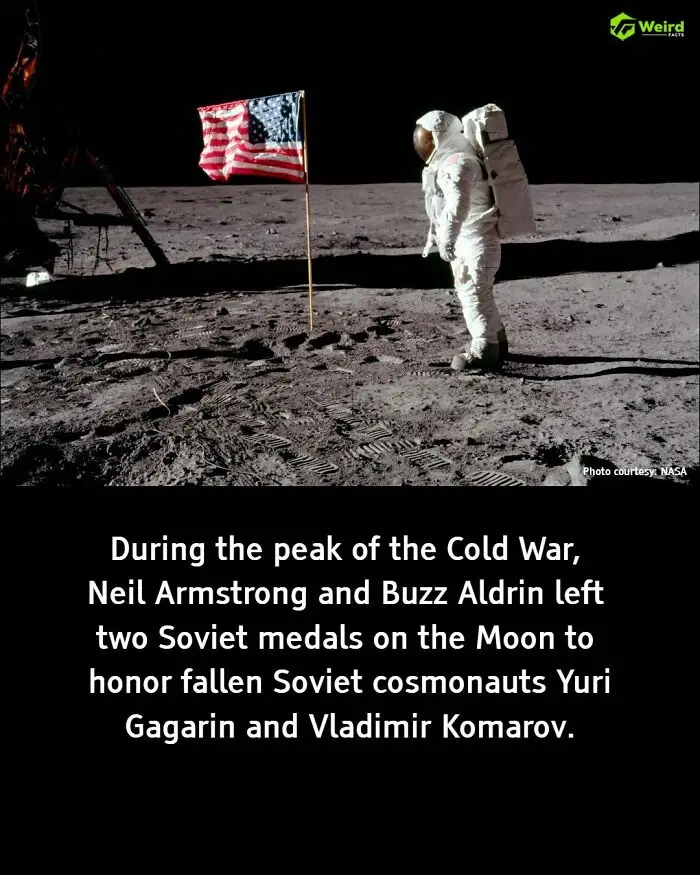
During the height of the Cold War, Apollo 11 astronauts carried two Soviet commemorative medals to the Moon.
The medals honoured fallen cosmonauts Yuri Gagarin, the first human in space, and Vladimir Komarov, who d**d in the Soyuz 1 accident.
The medals had been given to American astronaut Frank Borman by the cosmonauts’ widows during a visit to Moscow.
Neil Armstrong and Buzz Aldrin left them on the lunar surface as a quiet gesture of respect for fallen space pioneers. President Nixon even publicly noted the act, saying courage has no national boundaries.
Report
34points
#12
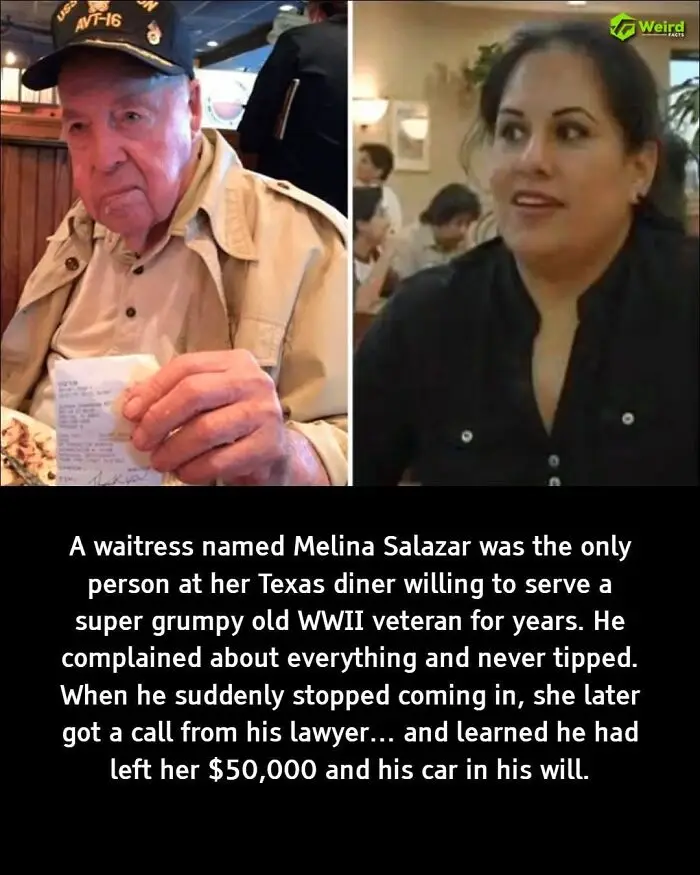
For nearly seven years, Melina Salazar was a waitress at Luby’s Cafeteria in Brownsville, Texas.
She regularly served Walter “Buck” Swords, an 89-year-old WWII veteran known for being grumpy and demanding about his food. Despite his difficult behavior, Salazar treated him with patience and kindness.
Swords d**d in July 2007. About five months later, just before Christmas, Salazar learned from his lawyer that he had left her $50,000 and his 2000 Buick in his will, apparently as thanks for the kindness she had shown him.
Report
33points
#13

In 1975, actress Tippi Hedren was visiting a refugee camp in California when the women kept admiring her fancy nails. Instead of just smiling, she flew in her personal manicurist every weekend to teach them the trade.
She helped those first 20 women get licensed and land jobs in salons.
That one act of kindness grew into something huge. Today around 80% of nail technicians in California are Vietnamese.. many are the children and grandchildren of those original women Hedren supported.
Sometimes the smallest gesture creates a whole new American dream.
32points
#14
In 1999, Namiko Takaba was fatally attacked inside her apartment in Nishi Ward, Nagoya, Japan. Her two-year-old son was found unharmed beside her.
Her husband, Satoru Takaba, refused to let the memory — or the clues — disappear. He moved out, but he never gave up the apartment.
For 26 years, he continued paying rent on the flat, spending more than 22 million yen (about US$145,000) and leaving key traces untouched. He believed that one day, the preserved DNA evidence would uncover the truth.
Police questioned thousands, but the case went cold. Then in 2025, DNA testing finally brought answers. A 69-year-old former classmate confessed to the crime after her DNA matched evidence preserved in the apartment.
Sometimes justice takes time. Sometimes it comes because someone refuses to let go.
Report
31points
#15
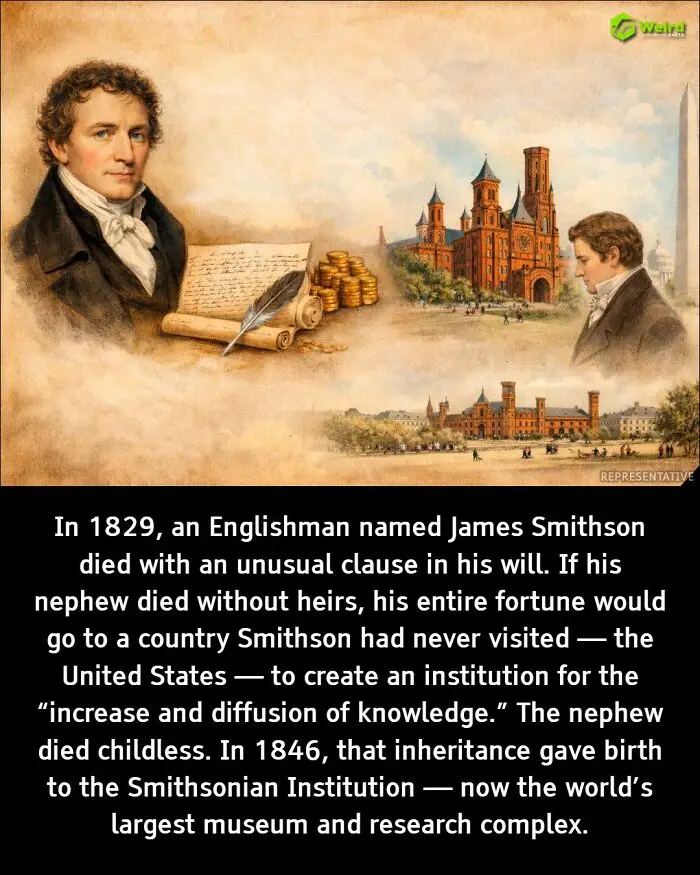
James Smithson was a British scientist, chemist, and mineralogist — and an unusual benefactor. Born out of wedlock and shaped by the limits and stigma of illegitimacy in Britain, Smithson never married, had no children, and his reasons for the bequest remain uncertain.
In his 1826 will, he included a remarkable clause: if his nephew, Henry James Hungerford, d**d without heirs, Smithson’s entire estate would go to the United States to create an institution dedicated to the “increase and diffusion of knowledge among men.” Smithson had never visited America, but some biographers argue he saw the young nation as a place that valued progress and merit.
When Smithson d**d in 1829, his nephew initially inherited the fortune. Six years later, Hungerford d**d childless, triggering the clause. After legal debates and an ocean-crossing transfer of gold coins, the U.S. Congress accepted the gift.
In 1846, the funds officially established the Smithsonian Institution in Washington, D.C.
Today, the Smithsonian includes more than 20 museums, libraries, and research centers, holds over 150 million objects, and serves as the world’s largest museum, education, and research complex — all because of a man who chose knowledge over bloodline, and a country he never saw over the one he came from.
An Englishman who never visited the U.S. ended up founding one of the world’s largest centers of learning.
Report
30points
#16
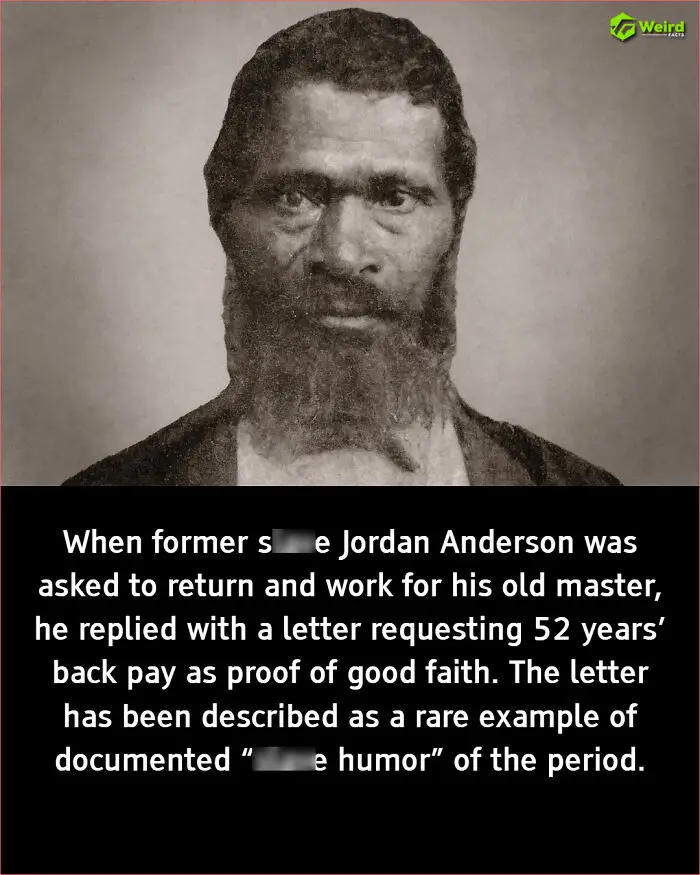
In August 1865, Jourdon Anderson, a formerly ensla**d man living in Dayton, Ohio, replied to his ex-ensl**er, Colonel P.H. Anderson, who had asked him to return to the Tennessee plantation.
In a dry, pointed letter, Anderson described his new life in Ohio—regular wages, a home, and children attending school—and then set a condition for any return: payment of back wages for 32 years of his work and 20 years of his wife Mandy’s, calculated at $11,680 plus interest. He also asked whether his daughters would be safe and whether schools for Black children existed nearby.
The letter, published in the Cincinnati press, has been noted for its sharp wit and moral clarity as it captured the realities and tensions of the immediate post-emancipation era.
Report
29points
#17
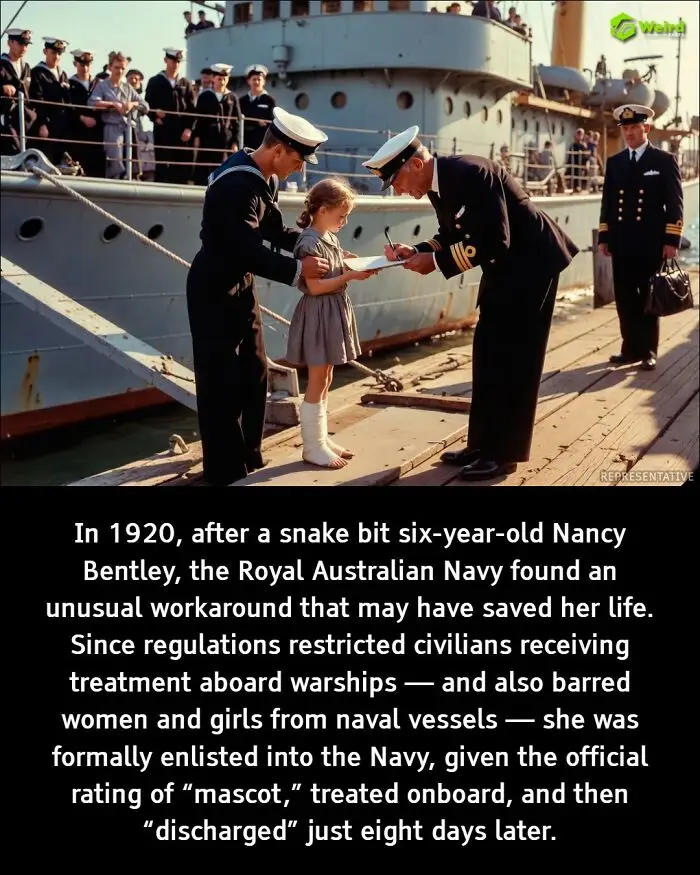
The incident involving Nancy Bentley took place in 1920, when she was just six years old. After being bitten by a snake near a coastal area, she urgently needed medical care. At the time, Australian naval regulations were strict: civilians were not permitted to receive treatment aboard naval vessels.
Faced with a child’s life at risk, the Royal Australian Navy improvised an unusual solution. Nancy was formally enlisted so she could legally remain onboard and receive treatment from the ship’s medical staff. She was given the official naval rating of “mascot,” making her, on paper, the youngest person known to have been enlisted in the Australian forces.
She stayed onboard for eight days, during which she received care from the ship’s medical staff. She was formally “discharged” from service after eight days, completing an eight-day “career” that remains a record for the youngest known enlistment.
The story is often cited as an example of how rigid rules were bent, turning a bureaucratic loophole into a potentially lifesaving act.
Report
29points
#18
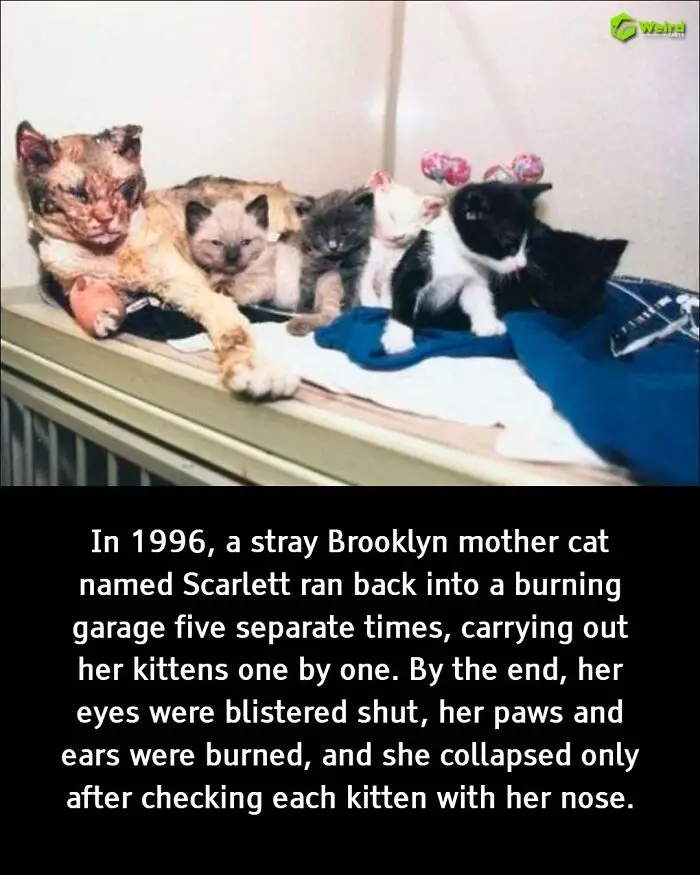
In 1996, a stray cat in Brooklyn did something incredible during a fire.
She had been hiding in an abandoned garage with her five kittens when the building caught fire. Instead of running away, the mother cat rushed back in again and again, carrying her babies out one by one.
By the time firefighters found her, she was badly burned. Her eyes were swollen shut, and her paws and ears were badly hurt. Even then, she used her nose to check each kitten before finally collapsing.
She was later named Scarlett, and her story touched people around the world. She and her kittens were taken in for treatment, and her bravery led to headlines, awards, books, and thousands of people wanting to adopt her.
Scarlett later found a safe home and lived there until 2008.
Report
29points
#19
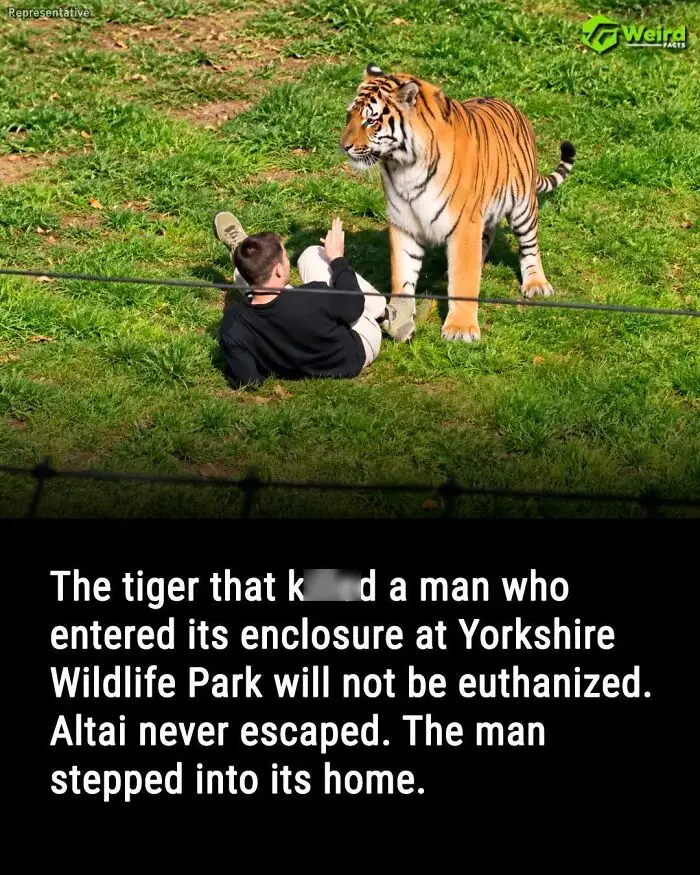
On October 10, a 23-year-old man climbed into a tiger enclosure at Yorkshire Wildlife Park in England. Inside was Altai, an endangered Amur tiger. The tiger attacked the man, and sadly, he d**d at the scene. The tiger never escaped. He stayed in his enclosure and was unharmed.
After the incident, many people were worried about what would happen to Altai. Some feared he might be put down. But the wildlife park announced the next day. Altai was safe and would not be put down because of the attack.
A young man lost his life. But the tiger will not lose his life for behaving like a wild animal.
Report
29points
#20
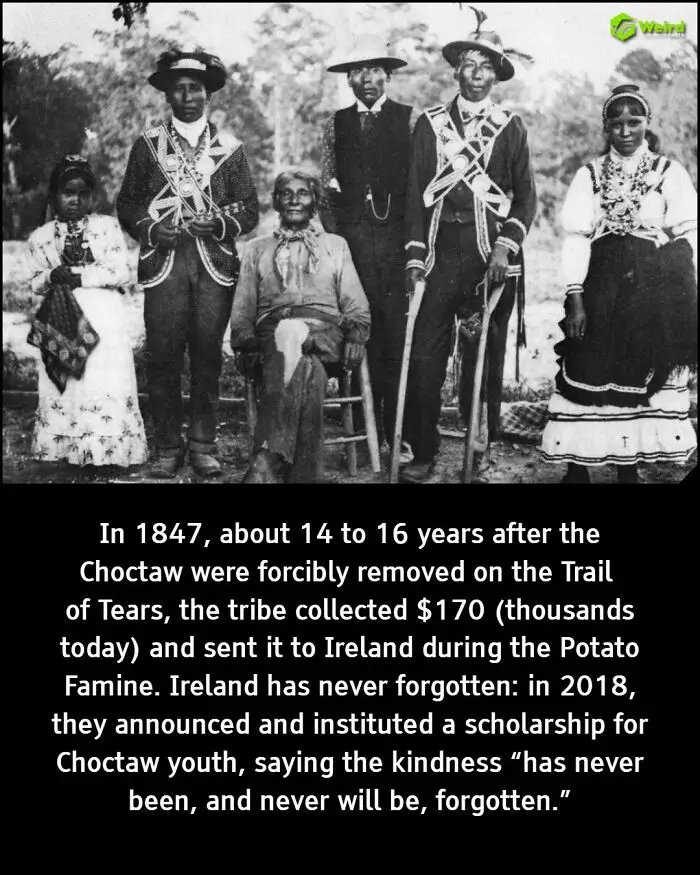
In 1831–1833, the Choctaw Nation was forcibly removed from Mississippi to Indian Territory (Oklahoma) under the Treaty of Dancing Rabbit Creek, an event that became part of the Trail of Tears.
In March 1847, only 14 years later, Choctaw people in Oklahoma collected $170 (equivalent to several thousand dollars today) and sent it to Ireland to aid victims of the Great Potato Famine. The donation was made at a meeting in Skullyville and forwarded through U.S. relief committees.
This act of generosity, coming so soon after their own suffering, created a lasting bond between the Choctaw and Irish peoples.
In 2018, Irish Prime Minister Leo Varadkar announced a scholarship programme for Choctaw students to study in Ireland, stating that the Choctaw act of kindness “has never been, and never will be, forgotten in Ireland.”
Report
28points


