






Your insatiable curiosity is something you should never be ashamed of. That desire to learn more about the world that surrounds us is hardwired into you. But no matter how educated you are, there will always be something new to learn.
We are featuring the most interesting and thoroughly weird facts and stories from around the globe, as shared on one popular Instagram account. Scroll down if you’re in the mood to learn something new and expand your mind.
#61

In a quiet corner of northeastern Nebraska lies Monowi, a town with a population of one. That single resident is Elsie Eiler, a resilient woman who holds a unique distinction: she is the town’s mayor, librarian, bartender, and sole inhabitant.
Monowi’s population peaked in the 1930s with around 150 residents, featuring a post office, general stores, a grocery store, and even a few churches. The town began a slow decline as families moved to larger cities in search of better opportunities. By 1980, the population had dwindled to just 18 people.
In 2000, Elsie and her husband, Rudy, were the only two people left. When Rudy passed away in 2004, Elsie became the sole remaining resident.
Today, Elsie manages the town’s operations entirely by herself. The village remains legally incorporated, which requires it to have a governing body. Consequently, Elsie holds town board meetings with herself, where she votes to approve her own liquor license and map out the town’s budget.
Her primary business is the Monowi Tavern, a cozy establishment filled with photos and memories of the town’s past. It is here that she carries out her official mayoral duties: collecting taxes from the bar (her own business), which are necessary to keep the village’s four streetlights operational and to pay state taxes.
Visitors from around the world frequently make the pilgrimage to Monowi to meet Elsie and grab a drink at her tavern, intrigued by the story of America’s smallest incorporated town. Though she keeps the town running out of necessity and a love for her home, Elsie has no intention of leaving. She sees her unique role not as a burden, but as a continuation of her life in the place she loves best.
Report
17points
#62
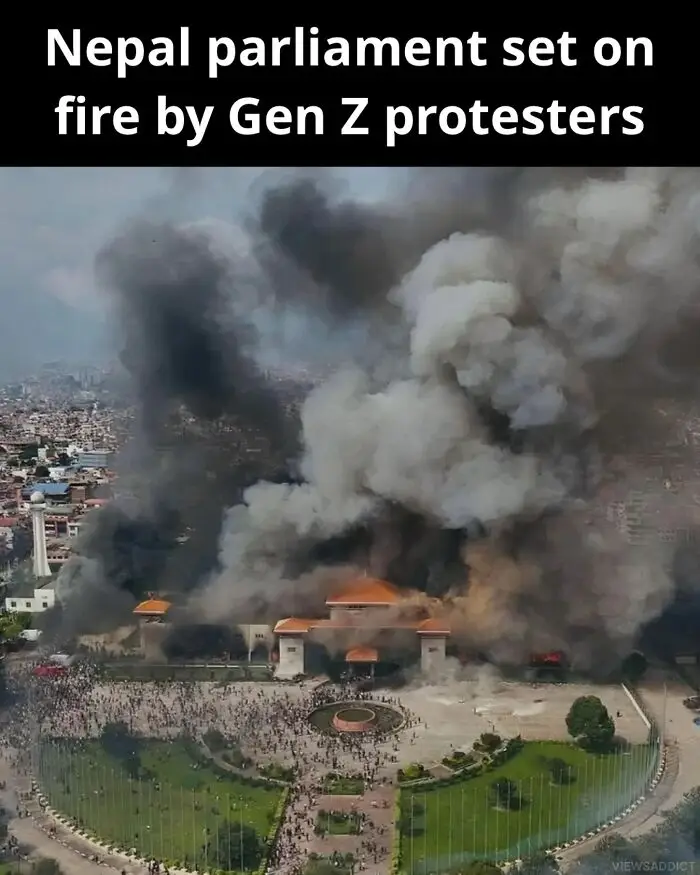
A sweeping ban on social media platforms has plunged Nepal into its most violent political crisis in decades.
On September 8, 2025, the government blocked Facebook, YouTube, X (Twitter), WhatsApp, and Instagram, requiring companies to register under new oversight laws. The move sparked mass protests led by Nepal’s “Gen Z” youth, who denounced it as a violation of free expression.
Security forces clashed with demonstrators nationwide, 19 lost their lives and hundreds were injured. Despite the government lifting the ban later that night, anger only deepened.
By September 9, protesters breached and set fire to the parliament building in Kathmandu, while the homes of Prime Minister K.P. Sharma Oli and other top leaders were torched. Offices of major political parties were also vandalized.
Facing mounting unrest, Prime Minister Oli resigned, following the earlier resignation of Home Minister Ramesh Lekhak. The government has since promised investigations, compensation for victims, and relief measures, but tensions remain high.
What began as outrage over a digital shutdown has morphed into a broader youth-led rebellion against corruption and authoritarianism—signaling a generational shift in Nepal’s politics.
Report
17points
#63
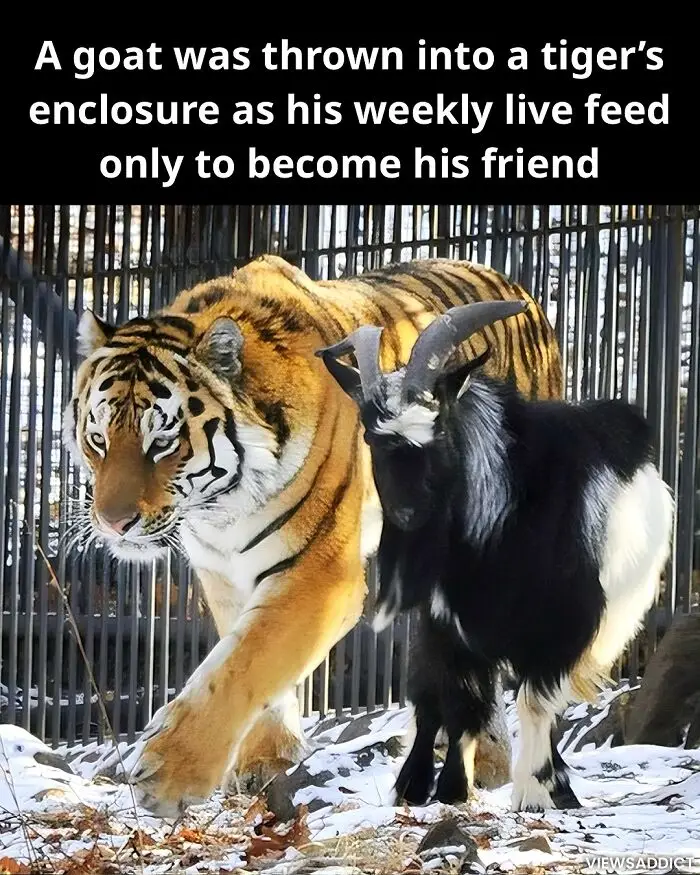
In 2015, an unusual friendship captured the hearts of millions around the world. At a safari park in Primorsky, Russia, a goat was placed into a Siberian tiger’s enclosure as part of the tiger’s weekly live prey feeding routine. Keepers fully expected the tiger, named Amur, to hunt the goat immediately.
Instead, something remarkable happened—the tiger spared the goat’s life. The goat, later named Timur, showed no fear and calmly wandered the enclosure, even taking over Amur’s sleeping spot. To the amazement of staff and visitors, the tiger accepted Timur as a companion rather than a meal.
The unlikely pair spent weeks together, sharing the same space, walking side by side, and even playing.
Their friendship became a global sensation, symbolizing resilience, peace, and the unexpected ways life can defy instincts. Though their companionship eventually ended, the story of Amur and Timur remains a powerful reminder that friendship can blossom in the most surprising places.
Report
17points
#64

László Polgár, a Hungarian educational psychologist, is renowned for his theory that “geniuses are made, not born,” and for proving it by raising his daughters, Susan, Sofia, and Judit, to be world-class chess players. He believed that with focused training and a supportive environment, any healthy child could achieve exceptional results in a chosen field. To prove his theory he trained his daughters in chess from age 4. His daughters, particularly Judit, became some of the greatest chess players in history, demonstrating the success of his educational approach.
Report
15points
#65

China and India clash at their border but their soldiers fight with rocks, sticks, and fists.
In 2020, the two armies clashed in the Galwan Valley, 4,000 meters (2,5 miles) up in the Himalayas.
Soldiers fought hand-to-hand for hours.
At least 20 Indian soldiers lost their lives.
A 1996 agreement, reinforced in 2005, bans firearms and explosives within two kilometers of the Line of Actual Control.
It was signed to prevent a small border incident from turning into a war.
That agreement is still valid today.
Patrol troops still carry their rifles, but keep them slung and pointed down.
But yet, the clashes are still fatal.
Soldiers fight with iron rods studded with nails, and many fall into the freezing Galwan river, causing casualties but without a single shot being fired.
Report
14points
#66

A new ocean is forming in Africa along a 35-mile crack that opened up in Ethiopia in 2005. The crack, which has been expanding ever since, is a result of three tectonic plates pulling away from each other.
Report
13points
#67

Before the EPA’s 1970 creation, America faced severe pollution, with legal dumping of toxic waste, rivers catching fire from industrial discharge, heavy smog, and little federal oversight, as environmental protection was fragmented and state-run, leading to a “race to the bottom” in regulations until the first Earth Day and growing public outcry spurred federal action for comprehensive laws like the Clean Air Act.
Before the EPA, states would actively try to encourage businesses to setup shop in their state by competing on what the companies could get away with like dump harmful chemicals, not properly treat byproducts, etc.
The EPA was created to set nationwide standards. It was created out of rising public pressure to control pollution, but one side effect was that states could no longer allow their lands to be destroyed to the highest bidder.
Report
12points
#68
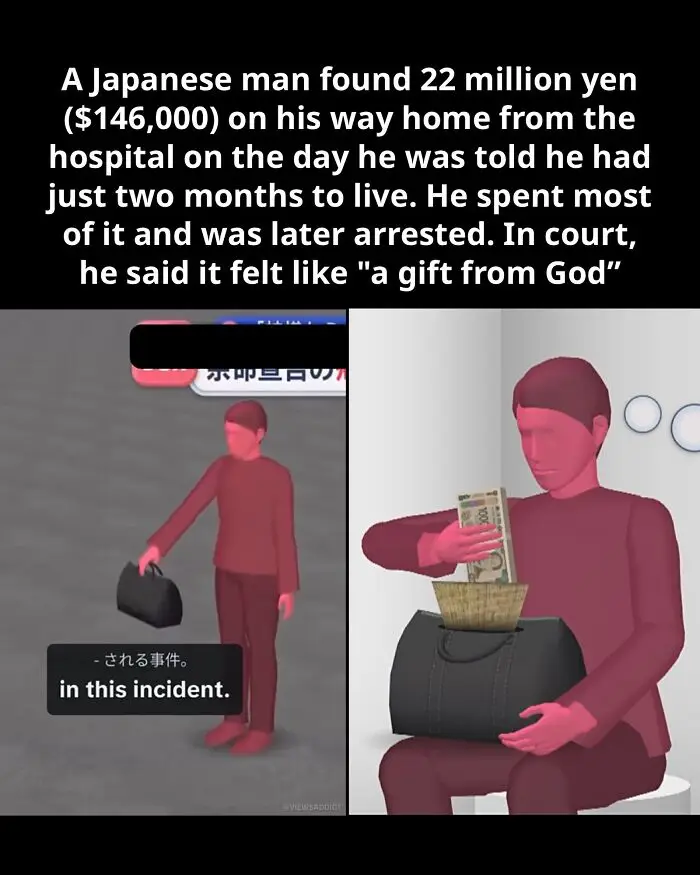
A Japanese man, Suenaga Takuya, 43, of Miyagi Prefecture, was indicted on charges of taking a bag containing 22 million yen ($139,000) that he found on a street in Aoba-ku, Sendai, in March, right after being
given a terminal diagnosis for cancer, and now faces a prison sentence.
According to TV Asahi and other Japanese media,
The money had been dropped by two security company employees during transport and was revenue collected from a game arcade.
At the first hearing at the Sendai District Court on Monday, Suenaga acknowledged the charges. He said he took the money because he “thought it was a gift from God.”
According to the indictment, Suenaga had just learned at a hospital that his cancer had returned shortly before he found the cash. He had believed he was cured, but the recurrence led his doctor to tell him he had two to three months to live.
“It was the day I was being discharged after receiving cancer treatment in hospital,” he said. “I had been suffering from carcinomatous meningitis and gastroesophageal junction cancer, and I received a terminal diagnosis after cancer was found to have recurred in my head.”
He was walking in a daze in front of Sendai Station on his way home when he spotted the bag on the ground. He initially passed it by but turned back out of curiosity about what was inside. He then reportedly bought a box cutter and opened the bag in a nearby public restroom, where he found the cash.
He took the money and spent about 18 million yen, roughly 150 million won, over approximately four and a half months on medical treatment and overseas travel.
Prosecutors sought a one-year custodial sentence, arguing that the defendant had used the large sum of cash to satisfy his own desires and compounded the harm to the victim. The defense asked the court for a suspended sentence, citing the defendant’s despair following the cancer recurrence and terminal diagnosis.
The ruling is scheduled to be handed down Nov. 6.
Report
10points
#69

29-year-old woman successfully posed as a nurse for 7 months, treating more than 4,000 patients. The woman, Autumn Marie Bardisa, reportedly worked at a hospital where she carried out routine checkups, administered care, and interacted with patients without raising suspicion.
She was so good at her job that hospital administrators considered her for a major promotion.
During the verification process, officials discovered she had no medical qualifications or nursing license.
She was arrested for impersonating a registered nurse, treating an estimated 4,486 patients between June 2024 and January 2025, after working at Advent Health Palm Coast Parkway under false pretenses for 7 months.
Sometimes knowing how to act well is all you need. What’s your though on this?
Report
9points
#70
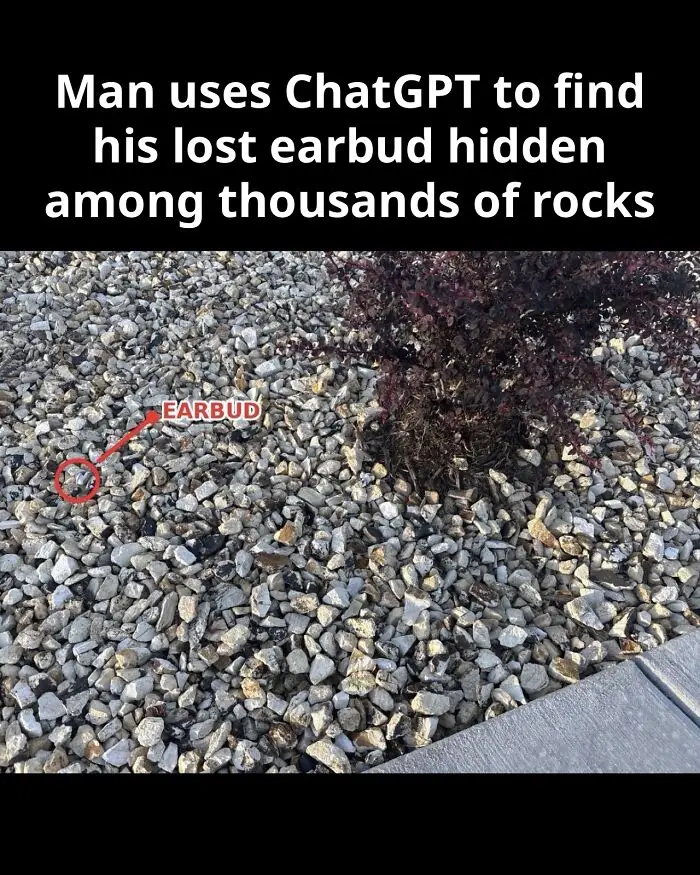
A dad lost his white Bose earbud in a patch of white gravel, and ChatGPT found it after he had already spent 10 minutes searching on his own.
He was running after his son near a park parking lot when his earbud case fell out of his hoodie pocket and broke open, sending the left earbud flying into the rocks while the sun was going down.
He sent ChatGPT a photo of the area, and it zoomed in and scanned the gravel section by section but said it couldn’t confidently spot the earbud, so it asked him for closer photos taken with the camera pointed straight down.
He sent three new photos, and ChatGPT found the earbud in the third one, describing its exact position in the frame and marking the spot with a red circle.
The whole process took less than five minutes and that he doesn’t think he would have ever found it without ChatGPT.
Report
7points
#71

A US woman sued a casino that told her the slot machine displaying a $43m (£34m) jackpot was faulty and offered a steak dinner instead.
Katrina Bookman hit the largest slot machine jackpot in US history at Resorts World Casino in Jamaica, Queens, and took a selfie showing the machine saying “printing cash ticket $42,949,672.76”. However, when she returned to find out her winnings, a casino employee informed her she had not won anything but only $2.25.
The New York State Gaming Commission confirmed that Bookman’s machine had malfunctioned, and the casino offered her a complimentary steak dinner instead.
The lawsuit filed at the Queens County Supreme Court said the Sphinx slot machine’s “bells, noises and lights” as well as the message on the screen told Ms Bookman she had won the jackpot. The subsequent disappointment left Ms Bookman anxious and depressed, the report said. She seeked damages from the casino for failing to maintain the slot machine as well as two companies that make and operate games machine.
A Resorts World spokesman said at the time that the machine had suffered an “obvious malfunction”.
The New York State Gaming Commission said Bookman’s machine had malfunctioned, and that she’d actually won just $2.25 (£1.86). The machine had a disclaimer stating ‘malfunctions void all pays and plays’, and as a result the commission said that they were required by law to give Bookman only what she’d actually won.
Unfortunately, there was no happy ending for Katrina Bookman. After delays to the case due to Covid, a judge at Queens County Supreme Court eventually ruled in favor of the defendants.
The reality was, the machine malfunctioned and the machine did display the following warning message to all players: Malfunctions void all pays and plays.
Report
5points
#72
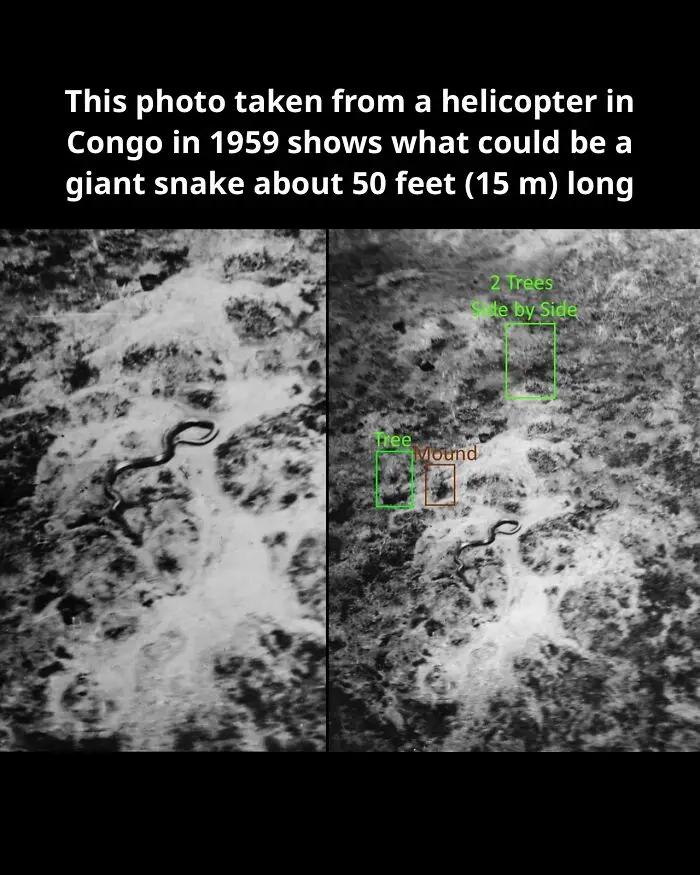
In 1959, Colonel Remy Van Lierde, a highly decorated Belgian fighter ace and WWII hero, was patrolling over the Congo jungle when he spotted something that defied modern biology.
Slithering through the dense canopy was a titanic snake. Van Lierde estimated it to be roughly 50 feet (15 meters) long, with a massive head and a triangle-shaped jaw.
To make sure he wasn’t hallucinating, the Colonel flew lower. Threatened by the rotor blades, the monster suddenly rose up 10 feet (3 meters) straight into the air, snapping its jaws. Van Lierde snapped a single, legendary photograph before pulling away in shock.
The photo was later analyzed by military experts, who confirmed the negative was 100% genuine, zero manipulation or doctoring.
To this day, this photograph remains one of history’s greatest unsolved mysteries, dividing researchers into two main camps:
Many believe that the deep, unexplored depths of the Congo basin are still hiding a surviving relative of the prehistoric Titanoboa, or a completely undiscovered giant species. They argue an experienced, highly trained military pilot wouldn’t be easily fooled by a simple glitch in perspective.
On the other side, skeptics argue that forced perspective trapped the pilot’s eyes. They suggest it was actually an exceptionally large African Rock Python (which can naturally grow up to 20 feet), made to look three times its size due to the angle of the helicopter and a lack of ground references.
What do you think? It was an ancient giant monster or just a big python caught in a perfect optical illusion?
Report
5points