





Did you know that Spielberg wanted to make a James Bond movie and was rejected? Or that Canada and Denmark have a sort of joint-custody agreement over an island? Much like chicken nuggets, or grapes if you are being more healthy, people love bite-sized bits of info.
So we’ve gathered some of the coolest and most interesting facts from the IG page with the same name. Get comfortable as you scroll through, upvote your favorites and be sure to share your own thoughts in the comments section down below.
More info: Instagram
#61
New research has found that second-born children – particularly boys – are more likely to engage in criminal behavior than their older counterparts, according to MIT economist Joseph Doyle.
In an interview with National Public Radio, Doyle said that second-born children are “much more likely to end up in prison, much more likely to get suspended in school, [or] enter juvenile delinquency.” He added that there’s a 25 to 40 percent increase in the chances of any of these outcomes happening when comparing a second-born sibling to a first-born.
Doyle’s research centers around boys because boys are more likely than girls to get into trouble during their teenage years, NPR said. Doyle examined data from thousands of brothers from Florida and Denmark, but came to similar conclusions when it came to crime and delinquency among second-born children.
The explanation? According to Simple Most, parents tend to spend more time with their firstborn child, giving them undivided attention and engaging in activities such as bedtime stories, arts and crafts, and playing instruments. Older siblings often perform better on tests and have higher IQ scores.
Additionally, first-born children look to their parents as their first role models in life, while second-born children also have role models who are “slightly irrational 2-year-olds,” Doyle said. This pushes the notion that first-born children may behave more maturely than their younger siblings.
The report notes that every family is different, and the research covers a broader spectrum.
Report
13points
#62
he human desire for companionship may feel boundless, but research suggests that our social capital is finite—we can handle only so many relationships at one time. Social scientists have used several ingenious approaches to gauge the size of people’s social networks; these have returned estimates ranging from about 250 to about 5,500 people. Looking more specifically at friendship, a study that used the exchange of Christmas cards as a proxy for closeness put the average person’s friend group at about 121 people.
However vast our networks may be, our inner circle tends to be much smaller. The average American trusts only 10 to 20 people. Moreover, that number may be shrinking: From 1985 to 2004, the average number of confidants that people reported having decreased from three to two. This is both sad and consequential because people who have strong social relationships tend to live longer than those who don’t.
So what should you do if your social life is lacking? Here, too, the research is instructive. To begin with, don’t dismiss the humble acquaintance. Even interacting with people with whom one has weak social ties has a meaningful influence on well-being. Beyond that, building deeper friendships may be largely a matter of putting in the time. A recent study out of the University of Kansas found that it takes about 50 hours of socializing to go from acquaintance to casual friend, an additional 40 hours to become a “real” friend, and a total of 200 hours to become a close friend.
If that sounds like too much effort, reviving dormant social ties can be especially rewarding. Reconnected friends can quickly recapture much of the trust they previously built while offering each other a dash of novelty drawn from whatever they’ve been up to in the meantime. And if all else fails, you could start randomly confiding in people you don’t know that well in hopes of letting the tail wag the relational dog. Self-disclosure makes us more likable, and as a bonus, we are more inclined to like those to whom we have bared our souls.
Report
13points
#63
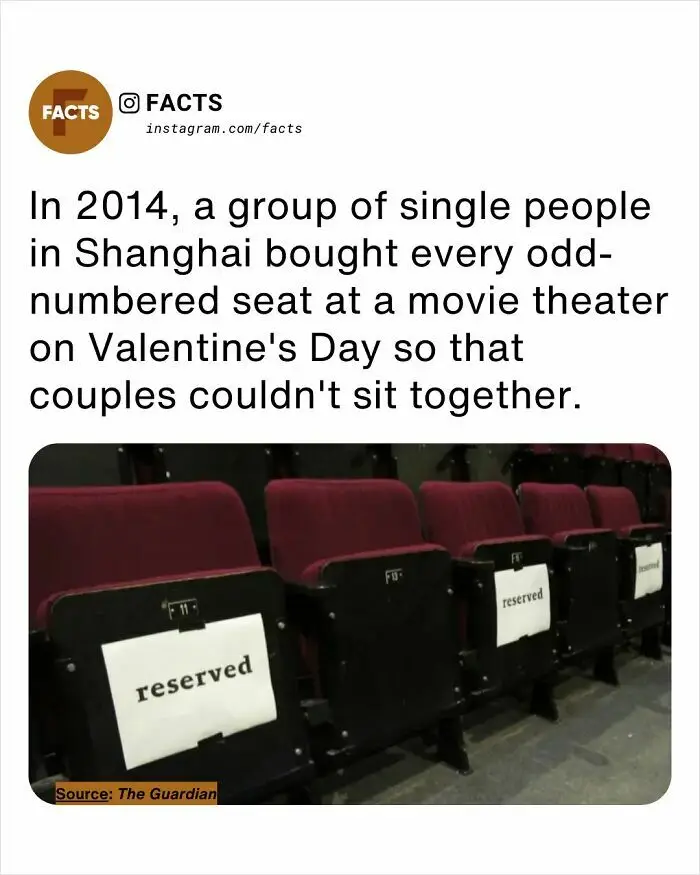
A group of embittered singles worked together to buy up the tickets to a 7:30 pm screening of ‘Beijing Love Story,’ a sappy big-budget romance, at the Shanghai Xintiandi cinema, according to the Shanghai Morning Post newspaper.
In a seating chart posted online, every other seat in the cinema was marked occupied.
"Want to see a movie on Valentine's Day?" the prank's organizer, an internet user going by the name UP, wrote online. "Sorry, you'll have to sit separately. Absence makes the heart grow fonder. Give us singles a chance."
UP described himself as a "computer nerd" in an anonymous interview with the newspaper, adding that he suffered a breakup in 2013.
He said the prank was difficult to execute. He lacked the money to snap up enough seats, and both the cinema's online booking system and its behind-the-counter staff rejected his requests for exclusively odd-numbered reservations. So he turned to a group-buying website, and quickly gained an enthusiastic following.
A cinema employee told the Xi'an Daily newspaper that it had decided to sell the even-numbered seats at a steep discount.
The stunt drew mixed reviews on the internet. Some users praised it as brilliant; others called it sadistic and ill-planned. "The dream of many singles has finally come true," wrote one user. "Too stupid. Won't people just switch seats?" wrote another.
Report
11points
#64
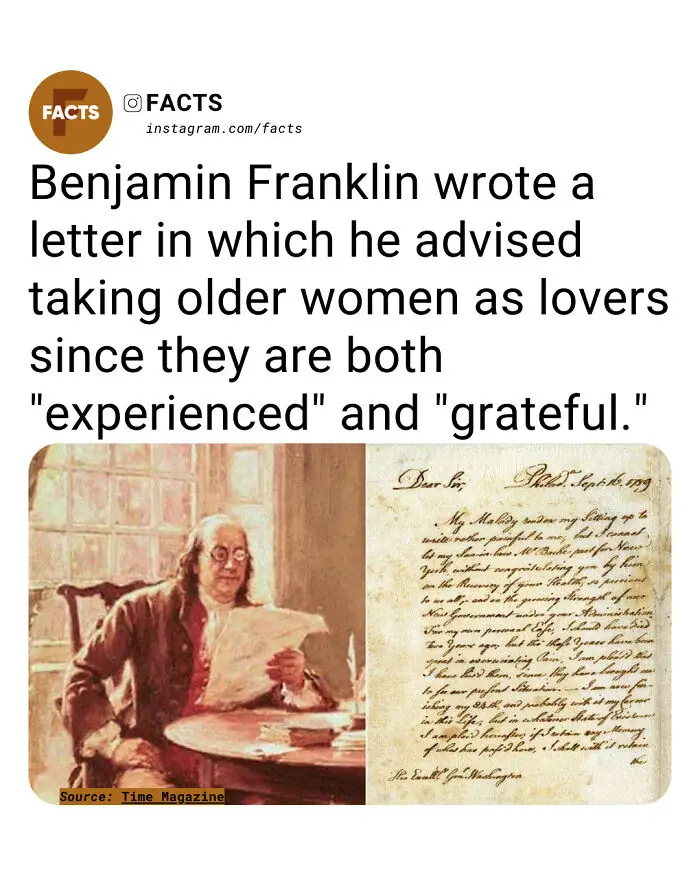
When Benjamin Franklin wasn’t pushing up his bifocals to go fly a kite in a rain storm, he was doling out love advice. In 1745, our nation’s beloved first Postmaster General wrote a letter to a younger friend advising the man “on the choice of a mistress.” In the eye-opening letter —which was not mailed but apparently simply shared for laughs in Ye Olde Locker Room — Franklin suggests the young man marry an older woman because they are both “experienced” and “grateful.”
Franklin went on to defend his thesis statement with cold, hard facts, undoubtedly collected through years of field research. Among the many reasons Franklin enumerated as to why the more mature woman is preferable to the more recent additions to the human race: They are more experienced.
While mature women may be slightly less attractive than some younger models, Franklin believed that they justified their continued existence by being kinder: “There is hardly such a thing to be found as an old Woman who is not a good Woman,” he wrote. Apparently, there is such a thing as an old man who is not a good man, though. To that point, Franklin also noted that with an older woman, there was none of that pesky guilt for “debauching a Virgin.”
Report
11points
#65
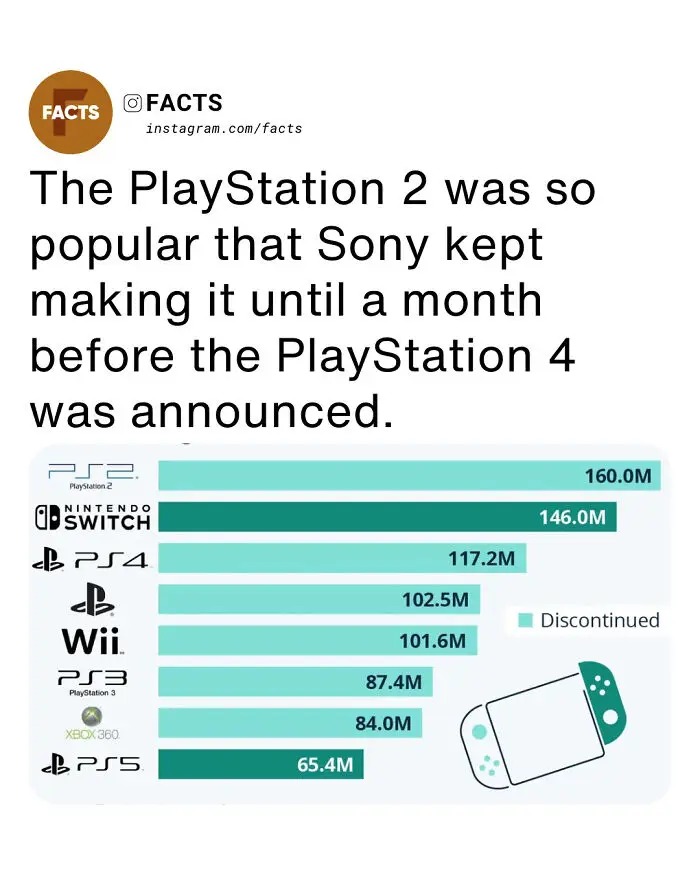
The iconic PlayStation 2 is certainly one of Sony’s greatest accomplishments in the video gaming industry, with more than 3,800 games developed for it.
It does seem remarkable to think that Sony released it 25 years ago, and the Japanese technology company had clearly invented something that was ahead of its time.
What is interesting to note also is that, in fact, the PlayStation 2 currently has one of the longest lifespans of any console to date.
Incredibly, Sony only stopped making them in early 2013, just a month before the PlayStation 4 was to be announced.
So what made this video console so special? Well, for a start, its processing power was second to none when it was launched in 2000.
The PlayStation 2 had 32 MB of RAM, which led to the graphics of the games looking phenomenal for the early ’90s.
Another of the key selling points for the console was the addition of the DVD player, which at the time was the latest way of viewing everyone’s favorite films and TV series.
It was also cheaper to buy a PlayStation 2 with the DVD player, which cost roughly £200, rather than a DVD player by itself, which ended up being double the price.
To demonstrate how much of a success the PlayStation 2 turned out to be, over 13 years, roughly 155 million consoles were sold around the world.
Report
8points
