






Did you know that Spielberg wanted to make a James Bond movie and was rejected? Or that Canada and Denmark have a sort of joint-custody agreement over an island? Much like chicken nuggets, or grapes if you are being more healthy, people love bite-sized bits of info.
So we’ve gathered some of the coolest and most interesting facts from the IG page with the same name. Get comfortable as you scroll through, upvote your favorites and be sure to share your own thoughts in the comments section down below.
More info: Instagram
#21

Feeling that the character presented an offensive Mexican stereotype, Cartoon Network shelved Speedy's films when it gained exclusive rights to broadcast them in 1999 (as a subsidiary of Time Warner, Cartoon Network is a corporate sibling to Warner Bros.). In an interview with Fox News on March 28, 2002, Cartoon Network spokeswoman Laurie Goldberg commented, "It hasn't been on the air for years because of its ethnic stereotypes."
Despite such controversy over potentially offensive characterizations, Speedy Gonzales remained a popular character in Latin America. Many Hispanic people remembered him fondly as a quick-witted, heroic Mexican character who always got the best of his opponents, at a time when such depictions of Latin Americans were rare in popular entertainment.
The Hispanic-American rights organization League of United Latin American Citizens called Speedy a cultural icon, and thousands of users registered their support of the character on the hispaniconline.com message boards. Fan campaigns to put Speedy back on the air resulted in the return of the animated shorts to Cartoon Network in 2002.
In a March 2021 essay, Los Angeles Times columnist Gustavo Arellano wrote, “I love Speedy so much, I keep a large painting of him in my home office. His kind smile and brown skin take me back to my childhood — and remind me of where we as Mexicans exist today.”
Report
45points
#22

Everybody may live and work in Svalbard indefinitely, regardless of country of citizenship. The Svalbard Treaty grants treaty nationals equal rights of abode as Norwegian nationals. Non-treaty nationals may live and work indefinitely visa-free as well. Per Sefland, then Governor of Svalbard, said, "It has been a chosen policy so far that we haven't made any difference between the treaty citizens and those from outside the treaty". "Regulations concerning rejection and expulsion from Svalbard" are enforced on a non-discriminatory basis. Grounds for exclusion include lack of means of support and violation of laws or regulations.
Report
42points
#23

During the eruption of Mount Vesuvius in 79 AD, a young man's brain was melted and then rapidly cooled by a superheated ash cloud, turning the brain tissue into natural glass, preserving its microscopic neuron structure.
This extraordinary discovery was made in the ancient Roman city of Herculaneum, where archaeologists in the 1960s found the remains of a 20-year-old man who passed away in his bed at the College of the Augustales. But it wasn't until 2020 that scientists confirmed the dark, shiny fragments inside his skull were actually his vitrified brain—the first and only documented case of natural brain glass ever found.
Researchers determined that vitrification required an extremely specific sequence: a superheated ash cloud exceeding 510°C (950°F) engulfed the victim, instantly heating his brain tissue, followed by rapid cooling at rates of about 1000 degrees per second as the ash cloud dissipated within minutes.
"When we realized that there was really a glassy brain, the scientific question was: How is it possible?" said Guido Giordano, a volcanologist at Roma Tre University who led the 2025 study published in Scientific Reports.
Under scanning electron microscopy, the glass fragments revealed an incredibly well-preserved network of neurons and axons, along with proteins specific to human brain tissue. The thick skull bones likely protected the brain from complete destruction, allowing parts to survive the heating process and undergo vitrification during the rapid cooling phase.
This remarkable preservation offers scientists an unprecedented glimpse into ancient Roman brain tissue, frozen in glass for nearly 2,000 years by one of history's most devastating volcanic eruptions.
Report
42points
#24

Grint had a pretty good reason to shirk the assignment. As the oldest of the three, then 15 (in 2004), he’d been preparing to take his General Certificate of Secondary Education exams, a series of standardized tests taken by British students at high school age. (Radcliffe and Watson were a year or two from the tests themselves.) Grint explained that he was too bogged down with his studies to give the assignment much thought.
“It’s quite Ron-ish not to do it,” Rupert Grint added. “I think [Cuarón] kind of appreciated that.”
_____
🍦 Smart but occasionally careless, with a fondness for snacks, Grint and his “Harry Potter” character may have more in common than he realizes.
When HuffPost asked about another Ron-ish story ― whether he’d kept the ice cream truck he bought as a teenager with a freshly minted driver’s license ― Grint responded in the affirmative.
“I’ll never get rid of it,” he said. But finding a place to park an ice cream truck has proven more trouble than not, considering its effect on pedestrians.
“They think, rightly, that you are a legitimate ice-cream salesman. And they queue up and expect ice cream, which I don’t have.”
Report
41points
#25

In an interview with Wired, Linus Torvalds said that around 2000, Steve Jobs offered him a place at Apple to work on its Unix-based kernel. "Unix for the biggest user base: that was the pitch," Torvalds says. However, he was no fan of Mac OS’s Mach kernel, and Jobs insisted that he drop working on Linux, something Torvalds refused to do. Instead, he continued his work with the open-source platform and now helps manage it on behalf of the Linux Foundation.
Torvald's business ventures haven't netted him the kind of wealth or fame that Jobs received, but he says he's glad he concentrated on the technical aspects of Linux. "I’m very happy with the feeling that I’ve done the right thing." Linux has likely been better off for it: everything from the Android smartphone system to Red Hat's enterprise OS has been built on the platform.
Torvald's business ventures haven't netted him the kind of wealth or fame that Jobs received, but he says he's glad he concentrated on the technical aspects of Linux. "I’m very happy with the feeling that I’ve done the right thing." Linux has likely been better off for it: everything from the Android smartphone system to Red Hat's enterprise OS has been built on the platform.
Report
41points
#26

Direct democracy is one of the special features of the Swiss political system. It allows the electorate to express their opinion on decisions taken by the Swiss Parliament and to propose amendments to the Federal Constitution. It is underpinned by two instruments: initiatives and referendums.
In Switzerland, the people play a large part in the decision-making process at all political levels. All Swiss citizens aged 18 and over have the right to vote in elections and on specific issues. The Swiss electorate is called on approximately four times a year to vote on an average of fifteen such issues. In recent decades, voter turnout has been a little over 40% on average.
Citizens are also able to propose votes on specific issues themselves. This can be done via an initiative, an optional referendum, or a mandatory referendum. These three instruments form the core of direct democracy.
The popular initiative allows citizens to propose an amendment or addition to the Constitution. It acts to drive or relaunch political debate on a specific issue. For such an initiative to come about, the signatures of 100,000 voters who support the proposal must be collected within 18 months. The authorities sometimes respond to an initiative with a direct counter-proposal in the hope that a majority of the people and the cantons support that instead.
Federal acts and other enactments of the Federal Assembly are subject to optional referendums. These allow citizens to demand that approved bills be put to a nationwide vote. In order to bring about a national referendum, 50,000 valid signatures must be collected within 100 days of publication of the new legislation.
All constitutional amendments approved by Parliament are subject to a mandatory referendum, i.e., they must be put to a nationwide popular vote. The electorate is also required to approve Swiss membership of specific international organizations.
Report
39points
#27

Public holidays in Japan were established by the Public Holiday Law of 1948 (as amended). A provision of the law specifies that when a national holiday falls on a Sunday, the next working day shall become a public holiday, known as furikae kyūjitsu (振替休日, "compensatory public holiday", literally "substitute holiday").
Additionally, any day that falls between two other national holidays shall also become a holiday, known as kokumin no kyūjitsu (国民の休日, literally "citizens' holiday"). May 4, sandwiched between Constitution Memorial Day on May 3 and Children's Day on May 5, was an annual example of such a holiday until it was replaced by Greenery Day in 2007.
Before Japan adopted the Gregorian calendar in 1873, the dates of holidays were based on the traditional Chinese lunisolar calendar. Thus, New Year's Day, for example, was celebrated at the beginning of spring, as it is in modern China, Korea, and Vietnam. Japan has 16 national, government-recognized holidays.
Report
37points
#28

Do chimpanzees fart? Yes.
“Worst when eating figs. So loud and frequent, we locate them in the forest occasionally by following the farts; Even worse when eating Cynometra seeds! Fiber!” wrote University of Kent evolutionary anthropology Ph.D candidate Adriana Lowe.
“Worst when eating figs. So loud and frequent, we locate them in the forest occasionally by following the farts; Even worse when eating Cynometra seeds! Fiber!” wrote University of Kent evolutionary anthropology Ph.D candidate Adriana Lowe.
Report
36points
#29
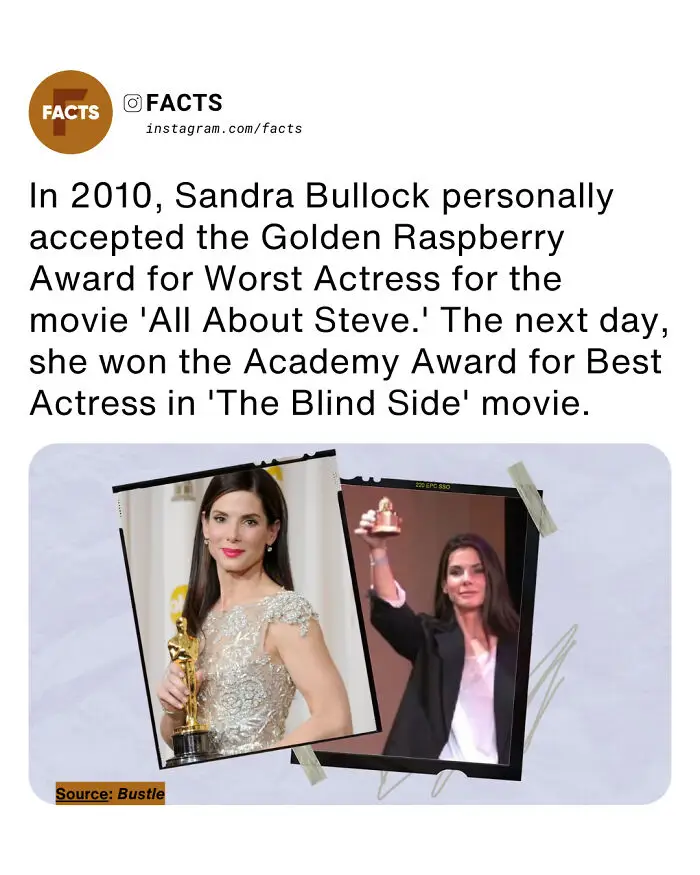
Bullock took home the "Golden Raspberry" for her performance in 'All About Steve.' The actress even showed up to the awards ceremony to pick up her prize for worst actress. "I think this is an extraordinary award," she joked. As Bullock came onto the stage to accept her honor and make her speech, she lugged a wagon full of 'All About Steve' DVDs for audience members to take.
Sandra Bullock not only received an Oscar nod for her performance in 'The Blind Side,' but in the race between Carey Mulligan, Helen Mirren, Meryl Streep, Gabourey Sidibe, and herself, it was Bullock who took home the statuette. In the drama, she played Leigh Anne Tuohy, who took in Michael Oher (played by Quinton Aaron) and helped him pursue football professionally.
Sandra Bullock not only received an Oscar nod for her performance in 'The Blind Side,' but in the race between Carey Mulligan, Helen Mirren, Meryl Streep, Gabourey Sidibe, and herself, it was Bullock who took home the statuette. In the drama, she played Leigh Anne Tuohy, who took in Michael Oher (played by Quinton Aaron) and helped him pursue football professionally.
Report
36points
#31

Samoyeds' friendly and affable disposition makes them poor guard dogs; an aggressive Samoyed is rare. The breed is characterized by an alert and happy expression, which has earned the nicknames "Sammie smile" and "smiley dog." With their tendency to bark, however, they can be diligent watchdogs, barking whenever something approaches their territory. Samoyeds are excellent companions, especially for small children or even other dogs, and they remain playful into old age.
According to the Samoyed Club of America, when Samoyeds become bored, they may become destructive or start to dig. With their sled dog heritage, a Samoyed is not averse to pulling things, and an untrained Samoyed has no problem pulling its owner on a leash rather than walking alongside.
According to the Samoyed Club of America, when Samoyeds become bored, they may become destructive or start to dig. With their sled dog heritage, a Samoyed is not averse to pulling things, and an untrained Samoyed has no problem pulling its owner on a leash rather than walking alongside.
Report
34points
#32

In the early 2000s, before the rise of smartphones, one mobile phone reigned supreme — the Nokia 3310. Launched in 2000, it quickly became a cultural phenomenon, celebrated for its durability, long battery life, and no-nonsense design. It was the kind of phone that could survive being dropped, stepped on, or even launched across a room — and still function like new. For millions of users, it was their first mobile phone, and it left a lasting impression that modern smartphones haven’t quite replicated.
The 3310 wasn’t flashy, but it was highly reliable. With its simple monochrome screen, tactile keypad, and a battery that could last up to a week on a single charge, it offered everything users needed at the time: calling, texting, and a few fun extras. Among its most memorable features was the game Snake II, which became a global pastime and helped define early mobile gaming. Its customizable covers also gave users a chance to personalize their phones long before apps and wallpapers became the norm.
Today, the Nokia 3310 is remembered fondly and even revived in a 2017 modern version with updated features and color screens. But for tech enthusiasts and nostalgic users alike, the original 3310 stands as a symbol of simpler times — when phones were tough, batteries didn’t need daily charging, and the biggest concern was beating your high score in Snake.
Report
34points
#33
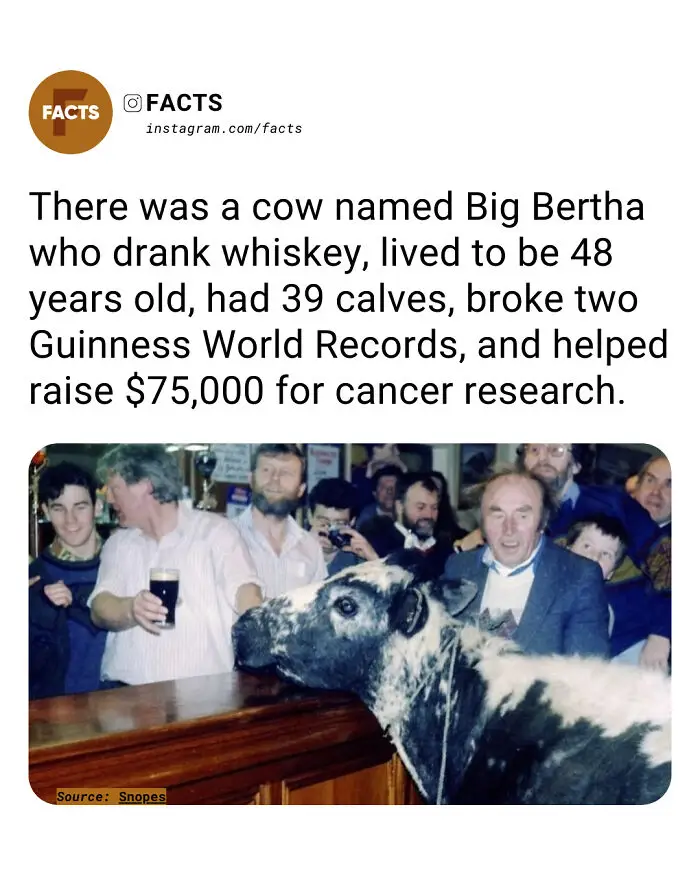
Big Bertha (17 March 1945 – 31 December 1993) was a cow who held two Guinness World Records: she was the oldest cow recorded, dying just three months short of her 49th birthday, and she also held the record for lifetime breeding, having produced 39 calves. During her lifetime, she helped raise $75,000 for cancer research and other charities.
Due to her record-breaking status, Big Bertha became a local celebrity. Her appearances at cattle fairs helped raise $75,000 for cancer research and other charities, and she would lead the St Patrick's Day parade in Sneem to aid with fundraising. Before her appearances at the noisy parades, O'Leary would feed Big Bertha whiskey to steady her nerves. After her passing on New Year's Eve 1993, a wake was held for her in a pub, the Blackwater Tavern at Raycoslough, Blackwater, in County Kerry. On Big Bertha's day of passing, O'Leary still had several of her offspring in his herd, the oldest of whom was then 35.
Due to her record-breaking status, Big Bertha became a local celebrity. Her appearances at cattle fairs helped raise $75,000 for cancer research and other charities, and she would lead the St Patrick's Day parade in Sneem to aid with fundraising. Before her appearances at the noisy parades, O'Leary would feed Big Bertha whiskey to steady her nerves. After her passing on New Year's Eve 1993, a wake was held for her in a pub, the Blackwater Tavern at Raycoslough, Blackwater, in County Kerry. On Big Bertha's day of passing, O'Leary still had several of her offspring in his herd, the oldest of whom was then 35.
Report
32points
#34

Experts have found that these little creatures can learn - even though they don't have a brain. They discovered that jellyfish are capable of changing their behaviour based on previous experiences - something that's never been seen before in other similar species. Scientists believe their findings could change our understanding of the brain and could reveal more about how our own brains work.
Jellyfish have been around for more than 500 million years, long before the first dinosaurs roamed on Earth.
They've often been thought of as very simple organisms - jellyfish are made up of around 98% water and have no bones, no brain, and no heart.
However, a new study by scientists from the University of Copenhagen has found that they can learn at a much more complex level than ever imagined.
They looked at Caribbean box jellyfish, which are only around a centimetre long and are known to be able to navigate their way through tricky obstacles, including murky waters and a maze of underwater mangrove roots.
Scientists discovered that they're able to do this by using their complex system of 24 eyes, which allows them to recognise obstacles.
They can then learn from past experiences in a process called associative learning.
Anders Garm, a marine biologist from the University of Copenhagen, explained that jellyfish can be trained to "predict a future problem and try to avoid it."
It's the first time that such simple creatures have been shown to have such abilities - until now, it's only been seen in more complex animals.
Experts say the study shows that even simple animals are capable of learning and that it could help us understand more about how our own brains work.
Report
30points
#35

More than just a box-office hit in China, the animated Hollywood comedy 'Kung Fu Panda' has led Chinese artists to find fault with their own film industry and call for fewer government controls on culture.
The movie, which tells the story of a fat panda who dreams of martial arts glory, was faithful to Chinese culture and laced with good humor, but China itself may have been incapable of producing such a film, a Chinese filmmaker and opera director lamented.
“The film’s protagonist is China’s national treasure and all the elements are Chinese, but why didn’t we make such a film?” Wu Jiang, president of the China National Peking Opera Company, was cited.
_____
🇨🇳 Lu Chuan, a young film director, applauded “Kung Fu Panda” as a fresh and rich take on Chinese culture, mixing references to martial arts films with classic legends.
“I cannot help wondering when China will be able to produce a movie of this caliber,” he wrote in the China Daily.
Report
26points
#36
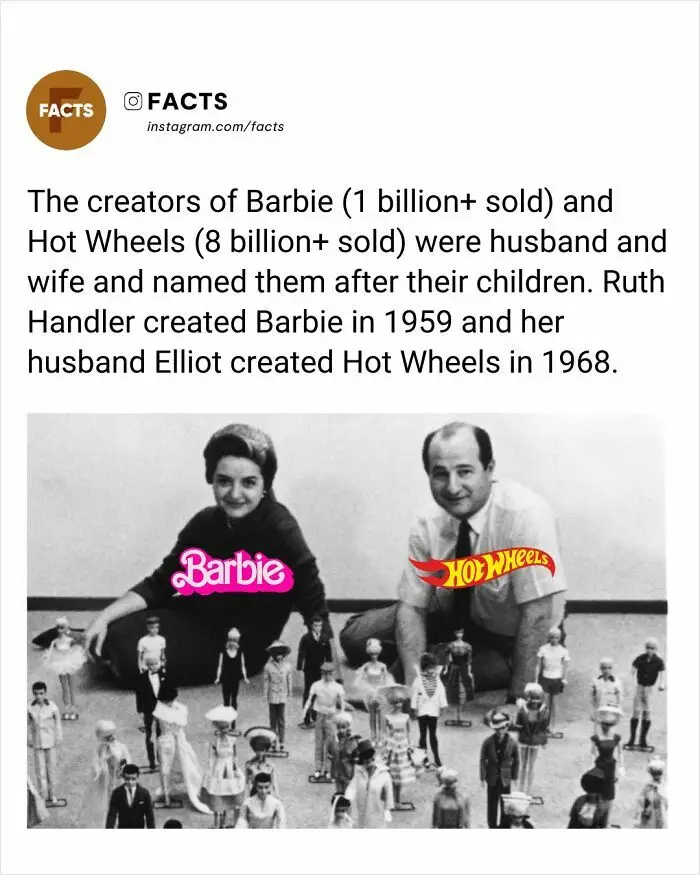
Ruth and Elliot Handler, the iconic couple that founded Mattel and created two of the most successful toys in history: Barbie and Hot Wheels.
In 1945, Ruth and Elliot Handler started Mattel in a Los Angeles garage, originally making picture frames and doll furniture. But Ruth had bigger ambitions—she was a visionary who would transform the entire toy industry.
On a 1956 family trip to Switzerland, Ruth spotted an adult-figured doll called Bild Lilli in a shop window. She realized young girls didn't just want baby dolls to nurture—they wanted dolls that showed them the women they could become. In 1959, she introduced Barbie, named after their daughter Barbara, at the New York Toy Fair. Every major retailer rejected it. Ruth went directly to children through television advertising, a radical move at the time. In its first year, 300,000 Barbies sold. Today, over 1 billion Barbies have been sold worldwide.
While Ruth conquered the doll market, Elliot focused on boys. In 1968, he launched Hot Wheels—die-cast cars with low-friction wheels that were faster and cooler than anything on the market. The timing was perfect: American car culture was exploding, and kids wanted miniature versions of muscle cars and custom hot rods. Hot Wheels became an instant phenomenon, and to date, over 6 billion cars have been sold—making it the best-selling toy line in history.
The couple also named Ken after their son Kenneth, making both their children the namesakes of cultural icons.
In 1975, the Handlers were forced to resign from Mattel after an SEC investigation revealed they had falsified financial documents, inflating earnings to boost stock prices. Ruth was convicted of fraud, receiving a suspended sentence with a fine and 500 hours of community service.
Ruth passed away in 2002, Elliot in 2011, but their creations live on as billion-dollar franchises that continue shaping childhoods around the world.
Report
25points
#37

A psychological study done in Germany during the 1980s found that the men who kissed their wives before going to work in the morning lived an average of five years longer than husbands who didn’t kiss.
Dr. Arthur Szabo, professor of psychology at the University of Kiel, collected data for two years from several dozen physicians, psychologists, and leading German insurance companies that cooperated to provide actuarial data. Szabo published his findings in a West German magazine called Selecta.
_____
The kissing husbands earned 20 to 35 percent more money and used less sick time than their peers who left with no goodbye kiss. In this same study, a sampling of Germany’s top 110 industrial managers shows that the 87 percent who left home after kissing their wives saw a pay increase and held their management positions. This same research outfit reported that not kissing one’s wife before leaving in the morning significantly increases the possibility of a car accident.
The psychologists who analyzed the data do not believe that kissing alone accounts for such a significant outcome between the two groups; rather, it is the positive attitude that is strongly associated with a healthy lifestyle. It’s quite clear from the study that the strong bond formed through regular kissing promotes not only emotional well-being but also physical health.
Report
25points
#38

A rare Chinese bowl bought for about $3 from a yard sale in the U.S. sold for $2.2 million at an auction in New York in 2007.
The bowl, found in New York state, "was bought for a few dollars from a tag sale near the consignor's home in the summer of 2007," said Cecilia Leung of Sotheby's. "At the time, the purchaser had no idea that they had happened upon a 1,000-year-old treasure."
The previous owner displayed the bowl in their living room for several years before they became curious about its origins and had it assessed, Leung said. Sotheby's pre-sale estimates valued the bowl, which measures just five inches in diameter, at between $200,000 $300,000.
The 'Ding' bowl is an example of Northern Song Dynasty pottery and described by Sotheby's as "remarkable and exceptionally beautiful."
The only other known bowl of the same size, form, and almost identical decoration has been in the collection of the British Museum in London for over 60 years, according to Sotheby's.
The bowl was purchased by London dealer Giuseppe Eskenazi for $2,225,000, after a prolonged battle between four bidders.
Report
25points
#39

According to the latest report, full-time workers nationwide need to earn more than $23 hourly to afford a modest one-bedroom rental.
The report from the National Low Income Housing Coalition estimated the hourly wages necessary for full-time workers to afford either a one- or two-bedroom rental without paying more than 30 percent of their monthly income.
Full-time employees need $23.67 per hour to afford a fair market, one-bedroom rental home without exceeding the 30 percent threshold. For a modest two-bedroom rental, workers must earn $28.58 an hour.
The report also found that no state where minimum wage workers who put in 40 hours weekly can afford a modest two-bedroom rental. A worker earning minimum wage must work an average of 104 hours per week to earn enough to pay for it.
For a one-bedroom rental, an employee making minimum wage would need to notch 86 hours a week. Fifty percent of workers do not earn enough during a 40-hour work week to afford a one-bedroom.
“Stable, affordable homes are a prerequisite for basic well-being, and no person should face the danger of losing their home,” NLIHC President and CEO Diane Yentel said in a statement.
“Yet too many low-income renters are facing worsening housing instability as housing costs rise and pandemic-era safety net programs expire,” she added.
Rents have soared in recent years amid a broader housing shortage that was exacerbated by the pandemic and growing inflation. Yet rents are stabilizing, and some markets are showing prices decline.
Still, wages failed to keep up with median rental price growth even before the pandemic-era boom. Nationwide rents grew by 17.9 percent between 2001 and 2021, while wages increased by just 3.2 percent, according to the report.
Report
25points
#40
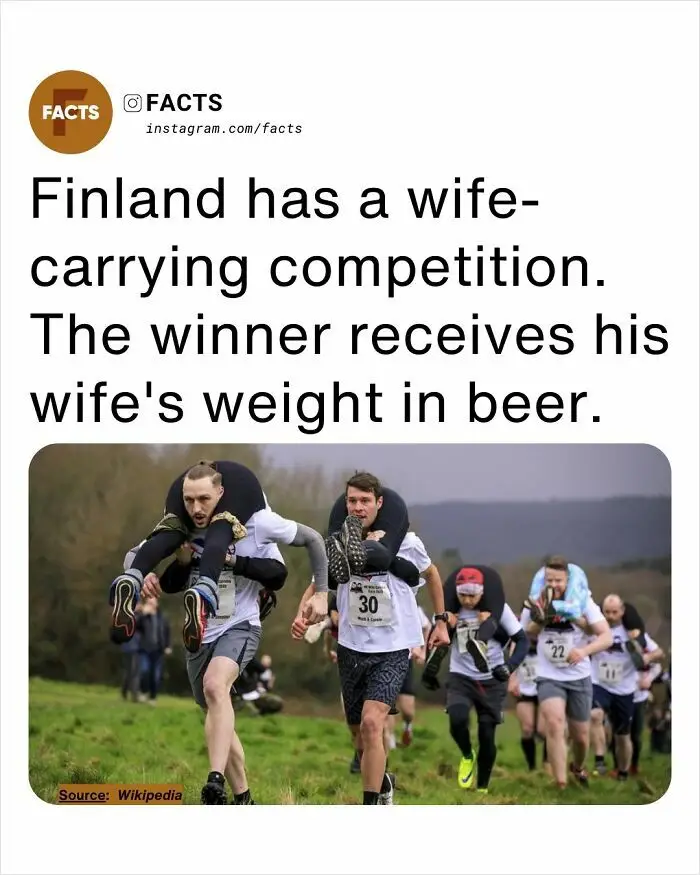
The Wife Carrying World Championships have been held annually in Sonkajärvi, Finland, since 1992 - would you partake?
It is a contest in which male competitors race while each carrying a female teammate. The objective is for the male to carry the female through a special obstacle course in the fastest time.
Several types of carrying methods may be used: either a classic piggyback, a fireman’s carry (over the shoulder), or Estonian-style (wife upside-down on his back with her legs over the neck and shoulders).
Report
24points
