




With millions of pictures taken every day, we can easily get lost in the vast world of images. That's why TIME magazine decided to create a list of the 100 most influential pictures ever taken. They teamed up with curators, historians, photo editors, and famous photographers around the world for this task. And now, you can find all of the most famous photos in one place, together with descriptions as to why these famous historical photos are such an important part of our legacy.
"No formula makes for iconic photos," the editors said. "Some rare historical photos are on our list because they were the first of their kind, others because they shaped the way we think. And some cut because they directly changed the way we live. What all of the 100 famous photos share is that they are turning points in our human experience."
The result they ended up with is not only a collection of superb historical photos but incredible human experiences as well. "The best photography is a form of bearing witness, a way of bringing a single vision to the larger world."
Ready to explore the world in a new view through the most famous photos of all time? If so, grab a cup of your favorite beverage and prepare for a journey that might just change the way you look at the world. The photo gallery of the most famous pictures of our age is right at your fingertips!
More info: time.com
#21 View From The Window At Le Gras, Joseph Nicéphore Niépce, 1826
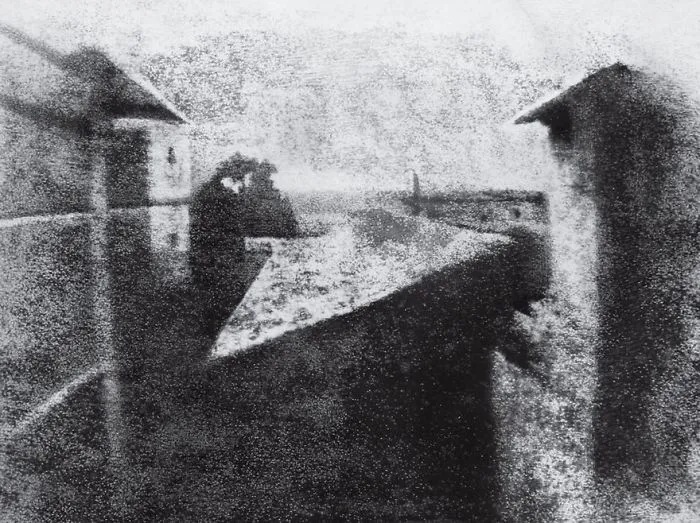
It took a unique combination of ingenuity and curiosity to produce the first known photograph, so it’s fitting that the man who made it was an inventor and not an artist. In the 1820s, Joseph Nicéphore Niépce had become fascinated with the printing method of lithography, in which images drawn on stone could be reproduced using oil-based ink. Searching for other ways to produce images, Niépce set up a device called a camera obscura, which captured and projected scenes illuminated by sunlight, and trained it on the view outside his studio window in eastern France. The scene was cast on a treated pewter plate that, after many hours, retained a crude copy of the buildings and rooftops outside. The result was the first known permanent photograph.
It is no overstatement to say that Niépce’s achievement laid the groundwork for the development of photography. Later, he worked with artist Louis Daguerre, whose sharper daguerreotype images marked photography’s next major advancement.
Report
64points
#22 Leap Into Freedom, Peter Leibing, 1961
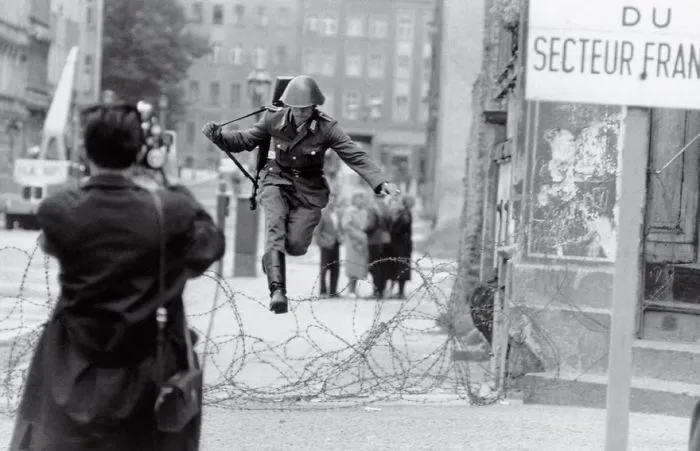
Following World War II, the conquering Allied governments carved Berlin into four occupation zones. Yet each part was not equal, and from 1949 to 1961 some 2.5 million East Germans fled the Soviet section in search of freedom. To stop the flow, East German leader Walter Ulbricht had a barbed-wire-and-cinder-block barrier thrown up in early August 1961. A few days later, Associated Press photographer Peter Leibing was tipped off that a defection might happen. He and other cameramen gathered and watched as a West Berlin crowd enticed 19-year-old border guard Hans Conrad Schumann, yelling to him, “Come on over!” Schumann, who later said he did not want to “live enclosed,” suddenly ran for the barricade. As he cleared the sharp wires he dropped his rifle and was whisked away. Sent out across the AP wire, Leibing’s photo ran on front pages across the world. It made Schumann, reportedly the first known East German soldier to flee, into a poster child for those yearning to be free, while lending urgency to East Germany’s push for a more permanent Berlin Wall. Schumann was sadly haunted by the weight of it all. While he quietly lived in the West, he could not grapple with his unintended stature as a symbol of freedom, and he committed suicide in 1998.
Report
59points
#23 The Hand Of Mrs. Wilhelm Röntgen, Wilhelm Conrad Röntgen, 1895
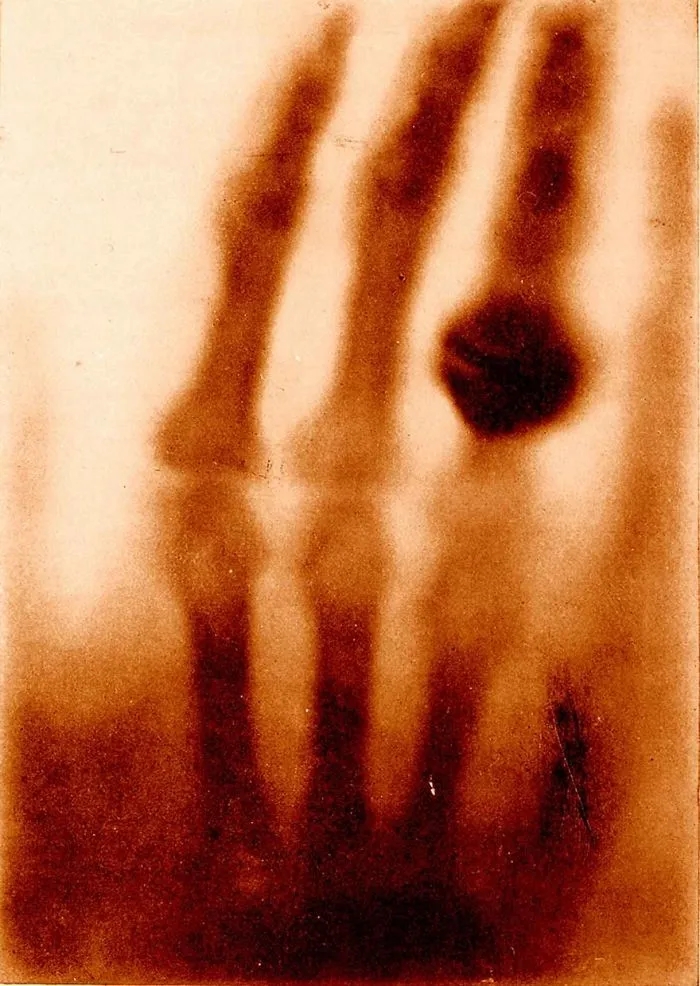
There’s no way of knowing how many pictures were taken of Anna Bertha Röntgen, and most are surely lost to history. But one of them isn’t: it is of her hand—more precisely, the bones in her hand—an image captured by her husband Wilhelm when he took the first medical x-ray in 1895. Wilhelm had spent weeks working in his lab, experimenting with a cathode tube that emitted different frequencies of electromagnetic energy. Some, he noticed, appeared to penetrate solid objects and expose sheets of photographic paper. He used the strange rays, which he aptly dubbed x-rays, to create shadowy images of the inside of various inanimate objects and then, finally, one very animate one. The picture of Anna’s hand created a sensation, and the discovery of x-rays won Wilhelm the first Nobel Prize ever granted for physics in 1901. His breakthrough quickly went into use around the world, revolutionizing the diagnosis and treatment of injuries and illnesses that had always been hidden from sight. Anna, however, was never taken with the picture. “I have seen my death,” she said when she first glimpsed it. For many millions of other people, it has meant life.
Report
52points
#24 Flag Raising On Iwo Jima, Joe Rosenthal, 1945
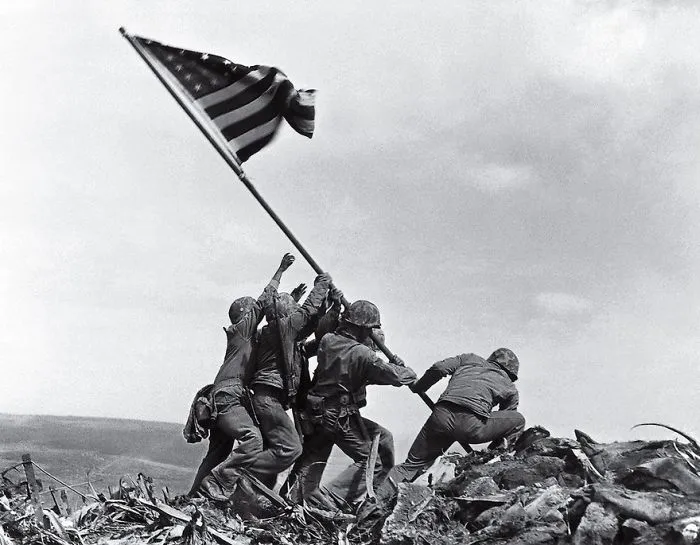
It is but a speck of an island 760 miles south of Tokyo, a volcanic pile that blocked the Allies’ march toward Japan. The Americans needed Iwo Jima as an air base, but the Japanese had dug in. U.S. troops landed on February 19, 1945, beginning a month of fighting that claimed the lives of 6,800 Americans and 21,000 Japanese. On the fifth day of battle, the Marines captured Mount Suribachi. An American flag was quickly raised, but a commander called for a bigger one, in part to inspire his men and demoralize his opponents. Associated Press photographer Joe Rosenthal lugged his bulky Speed Graphic camera to the top, and as five Marines and a Navy corpsman prepared to hoist the Stars and Stripes, Rosenthal stepped back to get a better frame—and almost missed the shot. “The sky was overcast,” he later wrote of what has become one of the most recognizable images of war. “The wind just whipped the flag out over the heads of the group, and at their feet the disrupted terrain and the broken stalks of the shrubbery exemplified the turbulence of war.” Two days later Rosenthal’s photo was splashed on front pages across the U.S., where it was quickly embraced as a symbol of unity in the long-fought war. The picture, which earned Rosenthal a Pulitzer Prize, so resonated that it was made into a postage stamp and cast as a 100-ton bronze memorial.
Report
51points
#25 Emmett Till, David Jackson, 1955
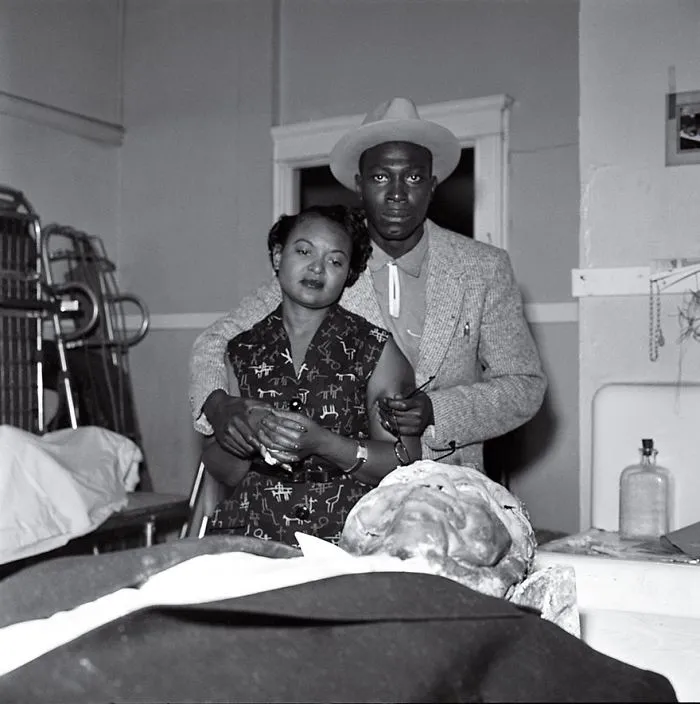
In August 1955, Emmett Till, a black teenager from Chicago, was visiting relatives in Mississippi when he stopped at Bryant’s Grocery and Meat Market. There he encountered Carolyn Bryant, a white woman. Whether Till really flirted with Bryant or whistled at her isn’t known. But what happened four days later is. Bryant’s husband Roy and his half brother, J.W. Milam, seized the 14-year-old from his great-uncle’s house. The pair then beat Till, shot him, and strung barbed wire and a 75-pound metal fan around his neck and dumped the lifeless body in the Tallahatchie River. A white jury quickly acquitted the men, with one juror saying it had taken so long only because they had to break to drink some pop. When Till’s mother Mamie came to identify her son, she told the funeral director, “Let the people see what I’ve seen.” She brought him home to Chicago and insisted on an open casket. Tens of thousands filed past Till’s remains, but it was the publication of the searing funeral image in Jet, with a stoic Mamie gazing at her murdered child’s ravaged body, that forced the world to reckon with the brutality of American racism. For almost a century, African Americans were lynched with regularity and impunity. Now, thanks to a mother’s determination to expose the barbarousness of the crime, the public could no longer pretend to ignore what they couldn’t see.
Report
50points
#26 Cotton Mill Girl, Lewis Hine, 1908
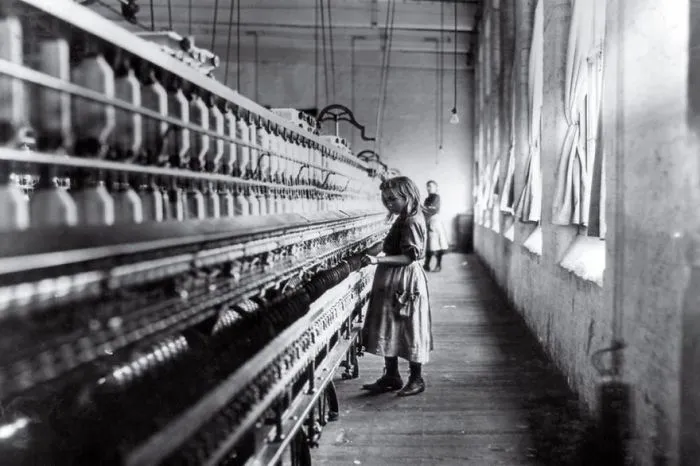
Working as an investigative photographer for the National Child Labor Committee, Lewis Hine believed that images of child labor would force citizens to demand change. The muckraker conned his way into mills and factories from Massachusetts to South Carolina by posing as a Bible seller, insurance agent or industrial photographer in order to tell the plight of nearly 2 million children. Carting around a large-format camera and jotting down information in a hidden notebook, Hine recorded children laboring in meatpacking houses, coal mines and canneries, and in November 1908 he came upon Sadie Pfeifer, who embodied the world he exposed. A 48-inch-tall wisp of a girl, she was “one of the many small children at work” manning a gargantuan cotton-spinning machine in Lancaster, S.C. Since Hine often had to lie to get his shots, he made “double-sure that my photo data was 100% pure—no retouching or fakery of any kind.” His images of children as young as 8 dwarfed by the cogs of a cold, mechanized universe squarely set the horrors of child labor before the public, leading to regulatory legislation and cutting the number of child laborers nearly in half from 1910 to 1920.
Report
48points
#27 Hitler At A Nazi Party Rally, Heinrich Hoffmann, 1934
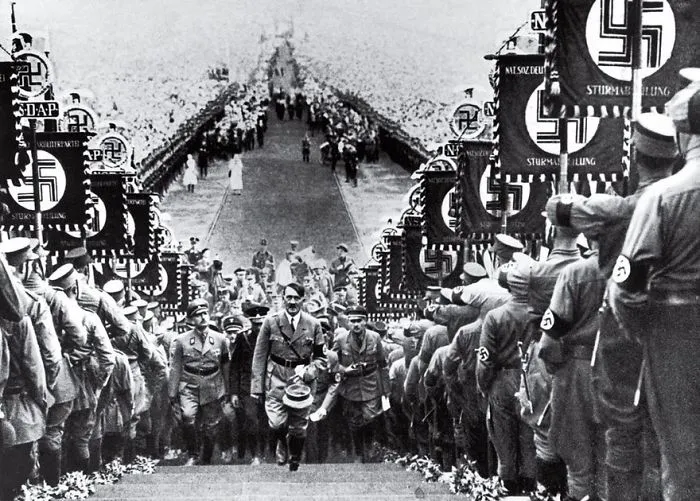
Spectacle was like oxygen for the Nazis, and Heinrich Hoffmann was instrumental in staging Hitler’s growing pageant of power. Hoffmann, who joined the party in 1920 and became Hitler’s personal photographer and confidant, was charged with choreographing the regime’s propaganda carnivals and selling them to a wounded German public. Nowhere did Hoffmann do it better than on September 30, 1934, in his rigidly symmetrical photo at the Bückeberg Harvest Festival, where the Mephistophelian Führer swaggers at the center of a grand Wagnerian fantasy of adoring and heiling troops. By capturing this and so many other extravaganzas, Hoffmann—who took more than 2 million photos of his boss—fed the regime’s vast propaganda machine and spread its demonic dream. Such images were all-pervasive in Hitler’s Reich, which shrewdly used Hoffman’s photos, the stark graphics on Nazi banners and the films of Leni Riefenstahl to make Aryanism seem worthy of godlike worship. Humiliated by World War I, punishing reparations and the Great Depression, a nation eager to reclaim its sense of self was rallied by Hitler’s visage and his seemingly invincible men aching to right wrongs. Hoffmann’s expertly rendered propaganda is a testament to photography’s power to move nations and plunge a world into war.
Report
48points
#28 Gandhi And The Spinning Wheel, Margaret Bourke-White, 1946
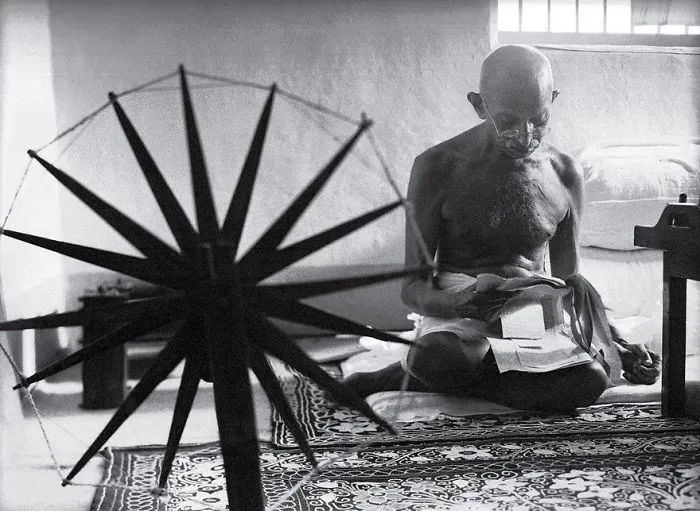
When the British held Mohandas Gandhi prisoner at Yeravda prison in Pune, India, from 1932 to 1933, the nationalist leader made his own thread with a charkha, a portable spinning wheel. The practice evolved from a source of personal comfort during captivity into a touchstone of the campaign for independence, with Gandhi encouraging his countrymen to make their own homespun cloth instead of buying British goods. By the time Margaret Bourke-White came to Gandhi’s compound for a life article on India’s leaders, spinning was so bound up with Gandhi’s identity that his secretary, Pyarelal Nayyar, told Bourke-White that she had to learn the craft before photographing the leader. Bourke-White’s picture of Gandhi reading the news alongside his charkha never appeared in the article for which it was taken, but less than two years later life featured the photo prominently in a tribute published after Gandhi’s assassination. It soon became an indelible image, the slain civil-disobedience crusader with his most potent symbol, and helped solidify the perception of Gandhi outside the subcontinent as a saintly man of peace.
Report
44points
#29 Fetus, 18 Weeks, Lennart Nilsson, 1965
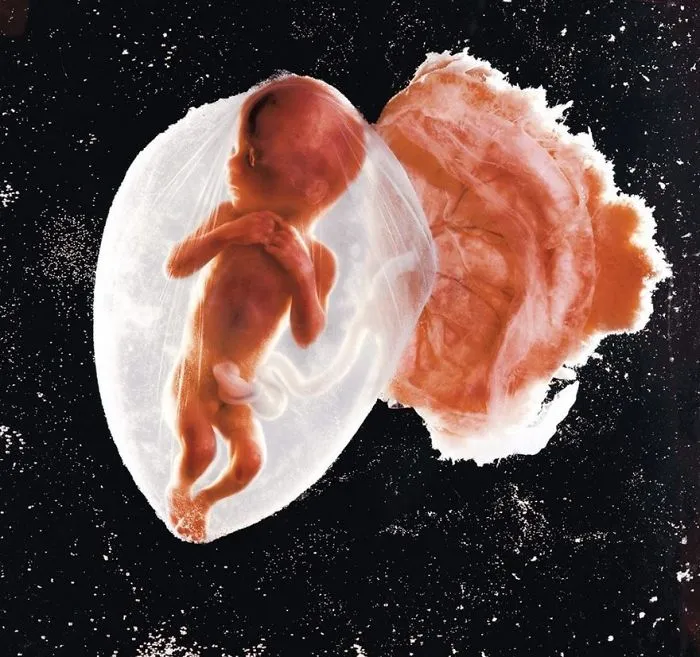
When LIFE published Lennart Nilsson’s photo essay “Drama of Life Before Birth” in 1965, the issue was so popular that it sold out within days. And for good reason. Nilsson’s images publicly revealed for the first time what a developing fetus looks like, and in the process raised pointed new questions about when life begins. In the accompanying story, LIFE explained that all but one of the fetuses pictured were photographed outside the womb and had been removed—or aborted—“for a variety of medical reasons.” Nilsson had struck a deal with a hospital in Stockholm, whose doctors called him whenever a fetus was available to photograph. There, in a dedicated room with lights and lenses specially designed for the project, Nilsson arranged the fetuses so they appeared to be floating as if in the womb.
In the years since Nilsson’s essay was published, the images have been widely appropriated without his permission. Antiabortion activists in particular have used them to advance their cause. (Nilsson has never taken a public stand on abortion.) Still, decades after they first appeared, Nilsson’s images endure for their unprecedentedly clear, detailed view of human life at its earliest stages.
Report
44points
#30 D-Day, Robert Capa, 1944
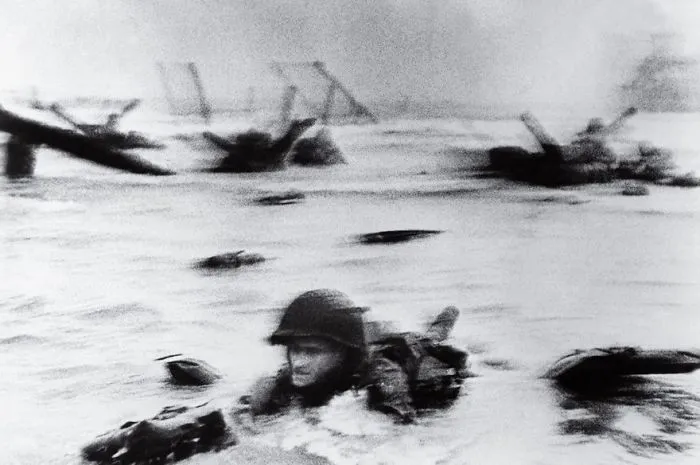
It was the invasion to save civilization, and LIFE’s Robert Capa was there, the only still photographer to wade with the 34,250 troops onto Omaha Beach during the D-Day landing. His photographs—infused with jarring movement from the center of that brutal assault—gave the public an American soldier’s view of the dangers of war. The soldier in this case was Private First Class Huston Riley, who after the Nazis shelled his landing craft jumped into water so deep that he had to walk along the bottom until he could hold his breath no more. When he activated his Navy M-26 belt life preservers and floated to the surface, Riley became a target for the guns and artillery shells mowing down his comrades. Struck several times, the 22-year-old soldier took about half an hour to reach the Normandy shore. Capa took this photo of him in the surf and then with the assistance of a sergeant helped Riley, who later recalled thinking, “What the hell is this guy doing here? I can’t believe it. Here’s a cameraman on the shore.” Capa spent an hour and a half under fire as men around him died. A courier then transported his four rolls of film to LIFE’s London offices, and the magazine’s general manager stopped the presses to get them into the June 19 issue. Most of the film, though, showed no images after processing, and only some frames survived. The remaining images have a grainy, blurry look that gives them the frenetic feel of action, a quality that has come to define our collective memory of that epic clash.
Report
42points
#31 The Pillow Fight, Harry Benson, 1964
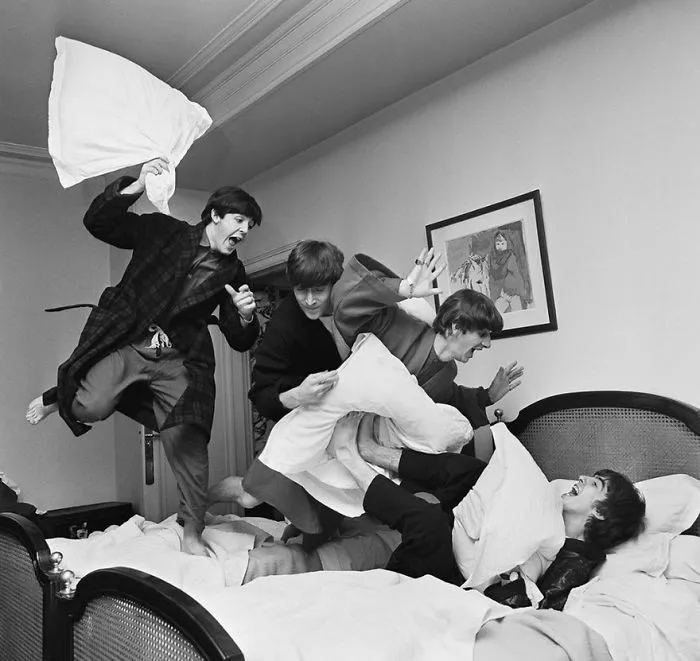
Harry Benson didn’t want to meet the Beatles. The Glasgow-born photographer had plans to cover a news story in Africa when he was assigned to photograph the musicians in Paris. “I took myself for a serious journalist and I didn’t want to cover a rock ’n’ roll story,” he scoffed. But once he met the boys from Liverpool and heard them play, Benson had no desire to leave. “I thought, ‘God, I’m on the right story.’ ” The Beatles were on the cusp of greatness, and Benson was in the middle of it. His pillow-fight photo, taken in the swanky George V Hotel the night the band found out “I Want to Hold Your Hand” hit No. 1 in the U.S., freezes John, Paul, George and Ringo in an exuberant cascade of boyish talent—and perhaps their last moment of unbridled innocence. It captures the sheer joy, happiness and optimism that would be embraced as Beatlemania and that helped lift America’s morale just 11 weeks after John F. Kennedy’s assassination. The following month, Benson accompanied the Fab Four as they flew to New York City to appear on The Ed Sullivan Show, kick-starting the British Invasion. The trip led to decades of collaboration with the group and, as Benson later recalled, “I was so close to not being there.”
Report
42points
#32 The Face Of Aids, Therese Frare, 1990
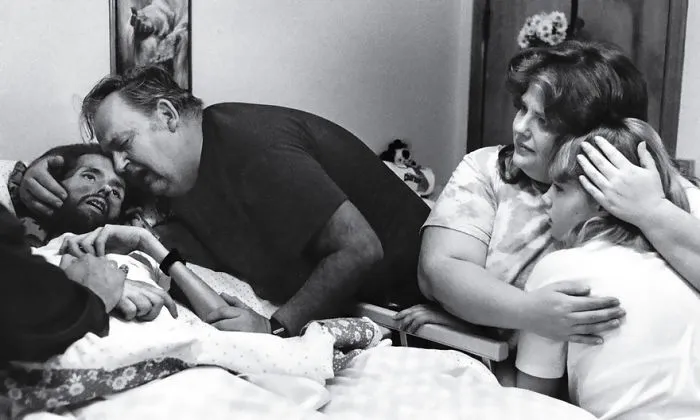
David Kirby died surrounded by his family. But Therese Frare’s photograph of the 32-year-old man on his deathbed did more than just capture the heartbreaking moment. It humanized AIDS, the disease that killed Kirby, at a time when it was ravaging victims largely out of public view. Frare’s photograph, published in LIFE in 1990, showed how the widely misunderstood disease devastated more than just its victims. It would be another year before the red ribbon became a symbol of compassion and resilience, and three years before President Bill Clinton created a White House Office of National AIDS Policy. In 1992 the clothing company Benetton used a colorized version of Frare’s photograph in a series of provocative ads. Many magazines refused to run it, and a range of groups called for a boycott. But Kirby’s family consented to its use, believing that the ad helped raise critical awareness about AIDS at a moment when the disease was still uncontrolled and sufferers were lobbying the federal government to speed the development of new drugs. “We just felt it was time that people saw the truth about AIDS,” Kirby’s mother Kay said. Thanks to Frare’s image, they did.
Report
42points
#33 First Cell-Phone Picture, Philippe Kahn, 1997
Boredom can be a powerful incentive. In 1997, Philippe Kahn was stuck in a Northern California maternity ward with nothing to do. The software entrepreneur had been shooed away by his wife while she birthed their daughter, Sophie. So Kahn, who had been tinkering with technologies that share images instantly, jerry-built a device that could send a photo of his newborn to friends and family—in real time. Like any invention, the setup was crude: a digital camera connected to his flip-top cell phone, synched by a few lines of code he’d written on his laptop in the hospital. But the effect has transformed the world: Kahn’s device captured his daughter’s first moments and transmitted them instantly to more than 2,000 people.
Kahn soon refined his ad hoc prototype, and in 2000 Sharp used his technology to release the first commercially available integrated camera phone, in Japan. The phones were introduced to the U.S. market a few years later and soon became ubiquitous. Kahn’s invention forever altered how we communicate, perceive and experience the world and laid the groundwork for smartphones and photo-sharing applications like Instagram and Snapchat. Phones are now used to send hundreds of millions of images around the world every day—including a fair number of baby pictures.
Report
42points
#34 Raising A Flag Over The Reichstag, Yevgeny Khaldei, 1945
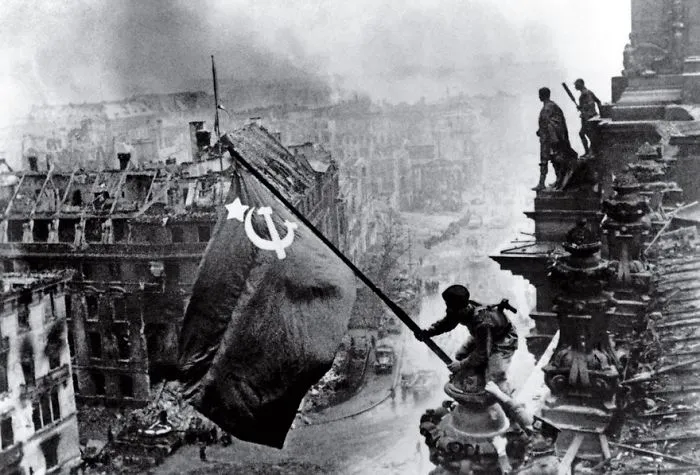
“This is what I was waiting for for 1,400 days,” the Ukrainian-born Yevgeny Khaldei said as he gazed at the ruins of Berlin on May 2, 1945. After four years of fighting and photographing across Eastern Europe, the Red Army soldier arrived in the heart of the Nazis’ homeland armed with his Leica III rangefinder and a massive Soviet flag that his uncle, a tailor, had fashioned for him from three red tablecloths. Adolf Hitler had committed suicide two days before, yet the war still raged as Khaldei made his way to the Reichstag. There he told three soldiers to join him, and they clambered up broken stairs onto the parliament building’s blood-soaked parapet. Gazing through his camera, Khaldei knew he had the shot he had hoped for: “I was euphoric.” In printing, Khaldei dramatized the image by intensifying the smoke and darkening the sky—even scratching out part of the negative—to craft a romanticized scene that was part reality, part artifice and all patriotism. Published in the Russian magazine Ogonek, the image became an instant propaganda icon. And no wonder. The flag jutting from the heart of the enemy exalted the nobility of communism, proclaimed the Soviets the new overlords and hinted that by lowering the curtain of war, Premier Joseph Stalin would soon hoist a cold new iron one across the land.
Report
40points
#35 Behind Closed Doors, Donna Ferrato, 1982
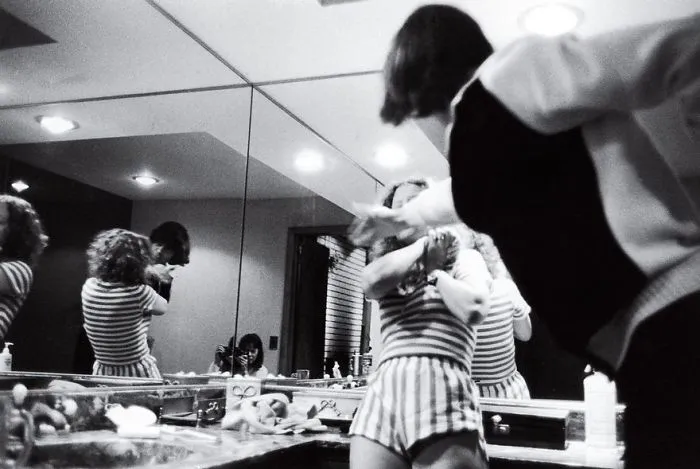
There was nothing particularly special about Garth and Lisa or the violence that happened in the bathroom of their suburban New Jersey home one night in 1982. Enraged by a perceived slight, Garth beat his wife while she cowered in a corner. Such acts of intimate-partner violence are not uncommon, but they usually happen in private. This time another person was in the room, photographer Donna Ferrato.
Ferrato, who had come to know the couple through a photo project on wealthy swingers, knew that simply bearing witness wasn’t enough. Her shutter clicked again and again. Ferrato approached magazine editors to publish the images, but all refused. So Ferrato did, in her 1991 book Living With the Enemy. The landmark volume chronicled domestic-violence episodes and their aftermaths, including those of the pseudonymous Garth and Lisa. Their real names are Elisabeth and Bengt; his identity was revealed for the first time as part of this project. Ferrato captured incidents and victims while living inside women’s shelters and shadowing police. Her work helped bring violence against women out of the shadows and forced policymakers to confront the issue. In 1994, Congress passed the Violence Against Women Act, increasing penalties against offenders and helping train police to treat it as a serious crime. Thanks to Ferrato, a private tragedy became a public cause.
Ferrato, who had come to know the couple through a photo project on wealthy swingers, knew that simply bearing witness wasn’t enough. Her shutter clicked again and again. Ferrato approached magazine editors to publish the images, but all refused. So Ferrato did, in her 1991 book Living With the Enemy. The landmark volume chronicled domestic-violence episodes and their aftermaths, including those of the pseudonymous Garth and Lisa. Their real names are Elisabeth and Bengt; his identity was revealed for the first time as part of this project. Ferrato captured incidents and victims while living inside women’s shelters and shadowing police. Her work helped bring violence against women out of the shadows and forced policymakers to confront the issue. In 1994, Congress passed the Violence Against Women Act, increasing penalties against offenders and helping train police to treat it as a serious crime. Thanks to Ferrato, a private tragedy became a public cause.
Report
39points
#36 Famine In Somalia, James Nachtwey, 1992
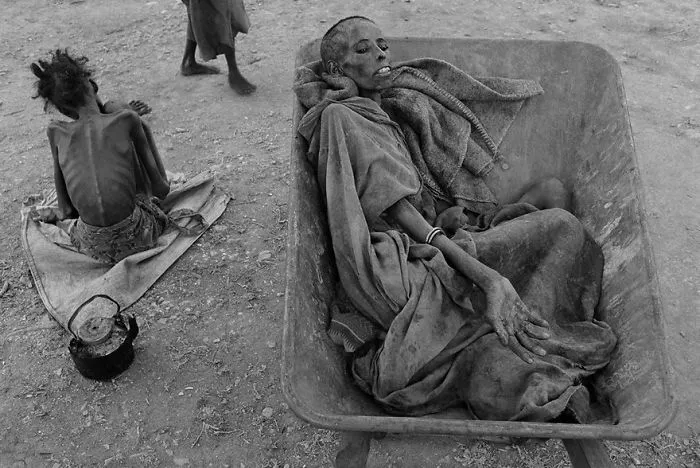
James Nachtwey couldn’t get an assignment in 1992 to document the spiraling famine in Somalia. Mogadishu had become engulfed in armed conflict as food prices soared and international assistance failed to keep pace. Yet few in the West took much notice, so the American photographer went on his own to Somalia, where he received support from the International Committee of the Red Cross. Nachtwey brought back a cache of haunting images, including this scene of a woman waiting to be taken to a feeding center in a wheelbarrow. After it was published as part of a cover feature in the New York Times Magazine, one reader wrote, “Dare we say that it doesn’t get any worse than this?” The world was similarly moved. The Red Cross said public support resulted in what was then its largest operation since World War II. One and a half million people were saved, the ICRC’s Jean-Daniel Tauxe told the Times, and “James’ pictures made the difference.”
Report
39points
#37 Muhammad Ali Vs. Sonny Liston, Neil Leifer, 1965
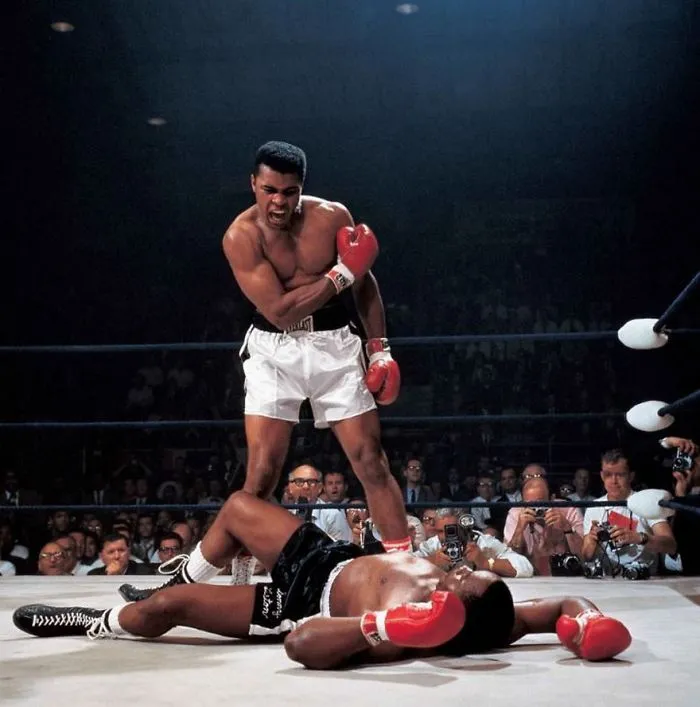
So much of great photography is being in the right spot at the right moment. That was what it was like for sports illustrated photographer Neil Leifer when he shot perhaps the greatest sports photo of the century. “I was obviously in the right seat, but what matters is I didn’t miss,” he later said. Leifer had taken that ringside spot in Lewiston, Maine, on May 25, 1965, as 23-year-old heavyweight boxing champion Muhammad Ali squared off against 34-year-old Sonny Liston, the man he’d snatched the title from the previous year. One minute and 44 seconds into the first round, Ali’s right fist connected with Liston’s chin and Liston went down. Leifer snapped the photo of the champ towering over his vanquished opponent and taunting him, “Get up and fight, sucker!” Powerful overhead lights and thick clouds of cigar smoke had turned the ring into the perfect studio, and Leifer took full advantage. His perfectly composed image captures Ali radiating the strength and poetic brashness that made him the nation’s most beloved and reviled athlete, at a moment when sports, politics and popular culture were being squarely battered in the tumult of the ’60s.
Report
38points
#38 The Situation Room, Pete Souza, 2011
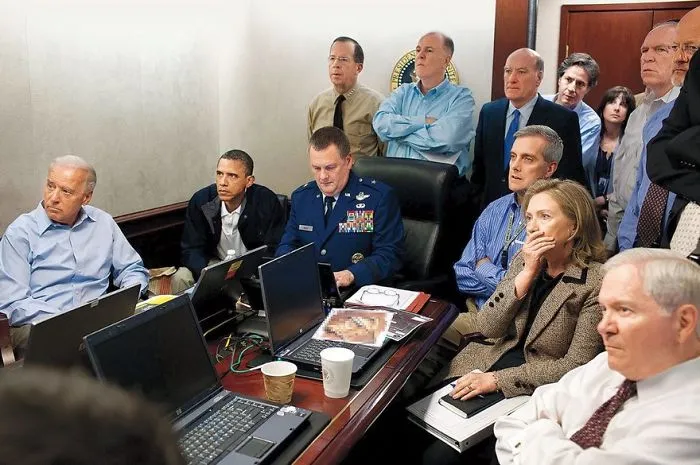
Official White House photographers document Presidents at play and at work, on the phone with world leaders and presiding over Oval Office meetings. But sometimes the unique access allows them to capture watershed moments that become our collective memory. On May 1, 2011, Pete Souza was inside the Situation Room as U.S. forces raided Osama bin Laden’s Pakistan compound and killed the terrorist leader. Yet Souza’s picture includes neither the raid nor bin Laden. Instead he captured those watching the secret operation in real time. President Barack Obama made the decision to launch the attack, but like everyone else in the room, he is a mere spectator to its execution. He stares, brow furrowed, at the raid unfolding on monitors. Secretary of State Hillary Clinton covers her mouth, waiting to see its outcome.
In a national address that evening from the White House, Obama announced that bin Laden had been killed. Photographs of the dead body have never been released, leaving Souza’s photo and the tension it captured as the only public image of the moment the war on terror notched its most important victory.
Report
38points
#39 Nuit De Noel, Malick Sidibe, 1963
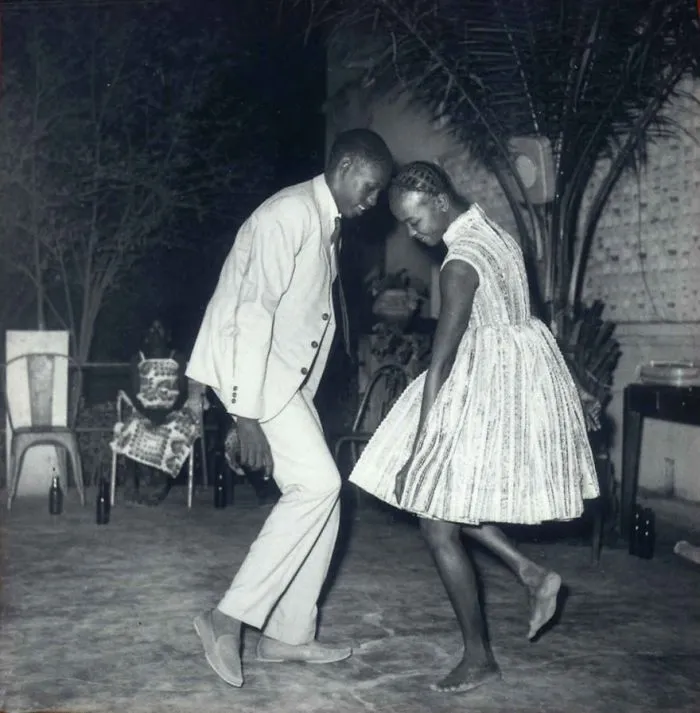
Malian photographer Malick Sidibé’s life followed the trajectory of his nation. He started out herding his family’s goats, then trained in jewelry making, painting and photography. As French colonial rule ended in 1960, he captured the subtle and profound changes reshaping his nation. Nicknamed the Eye of Bamako, Sidibé took thousands of photos that became a real-time chronicle of the euphoric zeitgeist gripping the capital, a document of a fleeting moment. “Everyone had to have the latest Paris style,” he observed of young people wearing flashy clothes, straddling Vespas and nuzzling in public as they embraced a world without shackles. On Christmas Eve in 1963, Sidibé happened on a young couple at a club, lost in each other’s eyes. What Sidibé called his “talent to observe” allowed him to capture their quiet intimacy, heads brushing as they grace an empty dance floor. “We were entering a new era, and people wanted to dance,” Sidibé said. “Music freed us. Suddenly, young men could get close to young women, hold them in their hands. Before, it was not allowed. And everyone wanted to be photographed dancing up close.”
Report
37points
#40 Saigon Execution, Eddie Adams, 1968
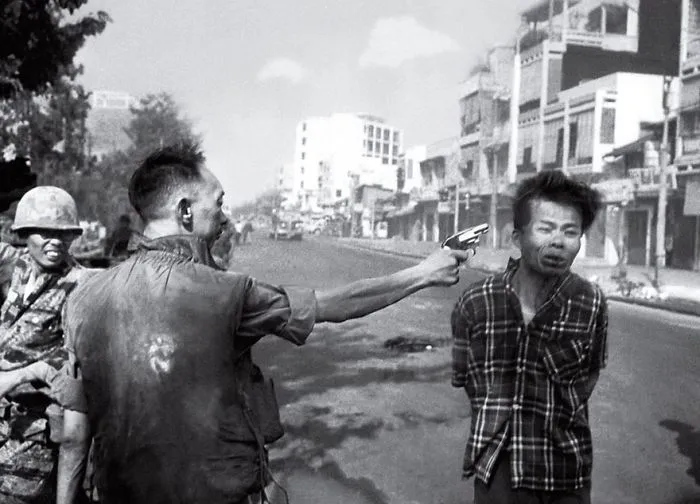
The act was stunning in its casualness. Associated Press photographer Eddie Adams was on the streets of Saigon on February 1, 1968, two days after the forces of the People’s Army of Vietnam and the Viet Cong set off the Tet offensive and swarmed into dozens of South Vietnamese cities. As Adams photographed the turmoil, he came upon Brigadier General Nguyen Ngoc Loan, chief of the national police, standing alongside Nguyen Van Lem, the captain of a terrorist squad who had just killed the family of one of Loan’s friends. Adams thought he was watching the interrogation of a bound prisoner. But as he looked through his viewfinder, Loan calmly raised his .38-caliber pistol and summarily fired a bullet through Lem’s head. After shooting the suspect, the general justified the suddenness of his actions by saying, “If you hesitate, if you didn’t do your duty, the men won’t follow you.” The Tet offensive raged into March. Yet while U.S. forces beat back the communists, press reports of the anarchy convinced Americans that the war was unwinnable. The freezing of the moment of Lem’s death symbolized for many the brutality over there, and the picture’s widespread publication helped galvanize growing sentiment in America about the futility of the fight. More important, Adams’ photo ushered in a more intimate level of war photojournalism. He won a Pulitzer Prize for this image, and as he commented three decades later about the reach of his work, “Still photographs are the most powerful weapon in the world.”
Report
36points