






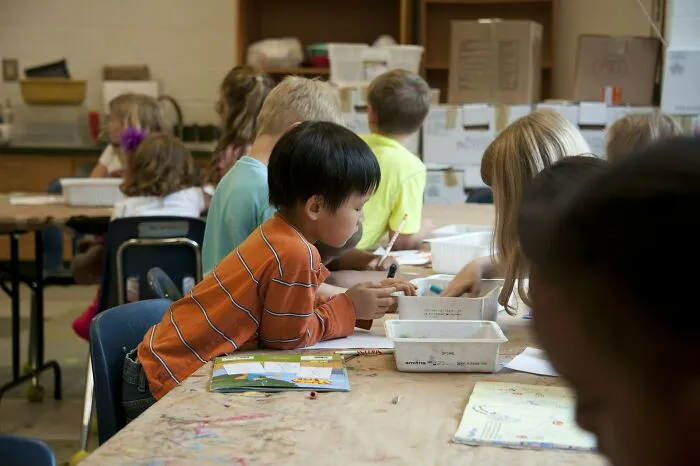
Every generation faces its fair share of advantages and challenges, and that will never change. Currently, a growing number of people are concerned about Generation Alpha, kids born between 2010 and 2024, who appear to be struggling with basic skills in school. Reading, writing, math… It’s not looking good.
#41
I have to teach kids how to read an analog clock on the regular.
I work with high schoolers.
I work with high schoolers.
Report
8points
#42
Been teaching in Japan for nearly 20 years and kids over here seem to be doing fine. They can normally read and write fine in 4 different alphabets. Basic skills like reading, writing and math are very high.
On the flip side critical thinking skills are somewhat lacking.
On the flip side critical thinking skills are somewhat lacking.
Report
8points
#43
I teach AP Lang and AP Lit, and even at those levels, the level of reading and writing is much lower than it used to be. There’s almost a complete lack of engagement in reading. Any kind writing isn’t any better. The problem I see most is that students don’t see the value in doing something unless it has a direct, instant correlation. So, learning to write a résumé makes a lot of sense to them, but reading a novel and really experiencing it, taking it in, broadening their view on life, etc. has very little value to them because they don’t see an instant benefit.
Report
8points
#44
It is significantly worse than that.
There is a small, but growing group of students who have basically surrendered anything that even approaches cognition to LLMs.
Were talking kids asking chatgpt how they feel about their morning.
It is only going to get worse.
There is a small, but growing group of students who have basically surrendered anything that even approaches cognition to LLMs.
Were talking kids asking chatgpt how they feel about their morning.
It is only going to get worse.
Report
7points
#45
K12 SysAd here, it's unbelievable how bad it is. iPad generation. I've been adamantly pushing no screens in DK/K/1st and limited screen time in 2nd-8th. A shocking percentage of parents give iPad's to kids at bewilderingly young ages just to pacify them. We've followed that up by making their entire curriculum app-based like Moose-Math, Teachme kindergarten/1st grade, tiktok time, geoboard, and so many other things that should be taught in the physical space. We've completely abandoned the "phonics" style reading and writing method. Don't just generalize kids right now, I play Magic Cards with people in their 20's and 30's and 90% of them can't clearly sight read their cards aloud. It's shocking how illiterate we collectively are. And that's coming from Me; my written grammar is abhorrent and I'm not a certified educator.
Report
7points
#46
What is so interesting about this is that it’s entirely an American problem. I’m an American living in France, and the kids here are into everything and very independent. School and after-school activities are intense where I live in the Alps. These kids are skiing and rock-climbing and learning other languages and taking art and music classes. Activities are cheap and expected, I’m talking €10 for 6 months of art classes. Devices are scarce, and even when kids have them, the culture prevents long screen times. French people are very social. In 5 years across multiple cities, I have yet to see a kid with a device in a restaurant.
The U.S. is doing something very wrong culturally, and I hope we figure out what it is soon.
The U.S. is doing something very wrong culturally, and I hope we figure out what it is soon.
Report
6points
#47
My wife is the head of the math department in her high school and she says the number of kids coming out of elementary school that are basically math illiterate is astounding.
Report
5points
#48
Yes. it's a combination of so many factors - bad curriculum, inability to fail, standardized testing, large class sizes, lack of parental involvement, phones/tablets. everyone wanted to blame covid but i started my internship in 2019 and my first day in a 4th grade classroom i was FLOORED by how these kids don't know how to read or write (and this was the best school in a large county). covid definitely made it worse for a couple years, but the kids got back to "normal" after about 2 years back in person. it's just that "normal" now is abysmally low. i have completely average 4th and 5th grade students who are unable to spell most everyday vocabulary words, unable to sound out unfamiliar words, and frequently write sentences that are missing words or make no sense. i teach the arts. i have largely given up on assigning written responses longer than 1-2 sentences because so many kids will take 10 minutes and give me something illegible/unreadable.
Report
5points
#49
I tutor privately. I'm not seeing that. What I am seeing is a large enthusiasm gap between boys and girls. I might have a girl who is okay at math, but who is studious and follows directions unquestioningly and so gets good grades. And then I'll have a boy student with greater natural ability but zero interest in putting more than the minimal energy or effort in. I see that pattern over and over.
Report
5points
#50
Former behavior support assistant, it looks like societal pressures, more divorces, less availability of parents/guardians for kids that need it, less school resources, revolving doors from budgeting and causing some kiddos who need lots of behavior support to need more support and it can impact an entire class room.
There were alot of rooms that needed to be cleared, and classrooms communicated to about social emotional learning. I don't remember that level of need for social emotional learning from a councilor weekly in multiple classes at all in my K-12. It feels like it takes more time to get some kiddos basic needs met and regulated that some of their academic needs realistically won't get met. All while class rooms get bigger, and resources don't keep up with the times or the needs. I have definitely worked with middle schoolers who can't spell or write basic sentences. There is that and tech feels more like a long term wheelchair than temporary assistance to academic growth for most students who need it.
I remember a elementary student who wouldn't sleep sometimes due to being on screens late, not talk to adults when they were emotional unregulated (often from sleep). The kiddo enjoyed tech so much that he wanted to make a game. I've been playing all sorts of games with varying levels of creativity. That student made a game that was a digital storefront to get students to click more to get more points and spend more time on the screen. It felt two steps away from making a whole game that was just loot boxes and more screen engagement. There were a spectrum of student needs that were similar. I worry the skills that tech are bringing are so latently not in student academic interest and so in the interest in making forever customers, that students will not have the same ability to exist or adapt outside of the digital sandboxes they grow up in as previous generations.
Report
5points
#51
Not a teacher but I had given training to some GenZ's the other day: 3 out of 7 of them only used one hand to type on a keyboard with their other hand just rested on their lap/phones. I have noticed this over the last few years and have to actively say "lets use both our hands cmon now" because its just so common.
Report
5points
#52
I teach university students. Frankly the biggest issue for me are their human skills. One of them told me she didn't submit her homework because she didn't know how to do it. Why the hell do you think I assigned that homework?? On the bright side, I've met kids 4 years younger than this batch and they're actually great so I have a bit of hope for the future.
Report
5points
#53
My 15 year old daughter reads over a 50 books a year. This is a parenting problem, not a kid problem. We're choosing to let them spend time in screens.
Report
4points
#54
High school math and physics here. I will answer with a resounding...kinda.
The top end kids are better than they've ever been. Society will have plenty of doctors and engineers going forward.
The middle-of-the-road kids have less desire to sit with confusion than before, relying mainly on AI and Photomath to do most of their work for them.
The idiots have always been idiots. That has not and will never change.
As far as basic skills go, most seem fine to me. And I don't teach in an affluent area. My kids are all rednecks.
Report
4points
#55
I think the whole "Gen Alpha can't read or write" thing is being blown way out of proportion.
I'm a university professor, so there could be some survivorship bias here since students who can't read or write don't make it to university. That said, my last batch of students didn't perform any worse from the ones I taught when I first started back in 2010.
I technically haven't taught Gen Alpha yet, but I've taught students who are only a few years older. I don't see any reason how things could have changed that drastically in such a short time.
And if you're talking about the youngest Gen Alpha kids, well ya, they're only two or three years old.
Report
3points