




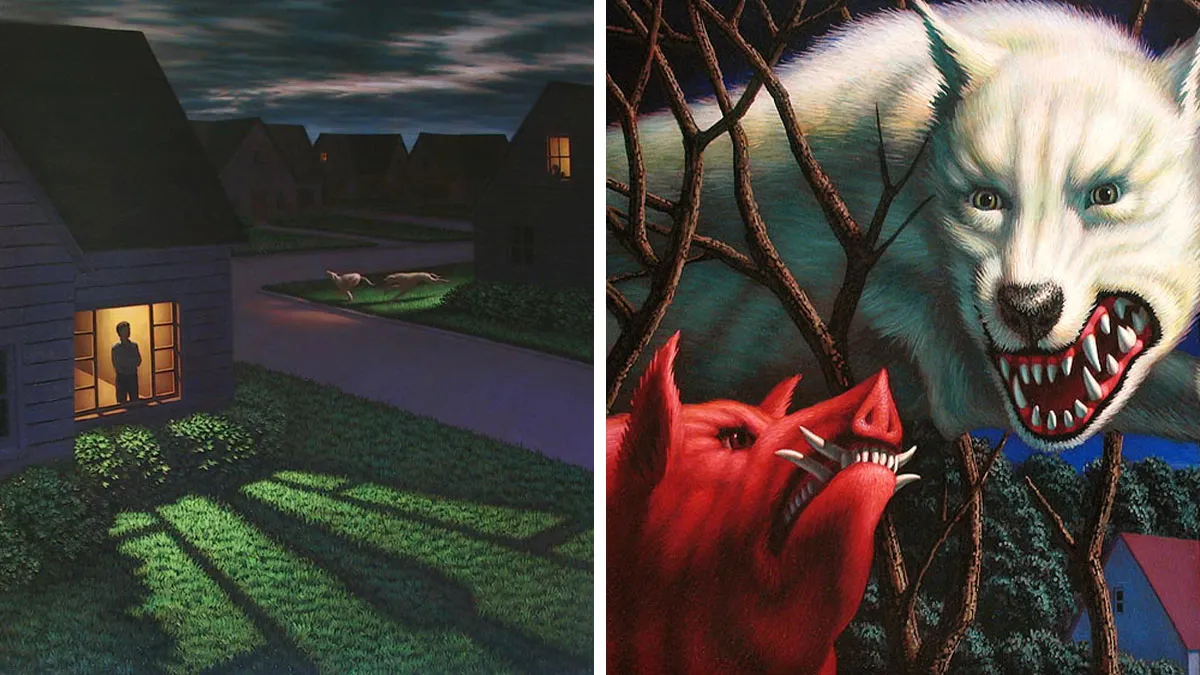


Leonard Koscianski’s paintings feel like suburban dreams that have wandered just a little too far into the uncanny. At first, his scenes may seem familiar: glowing windows, moonlit streets, leafy yards, swimmers, runners, birds, fish, and animals moving through carefully built spaces. But the longer you look, the stranger they become. Shadows stretch dramatically, creatures appear oversized or unexpected, and ordinary neighborhoods begin to feel charged with mystery, tension, and imagination.
Born in Cleveland, Ohio, Koscianski studied under R. Buckminster Fuller and American painter Wayne Thiebaud, receiving his Bachelor’s degree from the Cleveland Institute of Art and his Master’s degree from the University of California, Davis. Over the course of his career, his psychologically charged work has been exhibited internationally and included in public and private collections, such as the Metropolitan Museum of Art in New York, the Philadelphia Museum, and the Art Institute of Chicago. He has also received major recognition, including a National Endowment for the Arts Individual Artist Fellowship and a Rockefeller Foundation Bellagio Fellowship.
Scroll down to explore some of his striking artworks, and be sure to check out his website and Instagram to see more of his work.
More info: leonardkoscianski.com | Instagram
#22 “Wild Dogs”
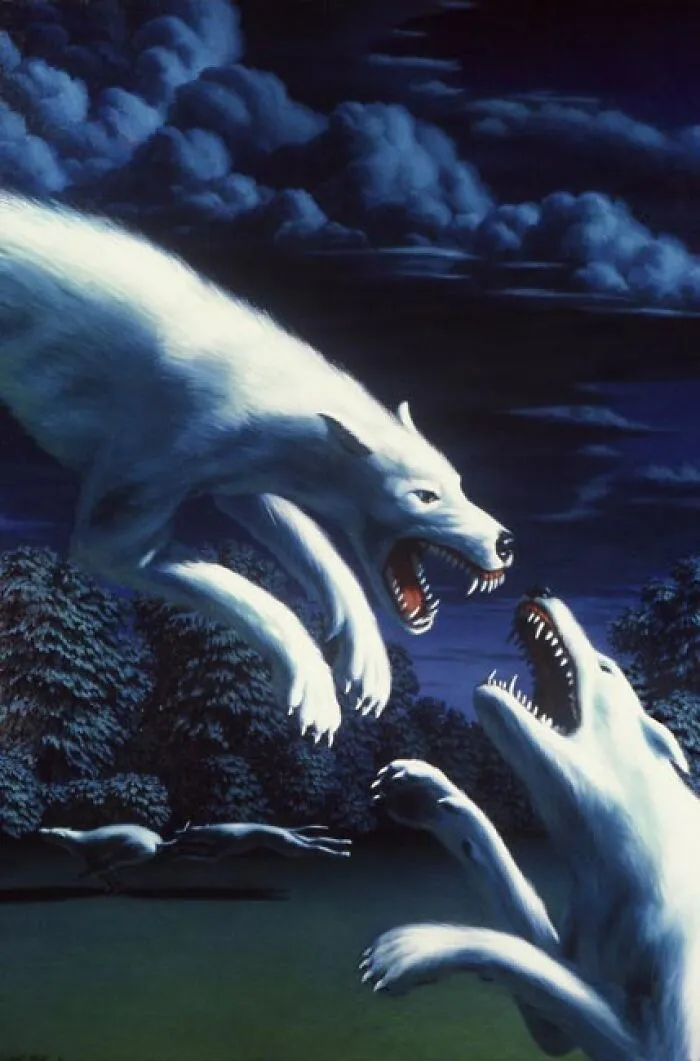
Description: “This painting was created using oil paint on canvas. It is Surreal in style, with a dreamlike character. The blue tonality gives the image a night time appearance. The lighting suggests moonlight. This painting was acquired by curator William Lieberman for the permanent collection of the Metropolitan Museum of Art. It is a classic example of 1980’s Postmodern Art.”
Report
5points
#23 “Claws”
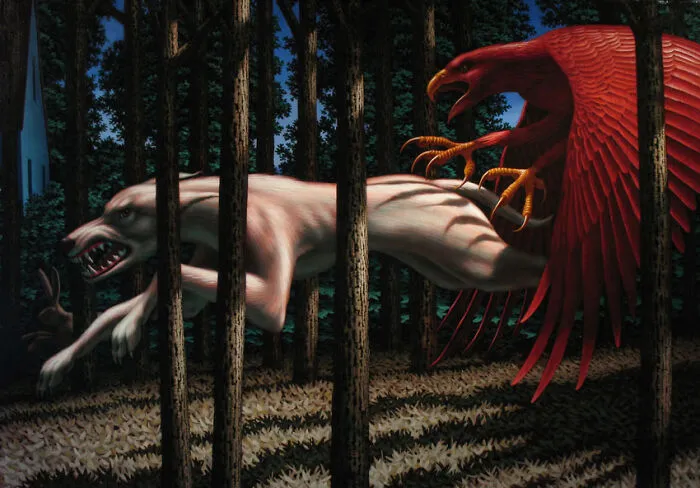
Description: “Claws is a large painting in oils on canvas. It is a wholly imaginary and surreal image of animal conflict. Being surreal, it can be read as a symbol of human conflict. The scene takes place behind a suburban home, which places it in a human context. Brush strokes are used to create texture, especially in the foreground leaves. The colors are symbolic with warm, even hot colors in the animal dominated foreground, and tranquil blues and greens in the distance. Even though the theme is fierce, there is a rhythmic elegance to the composition as a whole. This rhythmic quality harks back to the Mannerist paintings of 16th Century Italy. This borrowing of styles from the past makes this painting Postmodern in style.”
Report
5points
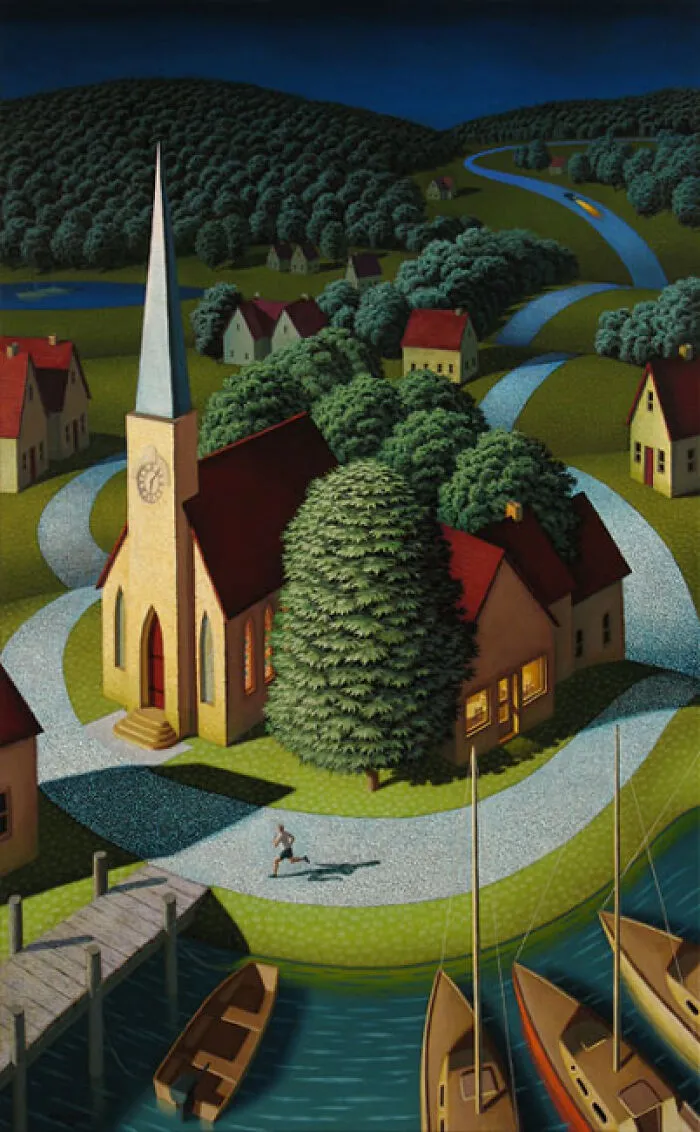
#25 “The Fisherman”
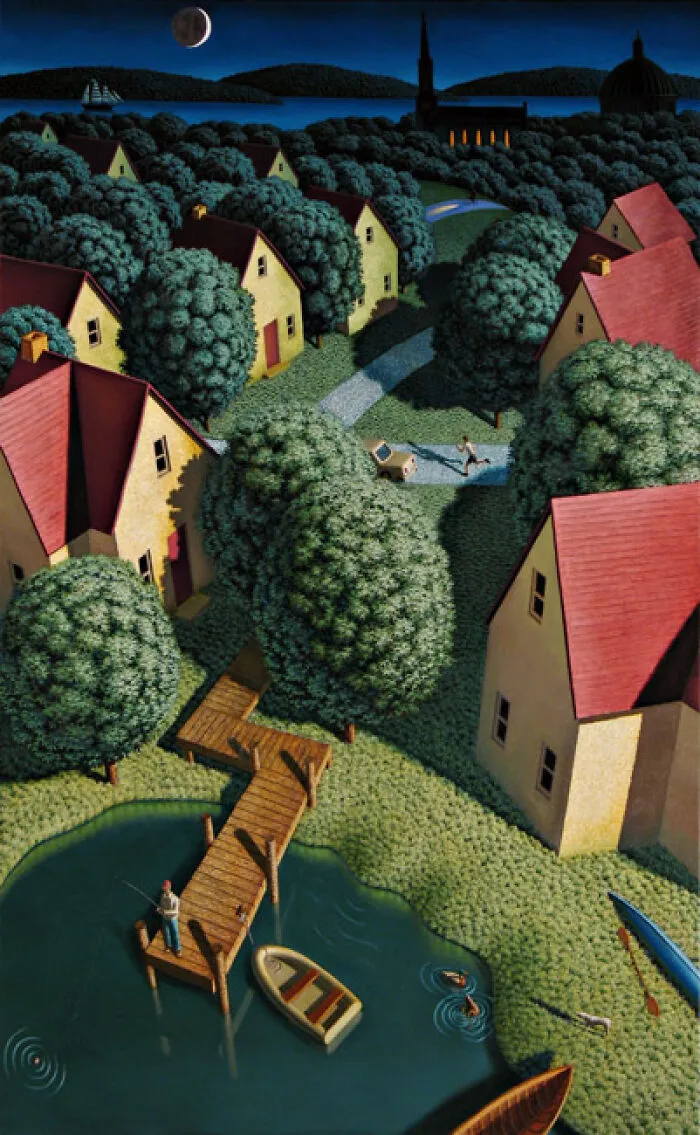
Description: “The Fisherman is a medium size painting in oils on canvas. It is an imaginary reconstruction of my favorite fishing spot, near my house, on Spa Creek, in Annapolis. The best time for fishing here is early in the morning, when the night is turning into day. In the painting, it is morning in the foreground, and still night in the blue background. It is Postmodern in that it appropriates different styles and recombines them into an eclectic whole.
The surreal space is curved. The viewer is looking straight down at the foreground, with the fisherman, and straight out at the distance, with silhouettes of prominent Annapolis churches. The road connects the foreground to the background. The fisherman is realistic, but the severely simplified houses are not. They are surreal houses, dream houses that are symbolic rather than real. Some aspects of the highly detailed water, grass, and trees are real, some are not. This painting was done from the imagination. It is influenced by Grant Wood, though the ultra simple houses are more like Italian Surrealist Giorgio de Chirico, and the fisherman is akin to the style of American realist Martin Johnson Heade. The primary color scheme is dominated by red, yellow, green and blue. The fisherman is red, white, and blue.”
The surreal space is curved. The viewer is looking straight down at the foreground, with the fisherman, and straight out at the distance, with silhouettes of prominent Annapolis churches. The road connects the foreground to the background. The fisherman is realistic, but the severely simplified houses are not. They are surreal houses, dream houses that are symbolic rather than real. Some aspects of the highly detailed water, grass, and trees are real, some are not. This painting was done from the imagination. It is influenced by Grant Wood, though the ultra simple houses are more like Italian Surrealist Giorgio de Chirico, and the fisherman is akin to the style of American realist Martin Johnson Heade. The primary color scheme is dominated by red, yellow, green and blue. The fisherman is red, white, and blue.”
Report
4points
#26 “Cymbidium And Butterfly”
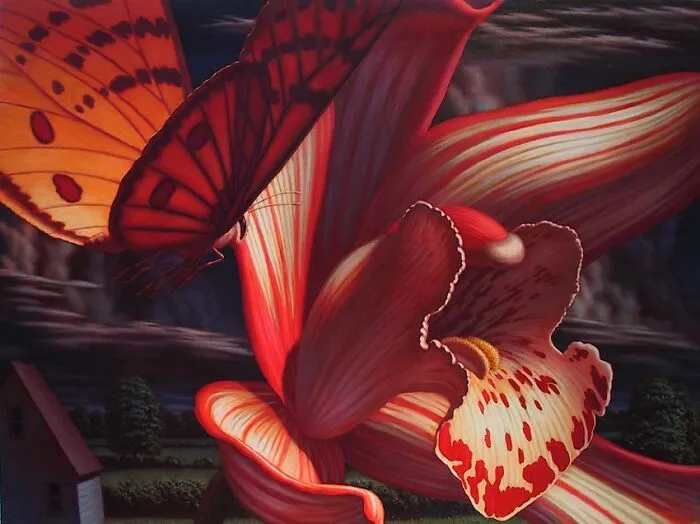
Description: “Cymbidium and Butterfly is done from the imagination. It is a large painting in oils on canvas. The dramatic Postmodern style combines elements of Surrealism and Expressionism. Though the orchid and butterfly seem based on observation, they are imaginary. With the orchid, the long thin brushstrokes create a sense of detail. The transparency of the butterfly wings are the result of subtle color relationships. The ominous feathery clouds create a stormy mood.
Technically speaking, the painting was first painted in a much cooler palette, then thin warm colors were glazed over this to create a luminosity and atmosphere, that would not be possible with straight “ala prima” painting. This appropriation of styles and techniques from the past is characteristic of Postmodernism. The white brush strokes, in the orchid, use relatively thick paint compared to the rest of the painting.”
Report
3points
#27 “Like A Fish Out Of Water”
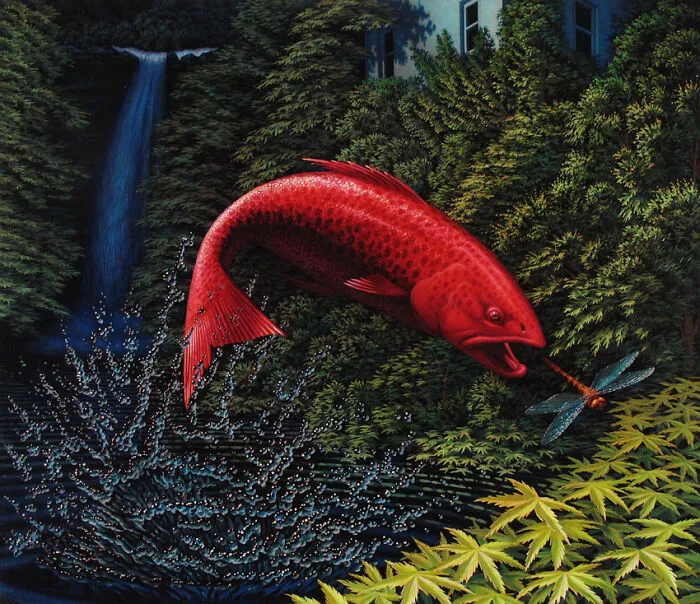
Description: “Like a Fish Out of Water is a small panel painting, in oils on a wooden panel. It is an imaginary reconstruction, inspired by a hike in the Shenandoah Mountains. I did see trout swimming in a pool, but they weren’t red. There was a waterfall, but it wasn’t blue. The marijuana leaves in the foreground suggest a dream state. Though based on an actual experience, it is painted from imagination. However, I did do some research when painting the dragon fly wings. The house is difficult to place in a rational space, but is important because it suggests the presence of civilization. This is Surrealist Art, but it is combined with other styles in a Postmodern Art manner. Portraits of leaping fish were popular in the Nineteenth Century, Winslow Homer comes to mind. Though this painting is not at all realistic, it does allude to the realist tradition in American Art, as well as the colorful romantic visions of the Hudson River School.”
Report
3points
#28 “Forest Green”
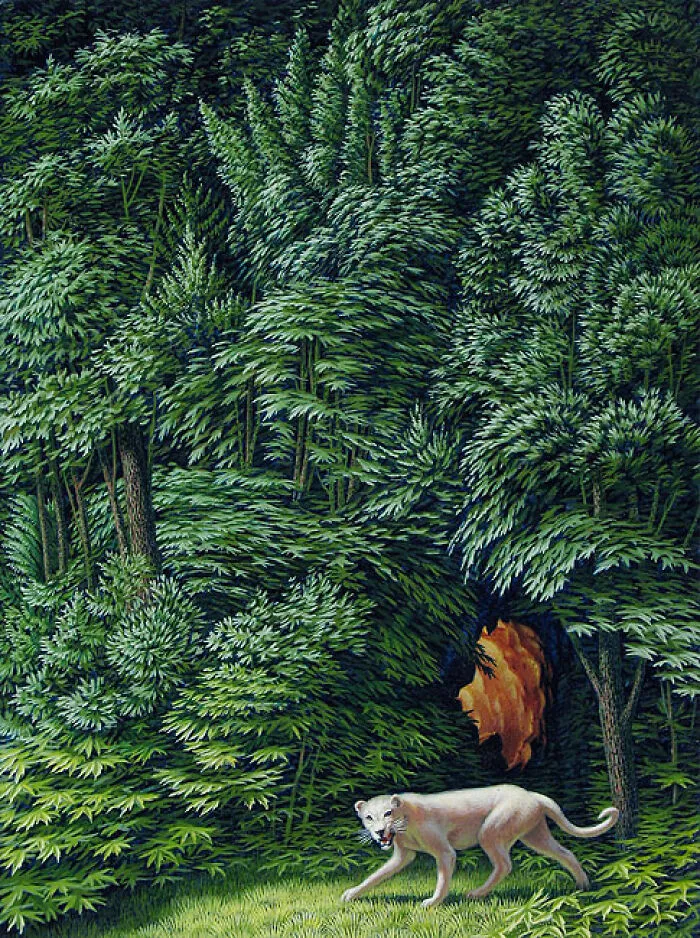
Description: “Forest Green is a small painting, in egg tempera, on a gessoed, wood panel. It is very precise in detail, but is not realistic. The egg tempera medium uses thin brushes, so it is conducive to detailed painting. At some points, it was painted using a magnifying glass. This scene is composed primarily of a lush green landscape of trees, with a white panther stalking across the foreground, and an illuminated cave under the trees. The landscape background is based on a 16th painting by Lucas Cranach.
The style is Postmodern in that it appropriates styles from the past and recombines them to create a contemporary image. It is dreamlike – more expressive, and surreal than realistic. There is a flow to the leaves and branches that creates a sense of movement and energy. It’s as if the leaves and branches are being stirred by the wind, it also expresses the animal energy, and motion of the white panther. The painting is green overall, however, there are many shades of green, ranging from a pale yellow, to a dark almost blue.”
Report
2points