



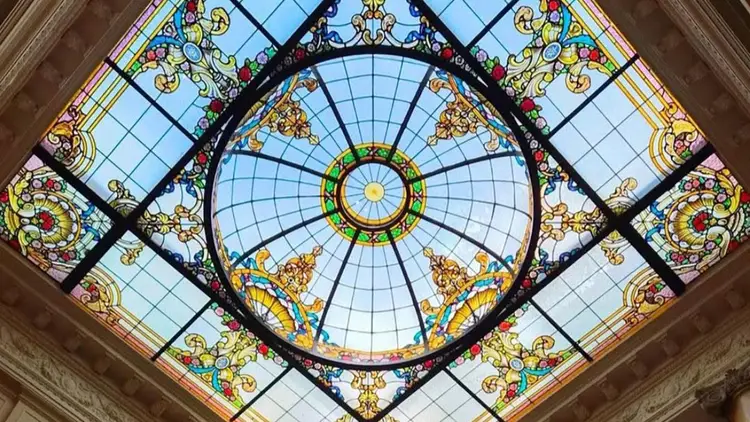

Art Nouveau began as a rebellion. By the 1890s, European cities were filling up with copies of Gothic cathedrals, Renaissance palaces, and Greek temples, and a new generation of architects and designers had had enough of borrowing from the past. They looked to nature instead: the bend of a stem, the spread of a peacock’s tail, the way a vine wraps around whatever it touches. Then they applied it to everything, from facades and staircases to door handles, radiator covers, and dessert spoons.
It was also remarkably short-lived. Within a couple of decades, the style that had looked daringly modern started to look fussy, then simply old-fashioned. Georges Fouquet’s jewelry shop in Paris, designed by Alphonse Mucha down to the last display case, opened on Rue Royale in 1901 and was taken apart as early as 1923. Many buildings had it worse. Victor Horta’s Maison du Peuple in Brussels, one of the movement’s landmarks, was demolished in 1965 despite protests from architects around the world. That loss became a turning point, and Art Nouveau slowly went from embarrassing to precious.
What survived is now spread across the world. Some of it sits in museums and carefully restored villas, but some still stands on ordinary streets, above supermarkets and bank branches, where a carved doorway or a curling balcony outshines everything around it. The Facebook group “The World Art Nouveau” collects these finds from Europe and beyond, and we’ve gathered some of our favorites below.
#22 The Peacock Cashier’s Desk From Georges Fouquet’s Jewelry Store By Alphonse Mucha
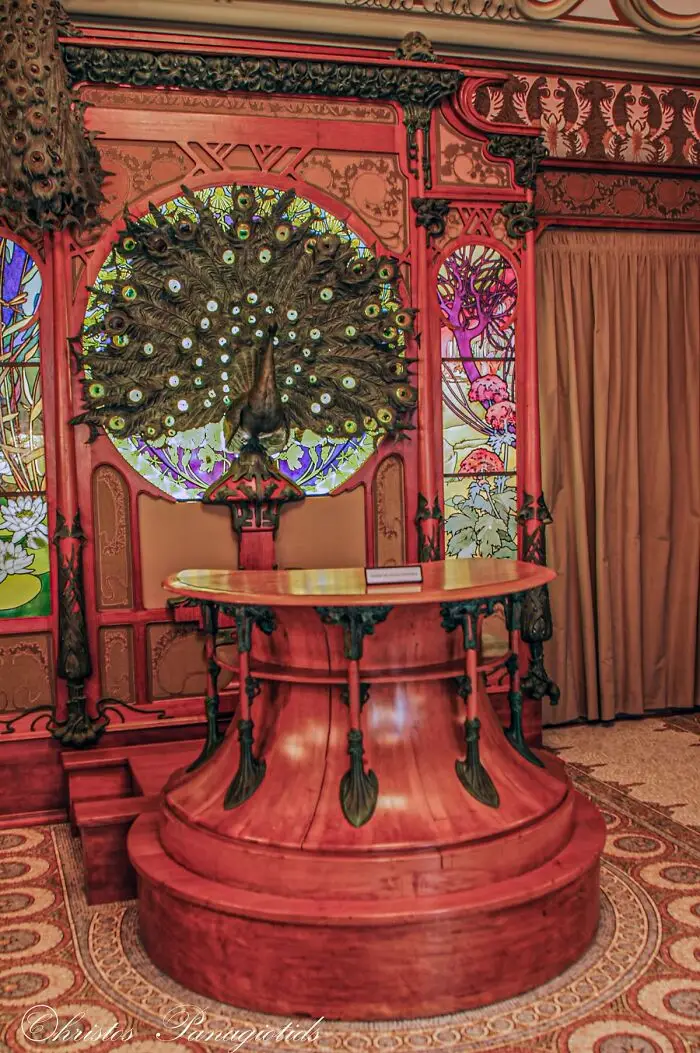
The cashier’s desk of Georges Fouquet’s jewelry store, with all its decorations designed by Alphonse Mucha, one of the leading artists of Art Nouveau. A bronze peacock spreads its tail against a round stained-glass window, its feathers set with shimmering “eyes,” while slender bronze plant stems wrap around the curved wooden counter below. Fouquet called on Mucha to design all aspects of his shop - both exterior and interior, and the contents including the furniture, light fittings and showcases. The shop’s life on Rue Royale was short: it was inaugurated on the rue Royale in 1901 and dismantled as early as 1923. In 1941 Fouquet gave each piece of Mucha’s revolutionary design to the Musée Carnavalet for safekeeping. In 1989 the Musée Carnavalet completed the painstaking job of reconstructing the boutique.
Report
9points
#23 Enameled Silver Coffee Pot By Gustav Gaudernack For The Norwegian Workshop David-Andersen
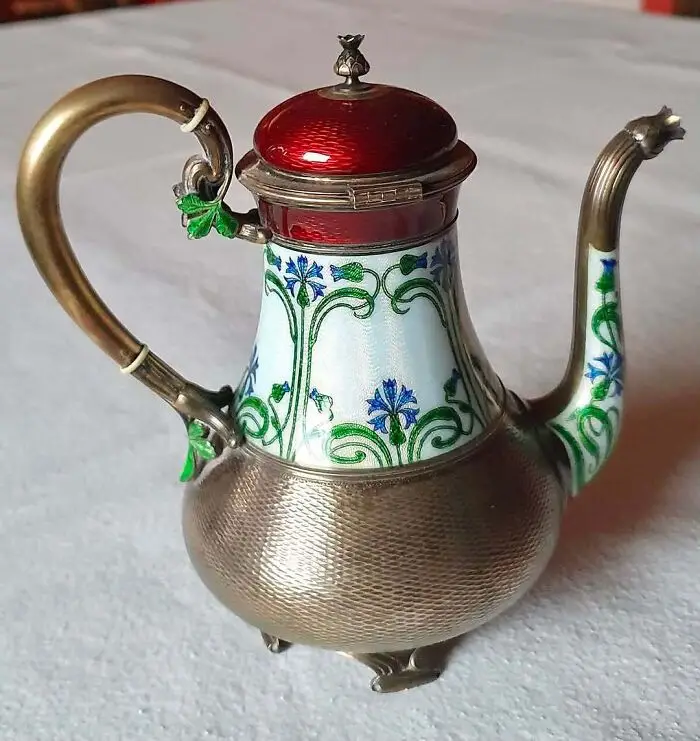
The piece pairs a finely engine-turned silver body with bands of guilloché enamel: a deep ruby-red lid and neck, and a pale, pearly central band decorated with blue cornflowers on flowing green stems that continue up the spout. Small enameled leaves curl around the handle, and a tiny flower bud crowns the lid. Gaudernack, who was born in Bohemia and trained as a designer in Vienna, joined David-Andersen in 1892 and soon became responsible for most of the firm’s production.
Report
9points
#24 The Green Entrance Door Of The Hans Giebisch House
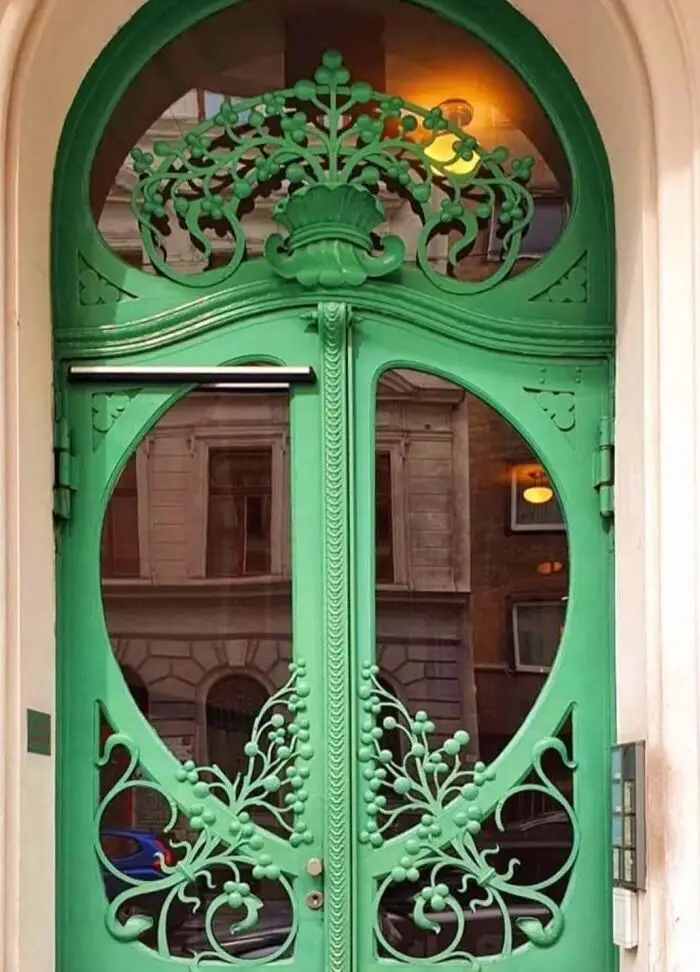
The beautiful entrance door of the Hans Giebisch House, an apartment building in Vienna’s 3rd district, Landstraße. The arched double door is painted bright green, with large oval glass panes framed by cast-iron vines.
Giebisch lived at 3, Marxergasse 25 from 1945 to 1966 (memorial plaque). The building has another famous former resident: the composer and piano humorist Hermann Leopoldi (1888-1959), who lived here until 1938.
Report
8points
#25 Bronze Table Lamp Attributed To Maurice Dufrêne, With An Acid-Etched Glass Shade By Daum Nancy
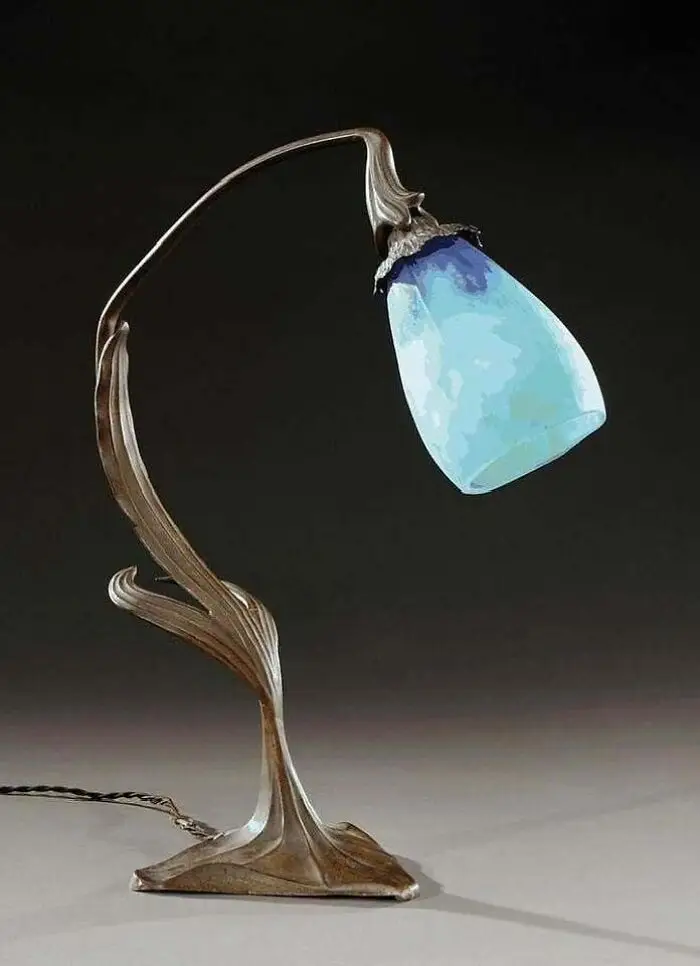
Art Nouveau gilt bronze table lamp attributed to Maurice Dufrêne, with an acid-etched glass shade by Daum Nancy, circa 1900–1905. The base is shaped like a growing plant. Long, ribbed leaves rise from a flared foot, and a single stem arches overhead, then bends down like a flower heavy with bloom.
Dufrêne was still a young designer when he worked in this style. In 1899, at the age of just 23, he became director and manager of La Maison Moderne, an association of artists who worked together to create designs which could be produced in multiples. The Paris gallery was run by the critic Julius Meier-Graefe, and its showrooms displayed rooms decorated in Art Nouveau style. By 1910, his work adapted more simplified forms using more substantial materials and construction, and in the 1920s he became an important French Art Deco designer.
Report
8points
#26 “Assyrian” Comb By Eugène Grasset, Paul Vever And Henri Vever
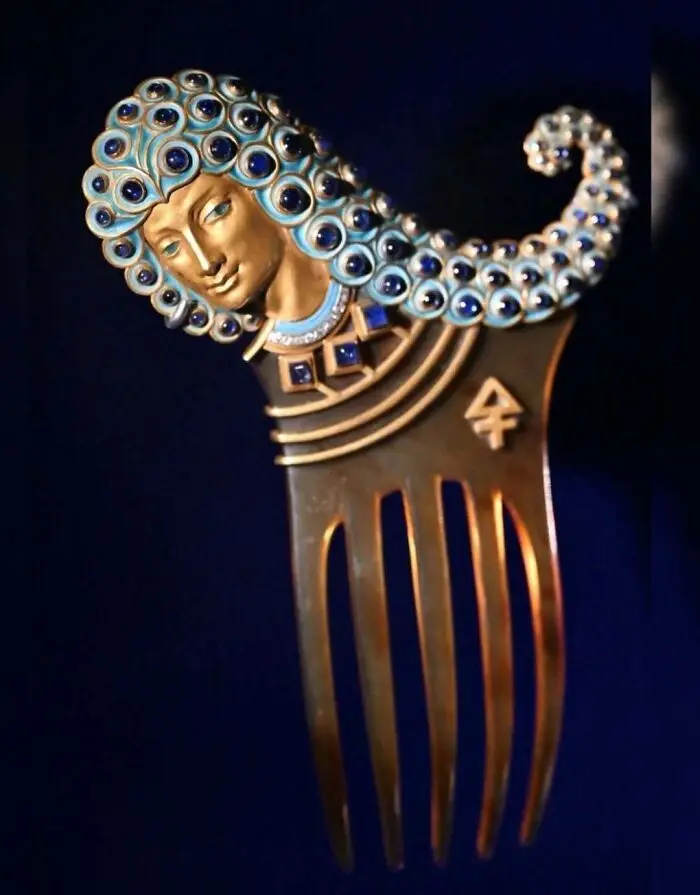
After designing furniture for Charles Gillot, Eugène Grasset ventured into another field of decorative art with the jewellers and goldsmiths Vever. The collection of some twenty pieces of jewellery he produced for this firm were shown at the Exposition Universelle in Paris in 1900. His jewelry often featured legendary female figures, animals and flowers, a style contemporaries saw as Byzantine, Irish and Japanese influenced. Today, the Musée des Arts Décoratifs has seven of the pieces Eugène Grasset designed for Vever, six of which were donated to the museum by Henri Vever in 1924.
Report
8points
#27 Casa Modest Andreu By Telm Fernández
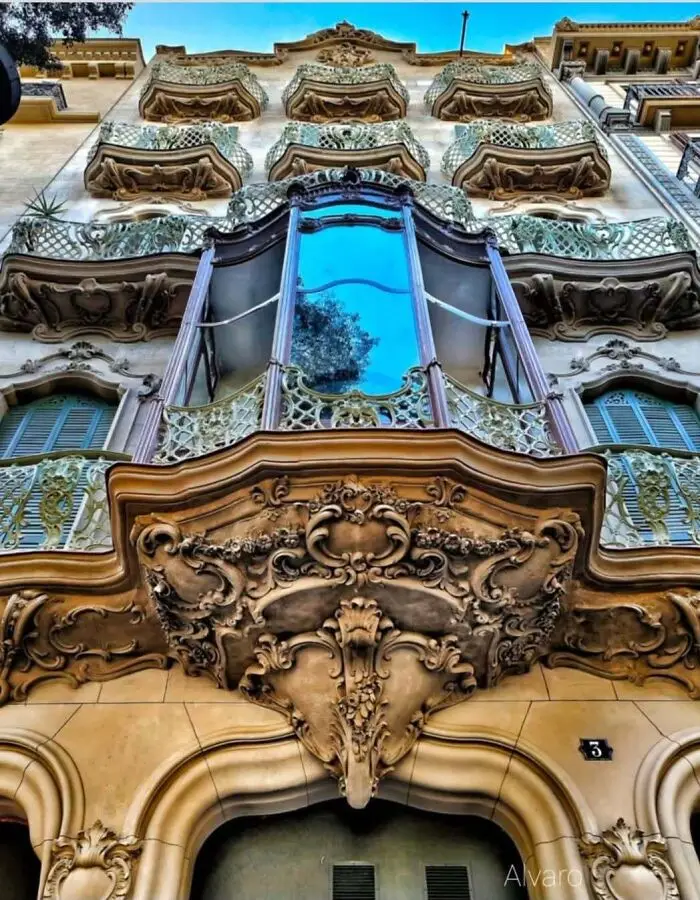
Casa Modest Andreu, Barcelona.
Designed by Telm Fernández i Janot and built between 1902 and 1906.
Report
8points
#28 Entrance Of 1 Rue Hébert
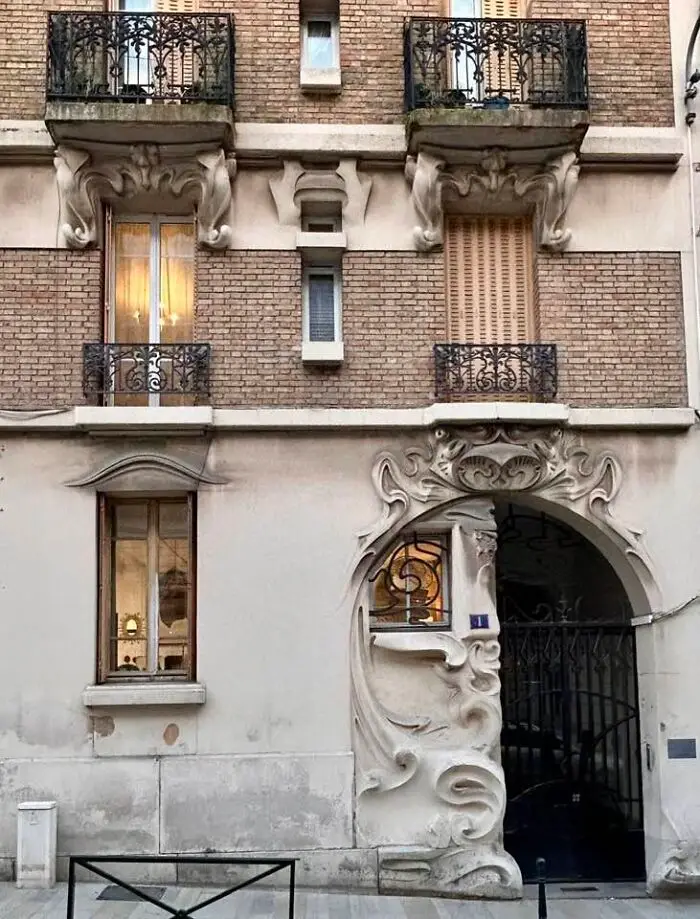
This apartment building near Clamart’s train station hides one of the town’s most theatrical entrances. The arched carriage doorway is framed by a carved stone surround that seems to melt down the facade. Whiplash curves, curling stems, and plant forms flow all the way to the sidewalk, and a small window with swirling ironwork is set right into the carving. The same style continues on the brick upper floors, where heavy stone brackets carved with curling leaves hold up the balconies, and wrought-iron railings repeat the looping lines of the entrance. The building is listed in France’s national architectural heritage inventory as “immeuble, 1 rue Hébert” (Mérimée ID IA92000067). The street has another claim to fame: in the 1930s, Black French and American intellectuals gathered just a few doors away, at 7 Rue Hébert, the Clamart home where the Martinique-born Nardal sisters hosted their famous literary salon.
Report
7points
#29 Darvas-La Roche House By József And László Vágó
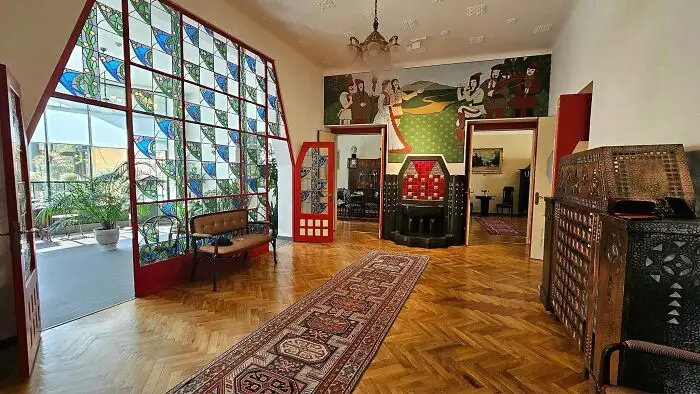
Darvas-La Roche House in Oradea, Romania, designed by the brothers József and László Vágó. It was commissioned by the timber merchant Imre Darvas, whose second shareholder in his joint stock company was Alfred La Roche, a banker in Basel (the house bears the names of both families), the house was built between 1909 and 1912. The first thing visitors see is the ground-floor lobby’s huge glazed wall. It’s a red-framed screen of stained glass filled with twisting green stems and bright blue petals. Across the herringbone parquet, the hall fountain is set with red ceramic tiles under a painted frieze of musicians and a couple in traditional dress. The hall fountain also has geometric Zsolnay ceramic elements, made by the famous Hungarian ceramics factory. On the right, a hammered copper cover hides the radiator, one of the house’s many copper radiator masks. After a long restoration, the house reopened its doors on Thursday 20 August 2020, and it now houses the first Art Nouveau Museum in Romania.
Report
7points
#30 The Ceramics And The Mosaic "Spring" By Leopold Forstner
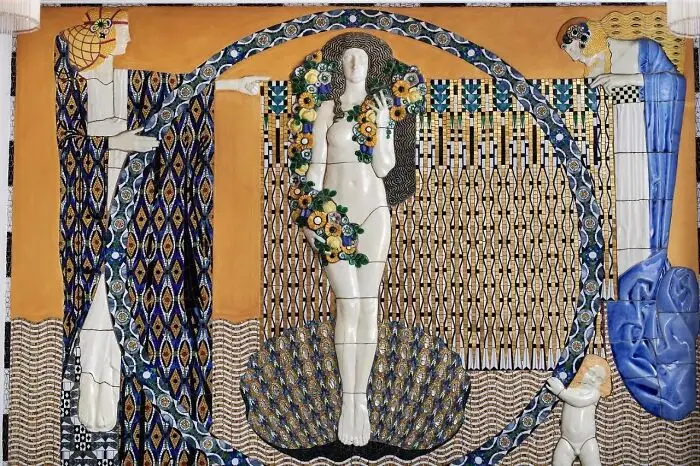
Grand Hotel Wiesler, Grieskai 4–8, Graz, Austria.
Built in 1902–1909 as a remodeling of an earlier building, the hotel was redesigned by Marcel Kammerer, who served as architect for the renovation and also painted The Golden Angel (Der goldene Engel) in the dining room.
Report
7points
#31 A Wall Sconce By Andor Pilch
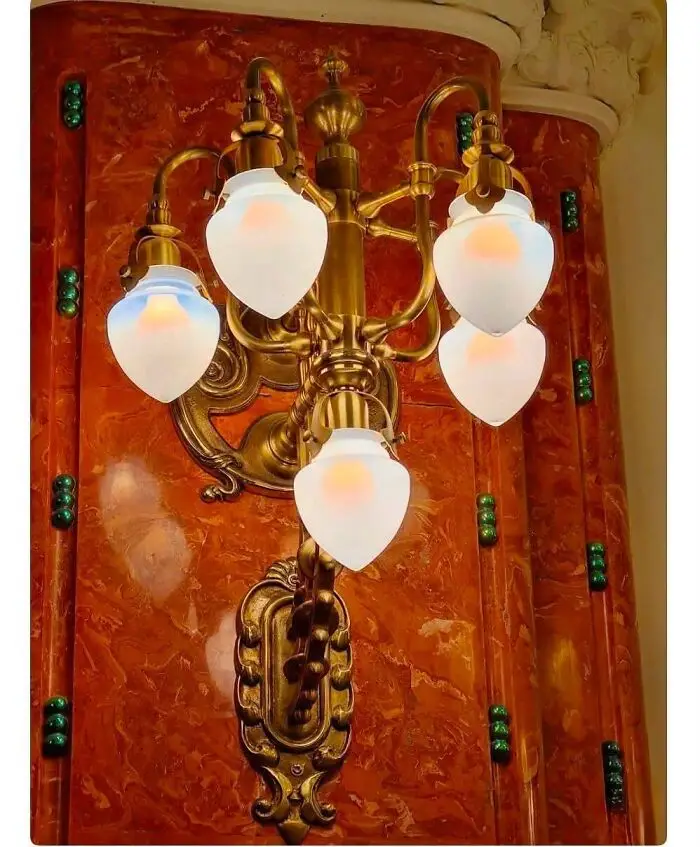
Art Nouveau wall sconce at the Palatinus Grand Hotel (originally the Pannonia Grand Hotel), 1913–1915, Király utca 5, Pécs, Hungary.
An elegant brass wall sconce inside the historic hotel, set against a decorative red-brown faux-marble column accented with green ceramic details.
The three-story hotel was commissioned by Imre Hamerli, a member of Pécs’ renowned glove-manufacturing family.
Report
7points
#32 “Phryné" Cameo Brooch By René Lalique
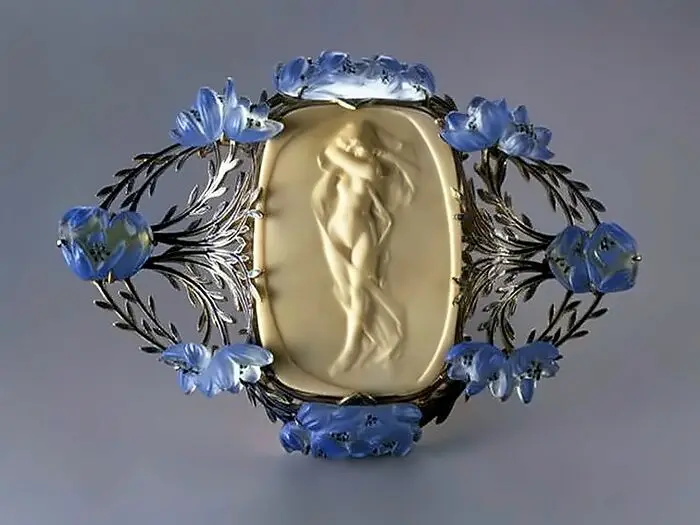
Phryne lived in the 4th century BC and apparently grew up poor, but became one of the richest women in Greece. Her beauty was legendary: she modeled for the artists Apelles and Praxiteles, and the Aphrodite of Knidos was based on her. She is best known for her trial for impiety, where she was defended by the orator Hypereides. According to legend, she was acquitted after baring her breasts to the jury, though the historical accuracy of this episode is doubtful. The story fascinated 19th-century artists, and her trial was depicted by Jean-Léon Gérôme in the 1861 painting Phryne Before the Areopagus, which influenced many subsequent depictions.
Report
6points
#33 Horace Howard Furness Desk By Frank Furness And Daniel Pabst
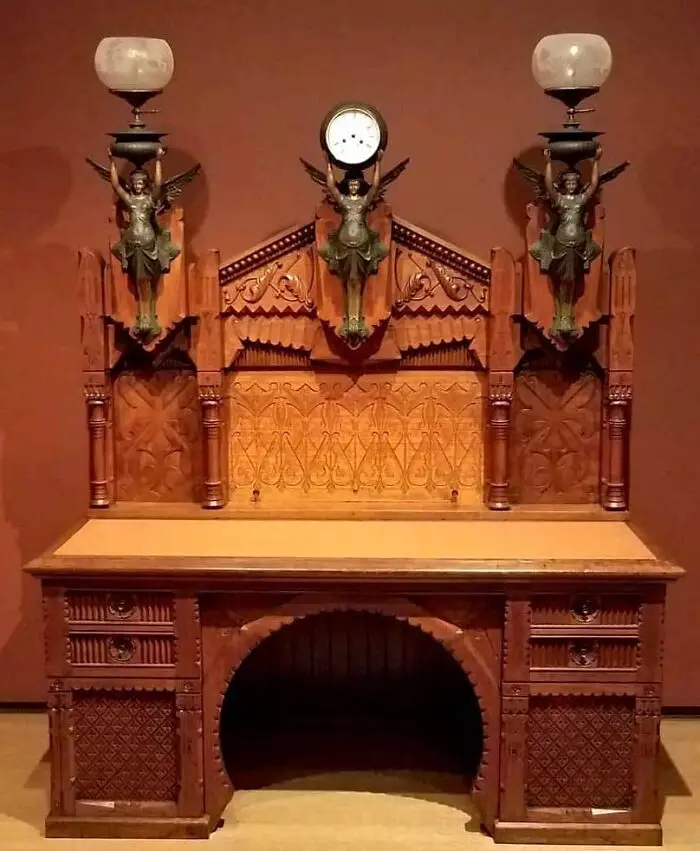
Horace Howard Furness desk, designed by Frank Furness and made by Daniel Pabst in Philadelphia, 1870–1871. Created for his brother Horace’s study, this desk embodies Frank Furness’s rejection of historicist design in favor of a bold and unorthodox juxtaposition of architectural forms. Horace went on to become America’s outstanding Shakespeare scholar, and the desk was part of the architect’s redesign of the interiors of Horace’s city house, at the southwest corner of 7th and Locust Streets in Philadelphia. Three bronze winged figures stand on top: two hold lamps with frosted glass globes, and the one in the middle raises a clock above her head. Below them, the wood is carved with zigzags, stylized leaves, and diamond patterns, and a wide arch opens under the writing surface. The desk combines walnut, white pine, maple, poplar, with clock and lamp mounts and glass globes. Pabst, a German-born cabinetmaker, built many of the architect’s pieces, as Furness often commissioned Pabst to execute his lively designs. Today the desk is in the Philadelphia Museum of Art, which describes it as Furness’s most important piece of furniture.
Report
3points

