





#1
#2
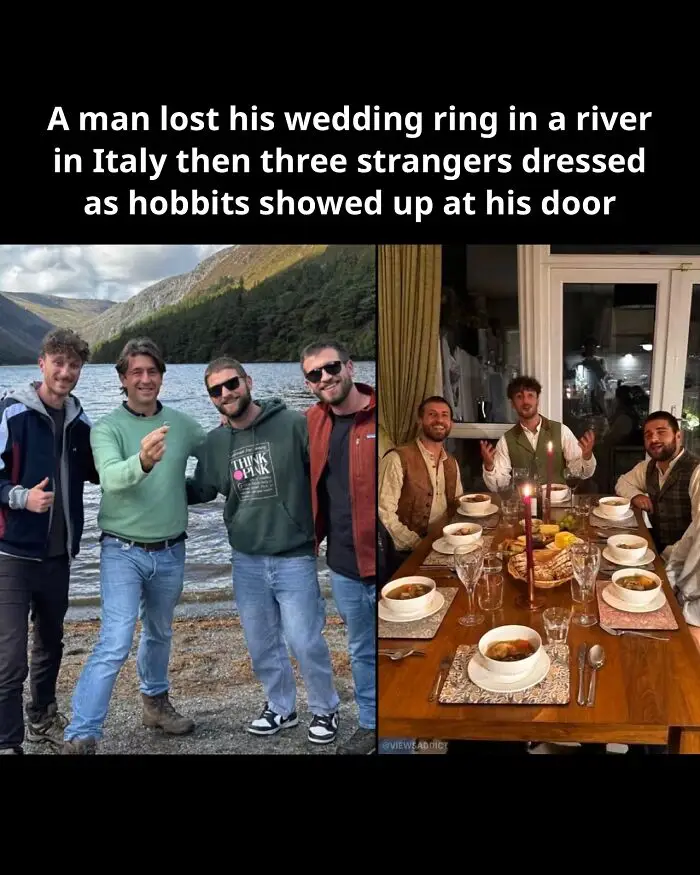
His wife asked three Italian men nearby for help, Filippo, Nicola and Edoardo. They took his number and promised to keep an eye out.
Naturally, they turned it into a quest.
Filippo, Nicola and Edoardo spent days searching, eventually tying themselves to boulders and diving into the rapids.
Against ridiculous odds, they found it.
Nine days after losing it, Patrick got a text from an unknown Italian number: a photo of his ring, with the message: “Hi Sméagol, look what we found.”
But they didn’t just mail it back.
Filippo, Nicola and Edoardo flew more than 1,000 miles to Ireland, showed up at his door dressed as Frodo, Merry and Sam.
Patrick later described the moment they arrived:
“They approached me, all three dressed like hobbits, playing music from the Lord of the Rings to hand me back the ring.”
Patrick invited them inside for a dinner togheter, and they became friends that night.
Sometimes the right people find you in the most unexpected way.
#3
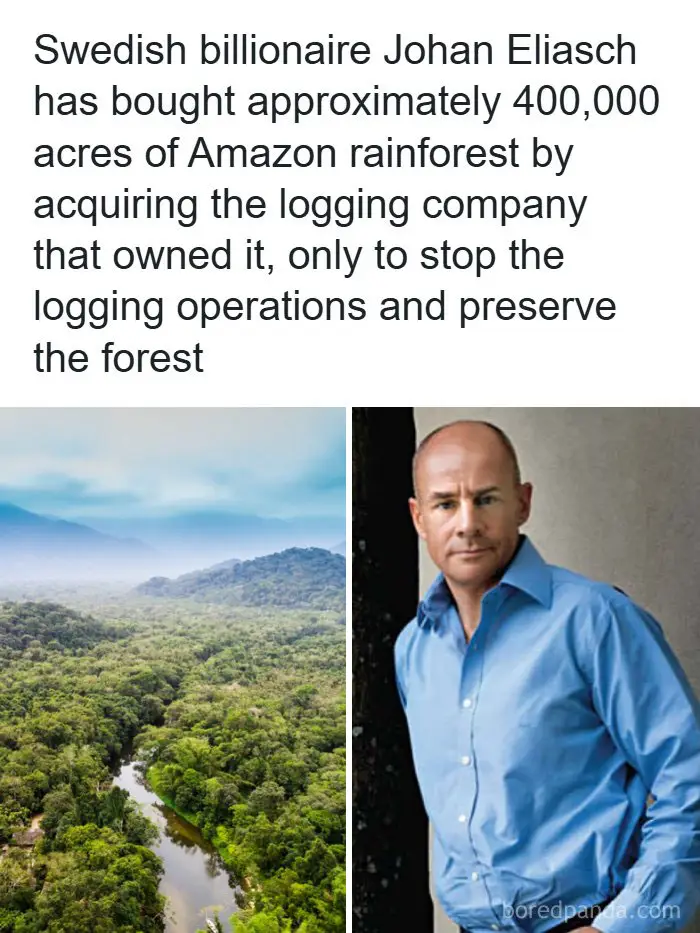
Eliasch’s goal was to preserve the area’s biodiversity and raise awareness about the need to protect the Amazon. While the purchase sparked debate in Brazil about foreign ownership of rainforest land, it remains one of the most notable private conservation efforts in the region.
Curiosity about your current environment, the past, and the world is what helps you survive and thrive. And yet, curiosity, as a whole, is a psychological phenomenon that remains poorly understood, despite being such a fascinating subject.
According to researchers Celeste Kidd and Benjamin Y. Hayden, who studied the psychology and neuroscience of curiosity, one reason we struggle to understand curiosity is “too much focus on delineating what is and is not curiosity.”
#4

During the 2025 admissions cycle, six of the country’s ten flagship national universities turned away applicants with records of school violence.
Two were rejected by Seoul National University, the country’s most prestigious.
Twenty-two were rejected by Kyungpook National University, which introduced a strict point-based penalty system for disciplinary histories.
Starting in 2026, all universities in South Korea will be required to factor school violence records into admissions.
In a country where grades have long decided everything, character is now part of the score.
Sometimes the smartest students still don’t get in, because who they were matters as much as what they scored.
#5
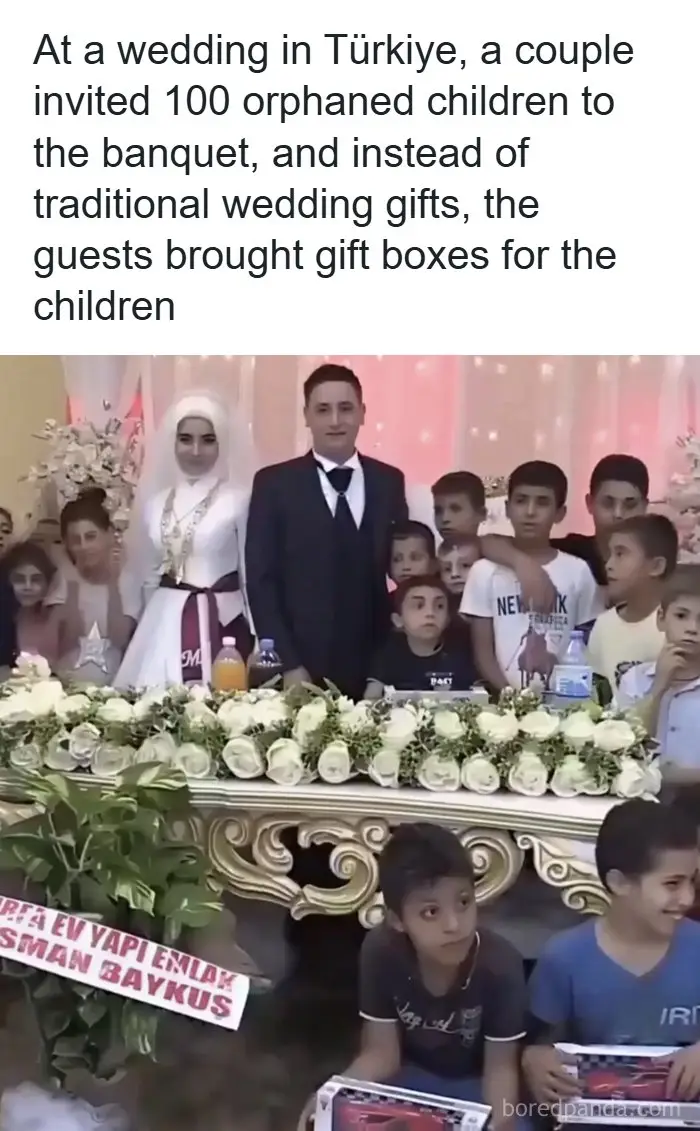
Partnering with the IHH Humanitarian Relief Foundation, the couple, dressed in their wedding attire, shared a meal with the children and gave each of them gift boxes filled with toys, clothes, and treats.
“We didn’t want our happiness to stay within four walls,” the groom said, adding that “the children’s smiles were the greatest gift we could receive.”
#6
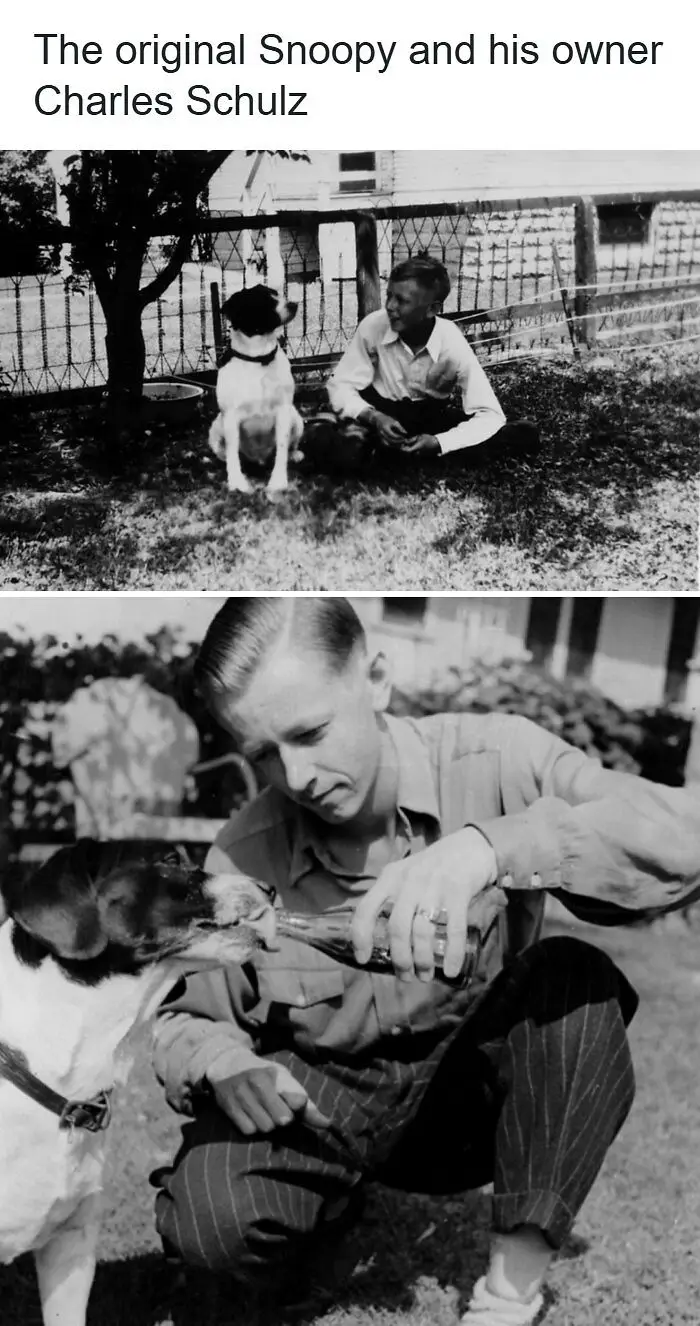
In the first picture is Charles Schulz and his dog Spike in 1935, when Schulz was 13 years old.
You can see Charles Schulz in Minnesota sharing a “pop” with his beloved childhood dog Spike (who had a notoriously strong stomach). Schulz would later pattern Snoopy’s appearance after Spike, and the dog’s behavior became the inspiration for some of Snoopy’s cartoon antics—perhaps even his love of root beer.
“Spike was the most intelligent, the wisest dog | ever knew. He had an amazing vocabulary, of words he understood. I could tell Spike to go down in the basement and bring me a potato, and he’d do it. We had long talks, he was a great listener. He was just plain smart, and the best friend I ever had.” — Charles M. Schulz, 1969.
The researchers argue that broadening the scope of inquiry into curiosity allows for the study of information-seeking in non-human subjects, such as monkeys, rats, and groundworms.
“Animal techniques allow for a granular view of mechanism, allows a greater range of manipulations, and allows cross-species comparisons,” Kidd and Hyden write.
Meanwhile, a broader perspective on curiosity allows researchers to study its relationship with reward and learning, rather than trying to study it in isolation.
#7
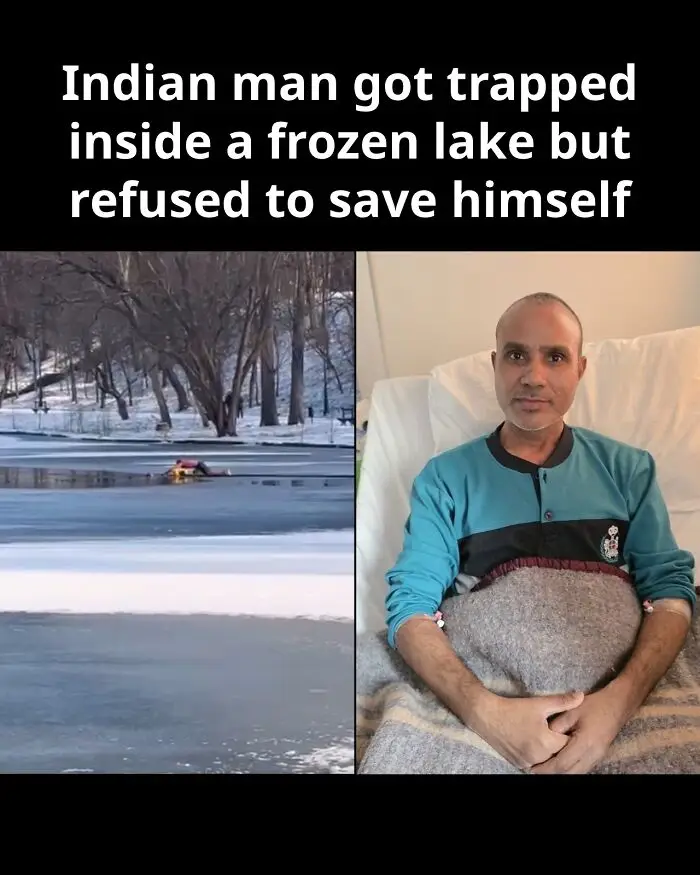
One morning while walking through a park in Craiova, a nightmare unfolded right in front of him.
A 5-year-old girl ran onto a frozen lake. The ice instantly gave way, plunging her into the sub-zero water. Her father tried to jump in but became trapped in the broken ice.
Without a second thought, Vipan grabbed a sled and rushed onto the ice. But midway through, the ice shattered beneath him too, dragging him into the freezing depths.
Instead of panicking or swimming away to save himself, Vipan grabbed the little girl and held her body above the water for nearly 30 agonizing minutes until rescue teams arrived.
Both survived severe hypothermic shock.
Romania was so moved by his bravery that the city officially awarded him honorary citizenship.
But the story didn’t end there. Deeply touched by his sacrifice, the local community raised funds to send him on an all-expenses-paid trip back to India, allowing him to finally reunite with his 8-year-old daughter.
This is the recent story of Vipan Kumar. From an immigrant construction worker to a certified national hero.
#8
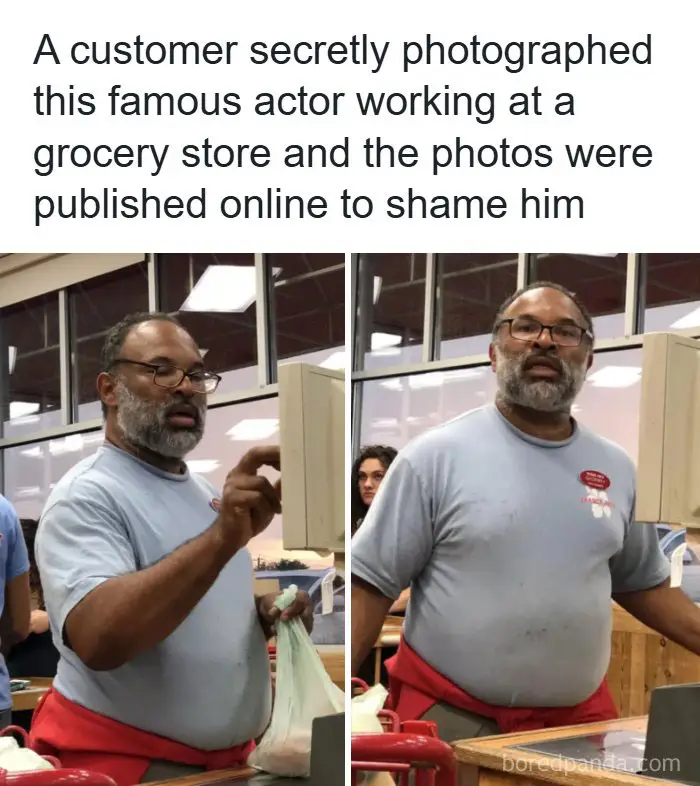
A customer secretly photographed him and sent the pictures to news outlets, which suggested the former TV star had fallen on hard times.
But Owens explained something most people don’t realize: most actors, even well-known ones, are gig workers. For every A-lister, there are many others working gig to gig, and steady, well-paying work is hard to find in a field this unpredictable.
That’s why many working entertainers need a regular job between roles.
The reaction was the opposite of what the photos were meant to provoke. Thousands of people defended him, and Tyler Perry offered him a role written specifically for him.
The attempt to shame him ended up reviving his career at 57 years old.
No job is beneath anyone, and you never know what someone is carrying behind the scenes.
#9
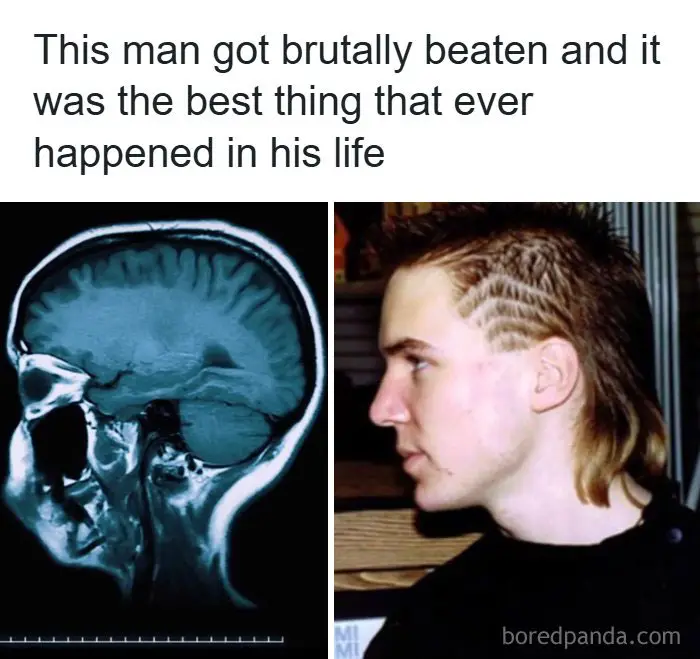
One night outside a karaoke bar, two men jumped him and beat him unconscious.
He woke up a completely different person. The world around him was no longer normal, everything he saw was made of geometric shapes and mathematical patterns.
Doctors diagnosed him with Acquired Savant Syndrome, a rare condition where brain trauma unlocks extraordinary abilities hidden inside the human brain.
Jason went from cheating on every math test to writing a book, giving TEDx talks and selling his mathematical fractal artwork worldwide.
Fewer than 100 people in the world have this condition. Makes you wonder what’s lying dormant inside your own mind.
Broadly speaking, curiosity allows human beings and other animals to:
- Activate learning systems
- Drive informative options and actions
- Improve performance
- Yield fitness benefits
“Although information is intangible, it has real value to any organism with the capacity to make use of it. The benefits may accrue immediately or in the future; the delayed benefits require a learning system,” the researchers explain.
#10
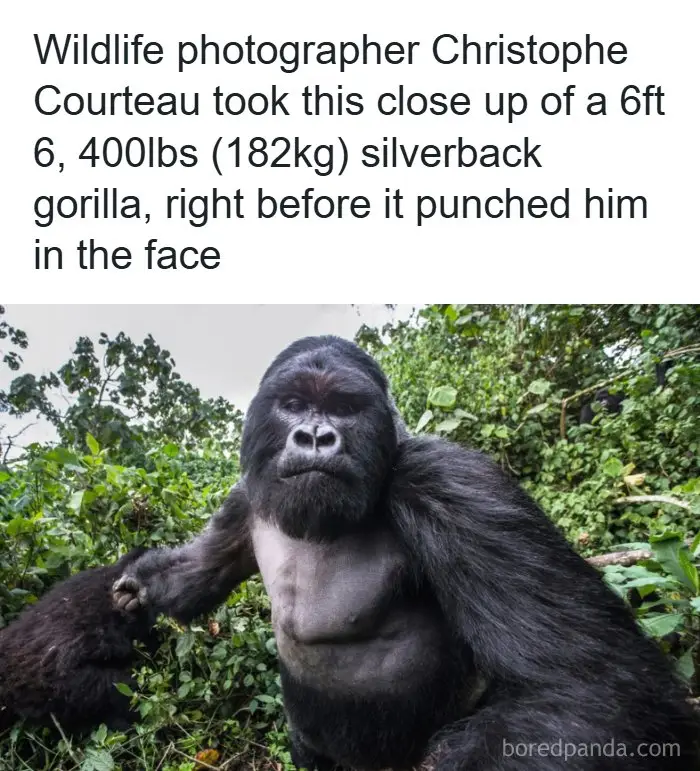
Christophe was punched at the Kwitonda gorilla group in Volcanoes National Park, Rwanda. Akarevuro, the silverback gorilla, was said to be intoxicated (drunk) from fermenting bamboo stems and became angry when he spotted the cameras.
#11
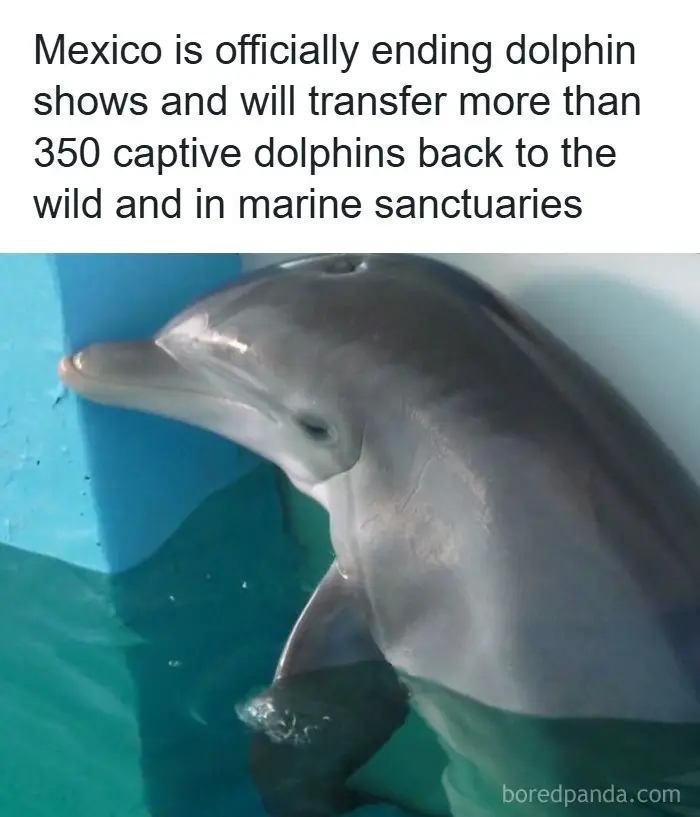
There are currently more than 350 dolphins in captivity across Mexico. The government and animal welfare organizations are now working on plans to relocate these animals.
Dolphins that experts determine are capable of surviving in the wild will go through a rehabilitation process and may be released into their natural habitats. However, most dolphins, especially those born or long held in captivity, cannot survive on their own and will instead be moved to sea sanctuaries or ocean pens, where they can live in more natural conditions under care.
This decision marks a major step for animal welfare in Mexico, ending dolphin shows and beginning a transition toward more ethical treatment of marine mammals.
#12
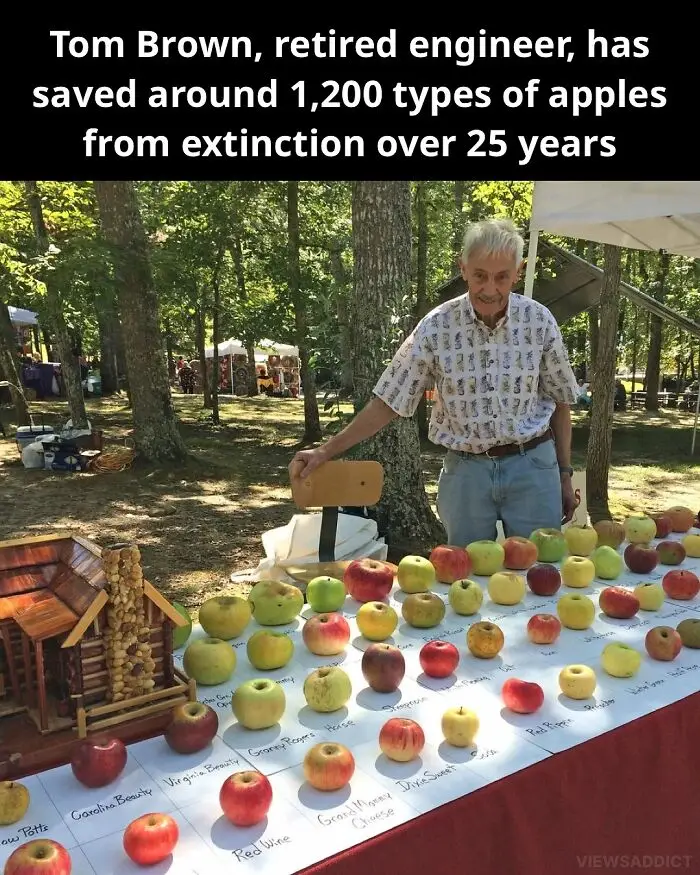
Many of these apples, once cultivated by small farms and homesteads, had vanished from markets and orchards as commercial agriculture shifted toward a handful of high-yield varieties. Brown’s work involves locating old trees, collecting cuttings, and grafting them to ensure the apples endure for future generations.
What began as a hobby has become a mission of preservation. His efforts not only safeguard biodiversity but also keep alive the flavors, colors, and stories of apples that were once integral to rural communities.
Thanks to Brown’s dedication, apples thought lost forever are finding new life in orchards and inspiring renewed interest in heritage fruit.
What do you think, Pandas? What ideas spark your curiosity the most? What topics are you most excited about?
Generally speaking, how much time do you find every day to apply your curiosity to learning new things about the world?
What’s something new that you learned this week that you’d like to share with everyone else?
Tell us what you think in the comments.
#13
#14
#15
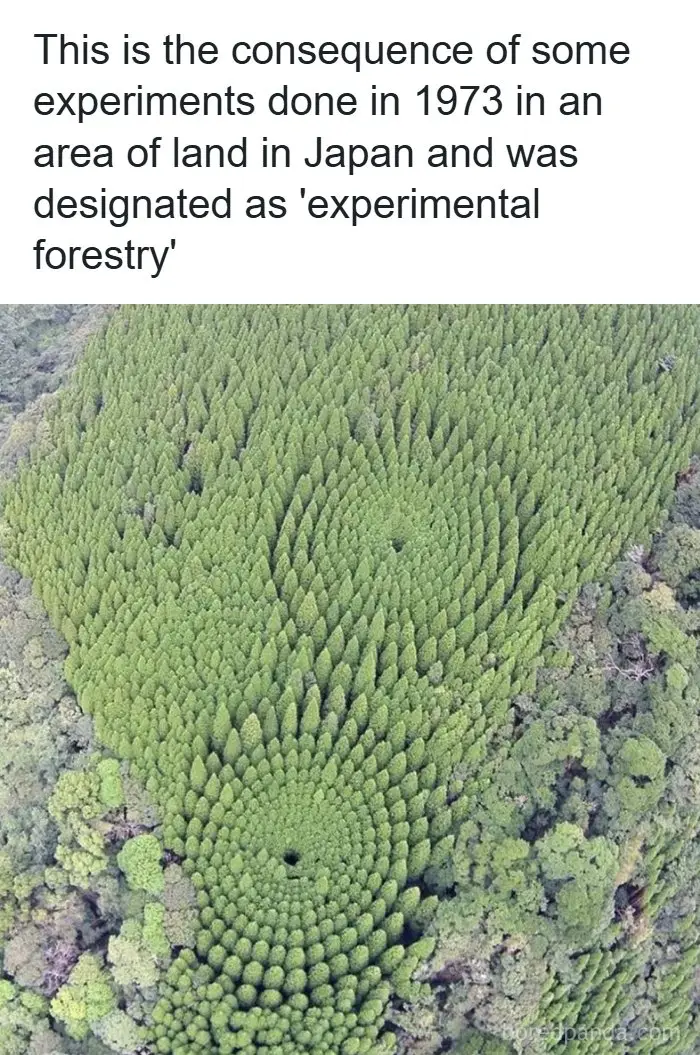
As you can see from today’s images, the forest has taken on this bizarre shape because there are the same number of trees in each ring, but each ring is smaller as you get closer to the center. It is very noticeable that the trees closest to each other are smaller, while those on the outer rings are significantly taller with a larger crown diameter.
Trees, as living beings, grow smaller when they are closer together, this happens due to the lack of space; furthermore, plants sense the presence of other plants near them and therefore grow according to the space they have available.
#16
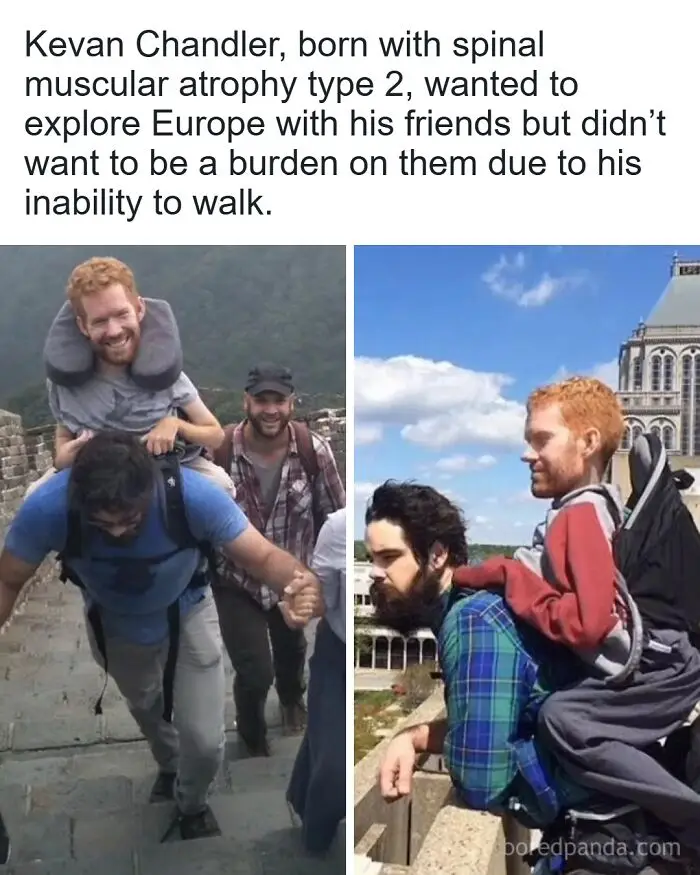
He almost let the dream slip away, until his friends stepped in.
“Kevan,” one of them said with a grin, “what if we just carried you?”
It sounded like a joke at first, but soon sketches turned into designs, and designs into a backpack sturdy enough to carry a man. Kevan’s friends took turns hoisting him onto their backs, not as a burden, but as a companion.
Together they roamed the cobblestone alleys of France, where Kevan marveled at cathedrals towering above him. In England, he laughed with strangers in cozy pubs, his friends’ footsteps echoing through history. And in Ireland, he felt the wind whip across the cliffs, his heart soaring higher than he thought possible.
For Kevan, it wasn’t just about travel. It was about trust, friendship, and discovering that adventure grows bigger when it’s carried together.
#17
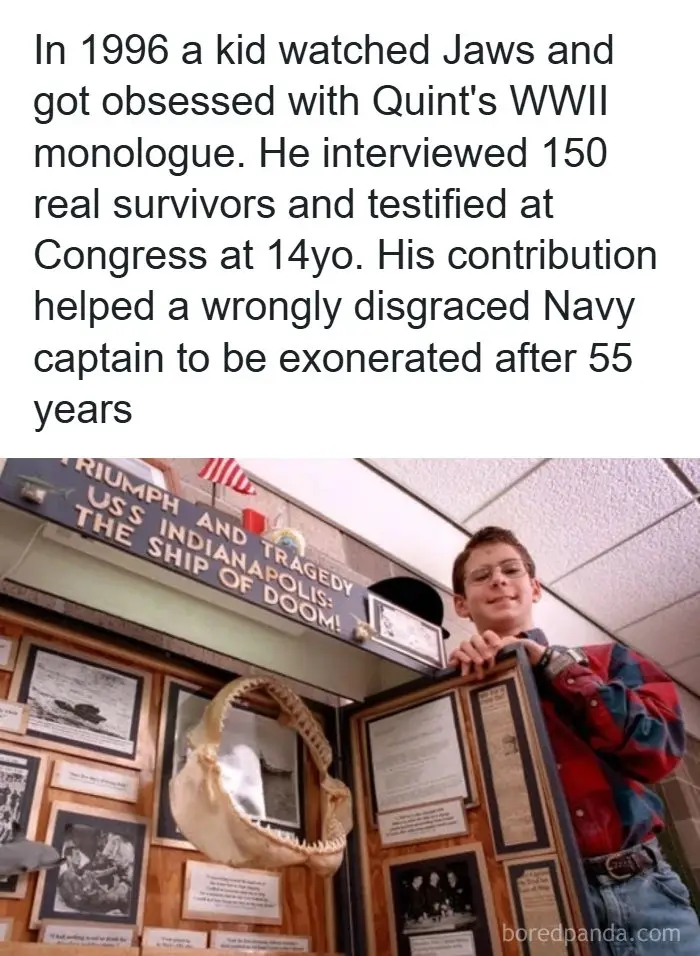
In one short scene in the film, Quint delivers a brief monologue describing survivors of the sinking being attacked by sharks while stranded at sea, which deeply captured the boy’s attention.
Hunter Scott, began researching the 1945 sinking of the USS Indianapolis, interviewed around 150 survivors and reviewed 800 documents. His research focused on the role of the ship’s captain, Charles B. McVay III, who had been court-martialed after the incident. He concluded that the ship’s Captain Charles Butler McVay III, who had been blamed for the tragedy, was innocent.
Scott presented his findings to the United States Congress at age 14. In 2000, Congress passed a resolution clearing Captain McVay’s name, and the U.S. Navy later formally exonerated him.
#18
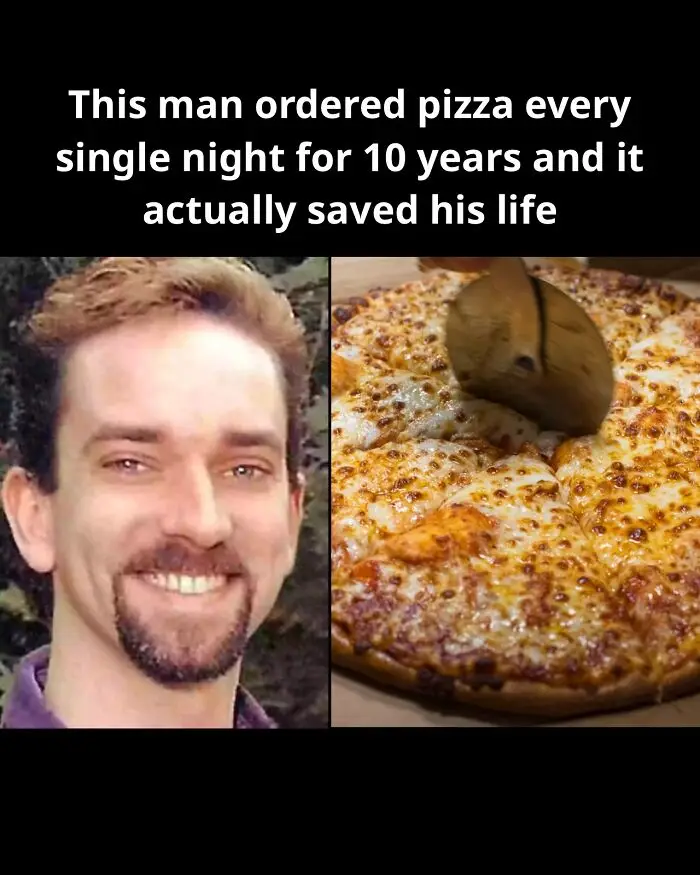
Then, his daily orders suddenly vanished.
At first, the evening delivery drivers didn’t panic, assuming Kirk had finally gone out of town or was visiting family. But the days kept stretching on.
The turning point came on a Saturday night, a specific night Kirk had literally never missed in years.
When his order failed to pop up on the screen by midnight, the store manager, Sarah Fuller, knew something was deeply wrong. She opened the store’s database and confirmed the reality: Kirk hadn’t placed an order in exactly 11 days.
Knowing Kirk lived alone and had suffered from health issues in the past, Sarah didn’t hesitate. At 1:00 AM, she sent a veteran delivery driver straight to his house.
When the driver arrived, he saw the lights were on and could hear the television blaring inside, but nobody answered the door. He tried calling Kirk’s phone, and it went straight to voicemail. He immediately dialed 911.
Deputies forced entry into the home and found Kirk collapsed on the floor. He had suffered a severe stroke and had been trapped inside, unable to move or call for help, for days. Doctors later confirmed that he was in critical condition and wouldn’t have survived another 24 hours.
It wasn’t a doctor or a neighbor who saved Kirk, it was the staff of his favorite pizza place who paid attention when his routine broke.
#19
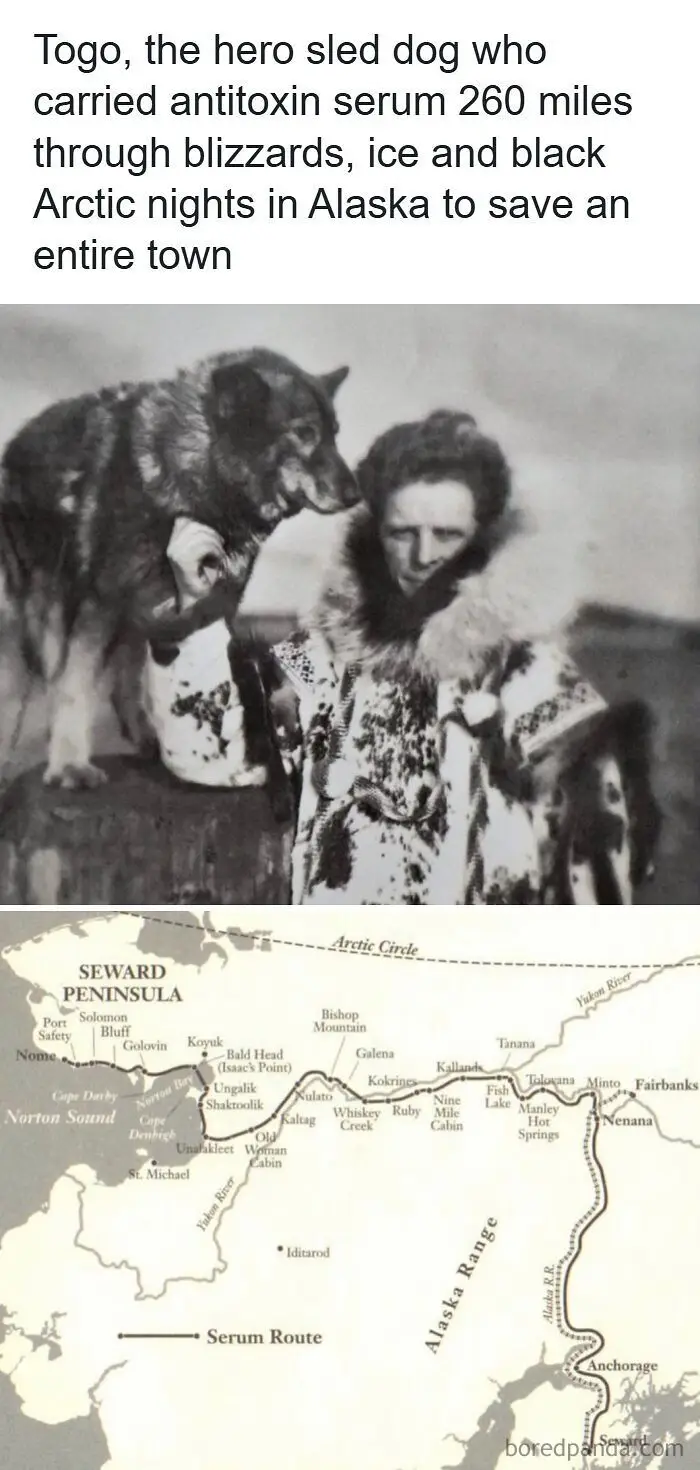
The diphtheria outbreak struck in 1925, threatening the lives of the more than 10,000 inhabitants of the area, especially children. The only viable medicine was in Anchorage, 1,000 miles away. Aircraft engines froze and the closest rail line was 674 miles away, so officials turned to sled dogs to move the serum.
Seppala’s team set out, 12-year-old Togo at the helm. They covered the most dangerous leg—a shortcut across Norton Sound-through the dark, in a blizzard. But in just 5½ days, the lifesaving serum was delivered to Nome. Togo and Seppala did an astounding 264 miles (421 km); other teams averaged 31.
Togo was very sick as a puppy and was given away to be a pet, deemed unsuitable to be a sled dog. He disagreed, jumping through a closed window to run back to his sled-dog siblings’ kennel. This greatly impressed venerated musher Leonhard Seppala.
Togo continued to be a troublemaker, though, and while he showed interest in being a sled dog, he still didn’t look the part at only 48 pounds.
But Togo changed Seppala’s mind. Before a big trip, Seppala put Togo in a kennel with instructions to not free him until the team was long gone. Togo broke out and trailed the team through nightfall, surprising Seppala the next day. On the way home, Seppala put him in a harness and Togo instantly settled down. Togo logged 75 miles (120km) on his first official day-unheard of for an inexperienced sled dog.
In 2011, Time named Togo the most heroic animal ever. In 2022, a Togo statue was unveiled in Maine, where he spent his last years. Disney released a film about Togo in 2019 with Willem Dafoe as Seppala and Togo played by Diesel, a direct descendant of Togo.
Seppala summarized the entire story perfectly: “I thought of the ice and the darkness and the terrible wind and the irony that men could build planes and ships. But when Nome needed life in little packages of serum, it took the dogs to bring it through.”
#20
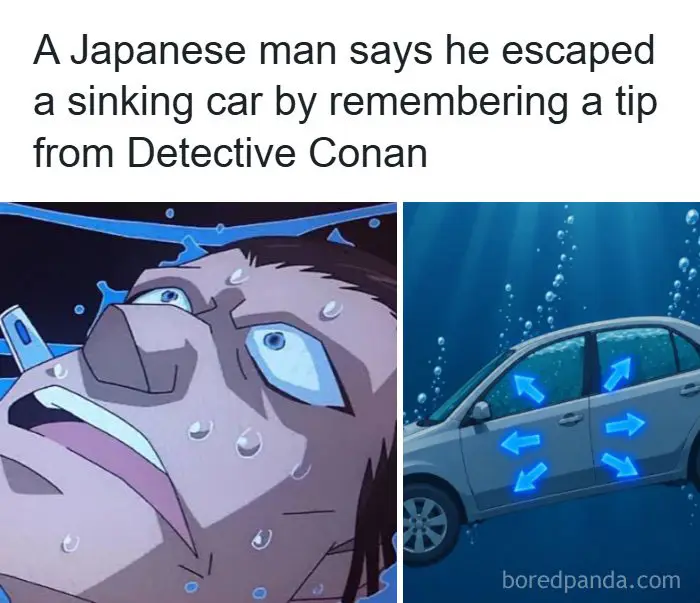
On November 8, he described a collision near a cemetery that sent his car into the water. “For the first 20 seconds I really thought this was it,” he wrote. “But then this scene flashed through my mind.”
He was remembering a sequence involving FBI agent Andre Camel, who escapes a submerged car in the anime. The scene showed a character breathing from an air pocket near the roof and waiting for water pressure to equalize before opening the door.
The driver says the memory helped him react: he found the door handle, pushed the door open and swam out.
A nearby resident helped him reach the bank. After describing his escape, he had one person he especially wanted to thank: “I can’t thank the creator of Conan enough.”