






History classes in school primarily tackle significant events in a particular country or the life stories of renowned figures throughout time. And because there is so much ground to cover, it would be impossible to learn all about them.
That’s where social media pages like Historyfeels come in. With compelling photos and equally captivating backstories about pop culture icons, everyday people, and powerful moments that left a mark over time, these posts may enliven you, especially if you consider yourself a history buff.
You likely won’t often see many of these tidbits of information discussed in classrooms. Scroll through and maybe learn something new today.
#21

The Choluteca Bridge, also known as the “Bridge to Nowhere,” became a global symbol of resilience, misfortune, and adaptation. Built in 1998 with Japanese engineering, the bridge was designed to withstand the strongest storms and stand for decades as a vital connection for Honduras. Ironically, when Hurricane Mitch swept across Central America later that same year, it devastated infrastructure, displaced over a million people, and caused massive loss of life. Yet the bridge itself remained intact, virtually undamaged by the storm. The catch was that Mitch had changed the course of the Choluteca River entirely. Instead of flowing beneath the bridge, the river carved out a new path beside it, leaving the impressive structure suspended over dry ground.
Report
33points
#22
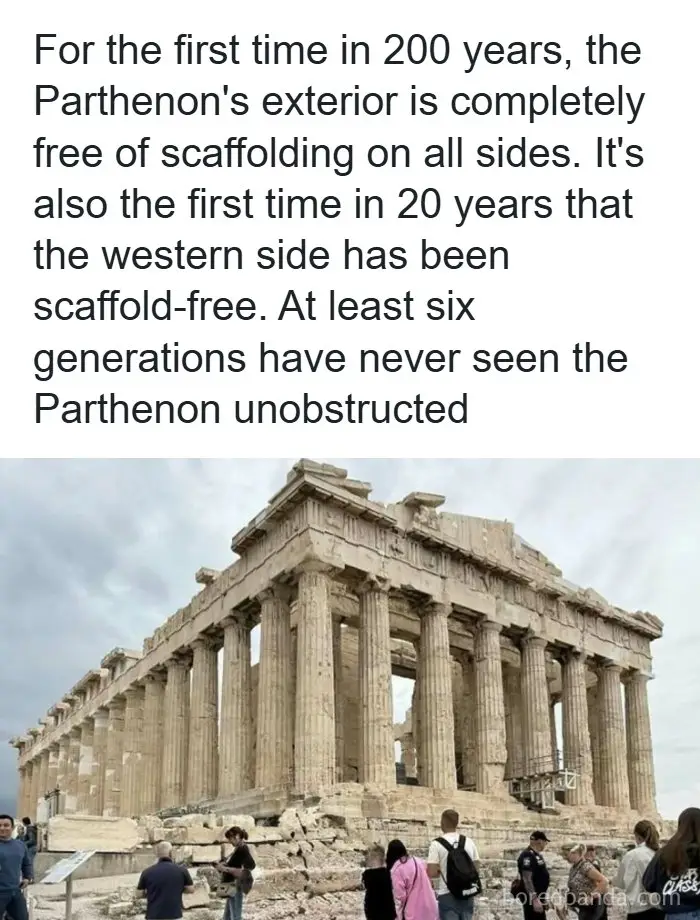
The Parthenon, standing atop the Acropolis in Athens since 447 BC, has endured more than two millennia of war, earthquakes, looting, and environmental decay. For the last two centuries, restoration has been an almost continuous process. Since the early 1800s, scaffolding has been a familiar sight around the temple as teams of architects, engineers, and conservators worked to repair structural damage, replace corroded metal clamps, and realign marble blocks that had shifted over time.
This moment, with the Parthenon fully free of scaffolding, marks a rare pause in that ongoing preservation. It offers an unobstructed view of one of humanity’s most iconic structures exactly as it stood under the ancient Athenian sun. Visitors can now walk around the entire perimeter and see the harmony of Doric columns and precise geometry that defined Greek architectural perfection.
The Parthenon was originally dedicated to Athena Parthenos, the city’s patron goddess, and once housed a 40-foot gold and ivory statue of her. Though time has stripped away its sculptures and color, the temple remains a symbol of democracy and cultural endurance.
Added Fact: The Parthenon’s restoration project, managed by the Acropolis Restoration Service since 1975, has been one of the longest and most meticulous architectural conservation efforts in the world, involving more than 2,000 marble fragments carefully repositioned using modern technology.
Report
32points
#23
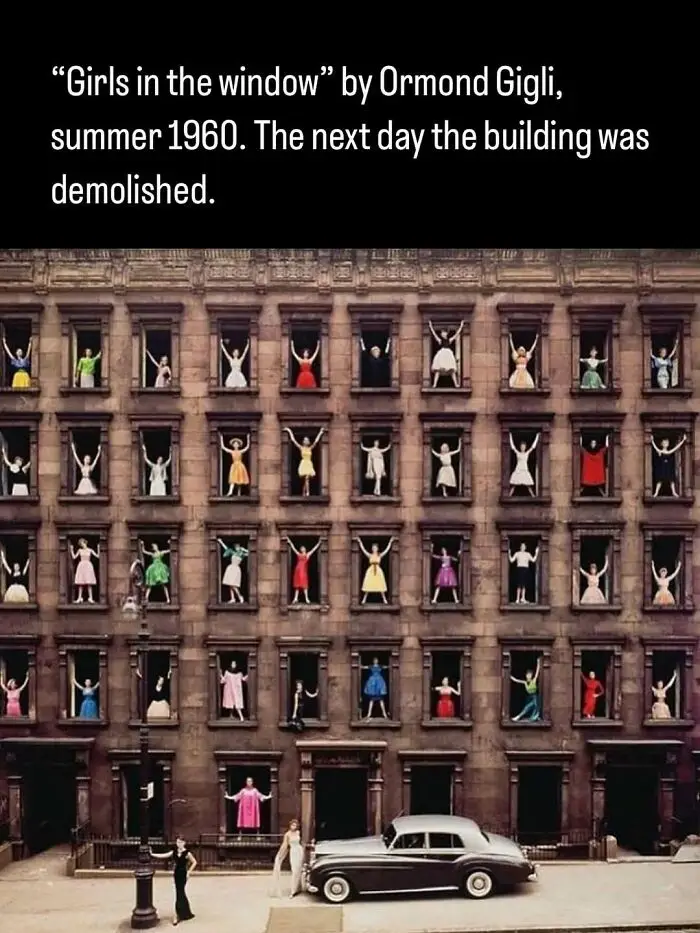
Gigli was a successful American photographer, he is most known however for this photo and had this to say about it in 2013.
“It was the summer of 1960, and one morning I glanced out of the window of my studio in Manhattan and noticed that a row of brownstones opposite were being prepared for demolition. Looking at the design of the empty windows, an idea struck me: put a woman wearing colourful clothes in each of the openings.
I sent over someone from my staff to talk to the demolition supervisor. He agreed to let us go ahead – provided we used his wife in the photograph. We could shoot the next day during their lunch hour, he said. After that, the building would be gone.
So, with 24 hours to pull it off, we called up all our contacts to find models and locate a Rolls-Royce to sit on the sidewalk in front. I had a good reputation, as I was working for Time and Life magazines, so it was quite easy to convince people.
There were models, socialites, my wife (second floor, far right), the supervisor’s wife (third floor, third from left), all wearing their best dresses [see footnote]. I moved them around to spread out the colours and told them to pose as if they were giving someone a kiss. As I was photographing, I noticed some of them were on the windowsills. As these were made of cement and sometimes break off, I shouted at them through a bullhorn to stay within the frames.
The noon sun was overhead and the light shone between the streets. Miraculously, the police didn’t come by and stop us – and, within an hour, I’d got my shot.
I have a big print of it up on my wall. I still smile whenever I look at it, even after all these years. Not bad.”
Report
29points
#24

The astronomer was Clifford Stoll, then 36 years old and working at the Lawrence Berkeley National Laboratory in California. Stoll had been reassigned from pure astronomy work to manage computers when he noticed something odd: a 75-cent discrepancy in accounting records for computer time. Most people might have written it off as a minor clerical error, but Stoll’s scientific instincts told him to investigate.
Over the next ten months, Stoll meticulously traced the anomaly through the lab’s computer systems. What he discovered was far bigger than a billing error, it was a hacker from West Germany who had broken into U.S. computer networks. The intruder was not just snooping for fun; he was stealing classified military information and selling it to the KGB, the Soviet Union’s intelligence agency during the Cold War.
Stoll used creative methods to track the hacker. In one famous example, he set up “digital honey pots”, fake files filled with enticing but meaningless military data, to monitor the intruder’s activity. He also coordinated with the FBI, CIA, and even German authorities, though at first, few officials took him seriously. Eventually, his persistence paid off: authorities arrested Markus Hess, the hacker, in West Germany.
This case became one of the earliest and most famous examples of cyber-espionage. It highlighted how vulnerable computer systems had become in the digital age, especially with sensitive defense information stored online.
Stoll later documented the entire experience in his bestselling book, The Cuckoo’s Egg (1989), which remains a classic in both cybersecurity and true-crime literature. His story demonstrated how even a tiny irregularity, just 75 cents, could unravel a global espionage plot. It’s the small details.
Fun Fact: To keep himself awake during the long nights of hacker tracking, Stoll would run around the lab’s hallways balancing on the walls and juggling. His eccentric energy became just as famous as the investigation itself.
Report
27points
#25
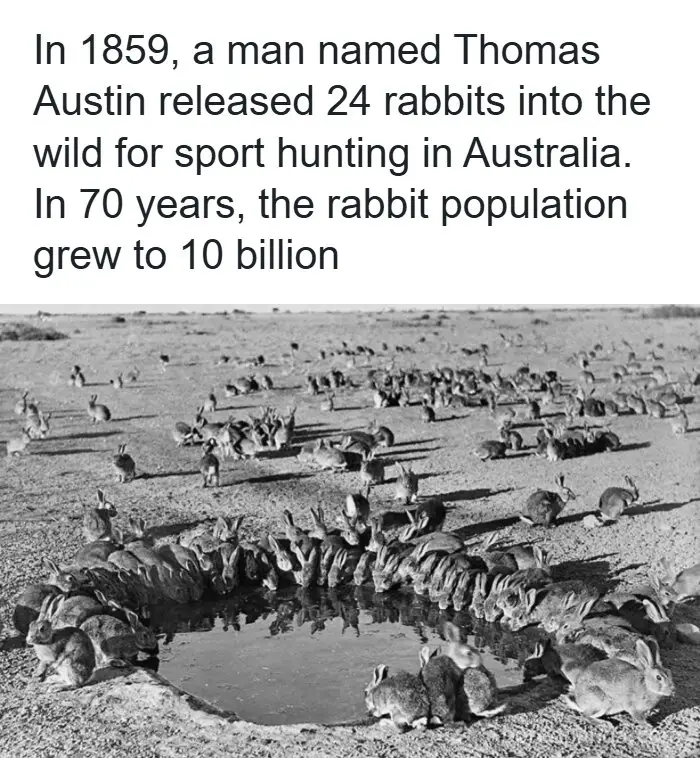
English settler Thomas Austin released just 24 European rabbits into the wild on his property in Victoria, Australia. He saw it as a harmless attempt to recreate the sport hunting he had enjoyed back home. But this decision would become one of the most devastating ecological mistakes in history. With no natural predators, abundant food, and ideal breeding conditions, the rabbit population exploded. Within a matter of decades, millions of rabbits were ravaging crops, stripping vegetation, and outcompeting native species. By the 1920s, it’s estimated that the population had skyrocketed to 10 billion rabbits. The government scrambled to control the infestation, building a rabbit-proof fence over 2,000 miles long and introducing diseases like myxomatosis in the 1950s. While efforts slowed their growth, rabbits remain a serious agricultural and environmental threat in Australia to this day. All from a decision that seemed harmless — just two dozen rabbits and an open gate.
Report
27points
#26

This grocery store sits inside Diocletian’s Palace, a Roman imperial complex built in the 3rd century AD in what is now Split, Croatia. Once the lavish retirement home of Emperor Diocletian, the sprawling palace complex is now fully integrated into the city, complete with shops, homes, restaurants, and even modern supermarkets. Here, ancient stone columns, arches, and Roman foundations stand alongside modern food displays and coolers, creating a striking visual blend of antiquity and everyday life. In some parts of the store, glass floor panels reveal preserved Roman ruins just beneath shoppers’ feet. Fun fact: Diocletian’s Palace is one of the best-preserved Roman structures in the world and is a UNESCO World Heritage Site. Locals have been living and working within its ancient walls continuously for over 1,700 years, making it one of the only “living” Roman palaces in existence. Bonus fun fact: The palace’s underground vaults were used as a filming location for Daenerys Targaryen’s throne room in Meereen in Game of Thrones.
Report
25points
#27

This comparison exposes in my opinion how distorted our sense of modern time has become. Thriller was released in 1982, a year that still feels recent to many people who lived through it, yet it now sits more than four decades in the past.
When the album debuted, the Second World War was closer in time than the present day is now. The world that produced Thriller existed without the internet, without smartphones, without digital streaming, and without the constant acceleration that defines contemporary culture.
The album itself became a temporal anchor. Its sound, visuals, and choreography were replayed so relentlessly that they never seemed to age. Music videos ran on loop. Radio kept it alive. Later, streaming froze it in a permanent present. As a result, Thriller feels less like an artifact and more like a shared memory that never stopped happening.
Report
24points
#28

In September 1776, John Adams and Benjamin Franklin traveled together to Staten Island as part of a failed peace delegation with Britain during the early stages of the American Revolution. On their journey, the two men stopped at a small New Jersey inn that had only one available room, and one bed. Adams, a New England lawyer known for his rigid habits, was forced to share it with Franklin, who was nearly 30 years his senior and famous for his unorthodox views on health and comfort.
According to Adams’ diary, the night quickly turned into a debate. Franklin insisted the window stay open to allow “fresh air,” arguing that night air was not dangerous, as many people then believed. Adams, adhering to the common 18th-century fear of “miasmas” or bad air causing illness, wanted it shut tight. Franklin, a lifelong advocate of ventilation, lectured Adams on his “theory of colds” until Adams finally gave in and let him keep it open.
Their conversation reflected more than just a clash of personalities, it revealed a genuine scientific divide of the era. Franklin’s writings on fresh air, exercise, and hygiene were decades ahead of their time, anticipating germ theory and public health reforms that wouldn’t emerge until the 19th century.
Added fact: Benjamin Franklin later published essays promoting the benefits of cool, circulating air and even described his habit of “air baths”; sitting naked in front of an open window each morning to improve health and mood, a practice that baffled his more prudish peers.
Historydictionary:
Miasma theory – The pre-germ-theory belief that diseases like cholera or the plague were spread by “bad air” arising from decaying matter.
Report
24points
#29
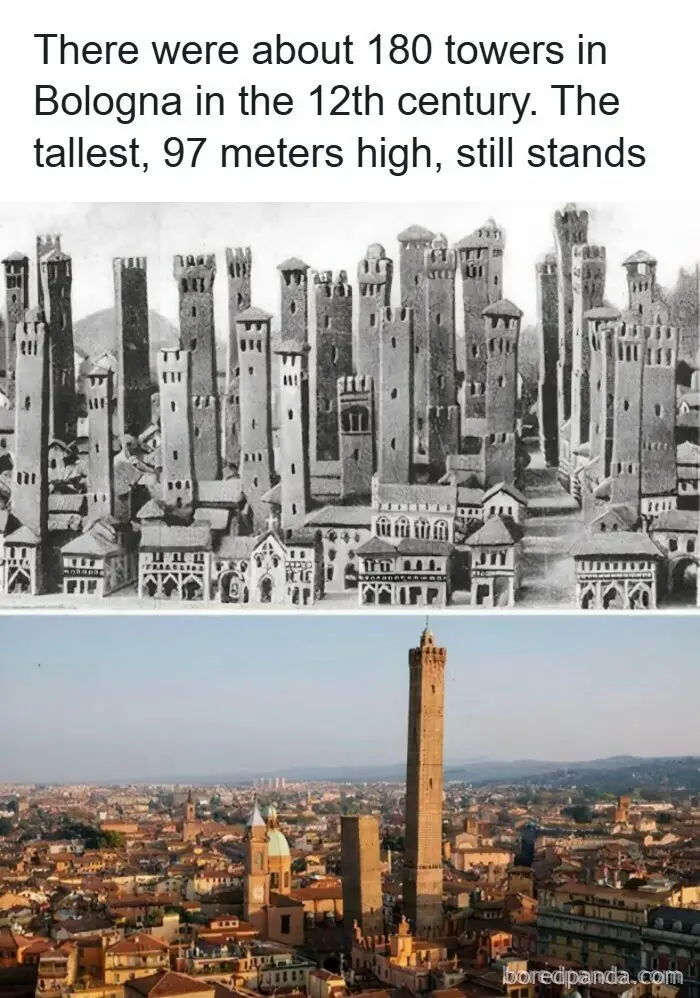
In the 12th and 13th centuries, the Italian city of Bologna was home to an astonishing 180 towers, earning it the nickname “the city of towers.” These structures weren’t just for defense, they were symbols of wealth and power. Noble families competed to build the tallest and most imposing towers, turning the medieval skyline into a vertical battlefield of status. Today, only about 20 of these towers survive, the most iconic being Asinelli Tower, which still rises to 97 meters (318 feet), making it the tallest leaning medieval tower in the world. Beside it stands the shorter Garisenda Tower, famously referenced by Dante in The Divine Comedy. These towers served multiple roles: fortresses, status symbols, and even places of refuge during family feuds or political unrest. Though time and urban development erased most of them, the surviving towers remain some of the most striking architectural relics of medieval Europe.
Report
24points
#30

The Graveyard of an empire. Each red icon marks the resting place of a sunken Japanese warship from World War II, revealing the staggering scale of Japan’s naval losses. By the end of the war, the Imperial Japanese Navy had lost over 700 major vessels, including 11 battleships, 25 aircraft carriers, and over 180 destroyers and submarines.
Many of these ships were sunk in legendary battles like Midway, where four Japanese aircraft carriers were lost in a single day, crippling Japan’s offensive power. Others fell during the Battle of Leyte Gulf, the largest naval battle in history, where Japan launched its last desperate gambit to hold the Philippines and lost decisively.
But not all ships were lost in battle. Many were sunk while evacuating troops, transporting supplies, or simply ambushed by U.S. submarines, which decimated Japanese shipping lanes. In fact, American submarines were responsible for sinking over 60% of Japanese merchant shipping, effectively choking the empire’s wartime logistics.
Fun facts:
•The battleship Yamato, the largest ever built, was sunk in 1945 with over 3,000 crew onboard, during a mission to defend Okinawa.
•Some ships sunk near Micronesia and Palau have become popular dive sites, like Truk Lagoon, often called the “Japanese Pearl Harbor.”
•Many sunken wrecks remain undiscovered, hidden deep beneath the Pacific, preserved in eerie silence.
Report
23points
#31
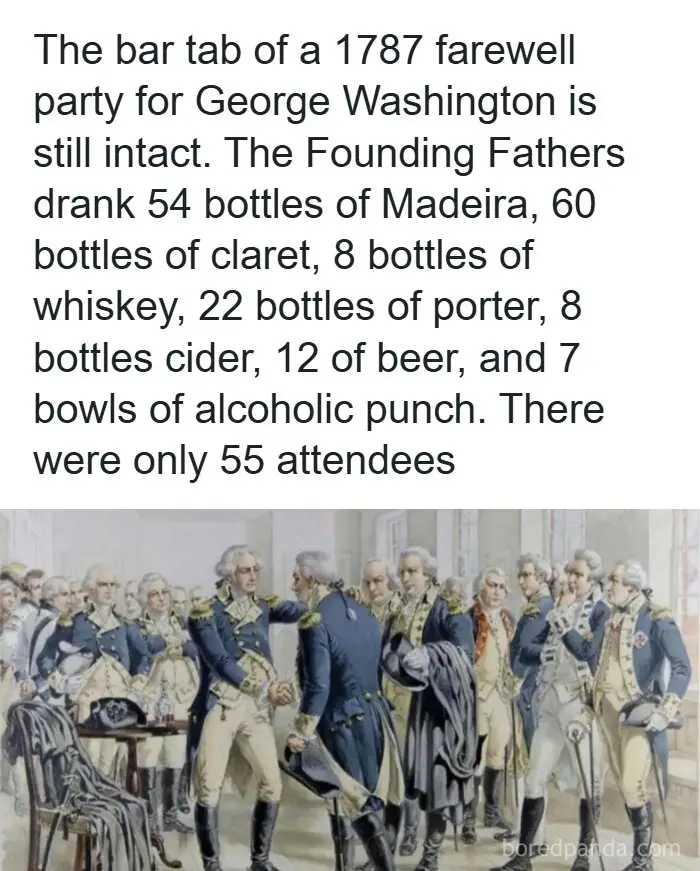
In September 1787, just before the signing of the U.S. Constitution, George Washington attended a farewell gathering in Philadelphia with fellow delegates of the Constitutional Convention.
With only 55 men in attendance, the tally reveals a feast of indulgence: dozens of bottles of fortified Madeira wine and claret, substantial amounts of whiskey, porter, and cider, along with large bowls of communal punch. Adjusted for inflation they all ran up a 15k bar tab. This type send-off was not unusual for the era.
Alcohol was a central feature of 18th-century social and political life, often consumed at levels that would astonish modern observers (or maybe not depending on who’s reading). Taverns and banquets were places where ideas were debated, alliances forged, and trust built, fueling not only camaraderie but the revolutionary spirit itself.
Fun Fact: Madeira wine was George Washington’s personal favorite, and he often ordered it by the cask.
Report
22points
#32
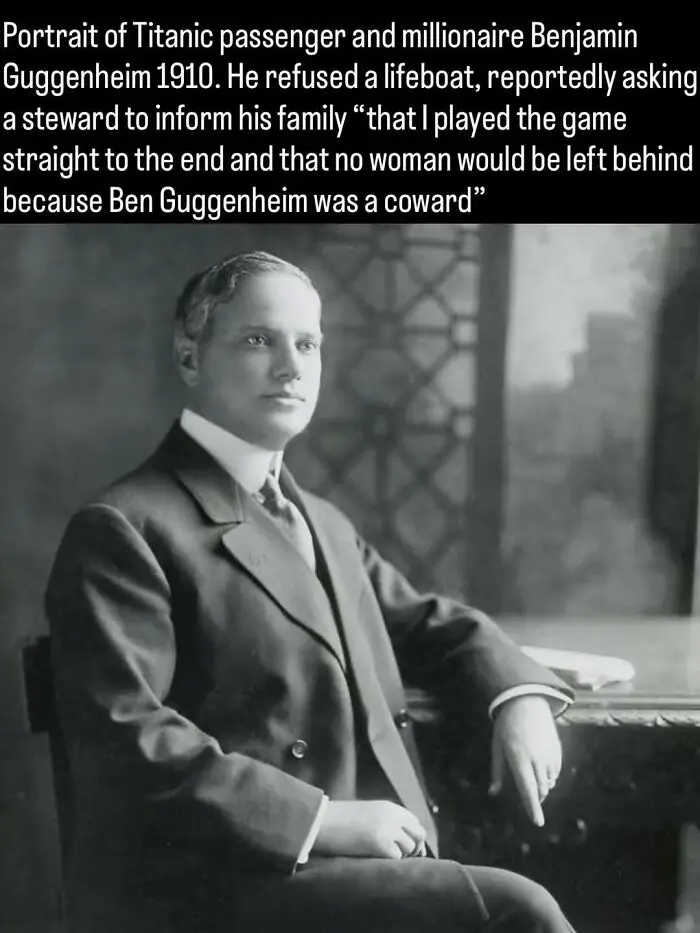
In the early hours of April 15, 1912, as the Titanic’s fate became clear, first-class passenger Benjamin Guggenheim refused to save himself. Instead of boarding a lifeboat, the American millionaire returned to his cabin, changed into evening clothes, and placed a rose in his buttonhole. “We’ve dressed up in our best,” he reportedly told a steward, “and are prepared to go down like gentlemen.” According to steward Henry Etches, Guggenheim asked that a message be delivered to his wife: “Tell her I played the game straight to the end and that my last thoughts are of her and our girls.” Later retellings have attributed an even more dramatic line to him, claiming he insisted that no woman would be left aboard because of his cowardice. Guggenheim and his valet were last seen on the ship’s deck, standing calmly as the Titanic slipped beneath the Atlantic.
Report
22points
#33
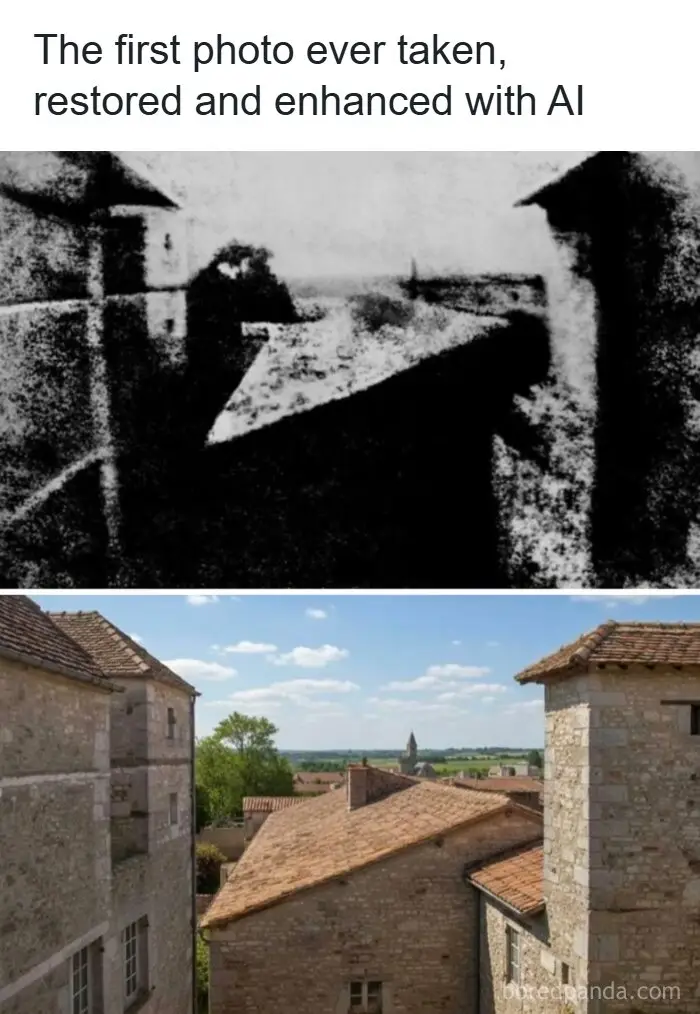
Originally captured in 1826 by French inventor Joseph Nicéphore Niépce, the image is titled ‘View from the Window at Le Gras’. It depicts the view from Niépce’s estate in Saint-Loup-de-Varennes, France, showing rooftops, a barn, and the distant horizon. The photograph was made using a process called heliography, in which a polished pewter plate was coated with bitumen of Judea, a light-sensitive substance that hardened when exposed to sunlight.
Niépce’s exposure lasted nearly eight hours, meaning sunlight illuminated both sides of the buildings during the day, giving the image its strange, dreamlike quality. The result was grainy and ghostly, but revolutionary. For the first time in history, light itself had been permanently captured on a surface, marking the birth of photography.
The version seen here has been digitally restored and enhanced with AI, offering a glimpse of what Niépce may have seen nearly 200 years ago. While some purists debate the ethics of AI restoration, it undeniably helps modern audiences appreciate the scale of his achievement and the clarity of his vision.
Added Fact: Niépce’s original plate still survives today and is housed at the University of Texas at Austin’s Harry Ransom Center, preserved as the world’s earliest surviving photograph.
Report
21points
#34
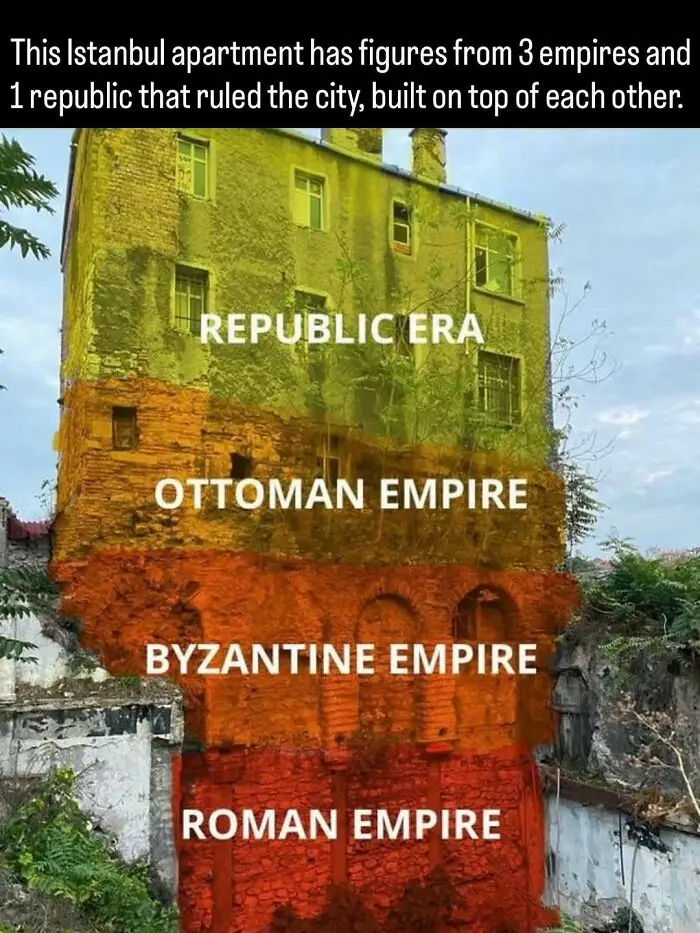
Each section of the structure reflects the city’s past rulers, stacked atop one another like sediment through time. At its base are stones from the Roman Empire, which first established Byzantium as a significant outpost. Emperor Constantine renamed the city Nova Roma, but it was popularly known as Constantinople, “City of Constantine.” Above that lies brickwork from the Byzantine Empire, which made Constantinople its glittering capital for over a thousand years. The Hagia Sophia, built in 537 AD, was the world’s largest cathedral for nearly a thousand years and featured a massive dome that seemed to float on light. Then come the architectural touches of the Ottoman Empire, which conquered the city in 1453 and ruled until the early 20th century. After taking the city, Sultan Mehmed II turned the Hagia Sophia into a mosque and renamed Constantinople Istanbul. Finally, crowning the top is the Republican era of modern Turkey, established in 1923. Under Mustafa Kemal Atatürk, Turkey adopted sweeping reforms—like switching from the Arabic to Latin alphabet in just one year.
Report
21points
#35
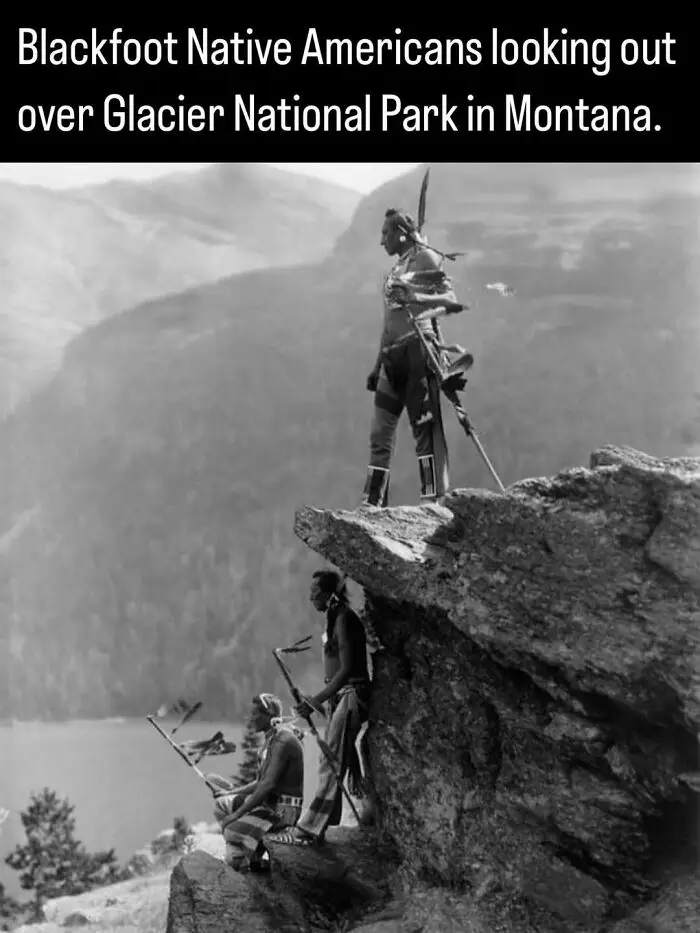
The photo was taken by Roland Reed, an American artist and photographer, who was part of an early 20th century group of photographers of Native Americans known as ‘pictorialists’. This photo is titled ‘The Eagle’. The picture was featured on the inside jacket of the book Alone with the Past: The life and photographic art of Roland W. Reed. The Blackfoot were a confederacy of Plains tribes whose territory once stretched across present-day Montana and Alberta. They were known for their warrior culture, complex spiritual beliefs, and deep relationship with the land and considered the mountains and plains sacred.
Report
21points
#36
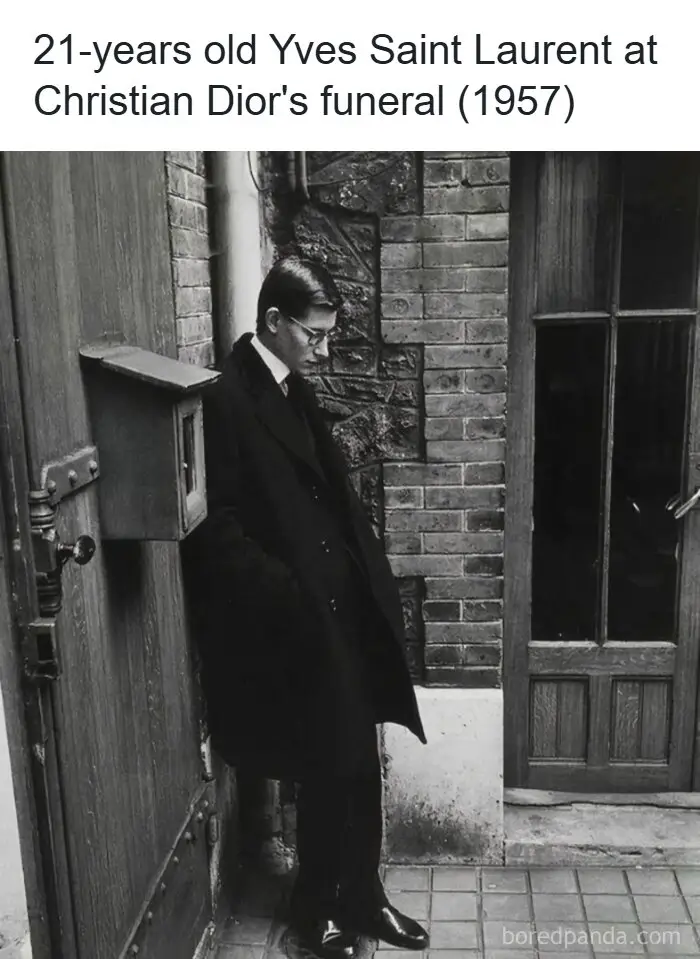
In 1957, the fashion world was shaken by the suddenpassing of Christian Dior, the man who had redefined postwar style with his groundbreaking “New Look.” Among the mourners was a young Yves Saint Laurent, only 21 years old, who had been working as Dior’s assistant.
This photograph captures him outside the funeral, leaning against a wall in quiet contemplation. Just days earlier, he had been unexpectedly named Dior’s successor, a decision that placed immense responsibility on his young shoulders. The atmosphere in Paris was heavy with grief, and Saint Laurent’s solemn posture reflected both the loss of his mentor and the weight of his new role.
Within months, he would debut his first collection for the house, proving that Dior’s faith in him was not misplaced. Yet in this moment, he was simply a young man mourning the end of an era while standing on the threshold of fashion history.
Report
20points
#37
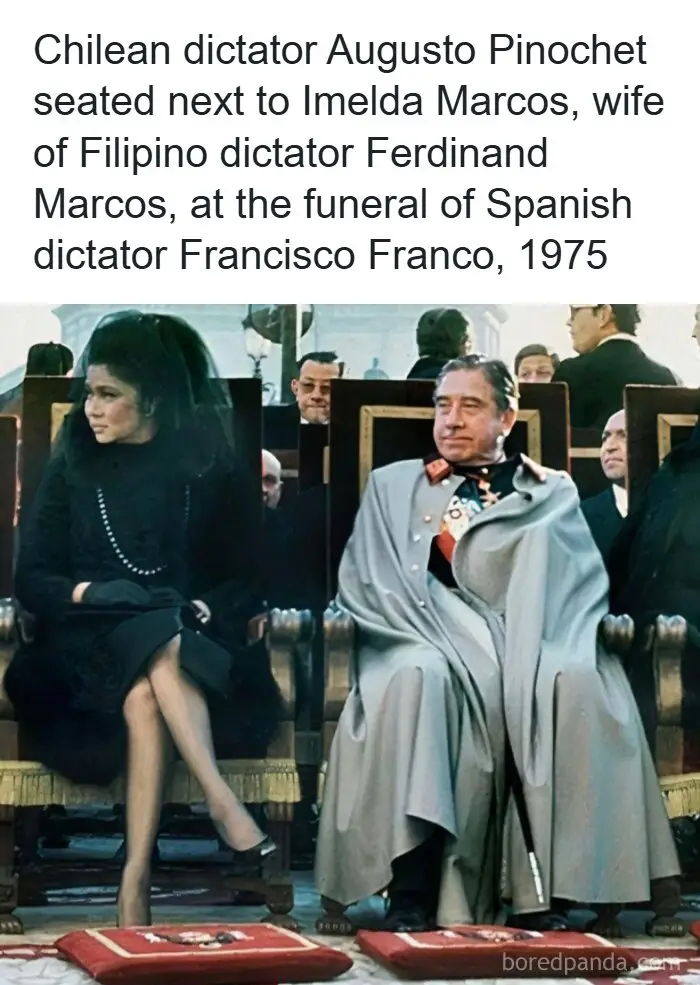
This photograph captures a moment heavy with the weight of twentieth-century authoritarianism. Taken in Madrid during the funeral of General Francisco Franco in 1975, it shows Chile’s military ruler Augusto Pinochet sitting beside Imelda Marcos, the glamorous yet controversial First Lady of the Philippines.
The event symbolized the passing of an era, one in which anti-communism and military power often justified iron-fisted rule. The event marked Spain’s transition toward democracy, but for Pinochet and Marcos, it underscored their own tightening grip on nations still under martial law.
Their contrasting appearances, Pinochet austere in military gray, Imelda regal in black, illustrate how style and power intertwined in the spectacle of dictatorship. Behind the ceremony, global politics were shifting: the Cold War was softening, and the alliances between these regimes were being tested by growing dissent and economic strain.
Additional Fact: Imelda Marcos, still alive at 96 years old, remains a controversial figure in the Philippines. The former First Lady and wife of dictator Ferdinand Marcos, she became infamous for her extravagant lifestyle amid widespread poverty and political repression during her husband’s rule. Her name really became synonymous with excess after the 1986 revolution that ousted the Marcos regime, when investigators discovered more than 2,700 pairs of designer shoes, along with jewelry, artwork, and luxury properties around the world—all allegedly purchased with public funds.
Report
20points
#38

In the span of just 44 days in 1991, rock history was rewritten. Between August and September, a wave of genre-defining albums was released that reshaped the sound of the decade. Metallica’s self-titled “Black Album,” Pearl Jam’s Ten, Guns N’ Roses’ Use Your Illusion I & II, Soundgarden’s Badmotorfinger, and Nirvana’s Nevermind all dropped in quick succession. Each album brought something different — from Metallica’s heavy polish to Nirvana’s raw grunge energy. Nevermind, in particular, would soon knock Michael Jackson off the top of the charts and become a symbol of a cultural shift. It wasn’t just a hot streak, it was a revolution in real time. These releases didn’t just dominate the airwaves, they marked the dawn of alternative rock’s mainstream takeover. Looking back, it’s hard to believe this explosion of legendary music happened in just over a month.
Report
20points
#39
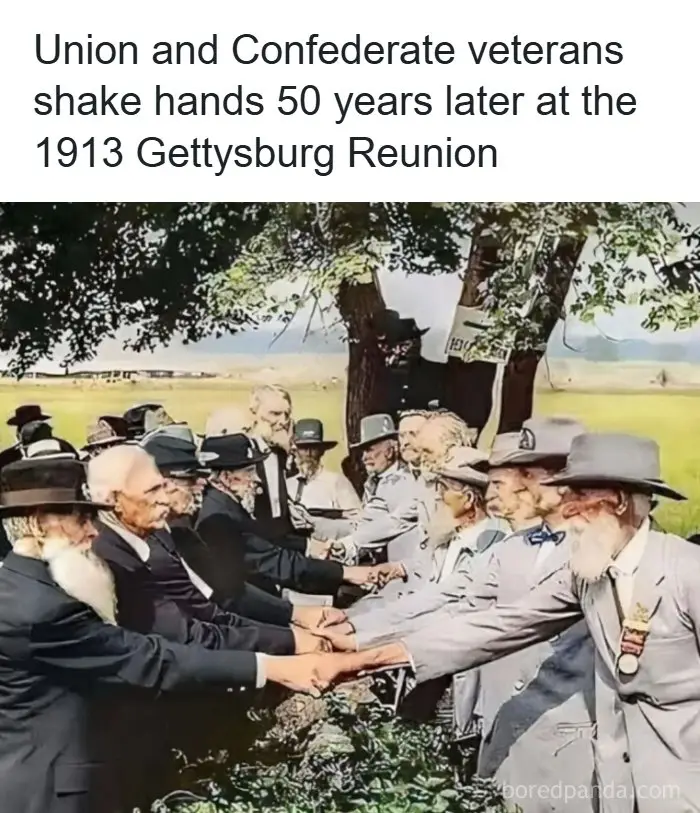
Fifty years after the Battle of Gettysburg (one of the bloodiest encounters of the American Civil War) veterans from both the Union and Confederate armies gathered once more on the same fields where they had once fought to the death.
The 1913 Gettysburg Reunion, also called the “Great Reunion,” brought together more than 50,000 aging soldiers in what was billed as a celebration of national reconciliation.
In this photograph, former enemies clasp hands across a symbolic line that had once divided the nation. The men’s faces show the passage of half a century — beards white, postures bent — yet their meeting was heavy with memory. Many of them had stood in those very fields as young men, amid cannon smoke and cries of the wounded.
The reunion was organized by both Northern and Southern veterans’ associations and funded in part by Congress. Though framed as unity and forgiveness, the event also reflected the complexities of American memory: a nation eager to heal, but not yet ready to confront the deeper injustices that had caused the war in the first place.
Added Fact: President Woodrow Wilson, the only U.S. president born in the Confederacy, attended the reunion and called it “a day of peace and brotherhood,” though African American veterans were largely excluded from the event’s commemorations.
Report
20points
#40
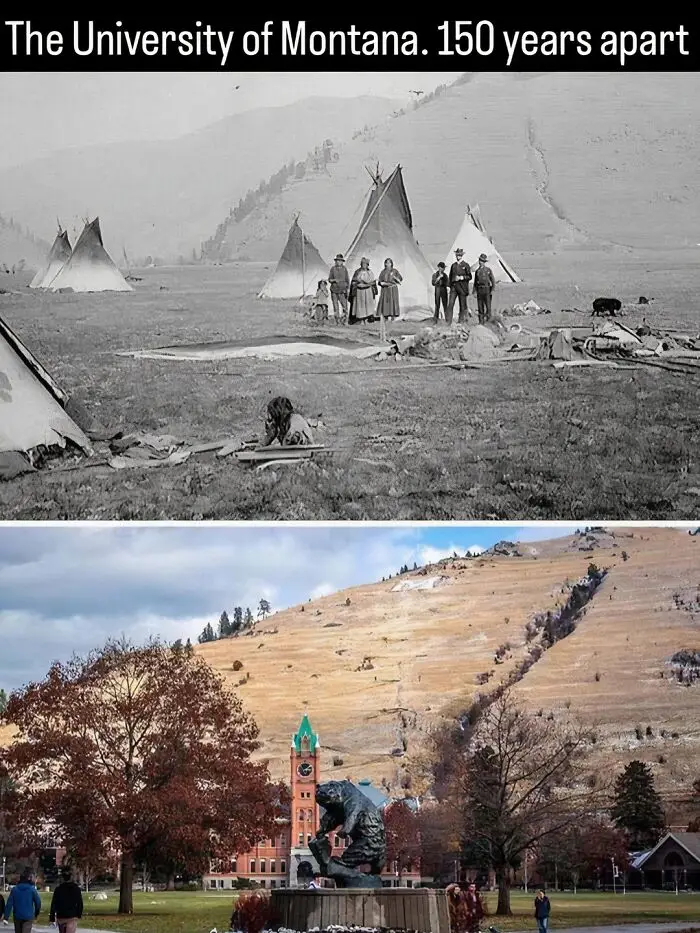
The land where the University of Montana stands today, in Missoula’s Clark Fork Valley, was long home to Indigenous peoples before the campus was established in 1893. For thousands of years, the area was part of the traditional homelands of the Salish (Séliš), Pend d’Oreille (Ql̓ispé), and Kootenai (Ksanka) peoples. The valley was valued for its abundant resources, seasonal camps, and its location along important travel and trade routes through the Northern Rockies. In 1855, the Treaty of Hellgate, negotiated under pressure from the United States government, led to the cession of millions of acres of tribal land. Most members of the Salish and Pend d’Oreille were later relocated to the Flathead Reservation north of Missoula, though the cultural and historical connection to the valley remains strong. Added fact: Missoula’s name comes from a Salish word meaning “place of cold water,” referencing the nearby Clark Fork River.
Report
18points