





In history class, we learn the broad strokes of the past. Big wars, fallen civilizations, and darkest periods of history are all part of the textbooks we read and learn from. However, there are many stories that history books often fail to include. And it’s not because they’re trying to hide something: there are just so many moments and personal stories that get lost in the intricate web of time, memory, and record-keeping.
The Facebook page “People of the Past: History, Science and Forgotten Stories” shares the lesser-known stories that might’ve fallen through the cracks but are still noteworthy. For example, did you know that windshield wipers were actually invented by a 27-year-old New Yorker, Mary Anderson? And have you ever heard about the story of a bear in the Polish army during WWII? You’ll find these and many more interesting historical moments below, so don’t dally and satisfy your curiosity for captivating history, and start scrolling!
#41
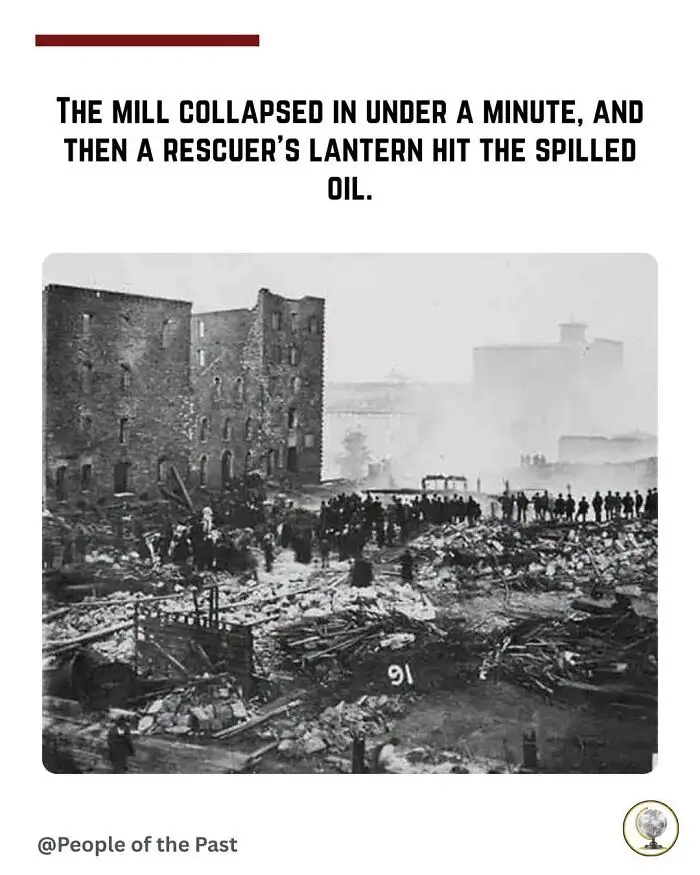
The cast-iron pillars holding up the Pemberton Mill were too thin. The manufacturer knew it. The engineer who inspected them knew it. The building went up anyway.
Lawrence, Massachusetts, January 10, 1860. Just before five in the afternoon, around 800 workers were finishing their shift inside the five-story textile mill on the bank of the Merrimack River. Most were women and children, immigrants from Ireland and beyond, paid by the hour to run the looms and spinning frames.
The collapse took less than a minute.
Witnesses said the upper floors seemed to lean, then drop straight down. Brick walls folded inward. Heavy machinery crashed through floor after floor, dragging workers with it. When the dust settled, the mill was a heap of brick, timber, and iron roughly 30 feet high, with hundreds of people buried inside.
The pillars had been cast by a foundry in South Boston years earlier. Tests at the time had shown they couldn't carry the load the architect specified. The engineer who signed off knew the columns were undersized. The mill went into production regardless, and more machinery was added over the years. The iron finally gave.
Rescuers came from every direction. Neighbors, off-duty workers, doctors, clergy. They dug through the rubble with bare hands and crowbars, pulling out survivors one by one through the freezing night. Fires were lit nearby for warmth and light. Lanterns were passed down into the wreckage to reach the trapped.
Around nine-thirty that evening, a lantern broke. The oil spilled across cotton, splintered wood, and machine grease. The pile caught instantly.
The people still pinned in the ruins couldn't be moved. Rescuers tried to reach them and were driven back by the heat. Some of the trapped called out to the crowd as the flames spread. A few asked to be shot. At least one priest stayed at the edge of the fire giving last rites until he had to be pulled away.
By morning, 145 workers were dead. Around 165 more were injured, many permanently.
A coroner's jury found the pillars defective and the inspection inadequate, but no one was ever prosecuted. The mill was rebuilt on the same site within two years, this time with wrought iron supports. Production resumed.
In Lawrence, the dead were buried in a common lot at Bellevue Cemetery. A small stone marks it. Most of the names underneath belonged to women who had come to America to work.
Report
11points
#42
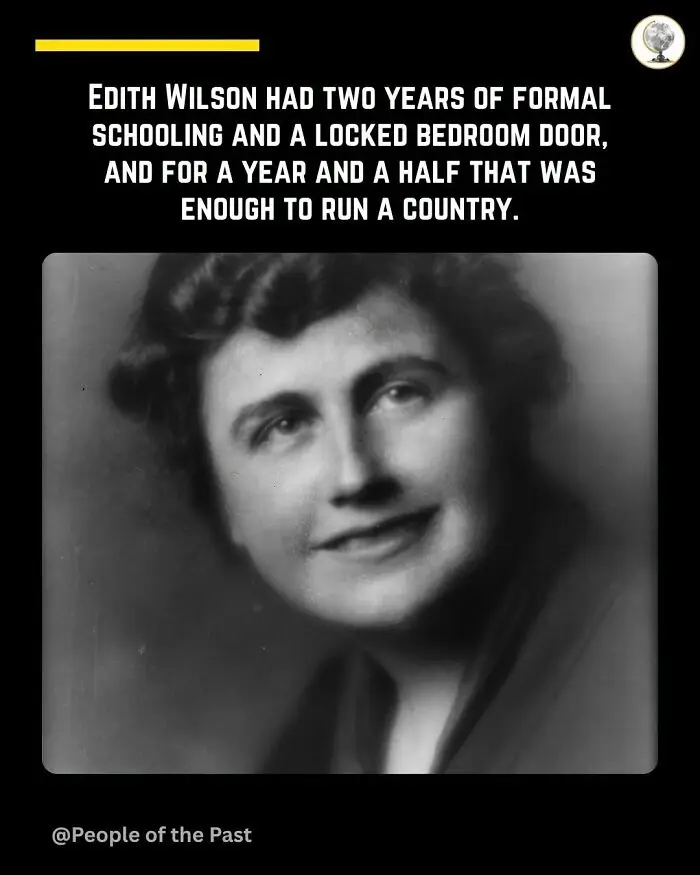
The door to the President's bedroom stayed closed.
On the other side of it, Woodrow Wilson lay paralyzed down his left side, half blind, and unable to speak above a whisper. On this side of it, his wife Edith decided which papers were worth disturbing him for.
It was October 1919. Wilson had collapsed after a cross country tour pushing the League of Nations. A massive stroke had left him incapacitated, and his doctor, Cary Grayson, agreed with Edith that the country could not be told how bad it was.
So they didn't tell anyone.
For 17 months, Edith Wilson sat between the President and the United States government. Cabinet officers sent memos. Senators sent urgent requests. Foreign ambassadors asked for audiences. Everything went to her first. She read it, decided what mattered, and carried a chosen few items into the darkened room. What came back out was often a note in her handwriting, claiming to relay his wishes.
She had two years of formal schooling as a girl in Virginia.
Bills piled up unsigned. Ambassadorships sat vacant. When Secretary of State Robert Lansing called cabinet meetings to keep the government functioning, Wilson eventually fired him for it. The order came through Edith. Vice President Thomas Marshall was kept entirely in the dark and refused to assume the office, terrified of being accused of a coup.
The League of Nations fight was lost during this period. The Treaty of Versailles failed in the Senate. Senator Gilbert Hitchcock was one of the few outsiders allowed near the sickroom, and even he saw only what Edith permitted.
She later wrote a memoir about it. My Memoir, published in 1939, is remarkably direct. She described her role as a stewardship. She insisted she never made a single decision on a public matter. She only decided, she said, what was important enough to bring to her husband.
Historians have spent a century working out what that distinction actually meant in practice. The answer keeps coming back the same. For a year and a half, the person reading the President's mail, controlling access to him, and signing his name on documents was Edith Bolling Wilson.
Woodrow lived until 1924. He never fully recovered. Edith outlived him by nearly four decades and attended John F. Kennedy's inauguration in 1961.
She took the secret of those 17 months as close to the grave as she could.
Report
11points
#43
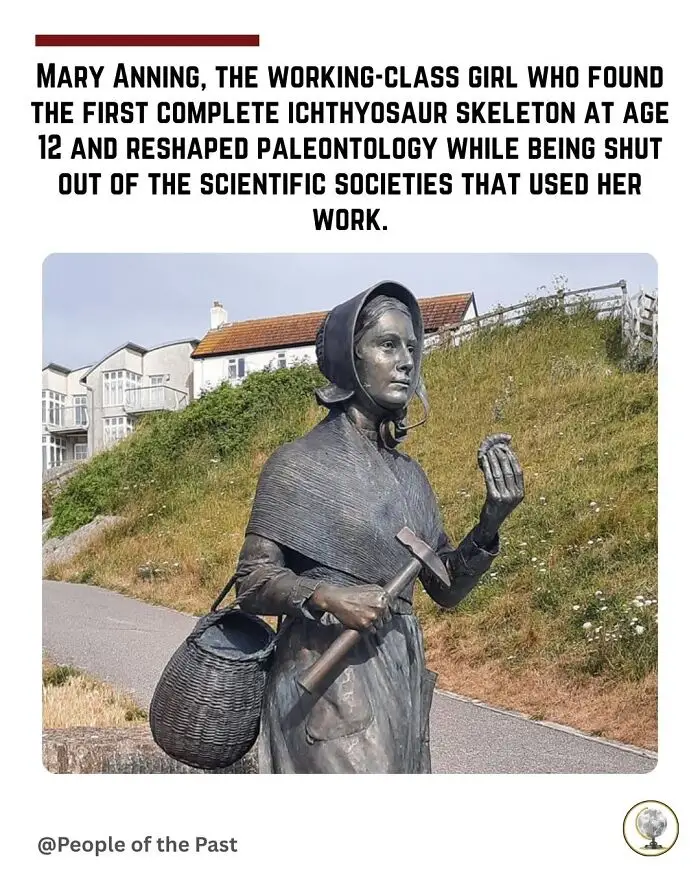
She was twelve years old when she pulled a sea monster out of a cliff.
Mary Anning lived in Lyme Regis on the south coast of England, where the cliffs crumble into the sea and spit out the bones of creatures that died 200 million years ago. Her family was poor. Her father, a cabinetmaker, supplemented their income by selling fossils to tourists, and he taught Mary how to find them before he died in 1810, leaving the family in debt.
Mary was eleven when he died. She kept hunting.
In 1811, her brother Joseph spotted a strange skull jutting from the cliffs at Black Ven. Mary, then twelve, spent months chipping away at the rock until she'd uncovered a seventeen-foot skeleton with a long snout and enormous eye sockets. It was the first complete ichthyosaur ever identified. Scientists in London were stunned.
They bought it. They studied it. They wrote papers about it. They did not credit her.
This became the pattern of her life. In 1823 she found the first complete plesiosaur, a creature so bizarre that the famous anatomist Georges Cuvier initially accused her of faking it. He had to retract. In 1828 she found the first pterosaur skeleton discovered outside Germany. She identified coprolites as fossilized feces, which gave geologists a window into prehistoric diets.
The men who bought her finds built careers on them. William Buckland, Henry De la Beche, Richard Owen. They published, they lectured, they collected honors. Mary stayed in Lyme Regis, scraping by, selling specimens out of a small shop on the seafront.
The Geological Society of London, founded in 1807, was the gatekeeper of the field she was helping to invent. It would not admit her. Women were barred from membership. She wasn't even allowed to attend meetings as a guest.
A friend recorded her bitterness late in life. "The world has used me so unkindly," she said, "I fear it has made me suspicious of everyone."
She died of breast cancer in 1847, aged forty seven. The Geological Society published an obituary, an honor usually reserved for fellows. It was the closest they came to acknowledging what she had done.
They admitted their first women members in 1904. Fifty seven years after Mary Anning was buried in a Lyme Regis churchyard, with the cliffs that had made her name still giving up their dead behind her.
Report
11points
#44
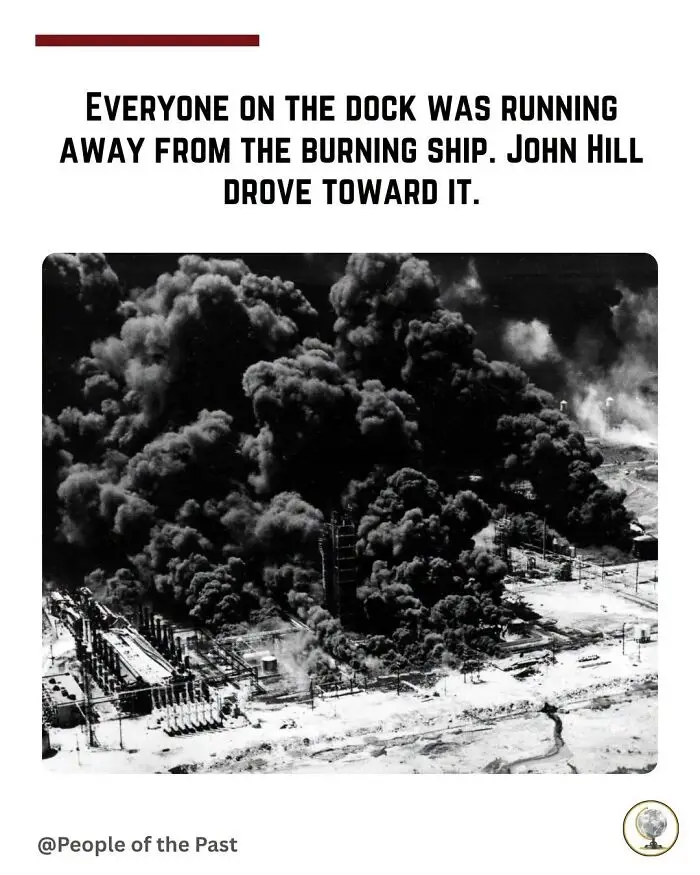
On the morning of April 16, 1947, a column of orange smoke was rising from the SS Grandcamp in Texas City harbor.
The French freighter was loaded with 2,300 tons of ammonium nitrate fertilizer bound for European farms still recovering from the war. A small fire had started in the hold overnight. By 8 a.m. the smoke had turned a strange, beautiful color and people along the docks stopped to watch.
John Hill was a Monsanto plant worker on the waterfront that morning. The Monsanto styrene plant sat 700 feet from the Grandcamp's berth. When the alarms went up, most workers started moving away from the ship. Hill got in his truck and drove toward it.
He was not a firefighter. He was a plant employee who understood, better than the crowd of onlookers, what ammonium nitrate could do when it cooked. He wanted to warn the volunteer fire crew already on the dock that the cargo was unstable.
He never reached them.
At 9:12 a.m. the Grandcamp exploded.
The blast was heard 150 miles away in Louisiana. Two small planes flying overhead were knocked out of the sky. A 15-foot wave surged across the harbor and lifted a steel barge onto dry land. The Monsanto plant vanished in a single concussive instant, k*****g 145 of its workers. The ship's two-ton anchor was hurled nearly two miles inland and buried itself ten feet deep in a field.
John Hill was never found. Neither was most of the volunteer fire department. Of the 28 men on the Texas City fire crew, 27 died at the dock.
The fires spread to a second freighter, the High Flyer, also loaded with ammonium nitrate and sulfur. It burned through the day and detonated just after 1 a.m. the next morning. More dead. More wreckage.
When the count was finished, at least 581 people were dead and more than 5,000 injured. Entire families were gone. Some bodies were never identified. A mass grave at Memorial Park holds 63 of them under a single marker.
The disaster led to the first ever class action lawsuit against the United States government, and eventually to the federal regulations that govern how ammonium nitrate is shipped and stored today.
The anchor still sits in that field, mounted now as a memorial. It weighs 3,200 pounds. It traveled 1.62 miles through the air in a few seconds.
John Hill drove the other way.
Report
10points
#45
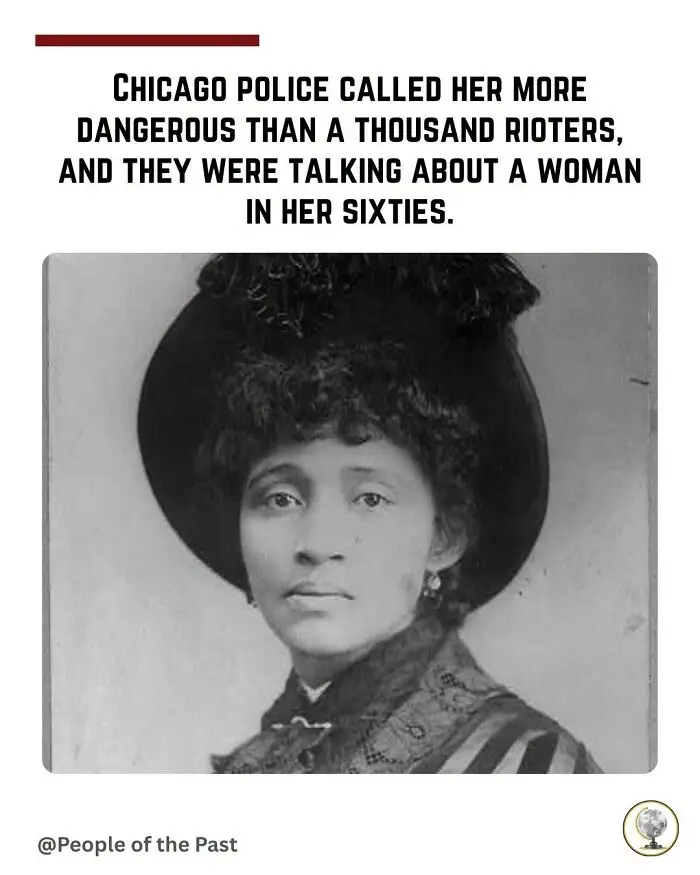
Chicago police had a file on Lucy Parsons that ran for decades. When she spoke in public, they showed up in numbers. One officer reportedly called her more dangerous than a thousand rioters.
She was in her sixties when she led the hunger marches through Chicago in the winter of 1915.
The city was choking on unemployment. Breadlines stretched around blocks. Lucy walked at the front of crowds of jobless workers, demanding food, shelter, and work from a city government that wanted her gone.
She'd been doing this since the 1870s.
Born around 1851, likely into slavery in Virginia or Texas, she'd married Albert Parsons, a former Confederate soldier turned radical labor organizer. They moved to Chicago and built a life around the eight-hour workday movement, mixed-race marriage laws be damned.
Then came Haymarket.
In 1886, a b**b went off at a labor rally in Chicago. Albert was one of four anarchists hanged for it, despite no evidence he'd thrown anything. Lucy was 35 and had two small children. She buried her husband and kept organizing.
She wrote for radical papers. She co-founded the Industrial Workers of the World in 1905, sharing a stage with Eugene Debs and Mother Jones. She organized garment workers, many of them immigrant women working 14 hour days in firetrap factories. She told them to arm themselves against the bosses who beat them.
The police followed her everywhere. They arrested her for speaking, for handing out leaflets, for walking down the wrong street. They tried to stop her from buying a meeting hall. They surveilled her into her eighties.
She outlived almost everyone she'd organized with.
In March 1942, at around 91 years old, Lucy died in a house fire in Chicago. She was nearly blind by then and lived in poverty. The fire took her, her partner George Markstall, and most of what she owned.
Before the ashes had cooled, FBI agents and Chicago police arrived at the house. They seized her library. Thousands of books, pamphlets, letters, and personal papers built over 60 years of labor organizing. The material was never returned to her family or to any archive.
Most of what Lucy Parsons wrote and read in her lifetime is gone.
What survives is the memory of an old woman walking at the front of a hunger march in 1915, with the Chicago police walking behind her, counting heads.
Report
10points
#46
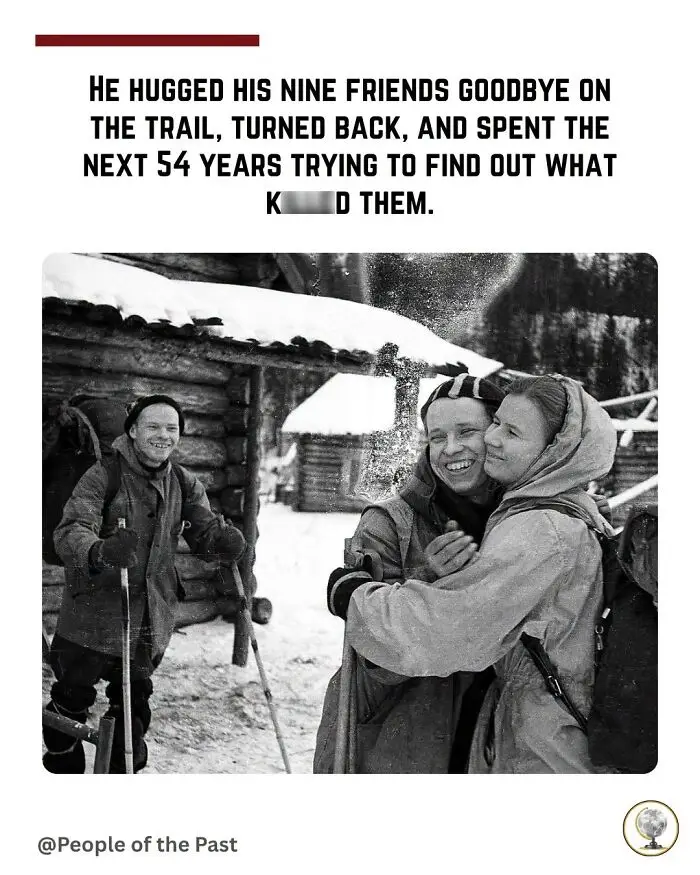
Yuri Yudin stepped off the trail on January 28, 1959. His leg was aching, the cold was making it worse, and he turned back toward the settlement of Vizhay while his nine friends kept walking north.
He was the only one who lived.
The group was led by Igor Dyatlov, a 23-year-old radio engineering student from the Ural Polytechnic Institute. They were experienced hikers, headed for Otorten mountain in the northern Urals, a route rated at the highest difficulty level the Soviet system recognized. Yudin had wanted to go. His sciatica decided otherwise.
He hugged each of them before he left. Photographs from that morning show him smiling with Lyudmila Dubinina, her arms wrapped around his shoulders.
The other nine pitched their tent on the slope of Kholat Syakhl on the night of February 1st. Something happened in the hours that followed. The tent was cut open from the inside. They ran into temperatures around minus 25 Celsius, most of them barefoot or in socks, some in only their underwear.
Searchers found the first bodies weeks later, scattered down the mountainside. Two were under a cedar tree where someone had tried to light a fire. Others were strung out along the path back to the tent, frozen mid crawl. The last four were found in May, buried in a ravine under several meters of snow. Dubinina was missing her tongue and eyes. Two others had crushed chests with no external wounds, the kind of injuries investigators compared to a car crash.
The Soviet inquiry closed the case that summer with a phrase that explained nothing: a compelling natural force.
Yudin was called in to identify their belongings. He sat with the recovered gear, item by item, naming whose boot, whose camera, whose diary. He kept doing it for decades as investigators reopened the file and theories piled up. Avalanche. Infrasound. Military weapons testing. A katabatic wind. A 2021 study pointed to a slab avalanche triggered by the slope cut they made for the tent. Others still aren't convinced.
Yudin lived another 54 years. He became an economist, then a town official in Solikamsk. He spoke to anyone who asked about his friends, and he never stopped trying to find out what k****d them.
He died in 2013 at 75. His ashes were buried in Yekaterinburg, in the same cemetery as the nine hikers he hugged goodbye on a winter morning in 1959.
He said, more than once, that if he could ask God a single question, it would be what really happened to them on that slope.
Report
9points
#47
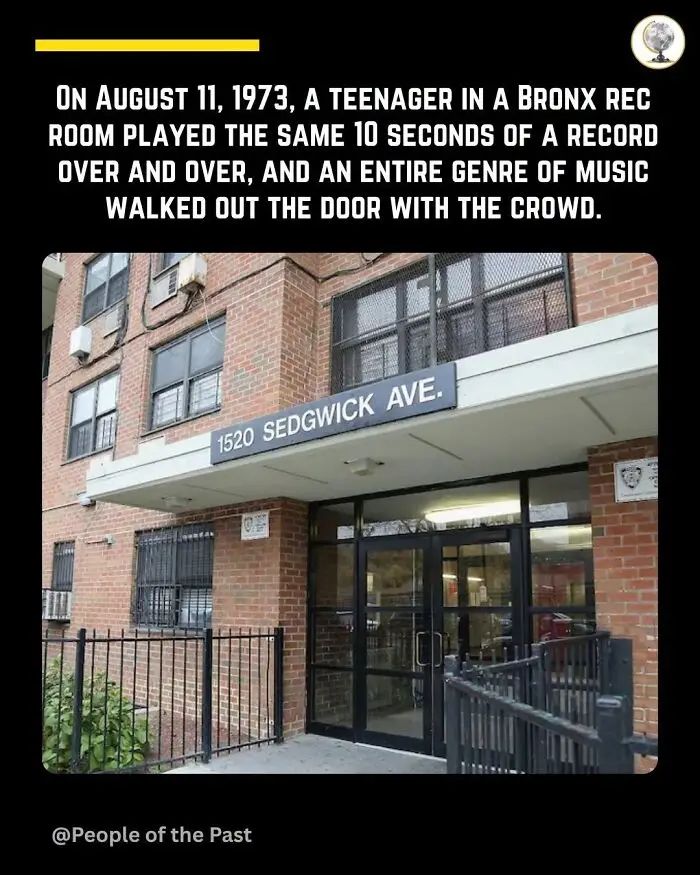
The rec room at 1520 Sedgwick Avenue was nothing special. Linoleum floor, folding chairs, a low ceiling, the kind of space a Bronx apartment building set aside for birthday parties and tenant meetings.
On August 11, 1973, Cindy Campbell rented it out for a back-to-school party.
She was 16 and wanted new clothes for the fall semester. The plan was simple. Charge a quarter at the door for girls, 50 cents for boys, sell sodas, and let her older brother handle the music. Her brother went by DJ Kool Herc. His real name was Clive.
Clive had been experimenting. He'd noticed that the part of a record people actually wanted to dance to was the instrumental break, the few seconds where the vocals dropped out and the drums took over. Most DJs played the whole song. Clive wanted just the break.
So he bought two copies of the same record, put them on two turntables, and figured out how to cue the second one up while the first was playing. When the break ended on one, he'd switch to the other and play the break again. Then back. Then back again. He called it the merry-go-round.
That night in the rec room, he stretched a 10 second drum break into minutes.
The dancers went off. People who had been bobbing along started doing something different on the floor, moving in the break itself, working the rhythm in ways nobody had names for yet. They'd be called b-boys and b-girls. The break gave them their name.
Herc's friend Coke La Rock grabbed the mic and started talking over the records, calling out names of people in the room, riffing on the rhythm. He wasn't singing. He was doing something else.
By the time the party ended, the four pieces were in the room. The DJ working the breaks. The MC on the mic. The dancers in the cypher. The crowd that knew it was watching something it had never seen.
Cindy made enough for her school clothes.
Clive kept doing parties, first in the rec room, then in the park across the street, then everywhere. Within a few years the South Bronx had a whole movement. Within a decade it had reached the rest of the country. Within 20 years it was the dominant sound on the planet.
1520 Sedgwick Avenue is still standing. In 2007 New York State recognized it as the birthplace of hip-hop.
A quarter at the door. Two turntables. A teenager trying to help his sister buy jeans.
Report
9points
#48
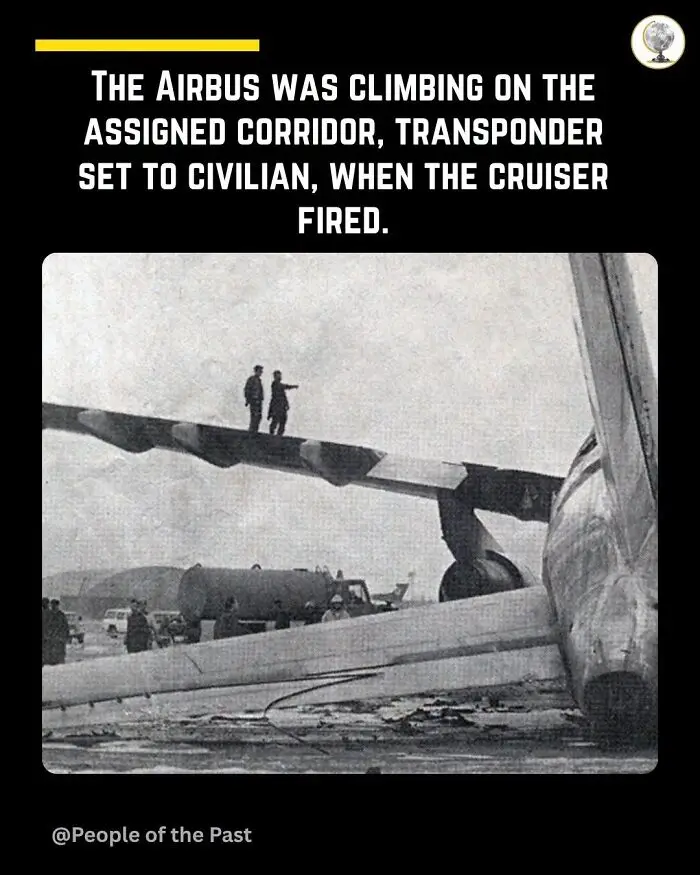
Captain Mohsen Rezaian lifted off from Bandar Abbas at 10:17 a.m. on July 3, 1988. He was 38 years old, flying a routine 28 minute hop across the Persian Gulf to Dubai. The Airbus A300 carried 290 people. Sixty-six of them were children.
Flight 655 was climbing through 13,500 feet on Amber 59, the assigned commercial air corridor, when the USS Vincennes locked on.
The Vincennes was a guided missile cruiser. That morning it was inside Iranian territorial waters, engaged in a surface skirmish with small Iranian gunboats. In the combat information center, officers misidentified the climbing Airbus as a descending F-14 Iranian fighter. The plane's transponder was broadcasting on the civilian Mode III channel. The radar contact was ascending, not descending. The flight was on schedule, on course, and squawking the right code.
None of that reached the firing decision.
At 10:24 a.m., seven minutes into the flight, two SM-2MR missiles left the Vincennes. One struck the Airbus near the left wing. The aircraft broke apart over the water.
Wreckage drifted for weeks. Iranian fishermen and recovery crews pulled bodies and luggage from the Gulf into August. A child's shoe. A wedding dress in a suitcase bound for a ceremony in Dubai. The seat cushions floated longest.
The initial U.S. account placed the Vincennes in international waters and described the Airbus as descending in attack profile. Both claims were later corrected. In 1992, Admiral William Crowe acknowledged on Nightline that the Vincennes had been inside Iranian territorial waters when it fired. The Pentagon's own investigation confirmed the Airbus had been climbing the entire time, on the correct corridor, on the correct transponder code.
The United States never formally apologized. In 1996 it agreed to pay $61.8 million in compensation to the families of the 248 Iranian victims, settling the case at the International Court of Justice without admitting legal liability.
Captain Rezaian's last radio transmission was a routine readback to Bandar Abbas approach control. The cockpit voice recorder was never recovered.
He had been in the air for seven minutes
Report
9points
#49
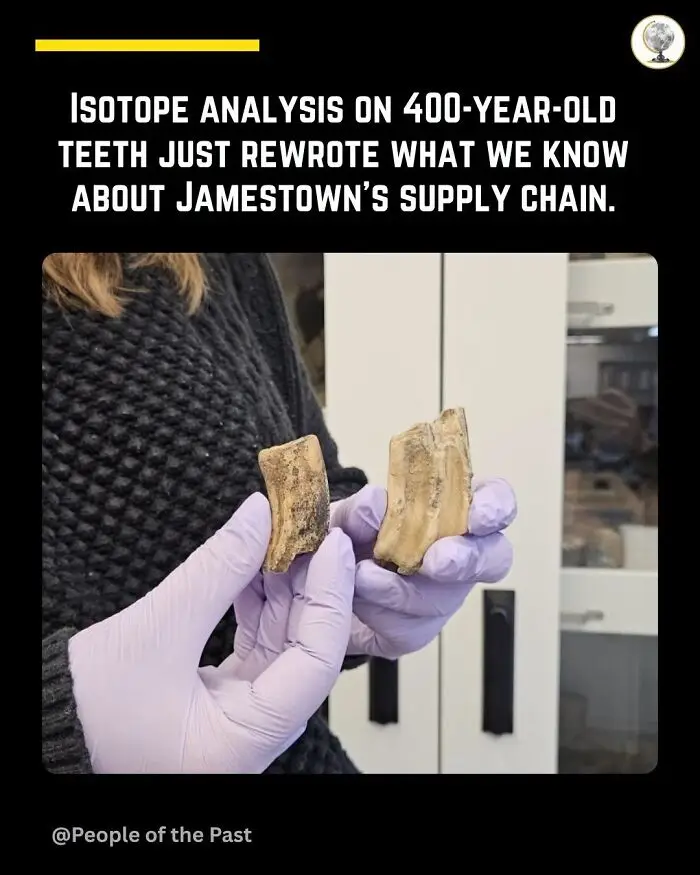
The trash pit told the story before anyone wanted to hear it.
In the winter of 1609, Jamestown was dying. The colony had swelled to around 300 people that summer. By spring, only about 60 were left alive. The survivors called it the Starving Time, and the bones in the ground showed exactly what that meant.
Archaeologists working at the James Fort site pulled butchered remains from refuse pits filled during that winter. Horses. Dogs. Rats. A young girl whose skull bore cut marks consistent with cannibalism. And donkeys, their bones broken open for marrow, the same way you'd process any other meat animal when there was nothing else left.
Donkeys were not supposed to be there.
The Virginia Company records make no mention of shipping them. England barely used donkeys as draft animals in this period. Yet here they were, eaten down to the bone inside an English fort on the Chesapeake.
Recent isotope analysis on the teeth pointed somewhere unexpected. The strontium and oxygen signatures locked into the enamel while the animals were young didn't match England. They didn't match Virginia either. They matched West Africa.
That single finding cracks open a story the official records never told.
The most likely route runs through the Cape Verde Islands and the Canaries, where Portuguese and Spanish traders kept donkeys as pack animals and resupplied passing ships. English vessels heading for Virginia stopped in these waters regularly, picking up water, salt, livestock, and whatever else could be bought or taken. Some of those stops were sanctioned. Many were not. Captains ran private trades on the side, and the Virginia Company in London had only the faintest idea what was actually being loaded onto its ships.
The donkeys were almost certainly meant for hauling. Building timber, dragging plows, moving barrels of grain from the landing to the storehouse. They were infrastructure on four legs, brought in quietly to keep the colony functioning.
Then the siege came. Powhatan's warriors cut off the fort from the surrounding country through the fall and winter of 1609. No hunting parties could leave. No trade could come in. The supply ship from England had wrecked in Bermuda. The colonists ate their horses first, then their dogs, then the donkeys that had crossed an ocean to plow Virginia soil.
When the survivors were finally relieved in May 1610, they were ready to abandon the colony entirely. They got as far as the mouth of the river before another fleet turned them back.
The bones stayed in the pit for 400 years, waiting for someone to ask where they came from.
Report
9points
#50

Mileva Maric walked into Zurich Polytechnic in 1896 as the only woman in her physics section, and the fifth woman ever admitted to the program.
She was Serbian, brilliant, and walked with a limp from a congenital hip dislocation. Her father had fought to get her the kind of education that women in the Austro-Hungarian Empire were not supposed to receive. She had already topped her class in Zagreb after special permission was granted for her to attend physics lectures with the boys.
At the Polytechnic, she met Albert Einstein. They studied together, argued together, shared books and notes and long evenings of equations. He wrote her letters that referred to "our work" and "our theory of relative motion." Whether that phrasing meant intellectual partnership or simply a young man in love writing tenderly to the woman he wanted is something historians still argue about.
In 1900, Einstein passed his final exams. Mileva failed hers. She tried again in 1901 and failed a second time. She was pregnant by then, carrying Einstein's child. The baby, a girl named Lieserl, was born in Serbia in 1902 and then disappears from the historical record entirely. No one knows what happened to her.
Mileva and Einstein married in 1903. The 1905 papers followed, the ones that rewrote physics: special relativity, the photoelectric effect, Brownian motion, mass-energy equivalence. Some of Einstein's letters from this period mention her involvement. The original manuscripts have not survived. Claims that she co-authored the work are not supported by documentary evidence. Claims that she had nothing to do with it ignore the letters in which Einstein himself suggests otherwise.
The truth sits somewhere we cannot fully reach.
The marriage came apart. By 1914, Einstein had moved to Berlin and fallen for his cousin Elsa. He sent Mileva a list of conditions for staying married, including that she serve him three meals a day and stop speaking to him when he asked. She left with their two sons.
The divorce was finalized in 1919. As part of the settlement, Einstein promised Mileva the money from any future Nobel Prize. He won it in 1921. He paid her, as agreed. She used much of it to care for their younger son Eduard, who developed schizophrenia and spent decades in a Zurich psychiatric hospital.
Mileva died in Zurich in 1948, in a small apartment, mostly forgotten.
What she contributed to the 1905 papers may never be settled. What is certain is that she was there, in the room, in the math, in the marriage, when the work was done.
Report
8points
#51
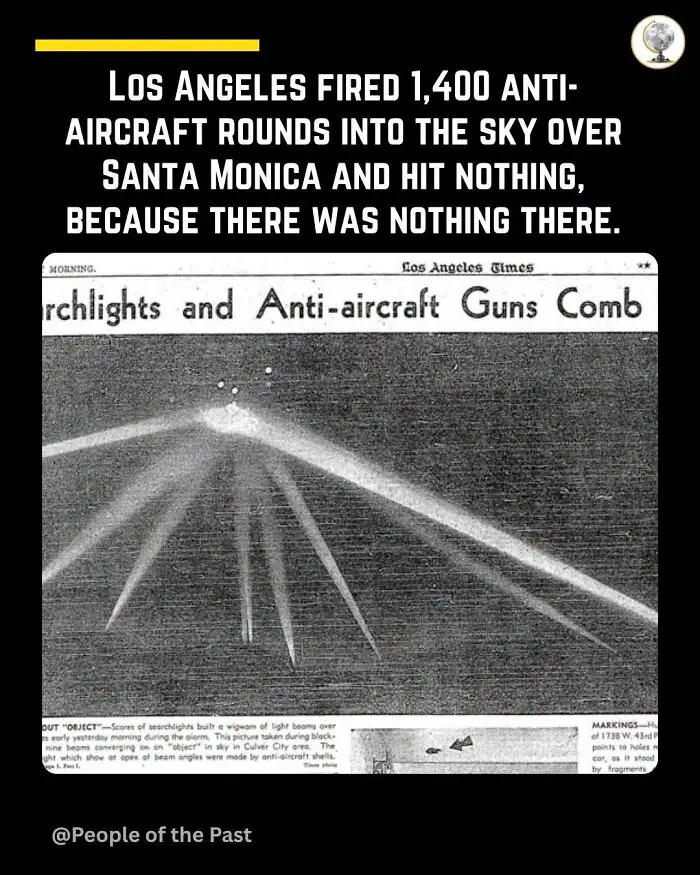
At 3:16 a.m. on February 25, 1942, the air raid sirens went off across Los Angeles.
Searchlights swept the sky over Santa Monica. Anti-aircraft batteries opened up from Inglewood to Long Beach. Tracer fire streaked above rooftops while half a million people sat in blacked-out houses, listening to their windows rattle.
The gunners fired 1,400 rounds in about an hour.
They were firing at nothing anyone could ever confirm. No bombs fell. No aircraft were shot down. No wreckage was recovered the next morning, despite shrapnel raining back onto streets and rooftops across the city.
Three months earlier, Pearl Harbor had been hit. The night before the Los Angeles incident, a Japanese submarine had surfaced off Santa Barbara and shelled an oil field at Ellwood. The whole West Coast was raw with the certainty that the next attack was coming.
So when radar picked up an unidentified target about 120 miles west of Los Angeles in the early hours of February 25, the response moved fast. Blackout ordered at 2:25 a.m. Sirens at 3:16. The 37th Coast Artillery Brigade opened fire shortly after.
What the gunners were aiming at is still not clear.
Witnesses described slow-moving objects, fast-moving objects, formations of planes, a single balloon, nothing at all. Newspaper photographers captured searchlights converging on patches of smoke that may have been their own flak bursts. Reports came in of a craft hit dozens of times that refused to fall. None of it held up under daylight.
The morning after, the Secretary of the Navy, Frank Knox, called it a false alarm caused by war nerves. The Secretary of War, Henry Stimson, said as many as 15 planes had likely been involved, possibly commercial aircraft flown by enemy agents to map defenses. The two statements contradicted each other within 24 hours and were never reconciled.
A weather balloon released by the Army earlier that night was later floated as the most likely trigger. Nobody could prove it.
Five civilians died during the raid. Three from heart attacks brought on by the noise and the panic. Two in car crashes on blacked-out streets. Houses and cars across the city were damaged by falling shrapnel. One unexploded shell punched through the roof of a home in Long Beach.
In 1983, the Office of Air Force History concluded the most likely cause was weather balloons combined with jittery gunners and war nerves feeding on each other. That has never satisfied everyone.
What the record actually shows is a city that had been bracing for an attack for almost three months, a radar contact in the dark, and a chain of human decisions made under enormous pressure.
The sky over Santa Monica was empty. The fear was not.
Report
7points
#52

He could swallow a live eel whole. He could eat a meal meant for 15 men in one sitting. And the French army thought they could use him.
Tarrare was born around 1772 in rural France, and by his teens his parents had thrown him out. He couldn't stop eating. A normal household couldn't feed him, so he drifted across the countryside, working with a band of thieves and prostitutes before landing with a traveling showman.
The act was simple. Tarrare would swallow corks, stones, live animals, whatever the crowd put in front of him. People paid to watch.
When the Revolutionary Wars broke out, he enlisted. The army rations weren't close to enough. He was found in the gutters eating refuse, in hospital kitchens stealing from patients, and once drinking the blood of men being bled by surgeons. They sent him to a military hospital in Soultz, where the doctors couldn't make sense of him.
General Alexandre de Beauharnais heard about the man who could eat anything and saw a use for him.
The plan was this: Tarrare would swallow a wooden box containing a secret document, walk through Prussian lines disguised as a German peasant, and pass the box in his stool to a French colonel held prisoner on the other side. They tested him first by feeding him a box stuffed with paper. It came out the next day, intact.
He was sent across the border. He didn't speak a word of German. The Prussians caught him almost immediately, beat him, and held him for over a day before he passed the box and confessed everything. He was strung up to be hanged, then cut down at the last moment and dumped back across French lines.
Tarrare went back to the hospital and begged the doctors to cure him. They tried laudanum, tobacco pills, wine vinegar, and soft-boiled eggs. Nothing worked. He was eventually thrown out of the hospital after being suspected of eating a 14 month old child who had vanished from the ward.
He died in Versailles in 1798, at around 26, of tuberculosis complicated by severe diarrhea.
The autopsy notes survive. His esophagus was so wide that surgeons could see down into his stomach when his jaw was held open. His stomach filled most of his abdominal cavity, lined with ulcers, packed with pus. The surgeons refused to continue the dissection because of the smell.
What was wrong with him has never been settled. Modern doctors have guessed at hyperthyroidism, a damaged amygdala, or a polyphagia tied to some undiagnosed brain injury. None of it explains all of it.
He was buried in Versailles. No monument. No marker. Just a name in a medical journal and a single line from the surgeon who opened him up, describing a body that had spent its whole short life trying, and failing, to be full.
Report
7points
#53
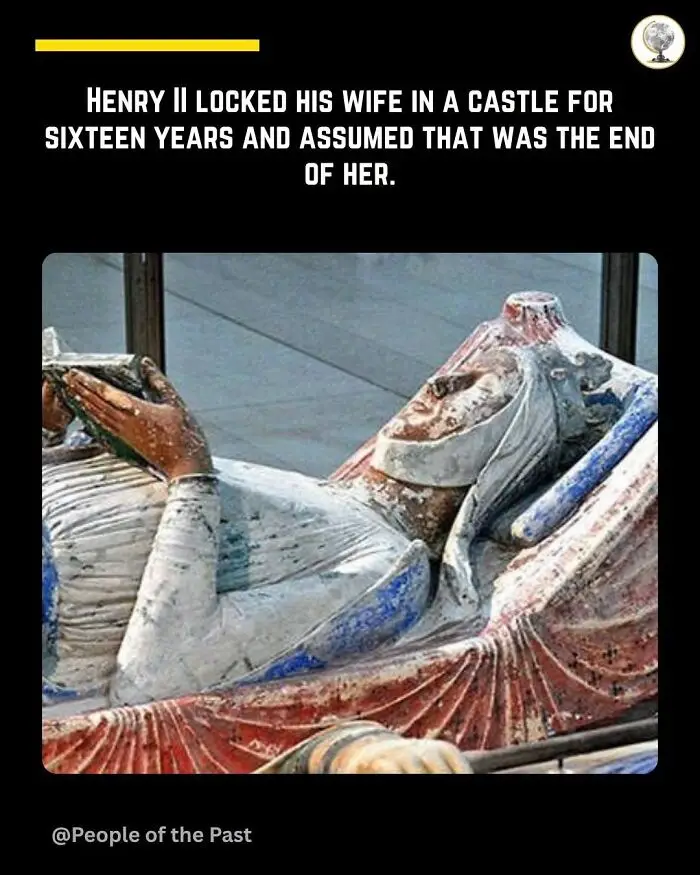
In 1173, Eleanor of Aquitaine made a choice that would cost her sixteen years of her life.
She backed her sons in open rebellion against their father, Henry II of England. The plan was simple in theory: her three eldest, Henry the Young King, Richard, and Geoffrey, would seize what their father refused to share. Eleanor, ruling her own duchy of Aquitaine, threw her weight and her wealth behind them.
The rebellion collapsed within a year.
Eleanor tried to flee to the French court, reportedly disguised as a man. Henry's men caught her before she crossed into safety. She was the Queen of England, Duchess of Aquitaine, former Queen of France, mother of future kings. None of it saved her.
Henry locked her up.
For the next sixteen years she was moved between royal castles, Sarum, Winchester, Berkhamsted, kept under guard and away from politics. She was allowed out occasionally for ceremonial appearances, Christmas at court, a royal wedding, the kind of moments that reminded everyone she still existed. Then back into confinement.
Her sons kept dying. Henry the Young King in 1183, of dysentery, begging his father for mercy on his mother as he went. Geoffrey in 1186, trampled at a tournament. Eleanor mourned them from behind walls.
Henry II died in 1189, broken by another rebellion, this one led by Richard.
The first order Richard gave as king was to free his mother.
She walked out at sixty seven years old. Most women of her era were long dead by that age. Eleanor was just getting started again. Richard left almost immediately for the Third C*****e, and Eleanor ruled England as regent in his place. She managed the treasury, kept the barons in line, and held the kingdom together while her son fought in the Holy Land.
When Richard was captured on his way home and held for ransom by the Holy Roman Emperor, it was Eleanor who raised the staggering sum of 100,000 marks of silver. She personally escorted him back to England.
She outlived Richard too. When he died in 1199, she was nearly eighty, and she rode south to secure Aquitaine for her youngest son, John. At seventy seven she crossed the Pyrenees to collect her granddaughter Blanche of Castile and deliver her to a French marriage that would shape European politics for generations.
She died in 1204 at the abbey of Fontevraud, around eighty two years old.
Sixteen years in a cell. Fifteen more years running half of Europe.
Report
7points
