




The winners of the Nature Photographer of the Year 2025 have been announced, celebrating the very best in nature photography from around the world. From breathtaking wildlife moments to stunning landscapes and unique perspectives on plants and fungi, this year’s competition received a record 24,781 entries from photographers in 96 countries.
This year’s overall winner, Åsmund Keilen from Norway, impressed the judges with his photo of a bird flying against the glowing summer sun, creating a magical and dreamlike moment. Alongside him, photographers from across the globe were recognized in categories including mammals, underwater scenes, plants, human and nature, and more. Each winning image invites viewers to pause, reflect, and marvel at the incredible diversity of life on our planet.
#41 Category Plants And Fungi | Category Winner: "Inferno" By Tobias Richter, Germany

"Blazing flames, glowing tree trunks, and illuminated plumes of smoke. In July 2022, the Elbe Sandstone Mountains experienced their largest documented forest fire. A natural disaster of this magnitude in the core area of my daily photographic work was hard to imagine, despite the known circumstances.
The dry, hot summers of recent years had allowed bark beetles to proliferate, and a significant portion of the spruce stands had fallen victim. High visitor pressure in the national park, along with the associated risk of fires, is unfortunately common in many areas. The landscape so familiar to me was about to change in ways I could not yet comprehend. I resolved to document this transformation continuously, capturing both the fire and its recovery over the following years."
3points
#42 Category Black And White | Runner-Up: "Night Swan Lake" By Mateusz Matysiak, Poland

"The fish ponds of the Barycz Valley, where I grew up, have always been one of the main breeding grounds for Mute Swans in Poland. During my school years, I spent most of my time in my valley counting water birds, especially swans, geese, and ducks.
For my master’s thesis, I naturally chose anseriformes, with swans at the forefront, the same species I had been studying throughout my youth on my ponds. I still have a great fondness for swans to this day. Nowadays, although I spend much of my time in the mountains and forests, I visit ponds with binoculars and a camera whenever I have the opportunity.
This was also the case one September evening when I went for a walk to the ponds in the Pisia Gągolina Valley in Mazovia. At one of the forest ponds, where a White-tailed Eagle had been hunting, I noticed a commotion among the birds. The startled ducks flew away, but the swans remained, swiftly swimming in unison to the safety of the pond. Dusk was falling, and the light was fading fast, especially as the pond lay on the edge of a dark forest. Yet the forest still shimmered faintly with the pale trunks of birch trees. The water was calm and perfectly smooth. I love minimalist shots, which I try to capture in the last remnants of daylight, especially in low-key photography. The strong contrast between the white birds, the dark surface of the water, and the forest wall created an opportunity to take new, intriguing shots, all the more so because the birch trunks were reflected in the smooth water as if in a mirror.
In the camera’s viewfinder, I saw a brilliant composition. I sensed that this was a chance to capture a unique photo of swans swimming through a dark corridor created by the bright streaks of trees and their reflections in the water. I did not have a tripod with me, so I had to shoot handheld, holding my breath as I smoothly followed the birds’ steady movement. One of the few long-exposure shots I took turned out perfectly. The result was a clean and harmonious composition. Once again, challenging lighting conditions helped me achieve one of my favourite photographs, and fittingly, it featured my beloved swans."
3points
#43 Category Birds | Highly Commended: "Stern Gaze" By Tibor Litauszki, Hungary (Country Of Origin Germany)

"A Pygmy Owl peers sternly from its nest hole. To capture the envisioned image, I waited a long time near the owl’s nest. When it finally looked out, I took the first photo with a telephoto lens, then switched lenses to capture a second shot of the blue twilight using in-camera multiple exposure and a long shutter speed."
3points
#44 Category Landscape | Highly Commended: "The Swan Lake" By Terje Kolaas, Norway

"Low temperatures cause most lakes and rivers around my home in Levanger, Norway, to freeze during winter, but one specific river usually stays open longer than the others. Here, a group of Whooper Swans often resides through the season. On this particularly cold day in February, fresh snowfall had transformed the ice and forest along the riverbanks into a pristine white landscape, conditions I absolutely love for photography. During a drone flyover, I spotted a narrow passage in the river and decided to wait for the birds to swim through it. After a few hours, my patience paid off, and with the drone hovering high and unobtrusive above the swans, this image was captured.
I wanted to retain some of the motion in the falling snow, so I used a long shutter speed to render the snowflakes as delicate streaks rather than spots.
Another important goal was to keep the birds visually separated. In this photograph, none of the swans overlap, which, in my opinion, makes a huge difference."
3points
#45 Category Plants And Fungi | Highly Commended: "The Underside Of Wonder" By Julius Kramer, Germany

"It was a grey, rainy spring day when I decided to head out with my camera. The forest was quiet, wrapped in mist and the steady rhythm of raindrops on leaves. I had no particular goal in mind, just the curiosity to see whether the first mushrooms of the season had appeared.
Not far from the road, I spotted a strikingly large Dryad’s saddle (Cerioporus squamosus) clinging to a tree trunk. Its patterned surface stood out vividly against the bark, almost glowing in the diffuse light of the rain.
For the next two hours, I explored every angle, experimenting with perspectives, light, and composition. Drops of water gathered on the cap, tiny mirrors reflecting the world around them, and I tried to capture each fleeting detail. Time seemed to disappear in the process, just me, the mushroom, and the camera.
By the time I finally packed up, both my gear and I were completely drenched. Yet I felt a deep sense of exhilaration. What had started as a simple walk in the rain had turned into an intimate photographic study, a reminder that even the most ordinary subjects, when given time and attention, can reveal extraordinary beauty."
3points
#46 Category Other Animals | Highly Commended: "Air Bubbles" By Lars Beygang, Germany

"With the arrival of the first warm days of spring, the spawning season of common frogs begins. Frogs gather in ponds, lakes, and other waters to find a mate and lay their clumps of eggs, which float on the surface. After about two to three weeks, the tadpoles hatch, and the cycle of transformation begins. In their first days, they cluster near the surface, feeding on the remnants of their eggs, which creates an ideal moment for observation and photography.
One sunny day, I returned to my local pond, where I had found many clumps of eggs weeks earlier. The tadpoles had just hatched, and small air bubbles shimmered on the surface. I set up my tripod above the water, hoping to capture both elements in a single composition. Eventually, I found a section where one half of the frame held a cluster of bubbles and the other half a gathering of tadpoles. To soften the contrast, I used my hand to shade the sunlight and create more even lighting.
With this photograph, I hope to draw attention to the declining spawning grounds of frogs and toads. In the weeks that followed, very little rain fell, and the water level in this pond dropped dramatically, threatening the survival of the tadpoles. Unable to watch them dry out, I carefully relocated them to a nearby pond, hoping to give them a better chance to continue their journey."
2points
#47 Category Nature Of “De Lage Landen” | Runner-Up: "Jackdaws At Dusk" By Mathijs Frenken, The Netherlands
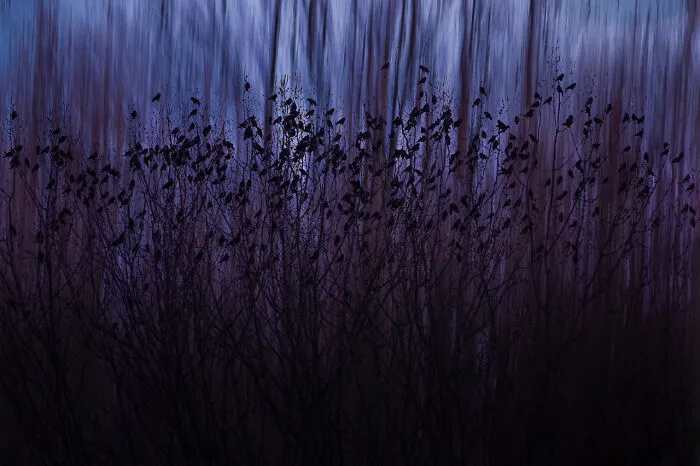
"To capture the feeling of dusk, I combined two different techniques in a multiple exposure. First, I used a long exposure with intentional camera movement (ICM) to blur the background trees into soft, painterly streaks of colour, creating an abstract, dreamy atmosphere. Then, I took a second, shorter exposure of the jackdaws in the trees. By layering these two images, the sharp silhouettes of the birds contrast beautifully with the hazy backdrop. The result is a moody and serene image that captures the quiet moment when the birds settle down for the night."
2points
#48 Category Black And White | Highly Commended: "Life In A Box" By Sarthak Agrawal, India

"The owl roost is located beside a flyover in the bustling city of Aurangabad, nestled within a residential apartment complex. I have been observing and documenting this barn owl roost for six to seven years. Despite its open location, the roost remains hidden from public view, offering a safe haven for the owls amidst the city’s ceaseless activity.
Initially, my focus was on close-up portraits and action shots, but over time, I shifted towards capturing the wider context of its urban environment.
This image holds a special place in my heart due to its unique composition. The juxtaposition of the owl’s small, dark roost against the stark black-and-white geometric pattern of the building creates a striking visual contrast and an almost claustrophobic atmosphere. Yet, the owl’s calm, relaxed demeanour amidst this urban chaos is a testament to its adaptability. A closer look reveals a second owl quietly tucked away in the shadows of the roost.
This image holds a special place in my heart due to its unique composition. The juxtaposition of the owl’s small, dark roost against the stark black-and-white geometric pattern of the building creates a striking visual contrast and an almost claustrophobic atmosphere. Yet, the owl’s calm, relaxed demeanour amidst this urban chaos is a testament to its adaptability. A closer look reveals a second owl quietly tucked away in the shadows of the roost.
Barn owls in my region are strictly nocturnal, making daytime sightings very rare. This shot was only possible during the breeding season, when the roost is full of chicks and the parents are forced to guard from the edge during daylight hours. I didn’t use bait.
Through this image, I aim to challenge the misconceptions surrounding barn owls in India. They are often misunderstood and feared due to superstitions associating them with bad luck, messengers of death, or black magic, which leads many to shun, harm, or kill these creatures. By highlighting their quiet resilience and natural charm, I hope to foster a sense of admiration and understanding for these fascinating birds."
2points
#49 Category Animals Portraits | Runner-Up: "Beast In Black" By Daniela Graf, Germany
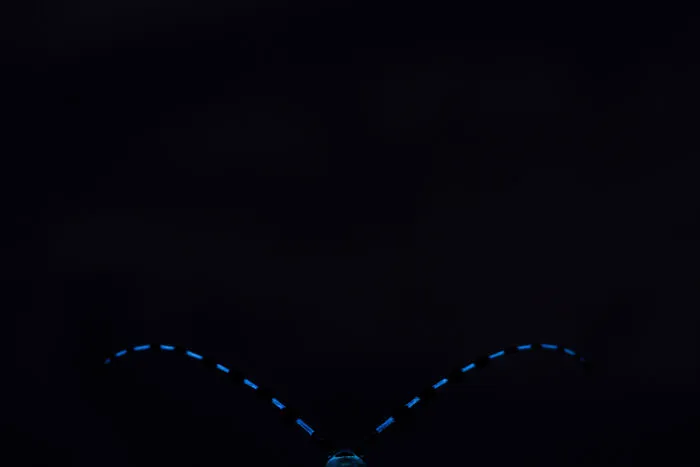
"The alpine longhorn beetle (Rosalia alpina) is one of my favourite animals to photograph. I’m completely in love with these very impressive blue beetles, especially their long antennae. On this day, a female beetle with beautifully curved antennae sat on a log in the shadows. I decided to underexpose the picture to emphasise the blue colour against a black background. The title of the image refers to a Finnish metal band.
I’m glad that there is a population of alpine longhorn beetles on the Swabian Alb. As a relic of the last Ice Age, it represents the only autochthonous population in Germany outside the Alps. To reproduce, they need the dead wood of European beeches. After mating, the females lay their eggs within the cracks of the timber. The larvae remain inside the wood and also pupate there. It takes about three or four years before the adult beetles emerge from the wood. These adults live only for about three weeks, as their only purpose is to ensure the continuation of the species. There are several projects to protect the beetles. Due to their life cycle, dead wood has to remain in the forest for years. Unfortunately, the beetles also deposit their eggs in dead wood that is used as firewood; as a result, those beetles have no chance to develop."
1point
#50 Category Birds | Highly Commended: "Flock Of Gold" By Alex Pansier, The Netherlands
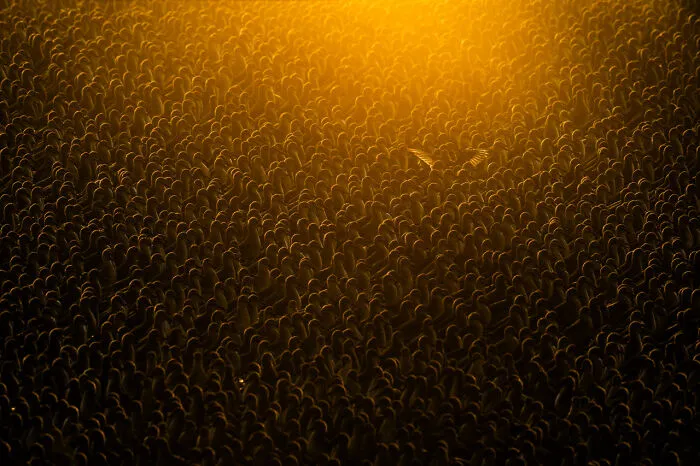
"At sunrise in September 2024, tens of thousands of Red Knots (Calidris canutus) gathered at Snettisham, Norfolk, England. The flock formed a dense golden cloud – a natural survival strategy during high tide that helps protect them from predators while conserving energy.
I positioned myself behind a sandbank so the birds would not notice me, with only my lens protruding above the ridge. Using my iPhone, I could remotely monitor what my camera was capturing. This careful approach allowed me to remain invisible while photographing their natural behavior.
Amid this fluid mass, one bird briefly broke away from the group. Its wings caught the first light of day, creating a striking contrast between individuality and the collective. This fleeting moment became the essence of the photograph. No baiting or attraction was used; the image reflects the birds’ natural behavior in their roosting grounds.
Red Knots are remarkably long-distance migrants, traveling up to 15,000 km each year between Arctic breeding grounds and wintering areas. Sites like Snettisham provide essential resting and feeding habitats along their journey. Observing their coordination and resilience in such numbers was both humbling and inspiring."
1point


