




The winners of the Nature Photographer of the Year 2025 have been announced, celebrating the very best in nature photography from around the world. From breathtaking wildlife moments to stunning landscapes and unique perspectives on plants and fungi, this year’s competition received a record 24,781 entries from photographers in 96 countries.
This year’s overall winner, Åsmund Keilen from Norway, impressed the judges with his photo of a bird flying against the glowing summer sun, creating a magical and dreamlike moment. Alongside him, photographers from across the globe were recognized in categories including mammals, underwater scenes, plants, human and nature, and more. Each winning image invites viewers to pause, reflect, and marvel at the incredible diversity of life on our planet.
#21 Category Youth | Highly Commended: "A Unique Home" By Vidyun Hebbar, India

"My father and I often look for wildlife in unique urban places, such as abandoned cars and scooters near our house in Bangalore, India. In one such vehicle—an old scooter—I found a Moorish Wall Gecko hiding inside the broken handlebar. When I returned a few days later, I discovered a second gecko in the same spot. I was fascinated by how these geckos managed to thrive in the middle of such an urban environment. To capture all their details, I used a head torch to illuminate the scene."
5points
#22 Category Other Animals | Highly Commended: "Above The Parapet" By Phil Hall, United Arab Emirates (Country Of Origin UK)

"Everyone has an opinion about Dubai. Most people see only one side, the glossy version popularised on social media. Yet behind that façade lies a rich and diverse ecosystem. Conservation efforts and habitat protection have created an environment that supports an astonishing range of wildlife.
Still, the desert remains fiercely inhospitable, rivalled perhaps only by polar landscapes. Any animal that calls the dunes home commands respect. The Sandfish Skink is one such desert specialist, its name reflecting its uncanny ability to swim through the sand. This talent helps it regulate body temperature and escape the extreme desert heat, which can soar well beyond 50°C in summer.
For this hot June shoot, my intended subject was the Arabian Oryx. I perched high on the crest of a dune, with a wide desert vista stretching out before me. The heat was relentless, and prevailing north-westerly winds blasted a constant stream of sand, making conditions even more hostile. I had been waiting patiently as a group of Oryx slowly traversed the dunes when, just a few metres away, I noticed a tiny Sandfish cautiously climbing the vast slope toward me.
I adjusted my settings and shifted my position, careful not to startle it, encouraging its slow ascent. My face and camera were fully exposed to the stinging winds as I waited. The Sandfish climbed slowly, higher and higher, until it reached the peak of the dune. My finger pressed firmly on the autofocus button, ready. Then, at last, its head lifted above the crest. For a brief moment, it paused, taking in a rare respite, and I pressed the shutter.
This image is one I am immensely proud of. It captures not only the hostility of the desert but also the hidden small-scale dramas that unfold daily beyond our view, moments that reveal a side of Dubai few ever see."
Report
5points
#23 Category Other Animals | Runner-Up: "Blue Army" By Imre Potyó, Hungary

"After several decades of absence, the spectacular and endangered Danube mayfly (Ephoron virgo) returned to the River Danube in 2012, likely due to improving water quality. This species had disappeared from Central European rivers for decades as a result of water pollution.
The summer of 2024 will undoubtedly be remembered by enthusiasts, as this year’s season, likely prolonged by dry, hot weather and persistently low water levels, lasted nearly a month. On 25 occasions, we waded deep into the strong currents, surrounded and overwhelmed by the swarms.
One massive swarm of Danube mayflies approached the illuminated city of Szentendre, Hungary. Drawn by the city lights through their strong positive phototaxis, millions of insects swarmed toward the brightly lit promenade. Last summer, streetlamps along the Danube promenade in Szentendre were overwhelmed on multiple evenings.
During the late-August festival, dense clouds of mayflies engulfed restaurants, vendors, wine bars, and concerts, creating both an unmissable and alarming spectacle. The insects circled the lights for hours, unable to escape, before falling to the asphalt, where they perished. Such evenings can cause ecological damage worth billions, as countless mayflies die along with the egg clusters that would have ensured the next generation."
5points
#24 Category Nature Of “De Lage Landen” | Highly Commended: "Fantasy Tree" By Mathijs Frenken, The Netherlands

"My goal for this image, Fantasy Tree, was to capture the mood of a fresh autumn morning, my favourite time of year. I used a multiple exposure technique, taking several shots on a chilly morning to create a sense of ethereal beauty. By combining the images, I layered the tree’s branches to create a dense, intricate pattern. The soft, watery sun breaking through the branches adds a single point of light, giving the otherwise cool scene a subtle glow and making the tree feel almost dreamlike."
5points
#25 Category Nature Art | Runner-Up: "Injured Guillemot" By Knut-Sverre Horn, Norway
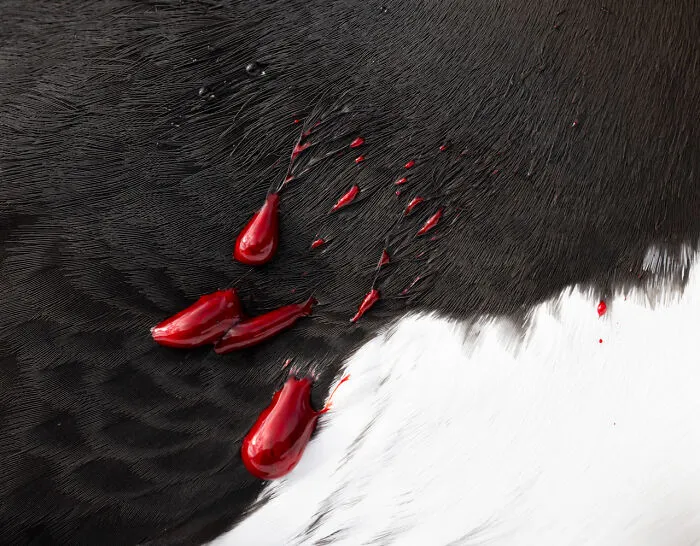
"I thought the guillemot was about to die when I found it lying still on the ground, partly covered in blood running from its right eye, on Hornøya, Varanger, Northern Norway. An hour earlier, I had been quite annoyed to realize that my brand-new macro lens was still in the camera bag, as I don’t like to haul around more gear than I’ll actually use. Now, the lens came in handy after all. The drops of blood made a striking contrast against the dark brown and white feathers.
I kneeled down and took a few photos with different framings and angles when the bird suddenly took flight. It was apparently able to see me with its left eye. I don’t know what caused the injury, but guillemots may fight fiercely, and I have also seen them collide mid-air when they circle the colony in huge swarms. Hornøya is one of my favourite places, and I take ninety-nine percent of my images close to my home in Varanger."
5points
#26 Category Mammals | Highly Commended: "No Fear, No Mercy" By Tomasz Szpila, Poland

"Some of Africa’s most fascinating animals are not its largest, but its smallest warriors. Among them, the honey badger (Mellivora capensis) has earned a reputation for unmatched courage and determination. Despite its modest size, this fearless predator can fend off much larger adversaries, often attacking with surprising aggression and stamina. Protected by exceptionally tough skin and a natural resistance to bites and stings, honey badgers have the tools to survive encounters that would doom most other animals. Yet, as with all creatures, youth and inexperience can tip the scales, making young individuals especially vulnerable to apex predators such as lions.
It was early one morning on the open plains near Lake Ndutu, in the southern Serengeti ecosystem, that I witnessed a dramatic and rare confrontation between these two iconic species. A young lion, full of energy and curiosity, had managed to corner a honey badger. At first glance, the scene appeared almost playful: the lion pawing, circling, and testing its opponent, as if enjoying a game. But for the honey badger, the reality was far from a game. Exhausted, breathing heavily, and with limited options for escape, it summoned all its strength and ferocity in a desperate attempt to resist.
Watching the two locked in this uneven battle was a stark reminder of the harsh realities of the natural world. The honey badger’s legendary reputation for fearlessness was on full display; it snapped, lunged, and refused to submit, even in the face of overwhelming odds. The young lion, however, held the advantage in both size and stamina, gradually wearing its opponent down. This time, the outcome was clear: the lion prevailed, asserting dominance over one of Africa’s most resilient fighters.
Encounters like this highlight the constant struggle for survival on the savanna, where even the fiercest spirit cannot always overcome sheer strength. In the end, the bravery and tenacity of the honey badger serve as a powerful symbol of wild resilience, but they also remind us that courage alone is not always enough to defeat a much stronger adversary."
5points
#27 Category Black And White | Highly Commended: "Tails And Paws" By Dvir Barkay, United States Of America

"The image was captured in the Ishasha sector of Queen Elizabeth National Park in Uganda. We found the famous tree-dwelling African lions of the Ishasha sector early in the morning and spent a good portion of the day with them. The lions frequently changed positions as they rested in the trees, and at one point, the male turned his back on the female. With their tails and paws hanging lazily below them, I was able to capture this image."
5points
#28 Category Human And Nature | Highly Commended: "Two Giants" By Richard Peters, United Kingdom

"Mara North Conservancy in the greater Maasai Mara offers a wonderful array of wildlife. The reserve is easy to navigate thanks to a central road that runs through the middle, which is periodically resurfaced to smooth out the bumps and ruts that build up over time. During a stay in the reserve, a large digger was left parked in the middle following recent maintenance work. The digger itself became a makeshift landmark for visitors to the park to gain their bearings. The entire time it was there, I thought it would be fun to photograph a giraffe or elephant near the digger as a way of showing how wildlife and humans coexist in this area.
One evening, we followed a herd of elephants that were slowly making their way towards the digger. I didn’t expect them to walk past it entirely, but some did indeed climb the small slope it stood on. Most went over the rise and continued on, but one stopped and walked around the back. Combined with the soft glow of a sunset sky, the moment was beautifully captured."
5points
#29 Category Underwater | Highly Commended: "Whoosh" By Geo Cloete, South Africa

"I live in a part of the world where exploration is limited only by imagination, the willingness to face challenges, and the knowledge of how to navigate them.
South African waters are home to sixty-three recognised species of sea anemones, among them the Sandy Anemone (Aulactinia reynaudi). These remarkable creatures have adapted to thrive in the turbulent intertidal zones and shallow waters along much of our shoreline, regions shaped by powerful swells and relentless wave action.
Their ability to flourish in such extreme conditions has always fascinated me. This image offers a glimpse into their world, a place of movement and stillness, vulnerability and strength, capturing the fleeting moment when the white water of a breaking wave rushes in and transforms their environment into something almost surreal.
Years of surfing and diving have taught me to read the moods of the sea — when it welcomes, and when it warns. That knowledge, combined with a vacuum sealed camera housing, allows me to safely enter their realm and witness this brief, mesmerising encounter between water, light, and life.
Although Sandy Anemones are capable of movement, they typically remain rooted in one spot for most of their lives, relying on the rhythm of the sea, the waves and tides, to deliver nourishment. Their quiet resilience mirrors the ocean itself: powerful, patient, and endlessly renewing."
5points
#30 Category Nature Of “De Lage Landen” | Category Winner: "Bike Tides" By Sam Mannaerts, Belgium

"This image was taken last winter during one of the only two snow days in Belgium. I live in Steendorp, about 100 metres from a river inlet (the Scheldt), where you can easily observe the tides. When I saw the low tide and the snow-covered patterns in the sludge, I decided to briefly fly the drone.
The snow was coming down quite heavily, and I didn’t want my drone to fall into the mud. So, for about two minutes, I flew over the inlet and took some photos. That’s when I noticed the bike in the mud. I loved the outlines the snow had created on the bike and the surrounding mud patterns, two things the Lowlands are known for, captured in one picture.
It also serves as an indictment of a society where illegal dumping seems to have become more the rule than the exception."
4points
#31 Category Human And Nature | Category Winner: "Difficult Crossing" By Xingchao Zhu, China

"This image was taken in March last year in Dulan County, Qinghai Province, China. Located on the Tibetan Plateau, the high altitude and harsh weather make everything challenging, including photographing wildlife. Although the Eurasian lynx is not as rare as the Iberian lynx, encountering one still requires great patience and a good deal of luck. Between March and April, their mating season, a Eurasian lynx was seen crossing a wire fence in a pastoral area while searching for a mate. The fragmentation of its territory makes survival increasingly difficult for wild animals."
4points
#32 Category Human And Nature | Highly Commended: "Echolocation" By Lana Tannir, Germany (Country Of Origin Croatia)

"Harbor porpoises (Phocoena phocoena) are small, elusive cetaceans found in coastal waters across the Northern Hemisphere. They rely on echolocation to navigate, communicate, and hunt. However, populations in many regions are declining due to human impacts such as underwater noise, pollution, overfishing, and bycatch in fishing nets.
At 30 years old, Freja is the most well-studied and oldest recorded harbor porpoise in the world. Since 1997, she has lived at Fjord & Bælt, a research facility in Kerteminde, Denmark, after being bycaught in a fisherman’s net and deemed non-releasable. Freja participates in non-invasive behavioral experiments such as this one, in which her eyes are covered with suction cups while she is asked to discriminate between two underwater targets, one made of aluminum and the other of plastic. A DTAG monitoring device on her back records her acoustic responses. Through these studies, scientists aim to understand how harbor porpoises use echolocation to hunt and how underwater noise affects their foraging abilities. Such research helps guide conservation strategies to support the survival of these elusive marine mammals in the wild.
This photograph was taken at the research station during one of these data collection sessions and is part of a larger photography project titled Saving the Harbor Porpoise. The project documents the work of scientists and conservationists in the North Sea and Baltic Sea, highlighting their efforts to study, protect, and raise awareness of this vulnerable species."
4points
#33 Category Plants And Fungi | Highly Commended: "Fallen Beauty" By Simon Booth, United Kingdom

"The photograph was taken while visiting family in Suffolk, not far from the village of Blythburgh. On that particular morning, I was out searching for subjects that might form the basis of a new video for my YouTube channel. For this reason, I filmed the entire process, from the moment I discovered the subject to capturing the final frame. You can watch the whole event unfold on my channel.
Whenever I head out with my camera, I usually aim to return with three images to feature in my videos, which are mostly centred on the genre of Intimate Landscapes. In these films, I often remind viewers that truly memorable photographs are rare. It is this very unpredictability that keeps me returning day after day, searching for those fleeting moments when nature unexpectedly reveals her most prized compositions. For me, it feels a lot like treasure hunting, and on this occasion, I even hinted that the scene I had found might be one of those special discoveries.
As it turned out, this was the final image I captured that morning, discovered just 100 yards from my campervan as I was about to call it a day. The subject was a fallen section of Scots pine, lying exposed in an open area long enough for its branches and cones to have been bleached pale by the sun. The moment I saw it, I sensed there was something compelling about it. It reminded me of frost, yet it was early summer. Choosing the composition did not take long, as this was the one part of the tree where the branches created the most pleasing pattern across the frame, with minimal gaps in the foliage. The irregular scattering of cones only added to its charm, almost inviting the viewer to count them; there are more than you might first expect."
4points
#34 Category Birds | Runner-Up: "King Penguins By The Pond" By Renato Granieri, United Kingdom (Country Of Origin Italy)

"I feel very fortunate to work as a photographer guide on small expedition ships. My lifestyle takes me to some of the most remote destinations, where I feel truly connected with nature. I have visited South Georgia, a sub-Antarctic island in the South Atlantic Ocean, on several occasions and spent considerable time photographing king penguins (Aptenodytes patagonicus) from land. Their charm keeps me returning again and again.
Molting penguins are a common sight in South Georgia. When king penguins undergo a molt, they shed and replace all their feathers at once over approximately four weeks. This process requires them to remain on land, as their old feathers are no longer waterproof, preventing them from hunting. During this time, they live off stored fat until their new, waterproof plumage is fully grown. To stay hydrated, they gather by freshwater ponds and molt nearby. In this image, you can clearly spot a number of chicks that have yet to develop waterproof feathers; chicks are covered in fluffy brown down.
During a landing, I spotted a pond surrounded by numerous adult and chick king penguins. I always look for patterns, and when I saw the pond’s vibrant pink color with all the penguins around it, I knew it would make a powerful image. I had to wait two years for the weather conditions to be just right to lift my drone and capture an aerial view. As an expedition photographer, I had the privilege of obtaining a permit through the operator Abercrombie & Kent. The flight was conducted in full accordance with the guidelines provided by the South Georgia authorities.
The moment I saw the pond and the king penguins bathed in warm afternoon light, I knew I had the shot I wanted."
4points
#35 Category Youth | Runner-Up: "On Gulliver's Back" By Merennege Chamathki Induwara Fernando, Sri Lanka

"I was deep inside Kumana National Park on the southeastern coast of Sri Lanka one quiet evening, patiently waiting by a waterhole after hearing a sudden alarm call, a likely sign that a leopard was nearby. My camera was ready, heart racing, eyes scanning the fading light for any movement in the bush. But just as the sun dipped low and bathed the landscape in golden light, something entirely unexpected drew my focus away from the shadows: a cluster of tiny frogs, glistening like bronze beads, perched on the back of a water buffalo.
The sight was surreal, a dozen small and agile paddy field frogs calmly resting on the broad, bristled back of a half-submerged buffalo. It was as if I had stumbled into a scene from a fable. In that instant, the story of predator and prey dissolved, and another tale emerged, one that reminded me of Gulliver’s Travels. These frogs, like Lilliputians, had found refuge on their own living giant, drifting gently through the swamp as if it were the most natural thing in the world. I quickly shifted focus, framed the composition, and captured a rare moment of peaceful coexistence.
What struck me most was how quietly this scene played out in the heart of leopard territory, a subtle, almost comical partnership between two wildly different species. Perhaps the frogs were seeking warmth, avoiding the dangers of the water, or simply enjoying an elevated view. Whatever the reason, they had transformed the buffalo into a floating island and, in doing so, gifted me a story I never expected to tell, a quiet moment of wonder, perfectly titled On Gulliver’s Back."
4points
#36 Category Youth | Category Winner: "Panning Bobcat" By Leo Dale, United States Of America

"I am very lucky to have spent dozens of hours in the field with bobcats along the California coast. As with every subject, there are certain highly improbable shots that you may dream of but never succeed in capturing. This picture, a sharp panning shot of a bobcat with prey, was one of those dreams.
Unless stressed, bobcats typically do not move anywhere with much speed, making it difficult to capture panning images. They also do not often display their prey across large, open areas. Additionally, for a clear panning image, the bobcat must be moving almost directly perpendicular to my camera lens, and I must track the cat’s gait perfectly. So, on this cloudy evening, when I managed to get myself into position with this bobcat and all the details above went according to plan, I was thrilled."
Report
4points
#37 Category Underwater | Highly Commended: "Wobbegong Shark" By Nicolas Remy, Australia (Country Of Origin France)

"The gulf wobbegong (Orectolobus halei) is one of the largest carpet sharks, reaching nearly 3 meters in length. An ambush predator, this animal spends most of its time motionless, waiting for suitable prey to come close enough for a rapid strike. This large individual was surrounded by a myriad of glassfish, a cohabitation I had witnessed before in the waters of Fish Rock Island (South West Rocks, NSW, Australia).
That particular day, however, the ocean surge could be felt at the 27-meter depth where the shark was located, causing the fish to swim together against the moving water every few seconds, all facing the same direction. The blue-green water also complemented the pink rocks, whose coloration comes from algae covering rocky seabeds in South-East Australia.
I decided this was a photographic opportunity worth pursuing and stayed for several minutes, timing my shot precisely when all the fish faced the camera. This angle also allowed me to photograph the “glass” fish without overexposing their reflective scales with my underwater flash lights. It took several long minutes to get the timing right, but the result was worth it."
4points
#38 Category Nature Art | Highly Commended: "Coup De Grace" By Åsmund Keilen, Norway

"This image was created in Østmarka National Park, Oslo, Norway. I was wandering through the terrain on a cold November day when a frozen pond quickly caught my attention. The low winter sun, combined with delicate ice crystals, cast colorful reflections of light. The ice bird chirped, and I listened. In that silence, the world exhaled. Time slowed down. Light bent. And then it let go. Fragile and temporary. A moment held in ice. The next day, the weather turned warm, and the ice bird flew away."
3points
#39 Category Youth | Highly Commended: "Couple" By Andres Luis Dominguez Blanco, Spain

"This photograph shows a short-eared owl (Asio flammeus) perched on a sunflower at dusk, in the agricultural plains near Valladolid, in the heart of the Spanish plateau. The image was taken during a summer visit, at a time when a noticeable concentration of adult and juvenile owls had gathered in the area after the breeding season. Their presence was linked to a local vole (Microtus arvalis) outbreak, which had resulted in an exceptional availability of prey.
During the visit, I observed how the owls became active at sunset. They emerged from the vegetation to preen on the sunflower stems before beginning their hunting flights. The sunflowers offered excellent visibility and natural camouflage within the farmland. The birds showed relatively calm behaviour, especially when observed discreetly from inside a vehicle.
To capture this image, I used a friend’s car as a hide and photographed through the rear window. This method allowed me to remain unnoticed and let the owl behave naturally. The vehicle also provided flexibility in composition and a lower perspective without disturbing the birds.
The photo highlights the short-eared owl’s ability to adapt to agricultural landscapes and take advantage of temporary ecological conditions. Though usually associated with open natural areas, these owls make effective use of farmland when prey is abundant. Their crepuscular habits make encounters like this possible, where light, environment, and behaviour align."
3points
#40 Category Plants And Fungi | Runner-Up: "In The Flow Of Time" By Balázs Ravasz, Hungary

"One summer evening, I was photographing water knotweed (Polygonum amphibium) at Lake Külső in Tihany, Hungary, when I noticed that the pollen on the water’s surface was drifting with the increasing wind. I captured this delicate scene using a long shutter speed."
3points


