
Bored Panda
27 Japanese Tattoos From Our London Studio And The Centuries-Old Stories Hidden In Each Symbol

27 Japanese Tattoos From Our London Studio And The Centuries-Old Stories Hidden In Each Symbol

32
0
In Japan, a traditional tattoo is called irezumi, which simply means “inserted ink.” An older word, horimono, translates as “carved thing.” Neither has anything to do with decoration, and that’s no accident. In Japanese tattooing, almost nothing is there just to look pretty: every tiger, flower and wave is chosen for what it means.
The full-body style took off in the 1820s, when the artist Utagawa Kuniyoshi released a series of woodblock prints showing tattooed heroes from the Chinese novel Water Margin. The prints were a hit in Edo, the city now called Tokyo, and soon people across the city wanted the same designs on their own skin.
At Sacred Gold Tattoo, next to Coal Drops Yard in London’s King’s Cross, several of our artists work in the Japanese tradition, from full back pieces to a single chrysanthemum on a forearm. We picked some of our favorite pieces from the studio and looked into what each symbol actually stands for. Scroll down to discover the stories behind them, and let us know in the comments which design you’d choose for yourself.

#1 Two Fighters, Two Superpowers
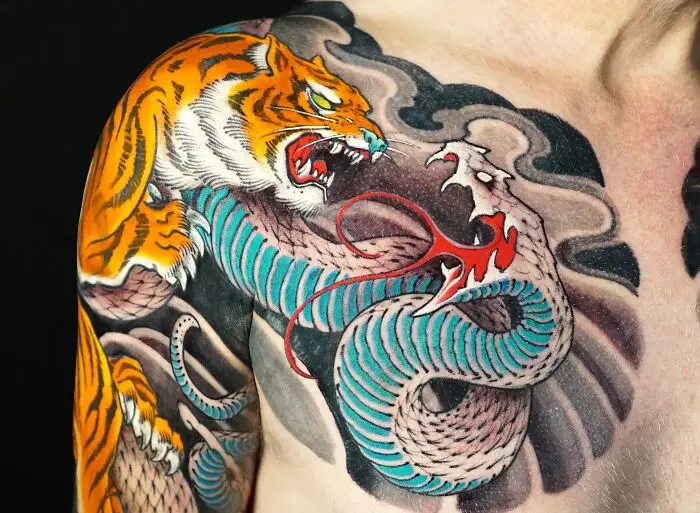
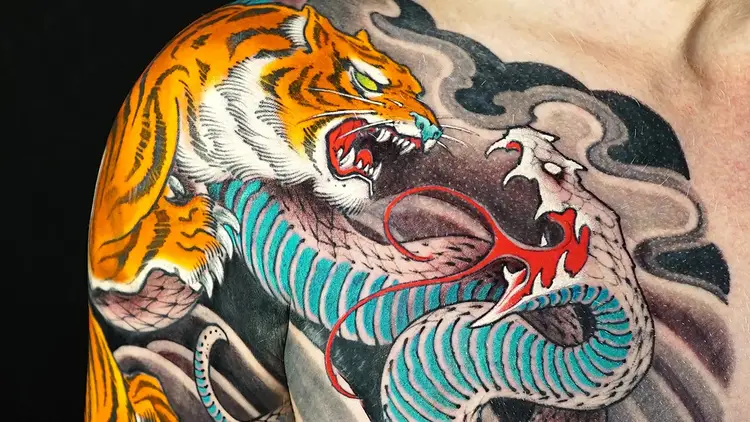
Dynamic tiger battling a serpent chest piece showcasing Japanese tattoos.
No two tigers have the same stripes, and the pattern runs deeper than the fur: the skin underneath is striped too. Snakes have a surprising trick of their own. They “smell” with their tongues, flicking scent particles up to the Jacobson’s organ, a special sensor in the roof of the mouth.
Work by João Bosco at Sacred Gold Tattoo, London, UK
11points

In Japanese art, the tiger and the dragon are eternal rivals: the dragon rules the clouds and rain, while the tiger commands the wind and the earth below. Their rivalry is so famous that the language has a word for two perfectly matched opponents, ryūko, or “dragon and tiger.” Nature sets the rules in other ways, too.

Cherry blossoms belong to spring, peonies to early summer and maple leaves to autumn, and a traditional tattooer always keeps each one in its proper season, just as Japan’s hanafuda flower cards give every month of the year its own plant.

#2 When Your Umbrella Turns 100
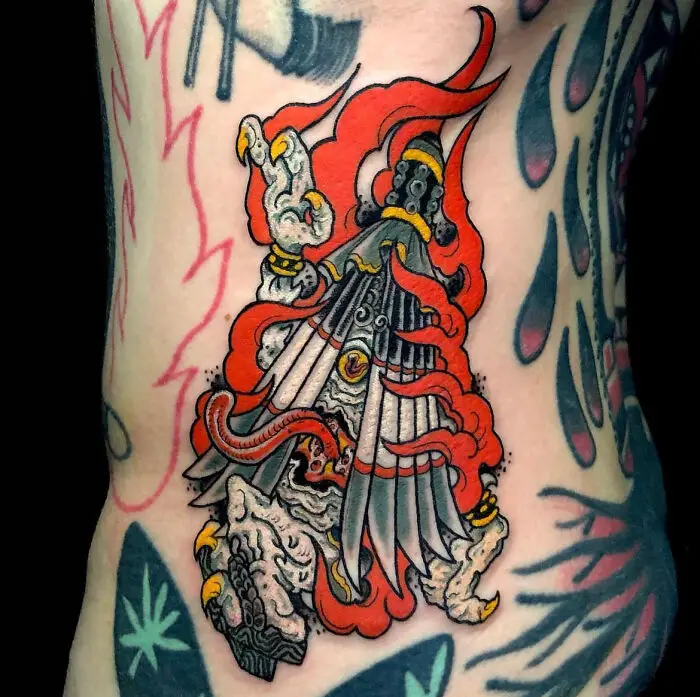
Japanese tattoo featuring the umbrella yokai Kasa-obake with fiery elements
In Japanese folklore, objects that reach 100 years old can come to life as tsukumogami. The most famous is the karakasa-obake, a hopping paper umbrella with one eye and one leg. That respect for old objects hasn’t disappeared. At Hari-kuyō, a memorial service for broken sewing needles, people thank the needles for their service by pushing them into soft tofu, giving them a gentle place to rest after years of piercing tough fabric.
Work by Matt at Sacred Gold Tattoo, London, UK
9points

#3 The Ninja Who Rode A Toad

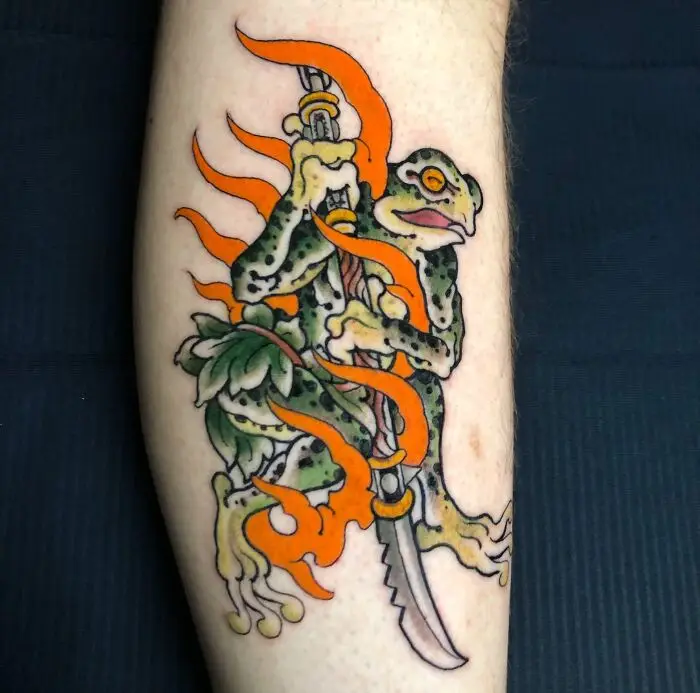
Japanese tattoos depicting a green warrior frog holding a sword wrapped in orange flames.
In Japanese, kaeru means both “frog” and “to return.” That’s why people tuck little frog charms into their wallets, hoping any money they spend will come back, and why travelers carry them for a safe trip home. A frog holding a sword also brings to mind Jiraiya, the ninja hero of 19th-century Japanese tales who could summon a giant toad. He later inspired a character of the same name in the anime Naruto.
Work by Matt at Sacred Gold Tattoo, London, UK
7points

Many of the creatures in these designs are yōkai, the catch-all word for the country’s monsters, ghosts and spirits, and plenty of them still look much the way the artist Toriyama Sekien drew them in his illustrated catalog of 1776. The masks have an even longer history. Many come from Noh, a form of theater more than 600 years old, and are carved so that a small tilt of the actor’s head changes the expression: tilted up, a face can look joyful, while tilted down, the same face turns sorrowful.

#4 The Dragon That Watches You
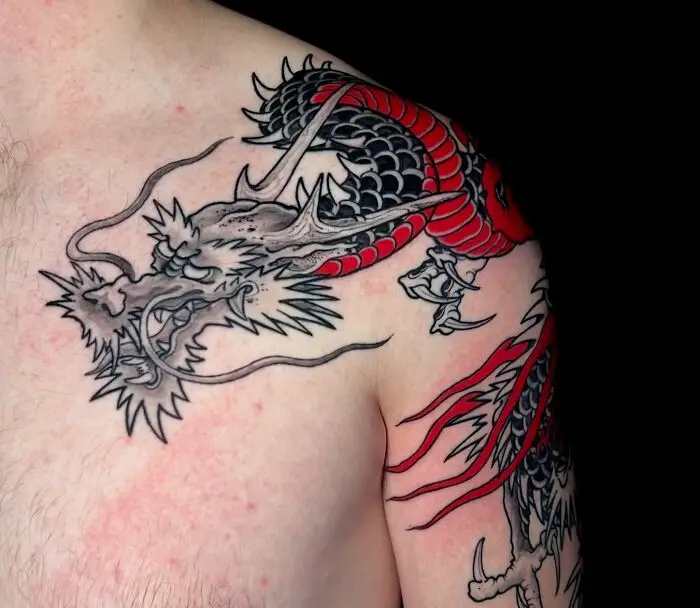
Shoulder and chest tattoo featuring detailed Japanese tattoos of a ferocious dragon with red highlights.
Some Japanese temples have ceiling dragons whose eyes seem to follow you wherever you stand. One of the best known is at Myōshin-ji in Kyoto, where painter Kanō Tan’yū spent eight years on a ceiling piece nicknamed “the dragon that glares in eight directions.” Even the claws carry meaning: Japanese dragons are traditionally drawn with three, while five were reserved for the Chinese emperor.
Work by Fernando at Sacred Gold Tattoo, London, UK
6points

#5 The Spider Of The Waterfall

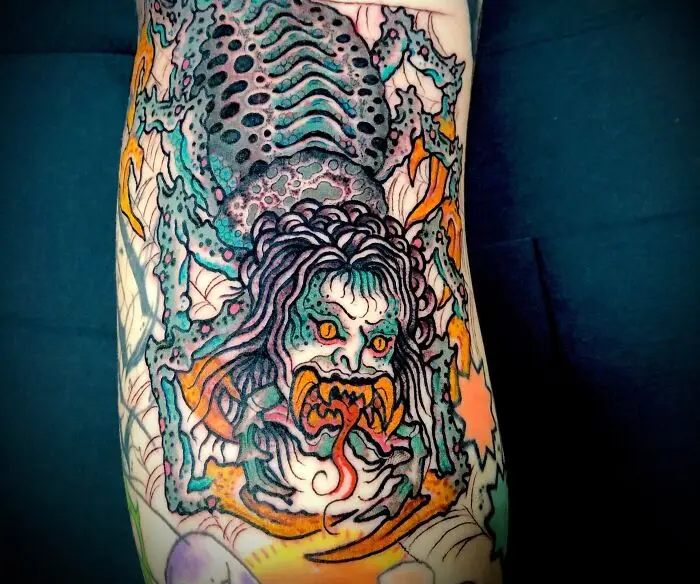
Color Japanese tattoo of the mythical spider demon Tsuchigumo with monstrous face
The jorōgumo is a spider spirit said to take the form of a beautiful woman. According to a legend from Jōren Falls on the Izu Peninsula, one tried to drag a woodcutter into the water by quietly winding her silk around his ankle. He noticed in time and looped the thread around a tree stump, which was yanked into the falls instead. Her name lives on in a real creature, too: the Joro spider, a large yellow-and-black species that has spread across parts of the southeastern United States.
Work by Matt at Sacred Gold Tattoo, London, UK
5points

Traditional tattoo masters, known as horishi, usually work under a name beginning with “Hori,” meaning “to carve,” which is given to them by their teacher. Some still work entirely by hand using tebori, pushing needles fixed to a long rod into the skin one stroke at a time, with no machine at all.

#6 The Mountain Owned By A Shrine
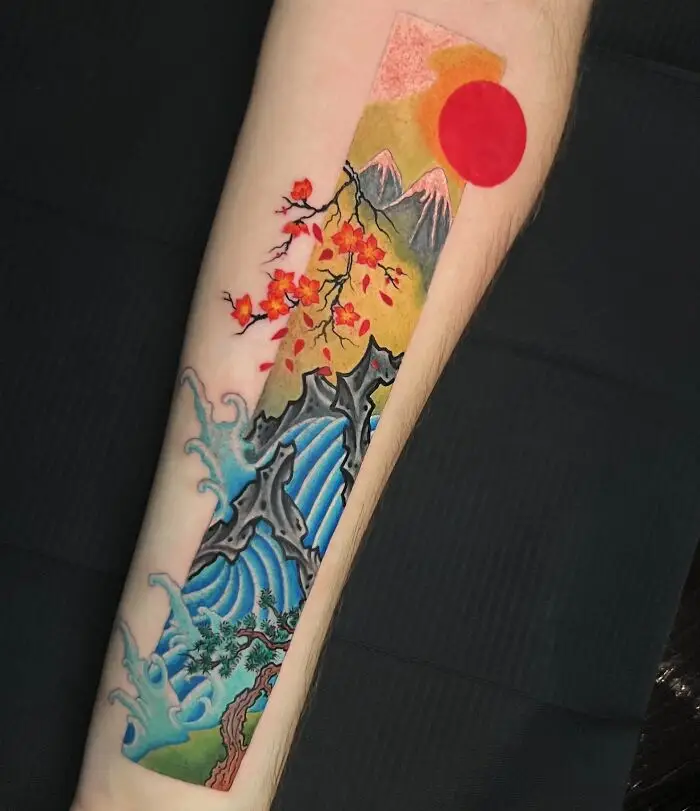
Vibrant Japanese tattoo sleeve showing Mt. Fuji, cherry blossoms, and ocean waves
Japan’s name, Nihon, means “origin of the sun,” which is why the country is often called the Land of the Rising Sun. Its most famous mountain holds a few surprises, too. The top of Mount Fuji is legally owned by a Shinto shrine, Fujisan Hongū Sengen Taisha, and women weren’t officially allowed to climb it until 1872. One woman didn’t wait: in 1832, Tatsu Takayama reached the summit dressed as a man.
Work by Fernando at Sacred Gold Tattoo, London, UK
5points

#7 The Earth Spider

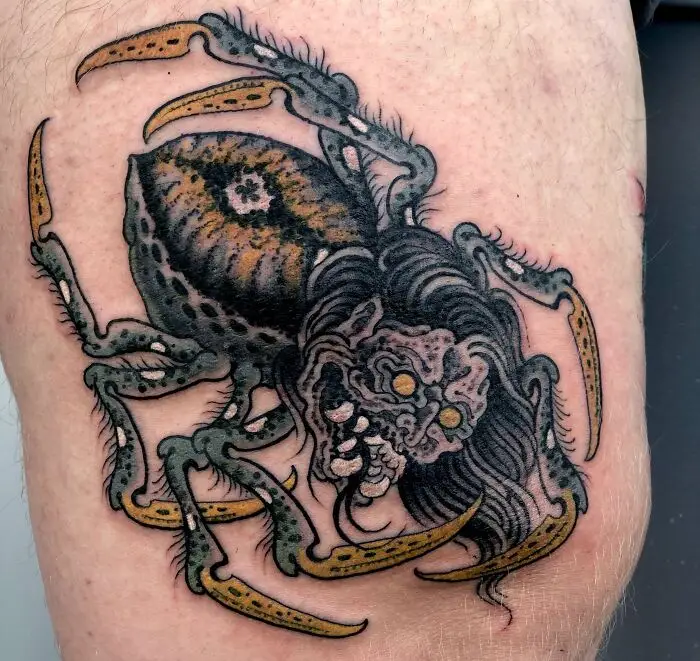
Japanese spider monster Tsuchigumo tattoo in traditional London studio style
The tsuchigumo, or “earth spider,” was a giant monster said to have been defeated by the legendary warrior Minamoto no Raikō. In Tsuchigumo, the Noh play that tells the story, the actor playing the spider flings long streams of white paper thread across the stage in a famously dramatic scene. The name has a darker history, too: ancient Japanese chronicles used it for local clans who refused to submit to the emperor.
Work by Matt at Sacred Gold Tattoo, London, UK
5points

#8 Japan's Football Crow

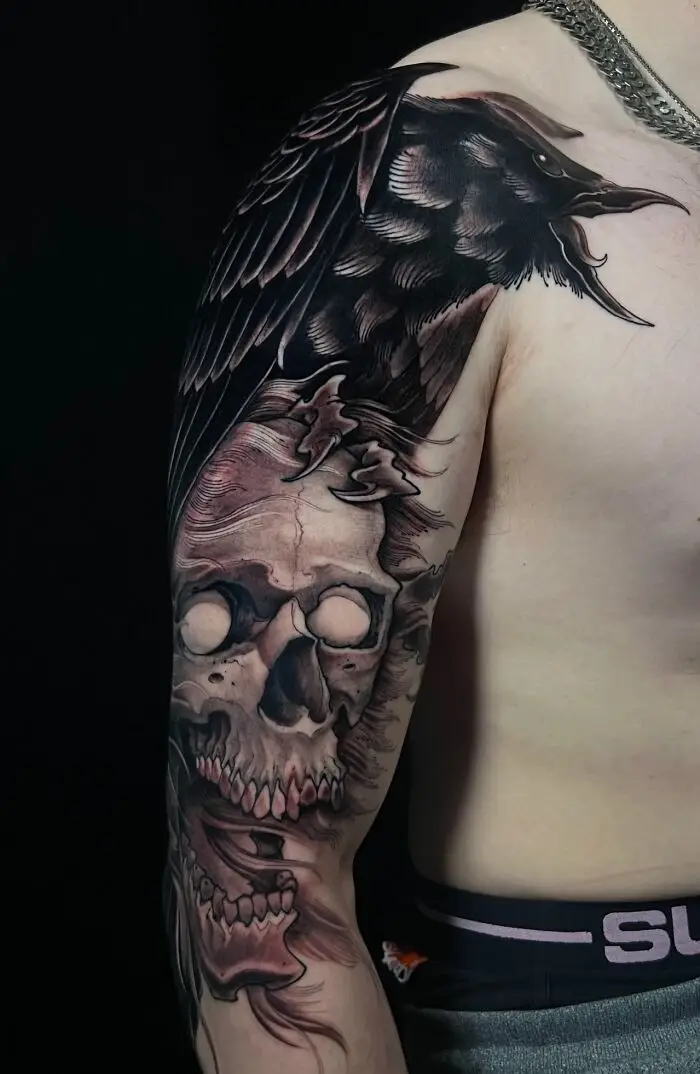
Japanese tattoos sleeve showing a raven perched on top of a detailed skull design on the upper arm.
In Japanese myth, a three-legged crow called Yatagarasu guided Emperor Jimmu, Japan’s legendary first ruler, through the mountains, and today it’s the emblem of the national soccer team. Real crows in Japan are pretty impressive, too. In Sendai, they’ve been seen dropping walnuts in front of cars at traffic lights so the tires crack them open, then waiting for the light to turn red before hopping out to collect their snack.
Work by João Bosco at Sacred Gold Tattoo, London, UK
5points

#9 The Woman Who Became A Serpent

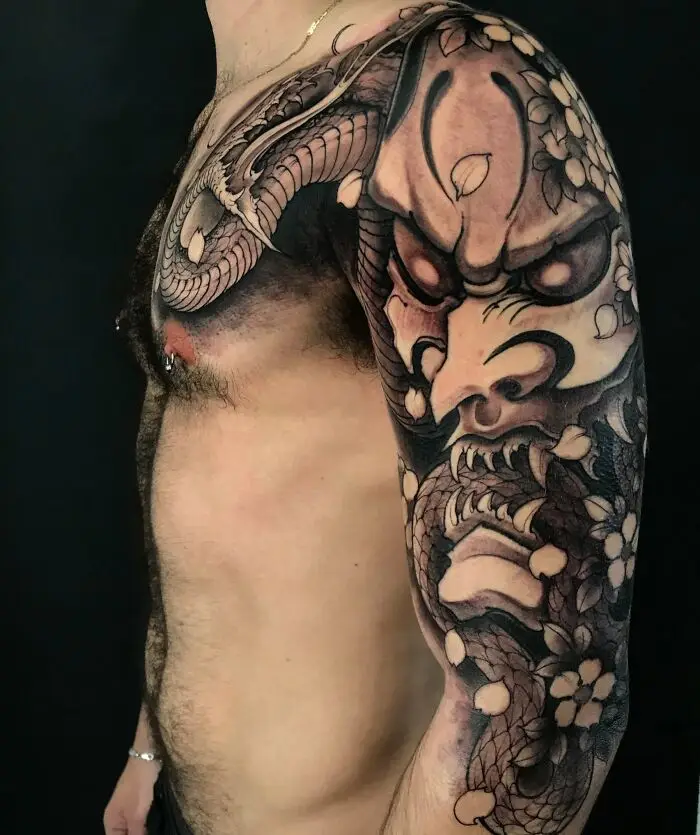
Japanese tattoos sleeve design featuring a fierce demon mask and snake wrapped around the arm.
The hannya mask shows a woman so consumed by jealousy that she has turned into a demon. Its link with snakes comes from the legend of Dōjōji. After the monk Anchin rejects her, a woman named Kiyohime transforms into a giant serpent and chases him to a temple, where he hides under the bell. She coils around it, breathing fire, until the bronze glows red-hot. The mask itself holds a clever trick: seen head-on, it looks furious, but tilted slightly downward, it seems to weep.
Work by João Bosco at Sacred Gold Tattoo, London, UK
4points

#10 Clothes Made Of Ink

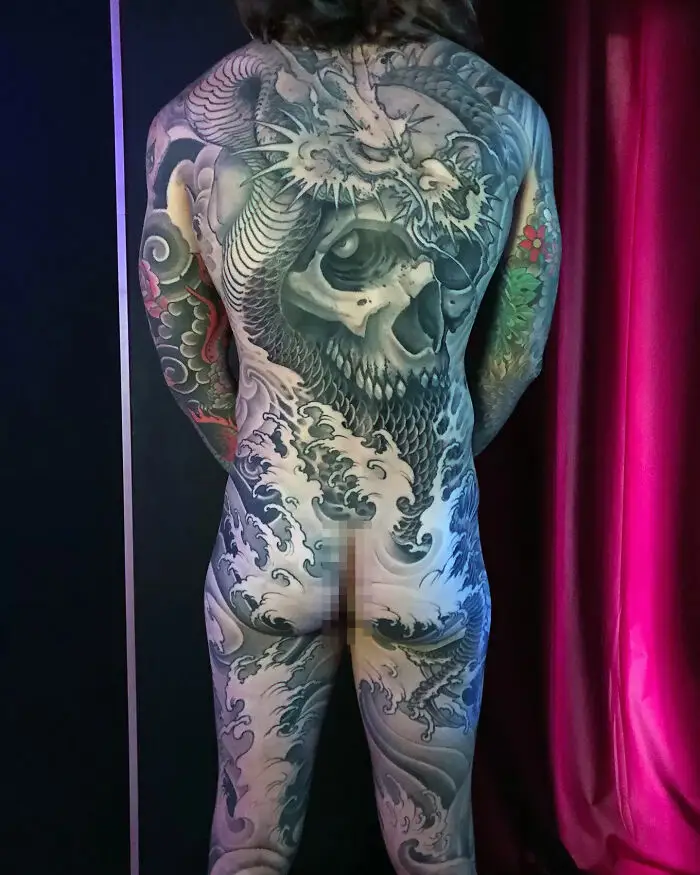
Full back Japanese tattoos depicting a large skull dragon hybrid surrounded by dynamic ocean waves.
In Edo-period Japan, firefighters and couriers often worked in little more than a loincloth, so full-body tattoos became a kind of clothing in their own right. That changed in 1872, when the Meiji government banned tattooing as part of its push to modernize the country. The ban stayed in place until 1948, during the US-led occupation, but the stigma has outlasted the law: even today, many Japanese hot springs turn away tattooed guests.
Work by João Bosco at Sacred Gold Tattoo, London, UK
4points

#11 Snakes Never Close Their Eyes

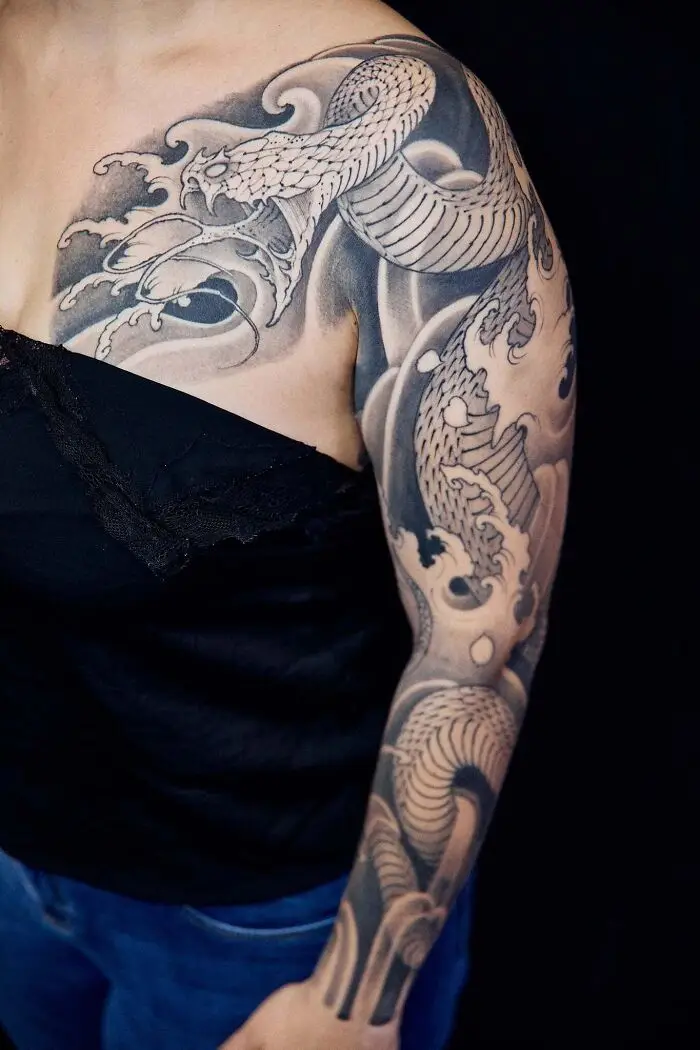
Full arm sleeve Japanese tattoos with black and grey snake and wave motif spanning chest and arm.
Snakes have no eyelids, so they sleep with their eyes open, each one shielded by a clear scale called a brille. They have no outer ears either and pick up sound mainly as vibrations through their jawbones. In Okinawa, snakes even end up behind the bar: a whole habu, a venomous local species, is steeped in awamori, the island’s traditional rice liquor, to make habushu.
Work by João Bosco at Sacred Gold Tattoo, London, UK
4points

#12 Demons Out, Luck In

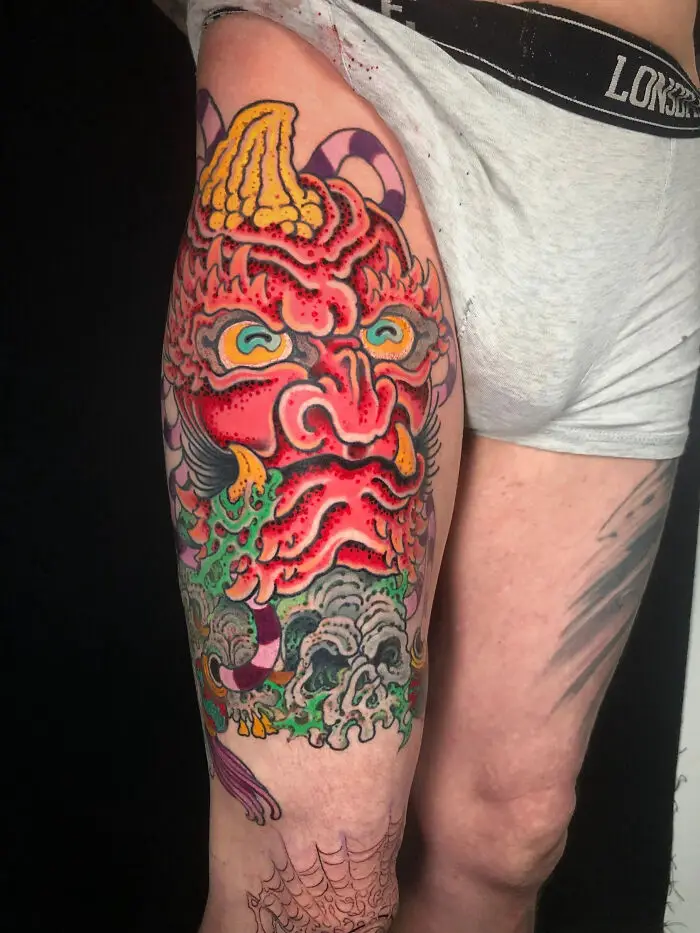
Vibrant Japanese tattoos of a fierce red demon mask with intricate detailing inked on a upper leg.
Oni are the ogres of Japanese folklore, and their look comes from an old compass. Evil spirits were believed to enter from the northeast, known as the “ox-tiger” direction, so oni are traditionally drawn with ox horns and tiger-skin loincloths. Every February at Setsubun, families still toss roasted soybeans out the door, shouting “Oni wa soto, fuku wa uchi!” (“Demons out, luck in!”), then eat one bean for each year of their age for a healthy year ahead.
Work by Matt at Sacred Gold Tattoo, London, UK
4points

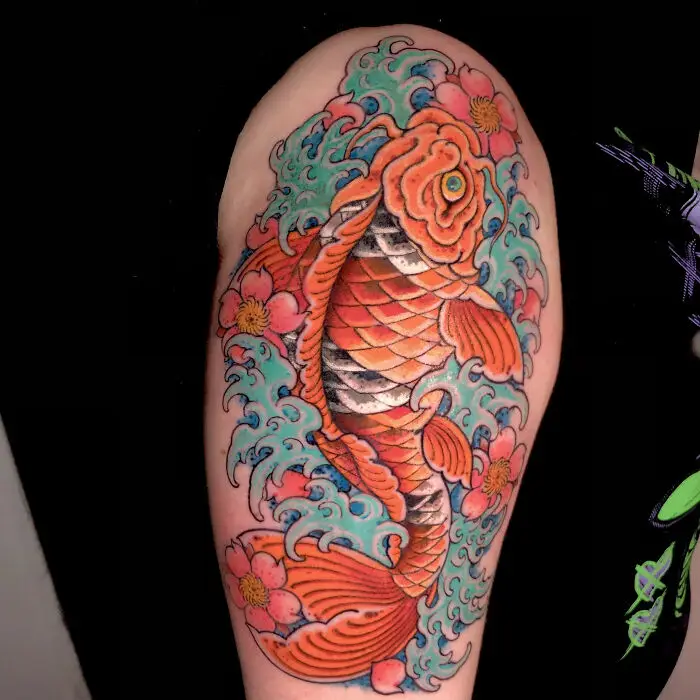
#13 A Fish Worth A Fortune

Colorful Japanese tattoos featuring an orange koi fish swimming among blue waves and pink flowers on an arm sleeve.
According to an old Chinese tale that’s also beloved in Japan, a koi that swims up the Dragon Gate waterfall turns into a dragon. Real koi can be just as legendary. In 2018, one called S Legend sold for more than 200 million yen (about $1.8 million). Another, named Hanako, was said to have reached the age of 226 based on the growth rings on her scales, though that figure is disputed.
Work by Matt at Sacred Gold Tattoo, London, UK
4points

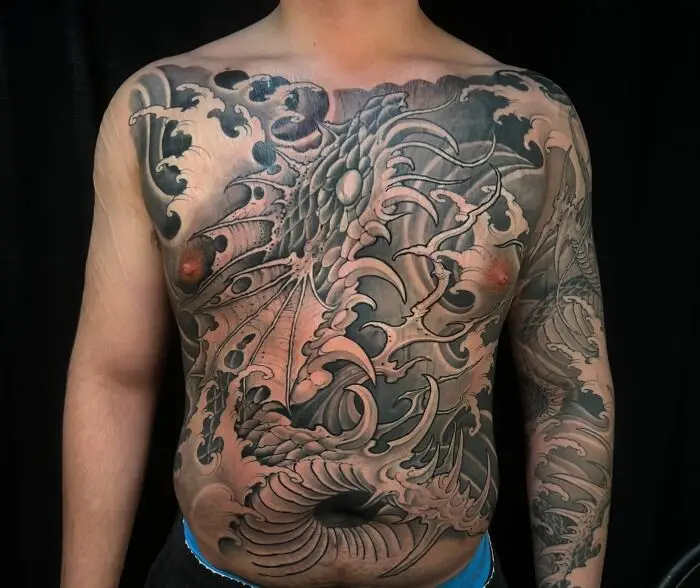
#14 The Dragon King Under The Sea

Full front torso Japanese dragon tattoo with intricate shading and ocean waves
In Japanese mythology, the dragon god Ryūjin rules the sea from Ryūgū-jō, his underwater palace, and controls the tides with two magic jewels. According to legend, the fisherman Urashima Tarō was invited there after rescuing a turtle. He stayed for what seemed like only a few days, but when he returned home, hundreds of years had passed.
Work by João Bosco at Sacred Gold Tattoo, London, UK
3points

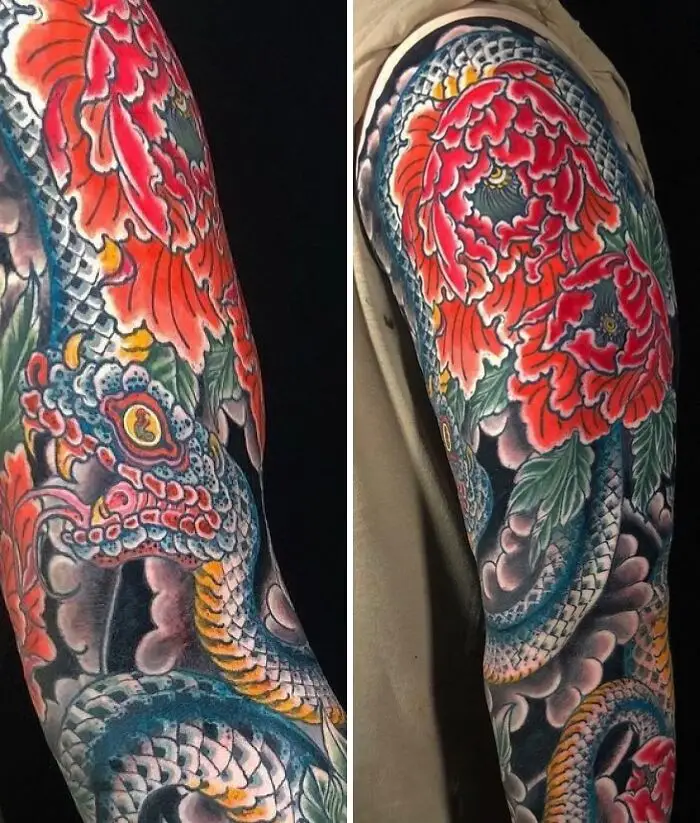
#15 The Flower That Means Wild Boar

Sleeve tattoo with Japanese tattoos of a blue snake coiled around vibrant red peonies.
Known as the “king of flowers” in China and Japan, the peony first arrived in Japan as a medicinal plant in the 8th century. Its Japanese name, botan, has a second meaning: wild boar meat. When eating meat was frowned upon, people used flower names as code, and the deep red slices, often arranged like petals on the plate, earned the nickname. Boar hotpot is still called botan nabe today. An old saying even describes the ideal woman as “an herbaceous peony when standing, a tree peony when sitting, and a lily when walking.”
Work by Matt at Sacred Gold Tattoo, London, UK
3points

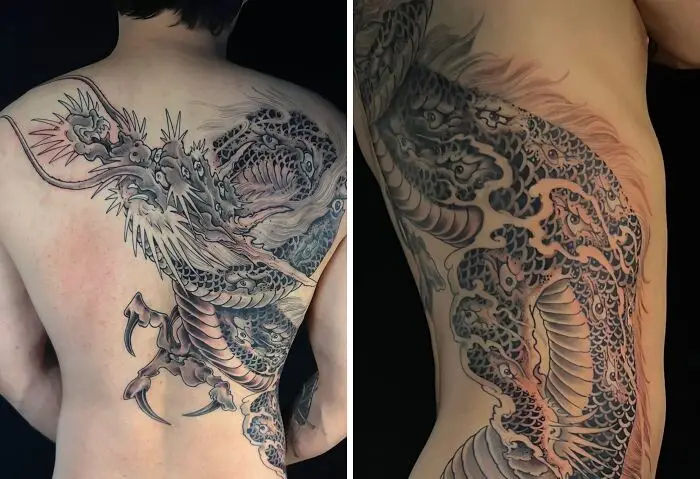
#16 The Dragon With A Hundred Eyes

Full back piece showcasing intricate Japanese tattoos of a powerful black and grey dragon.
Look closely at this dragon’s body and you’ll spot eyes peering from between the scales, a nod to hyakume, the “hundred eyes” creature of Japanese folklore. With no background to compete with, every claw and whisker gets its moment.
Work by João Bosco at Sacred Gold Tattoo, London, UK
3points

#17 The Secret On The Beer Label

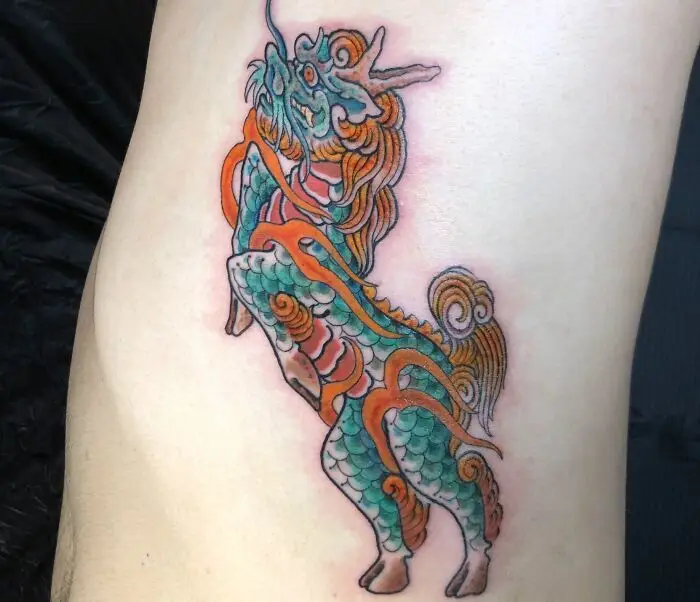
Vibrant Japanese tattoos featuring a colorful Kirin mythical creature with detailed scales and fiery accents.
In East Asian legend, the kirin appears only when a wise ruler is in power, and it’s so gentle that it won’t even step on a blade of grass. The myth also explains why the Japanese word for giraffe is kirin: when the first giraffes arrived in China in the 1400s, people believed they’d found the real thing. And look closely at a Kirin beer label: three tiny characters, キ, リ and ン, are hidden in the creature’s design, spelling out its name.
Work by Matt at Sacred Gold Tattoo, London, UK
3points

#18 The Tiger Always Comes Home

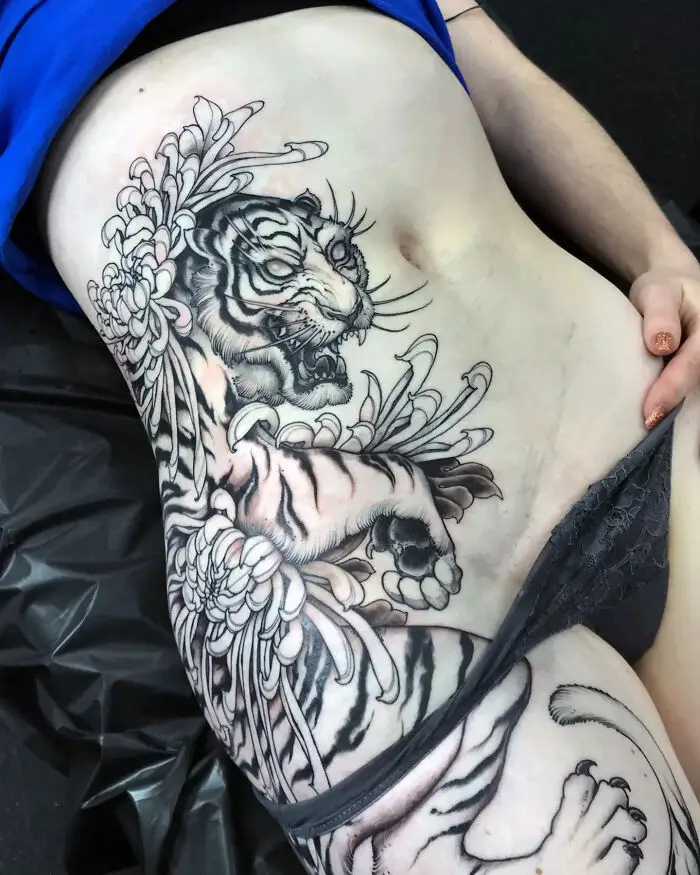
Side body Japanese tattoos depicting a fierce tiger surrounded by chrysanthemum flowers in black ink.
An old Japanese proverb says a tiger can travel a thousand ri (about 2,400 miles) and still find its way home. In wartime Japan, women stitched tigers onto senninbari, or “thousand-stitch” belts, hoping the soldiers who wore them would come back just as surely. Each woman usually added a single stitch, but those born in a Year of the Tiger were allowed to sew as many as their age.
Work by João Bosco at Sacred Gold Tattoo, London, UK
3points

#19 Dolls Made Of Flowers

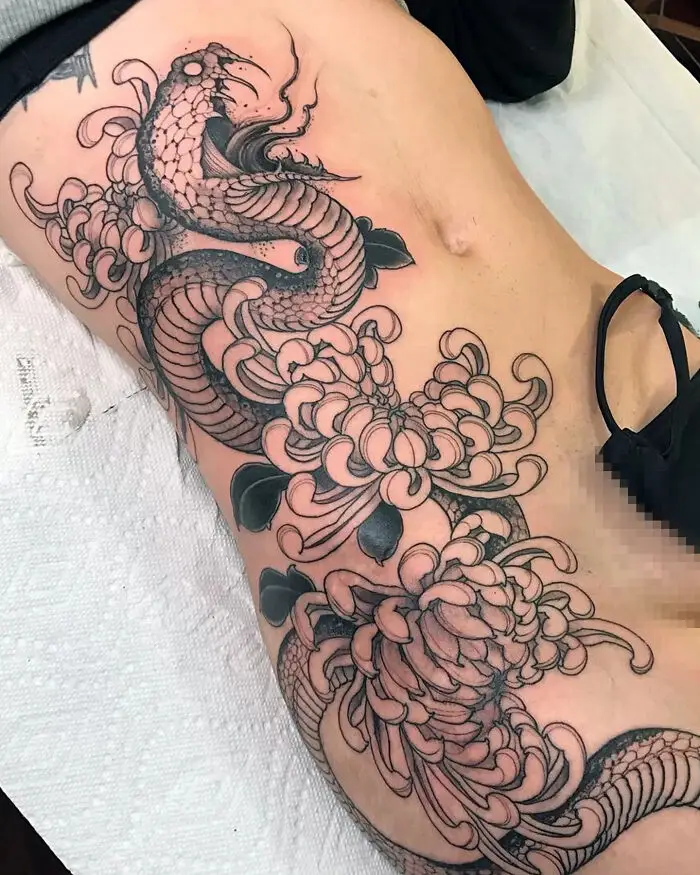
Japanese tattoos on a torso featuring a black and grey serpent coiling around large chrysanthemum flowers.
Every autumn, several festivals in Japan show off kiku ningyō: life-size dolls dressed in living chrysanthemums, still rooted and blooming. The flower has been the emblem of Japan’s imperial family for centuries, and a stylized chrysanthemum even appears on the cover of every Japanese passport.
Work by João Bosco at Sacred Gold Tattoo, London, UK
3points

#20 A Flower You Can Drink

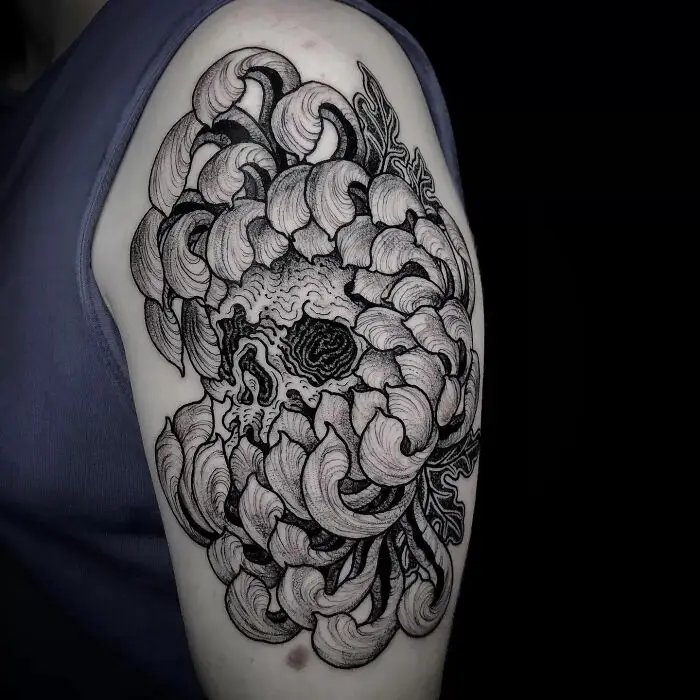
Detailed black and grey Japanese tattoos showcasing a stylized skull emerging from chrysanthemum petals.
Chōyō, the chrysanthemum festival, falls on the ninth day of the ninth month. Nine was seen as a strong, lucky number, so this “double nine” was a day to wish for a long life, traditionally by drinking sake with chrysanthemum petals floating in it. In Japan, the petals still end up on the plate, too, served as a garnish or pickled.
Work by Matt at Sacred Gold Tattoo, London, UK
3points
32
0