



Humans have a natural tendency to chase information when something catches their attention. Science Insights explains that curiosity can arise when people notice a gap between what they know and what they would like to know, creating a small sense of uncertainty that encourages them to find an answer. That may be why an unusual fact can be so difficult to ignore, even when it has no obvious practical use.
Discovering the missing piece provides a sense of satisfaction, and surprising or novel information can make that experience even more rewarding. Rather than needing a major mystery to become curious, people can experience this same process through something as simple as learning an unexpected detail about an animal, object, place, or historical event



That feeling of discovery can also encourage people to keep looking for more information. When something turns out to be different from what we expected, it naturally attracts attention because our brains are particularly sensitive to things that don't fit our existing assumptions.
The moment of realizing that a familiar subject has an unfamiliar detail can therefore make learning feel less like work and more like exploration. This is part of what makes collections of interesting facts so easy to scroll through: each new piece of information creates another opportunity to encounter something unexpected and close another tiny gap in our knowledge.
#7
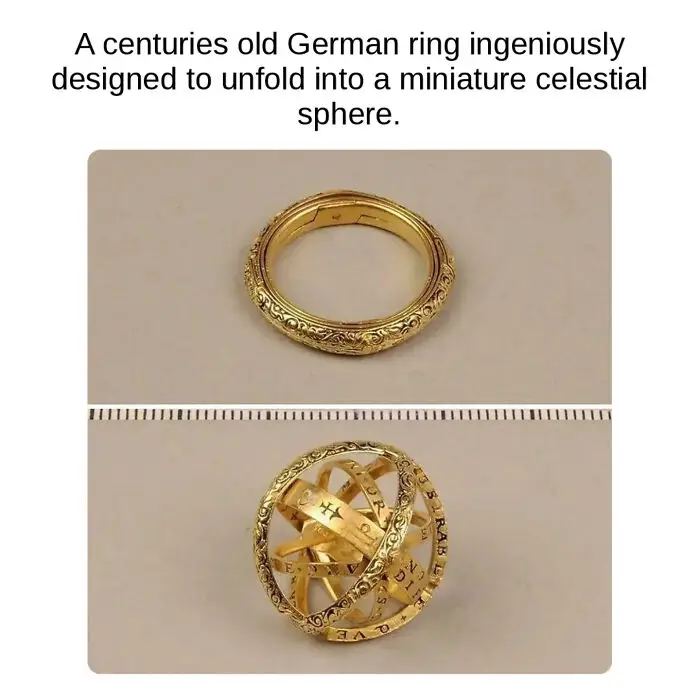
Beyond their unusual appearance, these rings also served a scientific purpose. Their engraved markings represented celestial coordinates and astronomical measurements, allowing some versions to function as basic astronomical instruments for observing the sky, estimating time, and understanding celestial movements. This made them much more than ordinary pieces of jewelry.
The rings became particularly popular in Germany during the 16th century, where skilled goldsmiths crafted them with remarkable precision. Some featured zodiac symbols, astronomical markings, and Latin inscriptions carrying philosophical or religious messages. They were often regarded as symbols of knowledge, education, social status, and religious devotion.
Today, surviving astronomical rings are treasured historical artifacts that reveal the remarkable craftsmanship of Renaissance metalworkers. They represent a time when scientific curiosity, artistic creativity, and personal adornment were closely connected, allowing people to literally wear a miniature model of the universe on their fingers.


There is another reason these discoveries can stay with us long after we've encountered them. Psychology Today notes that information is more likely to be remembered when it is novel, surprising, emotionally engaging, or personally meaningful. Instead of treating every piece of information equally, the brain gives greater attention to things that stand out.
The hippocampus, which plays a major role in forming memories, works alongside the brain's reward and motivation systems when we encounter novelty. As a result, an unusual fact can receive a stronger memory boost than an ordinary piece of information that never gives us a reason to pay particular attention.
#10

To show the scale of the problem, Otto’s Coffee House and Kitchen filled its shop floor with disposable cups. This powerful display highlighted how quickly takeaway cups can accumulate and contribute to environmental pollution.
The initiative encourages customers to bring their own cups instead of relying on single use alternatives. This simple habit can help reduce waste and promote more sustainable consumption.
Otto’s Coffee House and Kitchen hopes its efforts will inspire other coffee shops around the world to follow the same approach. Its message is clear: small changes in everyday habits can make a meaningful difference to the environment.


Surprise and emotion can make that effect even stronger. A fact that produces amusement, amazement, or disbelief is more likely to feel significant than one that simply confirms something we already expected. Connecting new information to something we already care about can have a similar effect, because personal relevance encourages deeper processing.
This helps explain why people can forget information they deliberately tried to memorize while effortlessly remembering an obscure fact they encountered years ago simply because it was strange enough to make them stop and think. The more an idea stands out, the more likely it is to leave a lasting impression.

#14

Some eggs have smooth surfaces, while others feature intricate ridges, bumps, or other patterns. Their shapes can range from round to oval, with each species producing eggs that have distinctive characteristics.
The colours of butterfly eggs are equally diverse, ranging from white and yellow to green and other subtle shades. These variations can help researchers identify different species and understand their reproductive habits.
Female butterflies often lay their eggs on specific host plants, ensuring that newly hatched caterpillars have access to suitable food. This remarkable process marks the beginning of a butterfly's life cycle, which transforms a tiny egg into a crawling caterpillar and eventually into a beautiful winged insect.

Yet our enthusiasm for learning new facts also reveals something slightly humbling about how much we actually understand. The BBC has explored how people can mistake familiarity for genuine understanding, particularly through the illusion of explanatory depth.
Someone may use an everyday object for decades and feel completely comfortable saying they know how it works, only to struggle when asked to describe its mechanism step by step. Familiarity gives us a sense of fluency, but that doesn't necessarily mean we possess the detailed knowledge needed to explain something properly.
#16
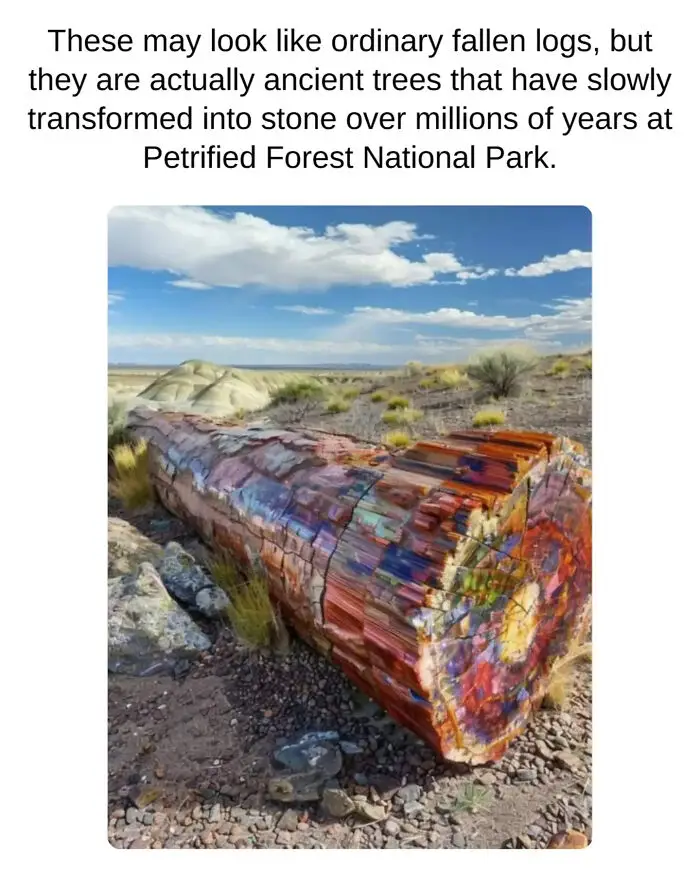
The process, known as petrification, begins when fallen trees become buried beneath sediment. Mineral rich water gradually enters the wood, depositing silica and other minerals within its cellular structure. Over time, these minerals harden into stone while preserving many of the wood’s original details.
The park provides a fascinating glimpse into the Late Triassic period, roughly 225 million years ago, when early dinosaurs lived alongside a variety of other ancient animals. Beyond its petrified trees, the area contains animal fossils, trace fossils, and geological evidence of ancient rivers and changing landscapes.
One of the most striking features of the fossilized wood is its vibrant range of colors. Iron compounds can produce red, orange, and yellow shades, while other minerals contribute darker and occasionally bluish or purplish tones. Together, these fossils offer scientists valuable clues about ancient ecosystems, geological processes, and the environmental conditions of a world that existed more than 200 million years ago.
#17

Green stripes can develop when seawater containing organic material becomes trapped and freezes into the iceberg. Brown or yellowish bands may form when sediment, rock particles, and minerals become incorporated into the ice.
This gap can extend far beyond household objects. People can become confident in their understanding of complicated ideas simply because they have encountered the terminology, headlines, or general explanation many times. Repeated exposure makes information feel easier to process, while confirmation bias can encourage us to notice evidence that supports what we already believe and overlook information that challenges it.
The result is that uncertainty can remain hidden until we are actually asked to explain what we supposedly know. Coming across an unexpected fact can be a useful reminder that even subjects that seem completely familiar may contain layers of information we have never considered.