






Typically, when we have questions, we google them and hope for the best. If the question is a tad more complicated, we might reach out to someone we know who is an expert. Unfortunately, the amount of actual experts the average person knows is probably too few to cover all the questions they may end up having.
So we’ve gathered some of the most interesting questions from an internet community dedicated to helping people get answers. So settle in as you read through, upvote your favorites and be sure to share your own examples in the comments down below.
#21 Why Did It Take Until The 1860s To Identify The Source Of The Nile, Despite The River Shaping Civilizations For Thousands Of Years?
The Nile was one of the most important rivers in human history. Ancient Egypt depended on it for thousands of years, and Greek and Roman writers knew about parts of it too.
What surprised me is that the source of the Nile wasn't identified by Europeans until 1862. I always assumed that following such an important river upstream would have been an obvious goal.
Was it mainly because the geography was too difficult, or were there political and cultural barriers that made exploration unlikely? Did earlier explorers get close but fail, or was knowledge about the upper Nile simply lost over time?
How do you think this mystery lasted for so long?
M45_: Following the Nile upstream seems obvious, but then you get to the almost impenetrable Sudd marshes (meaning barrier or obstruction in Arabic) in current day South-Sudan which were the real problem. The ancient Egyptians tried to follow the Nile to its source but couldn't get through the Sudd. Same with the Romans who set up an expedition but failed to pass.
What surprised me is that the source of the Nile wasn't identified by Europeans until 1862. I always assumed that following such an important river upstream would have been an obvious goal.
Was it mainly because the geography was too difficult, or were there political and cultural barriers that made exploration unlikely? Did earlier explorers get close but fail, or was knowledge about the upper Nile simply lost over time?
How do you think this mystery lasted for so long?
M45_: Following the Nile upstream seems obvious, but then you get to the almost impenetrable Sudd marshes (meaning barrier or obstruction in Arabic) in current day South-Sudan which were the real problem. The ancient Egyptians tried to follow the Nile to its source but couldn't get through the Sudd. Same with the Romans who set up an expedition but failed to pass.
Report
3points
#22 Why Do Planes Cruise At Around 33,000 Feet Instead Of Something Like 10,000?What Makes Higher Altitude “Better”?
I was on a flight recently and realized I never questioned this. Intuitively, flying lower feels easier and safer. Less distance to fall, more air to “hold” the plane. But planes go way higher instead. Is it about fuel, air resistance, traffic, or something else I’m missing?
Why is that height kind of the sweet spot?
Warm_Objective4162: Thinner air means less resistance which means faster while using less fuel.
Chillow_Ufgreat: Also, altitude is probably your most important resource when dealing with emergencies.
rdtrer: Also also, noise.
Why is that height kind of the sweet spot?
Warm_Objective4162: Thinner air means less resistance which means faster while using less fuel.
Chillow_Ufgreat: Also, altitude is probably your most important resource when dealing with emergencies.
rdtrer: Also also, noise.
Report
3points
#23 Why Do The British Eat Relatively Little Fish And Seafood Despite Having Such A Long Coastline And Fishing Tradition?
Britain has a long coastline, productive fishing grounds, and a deep maritime history, yet fish and seafood do not seem to play as central a role in everyday cuisine as they do in places like Japan, Norway, or Spain. Fish and chips is famous worldwide, but beyond a few common fish, seafood seems less prominent in everyday meals.
What shaped this difference?
YetAnotherInterneter: A lot changed during the Industrial Revolution. People moved away from coastal and agricultural regions towards inland cities for work.
Fresh fish doesn’t travel well compared to livestock which could be raised and transported to cities more easily.
But costal communities continued to eat a fish based diet. They just didn’t have a bigger impact on the national cuisine.
What shaped this difference?
YetAnotherInterneter: A lot changed during the Industrial Revolution. People moved away from coastal and agricultural regions towards inland cities for work.
Fresh fish doesn’t travel well compared to livestock which could be raised and transported to cities more easily.
But costal communities continued to eat a fish based diet. They just didn’t have a bigger impact on the national cuisine.
Report
3points
#24 Why Can Some Roman Concrete Survive 2,000 Years In Seawater When Modern Marine Concrete Can Need Repairs Much Sooner?
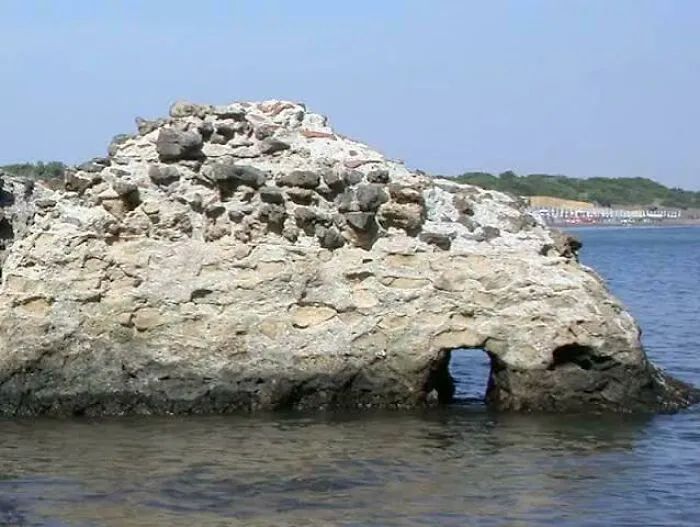
Some Roman harbor structures have remained exposed to Mediterranean seawater for centuries, and some are still remarkably well preserved. Modern concrete used in marine structures can also last for many decades, but may require repairs as deterioration sets in.
That Roman builders had no modern understanding of cement chemistry, yet some of their concrete developed remarkable long-term durability in seawater.
What was actually different about the way this concrete was made that allowed it to last so long?
Throwawayxdryx: They survive as ruins, modern concrete probably would as well
Frustrated9876: Modern concrete will also last centuries without being repaired, but structures in use cannot be left to deteriorate to that state or they cease being useful.
That Roman builders had no modern understanding of cement chemistry, yet some of their concrete developed remarkable long-term durability in seawater.
What was actually different about the way this concrete was made that allowed it to last so long?
Throwawayxdryx: They survive as ruins, modern concrete probably would as well
Frustrated9876: Modern concrete will also last centuries without being repaired, but structures in use cannot be left to deteriorate to that state or they cease being useful.
Report
2points
#25 Why Does A Country That Calls Itself The Richest In The World Have 42 Million People Relying On Snap Just To Eat?
A few days ago, I asked about how the U.S. government shutdown affects people’s daily lives, and I received many thoughtful replies. It made me realize how little I actually knew, and I’m truly grateful to everyone who shared their insights. ❤️❤️
Among those responses, I discovered something striking, there are about 42 million Americans, roughly 12% of the population, who rely on SNAP (Supplemental Nutrition Assistance Program) just to eat.
This made me see a deeper issue in the U.S. labor market: wages are not keeping up with the rising cost of living.
What kind of contradictions and economic divide lie behind this growing gap between the wealthy and the working class?
uninsane: Big corporations like Walmart make huge profits by not paying their employees enough. The American taxpayer contributes to those profits by feeding and providing Medicaid for those people. Long story short: pure greed
KraftwerkMachine: Wages wouldn’t even help in some cases: a lot of those people (including myself) are disabled and can’t work. So we can’t even reliably take care of our elderly and disabled.
Among those responses, I discovered something striking, there are about 42 million Americans, roughly 12% of the population, who rely on SNAP (Supplemental Nutrition Assistance Program) just to eat.
This made me see a deeper issue in the U.S. labor market: wages are not keeping up with the rising cost of living.
What kind of contradictions and economic divide lie behind this growing gap between the wealthy and the working class?
uninsane: Big corporations like Walmart make huge profits by not paying their employees enough. The American taxpayer contributes to those profits by feeding and providing Medicaid for those people. Long story short: pure greed
KraftwerkMachine: Wages wouldn’t even help in some cases: a lot of those people (including myself) are disabled and can’t work. So we can’t even reliably take care of our elderly and disabled.
Report
2points
#26 Why Are Many Christians So Conservative, Even Though Jesus Was One Of The Most Radical Progressives In History?
I’ve been thinking about this for a while and I’m genuinely curious. Historically, Jesus challenged social norms, spoke out for the marginalized, and advocated for radical changes in how people treated each other.
Yet today, many Christian communities seem to hold very conservative views on social, political, or cultural issues. Why is that?
Is it because religious institutions have evolved in ways that prioritize tradition and stability over radical change? Or is it something about human nature and the way beliefs are passed down through generations?
fish_perculator: Christianity is mostly a culture thing. Real and true faith in Christ and practice of his teachings and example is quite rare, and has been for a long time.
Edit: (sigh) yes probably all religions. The question was about Christianity, which is the only religion I was raised in, schooled in and studied from every angle from American evangelical biblical literalism to modern textual criticism of scripture, from four walls and a sermon fundamentalism to high church catholic worship and contemplative non-dualism.
I'm not gonna armchair theologian an opinion about Islam or Hinduism or whatever, it ain't my place.
TheFifthTone: Almost from the beginning Christianity has been hijacked by conservative converts like Paul who brought in their own ideas and traditions that heavily influenced the dogma.
ChasingPacing2022: Religion, for most people, has nothing to do with the stories in the religious texts. Religion is mostly a way to make people feel like they understand how the world works. Pastors and religious leaders teach only what they feel is right and use the religious text as a way to back up their beliefs. Pick literally any belief, you can always find at least one passage that backs it up in some way.
Also, most people don't read the Bible.
Yet today, many Christian communities seem to hold very conservative views on social, political, or cultural issues. Why is that?
Is it because religious institutions have evolved in ways that prioritize tradition and stability over radical change? Or is it something about human nature and the way beliefs are passed down through generations?
fish_perculator: Christianity is mostly a culture thing. Real and true faith in Christ and practice of his teachings and example is quite rare, and has been for a long time.
Edit: (sigh) yes probably all religions. The question was about Christianity, which is the only religion I was raised in, schooled in and studied from every angle from American evangelical biblical literalism to modern textual criticism of scripture, from four walls and a sermon fundamentalism to high church catholic worship and contemplative non-dualism.
I'm not gonna armchair theologian an opinion about Islam or Hinduism or whatever, it ain't my place.
TheFifthTone: Almost from the beginning Christianity has been hijacked by conservative converts like Paul who brought in their own ideas and traditions that heavily influenced the dogma.
ChasingPacing2022: Religion, for most people, has nothing to do with the stories in the religious texts. Religion is mostly a way to make people feel like they understand how the world works. Pastors and religious leaders teach only what they feel is right and use the religious text as a way to back up their beliefs. Pick literally any belief, you can always find at least one passage that backs it up in some way.
Also, most people don't read the Bible.
Report
2points
#27 Why Are Male Animals The “Beautiful” Gender In Nature, But Humans Consider Females To Be The “Beautiful” Ones?
In many animal species, males are the more visually striking ones. Think of peacocks, birds of paradise, or lions with manes. The usual explanation is sexual selection: females are choosier, so males evolve bright colors, ornaments, or displays to attract them.
Humans seem to reverse this pattern. Across many cultures, physical beauty is emphasized far more in women than in men. Women are more often judged by appearance, while men are more often judged by status, competence, or resources.
Is this mostly a cultural shift, or does it reflect a different evolutionary dynamic? And are we actually an exception, or just defining “beauty” in a different way when it comes to humans?
Due_Bowler_7129: Historically, men used to show out. I see especially in the West how the veneer of manliness became “rugged” and unkempt, low effort, and any sort of self-beautification or garishness of dress became “gay” or “metrosexual.” High-status men of antiquity were dripped out. High heels were created for men (for practical usage). You can still find places around the world where the men are as well dressed and groomed as the women, and it’s coded in their masculinity. To be a man is to look your best at all times.
insufficientbeans: There are many many animals where males do not primarily use beauty to compete for mates, primates are a very good example of this.
Primates including our closest relatives live in complex social systems, where often males compete for social clout, physical dominance, and providing resources in order to secure mates.
Physical attractiveness of course still plays a role but it simply isnt as important as everything else. Social clout in humans is one of the most sure ways to make yourself attractive, and thats often what men compete for.
Humans seem to reverse this pattern. Across many cultures, physical beauty is emphasized far more in women than in men. Women are more often judged by appearance, while men are more often judged by status, competence, or resources.
Is this mostly a cultural shift, or does it reflect a different evolutionary dynamic? And are we actually an exception, or just defining “beauty” in a different way when it comes to humans?
Due_Bowler_7129: Historically, men used to show out. I see especially in the West how the veneer of manliness became “rugged” and unkempt, low effort, and any sort of self-beautification or garishness of dress became “gay” or “metrosexual.” High-status men of antiquity were dripped out. High heels were created for men (for practical usage). You can still find places around the world where the men are as well dressed and groomed as the women, and it’s coded in their masculinity. To be a man is to look your best at all times.
insufficientbeans: There are many many animals where males do not primarily use beauty to compete for mates, primates are a very good example of this.
Primates including our closest relatives live in complex social systems, where often males compete for social clout, physical dominance, and providing resources in order to secure mates.
Physical attractiveness of course still plays a role but it simply isnt as important as everything else. Social clout in humans is one of the most sure ways to make yourself attractive, and thats often what men compete for.
Report
2points
#28 Why Can A Light Bulb From 1901 Still Be Glowing Today When Ordinary Incandescent Bulbs Last About 1,000 Hours?
There is a bulb in a fire station in Livermore, California that was installed in 1901 and is still in operation, with a few interruptions over the years. Ordinary incandescent bulbs are typically rated for about 1,000 hours.
That the Livermore bulb has lasted for more than a century, even though it was made with much older technology and its original specifications are not completely clear.
How different was this bulb from an ordinary incandescent bulb of its time, and what actually allowed it to last so long?
JeremiahCLynn: It is horribly inefficient, even for an incandescent bulb.
The brighter the incandescent light bulb, the more efficient it tends to be, but, as a trade-off, the shorter the life span. The opposite is also true: the longer-lasting bulbs are less efficient and make less light, but can be made to last a very long time.
This is one of the old and incredibly inefficient light bulbs, but it will last an incredibly long time.
That the Livermore bulb has lasted for more than a century, even though it was made with much older technology and its original specifications are not completely clear.
How different was this bulb from an ordinary incandescent bulb of its time, and what actually allowed it to last so long?
JeremiahCLynn: It is horribly inefficient, even for an incandescent bulb.
The brighter the incandescent light bulb, the more efficient it tends to be, but, as a trade-off, the shorter the life span. The opposite is also true: the longer-lasting bulbs are less efficient and make less light, but can be made to last a very long time.
This is one of the old and incredibly inefficient light bulbs, but it will last an incredibly long time.
Report
2points
#29 Why Do Tires Produce White Smoke During A Burnout, But Black Smoke When They’re Burned In A Pile?
I’ve noticed that a burnout can produce a huge cloud of thick white smoke, while a pile of burning tires usually produces very dark smoke.
It’s the same basic material, so what actually causes the smoke to look so different in these two situations?
False_Appointment_24: In a burnout, the rubber is liquefying and vaporizing, rather than combusting in a fire. Different processes, and you end up with particles that scatter all wavelengths of light in a burnout, which looks white.
It’s the same basic material, so what actually causes the smoke to look so different in these two situations?
False_Appointment_24: In a burnout, the rubber is liquefying and vaporizing, rather than combusting in a fire. Different processes, and you end up with particles that scatter all wavelengths of light in a burnout, which looks white.
Report
2points
#30 Why Do U.S. Presidential Elections Always Feel Like Picking The Lesser Of Two Evils Instead Of A Genuinely Good Candidate?
Every election seems to come down to choosing who’s “less bad” rather than someone perfect. Is this a result of the political system, media influence, money in campaigns, or something deeper about voter behavior?
TheSheepdog: Because they both field a candidate that they feel has the best broad appeal vs the best candidate.
Choice by committee has been shown to produce the second or third best option because of compromise
TheSheepdog: Because they both field a candidate that they feel has the best broad appeal vs the best candidate.
Choice by committee has been shown to produce the second or third best option because of compromise
Report
2points
#31 Why Wasn't Machu Picchu Used As A Last Refuge During The Spanish Conquest, Despite Being So Secluded?
Machu Picchu sits about 2,430 metres above sea level, in a remote and difficult-to-reach part of the Andes. There is no clear record of Spanish forces reaching or occupying it, and it only became widely known outside the region in 1911.
Yet when the Inca Empire fell, the last resistance was based elsewhere, in Vilcabamba.
Why didn't Machu Picchu become a refuge or a base for the last Inca resistance?
Menes009: do you realize vilcabamba and machu picchu are only ~50km apart? and that Machu picchu is not a fortress but instead a ceremonial/recreational place?
Also, the resistance got named "Vilcabamba Incas" because they ruled from Vilcabamba, it doesnt mean it was limited to only Vilcabamba. It is still unclear how wide and far their domain over the region was, but one could speculate Machu picchu was part of it at some point.
Yet when the Inca Empire fell, the last resistance was based elsewhere, in Vilcabamba.
Why didn't Machu Picchu become a refuge or a base for the last Inca resistance?
Menes009: do you realize vilcabamba and machu picchu are only ~50km apart? and that Machu picchu is not a fortress but instead a ceremonial/recreational place?
Also, the resistance got named "Vilcabamba Incas" because they ruled from Vilcabamba, it doesnt mean it was limited to only Vilcabamba. It is still unclear how wide and far their domain over the region was, but one could speculate Machu picchu was part of it at some point.
Report
2points
#32 Why Do Women's White Shirts Seem More See-Through Than Men's White Shirts?
Almost every white shirt I own seems to be see-through, and the same goes for a lot of my female friends. But my dad, brother, and male friends can wear white shirts without the same problem.
Is there something different about how women's and men's shirts are made?
BouncingSphinx: Women's shirts, especially just plain white tops, are often made thinner to accommodate being layered with other clothes rather than be standalone shirts. They also tend to be more form-fitting, so they'll have less gap between the shirt and anything under it, making anything under the shirt more likely to be seen.
There are a lot of men's shirts that are thin enough to be seen through as well when designed to be worn under another, like an undershirt under a button-up. Most men that do have those thinner white shirts also probably don't wear them as a plain shirt by itself.
Is there something different about how women's and men's shirts are made?
BouncingSphinx: Women's shirts, especially just plain white tops, are often made thinner to accommodate being layered with other clothes rather than be standalone shirts. They also tend to be more form-fitting, so they'll have less gap between the shirt and anything under it, making anything under the shirt more likely to be seen.
There are a lot of men's shirts that are thin enough to be seen through as well when designed to be worn under another, like an undershirt under a button-up. Most men that do have those thinner white shirts also probably don't wear them as a plain shirt by itself.
Report
2points
#33 Why Does The Ballpoint Pen Still Look Almost The Same As It Did In The 1950s?
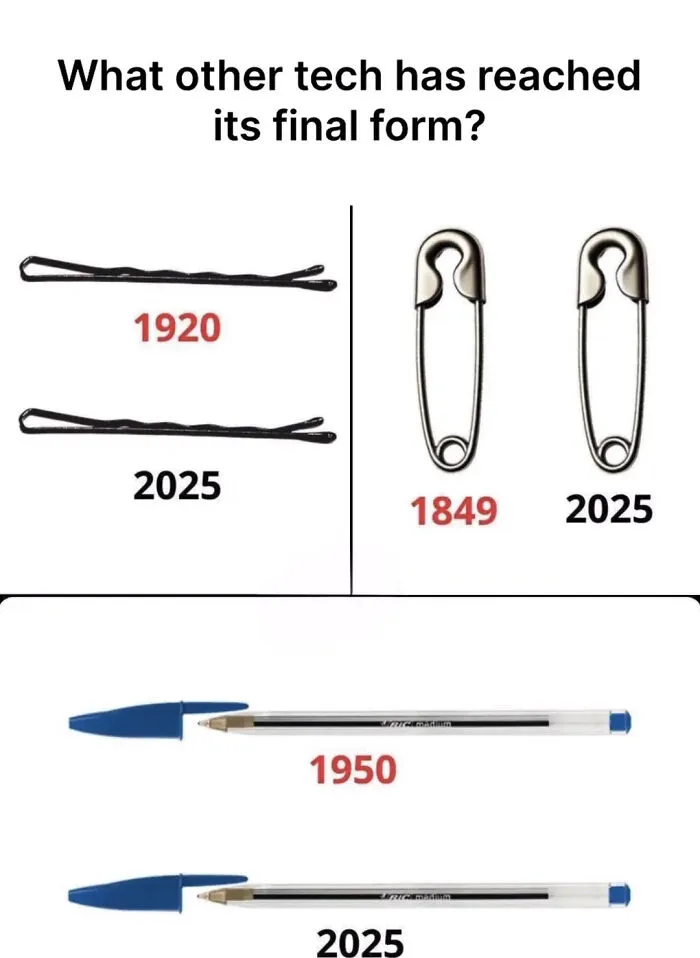
begorrah_gumdrops: The Bic ballpoint pen did not originally have a hole in the cap. I believe it was added to help stop children from choking on it.
Report
1point
#34 Why Did American Semi Trailers Grow From About 45 Feet In The 1970s To 48, Then 53 Feet, Instead Of Stopping At 50 Or Going To 60?
I knew trailers had gotten longer over time, but I hadn't realized the change was roughly 45 to 48 to 53 feet. If longer means more cargo space, what made those particular lengths stick instead of the industry moving toward 60 feet?
Special_Context6663: The nominal length of a pallet is 4’, so the trailer length was added in increments of 4’ to accommodate additional rows of pallets, (plus a little wiggle room: 45 vs 44 and 53 vs 52).
A few states have 57’ trailers, which is one more row.
Special_Context6663: The nominal length of a pallet is 4’, so the trailer length was added in increments of 4’ to accommodate additional rows of pallets, (plus a little wiggle room: 45 vs 44 and 53 vs 52).
A few states have 57’ trailers, which is one more row.
Report
1point
#35 Why Does A U.S. Government Shutdown Barely Seem To Affect Everyday Life?
Every time the U.S. government “shuts down,” news headlines explode like it’s the end of the world.
But when you look around… nothing really happens.
People still go to work. Kids still go to school. Netflix still runs. Even the stock market seems unfazed.
I’m Asian, and I genuinely find this fascinating. It makes me wonder — how much of “the government” actually touches daily life?
If a shutdown doesn’t cause chaos, does that mean we’ve already built a system where most people live outside the government?
Adnan7631: The critical parts of the government are still running, though a huge number of people are going unpaid. For example, the TSA continues to operate allowing flights to continue, but the workers are currently not getting paid.
But when you look around… nothing really happens.
People still go to work. Kids still go to school. Netflix still runs. Even the stock market seems unfazed.
I’m Asian, and I genuinely find this fascinating. It makes me wonder — how much of “the government” actually touches daily life?
If a shutdown doesn’t cause chaos, does that mean we’ve already built a system where most people live outside the government?
Adnan7631: The critical parts of the government are still running, though a huge number of people are going unpaid. For example, the TSA continues to operate allowing flights to continue, but the workers are currently not getting paid.
Report
1point
#36 Why Did Us Cities Tear Out Their Streetcar Systems In The 1950s?
Old photos show that Los Angeles once had one of the largest electric railway networks in the world, and hundreds of American cities had streetcar systems too. By the 1960s, most of these systems had disappeared or been converted to buses.
I've heard that GM and other companies helped push many streetcar systems toward replacement, and there was even an antitrust case involving some of these companies in 1949. But how much did corporate influence actually matter compared with other factors like cars, suburbs, and highway expansion?
Was the decline of streetcars mainly a business decision, a result of changing cities, or a combination of both?
Secret_Ostrich_1307: GM and the other companies definitely played a role, but they were operating in a system that was already becoming hostile to streetcars.
Streetcar companies were often financially weak, fares were regulated, cars were getting cheaper, suburbs were spreading, and highways were being heavily subsidized. Buses also gave transit agencies much more flexibility than fixed rails.
The interesting part is that removing the tracks probably reinforced the trend. Once the rails were gone, cities became even easier to design around cars and buses. So it seems less like one company killed the streetcars and more like several incentives were pushing in the same direction.
I've heard that GM and other companies helped push many streetcar systems toward replacement, and there was even an antitrust case involving some of these companies in 1949. But how much did corporate influence actually matter compared with other factors like cars, suburbs, and highway expansion?
Was the decline of streetcars mainly a business decision, a result of changing cities, or a combination of both?
Secret_Ostrich_1307: GM and the other companies definitely played a role, but they were operating in a system that was already becoming hostile to streetcars.
Streetcar companies were often financially weak, fares were regulated, cars were getting cheaper, suburbs were spreading, and highways were being heavily subsidized. Buses also gave transit agencies much more flexibility than fixed rails.
The interesting part is that removing the tracks probably reinforced the trend. Once the rails were gone, cities became even easier to design around cars and buses. So it seems less like one company killed the streetcars and more like several incentives were pushing in the same direction.
Report
1point
#37 Why Is The Word "Colonialism" Used So Differently When Discussing European Empires Compared With Historical Arab Expansion?
European empires are discussed, the word "colonialism" seems to come up almost automatically. But when I read about the historical Arab expansion into Africa and the Middle East, I don't seem to see that term used nearly as often.
How did that difference come about?
BlazeFireVale: For the same reason we don't usually talk about Roman colonialism. There are many ways to run an empire. Modern colonialism refers to a particular form of imperialism that became especially associated with the European overseas empires from the 15th century onward. It typically involved establishing colonies, governing them from a distant metropole, and structuring trade and administration to benefit the homeland through resource extraction. Not all imperialism is colonialism.
How did that difference come about?
BlazeFireVale: For the same reason we don't usually talk about Roman colonialism. There are many ways to run an empire. Modern colonialism refers to a particular form of imperialism that became especially associated with the European overseas empires from the 15th century onward. It typically involved establishing colonies, governing them from a distant metropole, and structuring trade and administration to benefit the homeland through resource extraction. Not all imperialism is colonialism.
Report
1point
#38 Why Are Window Screens So Standard In American Homes But Hasn’t Window Screen Technology Been Adopted To The Same Degree In Europe, Even In Fairly Buggy Places?
In the US it feels almost automatic that windows come with screens. Cheap, simple, everywhere. But in parts of Europe with real mosquito problems, they seem less common or more improvised. Is it architecture, climate, habits, or just path dependence? And how did screens become so “default” in the US in the first place?
LuxInTenebrisLove: It is really weird. My Italian host family told me screens prevent breezes coming into the room, which isn't true as we know living with screens. 🤷
The US used to have a real problem with Malaria in the South, (which is why CDC headquarters are in Atlanta). I wonder if we took up screens because of that danger.
LuxInTenebrisLove: It is really weird. My Italian host family told me screens prevent breezes coming into the room, which isn't true as we know living with screens. 🤷
The US used to have a real problem with Malaria in the South, (which is why CDC headquarters are in Atlanta). I wonder if we took up screens because of that danger.
Report
1point
#39 Why Do Pregnancy Test Adverts Never Show A Relieved Young Woman Looking At A "Not Pregnant" Result?
It's always the happy couple sitting on the bathroom floor.
Cultural-Budget7852: bc people who are trying buy more tests than those who aren’t
Cultural-Budget7852: bc people who are trying buy more tests than those who aren’t
Report
1point
#40 Why Do So Many People Equate Legality With Morality?
I’ve been noticing something strange about how people think: just because something is legal doesn’t mean it’s right, and yet so many act like it does. From corporate loopholes to controversial laws, people often assume that if it’s allowed, it must be okay.
Why is that? Is it trust in the system, a mental shortcut to avoid moral thinking, or just the way society teaches us to follow rules without questioning them?
It’s fascinating, because legality is just a set of rules — it doesn’t always align with ethics, fairness, or human well-being. So why do so many of us treat the law as a moral compass instead of a guideline?
Meowakin: Probably because so many things that are illegal are also morally wrong, and people lack critical thinking skills.
Of course, not everything that is illegal is morally wrong (which is just the flip side of what you're saying).
Why is that? Is it trust in the system, a mental shortcut to avoid moral thinking, or just the way society teaches us to follow rules without questioning them?
It’s fascinating, because legality is just a set of rules — it doesn’t always align with ethics, fairness, or human well-being. So why do so many of us treat the law as a moral compass instead of a guideline?
Meowakin: Probably because so many things that are illegal are also morally wrong, and people lack critical thinking skills.
Of course, not everything that is illegal is morally wrong (which is just the flip side of what you're saying).
Report
1point


