





They say a single picture can tell a story. But sometimes, knowing what’s behind the picture tells an even bigger one.
That’s exactly what History Cool Kids on Instagram does best—digging up incredible photos from the past and revealing the moments that made them iconic. Some will make you laugh, others might teach you something new, and a few will hit surprisingly deep.
Scroll down to see their most memorable posts and and upvote the ones that left a mark on you.
#41
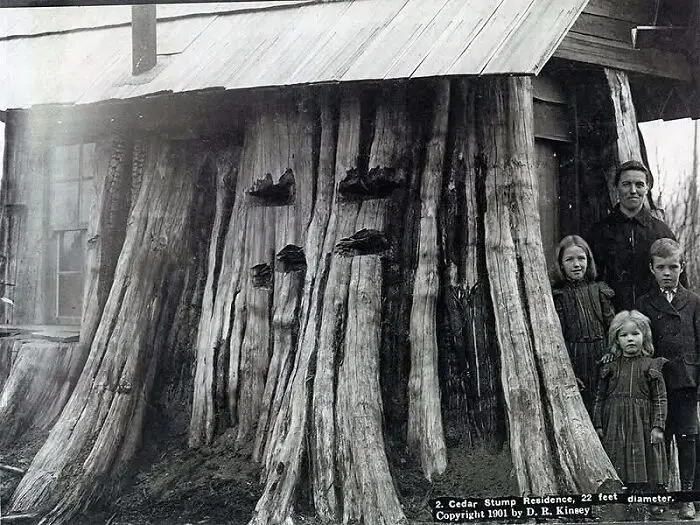
A family living in a tree stump house, 22 feet (7m) in diameter, 1901.
In the early 20th century, some families lived in tree stump houses, making use of nature’s massive remains, especially in the American Pacific Northwest, where logging had left behind enormous old-growth stumps from ancient redwoods or Douglas firs.
Families who lived in stump houses often built floors, walls, and roofs within or over the stump cavity, adding windows and doors to let in light and air. Some stumps were even big enough to accommodate two or three stories, with ladders or stairs connecting levels.
These homes provided not only shelter but also an affordable solution for settlers and loggers who needed immediate housing while clearing and homesteading forested land. Life inside a stump house was simple but resourceful—a wood stove for cooking, bunks or lofts for sleeping, shelves carved into the walls for storing essentials.
Report
42points
#42
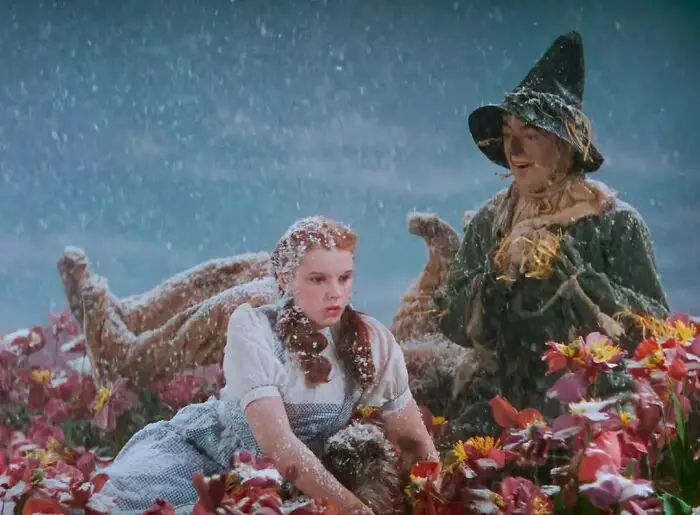
The “snow” in the Wizard of Oz movie was 100% pure asbestos.
Not only that, the Scarecrow stuffed his outfit with asbestos to prevent it from catching on fire.
The original Tin Man had his face painted with pure aluminum dust, which led to respiratory problems that sent him to the hospital. The film producer decided to replace him with actor Jack Haley. However, Haley was not immune to the toxic makeup, which caused an eye infection and made him miss four days of filming.
Margaret Hamilton as the Wicked Witch of the West also put on extremely toxic makeup that contained high levels of copper. Her makeup artist, Jack Young, once said, “Green is toxic because it’s made with copper. Every night when I was taking off the Witch’s makeup, I would make sure that her face was thoroughly clean. Spotlessly clean. Because you don’t take chances with green.”
Once she put on her makeup, Hamilton was forced to stick to a strict liquid-only diet to prevent her from ingesting any of the toxic paint.
Judy Garland was only 16 years old when she started filming the Wizard of Oz. On set, she was shunned by the Scarecrow, Tinman and the Cowardly Lion due to jealousy. Her only friend was Margaret Hamilton.
Report
41points
#43
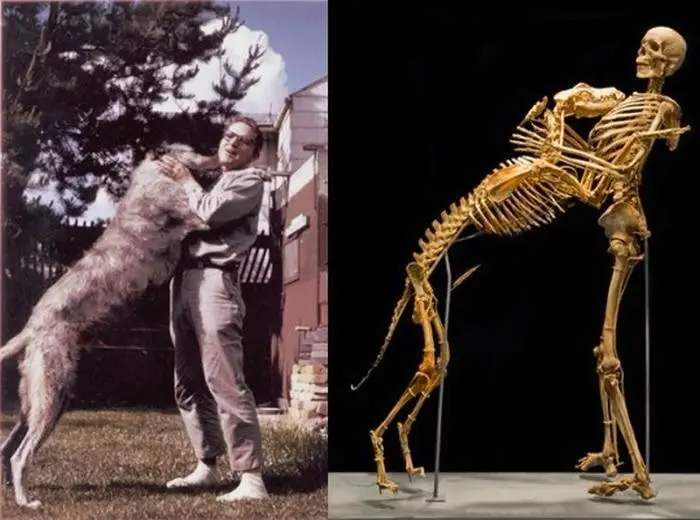
Grover Krantz, an American anthropologist best known for his research on human evolution (and his outspoken interest in Bigfoot) made an unusual request for his remains.
When he passed away in 2002, he donated his body to science on the condition that his beloved Irish Wolfhounds would be kept close to him even in the afterlife, just as they were in life.
Today, Krantz’s skeleton, along with the articulated skeleton of his favorite dog Clyde, are preserved and displayed together at the Smithsonian’s National Museum of Natural History.
It should be noted that Clyde passed away long before Dr. Krantz and his bones were saved. I do feel bad for his subsequent dogs, but what you going to do.
Report
40points
#44
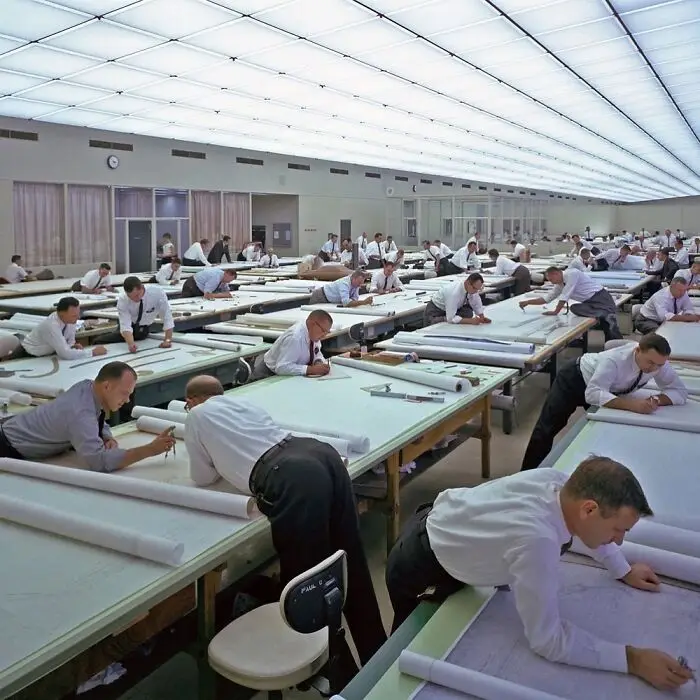
Office life before the invention of AutoCAD and other drafting softwares.
Prior to the release of AutoCAD in 1982, engineering drawings were all done by hand using different grade pencils, erasers, T-squares and set squares.
Even after all the manual labor, if a change was required, the engineers and toolmakers had to start from scratch and make the sketches all over again. Nowadays, architecture designers and other drafters are mainly just clicking their mouse and keyboard and not hunched over on a giant desk wondering if any changes will be made to their final drafts.
Report
39points
#45
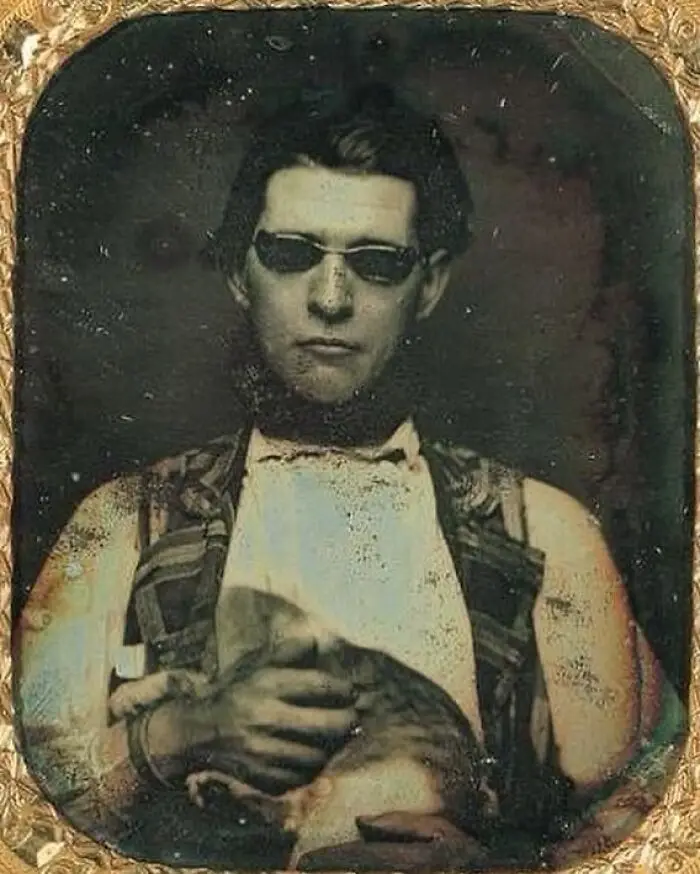
At first glance, I thought he could be a time traveler…
Those tinted glasses look too modern to be worn by anyone from the 1850s. His facial expression seems to convey a sort of coy playfulness as if he knows he belongs in the Matrix. The blurry cat only makes the portrait look more surreal.
But looks like there is an explanation for everything.
This is the caption provided the George Eastman Museum in Rochester, New York:
“Inscribed in pen on applied label on spine of case: 388 Entry 388 in Mackay’s notebook (located in library): Daguerreotype of young man, black hair, full beard, in vest & shirt & sleeves, holding cat which moved, making head disappear. Man has black glasses and probably blind. Very unusual. Attractive papier maché & pearl case. Case 1.25. Daguerreotype gift. Total 1.25. Unknown man.”
Report
39points
#46
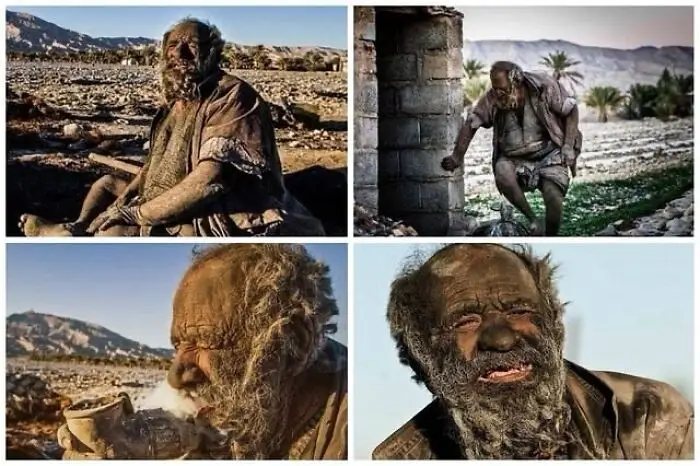
Amou Haji, often referred to as the “World’s Dirtiest Man,” was an Iranian hermit who became famous for reportedly not bathing for over 60 years.
He lived in the village of Dejgah in Iran’s southern Fars province and was known for his unconventional lifestyle. He avoided water and soap out of a deep-seated belief that bathing would make him sick. Despite his unhygienic habits, he lived to the remarkable age of 94, smoking animal dung in a pipe, eating roadkill (mostly porcupines), living in a hole he dug, and wearing a soldier’s helmet when it got cold outside. He began to live like this after a breakup led to immense emotional distress.
Ironically, after villagers finally persuaded him to wash for the first time in decades, Amou Haji passed away just a few months later in 2022.
Report
34points
#47
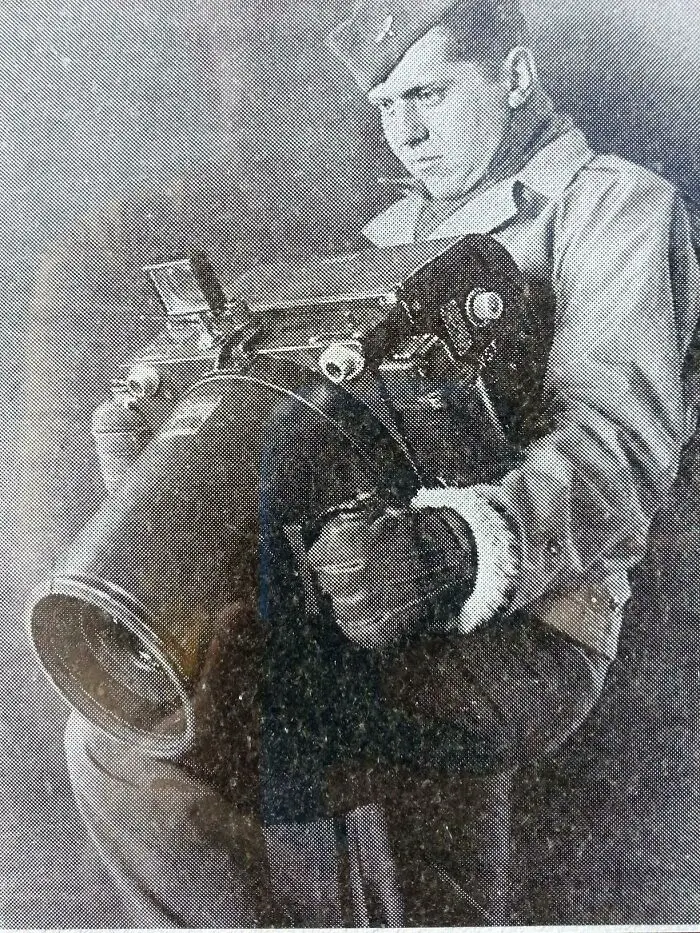
Fairchild K-17 camera used for aerial photos during World War 2.
While these cameras were mostly mounted securely in aircraft for steady, automated shooting, they were also designed to allow limited “hand-held” operation when needed, although the term “hand-held” was a bit optimistic given their sheer size and weight.
These cameras could be fitted with a pair of side handles and an optical viewfinder so an aerial photographer could maneuver them to capture oblique angles or quick shots through open hatches or windows. But this was no casual task. With a full 200-foot roll of film loaded in the A-5 magazine, the film magazine alone weighed about 30 pounds. Add the main camera body, a 12-inch lens cone, and all its fittings, and the K-17 tipped the scales at around 55 pounds (25 kg). Swapping in a longer 24-inch lens for higher-altitude detail shots pushed the weight up to nearly 75 pounds (34 kg).
Report
33points
#48
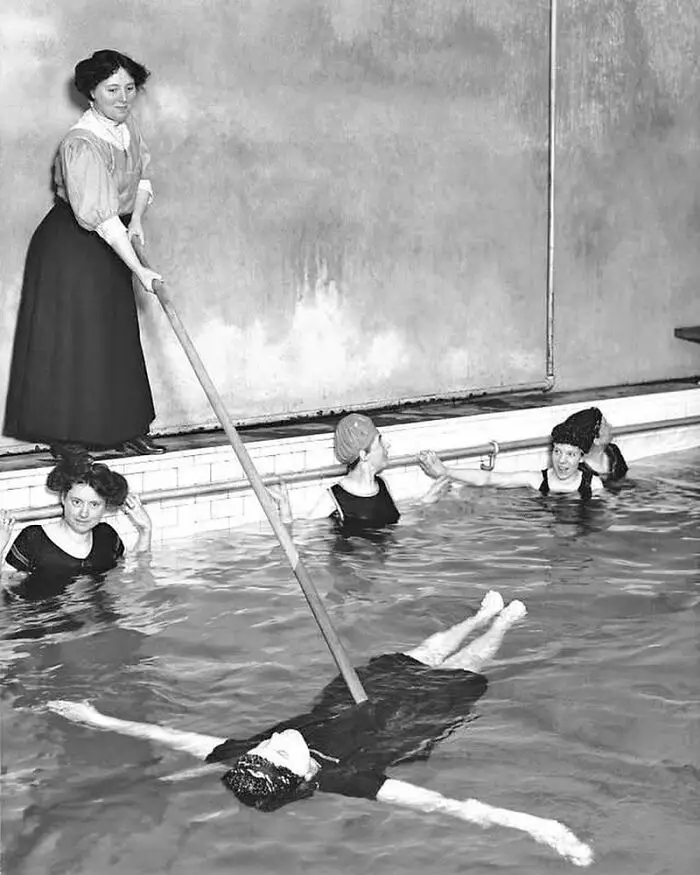
Swim instructor at the YMCA, Toronto, 1908.
The stick is used to test the student. The instructor pushes them underwater, which naturally triggers panic. However, if the swimmer resists the urge to thrash around and struggle, they’ll naturally float back up on their back.
Report
33points
#49
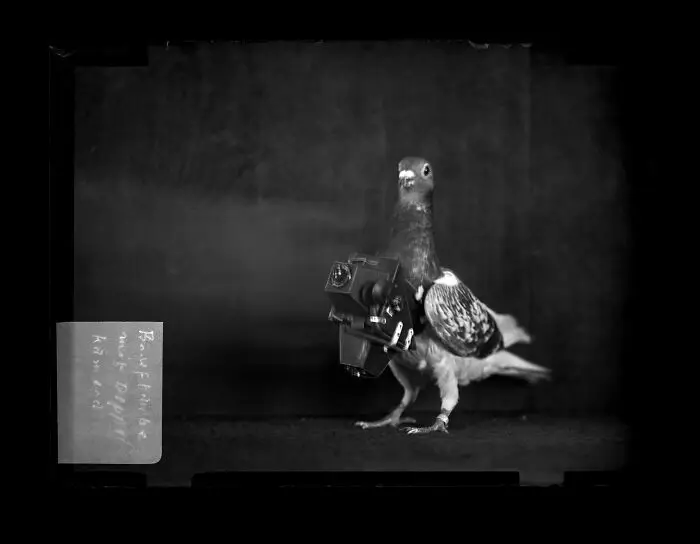
In 1908, Dr. Julius Neubronner, a German apothecary and inventor, devised an inventive method of aerial photography by strapping tiny, lightweight cameras onto pigeons.
His “pigeon camera” used a small harness and a clockwork timer that automatically triggered the shutter as the bird flew over towns, landscapes, or military areas. Neubronner originally used pigeons for delivering prescriptions, so adapting them for reconnaissance and photography was a natural leap for him.
The resulting images were ghostly, blurred glimpses of rooftops, streets, and open fields, which are considered some of the earliest examples of aerial photography taken without balloons or kites.
Neubronner’s invention fascinated crowds at exhibitions, where he even demonstrated his pigeons in flight. While the idea had potential military applications (and was tested during WWI for scouting), the rapid advancement of aircraft soon overshadowed his feathered fliers.
Report
31points
#50
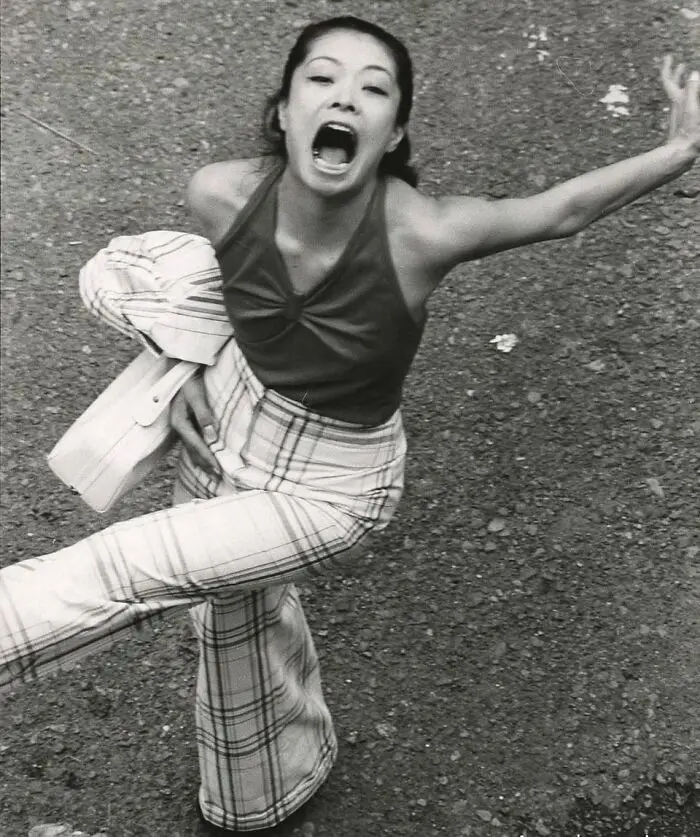
Japanese photographer Masahisa Fukase photographed his wife Yoko everyday for his photo series “From Window” in 1973.
Yoko left him after 10 years of marriage because according to her “…he would only look at me through the lens of a camera. The photos he took of me were undoubtedly depictions of himself.”
This sent Fukase into a deep spiraling depression and he would spend the next 6 years (1976 to 1982) photographing ravens in Hokkaido, Kanazawa, and Tokyo. His book Ravens, first published in 1986 is my personal favorite photo book of all time.
In 1976, when Fukase began capturing photos of ravens, he told Camera Mainichi magazine: “I’m wishing that I could stop this world. This act [of photography] may represent my own revenge play against life, and perhaps that is what I enjoy most.”
At the end of his project in 1982, Fukase simply wrote that he had “become a raven”.
Report
21points
