






They say a single picture can tell a story. But sometimes, knowing what’s behind the picture tells an even bigger one.
That’s exactly what History Cool Kids on Instagram does best—digging up incredible photos from the past and revealing the moments that made them iconic. Some will make you laugh, others might teach you something new, and a few will hit surprisingly deep.
Scroll down to see their most memorable posts and and upvote the ones that left a mark on you.
#21

A British soldier scolding a German woman who reportedly laughed during a mandatory screening of footage showing the concentration camp conditions.
These screenings were part of a broader Allied policy to force German civilians to confront the reality of the war crimes perpetrated in their name. In this specific case, the woman was removed from the screening after laughing, and then ordered to return and watch the film again.
Her reaction was documented to highlight the range of German civilian responses—shock, denial, indifference, or in rare but disturbing cases, mockery.
Report
59points
#22

Mugshot of John Wojtowicz who unsuccessfully tried to rob a bank in 1972 to pay for his wife Eden’s gender reassignment surgery.
Apparently, Wojtowicz had based his plans on the movie, “The Godfather” (1972) which he had watched earlier that day. His robbery attempt failed and he was arrested and sentenced to 20 years in prison of which he served five.
His story was later turned into a movie called “Dog Day Afternoon” (1975) starring Al Pacino and John Cazale, both of whom, interestingly enough, had starred in “The Godfather”.
For the rights to his story, Wojtowicz was paid $7,500 and 1% of the movie’s net profits, which he gave to Eden. After her operation, she married someone else before succumbing to pneumonia in 1987. Wojtowicz attended her funeral and delivered a eulogy.
Report
58points
#23

It should be noted that Kant did have a manservant by the name of Martin Lampe who was integral to Kant’s rigid daily schedule, helping to maintain the predictable, clockwork regularity that Kant believed was essential to his work and well-being. Lampe would wake Kant at the same time every day, prepare his meals, and manage his household affairs, freeing Kant to focus on his writing and teaching.
Lampe also faithfully read all of Kant’s work. However, when Kant published, “The Critique of Pure Reason” in 1781, he began to read it, but gave up halfway through, saying he’d end up in an asylum if he continued.
Report
58points
#24

The very final form of design.
Any other products that are just perfect, the way they are?
Report
58points
#25

Anne Frank was photographed with her sister Margot at the beach in Zandvoort in the Netherlands in 1940.
Margot was the older sister, quiet and serious, and while Anne’s diary became one of the most read accounts of the H*******t, Margot also kept a diary of her own during their time in hiding. Sadly, no trace of Margot’s diary was ever found after the war.
Margot, like Anne, was deported after the family’s hiding place was discovered in 1944. The sisters were eventually sent to the Bergen Belsen concentration camp, where they both perished of illness and starvation in early 1945, just weeks before the camp was liberated.
On April 5, 1944, Anne Frank wrote in her diary: “When I write I can shake off all my cares. My sorrow disappears, my spirits are revived! But, and that’s a big question, will I ever write be able to write something great, will I ever become a journalist or a writer?“
Report
57points
#26

Mississippi’s first interracial bride and groom, Berta and Roger Mills, enjoying their wedding cake in 1970.
“Roger and Berta Mills, newlyweds, live in a modest apartment, but only a few close friends know its location. They avoid grocery shopping at peak hours. ‘We don’t want to advertise,’ Mills explains. They have no home phone and their mailing address is the law office where Mills works as a clerk. ‘We are trying to remain anonymous to avoid as much hate mail or calls as we can,’ Mills said.
Despite the problems, Mills, who is white, describes his 11-week marriage to Berta Linson, a black, as ‘a very, very pleasant experience.’ ‘It’s been real smooth. I feel like I’m still on my honeymoon.’
Roger and Berta get together socially with four other interracial couples living here, all of whom were married in other states. ‘The whites I know in Jackson are attorneys and some wealthy people,’ Mills said. ‘It would be a step down for them to visit us where we are.’ Despite the problems, Mills said, he regards Mississippi as a ‘pretty good state.’ ‘Things are progressing. I kind of like Jackson and the state but Berta is fed up with the tension.’
He said she is looking forward to moving to Washington next year when he returns to law school at George Washington University... Although the U.S. Supreme Court long ago ruled that no state could prohibit interracial marriages, there was a law in Mississippi banning such unions. It was only after the couple experienced considerable publicity and secured a federal court order that the marriage took place in Jackson’s Central United Church.
‘Berta hated every minute of it and it caused her a great deal of anguish,’ said Mills. Publicity followed them all the way to Gatlinburg, Tenn., where they honeymooned at the foot of the Smoky Mountains. ‘Everywhere we stopped we saw newspapers carrying stories of the marriage,’ Mills said.”
Source: The Cincinnati Enquirer on November 26, 1970
Report
56points
#27
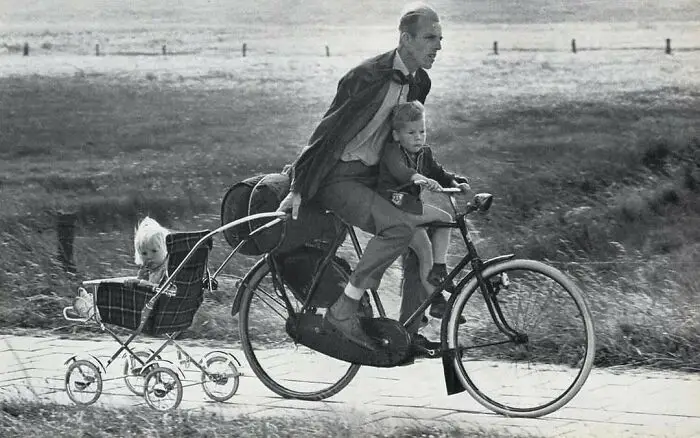
The Dutchiest father of all time, 1966.
He should invest in a bakfiets though—much safer way to transport two kids.
Report
56points
#28

Woman carrying hay on her head in Cogne, Italy, 1959. Photo by Pepi Merisio.
I briefly worked on a farm for a summer when I was a college student and I learned that if farmers don’t properly dry the hay they’re baling, the hay bales can spontaneously combust and they’re really hard to put out because the fire comes from deep inside the bale.
I know everyone is concerned about this lady’s back and neck, but I’m hoping she never experienced spontaneously combustible hay while it was on top of her head.
Report
53points
#29

Welsh wrestler Adrian Street with his coal miner father, 1974.
Adrian Street, born into a coal mining family in Brynmawr, Wales, rejected the harsh, traditional life of the mines that his father and generations before him had endured. By the 1970s, he had reinvented himself as an androgynous, flamboyant figure in the macho world of British wrestling, known for his peroxide hair, heavy makeup, and feather boas. His persona was designed to provoke and unsettle audiences expecting gritty, working-class brawlers.
In the photo, Street stands in full glittering wrestling regalia next to his father, still in his miner’s gear, covered in coal dust, looking every bit the symbol of the old industrial working class. The contrast is striking: the proud, defiant son gleaming in glam costume beside his stoic, exhausted father, who seems bemused and perhaps a bit bewildered by what his son has become.
Report
53points
#30
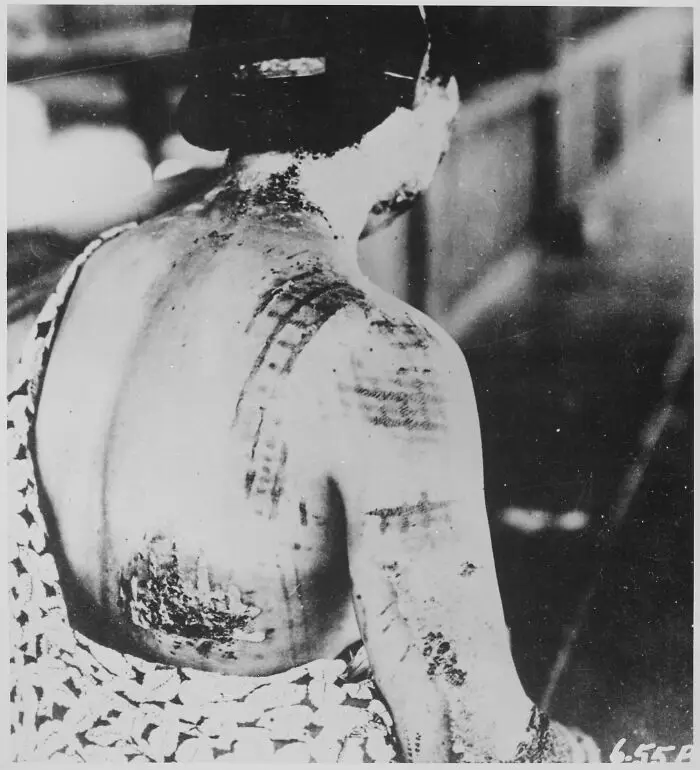
A woman from Hiroshima showing her back where her skin is burned in a pattern of the kimono worn at the time of the explosion, 1945.
When the intense flash of thermal radiation struck the city, it seared exposed skin instantly, but the thin fabric of clothing sometimes offered slight protection, leaving ghostly outlines of floral or geometric patterns on survivors’ bodies. Dark dyes often absorbed more heat, causing deeper burns where the fabric was darkest, while lighter areas reflected some of the rays.
Report
52points
#31

Fragment of a Seljuk box with a combination lock, which is said to allow for approximately 4 billion possible combinations.
Without the exact sequence, unlocking it would have been nearly impossible.
Dating back to 1200–1201, the Seljuk box exemplifies the advanced metalworking and mechanical sophistication of the Islamic world during the medieval period. Made in Iran, the box is composed of cast and hammered brass, richly inlaid with silver and copper in elegant geometric and calligraphic patterns.
Report
52points
#32
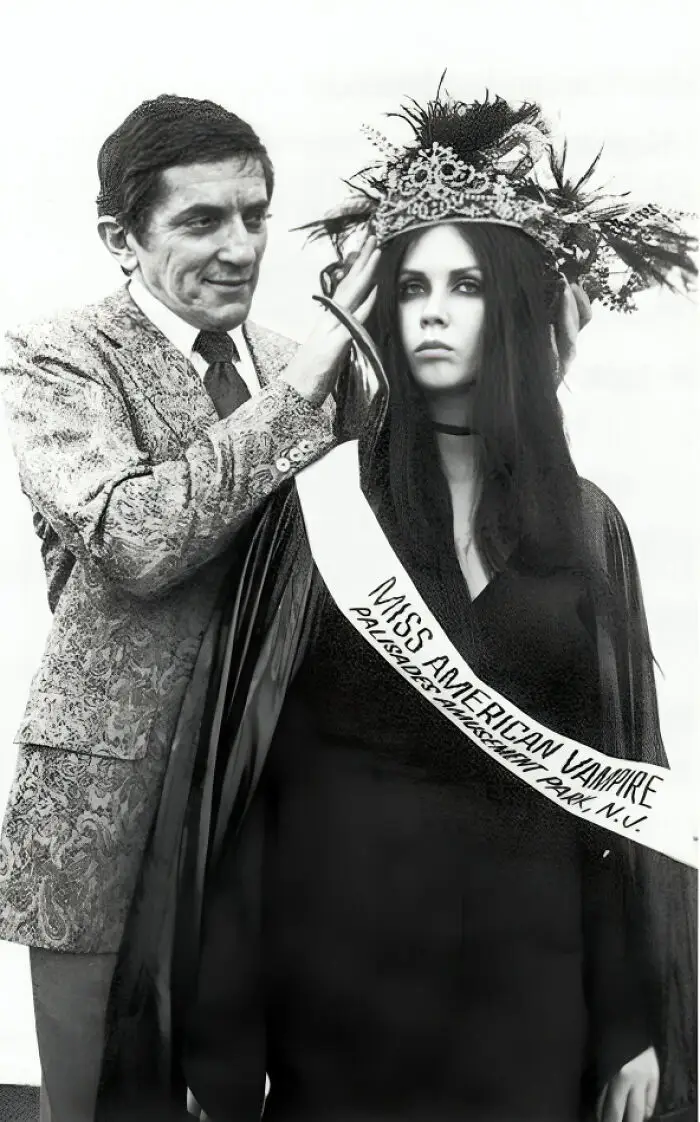
The crowning of the winner of Miss American Vampire, Palisades Amusement Park in New Jersey, September 1970.
Goth needs to make a comeback
Report
50points
#33

Kickin Jeans, also known as Action Jeans, were popular from 1977 to 1991. They looked like classic western jeans but featured stretch denim that let you move like a stuntman.
Not sure why it stopped being popular after 1991. Maybe that’s when everyone stopped kung fu fighting. I would grab a pair just for the “exclusive gusset in the crotch”.
Report
48points
#34

Just a man delivering a birthday cake on a bicycle in Cuba, 1997.
I hope he didn’t drop it. You can tell that he is stressed!
Report
48points
#35
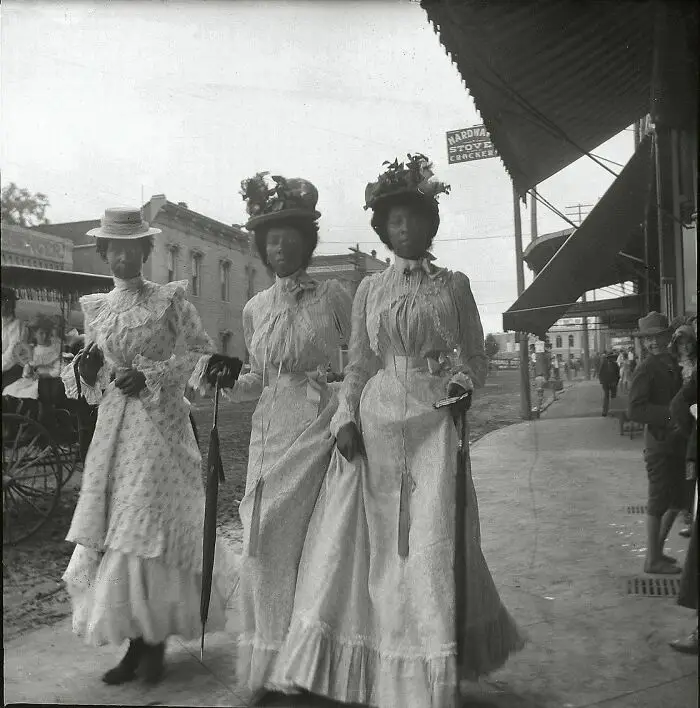
Three well dressed women of Marshall, Texas, USA. 1899.
I can’t image how hot they must have been wearing these dresses in the ungodly Texas heat. I figured the temperature might have been cooler back then than it is now.
Interestingly enough, when I looked into the highest temperature ever recorded in Marshall, Texas, it was 112 °F (44.4°C) which occurred on August 18, 1909. I then looked at the lowest temperature ever recorded in Marshall, Texas and it was -13 °F (-25°C) which occurred on February 16, 2021.
Anyway, I know more than a 125 years have passed, but I just wanted to say that I love their fit check and that they all look lovely. Considering the year, I hope these ladies went on to live long fulfilling lives.
That smirking kid in the back does make me a bit nervous…as if he’s up to no good.
Report
48points
#36

Charles the II of Spain was the result of nearly 200 years of inbreeding. The House of Habsburgs stopped introducing new genes at around 1550, leading to a circular family tree.
Charles the II had been born the son of an uncle-niece relationship, and historians Will and Ariel Durant described him as “short, lame, epileptic, senile and completely bald before 35… baffling Christendom by continuing to live.”
Before the age of six, Charles the II had managed to survive an onslaught of diseases which included chickenpox, measles, rubella, and smallpox. He could not walk until he was 8-years-old and could not chew food on his own. His tongue was so large that no one could understand what he was saying.
The nuncio papal Millini provided the following description of Charles the II: “The king is rather short, skinny, but not badly formed, only ugly in the face; he has a long neck, a long face, a long chin and as if it bent upwards; the lower lip typical of the Habsburgs; not very large eyes, turquoise blue and a fine and delicate complexion. He has a look with melancholy on his face and a little astonished. His hair is blond and long, and it is combed back so that the ears are exposed. He cannot straighten, unless he leans against a wall, a table or something else. His body is as weak as his mind. From time to time he shows signs of intelligence, memory and a certain liveliness, but not now; he usually looks slow and indifferent, appearing dumbfounded. You can do whatever you want with him, since he lacks of own will.”
Charles the II’s passing in 1700 (at the age of 39) led to the War of Spanish Succession and the dissolution of the The House of Habsburgs.
His autopsy report stated that his “heart was the size of a peppercorn; his lungs corroded; his intestines rotten and gangrenous; he had a single testicle, black as coal, and his head was full of water.”
Report
46points
#37

2,000 year old giant cat geoglyph discovered in Peru’s famous Nazca Lines, a place recognized as a UNESCO World Heritage Site.
Experts believe it dates back to the late Paracas period, which is slightly older than most of the other Nazca Lines that fill the arid plain below. Unlike many of the more famous geoglyphs that are etched on the flat desert floor, this one was carved into a steep slope and had faded so much over time that it was nearly invisible until archaeologists spotted it while doing maintenance work.
The Nazca Lines include hundreds of massive drawings of animals, plants, and geometric shapes made by removing dark stones to reveal the lighter ground beneath. They have survived for centuries because the dry windless climate keeps them undisturbed.
Report
43points
#38

David Vetter (aka “Bubble Boy”) was born in 1971 with severe combined immunodeficiency (SCID), a rare and life-threatening genetic disorder that left him without a functioning immune system.
Even the most ordinary germs could be fatal, so from infancy, he lived in a completely sterile, sealed environment designed to protect him from infection. The structure allowed for limited interaction with his family and doctors, but every object or person that came into contact with him had to go through extensive sterilization.
His condition gained national attention, symbolizing both the promise and the limitations of medical science in the 1970s and early 1980s. Despite the isolation, David showed remarkable intelligence, curiosity, and humor. He received his education through television and written materials passed into the bubble, and maintained relationships through a transparent barrier.
In 1983, at age 12, David underwent a bone marrow transplant from his sister in an experimental effort to give him a functioning immune system. Sadly, the transplant introduced an undetected Epstein-Barr virus, which led to cancer. David passed away a few months later from lymphoma, a complication of the virus.
Approximately $1.3 million was spent on his care.
Report
43points
#39
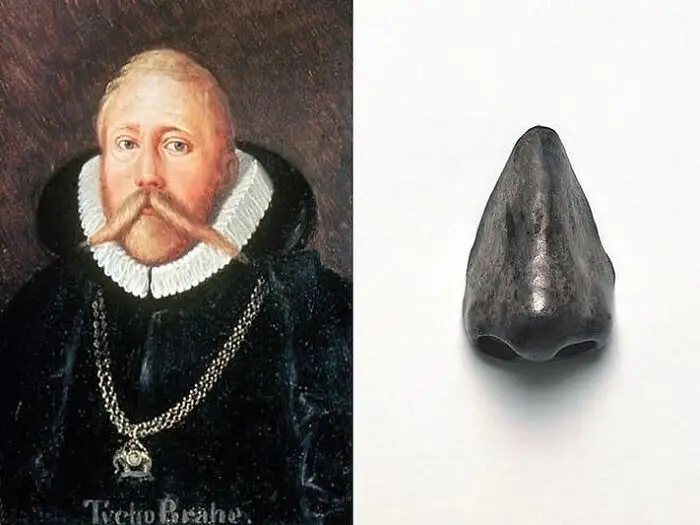
The man on the left is Danish astronomer Tycho Brahe (1546-1601).
The fake nose (made of bronze) on the right is what he wore after he lost his real nose in a sword duel with his cousin Manderup Parsberg.
They had gotten into a drunken quarrel over who was the better mathematician.
On special occasions, Brahe would swap out the bronze nose for a silver or gold one.
Report
43points
#40

A pair of hammerhead sharks depicted in the “Oki National Products Illustration Notes” during the Edo Period in Japan, 1735.
I love how this illustration appears to be remarkably modern and cartoon-like, despite it being nearly 300 years old. I guess the Japanese always had a knack for drawing cute animals even way back then…
One cool fact about hammerhead sharks is that no fatal attacks against humans have ever been recorded. They also travel in large groups of up to 500 sharks, usually in the summer months as they migrate to find cooler waters. As for its weird head shape, the hammerhead has evolved to be better at sensing its environment, however the drawback is that they are equipped with smaller mouths, making them less effective at k*****g their prey.
Report
42points
