



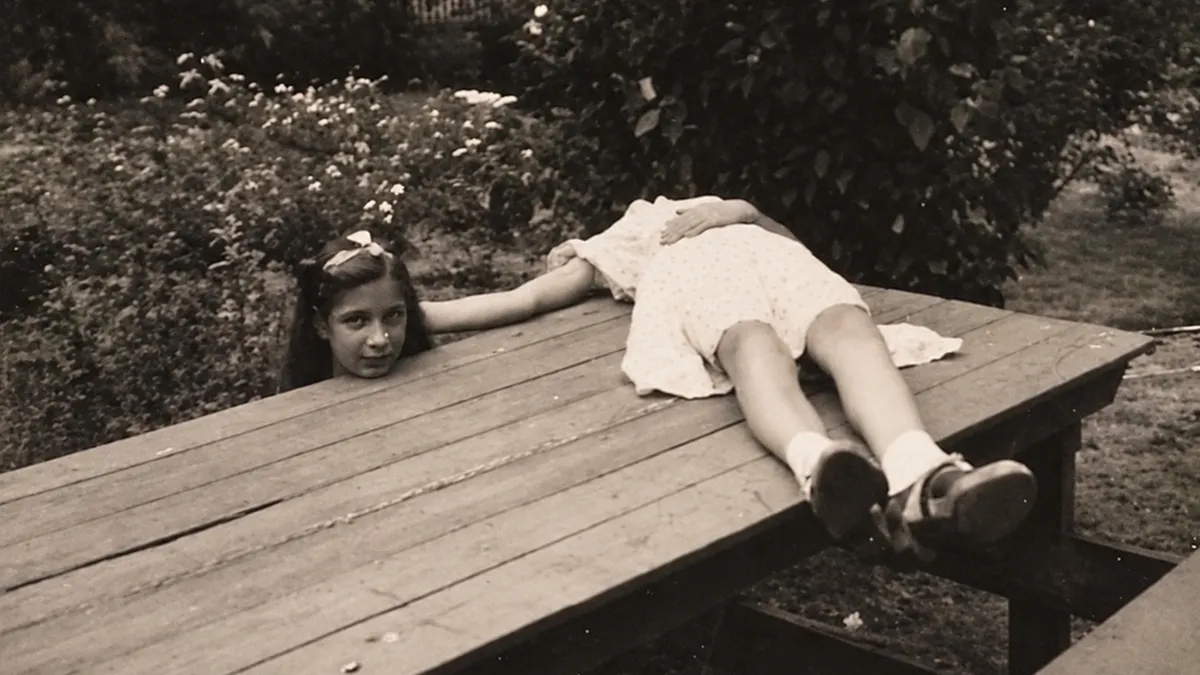


Every single one of us has probably wished they could be omnipresent at some point in their lives. Witnessing historical events unfold right before our eyes is exactly the kind of superpower many of us wish we had.
But some people have actually been there when history was made. Of course, cameras weren't as readily available back then, but against all odds, some people still captured historical moments that don't necessarily appear in our history books. So, we've gathered a few incredible pictures from Instagram to show that being in the right place at the right time really does pay off.
#41
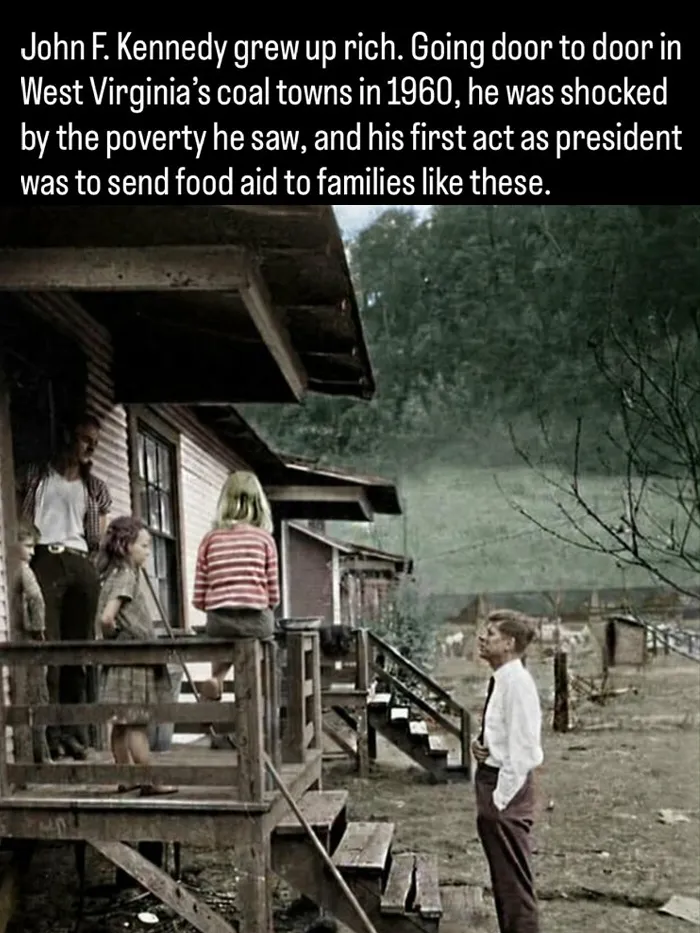
The West Virginia primary on May 10, 1960, was one of the most important moments of Kennedy’s run for president. No Catholic had ever been elected to the White House, and many Democratic leaders doubted one could win. West Virginia was about 95% Protestant, so it became the test.
Kennedy spent weeks traveling through the state’s small towns and coal camps, shaking hands at mine entrances, talking to families on their porches and going down into a mine himself. He took the religion question head on, telling voters that nobody had asked about his faith when he served in the Navy during World War II.
The trip also changed him. He saw unemployed miners, hungry children and families living on government surplus food like flour and cornmeal. Journalist Theodore White, who followed the campaign, wrote that Kennedy told an aide one night, “Imagine, just imagine kids who never drink milk.”
He won the primary in a landslide, taking about 61% of the vote over Senator Hubert Humphrey, who dropped out of the race that night. On his second day as president, Kennedy signed his first executive order, expanding food aid for needy families. A few months later, the first food stamps of the new program went to an unemployed miner with 13 children in McDowell County, West Virginia.
Added fact: Kennedy returned to West Virginia in June 1963 for the state’s 100th birthday. Speaking in the pouring rain in Charleston, he told the crowd, “The sun does not always shine in West Virginia, but the people always do.”
Report
5points
#42
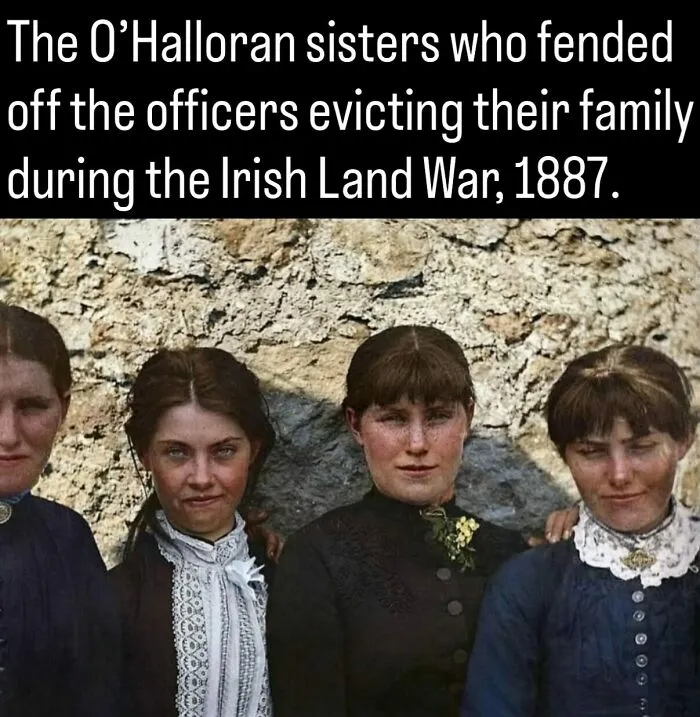
In the late 1880s, rural Ireland was gripped by the Irish Land War, a bitter struggle between tenant farmers and landlords. Families like the O’Hallorans lived on land they did not own, paying rent to absentee landlords, often English, while surviving on marginal incomes. When crops failed or rents rose, eviction followed swiftly. In 1887, the O’Halloran family faced removal after falling behind on rent, a fate shared by tens of thousands of Irish tenants during that decade.
What made this case remarkable was the response. When officers arrived to carry out the eviction, the O’Halloran sisters physically resisted. They blocked doorways, confronted bailiffs, and used whatever was at hand, sticks, stones, and sheer determination, to delay the process and draw attention to their cause. Their defiance became a local symbol of resistance, echoing tactics encouraged by land reform activists who believed public confrontation could shame landlords and halt evictions.
Colorized by: @sannadullaway
Added fact: During the height of the Irish Land War, over 15,000 evictions were carried out between 1879 and 1889. Acts like the O’Halloran sisters’ resistance helped build momentum that eventually led to the Land Purchase Acts, which allowed many tenant families to buy the land they worked, fundamentally reshaping rural Ireland.
Report
5points
#43
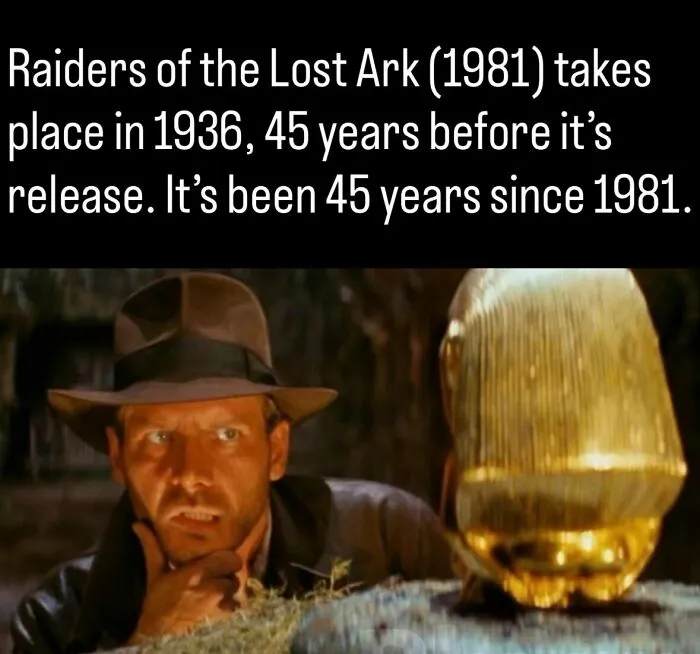
When Raiders of the Lost Ark came out in 1981, it was already designed to feel like a throwback.
The film is set in 1936, with Indiana Jones chasing ancient relics in a world of old airplanes, desert dig sites, military uniforms, secret maps, and prewar danger. To audiences at the time, 1936 felt like deep cinematic history.
But now the distance has flipped.
The gap between 1936 and 1981 is the same as the gap between 1981 and 2026. That means Raiders is now as old to us as the world it was recreating was to the people who first saw it in theaters.
That is what makes this so strange. The movie still feels modern in the way blockbusters do. It moves fast, looks huge, and basically created the template for decades of adventure films.
But on the calendar, it has crossed into the same kind of nostalgic distance it was originally built to imitate.
Indiana Jones was chasing lost history. Now Raiders is becoming part of it.
Added fact: Harrison Ford was about 38 when Raiders of the Lost Ark was filmed, while the character Indiana Jones is generally treated as being in his late 30s during the events of the movie.
Report
5points
#44
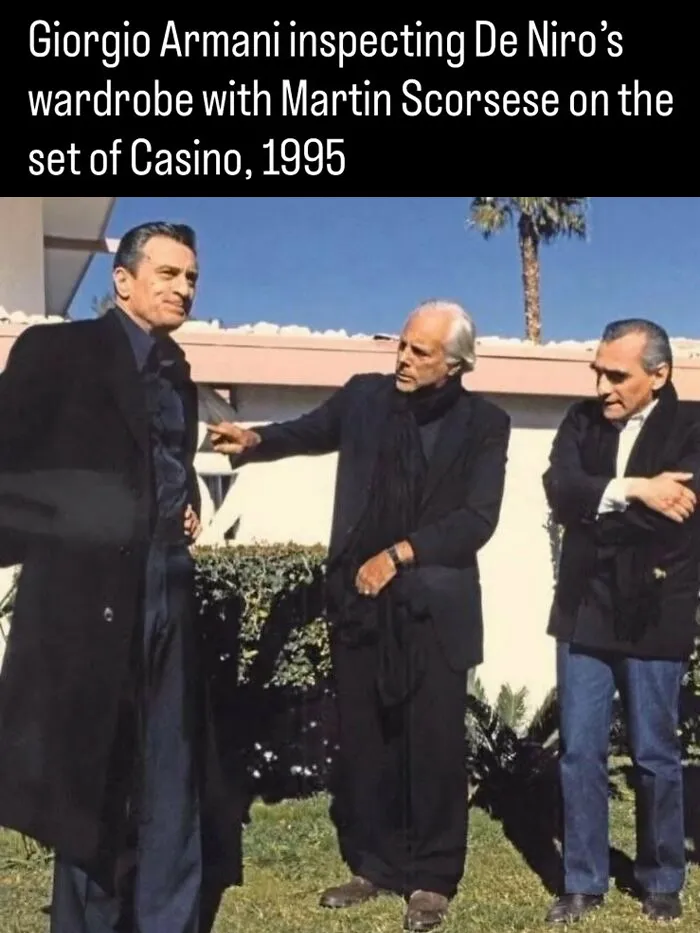
One of the reasons Casino looks so polished is that the clothing was treated almost like another character in the film.
Robert De Niro’s Sam “Ace” Rothstein moves through Las Vegas in a series of carefully coordinated suits, shirts, ties, and accessories that reflect both his wealth and his obsession with control.
Giorgio Armani was closely associated with the film’s wardrobe, and his influence fit perfectly with the world Scorsese was recreating. The clothes needed to feel expensive, precise, and unmistakably tied to the flashy Las Vegas of the 1970s and early 1980s.
De Niro reportedly wore dozens of different outfits throughout the movie, many of them built around bold color combinations that would look excessive almost anywhere else. In Casino, that excess is the point.
Rothstein is a man who wants every detail managed, from the casino floor to the way he dresses.
Scorsese also used wardrobe to separate his characters visually. De Niro’s clothing is controlled and immaculate, while Joe Pesci’s Nicky Santoro gradually becomes more aggressive and less refined as the film progresses.
Added Fact: Costume designers Rita Ryack and John Dunn created hundreds of costumes for Casino, and De Niro alone reportedly had around 70 different costume changes during the film.
Report
4points
#45

The Vietnam War was not only fought against an enemy. It was fought against the jungle itself.
American soldiers moved through heat, monsoon rain, mud, leeches, mosquitoes, snakes, spiders, and insects that seemed almost unreal to men who had grown up far from Southeast Asia.
Photos like this became part of the unofficial record of the war because they showed the daily environment in a way combat reports could not.
The centipede in the image was likely a giant tropical centipede, the kind found across Southeast Asia.
These animals can grow more than a foot long, move quickly, and deliver a painful venomous bite. For troops sleeping on the ground, marching through dense vegetation, or digging into wet terrain, creatures like this were not curiosities. They were part of the constant stress of jungle warfare.
That is what makes the photo so striking. It is not a battlefield scene, but it still explains something about the war. Even when no one was shooting, the jungle never really left soldiers alone.
Added fact: During the Vietnam War, disease and environmental hazards were a major problem for troops. Malaria, jungle rot, infected wounds, leeches, and venomous animals were constant threats in the field.
Report
4points
#46

For more than fifteen centuries, the papacy in Rome and Japan’s imperial institution developed at opposite ends of Eurasia without a reigning pope ever meeting a reigning Japanese emperor. That changed on February 24, 1981, when Pope John Paul II met Emperor Hirohito at the Imperial Palace in Tokyo during the first papal visit to Japan.
The striking “1,528 years” figure comes from counting the historically documented Japanese imperial line from roughly 453, during the reign traditionally attributed to Emperor Ankō, until the 1981 meeting. The precise number depends on where historians begin the reliably recorded imperial succession. Japan’s traditional chronology stretches much further back, to the legendary Emperor Jimmu in 660 B.C., while the papacy traces its origins to Saint Peter in the first century. For that reason, the figure is best understood as a fascinating historical calculation rather than an exact, universally accepted measurement.
John Paul II’s four-day journey carried enormous symbolic weight. Christianity had reached Japan through Jesuit missionary Francis Xavier in 1549, but later rulers outlawed the faith and subjected Japanese Christians to centuries of persecution. Diplomatic relations between Japan and the Holy See were eventually established in the 20th century. The 1981 encounter therefore represented not merely two leaders meeting, but the convergence of two institutions whose histories stretched back across vastly different cultures and civilizations.
Added fact:
Hirohito had previously met Pope Benedict XV at the Vatican in 1921, but he was still Japan’s crown prince rather than its reigning emperor.
Report
4points
#47
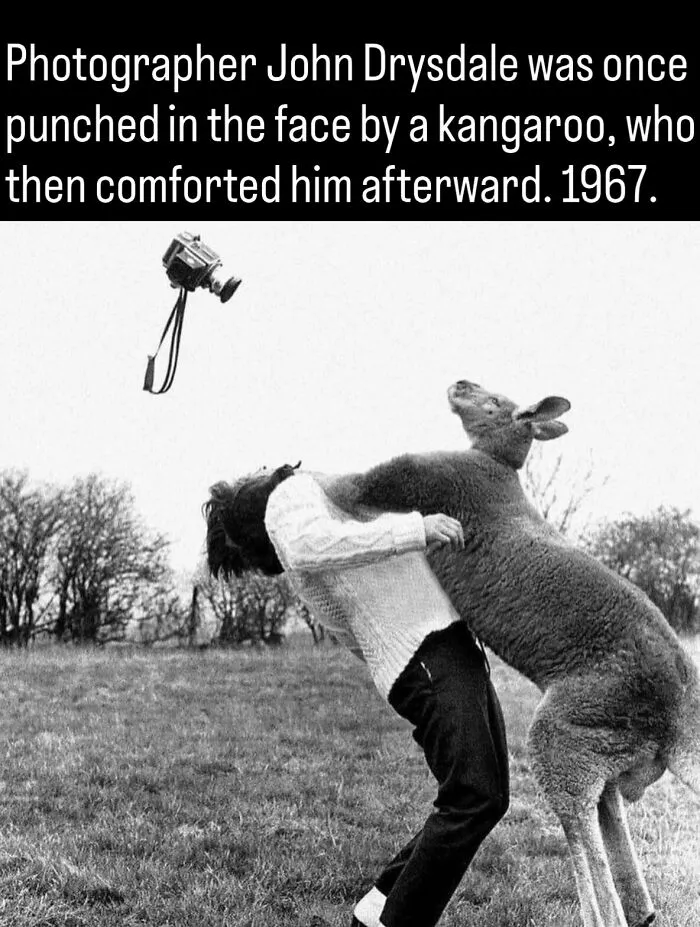
British photographer John Drysdale became known for capturing wonderfully strange moments between people and animals, and this sequence remains one of his most memorable. While photographing a kangaroo in England, Drysdale moved close enough for the animal to rise on its hind legs and lunge toward him. One image catches the instant of impact, with Drysdale bending backward as his camera flies from his hands.
What happened next transformed an amusing action photograph into something far more endearing. In the following images, the kangaroo appears to calm down, approach the fallen photographer and place its paws around him as though offering an apology. The sequence looks almost too perfectly timed to be real, resembling a scene from a silent comedy.
Drysdale specialized in photographing animals in playful, unexpectedly human situations. Rather than concentrating only on wildlife in its natural habitat, he often created images that emphasized affection, curiosity and humor. His photographs featured children interacting with elephants, dogs, chimpanzees, donkeys and other animals, frequently making the animals appear like characters with personalities of their own.
Whether the “comforting” gesture was genuine affection or simply another moment of animal curiosity, Drysdale’s camera turned the encounter into an unforgettable visual story.
Added Fact: Drysdale was born in Uganda and later received recognition from both the British Press Pictures of the Year and World Press Photo.
Report
4points
#48

Suspended from the ceiling like a metallic rainstorm, tens of thousands of small steel tags glint in the light, each one etched with a name, a number, and a date that marks a life cut short. This installation is made up of replica dog tags, one for every American soldier who never made it home from the Vietnam War.
Seen from below, the display forms a heavy, rippling canopy, an ocean of memory frozen midair. Visitors describe hearing the faint sound of the tags brushing against one another, like distant wind chimes. That sound, gentle yet constant, mirrors the endless echo of a conflict that left deep scars on both sides of the Pacific.
Each tag represents more than data; it’s a story that ended far from home. The installation transforms the language of war (serial numbers, metal, uniformity) into a chorus of remembrance. In their silence, the tags speak of sacrifice, confusion, and the long shadow of a generation’s loss.
Added Fact: The installation, titled Above and Beyond, hangs in the National Veterans Art Museum in Chicago. It includes over 58,000 replica tags, one for each American soldier k****d or missing in action during the Vietnam War. When the museum first opened, visitors were greeted by the soft, echoing ring of metal, a sound that made many pause before taking their next step.
Report
4points
#49
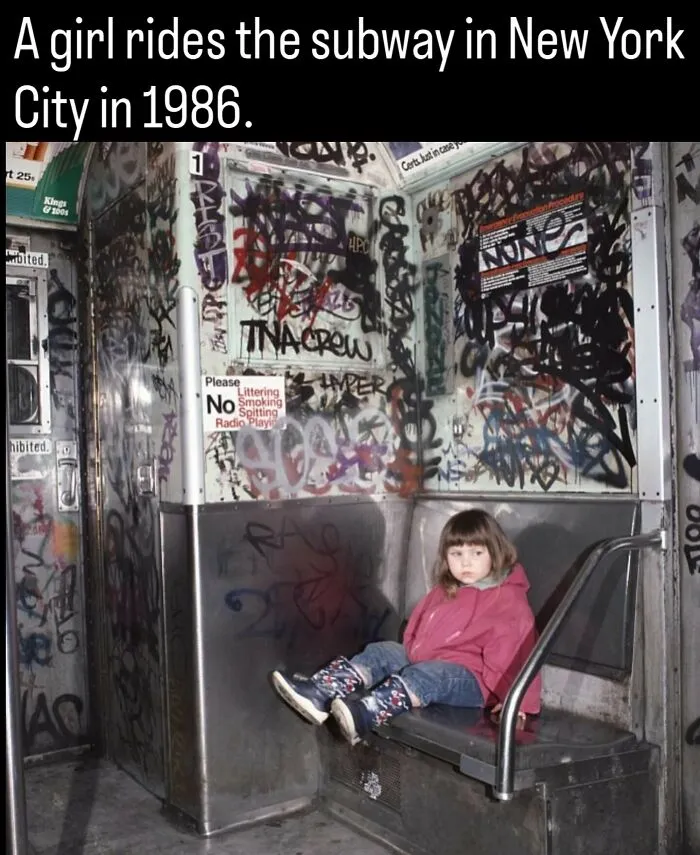
Photographer Camilo José Vergara captured this image of a young girl named Virginia sitting inside a graffiti-covered No. 1 subway car in Manhattan.
By 1986, New York’s subway system had endured years of financial neglect, deteriorating equipment and widespread vandalism. Graffiti covered nearly every available surface in some cars, from doors and windows to advertisements and interior walls. Mechanical failures were common, stations were poorly maintained and many passengers viewed the system as unpredictable and unsafe.
Yet this was also an ordinary part of life for millions of New Yorkers. Virginia’s calm expression amid the chaotic layers of paint creates a striking contrast: childhood innocence surrounded by a transit system that appeared to be collapsing around its passengers.
The graffiti itself represented different things to different people. City officials and many commuters regarded it as evidence that public order had broken down. The young writers who risked arrest to paint trains saw the subway as a moving canvas capable of carrying their names and artwork across all five boroughs.
This photograph was taken as the city began reclaiming the system. Trains were cleaned more aggressively, vulnerable rail yards were secured and freshly painted cars were quickly removed from service if they were vandalized.
Added fact: In May 1989, New York transit officials declared that every subway car in regular service was graffiti-free, effectively ending the era documented in this photograph.
Photograph by Camilo José Vergara.
Report
4points
#50
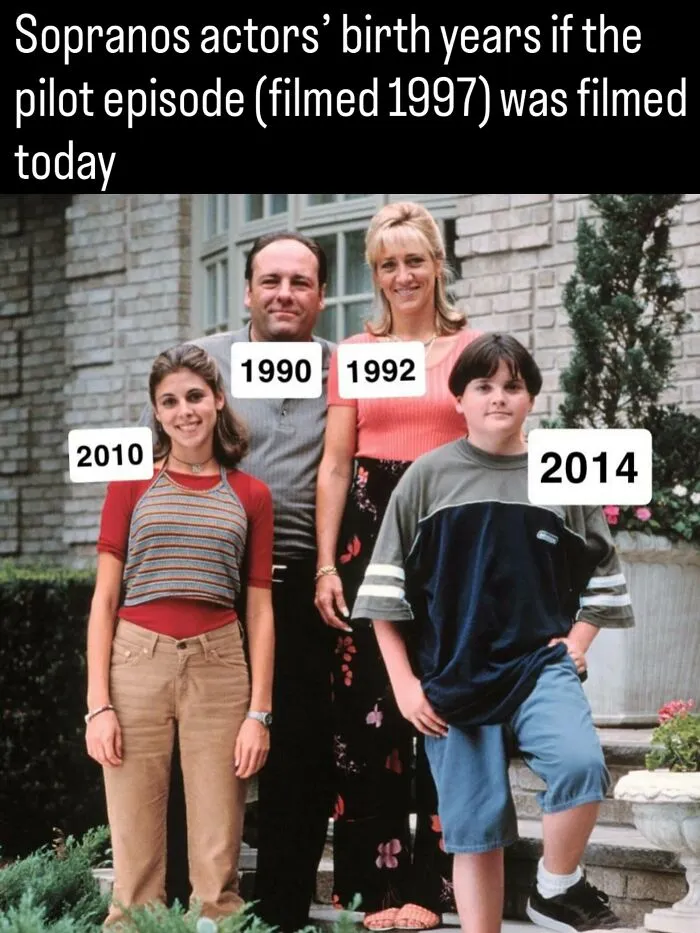
The Sopranos pilot was filmed in 1997, nearly two years before the series officially premiered on HBO in January 1999.
James Gandolfini, who played Tony Soprano, was born in 1961 and was about 36 when the pilot was filmed. If someone the same age were filming that role today, they would have been born around 1990.
Edie Falco, who played Carmela, was born in 1963 and was about 34 during filming. Her modern equivalent would have been born around 1992.
Jamie-Lynn Sigler, who played Meadow, was born in 1981 and was roughly 15 or 16 when the pilot was shot, putting a present-day equivalent around 2010.
Robert Iler, who played A.J., was born in 1985 and was about 12 during filming, meaning an actor the same age today would have been born around 2014.
Added fact: The pilot was originally titled The Sopranos, but HBO initially passed on ordering a full series. Creator David Chase reportedly considered expanding it into a feature film before HBO eventually came back and ordered the show to series.
Report
3points
#51
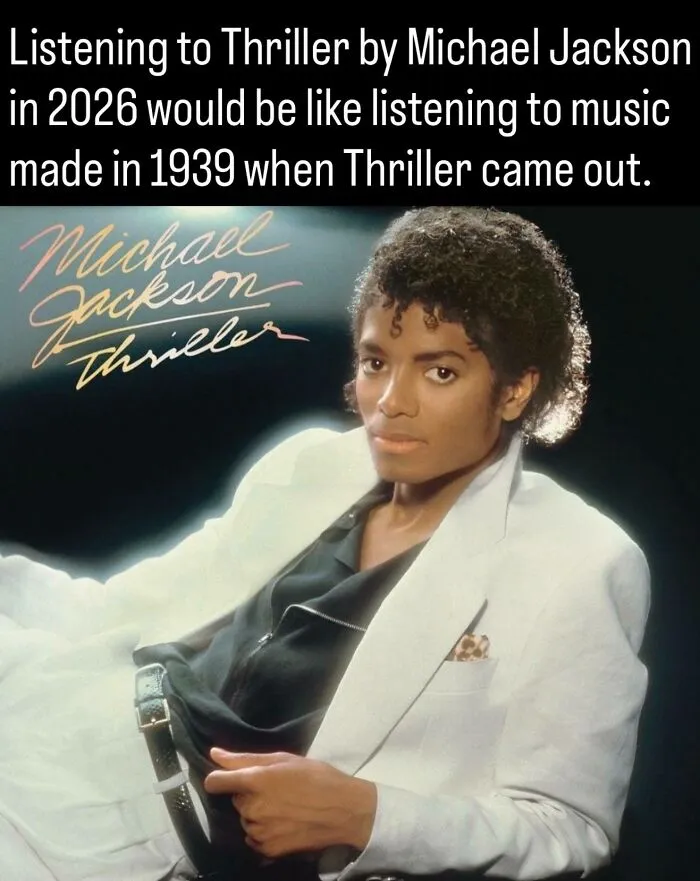
When Thriller was released in November 1982, the musical world it entered was dramatically different from the one that exists today.
Looking backward 43 years from 1982 lands in 1939, an era dominated by big band orchestras, swing, early jazz standards, and crooners rather than modern pop production.
Yet unlike much music from 1939, Thriller does not often feel “old” to modern listeners.
Produced by Quincy Jones, the album blended pop, rock, R&B, funk, and cutting edge studio techniques in ways that reshaped popular music. Songs like Billie Jean, Beat It, and Thriller remain instantly recognizable across generations.
The album’s influence extended beyond sound alone. Its music videos transformed MTV and helped establish the music video as a major artistic and commercial force.
The nearly 14 minute Thriller short film, directed by John Landis, blurred the line between music video and cinematic storytelling.
Added fact:
Thriller remains the best selling album in history, with estimated worldwide sales exceeding 70 million copies.
Report
3points
#52
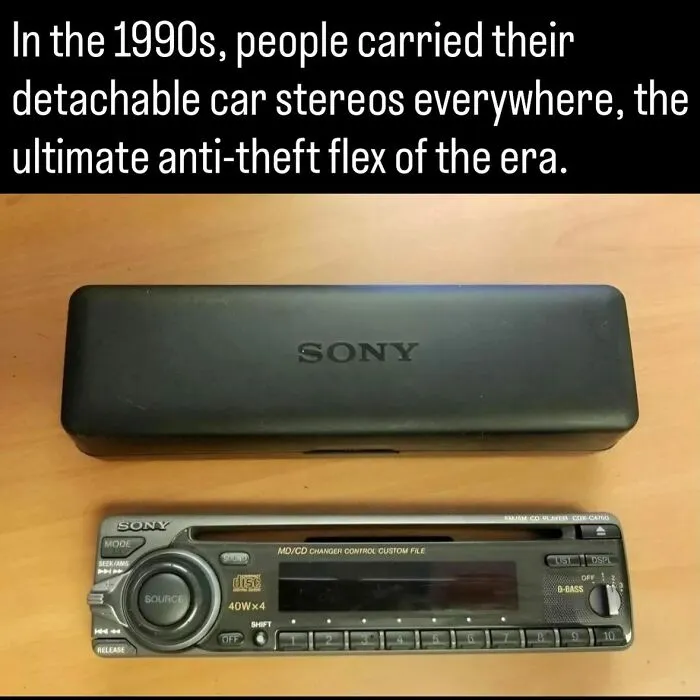
Before Bluetooth speakers and in-car infotainment systems, the 1990s saw the rise of the removable faceplate car stereo. These devices, like the Sony model pictured, became both a status symbol and a necessity in an era of rampant car stereo theft. Automakers of the time offered basic factory radios, so music lovers often upgraded to aftermarket systems that offered better sound, CD compatibility, and features like “Mega Bass” or equalizer controls. The detachable faceplate was a simple but clever deterrent. Thieves could not easily sell or use a stereo without its control panel, so owners would pop it off and carry it with them, often in a branded hard case like the one shown.
The act of slipping a stereo face into your jacket pocket or carrying it into a restaurant became an almost comical yet iconic ritual. It was a visual cue of the late 90s car culture, where technology, music, and personal style intersected. Brands like Sony, Pioneer, and Kenwood led the way, offering increasingly sleek models with digital displays, flashing LEDs, and anti-shock CD playback. For many, investing in such a system was about more than just sound, it was about identity and control in a pre-digital age when car interiors became an extension of personal expression.
Added Fact: Some detachable stereos evolved into “motorized face” designs in the early 2000s, where the front panel would automatically tilt or retract to conceal the slot—another inventive step in the ongoing battle against car break-ins.
Report
3points
#53
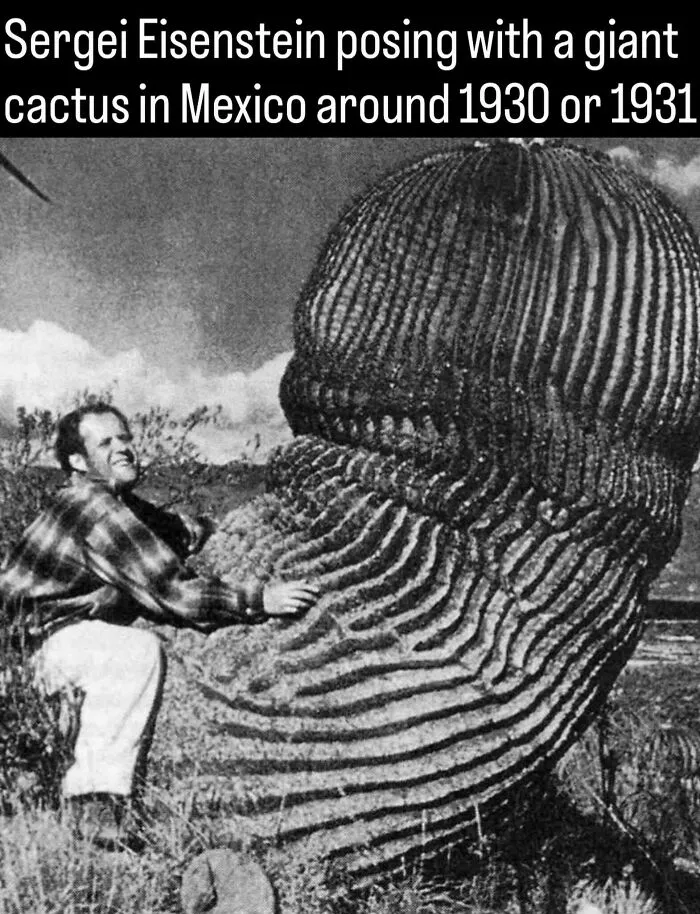
By the early 1930s, Eisenstein was already one of cinema’s most influential directors, but his time in Mexico came during an uncertain and complicated period in his life.
After transforming filmmaking with works such as Battleship Potemkin, Eisenstein became famous for his theory of montage, the idea that meaning could be created by placing contrasting images together rather than relying on a straightforward narrative. In 1930, he traveled to Mexico to begin an independently financed film project that would eventually become known as ¡Que Viva México!
The film was intended as a sweeping portrait of Mexican history, religion, landscape, tradition, and social inequality. Eisenstein filmed enormous amounts of footage, but the production gradually collapsed under financial disputes, political pressure from the Soviet Union, delays, and disagreements with his American backers.
He was ultimately forced to leave Mexico without completing or editing the film. Other filmmakers later assembled portions of the footage, but none of those versions fully represented Eisenstein’s original plan.
The experience nevertheless had a lasting influence on him.
Added fact: Eisenstein was also a prolific artist who filled sketchbooks with thousands of drawings, often planning scenes visually before filming and approaching cinema almost like architecture in motion.
Report
2points
