




Every single one of us has probably wished they could be omnipresent at some point in their lives. Witnessing historical events unfold right before our eyes is exactly the kind of superpower many of us wish we had.
But some people have actually been there when history was made. Of course, cameras weren't as readily available back then, but against all odds, some people still captured historical moments that don't necessarily appear in our history books. So, we've gathered a few incredible pictures from Instagram to show that being in the right place at the right time really does pay off.
#21
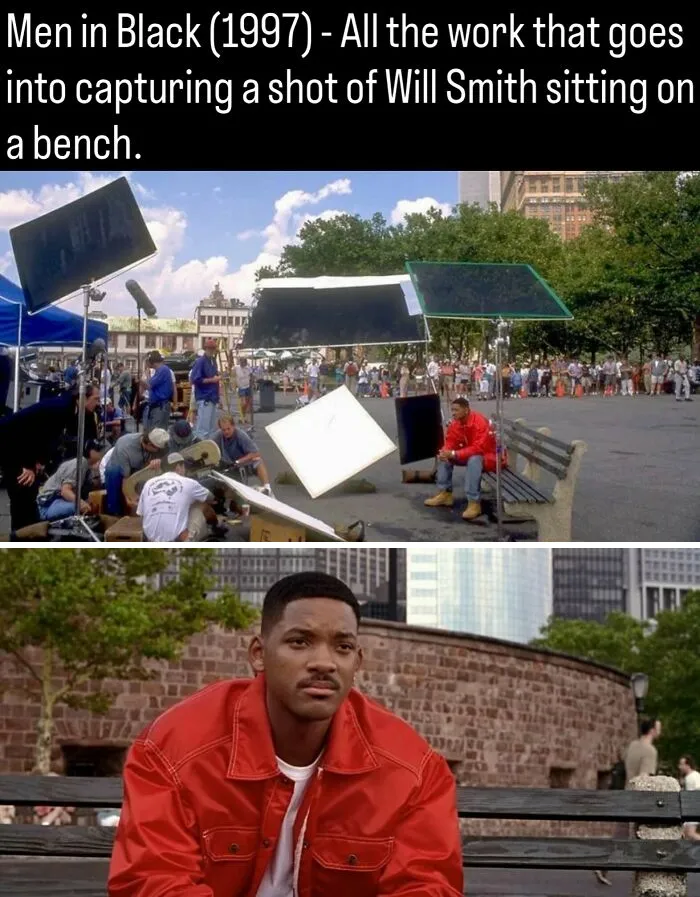
Director Barry Sonnenfeld specifically wanted the story set in New York because he joked that New Yorkers were uniquely capable of seeing something completely bizarre on the street and simply continuing with their day.
That attitude became part of the identity of Men in Black. The movie treats aliens, secret government agents and intergalactic disasters as if they are simply another layer of everyday New York life.
The finished shot looks almost effortless: Will Smith sitting alone on a park bench in New York. But pull the camera back and you see how much work went into making that “natural” image happen.
Around Smith are large bounce boards, reflectors, diffusion frames, flags and lighting equipment, with crew members positioned just outside the camera’s view. Instead of simply relying on the midday sun, the cinematography team could soften harsh overhead light, redirect sunlight onto Smith’s face and block unwanted reflections or shadows.
The goal wasn’t to make the scene look dramatically lit. It was to make carefully controlled lighting look like nothing had been done at all.
That illusion is one of the foundations of filmmaking. A few feet outside virtually any polished movie frame can be an organized mess of equipment, cables and dozens of people concentrating on details the audience is never supposed to notice.
Men in Black was filmed extensively around New York City, using recognizable locations throughout Manhattan while blending them with elaborate sets, practical effects and visual effects.
Added fact: Men in Black became one of the biggest films of 1997, earning nearly $590 million worldwide and winning the Academy Award for Best Makeup.
Report
6points
#22
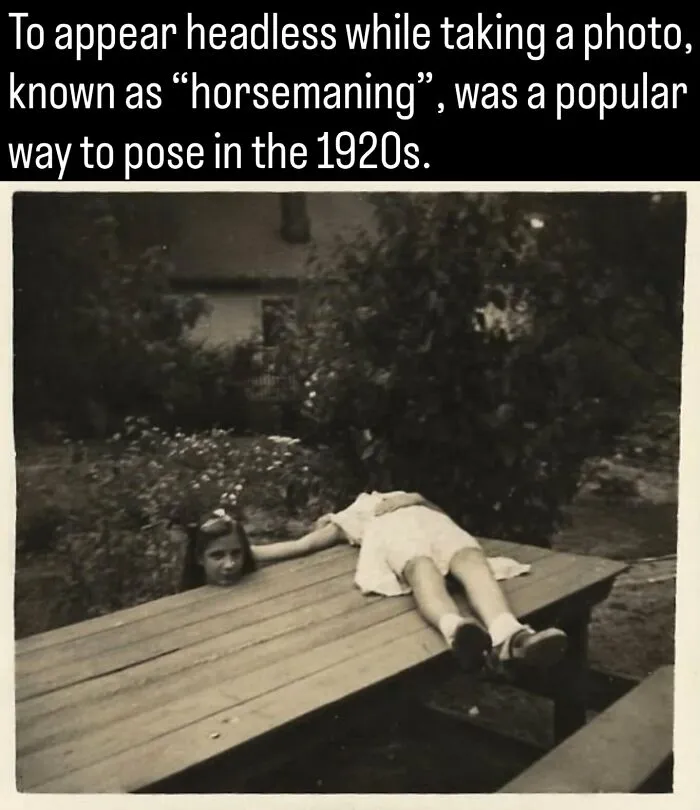
Long before social media challenges, people were already coming up with bizarre ways to pose for photographs.
In the 1920s, one of them involved making it appear as though a person had been completely decapitated.
The trick usually required two people rather than photographic editing. One person positioned themselves so their head was hidden behind a table, bench, or other surface.
A second person concealed the rest of their body while leaving only their head visible nearby. From the camera’s fixed angle, the two people appeared to become a single person whose head had been removed and placed beside them.
What is especially interesting is that the idea of making people appear headless was already decades old.
Victorian photographers created elaborate “headless portraits” using darkroom techniques and combined negatives, sometimes showing people casually holding their own severed heads. The 1920s version essentially turned that elaborate photographic illusion into something ordinary people could recreate with friends and a camera.
There is also an important catch to the name. “Horsemaning” appears to be a later name applied to the old photographs, referencing the Headless Horseman in Washington Irving’s The Legend of Sleepy Hollow.
Added Fact: The Legend of Sleepy Hollow was published in 1820, meaning the character that eventually inspired the name was already roughly a century old when these photographs were being taken.
Report
6points
#23

Few automotive interiors capture the spirit of 1980s futurism quite like the 1985 Nissan 300ZX. At a time when digital technology was just beginning to shape everyday life, this cockpit felt like it had been pulled straight from a sci-fi film. The glowing green digital gauges, electronic voice warnings, and driver-focused layout weren’t just flashy, they represented a bold shift toward the idea that cars could be both performance machines and technological showcases.
The 300ZX, part of Nissan’s legendary Z-car lineage, was built during an era when manufacturers competed not only on speed and handling but on innovation. Its digital instrument cluster was considered cutting-edge, using LED and LCD technology to present speed, RPMs, fuel levels, and performance data in ways that felt revolutionary for drivers accustomed to analog dials.
Beyond style, the car helped redefine Japanese sports cars globally, proving they could rival European and American performance vehicles while offering reliability and advanced electronics.
Added fact: The Z31 generation 300ZX was one of the first production sports cars to offer a factory turbocharged engine paired with advanced onboard diagnostics, helping pave the way for the tech-heavy performance cars that dominate today’s automotive world.
Report
6points
#24
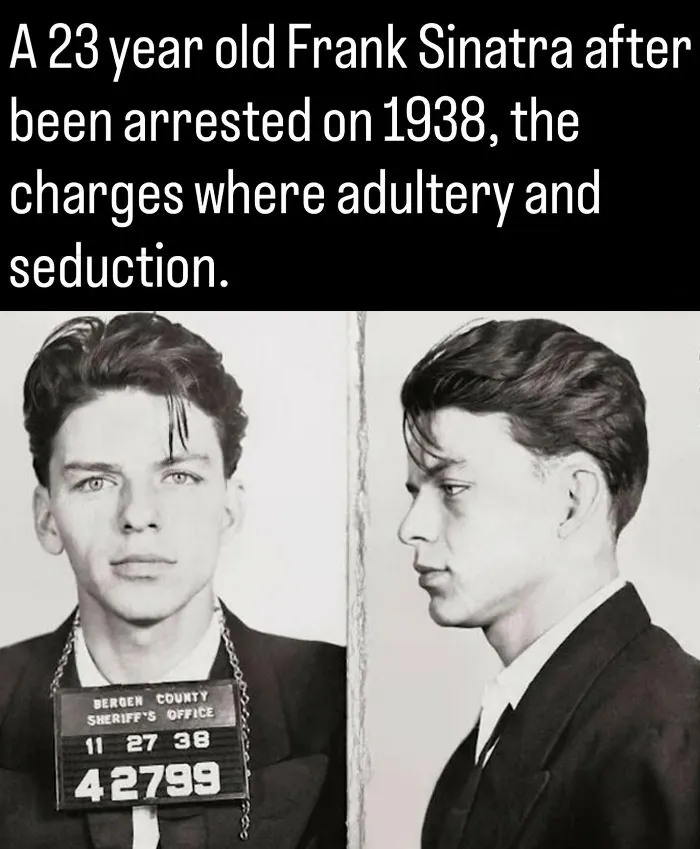
Sinatra was still an unknown local singer when this mugshot was taken by the Bergen County Sheriff’s Office in New Jersey on November 27, 1938. Technically, he was 22 and only two weeks away from his 23rd birthday.
The original charge was “seduction,” an offense that sounds bizarre today but existed under New Jersey law at the time.
Sinatra was accused of having a relationship with an unmarried woman “of good repute” after allegedly promising to marry her. In an era when a woman’s history could seriously affect her social standing and marriage prospects, some states treated obtaining consent through a false promise of marriage as a crime.
Sinatra was arrested and released after posting a $1,500 bond. The seduction charge could not stand after authorities learned that the woman was already married. Prosecutors then replaced it with an adultery charge, which was also eventually dismissed. Sinatra was never convicted in the case.
At the time, he was singing at small clubs and working to escape the limited opportunities of his hometown of Hoboken. Within a few years, he would become one of America’s first modern pop superstars, inspiring scenes of teenage hysteria long before Elvis Presley or the Beatles.
Added Fact: Less than four months after the adultery case was dismissed, bandleader Harry James hired Sinatra as a featured vocalist, giving him his first major break in the music industry.
Report
6points
#25

Known as “The Meteor,” this enormous mass was recovered from the ruins of the World Trade Center following the September 11, 2001, terrorist attacks. It consists of building materials and everyday objects crushed and fused together as the towers collapsed.
The description that it represents approximately four to five floors should not be interpreted as four complete floors preserved in their original order. Instead, the tremendous weight and force of the collapsing structures compacted sections of concrete, steel, reinforcing bars, office contents and other debris into a single dense mass.
Temperatures remained extremely high in portions of the debris pile for weeks after the attacks. Combined with pressure from hundreds of thousands of tons of wreckage, those conditions transformed recognizable parts of the buildings into formations unlike anything normally produced by a structural collapse.
Its rounded, rocklike appearance led recovery workers to compare it to an object that had fallen from space, earning it the nickname “The Meteor.” Seen up close, however, pieces of twisted metal and other materials remain visible throughout its surface.
Rather than representing one identifiable office or location, the mass preserves fragments of numerous spaces and objects that were violently brought together during the destruction of the towers.
Added Fact: Investigators and museum conservators often call formations like this “composites” because they contain multiple kinds of material—including steel, concrete, glass and objects from the offices—compressed into a single mass.
Report
6points
#26

Buffalo Central Terminal opened in 1929 as one of the grandest railroad stations in the United States. Its soaring 17-story office tower, enormous arched concourse and Art Deco interiors were designed to present Buffalo as a modern city with a prosperous future.
At its busiest during World War II, the terminal was filled with soldiers, families and workers traveling across the country. More than 150 trains reportedly passed through each day during the war years. The 1945 photograph captures that peak: a powerful New York Central locomotive approaching a station that served as one of the most important transportation hubs in the region.
But the terminal opened only months before the stock market crash of 1929. In the decades that followed, automobiles and commercial aviation steadily replaced long-distance passenger trains. The building was also several miles from downtown, making it less convenient as Buffalo’s population and travel patterns changed.
The final passenger train departed in 1979. Much of the complex was subsequently abandoned, stripped and exposed to decades of harsh Buffalo weather. Yet the terminal survived. Preservation groups eventually secured the property, and major stabilization and redevelopment work is now underway to give the landmark a new purpose.
Added fact: The terminal’s original concourse clock disappeared after the station closed but was recovered and returned to Buffalo in 2004.
Report
6points
#27
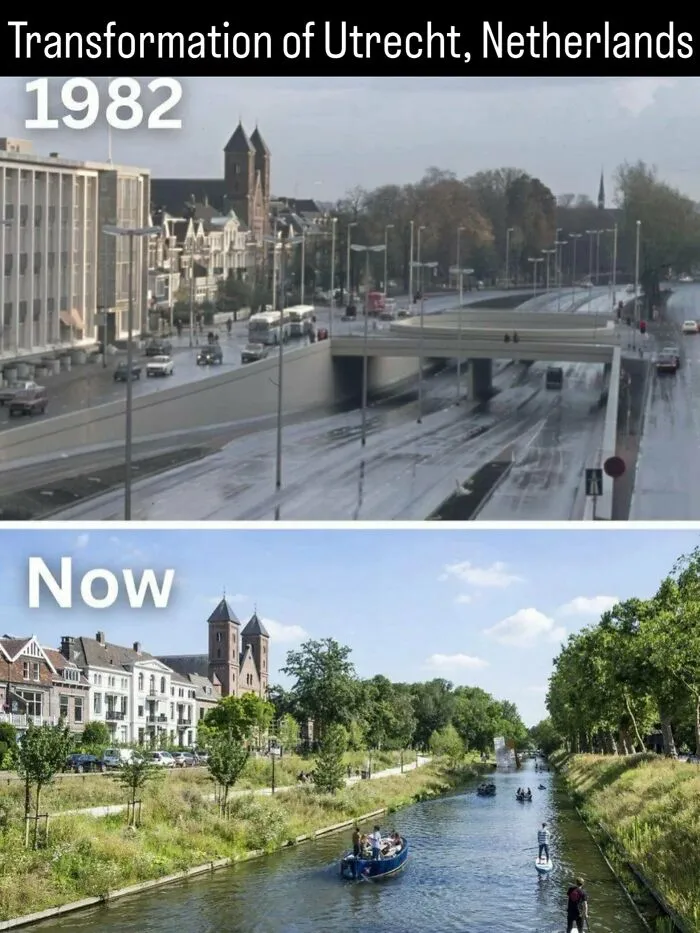
In 1982, this part of central Utrecht looked completely different.
A section of the city’s historic canal had been drained and replaced by a major roadway called the Catharijnebaan, reflecting a postwar planning philosophy that prioritized cars and traffic flow through city centers.
The waterway had a much older history. Utrecht’s defensive canal system dates back roughly 900 years, to around the time the city received its city rights in 1122.
By the 20th century, however, planners were considering turning much of the canal ring into roads. Beginning around 1969, part of the Catharijnesingel was drained, and by the 1970s cars were traveling where boats had once passed.
Eventually, Utrecht reversed course. Residents supported restoring the canal in a 2002 referendum, and over the following years the roadway was removed, the channel was excavated again and green public space was created along the water.
In September 2020, the final restored section officially reopened, allowing boats to travel around Utrecht’s historic canal ring again for the first time in roughly half a century.
Added fact: Plans drawn up in 1958 were even more dramatic and contemplated filling in much more of Utrecht’s canal system to create roads. The survival of much of the historic canal ring helped make the later restoration possible.
Report
6points
#28
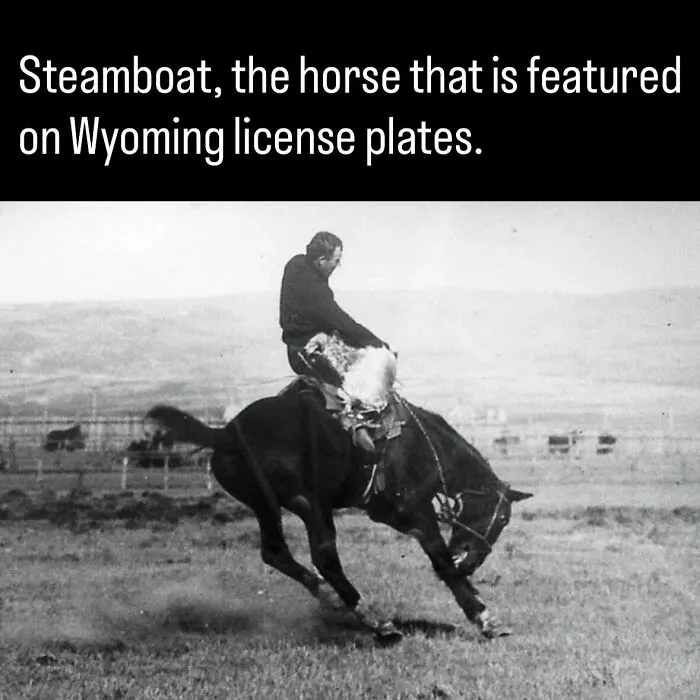
Steamboat was a celebrated bucking horse from the American West whose image would come to symbolize a regional ideal of untamed strength and independence.
Photographs of the animal in full motion capture more than a single animal at work. They preserve an era when the horse was central to ranch life and to a public imagination that prized rugged individualism.
The rider in this image is small against the animal’s energy and the open landscape. The visible fence and distant cattle remind us that this was not a staged studio scene but a working ranch where stock and people shared a daily rhythm shaped by weather and seasons. Over time Steamboat moved beyond lived reality to become an emblem. His silhouette was eventually stylized into an enduring state symbol.
That transformation from creature to icon shows how communities turn specific material experiences into myth. Photographs like this one helped fix a particular image of the West in national memory at a moment when modernity was reshaping rural life.
Added fact: The cowboy and bucking horse motif later became an officially recognized emblem on Wyoming license plates and is often called the most photographed horse in American history.
Report
6points
#29
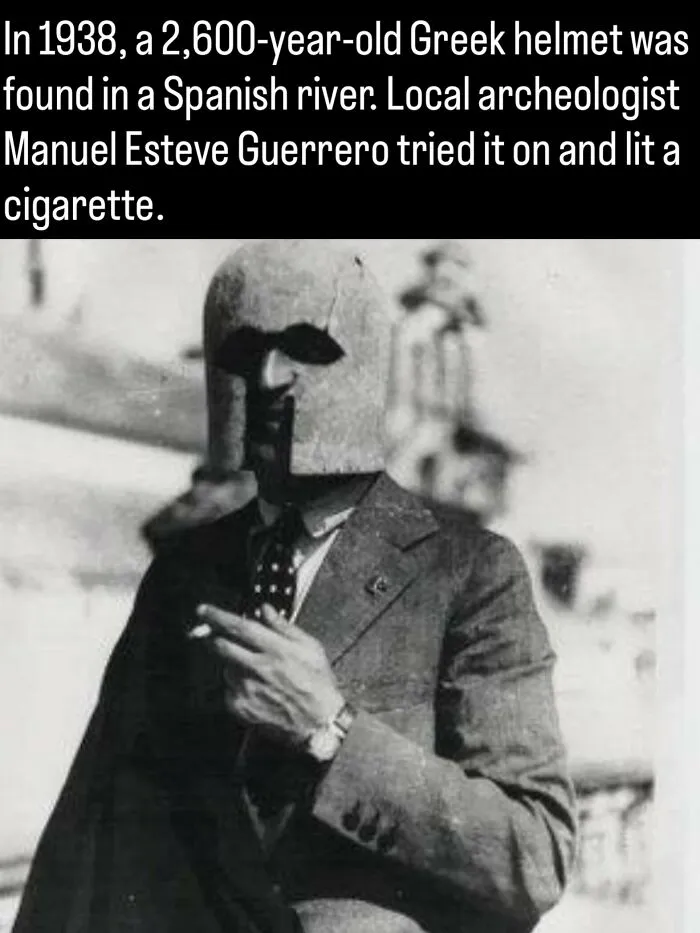
The helmet turned up near the Guadalete River outside Jerez de la Frontera in southern Spain. It was hammered from a single sheet of bronze and dates to around the 7th century BC, making it one of the oldest Greek objects ever found in Western Europe.
The name “Corinthian” describes the helmet’s style, not where it was made. This design covered almost the entire face, leaving only narrow openings for the eyes and mouth.
How it ended up so far from Greece is still a mystery. A hole in its side was once blamed on battle damage, but some researchers now think it may have been a ritual offering to river gods, much like helmets left at Greek temples.
Esteve, a young librarian who also served as the town’s archaeologist, made sure the find went into Jerez’s archaeological collection.
This photo was taken outside the town’s old library. It was clearly meant as a joke, and no archaeologist would be allowed to do something like this today.
It was never officially published and sat in the museum archives for decades.
Added fact: The helmet is now one of the highlights of the Archaeological Museum of Jerez de la Frontera.
Report
6points
#30
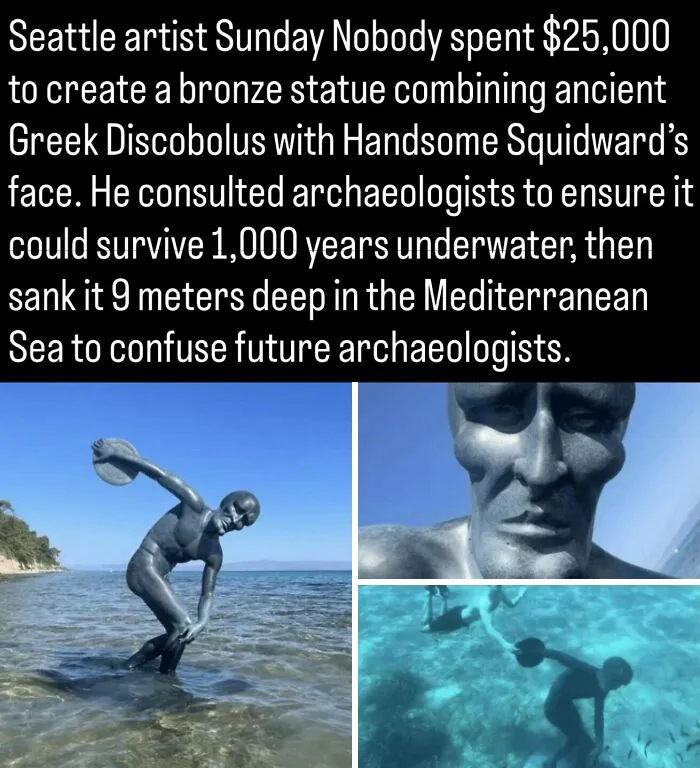
The project is one of the more unusual intersections of classical art, internet culture, and conceptual sculpture in recent years.
By blending the famous Discobolus (Discus Thrower), one of the best-known surviving examples of ancient Greek athletic sculpture, with the exaggerated facial features of “Handsome Squidward” from SpongeBob SquarePants, the artist intentionally blurred the line between serious archaeology and modern satire.
Rather than displaying the sculpture in a gallery, Sunday Nobody had it cast in bronze and deliberately placed it beneath the Mediterranean Sea.
Bronze was chosen because it has been used for monumental sculpture for thousands of years and can survive underwater for centuries, developing a natural patina that makes it resemble genuine ancient artifacts.
The idea was to create an object that, if discovered in the distant future without any surviving historical records, might raise fascinating questions about the civilization that created it.
Although the project was conceived as an artistic experiment rather than an actual attempt to deceive archaeologists, it highlights how much context matters in archaeology. Artifacts are rarely interpreted in isolation.
Their surrounding sediments, nearby objects, manufacturing techniques, and chemical composition all help researchers determine authenticity and age. Without that context, even experienced experts can be misled by appearances alone.
Added fact: The original Discobolus was sculpted by the Greek artist Myron around 450 BC, but the famous version seen in museums today is actually a Roman marble copy. The original bronze statue has been lost, making Roman copies invaluable for understanding one of the masterpieces of Classical Greek art.
Report
6points
#31
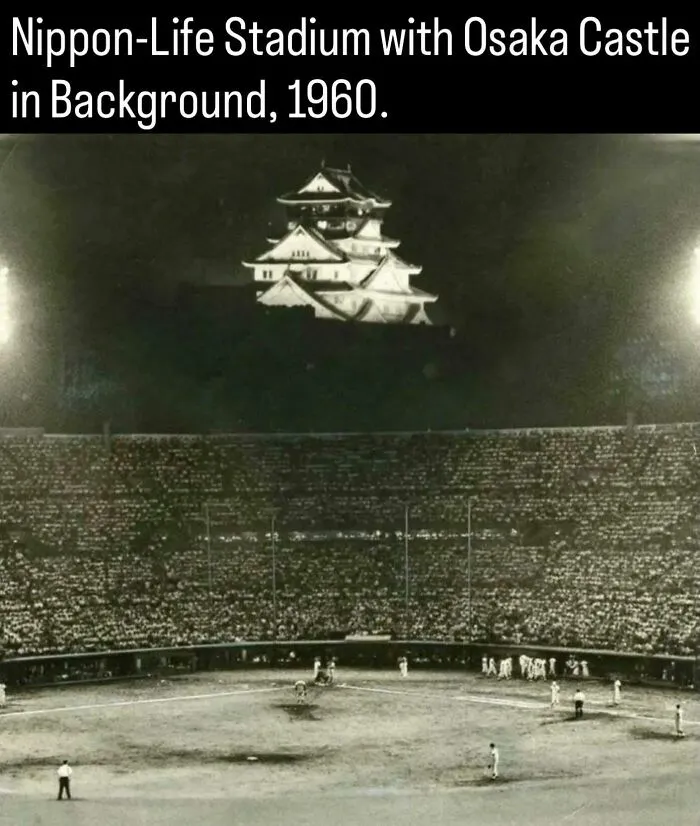
A stunning backdrop. Nippon Life Stadium opened in 1950 and became one of Osaka’s great postwar baseball venues.
For decades, it hosted the Kintetsu Buffaloes and put thousands of fans beneath one of the strangest backdrops in sports.
Above the outfield stood Osaka Castle. The original castle was built in the late 1500s by Toyotomi Hideyoshi, one of Japan’s great unifiers, though the tower seen today is a 1931 reconstruction.
That contrast is the whole (beautiful) image: postwar baseball under floodlights, framed by a symbol of samurai age power.
Added fact: Nippon Life Stadium was closed in 1997 and demolished soon after.
Report
6points
#32

Hidden inside a narrow compartment above the ship’s rudder, the four men began an extraordinary and extremely dangerous journey across the Atlantic Ocean. They had brought limited food and water, but their supplies reportedly ran out around the tenth day. For the final stretch, they survived by drinking seawater as powerful waves crashed only a few feet beneath them.
The men had no control over the ship’s destination and little sense of where it was taking them. They believed they were traveling toward Europe. Instead, after approximately two weeks and 3,500 miles, the Ken Wave reached the Brazilian port of Vitória.
Brazilian authorities discovered the men crouched above the rudder and carefully brought them to safety. Photographs of the rescue showed officials handing water to the exhausted stowaways from a nearby boat. All four were taken for medical treatment and were reported to be in stable condition.
Their survival was remarkable. Rudder compartments offer almost no protection from rough seas, mechanical movement, exposure or falls. Two of the men eventually returned to Nigeria, while the other two reportedly applied for asylum in Brazil.
Added fact: To keep themselves from being swept into the Atlantic, the men reportedly tied themselves to the ship and stretched netting around the rudder area.
Report
6points
#33
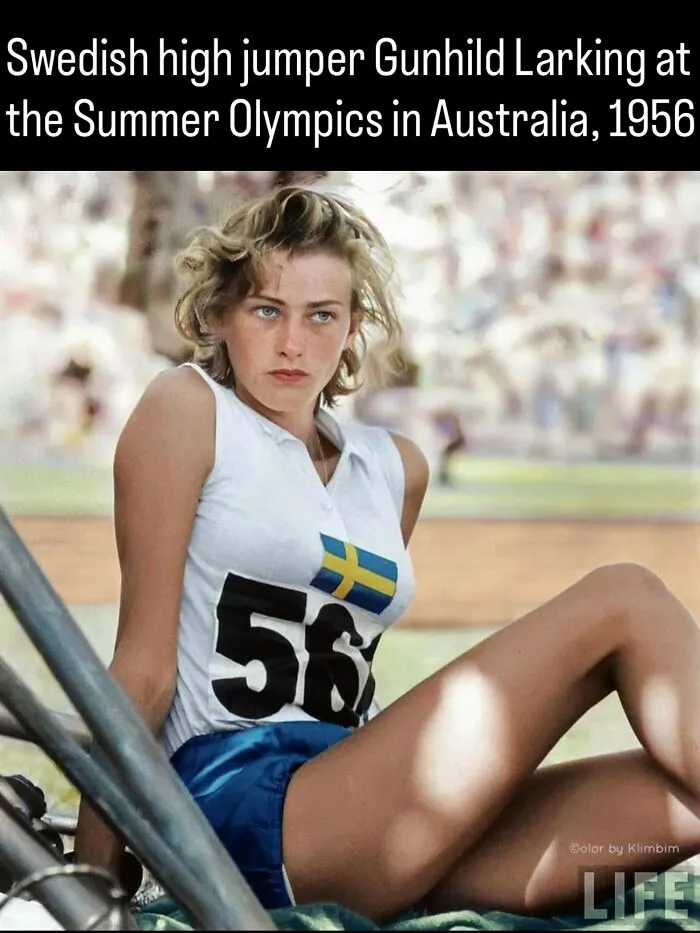
Gunhild Larking was only 20 years old when she represented Sweden at the 1956 Summer Olympics in Melbourne. The competition was already her second Olympic appearance: four years earlier, at just 16, she had finished ninth at the Helsinki Games.
In Melbourne, Larking advanced through the qualifying round by clearing 1.58 meters. During the final, she cleared 1.67 meters (approximately 5 feet 5¾ inches) matching the best jump of her career. She narrowly missed the podium and finished fourth based on the number of attempts required to clear the earlier heights. American athlete Mildred McDaniel won gold after clearing 1.76 meters and setting a new world record.
Larking was one of Sweden’s leading female athletes of the 1950s. She won five consecutive Swedish national high-jump championships between 1952 and 1956 and also finished fourth at the 1954 European Athletics Championships in Bern.
Athletes at the time competed on cinder tracks, and high jumpers landed in pits filled with sand or sawdust rather than the thick foam mats used today. Competitors also relied on techniques that predated the revolutionary Fosbury Flop.
Added Fact: LIFE magazine photographer George Silk photographed Larking throughout the Melbourne Olympics. One of his images became internationally famous after appearing in the magazine’s Christmas issue, and Larking subsequently received offers to work as a model.
Report
6points
#34

It looks like something from a horror movie, but there was a very practical problem behind early beekeeping protection: how do you work around thousands of defensive insects without getting stung repeatedly in the face?
Beekeeping was already an important part of European rural life during the Middle Ages. Honey was one of the major sweeteners available before refined sugar became widely accessible, while beeswax was especially valuable for candles, religious use and household work.
Medieval beekeepers commonly kept colonies in skeps, dome-shaped hives traditionally made from woven straw or similar materials. Unlike modern wooden hives with removable frames, inspecting and harvesting from a skep could put the beekeeper into extremely close contact with the colony. Smoke was therefore an important tool for calming bees, while clothing could provide additional protection.
The dramatic wicker-faced clothing seen here is a modern interpretation of historical protective gear rather than something we can confidently say every medieval beekeeper wore. Surviving medieval illustrations show that clothing and equipment varied considerably across centuries and regions.
Still, the basic concept behind the look makes perfect sense: heavy fabric protects the body, while a barrier keeps bees away from the eyes and face.
Added fact: Medieval beekeeping illustrations survive from as early as the 11th century, giving historians a surprisingly long visual record of how Europeans handled and harvested honeybee colonies.
Report
6points
#35
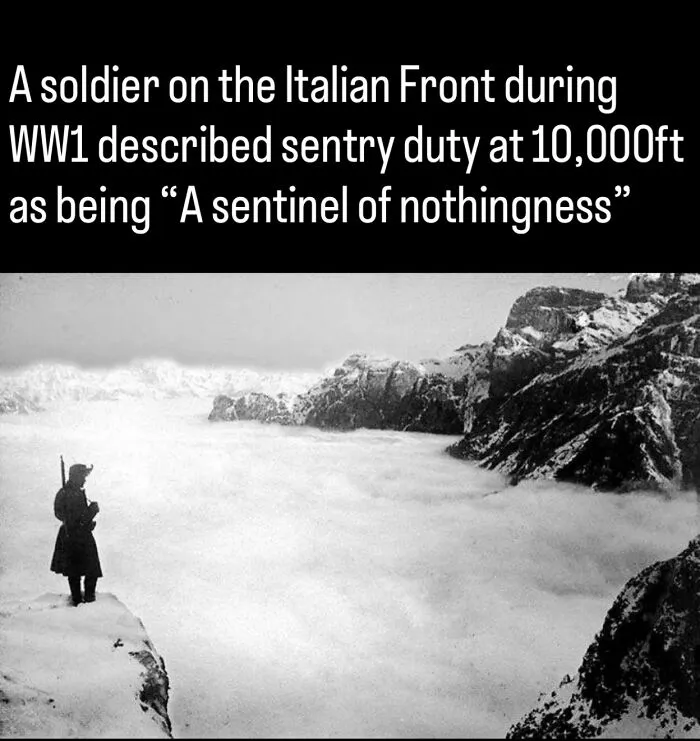
When Italy entered World War I in 1915, its front with Austria-Hungary ran through some of Europe’s harshest mountain terrain. In the Alps, troops fought and stood watch on ridges and passes thousands of meters above sea level. At those heights, the cold, storms, thin air and risk of avalanches could be as dangerous as enemy fire.
Armies built paths, shelters and supply lines across the mountains, hauling food, ammunition and artillery into positions that were difficult to reach even in good weather. Soldiers might spend long stretches isolated at exposed posts, watching a landscape where the weather could close in and movement could become impossible.
A diary entry from May 28, 1916, by a soldier identified as C.D. from Italy’s Trentino region describes a storm at Cercen Pass, snow on the highest peaks and the soldiers’ longing for peace. It gives a glimpse of the exhaustion behind the dramatic mountain scenery: the men were not only fighting an opposing army, but enduring a landscape that could make every day a struggle to survive.
Added fact: National Geographic reported that fighting in the “White War” reached elevations of about 12,000 feet (3,600 meters), with temperatures dropping as low as −22°F (−30°C).
Report
6points
#36

After 26 years of smoking, Ibrahim Yücel decided that willpower alone was no longer enough.
The 42-year-old from Kütahya, Turkey, had been smoking roughly two packs of cigarettes a day and said he had tried quitting dozens of times. He would stop on important occasions such as his wedding anniversary or his children’s birthdays, only to begin smoking again a few days later.
Then his father died from lung cancer.
The loss frightened Yücel enough that he came up with an extreme solution: he built a cage shaped roughly like a motorcycle helmet and locked it around his own head. The openings were reportedly small enough that he could drink through a straw, but not large enough to easily put a cigarette in his mouth.
Each morning, Yücel would lock the cage and hand the key to his wife, Kevser. She initially disliked the idea and found it embarrassing, but eventually agreed because she wanted him to stop smoking. She would unlock it when he needed to eat. His teenage daughter also supported the attempt after watching her grandfather d*e from lung cancer.
Added fact: Before putting on the cage, Yücel reportedly swore on the Quran that he was serious about giving up cigarettes, making the device part of a much larger personal commitment to quit.
Report
5points
#37

The growth of remote astronomy has transformed amateur astrophotography. Facilities like these are typically located in areas with very dark skies, dry air and lots of clear nights, far from the glow of any city.
This one appears to be Starfront Observatories in Coleman County, Texas, which opened in 2024. Customers ship their telescopes to the site, and the staff installs them on fixed mounts inside long buildings with roll-off roofs. When it gets dark, the roofs slide open automatically. At dawn or when bad weather moves in, they close again.
Owners control everything over the internet. From a laptop at home, they can point the telescope, run the camera all night and download the images the next morning. The site handles power, security, repairs and a fast fiber connection, since a single telescope can produce hundreds of gigabytes of images in one night.
It has grown fast. The site reportedly gets more than 220 clear nights a year and now hosts over 600 telescopes, with prices starting at around $99 a month. Not long ago, remote hosting like this could cost thousands.
Added fact: Light pollution is the reason places like this exist. A 2016 study found that nearly 80% of people in North America can no longer see the Milky Way from where they live.
Report
5points
#38
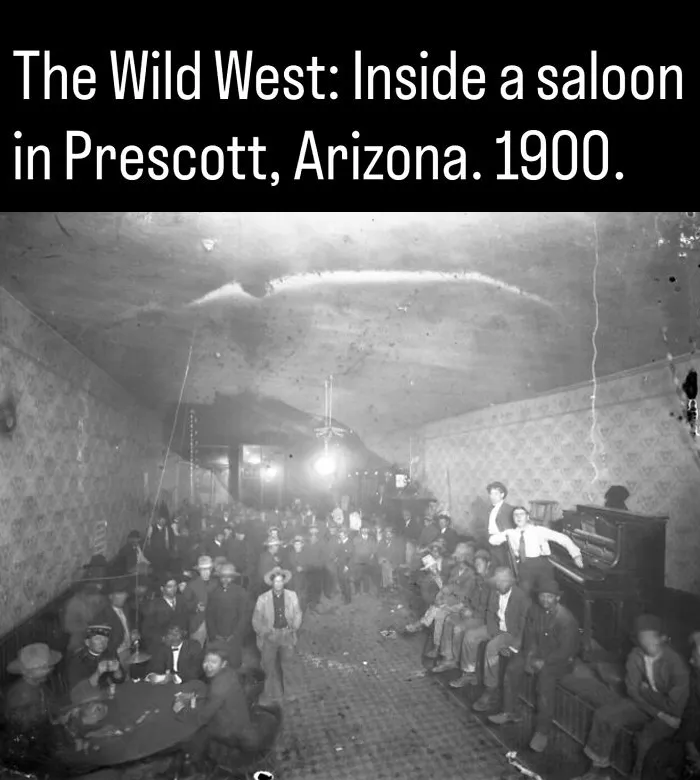
By 1900, Prescott was one of the most established towns in the Arizona Territory. Founded in 1864, it had served as the territorial capital and developed into an important center for mining, ranching, government and trade.
Its most famous entertainment district was Whiskey Row, a stretch of Montezuma Street packed with saloons, gambling rooms, hotels and other businesses. At its height, the district reportedly contained more than 40 saloons standing near one another.
The crowded room in this photograph offers a less romanticized view of saloon life than Hollywood later created. Patrons sit shoulder to shoulder beneath electric lights, while card games, drinking and conversation fill the narrow interior. A pianist stands against the wall, providing entertainment in an era before radio or recorded music became common.
Saloons functioned as more than places to drink. In Western towns, they could serve as informal meeting halls, gambling establishments, employment exchanges and gathering places where miners, ranchers, railroad workers, businessmen and travelers mixed.
Yet this world was also changing rapidly. Prescott already had rail connections, electric lighting and an increasingly permanent downtown. The frontier was not vanishing overnight, but it was steadily becoming part of modern America.
Added Fact: On July 14, 1900, a massive fire destroyed five blocks of Prescott, including most of Whiskey Row. Patrons reportedly carried the Palace Saloon’s wooden bar and liquor across the street before the flames reached it.
Report
5points
#39

Long before curved ultrawide displays and virtual-reality headsets became widely available, serious flight-simulation enthusiasts built elaborate home cockpits using multiple computers and bulky CRT monitors.
This photograph, dated March 2, 2002, shows an especially ambitious setup designed to surround its operator with outside views, cockpit instruments, navigation displays, and aircraft controls.
Each monitor appears to perform a different role. The larger screens provide views through the aircraft’s windows, while the smaller central displays show instruments and control panels. Several computer towers beneath the desk were likely needed because one consumer PC of the era could not smoothly render all those independent views at once. Specialized programs such as WidevieW allowed separate computers running Microsoft Flight Simulator to communicate over a local network and remain synchronized. Similar installations from this period used numerous monitors and networked PCs to create a panoramic field of vision.
The system would have required considerable patience, technical knowledge, wiring, desk space, and electricity. Every CRT was deep, heavy, and capable of producing a substantial amount of heat. Despite its improvised appearance, the basic concept remains familiar today: dedicate different screens to the scenery, flight instruments, navigation systems, and aircraft controls to make a home simulator feel more like a genuine cockpit.
Added fact: The setup was later expanded. A surviving 2003 discussion described an upgraded version containing 13 monitors and nine networked computers, showing how quickly this already enormous simulator continued to grow.
Report
5points
#40
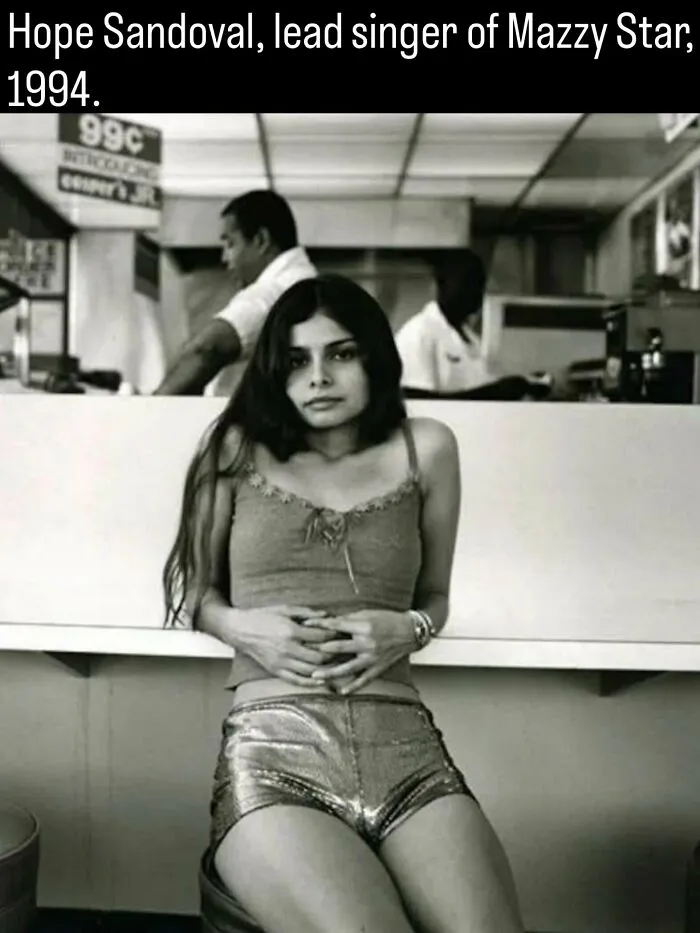
By 1994, Hope Sandoval had become one of alternative rock’s most recognizable voices, though she rarely sought the spotlight. As the lead singer of Mazzy Star, her haunting vocals and understated stage presence helped define the dream pop and psychedelic folk sound that emerged in the early 1990s. Unlike many artists of the era, Sandoval avoided celebrity culture, granting few interviews and often performing with dim lighting that kept much of the band’s attention on the music rather than the performers.
Mazzy Star’s breakthrough came with the release of “Fade Into You” in 1993. The song became an international hit, reaching the Billboard Hot 100 and introducing the band’s atmospheric style to mainstream audiences. Although the group released relatively few albums, its music has remained influential, inspiring generations of indie, shoegaze, and alternative musicians.
Sandoval has continued recording with Mazzy Star and other musical projects while maintaining the privacy that has become one of her defining characteristics.
Added Fact: Despite “Fade Into You” becoming one of the most enduring alternative songs of the 1990s, Mazzy Star never won a Grammy Award. The song has continued to gain new audiences through film, television, streaming platforms, and social media, making it the band’s signature recording more than three decades after its release.
Report
5points
