





#1

The album produced five No. 1 singles on the Billboard Hot 100, including “I Just Can’t Stop Loving You,” “Bad,” “The Way You Make Me Feel,” “Man in the Mirror,” and “Dirty Diana.”
Its music videos also helped transform pop promotion into something closer to cinema, with elaborate sets, choreography, costumes, and storytelling.
In 1988, “Weird Al” Yankovic released Even Worse, a title that jokingly suggested his album was one step beyond Bad. Its best known track, “Fat,” parodied Jackson’s “Bad” and recreated many details from the original video, including the subway setting, costumes, dancers, and choreography. Yankovic even wore a massive rubber suit and altered facial prosthetics for the performance.
The parody became one of the biggest hits of Yankovic’s career and won the Grammy Award for Best Concept Music Video.
Added fact: The title Even Worse was itself part of the joke, since the album cover directly imitated Jackson’s pose and outfit from Bad.
Additional Added fact: Michael Jackson granted Yankovic permission to use the same subway set where the original “Bad” video had been filmed.
#2

Its twin towers rise approximately 157 meters, or 516 feet, making it one of the tallest churches in the world and the tallest cathedral with two matching spires.
Construction began in 1248 to create a monumental home for the Shrine of the Three Kings, which traditionally contains relics associated with the biblical Magi. Builders completed the choir in 1322, but work gradually slowed and eventually stopped during the 16th century. For more than 300 years, an unfinished medieval crane remained on the cathedral’s south tower and became a familiar part of Cologne’s skyline.
Construction resumed in 1842, using surviving medieval plans to preserve the original Gothic vision. The cathedral was finally completed in 1880—more than six centuries after the foundation stone was laid. At the time of its completion, it was the tallest building in the world.
The building’s scale becomes especially striking from above. Measuring roughly 144.5 meters long and 86 meters wide at the transept, the cathedral occupies an immense footprint in the center of a modern city, directly beside Cologne’s main railway station and only a short distance from the Rhine.
Added Fact: Cologne Cathedral was struck repeatedly during World War II and suffered serious damage, yet its main structure remained standing while much of the surrounding city was reduced to rubble.
#3

The 1930s were defined by widespread unemployment, with nearly one in four Americans out of work. In industrial towns across the South, where textile mills and factories dominated local economies, workers earned only a few dollars a week, barely enough to feed their families, let alone afford rent. Meanwhile, many business owners accumulated wealth through company housing systems, where employees were often required to live in employer-owned homes, effectively keeping them trapped in cycles of debt and dependence.
Protests like this one were part of a broader labor movement that grew throughout the decade, leading to the formation of unions, strikes, and the eventual passage of New Deal labor protections under Franklin D. Roosevelt. Workers demanded not just higher wages but dignity and fairness, ideas that reshaped American labor law for generations.
Added fact: During the Depression, over 250,000 tenant farmers and sharecroppers across the South were evicted from their land, leading to the rise of the Southern Tenant Farmers’ Union, one of the earliest interracial labor movements in the U.S.
While many of these images are much darker, others are simply funny, showing that humans have always had a funny bone. A great example appears in the myths surrounding the Victorian era.
Many people believe people in the 1800s were always serious and proper, but photography created that illusion. Back then, cameras had long exposure times, making it nearly impossible to hold a natural smile for a photograph. So people often looked serious, making them seem far more serious than they actually were.
#4
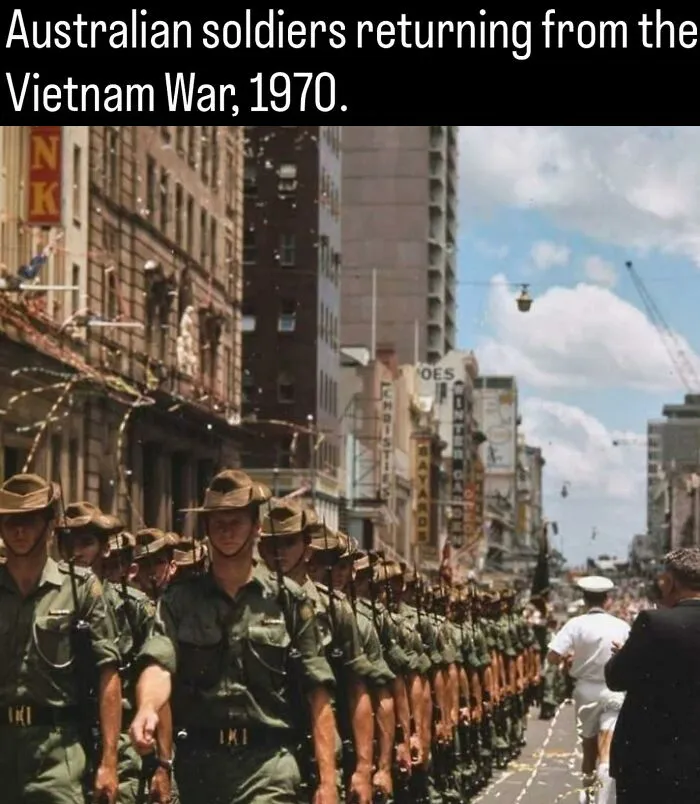
Scenes like this homecoming parade were a complicated moment.
Early in the war, returning soldiers were often welcomed with public ceremonies and official recognition. But as the conflict grew more controversial, public opinion in Australia shifted sharply. Anti-war protests, especially after the introduction of conscription through the national service lottery, became widespread across major cities.
Many veterans returned to a country divided over the war they had fought. While some received parades and formal honors, others experienced indifference or hostility, and the long-term physical and psychological effects of the conflict were not widely understood at the time.
Added fact: Australia’s largest official Vietnam veterans welcome home parade did not take place until 1987, when over 20,000 veterans marched through Sydney—17 years after the war ended.
#5
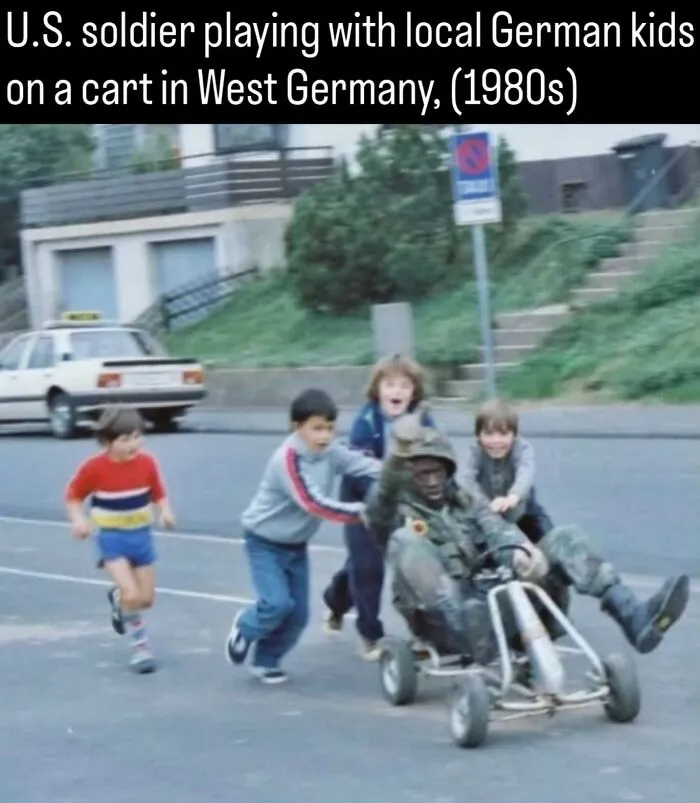
American military bases stretched across cities such as Frankfurt, Stuttgart, Ramstein, and West Berlin, creating long-term cultural ties between U.S. service members and German communities. Many soldiers lived in Germany for years with their families, and millions of Americans rotated through the country between 1945 and the end of the Cold War in 1991.
For many West German children during the era, American soldiers, vehicles, and bases became a normal part of everyday life, reflecting how closely civilian life and military presence overlapped in divided Germany.
Added fact: At the height of the Cold War, more than 1.3 million NATO and Warsaw Pact troops faced each other across the inner German border, making Central Europe the most likely flashpoint for a potential Third World War.
#6

When a camel places its foot on the ground, the two toes spread apart and the pad flattens, increasing the surface area touching the sand. This distributes the animal’s weight more evenly and prevents its feet from sinking deeply, essentially functioning like a natural snowshoe.
The thick pad also protects the foot against scorching desert ground, sharp stones and rough terrain.
A camel’s unusual feet are only one part of its desert survival system. Its long legs keep much of its body away from the intense heat radiating from the ground, while thick eyelashes and nostrils that can narrow help protect it during blowing sand. Despite their awkward appearance, camels can travel long distances over terrain that would quickly exhaust many other large mammals.
The scientific name for the camel family’s group, Tylopoda, comes from Greek words meaning “padded foot”, a direct reference to this defining feature.
Added fact: Unlike horses, camels walk by moving both legs on the same side of their body forward together, producing their distinctive swaying motion.
#7
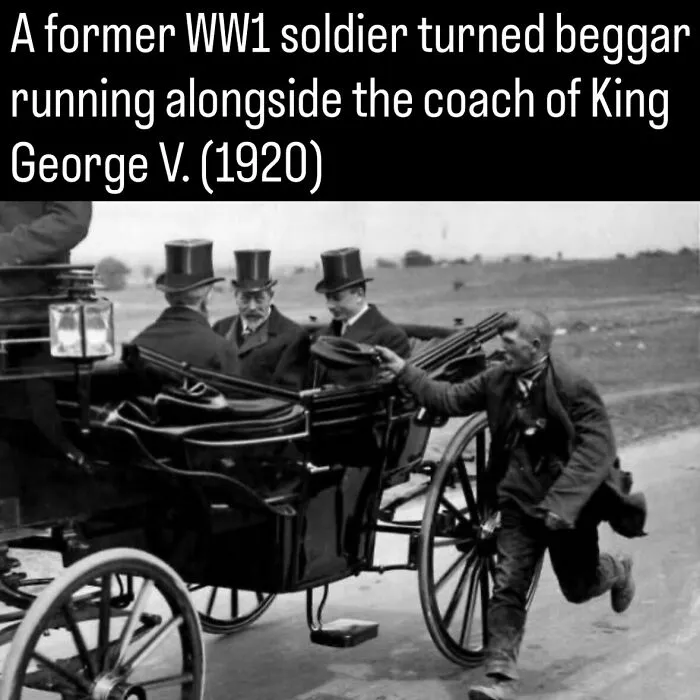
Millions had been demobilized after World War I and expected to return to stable jobs and homes. Instead, many encountered unemployment, poverty, physical disabilities and limited government assistance. Some veterans were forced to sell small goods or seek money in the streets to survive.
By 1921, approximately 2 million people were unemployed in Britain. The Imperial War Museums notes that the number reached 2 million again by 1922, including roughly half a million former servicemen.
The image’s contrast is unmistakable: a desperate man sprinting beside an open royal carriage, reaching toward passengers who remain seated only a few feet away. Whether he received anything is unknown.
Added fact: The British Legion was established in 1921 partly to unite veterans’ organizations and address the widespread unemployment, poverty and inadequate support experienced by former servicemen.
While many of these images are much darker, others are simply funny, showing that humans have always had a funny bone. A great example appears in the myths surrounding the Victorian era.
Many people believe people in the 1800s were always serious and proper, but photography actually created that illusion. Back then, cameras required long exposure times, making it nearly impossible to hold a natural smile for a photograph. And so, people often struck serious poses and carefully composed their looks, making them appear far more serious than they actually were.
#8
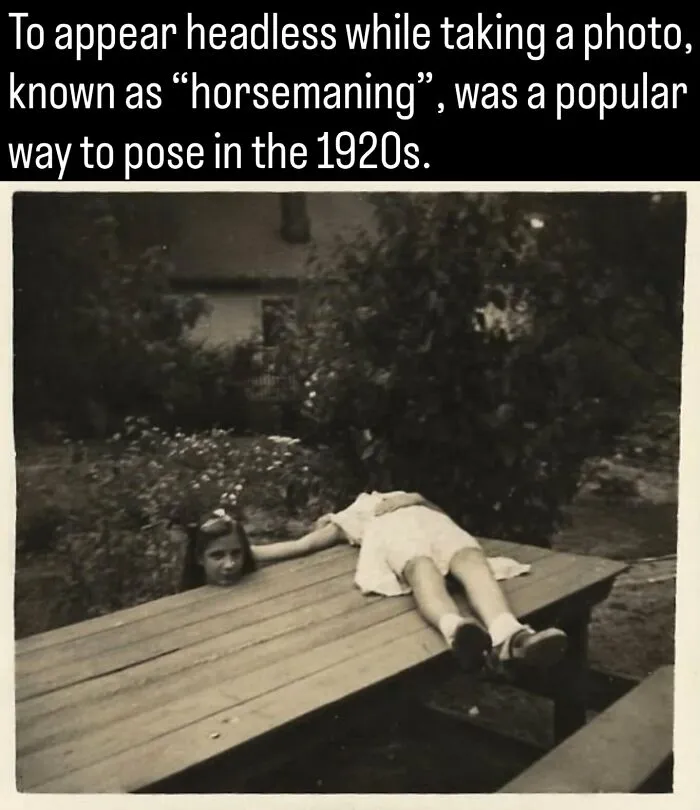
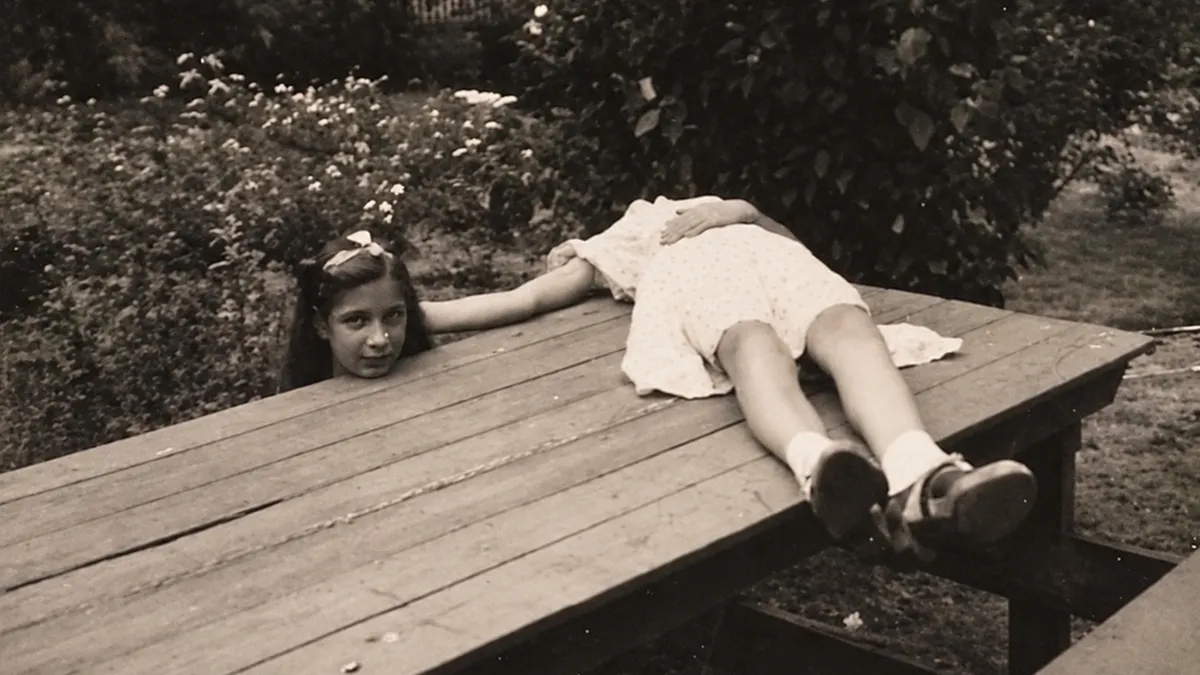
In the 1920s, one of them involved making it appear as though a person had been completely decapitated.
The trick usually required two people rather than photographic editing. One person positioned themselves so their head was hidden behind a table, bench, or other surface.
A second person concealed the rest of their body while leaving only their head visible nearby. From the camera’s fixed angle, the two people appeared to become a single person whose head had been removed and placed beside them.
What is especially interesting is that the idea of making people appear headless was already decades old.
Victorian photographers created elaborate “headless portraits” using darkroom techniques and combined negatives, sometimes showing people casually holding their own severed heads. The 1920s version essentially turned that elaborate photographic illusion into something ordinary people could recreate with friends and a camera.
There is also an important catch to the name. “Horsemaning” appears to be a later name applied to the old photographs, referencing the Headless Horseman in Washington Irving’s The Legend of Sleepy Hollow.
Added Fact: The Legend of Sleepy Hollow was published in 1820, meaning the character that eventually inspired the name was already roughly a century old when these photographs were being taken.
#9

Roman gold and silver coins have been found across southern India, including large hoards in modern Tamil Nadu and Kerala.
They likely arrived through maritime trade, as Roman merchants exchanged precious metals for pepper, gemstones, ivory and textiles.
Roman and Eastern Roman coins have also surfaced along ancient trade routes in Central Asia and China.
One tomb in China’s Shaanxi province contained two Eastern Roman gold coins alongside a Persian silver coin, evidence of how objects could travel across several interconnected trading networks without their original owners ever making the full journey.
Even Iceland has produced several Roman coins, despite never belonging to the empire. Their presence does not mean Roman soldiers reached the island. They may have been carried there centuries later by travelers, collectors or early settlers.
Perhaps the strangest discovery came from Katsuren Castle in Okinawa, Japan, where archaeologists identified several late Roman bronze coins.
Because the castle flourished roughly 1,000 years after the coins were minted, researchers believe they probably reached Japan through medieval Asian trade networks rather than direct contact with ancient Rome.
Added fact: Roman coins found outside the empire were not always treated as money. In some regions, they were pierced, mounted or copied and used as jewelry, ornaments or symbols of status.
#10
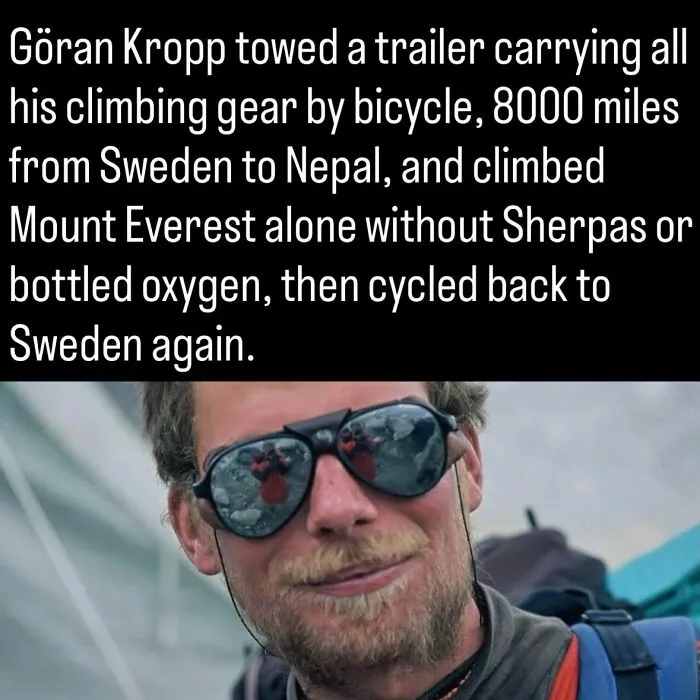
Unlike most climbers who depend on Sherpa teams and bottled oxygen, Kropp chose to face the mountain alone and unaided. His climb was an act of extraordinary endurance, testing the absolute limits of the human body at extreme altitude. When he finally stood atop Mount Everest, he had achieved one of the purest ascents in the history of the mountain.
Afterward, he did not rest or fly home. Instead, he mounted his bicycle once more and pedaled all the way back to Sweden. His expedition represented not only physical strength but also a philosophy of self-sufficiency that has rarely been matched in the world of exploration.
Added fact: Kropp later returned to Everest in 1999, this time with his fiancée, showing that his incredible determination was matched by a deep love of adventure and partnership.
#11

For much of modern history, universities were overwhelmingly male institutions. Women were formally excluded from many European and American colleges until the 19th century, and even after admission became possible, social expectations, financial barriers and restrictions on professional employment kept female enrollment low.
That pattern changed dramatically during the 20th century. Expanded public education, women’s-rights movements, wartime employment and growing demand for educated workers opened universities to far more women. Across much of Europe, the Americas and parts of Asia, women eventually reached parity with men and then became the majority of students.
However, enrollment does not tell the entire story. Women may outnumber men overall while remaining underrepresented in engineering, computing and certain scientific fields. Likewise, greater enrollment does not necessarily translate into equal pay, employment opportunities or leadership positions after graduation.
The red regions reveal where poverty, early marriage, conflict, security concerns and traditional gender expectations can still restrict women’s educational opportunities.
Added fact: The map uses a measurement known as the Gender Parity Index. A value of 1 indicates equal enrollment; anything above 1 favors women, while anything below 1 favors men.
And it wasn't just the time and effort involved. Historical records show that in the 1840s, a single daguerreotype portrait could cost around $2 to $5. That's equivalent to roughly $70 to $180 today, or nearly a week's wages for a laborer.
Today, people worldwide take over 2 trillion photos every year. In fact, we now snap more photos in just two minutes than were taken throughout the entire 19th century combined. If that isn't completely mind-boggling, I don't know what is!
#12
That attitude became part of the identity of Men in Black. The movie treats aliens, secret government agents and intergalactic disasters as if they are simply another layer of everyday New York life.
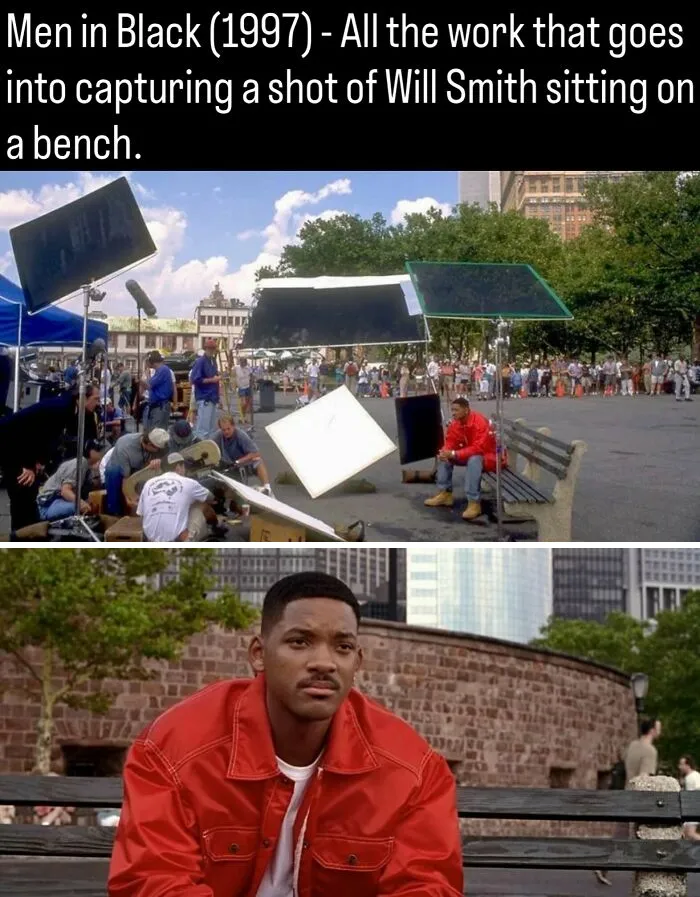
The finished shot looks almost effortless: Will Smith sitting alone on a park bench in New York. But pull the camera back and you see how much work went into making that “natural” image happen.
Around Smith are large bounce boards, reflectors, diffusion frames, flags and lighting equipment, with crew members positioned just outside the camera’s view. Instead of simply relying on the midday sun, the cinematography team could soften harsh overhead light, redirect sunlight onto Smith’s face and block unwanted reflections or shadows.
The goal wasn’t to make the scene look dramatically lit. It was to make carefully controlled lighting look like nothing had been done at all.
That illusion is one of the foundations of filmmaking. A few feet outside virtually any polished movie frame can be an organized mess of equipment, cables and dozens of people concentrating on details the audience is never supposed to notice.
Men in Black was filmed extensively around New York City, using recognizable locations throughout Manhattan while blending them with elaborate sets, practical effects and visual effects.
Added fact: Men in Black became one of the biggest films of 1997, earning nearly $590 million worldwide and winning the Academy Award for Best Makeup.
#13
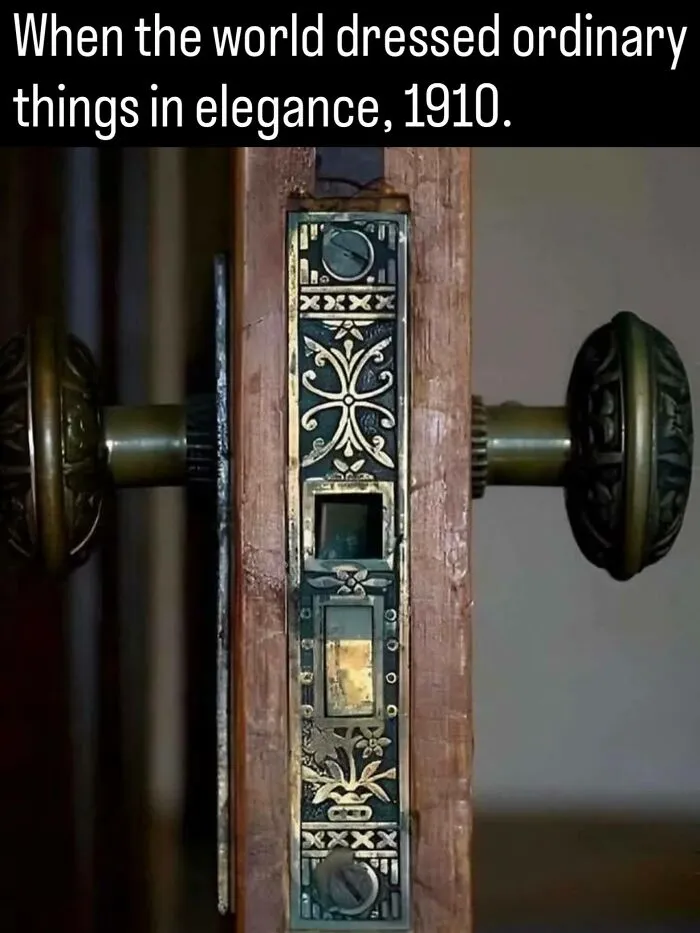
This was still the age when craftsmanship shaped domestic life. Many middle-class and upper-class homes used solid brass, bronze, or cast metal hardware because it was durable, repairable, and visually rich. Instead of hiding mechanical details, designers often celebrated them. A door was not just an entrance. It was a surface for woodwork, metalwork, and ornament.
The design here reflects the influence of late Victorian, Edwardian, and Art Nouveau taste, when even practical objects carried curves, symmetry, and decoration. Before mass-produced plastic fixtures became common, everyday materials had weight. They aged. They tarnished. They were polished by hand and worn smooth by use.
It is a reminder that beauty once lived in the smallest contact points of daily life.
Added fact: In the early 1900s, many decorative door plates were sold through hardware catalogs, meaning homeowners could choose ornate designs much like selecting furniture or wallpaper.
#14
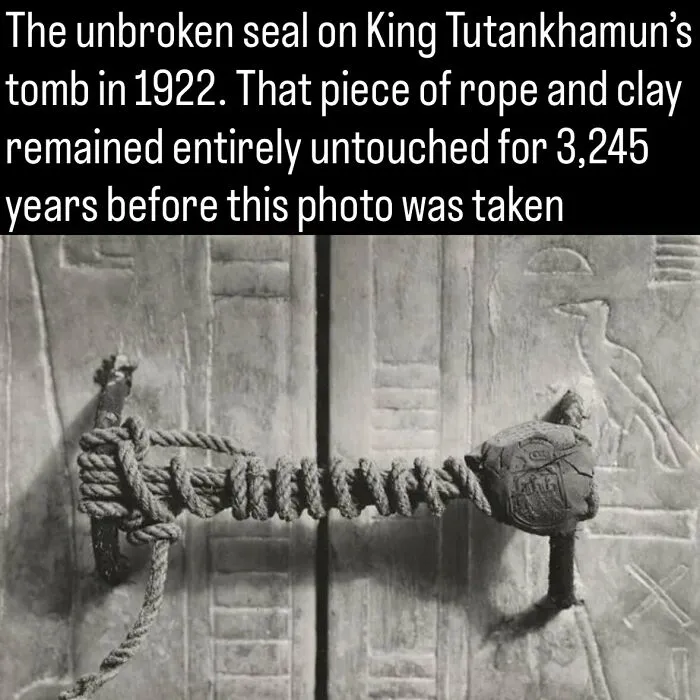
It was taken by excavation photographer Harry Burton as Howard Carter’s team worked through the burial chamber.
Tutankhamun had died more than 3,000 years earlier, around 1323 B.C. His tomb was discovered in Egypt’s Valley of the Kings by Carter’s team in November 1922. Although ancient thieves had entered portions of the tomb, they had not stripped it like so many other royal burials, leaving an extraordinary collection of objects behind.
The rope pictured here had been wrapped around the handles of the shrine doors and secured with a clay seal.
The seal featured imagery associated with Anubis, the jackal-headed god closely connected with embalming and the protection of the d**d. Its survival indicated that this inner barrier had remained undisturbed since antiquity.
The preservation of something as fragile as rope was possible largely because of the extraordinarily dry conditions inside the sealed Egyptian tomb.
Beyond those doors were further layers protecting Tutankhamun’s remains, eventually leading Carter and his team to the young pharaoh’s nested coffins and famous golden funerary mask.
Added fact: Carter discovered the tomb in 1922, but the excavation was extraordinarily slow. The team did not finally reach and examine Tutankhamun’s mummy until 1924, more than a year after the first chambers were opened.
#15
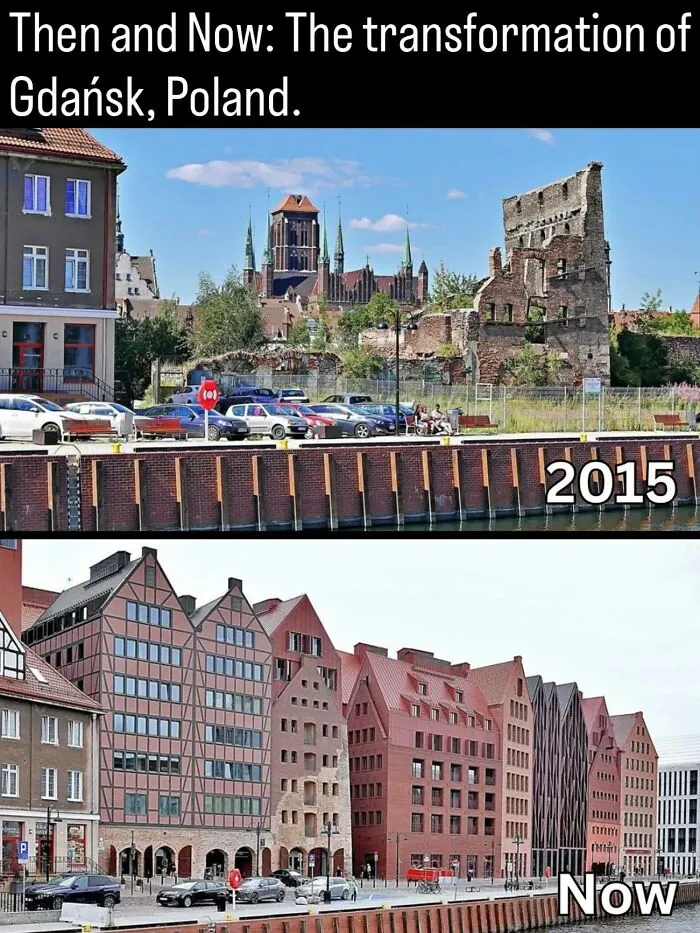
Entire districts were left in ruins, including parts of the old waterfront and Granary Island, which had once been one of the richest trading zones in the Baltic.
For decades, some of these damaged areas remained empty lots, shattered walls, or partial ruins. Even in 2015, as the top image shows, fragments of old brick buildings still stood as reminders of the destruction.
The church towers in the background connected the modern city to its medieval past, but the foreground remained unfinished.
The newer image: the rebuilt waterfront uses architecture inspired by Gdańsk’s historic gabled merchant houses, blending modern construction with the city’s traditional silhouette.
This kind of redevelopment has been central to Gdańsk’s identity in the 21st century: not simply replacing what was lost, but trying to reconnect the city with its Hanseatic past while making the area livable again.
Added fact: Gdańsk was historically one of the most important ports in the Hanseatic League, a powerful medieval trade network that linked cities across northern Europe.
#16
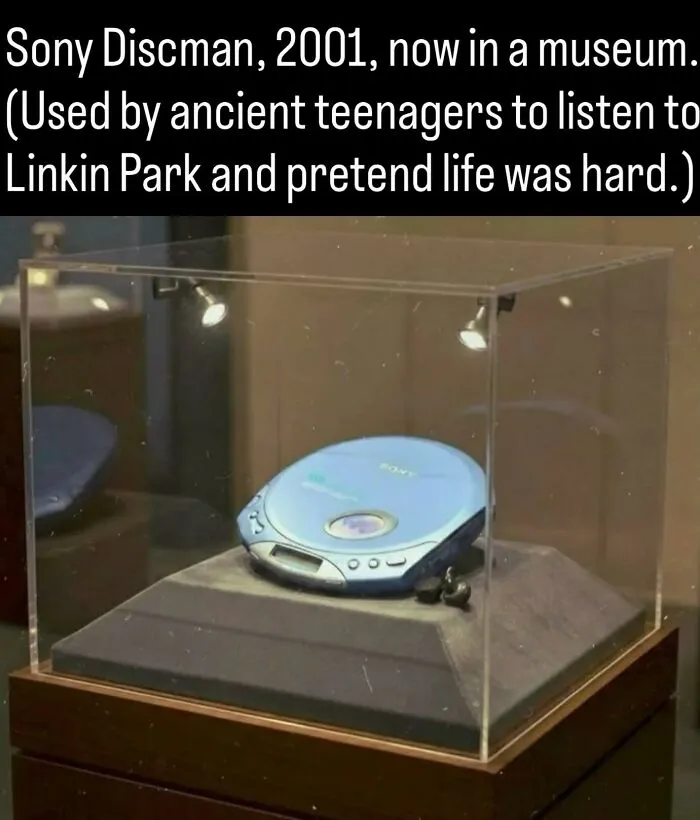
Long before smartphones and streaming services put millions of songs in a pocket, music lovers carried their favorite albums on compact discs. A Discman could only hold one CD at a time, meaning listeners often left home with a backpack or binder filled with albums for the day.
By 2001, portable CD players had become common around the world. Models featured anti-skip technology that buffered a few seconds of music to prevent interruptions while walking, running, or riding in a car. Despite those improvements, many users still remember the frustration of a scratched CD or a player skipping at exactly the wrong moment.
The year 2001 also marked a major shift in music consumption. MP3 players were beginning to emerge, and Apple’s iPod would be released later that year. Within a decade, portable CD players had largely disappeared from everyday use, replaced by digital music libraries and eventually streaming platforms.
Today, devices like the Discman represent a brief but important era between the cassette tape and the digital age, when owning music meant physically carrying it with you.
Added fact: The original Sony Discman debuted in 1984 and was capable of playing standard CDs years before MP3 technology existed. At its peak, Sony sold millions of portable CD players annually, making the Discman one of the most successful portable music devices ever created.
#17

The 42-year-old from Kütahya, Turkey, had been smoking roughly two packs of cigarettes a day and said he had tried quitting dozens of times. He would stop on important occasions such as his wedding anniversary or his children’s birthdays, only to begin smoking again a few days later.
Then his father died from lung cancer.
The loss frightened Yücel enough that he came up with an extreme solution: he built a cage shaped roughly like a motorcycle helmet and locked it around his own head. The openings were reportedly small enough that he could drink through a straw, but not large enough to easily put a cigarette in his mouth.
Each morning, Yücel would lock the cage and hand the key to his wife, Kevser. She initially disliked the idea and found it embarrassing, but eventually agreed because she wanted him to stop smoking. She would unlock it when he needed to eat. His teenage daughter also supported the attempt after watching her grandfather d*e from lung cancer.
Added fact: Before putting on the cage, Yücel reportedly swore on the Quran that he was serious about giving up cigarettes, making the device part of a much larger personal commitment to quit.
#18
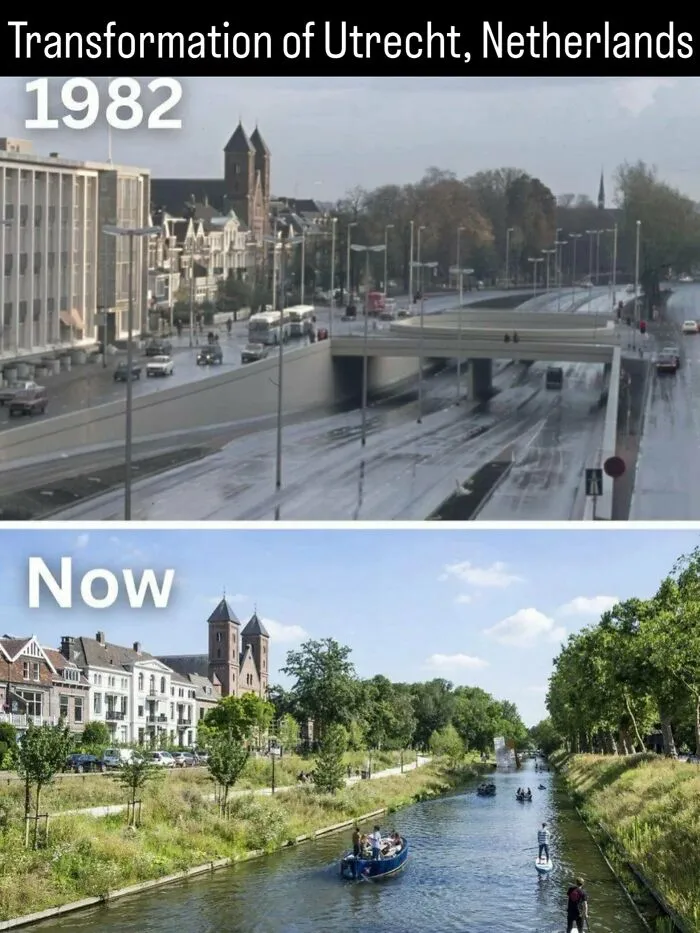
A section of the city’s historic canal had been drained and replaced by a major roadway called the Catharijnebaan, reflecting a postwar planning philosophy that prioritized cars and traffic flow through city centers.
The waterway had a much older history. Utrecht’s defensive canal system dates back roughly 900 years, to around the time the city received its city rights in 1122.
By the 20th century, however, planners were considering turning much of the canal ring into roads. Beginning around 1969, part of the Catharijnesingel was drained, and by the 1970s cars were traveling where boats had once passed.
Eventually, Utrecht reversed course. Residents supported restoring the canal in a 2002 referendum, and over the following years the roadway was removed, the channel was excavated again and green public space was created along the water.
In September 2020, the final restored section officially reopened, allowing boats to travel around Utrecht’s historic canal ring again for the first time in roughly half a century.
Added fact: Plans drawn up in 1958 were even more dramatic and contemplated filling in much more of Utrecht’s canal system to create roads. The survival of much of the historic canal ring helped make the later restoration possible.
#19

The men had no control over the ship’s destination and little sense of where it was taking them. They believed they were traveling toward Europe. Instead, after approximately two weeks and 3,500 miles, the Ken Wave reached the Brazilian port of Vitória.
Brazilian authorities discovered the men crouched above the rudder and carefully brought them to safety. Photographs of the rescue showed officials handing water to the exhausted stowaways from a nearby boat. All four were taken for medical treatment and were reported to be in stable condition.
Their survival was remarkable. Rudder compartments offer almost no protection from rough seas, mechanical movement, exposure or falls. Two of the men eventually returned to Nigeria, while the other two reportedly applied for asylum in Brazil.
Added fact: To keep themselves from being swept into the Atlantic, the men reportedly tied themselves to the ship and stretched netting around the rudder area.
#20
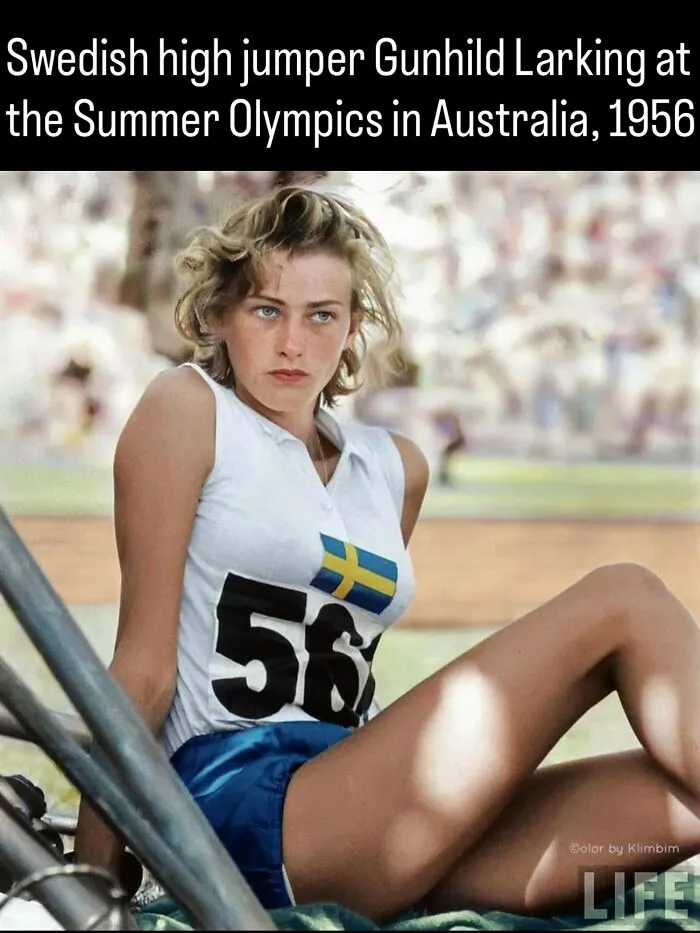
In Melbourne, Larking advanced through the qualifying round by clearing 1.58 meters. During the final, she cleared 1.67 meters (approximately 5 feet 5¾ inches) matching the best jump of her career. She narrowly missed the podium and finished fourth based on the number of attempts required to clear the earlier heights. American athlete Mildred McDaniel won gold after clearing 1.76 meters and setting a new world record.
Larking was one of Sweden’s leading female athletes of the 1950s. She won five consecutive Swedish national high-jump championships between 1952 and 1956 and also finished fourth at the 1954 European Athletics Championships in Bern.
Athletes at the time competed on cinder tracks, and high jumpers landed in pits filled with sand or sawdust rather than the thick foam mats used today. Competitors also relied on techniques that predated the revolutionary Fosbury Flop.
Added Fact: LIFE magazine photographer George Silk photographed Larking throughout the Melbourne Olympics. One of his images became internationally famous after appearing in the magazine’s Christmas issue, and Larking subsequently received offers to work as a model.
